
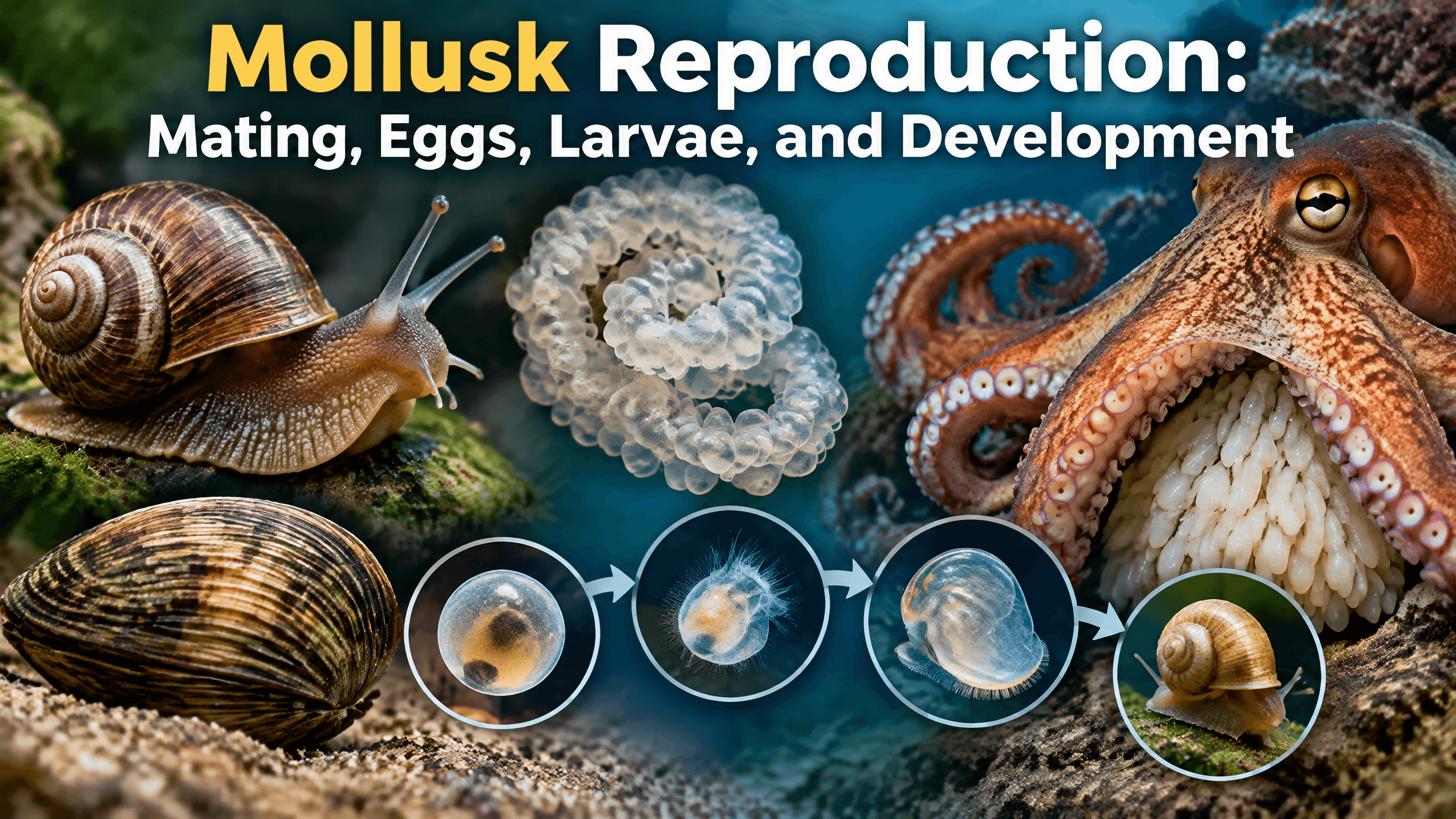
Mollusk reproduction is remarkably diverse. Snails, clams, octopuses, chitons, and other members of Mollusca do not share one standard mating system or one standard life cycle. Some species have separate males and females, while others are simultaneous or sequential hermaphrodites. Fertilization may happen outside the body or after sperm transfer. Young may hatch as crawling juveniles, pass through swimming larval stages, or depend temporarily on another animal during development.
The most useful way to understand this diversity is to separate four questions: how adults produce and transfer gametes, where fertilization happens, whether embryos are brooded or released, and what form the young take before becoming juveniles. Those questions reveal why a marine snail, a freshwater mussel, and an octopus can all be mollusks yet reproduce in very different ways.
Quick Answer
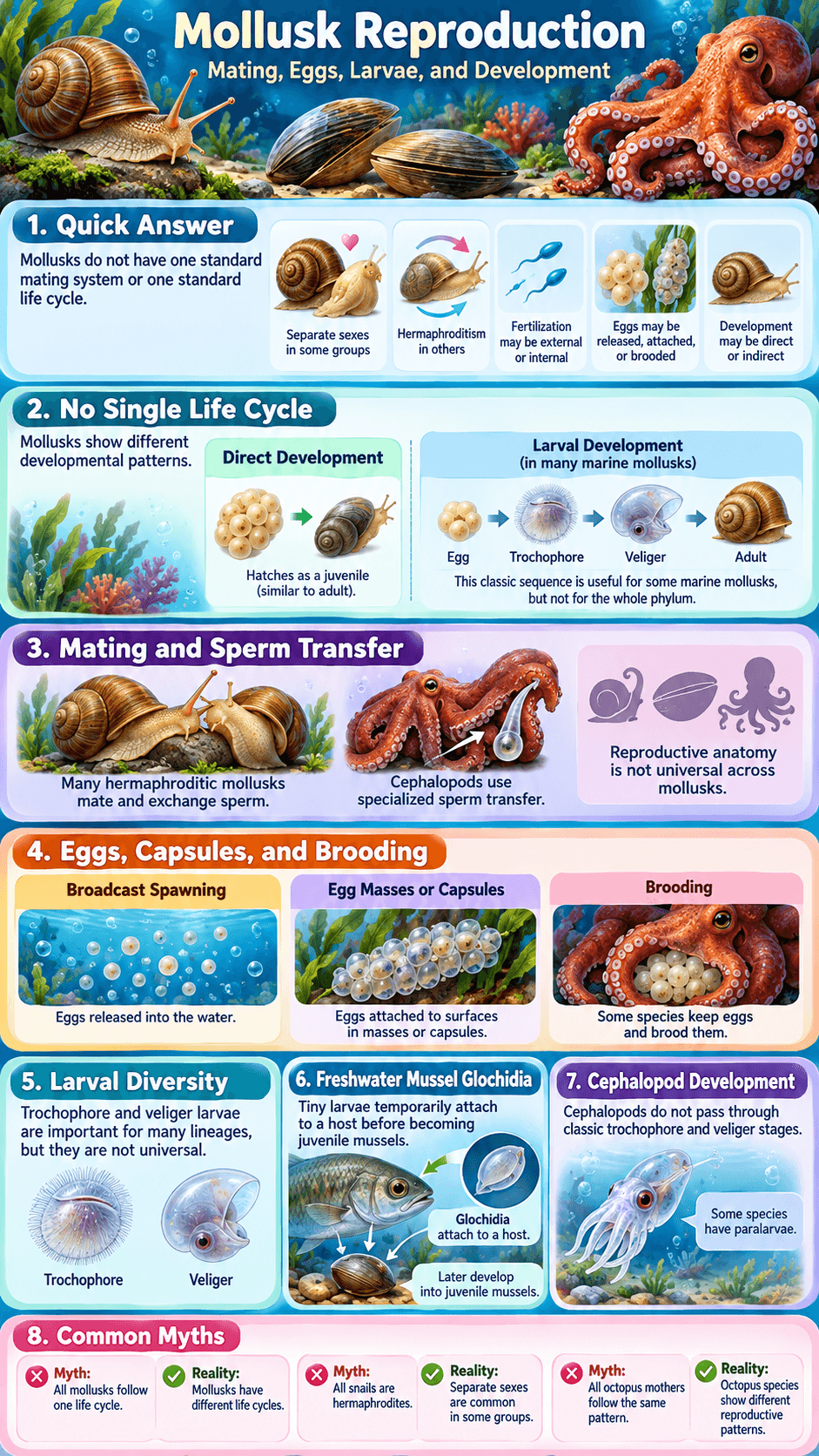
Mollusks reproduce through many different systems. Separate sexes are common in some groups, while hermaphroditism occurs in others. Fertilization may be external, internal, or occur after sperm is drawn into the mantle cavity. Eggs can be released freely, packaged in capsules or masses, attached to surfaces, or brooded by a parent. Development can be direct, producing a juvenile that resembles a small adult, or indirect, involving specialized stages such as trochophore or veliger larvae. Many unionid freshwater mussels add another unusual step: microscopic glochidia must attach temporarily to a suitable host before becoming juvenile mussels.
There Is No Single Mollusk Life Cycle
A simple diagram that shows egg, trochophore, veliger, and adult can be useful for introducing development in some marine mollusks, but it becomes misleading when presented as the life cycle of the entire phylum. Mollusks occupy oceans, rivers, lakes, wetlands, forests, deserts, and other environments, and their reproductive strategies have diversified along with their body plans and habitats.
Separate Sexes and Hermaphroditism
Some mollusk species are gonochoric, meaning individuals function as either male or female. Others are hermaphroditic and can produce both sperm and eggs, either at the same time or at different stages of life. A review of molluscan sexual systems emphasizes that Mollusca contains a wide range of reproductive arrangements rather than one dominant pattern. Even within gastropods, familiar examples can give a distorted impression if they are generalized too broadly.
For example, many land snails and sea slugs are simultaneous hermaphrodites, but many other gastropods have separate sexes. Some species change functional sex during life. The existence of all these systems is one reason broad statements such as “snails are hermaphrodites” should be avoided.
Internal and External Fertilization
External fertilization occurs when eggs and sperm meet outside the adult body, often in water. Many marine mollusks release gametes into the surrounding water, sometimes in synchronized spawning events. Other mollusks use internal sperm transfer, sperm storage, or fertilization inside reproductive passages or mantle-associated spaces. Freshwater mussels provide yet another pattern, with males often releasing sperm into the water and females drawing sperm in as they filter water.
These differences matter because fertilization mode affects how adults find mates, how many gametes may be released, how embryos are protected, and how far offspring can disperse before settling into suitable habitat.
Direct Development and Larval Development
In direct development, young emerge in a form that already resembles a small juvenile and do not pass through a free-swimming larval stage comparable to a veliger. In indirect development, embryos produce a distinct larval form that may swim or drift before metamorphosing into the juvenile body plan. Both approaches occur within Mollusca, and intermediate or highly modified developmental patterns occur as well.
Developmental mode can vary even among relatively close relatives. That variation is biologically important because a planktonic larva can disperse over water currents, while direct development often keeps young closer to the habitat occupied by the adults.
Mating and Sperm Transfer
Mollusk mating behavior ranges from simple release of gametes into water to prolonged partner interactions involving specialized reproductive organs. The basic goal is the same, bringing sperm and eggs together, but the anatomy and behavior used to accomplish that goal differ widely.
Partner Mating in Many Hermaphroditic Mollusks
Being hermaphroditic does not mean that an animal simply fertilizes itself. Many hermaphroditic mollusks mate with partners and exchange or transfer sperm. In a 2024 study of the simultaneous hermaphrodite Planorbella trivolvis, reciprocal mating was common, illustrating how two individuals can participate in both reproductive roles during a mating interaction. The study also notes that self-fertilization is possible in this species but is not the same thing as its typical partner-based mating behavior. See the Journal of Molluscan Studies research on Planorbella mating.
Other hermaphroditic mollusks mate unilaterally, with one individual acting primarily as sperm donor and the other as recipient during a particular encounter. Some species can switch roles between encounters or during life. The details depend on lineage, anatomy, environmental conditions, and reproductive strategy.
Specialized Sperm Transfer in Cephalopods
Cephalopods use specialized structures and spermatophores, which are packages containing sperm, for internal sperm transfer. In many coleoids, a modified arm known as a hectocotylus participates in transferring spermatophores, although anatomy and behavior vary among octopuses, squid, and cuttlefish. Nautiluses use a different reproductive arrangement. A broad review of cephalopod sexual selection describes substantial diversity in mating tactics and reproductive structures across the group. See the review of sexual selection in cephalopods.
This is a good example of why an octopus mating description should not be presented as a universal cephalopod template. Even within one class, sperm transfer, storage, mate competition, and egg-laying behavior can differ strongly among species.
Why Reproductive Anatomy Is Not Universal Across Mollusks
Mollusks share deep evolutionary ancestry, but their reproductive structures have been extensively modified. A bivalve that releases sperm into water, a land snail that mates with a partner, and a squid that transfers spermatophores solve the same reproductive problem with very different anatomy. Those differences reflect the broader transformation of the molluscan body plan across lineages.
Spawning, Eggs, Capsules, and Brooding
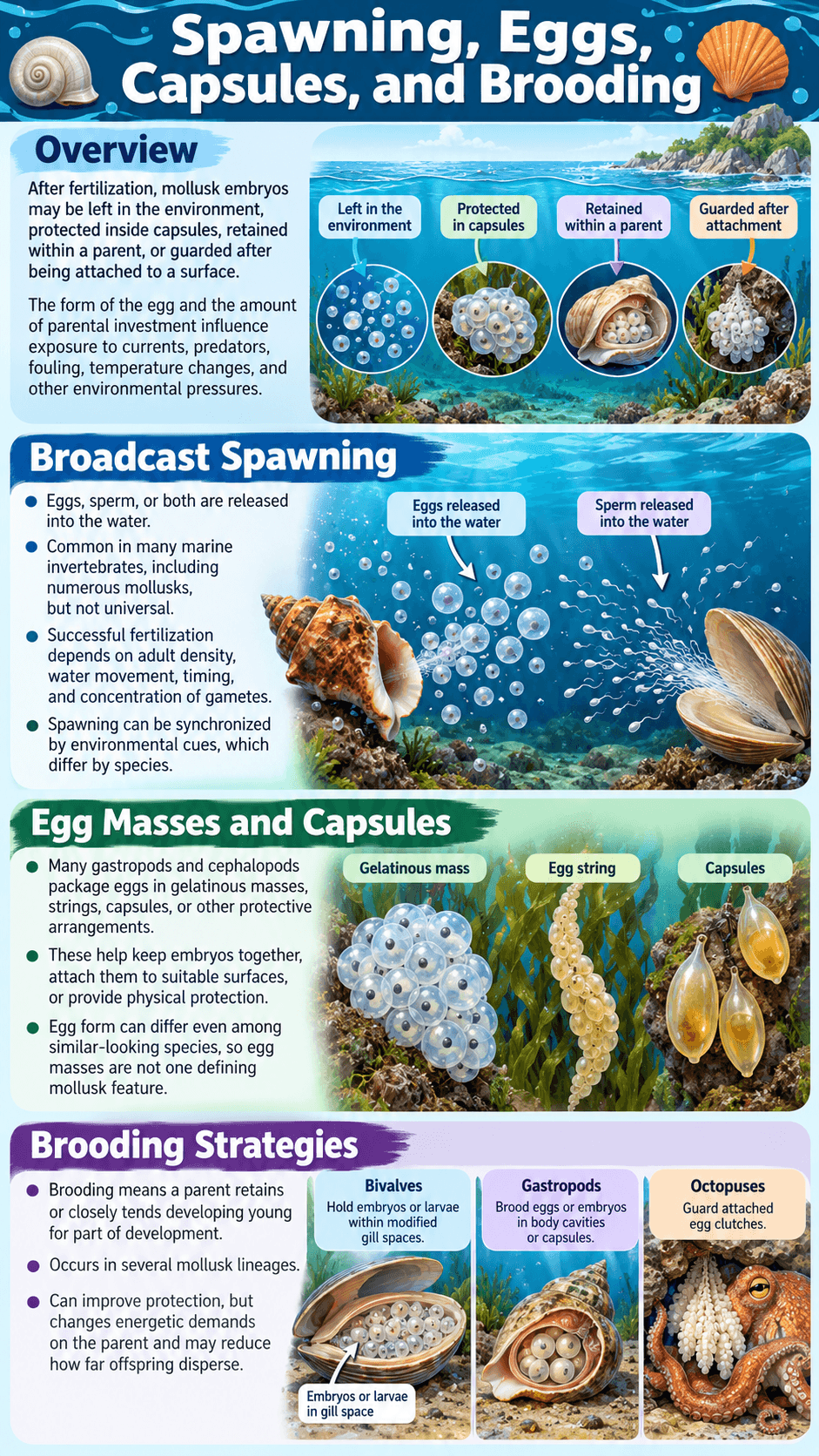
After fertilization, mollusk embryos may be left in the environment, protected inside capsules, retained within a parent, or guarded after being attached to a surface. The form of the egg and the amount of parental investment influence how exposed embryos are to currents, predators, fouling, temperature changes, and other environmental pressures.
Broadcast Spawning
Broadcast spawning releases eggs, sperm, or both into the water. It is common in many marine invertebrates, including numerous mollusks, but it is not universal. Successful fertilization depends on factors such as adult density, water movement, timing, and the concentration of gametes. Spawning can also be synchronized by environmental cues, though the cues and timing differ by species.
Egg Masses and Capsules
Many gastropods and cephalopods package eggs in gelatinous masses, strings, capsules, or other protective arrangements. These structures can help keep embryos together, attach them to suitable surfaces, or provide physical protection. Egg form can differ even among species that look similar as adults, so egg masses should not be treated as a single defining mollusk feature.
Brooding Strategies
Brooding means that a parent retains or closely tends developing young for part of development. It occurs in several mollusk lineages. Some bivalves hold embryos or larvae within modified gill spaces, some gastropods brood eggs or embryos in body cavities or capsules, and many octopuses guard attached egg clutches. Brooding can improve protection, but it also changes the energetic demands placed on the parent and may reduce how far offspring disperse.
Trochophore Larvae
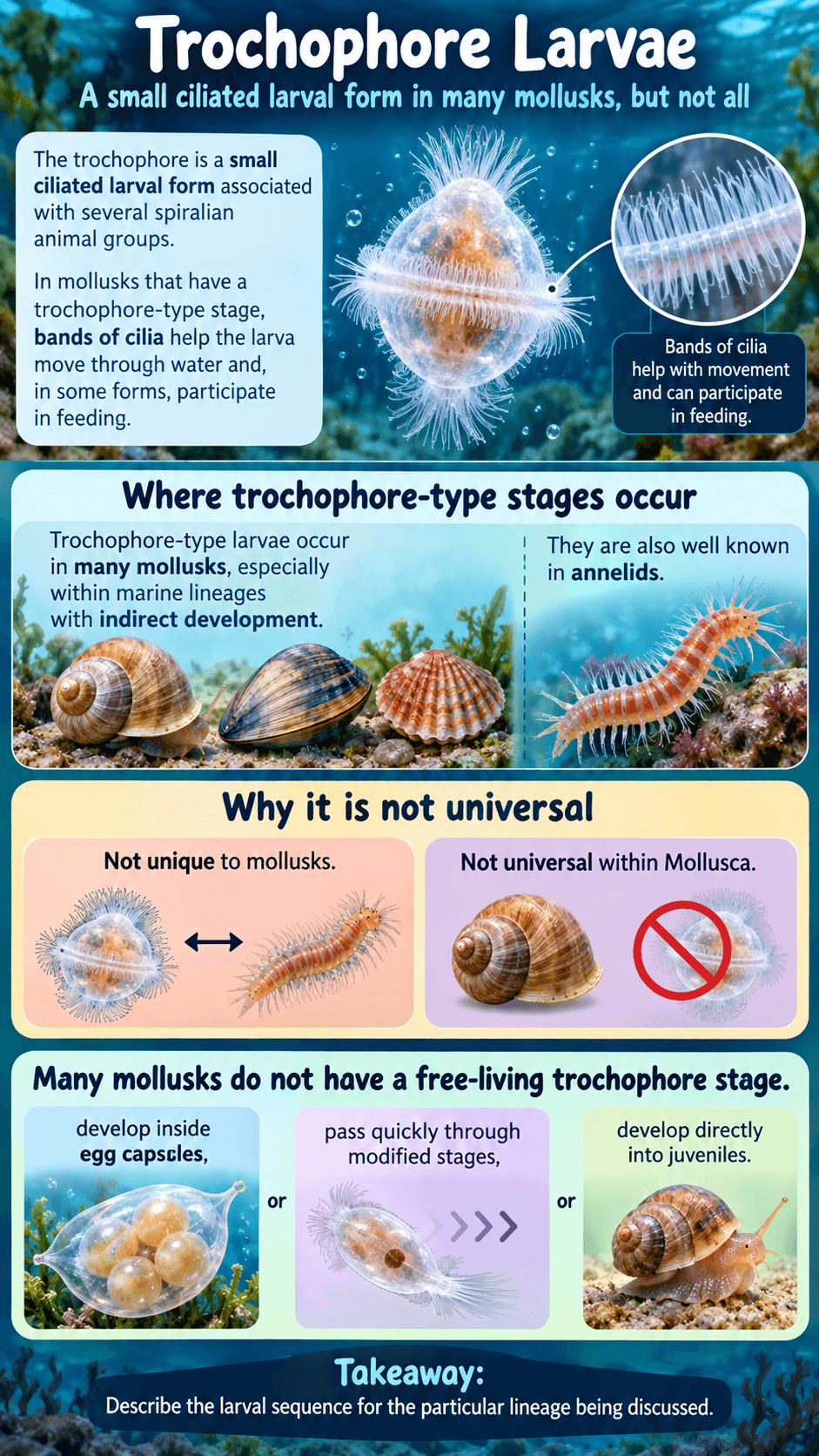
The trochophore is a small ciliated larval form associated with several spiralian animal groups. In mollusks that have a trochophore-type stage, bands of cilia help the larva move through water and, in some forms, participate in feeding. It is a useful developmental concept, but it should not be turned into a universal mollusk label.
Where Trochophore-Type Stages Occur
Trochophore-type larvae occur in many mollusks, especially within marine lineages with indirect development. They are also well known in annelids. Research on the evolutionary history of the trochophore emphasizes that this larval organization appears across more than one spiralian lineage rather than belonging exclusively to Mollusca. See the review of trochophore larval evolution.
Why Trochophore Is Not Unique to Mollusks or Universal Within Mollusca
Two cautions prevent a common textbook oversimplification. First, other animal groups also have trochophore or trochophore-like larvae. Second, many mollusks do not have a free-living trochophore stage. Embryos may develop inside egg capsules, pass quickly through modified stages, or develop directly into juveniles. The larval sequence therefore needs to be described for the particular lineage being discussed.
Veliger Larvae
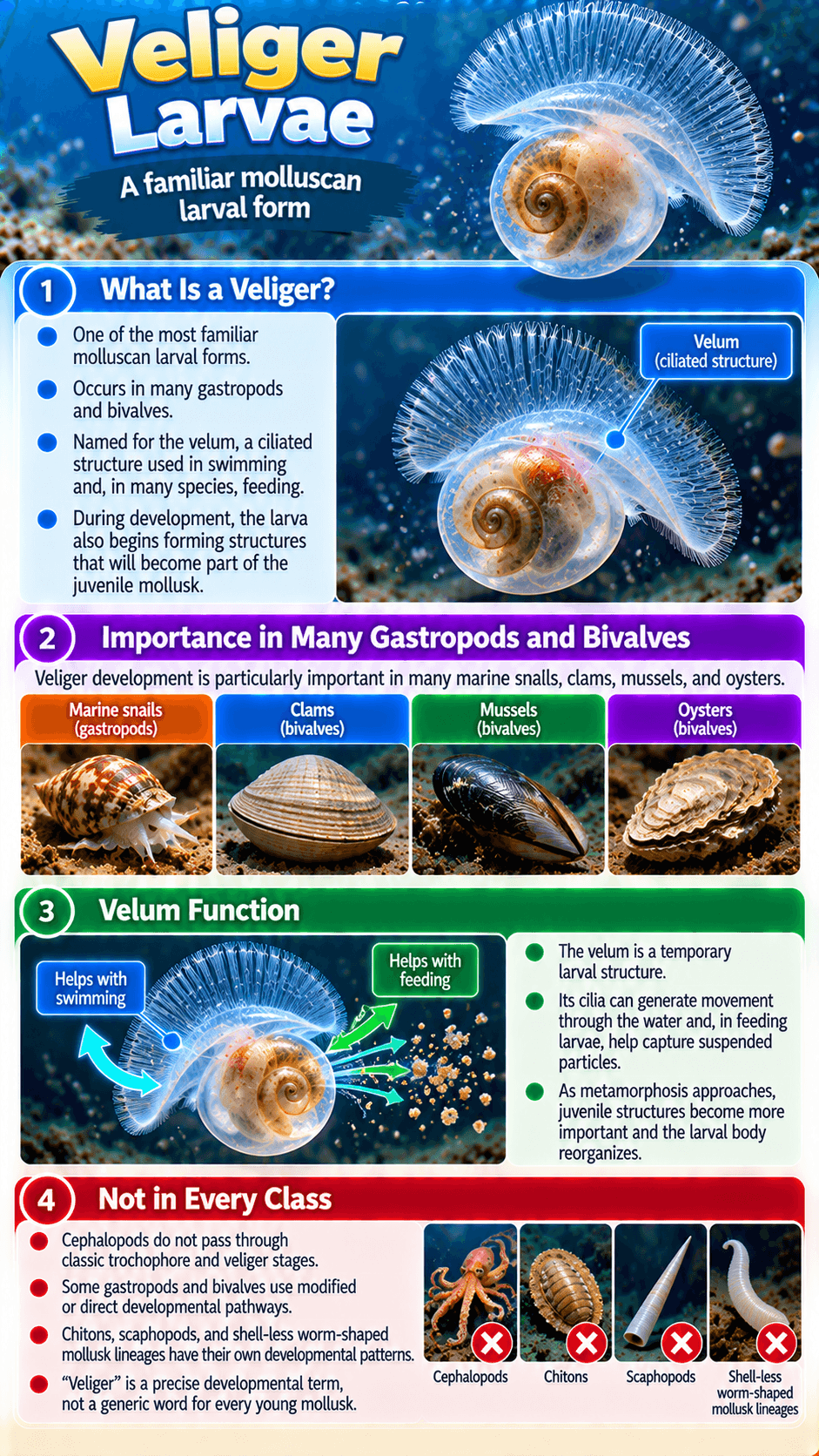
The veliger is one of the most familiar molluscan larval forms. It occurs in many gastropods and bivalves and is named for the velum, a ciliated structure used in swimming and, in many species, feeding. During development, the larva also begins forming structures that will become part of the juvenile mollusk.
Importance in Many Gastropods and Bivalves
Veliger development is particularly important in many marine snails, clams, mussels, and oysters. In common bivalve developmental patterns, a trochophore stage is followed by a veliger, later progressing toward a stage capable of settlement and metamorphosis. A recent review of bivalve larval biology describes the velum as a prominent ciliated organ and also notes that bivalves include other developmental modes, including direct development and specialized larval forms. See the review of bivalve larval development.
Velum Function at Overview Depth
The velum is not simply a “baby foot.” It is a temporary larval structure whose cilia can generate movement through the water and, in feeding larvae, help capture suspended particles. As metamorphosis approaches, juvenile structures become more important and the larval body reorganizes.
Why Veliger Does Not Apply to Every Class
Cephalopods do not pass through classic trochophore and veliger stages. Some gastropods and bivalves also use modified or direct developmental pathways. Chitons, scaphopods, and the shell-less worm-shaped mollusk lineages have their own developmental patterns. “Veliger” is therefore a precise developmental term, not a generic word for every young mollusk.
Freshwater Mussel Glochidia
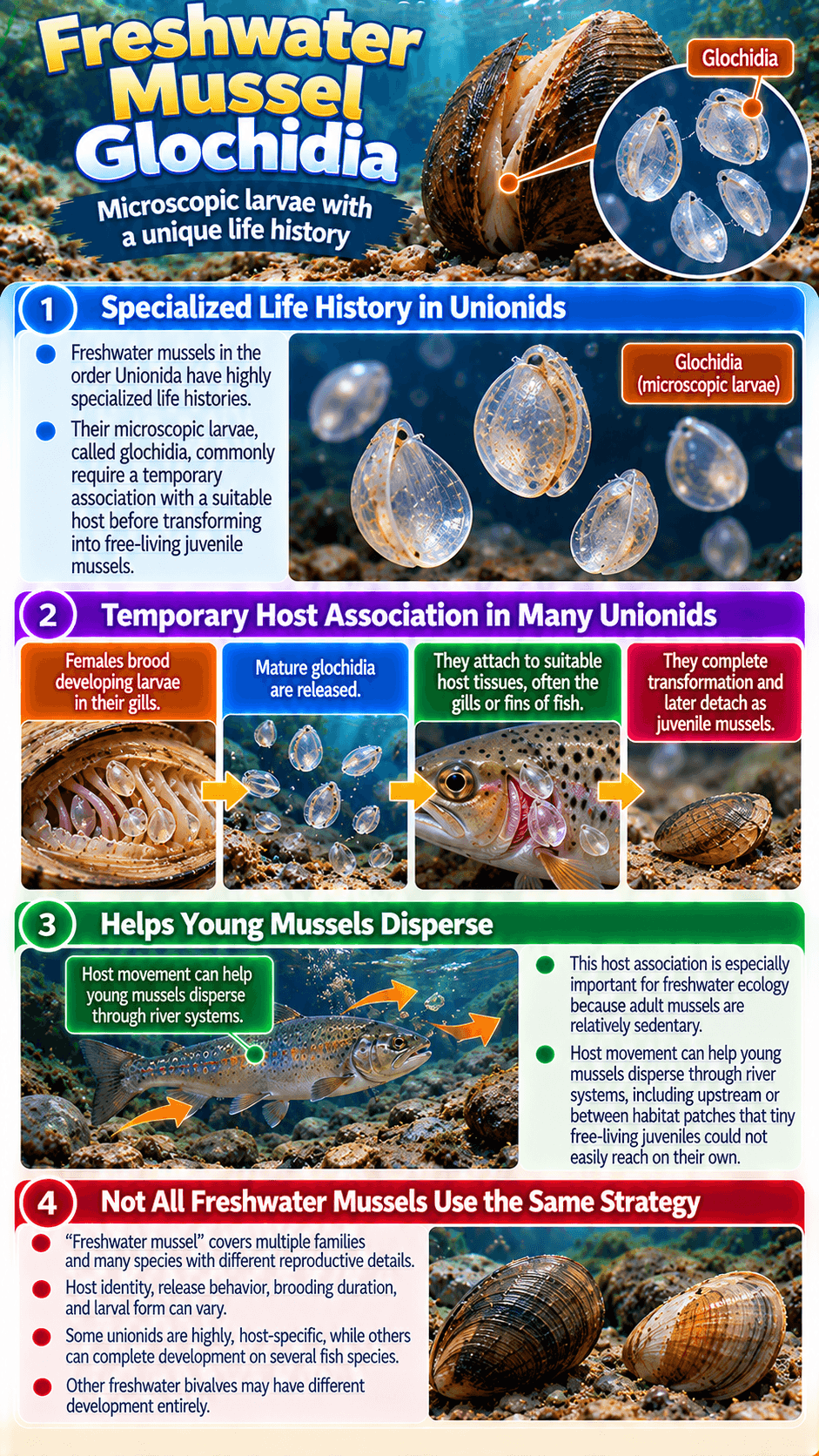
Freshwater mussels in the order Unionida include some of the most specialized mollusk life histories. Their microscopic larvae, called glochidia, commonly require a temporary association with a suitable host before transforming into free-living juvenile mussels.
Temporary Host Association in Many Unionids
In many unionid mussels, females brood developing larvae in their gills. When mature glochidia are released, they attach to suitable host tissues, often the gills or fins of particular fish. During this temporary phase they complete transformation and later detach as juvenile mussels. The U.S. Fish and Wildlife Service describes this pattern for the western pearlshell and identifies salmonids as documented hosts for that species. See the U.S. Fish and Wildlife Service western pearlshell profile.
This host association is especially important for freshwater ecology because adult mussels are relatively sedentary. Host movement can help young mussels disperse through river systems, including upstream or between habitat patches that tiny free-living juveniles could not easily reach on their own.
Why Not All Freshwater Mussels Use the Same Host Strategy
“Freshwater mussel” covers multiple families and many species with different reproductive details. Host identity, release behavior, brooding duration, and larval form can vary. Some unionids are highly host-specific, while others can complete development on several fish species. Other freshwater bivalves outside the unionid pattern may have different development entirely. It is safer to describe glochidial host dependence as a characteristic of many unionids rather than a universal rule for every freshwater mussel.
Cephalopod Development
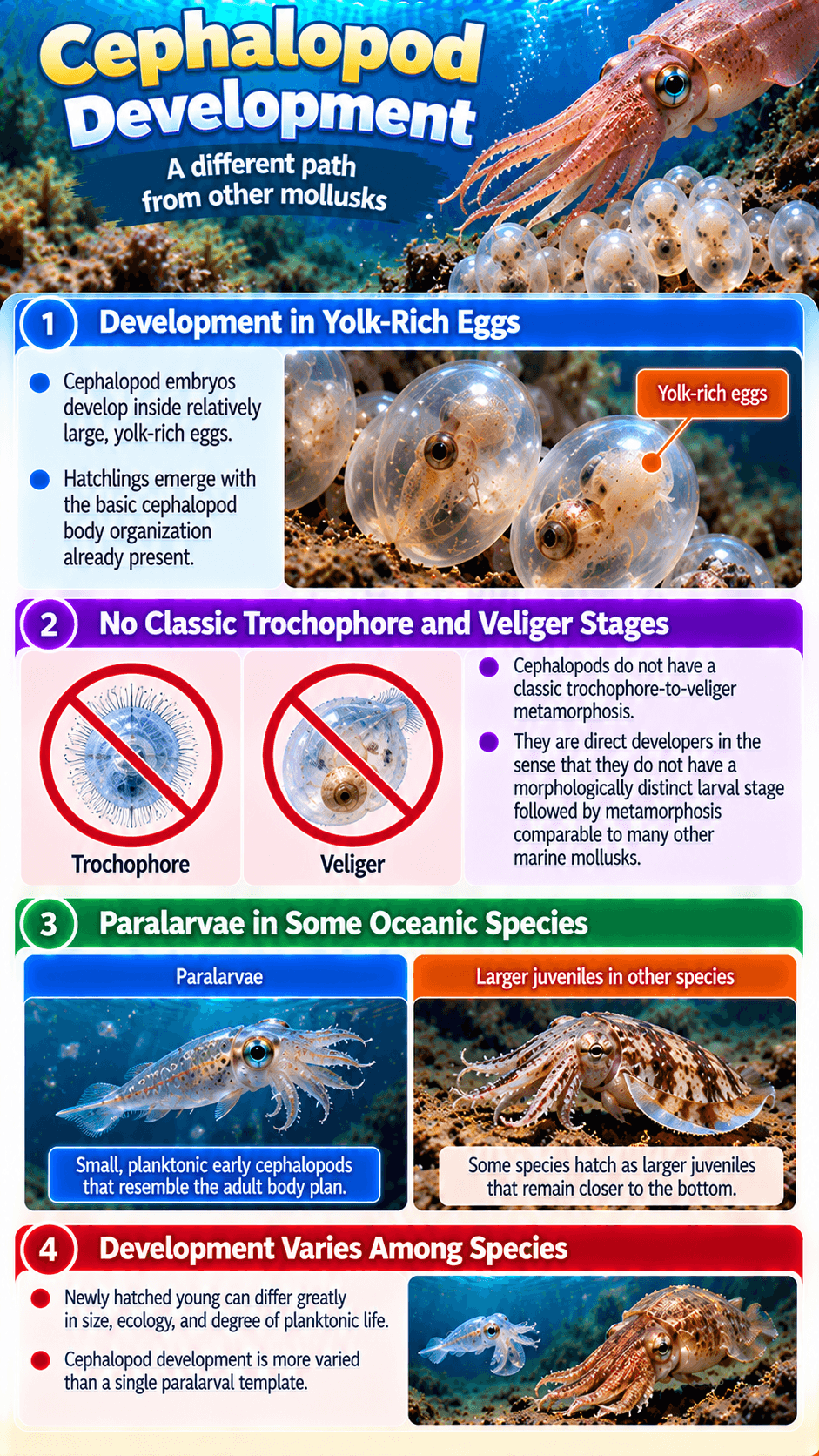
Cephalopods stand apart from the classic trochophore-to-veliger picture. Their embryos develop inside relatively large, yolk-rich eggs, and hatchlings emerge with the basic cephalopod body organization already present. There is no classic molluscan metamorphosis from trochophore to veliger to juvenile.
Development Without Classic Trochophore and Veliger Stages
Modern reviews describe cephalopods as direct developers in the sense that they do not have a morphologically distinct larval stage followed by metamorphosis comparable to many other marine mollusks. However, newly hatched young can differ greatly in size, ecology, and degree of planktonic life. That is why “direct development” should not be interpreted as meaning that every hatchling behaves like a tiny benthic adult.
Paralarvae in Some Oceanic Species
The term paralarva is often used for small, planktonic early cephalopods that resemble the adult body plan but occupy a different ecological stage. Other species hatch as larger juveniles that remain closer to the bottom. A review of cephalopod life-cycle terminology distinguishes these patterns and emphasizes that cephalopod development is more varied than a single paralarval template. See the review of cephalopod life-cycle patterns.
Hermaphroditism Without the Snail Myths
Snails are often used as the public example of animal hermaphroditism, but that shorthand hides major biological differences. Gastropods include separate-sexed species, simultaneous hermaphrodites, and sequential hermaphrodites. Even among hermaphroditic species, self-fertilization, partner choice, sperm storage, and mating roles differ.
Simultaneous and Sequential Systems
A simultaneous hermaphrodite can function in male and female reproductive roles during the same general period of life. A sequential hermaphrodite changes functional sex over time. In some gastropods, individuals begin life functioning as males and later function as females, while other lineages follow different patterns. These systems can be influenced by body size, social context, or ecology, depending on the species.
Why Not All Snails Are Hermaphrodites
Many familiar terrestrial snails are hermaphroditic, which makes the trait seem universal. It is not. Numerous marine and freshwater gastropods have separate sexes. The correct statement is that hermaphroditism is widespread in some gastropod lineages, not that every snail has both reproductive functions.
Why Hermaphroditism Does Not Mean Automatic Self-Fertilization
Having both sperm-producing and egg-producing function can make self-fertilization physiologically possible in some species, but many hermaphroditic mollusks normally reproduce with partners. Cross-fertilization can maintain genetic mixing, and mating systems may include sperm exchange, sperm storage, mate choice, or role conflict. Whether selfing occurs, and how often, has to be checked species by species.
Parental Care and Egg Tending
Mollusks are sometimes described as animals that simply release huge numbers of eggs and provide no care. That pattern exists, but it is far from universal. Brooding, egg guarding, egg cleaning, ventilation, and strategic egg placement occur in multiple lineages.
Octopus Egg Care as One Example
Many incirrate octopuses show prolonged maternal egg care. Females commonly guard attached eggs, keep water moving across them, and clean them until hatching. A review of cephalopod reproductive behavior documents extended egg care across studied incirrate octopods while also showing that egg placement and brooding behavior vary among species. That pattern has been documented across multiple studied octopod lineages.
Octopus brooding is biologically striking, but it should not become the model for every mollusk. Bivalves may brood in gills, gastropods may protect eggs in capsules or retain embryos, and many mollusks release offspring with little or no post-spawning care.
Brooding and Egg Placement in Other Mollusks
Egg placement can be as important as active guarding. Capsules may be attached to rocks, plants, shells, or hidden surfaces. Bivalves can retain embryos within the mantle cavity or gills. Some gastropods carry or brood developing young. These strategies change the balance between offspring number, protection, dispersal, and parental energy investment.
Why Reproductive Senescence Claims Need Species-Level Care
Popular descriptions often say that an octopus mother stops eating, guards her eggs, and then dies. This describes a common pattern in several well-studied semelparous octopuses, but cephalopod reproductive schedules are not identical. Brooding duration, feeding behavior, spawning pattern, and post-reproductive decline differ among species. Even within octopuses, unusual reproductive strategies have been documented, so broad claims should be tied to the species being discussed.
Common Reproduction Myths
Every Mollusk Follows Egg to Trochophore to Veliger to Adult
This sequence applies to some mollusks with indirect development, especially many marine gastropods and bivalves. It does not fit cephalopods, direct-developing gastropods, many brooders, or unionid freshwater mussels with glochidia. A life-cycle diagram should therefore identify the group it represents rather than implying a phylum-wide rule.
All Snails Are Hermaphrodites
Many snails are hermaphroditic, but many are not. Gastropods contain both separate-sexed and hermaphroditic systems, along with sequential sex change in some lineages. “Snails can be hermaphroditic” is accurate; “all snails are hermaphrodites” is not.
All Octopus Mothers Follow the Same Post-Reproductive Pattern
Maternal egg care and post-reproductive decline are important features of many octopus species, but the timing and behavioral details vary. Some species have exceptionally long brooding periods, while others have different spawning schedules or feeding patterns. Treating one laboratory species as a universal octopus model can hide that diversity.
How Reproduction Interacts With Anatomy, Habitat, and Conservation
Anatomy Shapes Sexual Systems and Fertilization
Reproductive structures are built into the broader molluscan body plan. Mantle cavities, gills, ducts, modified arms, gonads, and specialized storage structures can all participate in reproduction, but their arrangement differs sharply among classes. Understanding anatomy makes reproductive diversity easier to interpret without forcing unrelated groups into the same template.
Habitat Influences Larval Dispersal
Water currents can carry planktonic larvae far from their parents, while terrestrial and brooding species often keep embryos in protected capsules or moist locations. Freshwater rivers add another challenge: dispersal against current. The host-associated glochidia of many unionid mussels provide one solution by using mobile hosts during a critical developmental stage.
Freshwater Mussel Life Cycles Can Shape Conservation Needs
For host-dependent freshwater mussels, protecting adult mussels alone may not be enough to sustain a population. Reproduction can also depend on the presence of compatible host species, suitable water quality, appropriate river habitat, and conditions that allow juveniles to settle after leaving the host. This is why life-cycle knowledge can be essential when biologists evaluate declines or plan recovery work.
FAQ
Do all mollusks lay eggs?
Egg production is fundamental to molluscan sexual reproduction, but the way eggs are handled varies greatly. Eggs may be spawned into water, placed in capsules or masses, brooded internally, retained in gills or mantle-associated spaces, or guarded after deposition. Some species also show specialized reproductive modes, so it is better to describe the exact lineage than assume one egg-laying pattern for Mollusca.
What is a veliger larva?
A veliger is a developmental stage found in many gastropods and bivalves. It typically has a ciliated velum that helps with swimming and often feeding. The veliger is important in many marine mollusk life cycles, but it is not a universal “baby mollusk” stage. Cephalopods, many direct developers, and several other lineages follow different developmental pathways.
Are all snails hermaphrodites?
No. Many land snails and other gastropods are simultaneous hermaphrodites, but numerous snail species have separate sexes, and some lineages show sequential sex change. Hermaphroditism is a major gastropod reproductive strategy, not a defining trait of every snail.
Final Thoughts
Mollusk reproduction makes sense only when its diversity is kept in view. There is no single mating system, fertilization method, egg strategy, or larval pathway shared unchanged across Mollusca. Trochophores and veligers are important in many lineages, glochidia define a specialized phase in many unionid freshwater mussels, and cephalopods develop without the classic trochophore-to-veliger sequence. The same caution applies to sexual systems: separate sexes, simultaneous hermaphroditism, and sequential sex change all occur within the phylum.
That variety is not a collection of exceptions to one “normal” mollusk life cycle. It is the central biological pattern. Looking at how each lineage mates, fertilizes eggs, protects embryos, disperses young, and reaches the juvenile stage gives a much more accurate picture of how mollusks reproduce.

Ethan Walker is the founder and research editor of Animal Fact Central. He creates and reviews educational animal facts content using trusted wildlife, pet care, and science-based sources. His work focuses on making animal behavior, adaptations, habitats, and species facts clear, accurate, and engaging for everyday readers.
Read More Details About Ethan Walker: https://animalfactcentral.com/ethan-walker/