
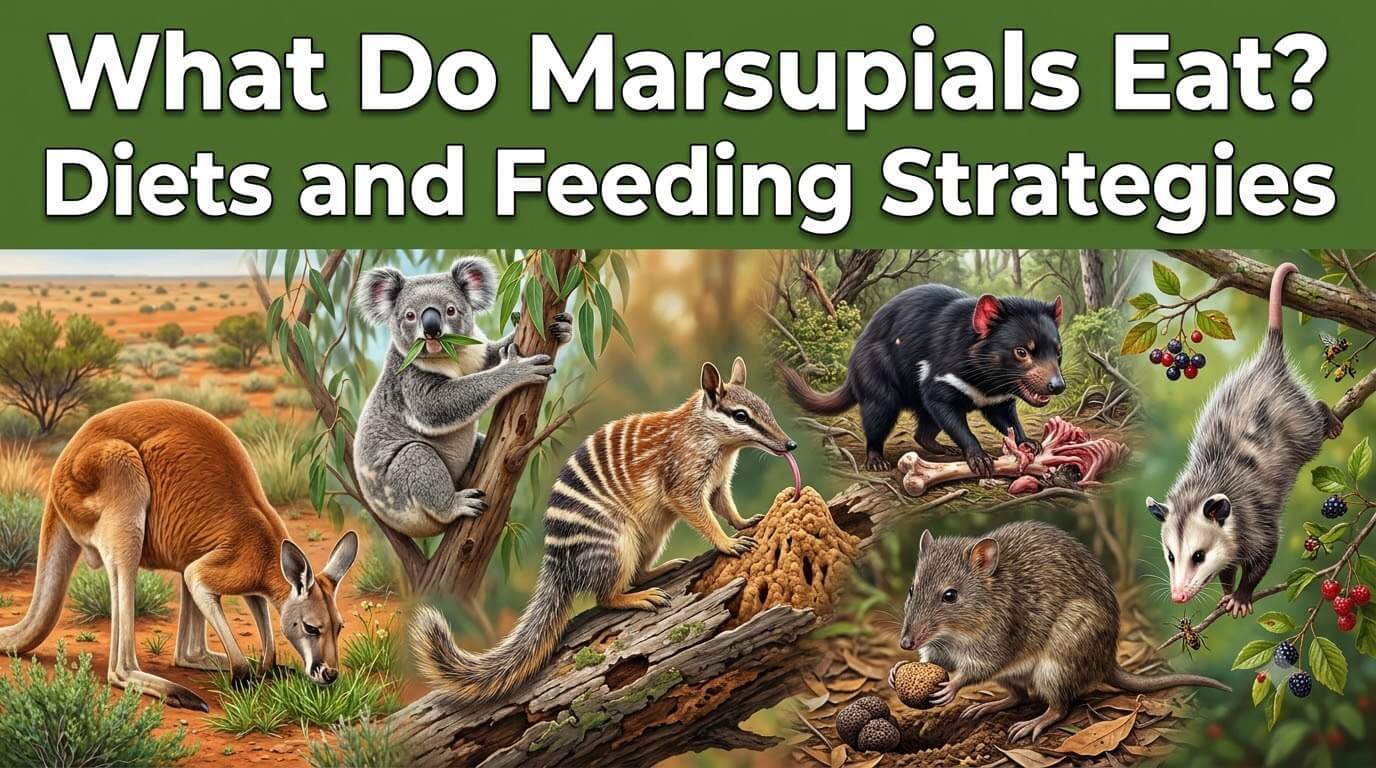
Marsupials eat an enormous range of foods. Some, such as kangaroos and wombats, are mainly herbivores. Koalas are highly specialized leaf eaters. Potoroos and bettongs can rely heavily on fungi. Numbats specialize on termites. Bandicoots and bilbies often combine insects and plant foods. Quolls are predators, Tasmanian devils hunt and scavenge, and many opossums are flexible omnivores.
That diversity matters because “marsupial diet” is not one feeding strategy. Marsupials occupy very different habitats across the Americas and Australasia, and their teeth, digestive systems, movement, senses, and daily behavior reflect the foods available to them. Understanding what marsupials eat therefore means looking at several feeding categories rather than assuming that kangaroos or koalas represent the whole group.
Quick Answer
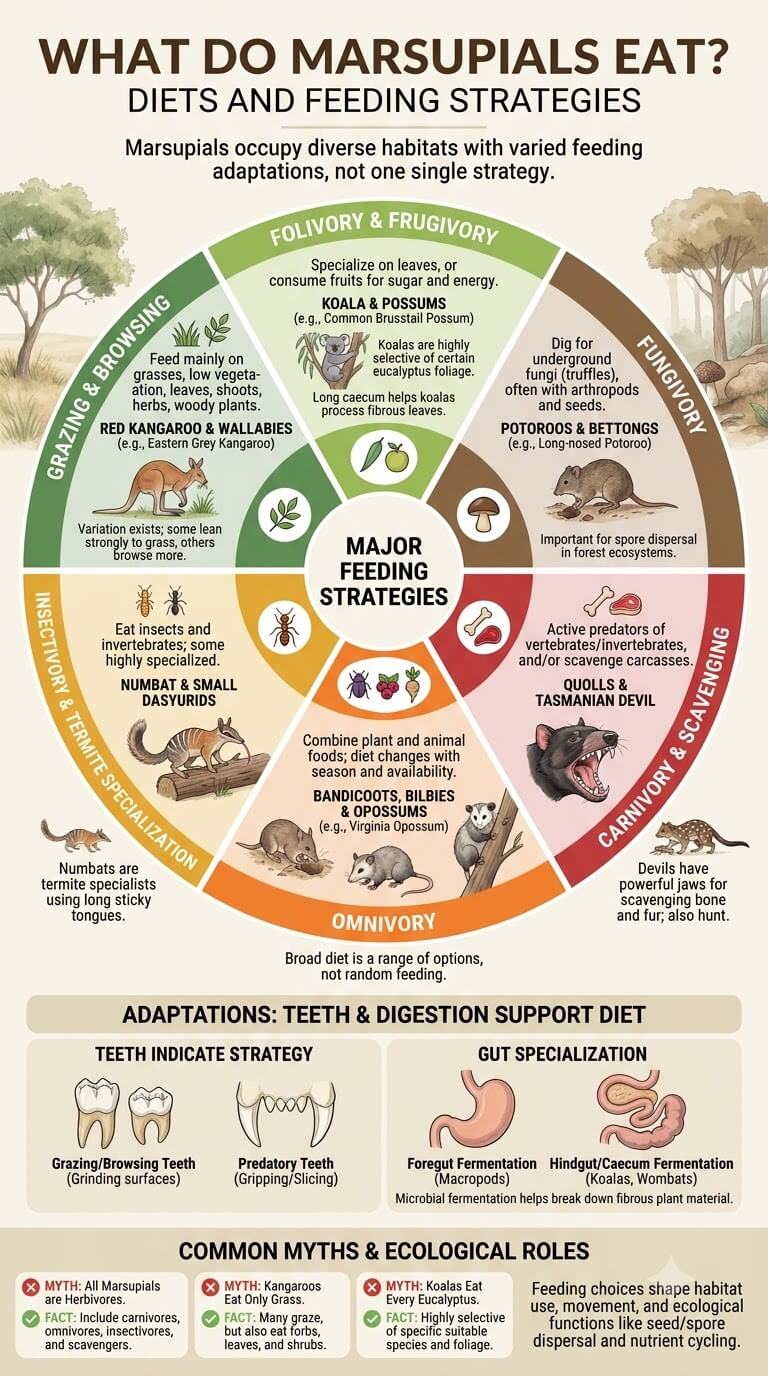
Marsupials can be grazers, browsers, folivores, frugivores, fungivores, nectar feeders, insectivores, omnivores, predators, and scavengers. The exact diet depends on the species. A red kangaroo may feed mainly on grasses while also taking forbs and shrub leaves. A koala selects leaves from suitable eucalypts. A numbat specializes heavily on termites. A long-nosed potoroo feeds largely on fungi, while a Virginia opossum uses a broad seasonal diet that includes both plant and animal foods.
The useful question is not “what do marsupials eat?” as if there were one answer, but “what does this marsupial eat, and what adaptations help it obtain and digest that food?”
Marsupials Use Many Different Feeding Strategies
Grazing and browsing
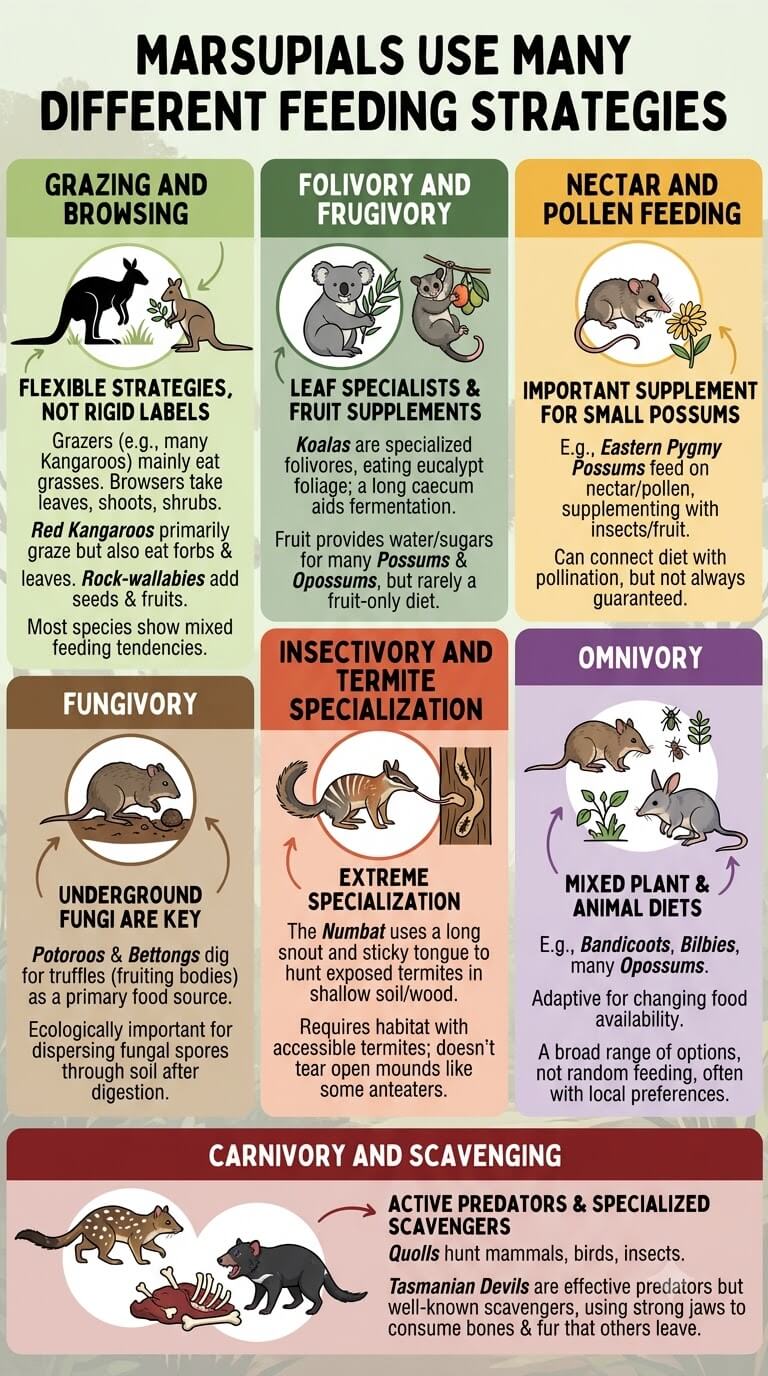
Grazers feed mainly on grasses and other low vegetation, while browsers take leaves, shoots, herbs, and woody plants. Several large kangaroos lean strongly toward grazing, but even within macropods there is variation. The Australian Museum’s red kangaroo profile describes red kangaroos as herbivores that feed primarily on grasses while also eating forbs and leaves from shrubs.
Wallabies show similar flexibility. Some species feed heavily on grasses and herbs, while rock-wallabies may add browse, seeds, fruits, and flowers. The distinction between grazer and browser is therefore useful as a tendency, not a rigid label for an entire family.
Folivory and frugivory
Folivores specialize on leaves, and koalas are the best-known marsupial example. Their diet is much narrower than that of a typical grazing kangaroo. Koalas select foliage from suitable eucalypts and can also take some stems and flowers. Their long caecum, a fermentation chamber in the large intestine, helps process a fibrous diet.
Fruit eating also occurs in many marsupials, especially arboreal possums and several American opossums. Fruit can provide water, sugars, and seasonal energy, but few marsupial lineages can be summarized accurately as fruit-only feeders.
Nectar and pollen feeding where documented
Some small possums use flowers as important food sources. Eastern pygmy possums, for example, feed on nectar and pollen from flowering trees and shrubs while supplementing their diet with insects and fruit. Their small size and climbing ability allow them to exploit flowers in the canopy and dense vegetation.
Nectar feeding can also connect diet with pollination when animals move pollen between flowers, although the ecological importance of that role varies by species and plant system. It should not be assumed for every possum that visits flowers.
Fungivory
Fungi are an important but easily overlooked marsupial food. Several potoroos and bettongs dig for underground fruiting bodies commonly called truffles. The Australian Museum’s long-nosed potoroo profile describes fungi as the primary component of its diet, with arthropods, seeds, and plant material also consumed.
Fungivory matters beyond nutrition because spores can survive passage through the digestive tract and be deposited elsewhere. In some forest ecosystems, marsupials that consume underground fungi can help move fungal spores through the soil environment. The strength of that ecological role depends on the species, location, and fungi involved.
Insectivory and termite specialization
Many marsupials eat insects and other invertebrates, but the numbat stands out for specialization. Its long snout and narrow sticky tongue are adapted to feeding on termites exposed in shallow soil and decaying wood. Official Western Australian recovery material describes the numbat’s feeding activity as essentially a hunt for termites, with ants taken in much smaller amounts and often incidentally.
Numbats do not simply tear open large termite mounds like some placental anteaters. They exploit accessible galleries and follow termite activity through the day. This dietary specialization affects where numbats can live because they need habitats that provide enough accessible termites.
Omnivory
Omnivores combine plant and animal foods. Bandicoots and bilbies are good Australasian examples, while many American opossums also use mixed diets. Omnivory can be especially useful in environments where food availability changes strongly by season or rainfall.
Calling a species omnivorous does not mean it eats everything equally. Populations can prefer particular foods, and individual animals respond to what is locally available. A broad diet is a range of options, not random feeding.
Carnivory and scavenging
Several marsupials are active predators. Quolls hunt mammals, birds, reptiles, insects, and other prey depending on species and body size. Tasmanian devils also kill prey but are especially well known for scavenging carcasses.
The Australian Museum’s Tasmanian devil profile describes devils as mainly scavengers that can also be effective predators. Their strong jaws and teeth allow them to consume tissues that many scavengers leave behind, including bone and fur.
Herbivorous Marsupials
Kangaroos and wallabies: grazing and browsing variation
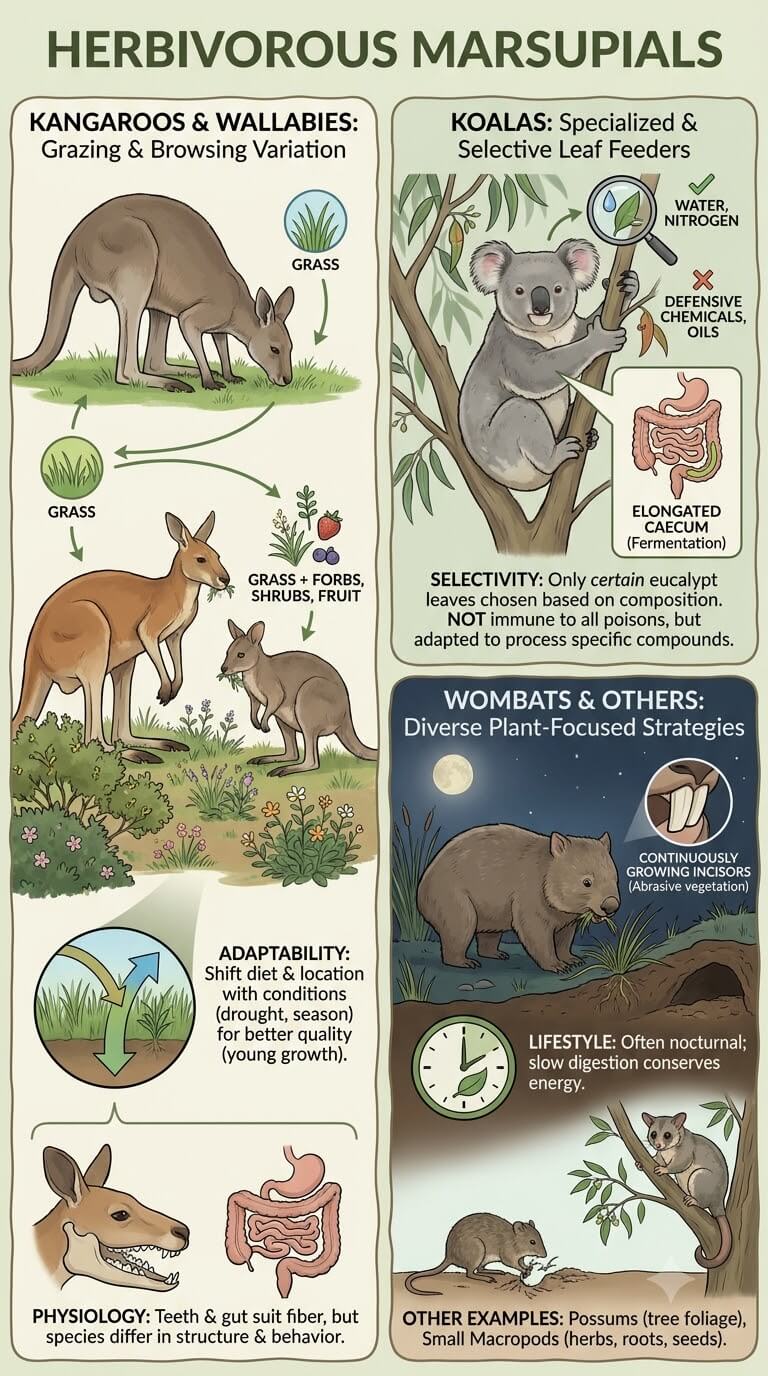
Kangaroos are often described as grass eaters, and that is broadly correct for several well-known species, but the details vary. Eastern grey kangaroos are predominantly grazers, while red kangaroos feed on grasses but also take forbs and shrub leaves. Wallabies may use a greater mix of grasses, herbs, browse, flowers, fruits, and seeds depending on habitat.
Food quality changes through drought, rainfall, fire, and season. Young green growth can contain more protein and be easier to digest than dry mature grasses. As conditions change, herbivorous marsupials may shift which plant parts they select or how far they travel while feeding.
Macropod teeth and digestive anatomy are well suited to fibrous plant diets, but it is unnecessary to treat every kangaroo or wallaby as an identical ruminant-like grazer. Marsupials use their own digestive physiology, and species differ in gut structure, body size, and feeding behavior.
Koalas: specialized leaf feeding and selective foliage use
Koalas have one of the most specialized diets among living marsupials. The Australian Museum’s koala profile describes their diet as leaves from certain eucalypt species, with some flowers and stems also eaten. The key word is certain. Koalas do not treat every eucalyptus tree as equally suitable food.
Leaves differ in water content, fiber, nitrogen, oils, and defensive plant chemicals. Koalas make selective feeding decisions that vary with location and available tree species. Their digestive tract includes an elongated caecum that supports microbial fermentation of fibrous plant material.
The popular statement that koalas can “eat poisonous eucalyptus” needs careful wording. Eucalypt leaves contain plant secondary compounds that can be difficult for many animals to process, but toxicity varies among species and chemical mixtures. Koalas have physiological and sensory adaptations that help them select and metabolize suitable foliage. That does not make them immune to every eucalypt compound or capable of eating any eucalyptus leaf.
Wombats and other plant-focused examples
Wombats are terrestrial herbivores with strong jaws and continuously growing incisors suited to abrasive vegetation. The Australian Museum’s bare-nosed wombat profile lists native grasses, sedges, and rushes as major foods, with some dry leaves, stalks, and small amounts of bark also taken.
Wombats often feed for hours after sunset, although cool conditions can shift activity. Their slow digestion helps extract nutrients from fibrous food, fitting a lifestyle in which energy conservation can be important.
Other plant-focused marsupials occupy very different ecological settings. Some possums browse foliage in trees, while small macropods feed on herbs, roots, seeds, or underground plant parts. Herbivory in marsupials is therefore a broad category with many specialized forms.
Mixed and Specialized Feeders
Possums and mixed plant-animal diets by species
Possums are not one dietary type. Common brushtail possums eat leaves, flowers, and fruits and can exploit a variety of foods in urban and natural habitats. Eastern pygmy possums emphasize nectar and pollen but also eat insects and fruit. Other possums and gliders differ again.
Arboreal feeding creates a distinct set of constraints. Food is distributed among branches, flowers may be seasonal, and leaves differ chemically even within one plant community. Climbing ability, grasping feet, smell, taste, and memory of feeding sites can all influence what an animal eats.
Bettongs and potoroos with fungi and plant foods where supported
Potoroos and bettongs are small relatives of kangaroos that often forage close to the ground. Several species dig for fungi, roots, tubers, seeds, and other foods. Long-nosed potoroos are especially associated with fungi, while rufous bettongs use a broader diet that includes herbs, roots, tubers, and fungi.
Digging changes how these animals interact with soil. A potoroo searching for underground fungi disturbs leaf litter and soil structure while finding food. When fungal spores survive digestion, feeding can also become part of spore dispersal.
Not every bettong or potoroo depends on fungi to the same degree. Diet varies among species and habitats, so “rat-kangaroo equals truffle eater” is too broad even though fungivory is important in several members of the group.
Bilbies and bandicoots as omnivorous foragers
Bandicoots and bilbies combine strong digging forelimbs with long snouts that help them search soil and litter. Animal Diversity Web describes peramelemorphs as broadly omnivorous, taking foods such as insects, larvae, earthworms, spiders, plant material, bulbs, grasses, seeds, fungi, and occasionally small vertebrates.
That mixed diet makes digging especially valuable. The animals can reach buried invertebrates and underground plant parts rather than depending only on food visible at the surface.
Regional availability matters. One population may emphasize insects, another roots or seeds, and another fungi. The word omnivore should therefore describe dietary breadth, not a fixed menu.
Numbats and termite specialization
Numbats are among the clearest dietary specialists in Marsupialia. Their feeding is overwhelmingly focused on termites. They use smell and a long tongue to locate and collect termites from shallow galleries, decaying logs, and other accessible sites.
This specialization affects daily activity. Numbats track when termites are close enough to the surface to be reached, so feeding schedules can shift with soil temperature and season. Their ecology is tightly tied to termite availability.
Popular descriptions sometimes call numbats “anteaters,” but they are not taxonomic anteaters. The comparison refers only to convergent insect-feeding adaptations.
Carnivorous and Scavenging Marsupials
Quolls as predators
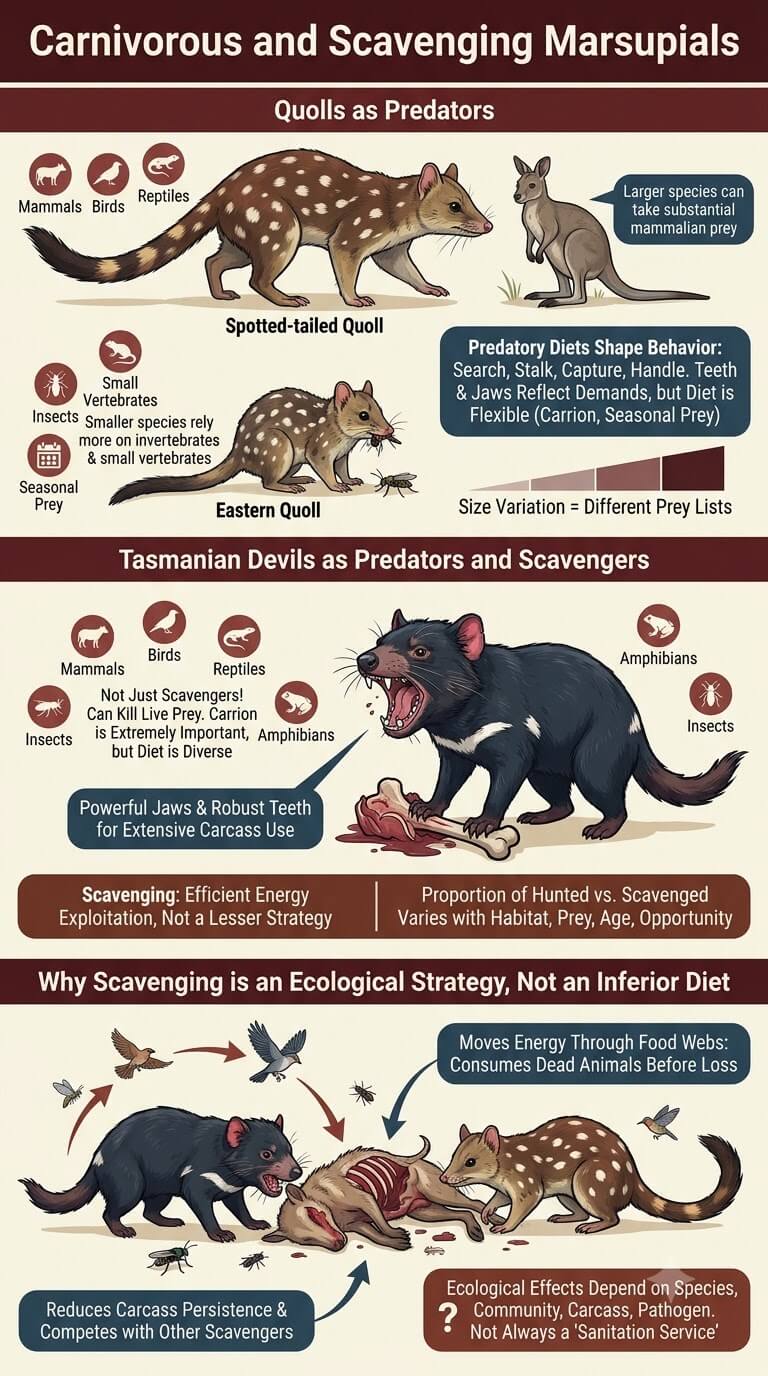
Quolls are active marsupial predators. Depending on the species, they can eat insects, birds, reptiles, small mammals, and larger vertebrate prey, and they may also scavenge. Spotted-tailed quolls are among the larger living quolls and can take substantial mammalian prey.
Smaller quoll species rely more heavily on invertebrates and small vertebrates. This size-related variation is another reason “carnivorous marsupial” should not imply one prey list for every dasyurid.
Predatory diets shape behavior. Quolls need to search, stalk, capture, and handle prey rather than simply crop vegetation. Their teeth and jaw mechanics reflect those demands, but diet remains flexible enough for many species to use carrion or seasonal prey when available.
Tasmanian devils as predators and scavengers
Tasmanian devils are often described only as scavengers, which understates their feeding behavior. Carrion is extremely important, but devils can also kill live prey. Their diet can include mammals, birds, reptiles, amphibians, and insects.
Scavenging is not a lesser feeding strategy. Finding and processing carcasses efficiently reduces the need to capture every meal and allows an animal to exploit energy already available in the ecosystem. For devils, powerful jaws and robust teeth allow extensive use of carcass material.
The proportion of hunted versus scavenged food can vary with habitat, prey availability, age, and opportunity. It is therefore more accurate to describe devils as capable predators that rely heavily on scavenging than to force them into one category.
Why scavenging is an ecological strategy, not an inferior diet
Scavengers help move energy through food webs by consuming dead animals before that material is lost to other decomposers. They can reduce carcass persistence and compete with other scavengers for concentrated food resources.
That role does not make every scavenger a sanitation service for people, nor does it mean scavenging prevents all disease. Ecological effects depend on the species, community, carcass type, and pathogen.
American Marsupial Diets
Opossum omnivory and species-level variation
American opossums include many species, and their diets are not all identical. The Virginia opossum is a useful US example of flexible omnivory. The Smithsonian’s Virginia opossum profile lists small mammals, birds, insects, worms, plant material, fruits, and seeds among foods used by the species, with reptiles and amphibians also taken in some habitats.
This flexibility helps Virginia opossums exploit seasonal changes and human-modified landscapes. Still, describing them as animals that “eat anything” is too loose. They make feeding choices within the opportunities available to them.
Why no single opossum diet describes Didelphidae
Didelphidae contains many American opossums occupying terrestrial, arboreal, and semi-aquatic environments. Different species encounter different prey, fruits, flowers, insects, and other resources.
A water opossum using streams does not have the same feeding ecology as a forest canopy species or a Virginia opossum foraging near a suburban edge. The family is diverse enough that diet should be checked at the species level whenever precision matters.
Anatomy and Digestion That Support Marsupial Diets
Teeth as supporting evidence without reducing diet to dentition
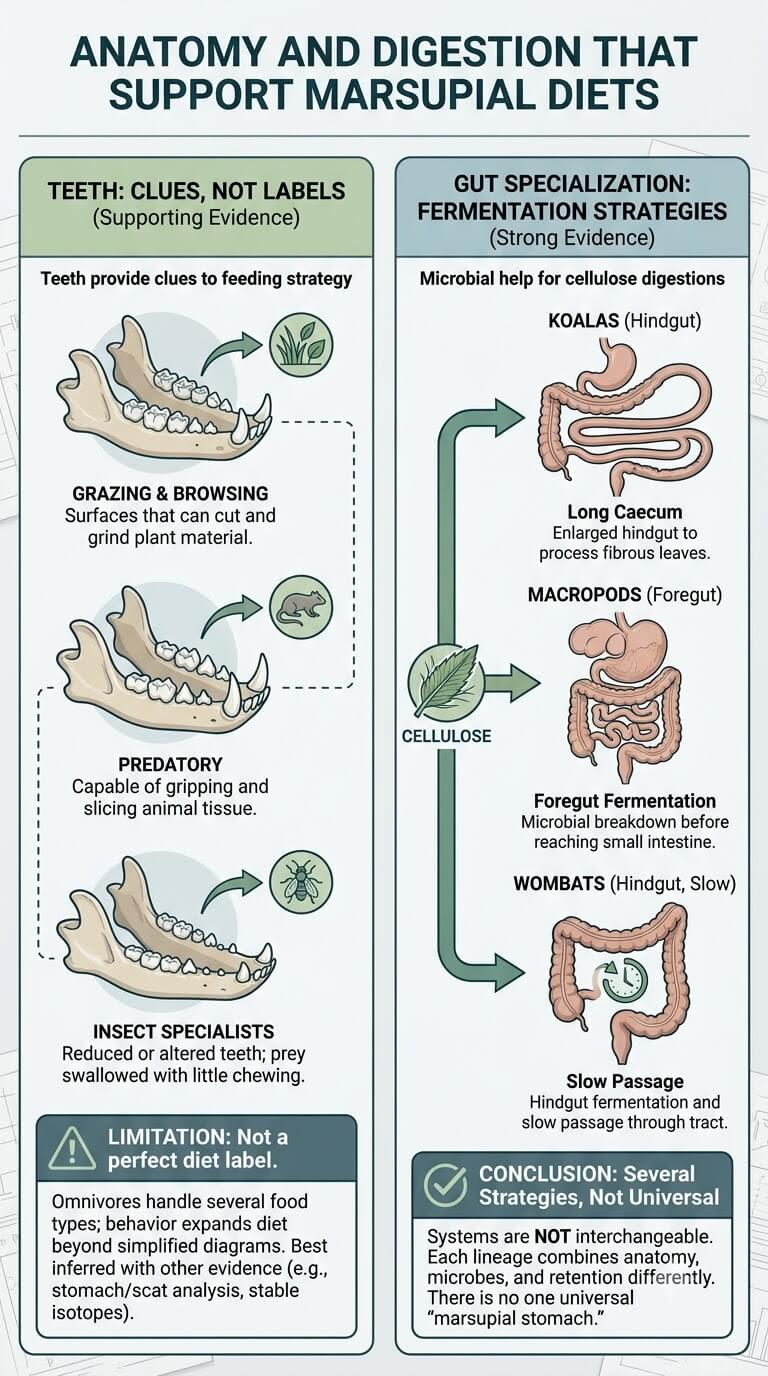
Teeth provide clues to feeding strategy. Grazing and browsing marsupials need surfaces that can cut and grind plant material. Predatory marsupials need teeth capable of gripping and slicing animal tissue. Insect specialists may have reduced or altered teeth when prey is small and swallowed with little chewing.
But teeth are not a perfect diet label. Omnivores can handle several food types, and behavior can expand what an animal eats beyond what a simplified tooth diagram suggests. Diet is best inferred from anatomy together with direct observations, stomach or scat analysis, stable isotopes, and other ecological evidence.
Gut specialization and fermentation where evidence is strong
Plant material, especially mature leaves and grasses, contains cellulose and other compounds that mammals cannot digest efficiently without microbial help. Herbivorous marsupials therefore rely on fermentation in specialized sections of the digestive tract.
Koalas use an enlarged hindgut, including a long caecum, to process fibrous leaves. Macropods use foregut fermentation with microbial communities that help break down plant material before it reaches the small intestine. Wombats use hindgut fermentation and slow passage through the digestive tract.
These systems are not interchangeable. Each lineage combines anatomy, microbes, feeding behavior, and retention time differently. It is more accurate to describe several marsupial fermentation strategies than one universal “marsupial stomach.”
Common Myths and Mistakes
All marsupials are herbivores
False. Marsupials include herbivores, omnivores, insect specialists, predators, and scavengers. Koalas, numbats, quolls, devils, bandicoots, and opossums alone are enough to show the range.
Kangaroos eat only grass
Too simple. Several large kangaroos are strongly grass-focused, but species and populations can also eat forbs, leaves, browse, and other plant material. Wallabies often use even broader plant diets.
Koalas can eat every eucalyptus species
False. Koalas are selective. They use suitable foliage from particular eucalypts available within their range, and leaf chemistry, moisture, and nutritional value influence feeding choices.
Tasmanian devils only scavenge
False. Devils are important scavengers but can also hunt live prey. Treating them as scavengers only misses part of their feeding ecology.
Opossums indiscriminately eat anything
False. Virginia opossums are flexible omnivores, but a broad diet does not mean random feeding. Food use changes with season, habitat, and local availability, and other opossum species can be more specialized.
How Food Choices Shape Marsupial Life
Habitat and food availability
Diet links an animal directly to habitat. Koalas need landscapes containing suitable food trees. Numbats need accessible termite populations. Potoroos need environments that support underground fungi and protective ground cover. Grazing kangaroos depend on the condition and availability of herbaceous vegetation.
When habitat changes, the effect on a marsupial often begins with food. Drought can reduce grass quality, land clearing can remove browse or hollow-bearing trees, and altered fire patterns can change fungi, insects, and plant regrowth.
Movement and foraging strategy
How an animal moves often matches how it finds food. Kangaroos travel across open ground while grazing. Possums climb to reach leaves, flowers, and fruit. Bilbies and bandicoots dig. Potoroos search the forest floor for fungi. Quolls patrol large areas for prey, while numbats move between accessible termite galleries.
Movement therefore cannot be separated cleanly from diet. A feeding strategy creates a set of spatial problems, and anatomy helps the animal solve them.
Ecological roles created by feeding
Feeding behavior also determines ecological function. Grazers alter vegetation. Predators remove prey. Scavengers consume carcasses. Digging omnivores disturb soil. Fruit and fungi consumers can move seeds or spores. Termite specialists transfer energy from social insects into mammalian food webs.
Those roles should be described carefully. Not every fungus-eating marsupial is equally important for spore dispersal, not every digging animal qualifies automatically as an ecosystem engineer, and no feeding role makes an animal universally beneficial in every setting.
FAQ
Are any marsupials carnivores?
Yes. Quolls are active predators, and Tasmanian devils can both hunt and scavenge. Smaller dasyurids often eat insects and small vertebrates. Carnivory varies in degree, so not every member of a predatory lineage eats the same prey.
Which marsupials specialize on insects or termites?
Numbats are among the most specialized examples because their wild diet is overwhelmingly focused on termites. Many smaller dasyurids also eat large quantities of insects and other invertebrates, while bandicoots and bilbies include insects as part of broader omnivorous diets.
Do marsupials eat fungi?
Yes. Potoroos and several bettongs are notable fungus eaters, and fungi also appear in the diets of some bandicoots, possums, wombats, and other mammals. The importance of fungi varies from a major food source to an occasional item depending on species and habitat.
Can different kangaroo or wallaby species have different diets?
Yes. Many are herbivorous, but the balance of grasses, herbs, browse, leaves, flowers, fruits, and other plant foods varies among species and environments. Even within one species, rainfall, drought, season, and local vegetation can change what is available and selected.
Final Thoughts
What marsupials eat depends on the species, not on the fact that the animal has marsupial ancestry. Kangaroos and wombats show different forms of herbivory, koalas specialize on selected eucalypt foliage, potoroos can rely heavily on fungi, numbats specialize on termites, bandicoots and bilbies combine plant and animal foods, quolls are predators, Tasmanian devils hunt and scavenge, and American opossums include flexible omnivores. These diets are tied closely to teeth, gut anatomy, movement, senses, habitat, and daily behavior. The most useful way to understand marsupial feeding is therefore to ask how each species obtains and processes its food, and what that feeding strategy allows it to do in its environment.

Ethan Walker is the founder and research editor of Animal Fact Central. He creates and reviews educational animal facts content using trusted wildlife, pet care, and science-based sources. His work focuses on making animal behavior, adaptations, habitats, and species facts clear, accurate, and engaging for everyday readers.
Read More Details About Ethan Walker: https://animalfactcentral.com/ethan-walker/