
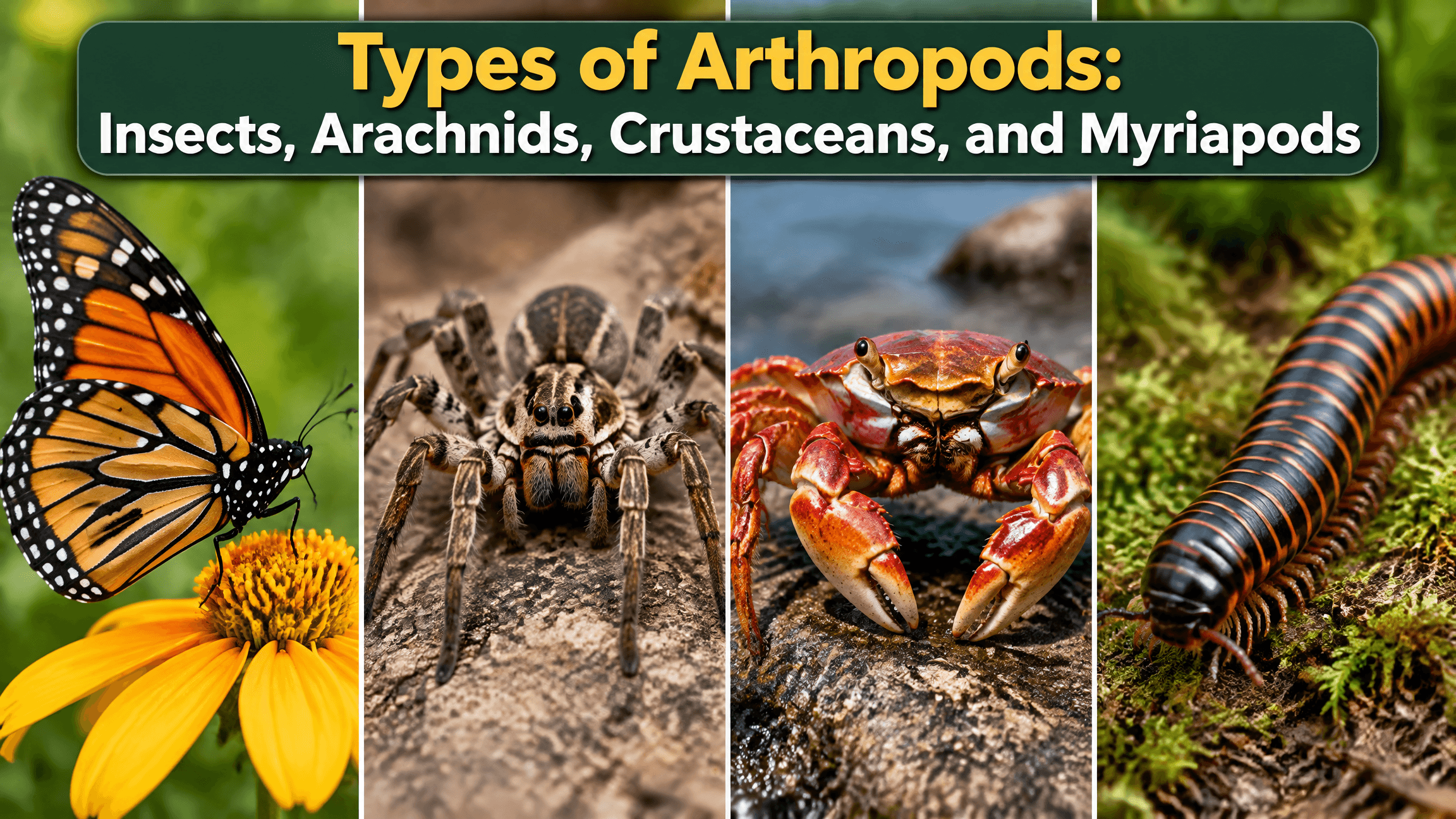
The most familiar types of arthropods are insects, arachnids, crustaceans, and myriapods. That four-part list is useful for learning because it puts butterflies, spiders, crabs, centipedes, and millipedes into recognizable groups. It is not, however, a perfect picture of modern arthropod evolution.
A more scientific framework recognizes several deeper branches. Chelicerata includes arachnids and horseshoe crabs, and many classifications also place sea spiders there. Myriapoda includes centipedes, millipedes, pauropods, and symphylans. Pancrustacea includes Hexapoda, the group containing insects and their close six-legged relatives, together with multiple crustacean lineages.
This means “insects, arachnids, crustaceans, and myriapods” works well as a reader-friendly introduction, but those names do not all represent equivalent branches at the same evolutionary depth. Understanding both versions gives a clearer picture of arthropod diversity without turning the subject into an unnecessarily complicated taxonomic tree.
Quick Guide to the Major Arthropod Groups

The Smithsonian National Museum of Natural History arthropod guide presents familiar groups such as Chelicerata, Hexapoda, Myriapoda, Diplopoda, Chilopoda, Arachnida, and Crustacea in a relationship-based framework. That is a useful starting point because it separates everyday names from the deeper branches they belong to.
| Familiar group | Broader evolutionary context | Typical examples | Useful identifying clues |
|---|---|---|---|
| Insects | Hexapoda within Pancrustacea | Beetles, butterflies, flies, ants, grasshoppers | Adults typically have three pairs of walking legs, one pair of antennae, and head, thorax, and abdomen |
| Arachnids | Chelicerata | Spiders, scorpions, ticks, mites, harvestmen | Typically four pairs of walking legs as adults, no antennae, and chelicerae near the mouth |
| Crustaceans | Multiple non-hexapod lineages within Pancrustacea | Crabs, shrimp, lobsters, copepods, krill, barnacles, woodlice | Highly variable bodies, usually two pairs of antennal structures in the crustacean body plan, many aquatic forms |
| Myriapods | Myriapoda | Centipedes, millipedes, pauropods, symphylans | Head followed by an elongated trunk with many segments and numerous legs |
The table describes common patterns rather than rigid rules for every life stage or species. Juveniles can differ from adults, structures may be reduced, and specialized lineages can depart from the most familiar appearance. In classification, a useful clue is not automatically a universal definition.
Why Arthropod Classification Is More Complex Than Four Boxes
Familiar Groups and Deeper Evolutionary Branches
Everyday classification often starts with appearance. An insect has six legs, an adult arachnid usually has eight, a crab looks crustacean, and a centipede or millipede has a long trunk with many legs. These patterns are useful for identification, but evolutionary classification asks a different question: which groups share the most recent common ancestry?
That distinction is why a simple four-box diagram can be educational without being a complete evolutionary tree. Arachnids belong within the larger chelicerate branch. Insects belong within Hexapoda. Hexapoda, in turn, belongs within Pancrustacea, alongside the lineages commonly called crustaceans.
Rank names can also vary among databases or textbooks. One source may emphasize a subphylum, class, superclass, or other rank differently from another while still agreeing on the underlying membership of many major groups. For a beginner, the branching relationship is often more informative than memorizing a particular rank label.
Chelicerata, Myriapoda, and Pancrustacea
A widely used modern framework recognizes Chelicerata, Myriapoda, and Pancrustacea as major living arthropod branches. The details of the deepest relationships among these groups have been studied with anatomy, development, fossils, and molecular data, and classifications can differ in rank or naming convention.
For a general reader, the important point is not memorizing every rank. It is recognizing that “insect,” “arachnid,” “crustacean,” and “myriapod” are convenient names layered onto a more detailed evolutionary structure.
That layered approach also prevents a common mistake: assuming that every familiar category is equally broad. “Arachnid” is a class within Chelicerata, while “insect” is a class within Hexapoda. “Crustacean” is a convenient collective name for a large and evolutionarily complicated set of non-hexapod pancrustaceans. “Myriapod” refers to the larger branch that contains several classes, including centipedes and millipedes.
Chelicerata
Arachnids: Spiders, Scorpions, Ticks, Mites, and More
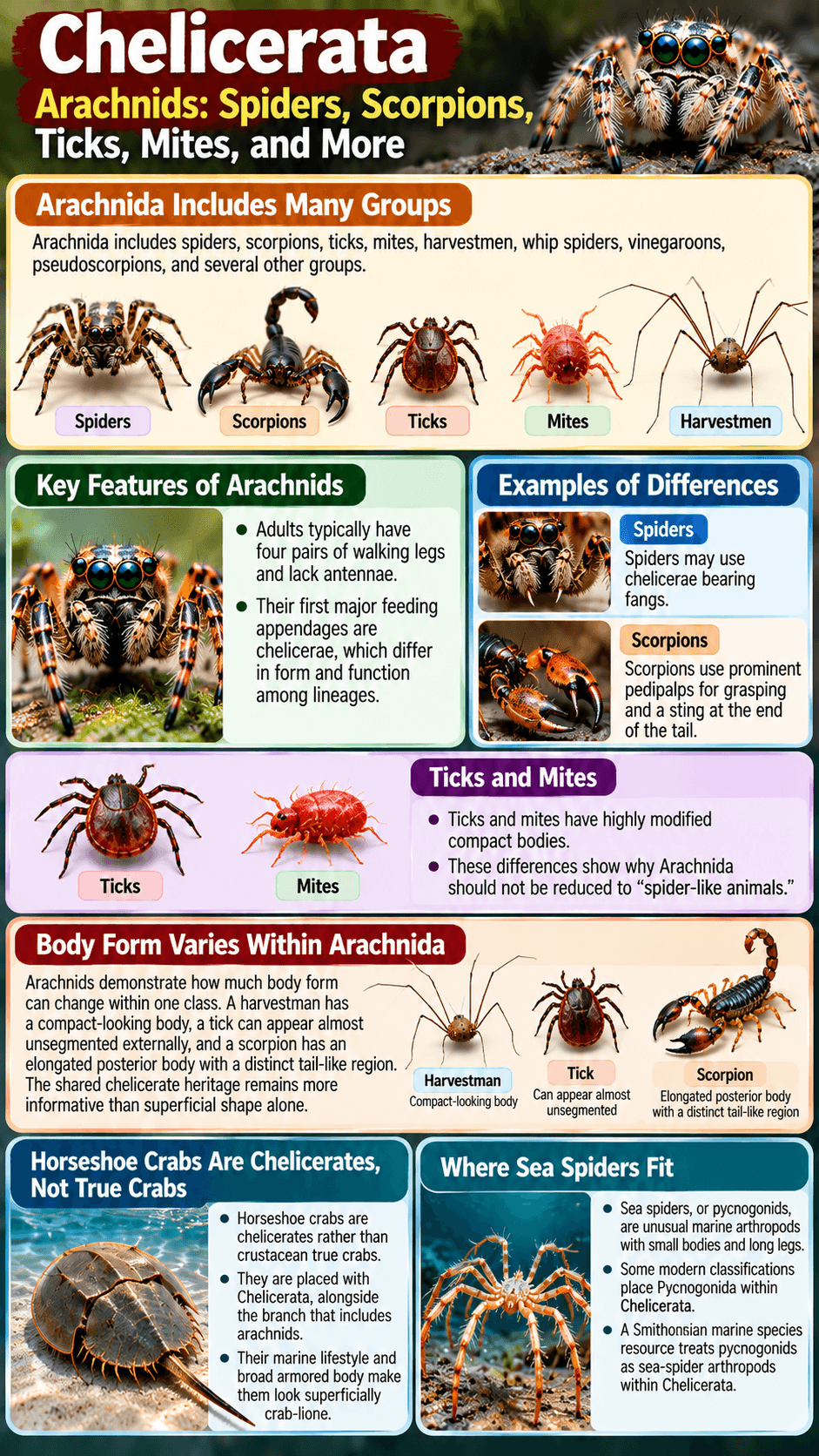
Arachnida includes spiders, scorpions, ticks, mites, harvestmen, whip spiders, vinegaroons, pseudoscorpions, and several other groups. Adult arachnids typically have four pairs of walking legs and lack antennae. Their first major feeding appendages are chelicerae, which differ in form and function among lineages.
Spiders may use chelicerae bearing fangs, scorpions use prominent pedipalps for grasping and a sting at the end of the tail, and ticks and mites have highly modified compact bodies. These differences show why Arachnida should not be reduced to “spider-like animals.”
Arachnids also demonstrate how much body form can change within one class. A harvestman has a compact-looking body, a tick can appear almost unsegmented externally, and a scorpion has an elongated posterior body with a distinct tail-like region. The shared chelicerate heritage remains more informative than superficial shape alone.
Horseshoe Crabs Are Chelicerates, Not True Crabs
Horseshoe crabs are one of the best examples of why common names can mislead. Despite the word “crab,” they are chelicerates rather than crustacean true crabs. The Smithsonian’s arthropod group guide places horseshoe crabs with Chelicerata, alongside the branch that includes arachnids.
Their marine lifestyle and broad armored body make them look superficially crab-like, but classification depends on evolutionary relationships and anatomical organization rather than overall resemblance.
Horseshoe crabs are also useful for remembering that Chelicerata is not synonymous with Arachnida. Arachnids are one major chelicerate lineage, while horseshoe crabs belong to another living chelicerate branch.
Where Sea Spiders Fit
Sea spiders, or pycnogonids, are unusual marine arthropods with small bodies and long legs. Some modern classifications place Pycnogonida within Chelicerata, while the exact deep relationship between sea spiders and other chelicerates has been debated in zoological research.
A Smithsonian marine species resource treats pycnogonids as sea-spider arthropods within Chelicerata. For an introductory classification, it is reasonable to mention them with chelicerates while also acknowledging that their precise placement has received continued scientific attention.
Myriapoda

Chilopoda: Centipedes
Centipedes belong to Chilopoda. Their bodies consist of a head followed by a segmented trunk, with one pair of walking legs on each leg-bearing trunk segment. The first trunk appendages are modified into forcipules used to capture prey and deliver venom.
Centipedes are generally predators, although their prey and hunting behavior vary with species and size. The group includes compact soil-dwelling forms as well as long-legged house centipedes and larger scolopendromorph centipedes.
The segment pattern also helps separate centipedes from millipedes. A centipede’s leg-bearing trunk units typically carry one pair of legs, but not every body segment should be interpreted as identical in function. The front part of the trunk includes highly specialized structures associated with feeding and venom delivery.
Diplopoda: Millipedes
Millipedes belong to Diplopoda. Many of their apparent trunk units are diplosegments, formed through developmental fusion and typically carrying two pairs of legs. This differs from the centipede pattern and gives many millipedes a denser sequence of legs along the trunk.
Millipedes are commonly associated with decaying plant material, fungi, and other organic matter, although feeding habits vary. Many defend themselves by curling, using armored body form, or releasing defensive secretions rather than actively hunting prey.
The contrast with centipedes is therefore anatomical as well as ecological. Centipedes have a predator-oriented body plan with forcipules near the head, while millipedes commonly have a heavier cylindrical or flattened trunk adapted to moving through litter, soil spaces, bark, and other ground-level microhabitats.
Pauropoda and Symphyla
Myriapoda contains two less familiar groups in addition to centipedes and millipedes: Pauropoda and Symphyla. Pauropods are tiny, soft-bodied soil arthropods. Symphylans are also small soil-dwelling myriapods and are sometimes called pseudocentipedes because of their elongated appearance.
The Integrated Taxonomic Information System treatment of Myriapoda includes Chilopoda, Diplopoda, Pauropoda, and Symphyla. These smaller groups matter because “myriapod” is broader than just centipedes and millipedes.
Pauropods and symphylans are easily overlooked because they are small and usually live within soil or litter rather than in exposed places. Their existence makes Myriapoda a more varied branch than the familiar centipede-versus-millipede comparison suggests.
Why Common Names Do Not Give Exact Leg Counts
Centipede does not mean an animal must have exactly 100 legs, and millipede does not mean every species has exactly 1,000. The names refer broadly to many-legged body forms, not fixed numerical definitions.
Leg number varies among species and may change during growth in some lineages. Using exact leg counts as the definition of either group can therefore cause misidentification. Body organization, especially the pattern of legs on trunk units, is usually more useful.
Pancrustacea

What Pancrustacea Means
Pancrustacea is the evolutionary grouping that unites hexapods with crustacean lineages. This framework emerged from multiple lines of evidence and changed the older picture in which insects and crustaceans were treated as completely separate major branches.
The implication is important: Hexapoda is nested within the broader pancrustacean radiation. That does not mean a modern insect is literally a shrimp or that living insects evolved from living shrimp. It means hexapods and the animals commonly called crustaceans share ancient ancestry within the same larger branch.
Pancrustacea is therefore most useful as an evolutionary idea. It explains why certain features of the nervous system, eyes, development, and appendages can be compared across hexapods and crustacean lineages while also recognizing that hundreds of millions of years of diversification have produced very different modern forms.
Hexapoda and Its Relationship to Crustacean Lineages
Hexapoda includes Insecta plus several non-insect six-legged groups. Molecular and morphological research supports a close evolutionary relationship between hexapods and crustacean lineages.
The World Register of Marine Species treatment of Crustacea explicitly notes that traditional Crustacea is paraphyletic and that Hexapoda emerges from within Pancrustacea. WoRMS continues to use “Crustacea” as a convenient name for the non-hexapod pancrustacean assemblage.
This is a good example of taxonomy balancing evolutionary precision with practical communication. “Crustacean” remains useful for animals such as crabs, shrimp, barnacles, copepods, and woodlice even though a strict evolutionary diagram requires the caveat that excluding Hexapoda leaves a paraphyletic assemblage.
Why Insects Did Not Evolve From Modern Shrimp
Evolutionary statements can become misleading when they are compressed into phrases such as “insects came from shrimp.” Modern shrimp are living branches with their own evolutionary histories. Insects did not descend from the shrimp species alive today.
A better description is that insects and crustacean lineages share ancient pancrustacean ancestry. Some crustacean branches are more closely related to hexapods than a simple “insects versus crustaceans” split would suggest.
The same reasoning applies throughout evolution. Humans did not evolve from modern chimpanzees, birds did not evolve from modern crocodiles, and insects did not evolve from modern shrimp. Living relatives share ancestors rather than serving as unchanged ancestors of one another.
Hexapoda Is Broader Than Insecta
Insecta
Insecta is the enormously diverse class containing beetles, butterflies and moths, flies, bees, wasps, ants, grasshoppers, dragonflies, cockroaches, true bugs, and many other groups. Adult insects characteristically have three pairs of walking legs attached to the thorax and one pair of antennae.
ITIS places Insecta within the subphylum Hexapoda. This is the simplest way to understand the relationship: all insects are hexapods, but Hexapoda includes more than Insecta.
Wings are not required for an animal to be an insect. Many insect lineages are wingless, and some species lose wings in particular castes, sexes, or life stages. Six-legged adult organization and the wider insect body plan are more fundamental than flight.
Springtails, Protura, and Diplura
Springtails belong to Collembola, while Protura and Diplura are two other non-insect hexapod groups. They are generally small and are especially associated with soil, litter, or other humid microhabitats.
Their exact rank has not been expressed identically by every classification system. ITIS notes that the ranks used for Collembola, Protura, and Diplura vary among major references. For general readers, the stable point is that these groups belong to Hexapoda but are not members of Insecta.
These groups also differ from insects in important anatomical details. Their mouthparts are enclosed within the head capsule rather than exposed in the typical insect pattern, one reason they have historically been grouped under names referring to entognathous hexapods.
Why “Hexapod” and “Insect” Are Not Exact Synonyms
In everyday writing, insects dominate most discussions of six-legged arthropods because they are far more familiar and conspicuous. Scientifically, however, using Insecta and Hexapoda as exact synonyms erases the non-insect hexapods.
This distinction becomes especially important in classification articles, museum labels, and educational diagrams. A springtail may look insect-like and has six legs as an adult, but it is not classified inside Insecta in the framework used here.
Crustacean Diversity in Modern Context
Decapods: Crabs, Lobsters, Shrimp, and Crayfish
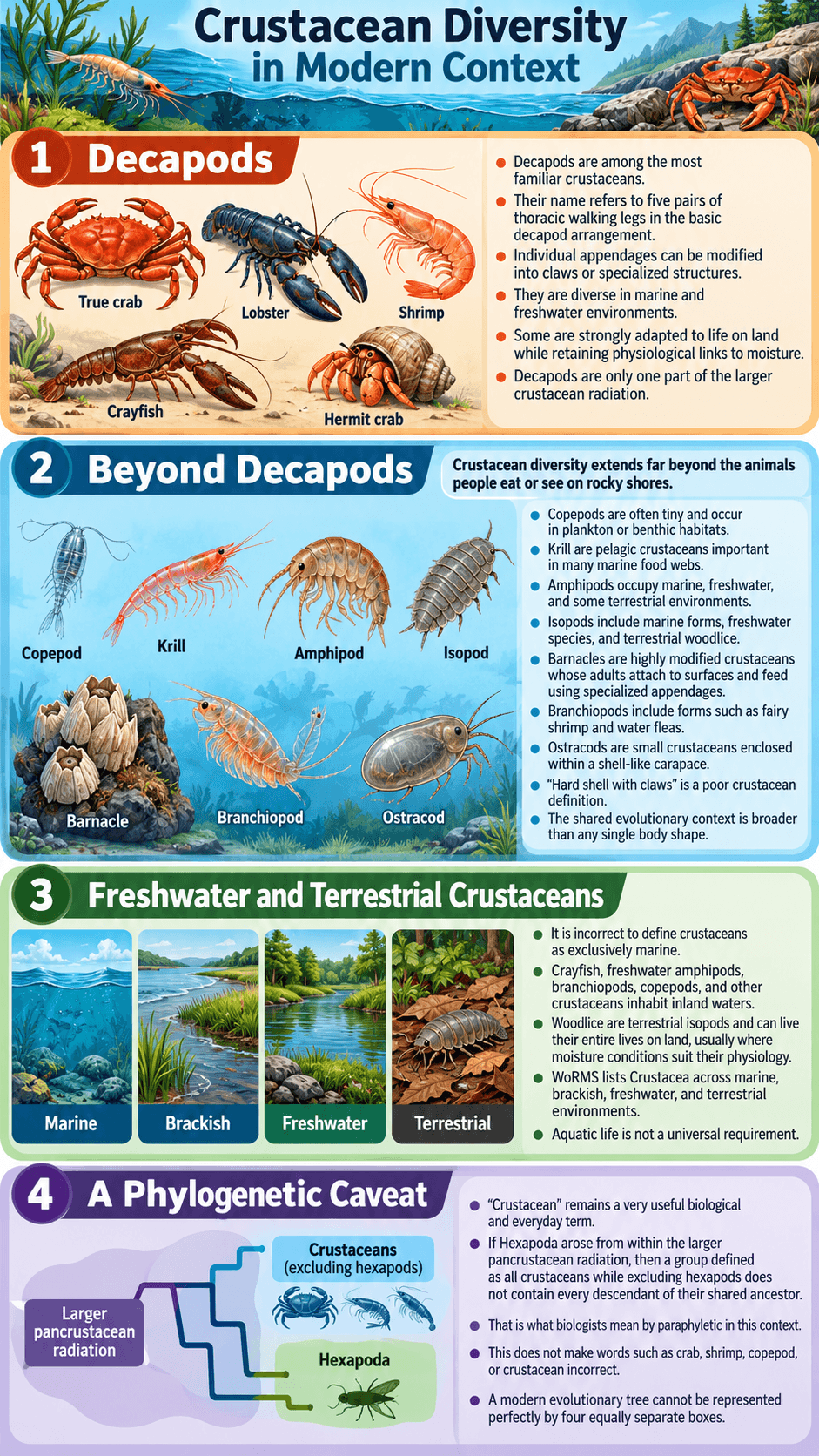
Decapods are among the most familiar crustaceans. The group includes true crabs, lobsters, many shrimp, crayfish, hermit crabs, and related forms. Their name refers to five pairs of thoracic walking legs in the basic decapod arrangement, although individual appendages can be modified into claws or specialized structures.
Decapods are diverse in marine and freshwater environments, and some have become strongly adapted to life on land while retaining physiological links to moisture. Their familiar form can make it easy to assume all crustaceans look similar, but decapods represent only one part of the larger crustacean radiation.
Copepods, Krill, Amphipods, Isopods, Barnacles, Branchiopods, and Ostracods
Crustacean diversity extends far beyond the animals people eat or see on rocky shores. Copepods are often tiny and occur in plankton or benthic habitats. Krill are pelagic crustaceans important in many marine food webs. Amphipods occupy marine, freshwater, and some terrestrial environments.
Isopods include marine forms, freshwater species, and terrestrial woodlice. Barnacles are highly modified crustaceans whose adults attach to surfaces and feed using specialized appendages. Branchiopods include forms such as fairy shrimp and water fleas, while ostracods are small crustaceans enclosed within a shell-like carapace.
These examples show why “hard shell with claws” is a poor crustacean definition. Copepods may be tiny and streamlined, barnacles are attached as adults, woodlice walk on land, and ostracods enclose much of the body in a two-part carapace. The shared evolutionary context is broader than any single body shape.
Freshwater and Terrestrial Crustaceans
It is incorrect to define crustaceans as exclusively marine. Crayfish, freshwater amphipods, branchiopods, copepods, and other crustaceans inhabit inland waters. Woodlice are terrestrial isopods and can live their entire lives on land, usually in places where moisture conditions suit their physiology.
WoRMS lists Crustacea across marine, brackish, freshwater, and terrestrial environments. The balance differs among lineages, but aquatic life is not a universal requirement.
Why Traditional “Crustacea” Needs a Phylogenetic Caveat
“Crustacean” remains an extremely useful biological and everyday term. The complication is that if Hexapoda arose from within the larger pancrustacean radiation, then a group defined as all crustaceans while excluding hexapods does not contain every descendant of their shared ancestor.
That is what biologists mean by paraphyletic in this context. It does not make words such as crab, shrimp, copepod, or crustacean incorrect. It simply explains why a modern evolutionary tree cannot be represented perfectly by four equally separate boxes.
Familiar Arthropod Groups Compared
Body-Region Patterns
Adult insects usually have a head, thorax, and abdomen. Spiders typically have a prosoma and opisthosoma. Myriapods have a head and elongated trunk. Crustacean tagmata are highly variable, with different groups fusing and specializing segments in different ways.
These patterns are useful for recognition, but none should be treated as the body formula for all arthropods. A compact tick and a long centipede can look almost unrelated at first glance even though both retain modified versions of the segmented arthropod framework.
Antennae and Mouthpart Differences
Insects and myriapods have one pair of antennae, while crustaceans characteristically have two pairs of antennal structures in the broader crustacean body plan. Chelicerates have no antennae.
Chelicerates use chelicerae as the first major feeding appendages. Insects, myriapods, and crustacean lineages belong to the mandibulate side of arthropod diversity and possess mandibles in their ancestral organization, although their mouthparts can be dramatically modified.
Typical Appendage Patterns
Adult insects have three pairs of walking legs. Adult arachnids typically have four pairs. Centipedes and millipedes carry walking legs on many trunk units. Crustaceans vary widely, from copepods with compact appendage sets to decapods with their familiar arrangement of thoracic walking legs.
Leg number is therefore excellent for distinguishing some familiar groups, but it is not a good universal definition of Arthropoda itself. The more general arthropod feature is the presence of paired jointed appendages that can be modified for different functions.
Habitat Tendencies and Important Exceptions
Insects are especially diverse on land and in freshwater, with relatively few fully marine representatives. Arachnids are predominantly terrestrial, though some mites and a few other forms occur in aquatic settings. Myriapods are mainly terrestrial and often associated with soil, litter, bark, or humid microhabitats.
Crustaceans are especially diverse in marine and freshwater systems, but terrestrial isopods and other land-adapted forms show that the boundary is not absolute. Habitat is therefore useful context, not a classification shortcut.
Common Classification Mistakes
Spiders Are Insects
Spiders are arachnids, not insects. Both are arthropods, but they belong to different major branches. Adult spiders typically have eight walking legs, no antennae, chelicerae, and a body organization unlike the insect head-thorax-abdomen pattern.
Horseshoe Crabs Are Crustaceans
Horseshoe crabs are chelicerates. Their common name reflects resemblance rather than close relationship to true crabs. They are more appropriately discussed alongside other chelicerates than inside Crustacea.
Woodlice Are Insects
Woodlice, including pillbugs and sowbugs, are terrestrial isopod crustaceans. They often live under logs, stones, bark, or litter, so they are encountered in the same places as many insects and myriapods. Their habitat does not make them insects.
Centipedes and Millipedes Are Insects
Centipedes and millipedes are myriapods. Their many-segmented trunks and numerous walking legs immediately distinguish them from the six-legged adult insect body plan.
Tardigrades Are Arthropods
Tardigrades are not arthropods. They belong to their own phylum, Tardigrada. They are close relatives of arthropods within the broader radiation of molting animals, but evolutionary proximity does not place them inside Arthropoda.
Different Questions Within Arthropod Biology
Classification and Defining Traits
Classification asks how groups such as Chelicerata, Myriapoda, and Pancrustacea relate to one another. Defining traits ask why all of them count as arthropods in the first place. The first question concerns branching relationships; the second concerns the shared body-plan framework and ancestry of the phylum.
Classification and Comparative Anatomy
Names on a tree do not explain every anatomical difference. Comparing antennae, chelicerae, mandibles, tagmata, leg arrangements, respiratory organs, and sensory systems requires a closer look at how structures differ among lineages.
This is why identifying a spider as a chelicerate and explaining how a spider’s prosoma functions are related but separate tasks. One is primarily a classification question, while the other examines body organization and function.
Broad Branches and More Detailed Groups
Chelicerata contains far more than a single familiar animal, and the same is true for Myriapoda and Pancrustacea. Once the broad map is clear, individual branches can be examined at finer scale without losing their place in the larger arthropod tree.
Arachnids, for example, include lineages as different as spiders, scorpions, ticks, mites, and harvestmen. Crustacean diversity spans tiny planktonic forms, attached barnacles, terrestrial woodlice, and large decapods. The broader classification provides context for those later comparisons.
FAQ
What Are the Main Types of Arthropods?
For a simple introduction, the main familiar types are insects, arachnids, crustaceans, and myriapods. A more evolutionary framework recognizes Chelicerata, Myriapoda, and Pancrustacea as major living branches, with insects belonging to Hexapoda inside Pancrustacea and arachnids belonging inside Chelicerata.
Are Insects Crustaceans?
Insects are hexapods, not members of “Crustacea” in the convenient traditional sense used for non-hexapod pancrustaceans. However, modern evolutionary evidence places Hexapoda within Pancrustacea, meaning insects share a deeper branch with crustacean lineages than older four-box diagrams suggested.
What Is the Difference Between Hexapoda and Insecta?
Hexapoda is the broader group. Insecta is one major lineage within it. Springtails, Protura, and Diplura are hexapods but are not placed inside Insecta in the framework used by ITIS and many modern zoological references.
Are Horseshoe Crabs Arachnids?
Horseshoe crabs are chelicerates, but they are not members of Arachnida. Arachnids and horseshoe crabs are separate chelicerate lineages. Calling horseshoe crabs “crabs” also does not make them crustaceans.
Final Thoughts
The familiar types of arthropods are insects, arachnids, crustaceans, and myriapods, and those categories are useful for recognizing major forms of arthropod life. A modern evolutionary view adds an important layer: arachnids belong within Chelicerata, myriapods form their own major branch, and insects are hexapods within Pancrustacea alongside crustacean lineages.
That framework explains several common puzzles at once. Horseshoe crabs are chelicerates rather than true crabs. Woodlice are terrestrial crustaceans rather than insects. Springtails are hexapods without being insects. Centipedes and millipedes are myriapods, and tardigrades are not arthropods at all. Learning the broad branches first makes the diversity easier to understand without oversimplifying how these animals are actually related.

Ethan Walker is the founder and research editor of Animal Fact Central. He creates and reviews educational animal facts content using trusted wildlife, pet care, and science-based sources. His work focuses on making animal behavior, adaptations, habitats, and species facts clear, accurate, and engaging for everyday readers.
Read More Details About Ethan Walker: https://animalfactcentral.com/ethan-walker/