
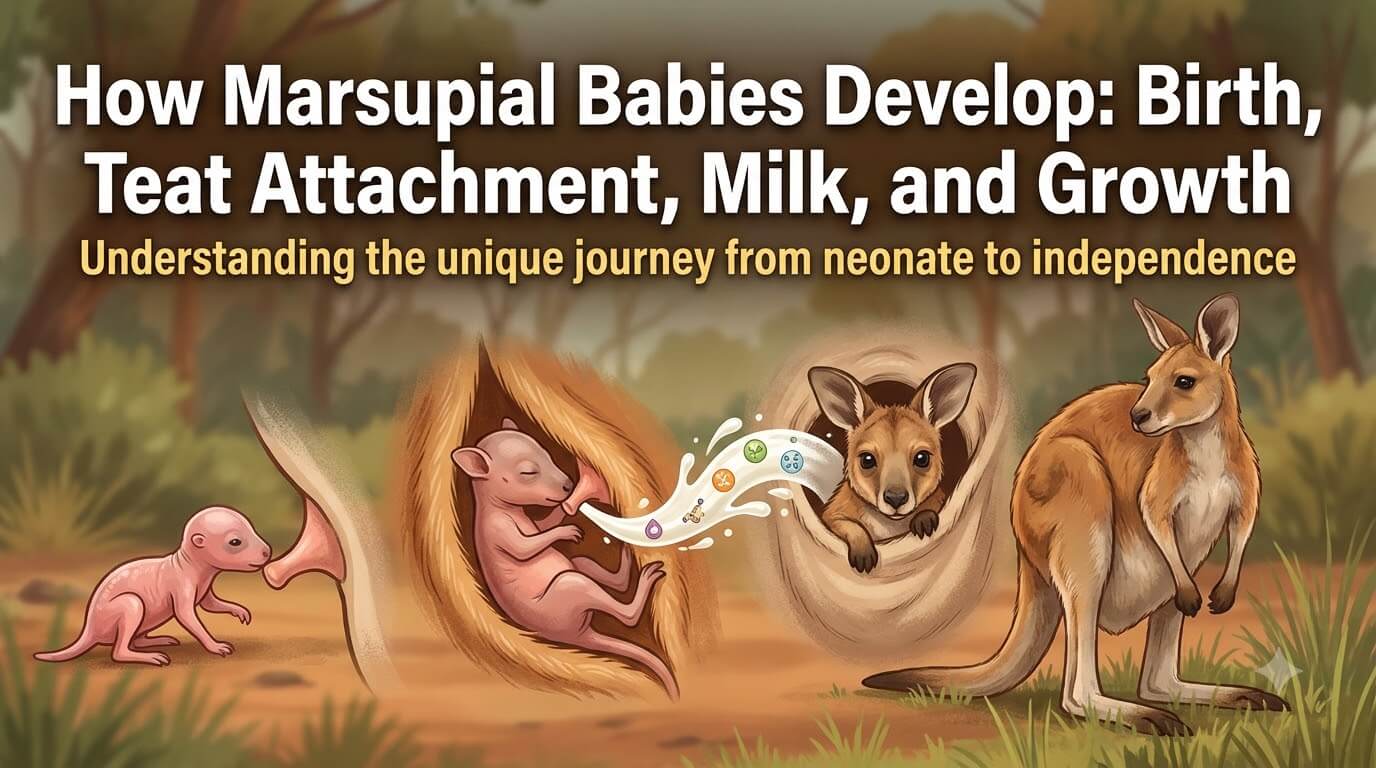
Marsupial babies begin life outside the uterus at a much earlier developmental stage than the newborns of many placental mammals. That does not mean they are unhealthy or pathologically premature. Early birth is part of a normal marsupial reproductive strategy in which pregnancy is followed by an unusually important period of milk-supported development. The newborn reaches the mother’s mammary area, establishes contact with a teat, and continues forming many of the organs, senses, muscles, and behaviors it will need later in life.
Kangaroo joeys provide the most familiar picture, but they are not a universal model. Some newborn marsupials climb upward into a deep pouch. Others travel a shorter route, move downward toward a rear-facing pouch, or attach to teats where there is no fully enclosing pouch at all. Growth after birth also differs among kangaroos, koalas, wombats, opossums, dasyurids, bandicoots, and other lineages.
Quick Answer
Marsupial baby development follows a broad sequence: a relatively short prenatal phase, live birth at an early developmental stage, movement to or placement near the mammary area, teat attachment, prolonged lactation, continuing organ development, increasing mobility, and eventually weaning and independence.
The mother’s milk does much more than provide calories. Its nutrient and bioactive composition changes across lactation, helping support different stages of growth. A peer-reviewed review of marsupial milk describes large changes in milk composition during lactation and emphasizes the importance of milk for nutrition, growth, and immune protection in highly immature young.
The exact schedule is species-specific. A kangaroo, koala, opossum, and dunnart can all be marsupials while differing in litter size, pouch use, time attached to a teat, rate of sensory development, emergence from maternal shelter, and age at weaning.
Before Birth: The Brief Prenatal Setup
Fertilization, pregnancy, and placental exchange at high level
Marsupial development does not begin in the pouch. Fertilization and early embryonic development occur inside the female reproductive tract, and pregnancy includes real maternal-fetal exchange through placental tissues. The common claim that marsupials have “no placenta” is incorrect.
A major review of marsupial placental biology describes a functional chorio-vitelline, or yolk-sac, placenta as central to marsupial pregnancy, with additional variation among lineages. Bandicoots provide an especially notable example because they can also develop a chorioallantoic placental component.
The prenatal phase is therefore biologically active even when it is short compared with the long period of nursing that follows. The embryo grows, fetal membranes develop, placental exchange occurs, and the newborn reaches a stage at which it can survive the transition to the teat.
Why relatively short pregnancy does not mean no prenatal investment
It is easy to compare a marsupial pregnancy with a human or another familiar placental mammal and conclude that the mother invests little before birth. That conclusion is too simplistic. Marsupial mothers still invest energy and physiology in pregnancy, placental tissues, uterine secretions, and preparation of the mammary system.
The more useful distinction is where development happens. In many marsupials, a large share of growth that occurs prenatally in familiar placental mammals happens after birth instead. Maternal investment has not disappeared. Much of it has shifted from gestation to prolonged lactation.
Birth at an Early Developmental Stage
Newborn body proportions and immature systems
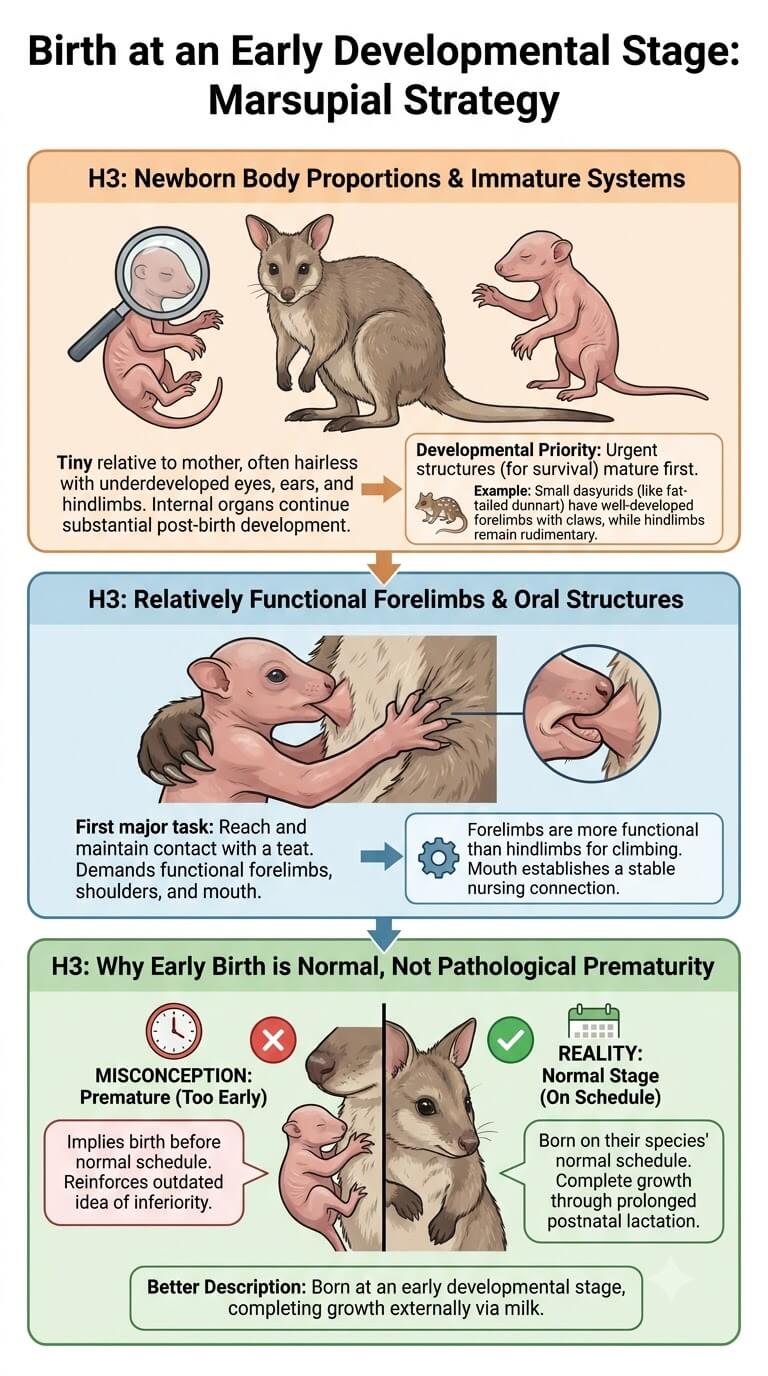
A newborn marsupial can look strikingly different from its adult form. The body is tiny relative to the mother, the skin may be largely hairless, the eyes and ears may be undeveloped, and the hindlimbs can be much less mature than the forelimbs. Many internal organs also continue substantial development after birth.
Those proportions are not random. The body regions needed immediately for survival receive developmental priority, while structures that are less urgent can mature later during the nursing period.
This pattern is especially clear in small dasyurids. A detailed study of the postnatal development of the fat-tailed dunnart found well-developed newborn forelimbs with claws while the hindlimbs remained rudimentary. The study also documented major continued development of the mouth, skin, skeleton, and internal organs after birth.
Relatively functional forelimbs and oral structures
For many newborn marsupials, the first major task is reaching and maintaining contact with a teat. That places strong developmental demands on the forelimbs, shoulders, head, mouth, and associated sensory systems.
The forelimbs are often much more functional at birth than the hindlimbs. In species that perform a substantial climb, the front limbs must grip and pull the body across the mother’s fur or skin. The mouth must also establish a stable nursing connection before the rest of the body is capable of independent feeding.
Researchers studying marsupial neonates have described specialized oral development associated with this early teat dependence. In some dasyurids, the mouth remains highly specialized around the teat for part of early development before later changing toward the mobile jaws of an older juvenile.
Why early birth is normal, not pathological prematurity
The word “premature” usually implies birth before the normal developmental schedule for a species. Healthy marsupial young are not born too early by that definition. They are born when their species normally gives birth.
Calling them premature can also reinforce the outdated idea that marsupial reproduction is an inferior version of placental reproduction. A better description is that marsupials are born at an early developmental stage and complete much of their growth through prolonged postnatal lactation.
Reaching and Attaching to a Teat
Movement toward a teat where applicable
The dramatic kangaroo climb is real for macropods, but not every marsupial newborn travels the same route. Newborn kangaroos and wallabies can move from the birth opening upward into a forward-facing pouch. Some other marsupials have shorter or differently oriented routes, and species without a full pouch attach to exposed or less enclosed teats.
Differences in vestibular and motor development reflect those challenges. Research comparing marsupial newborns has shown that the locomotor demands range from a substantial climb in some diprotodonts to much shorter movements in some didelphids and peramelids.
The important shared feature is not the direction of travel. It is the need to establish a nursing connection while the newborn is still highly immature.
Attachment and early nursing
Once a newborn reaches a teat, early attachment can be prolonged. The teat can elongate within the mouth, and the young remains dependent on milk while the jaws, neck, digestive system, limbs, and sensory organs continue developing.
Older popular accounts sometimes describe the newborn as if it were permanently fused to the teat. The reality is more nuanced. Early attachment can be very close and prolonged, but the duration differs among species and eventually gives way to intermittent suckling as the juvenile matures.
This is also why the phrase “joey floats in the pouch” is misleading. The defining early relationship is between young and teat. The pouch, when present, protects that connection.
Species without a full pouch and alternative arrangements
Not all young enter a deep enclosure. The gray short-tailed opossum is a pouchless marsupial whose newborns attach to exposed teats on the mother’s abdomen. Other marsupials use shallow folds or less complete coverings.
These species prove that a deep pouch is not required for the basic developmental strategy. Teat access, milk, maternal contact, shelter, and behavior can provide the necessary support even when the mammary area is not enclosed by a kangaroo-style pocket.
Development Continues During Lactation
Ongoing organ and sensory development
After birth, marsupial young continue building systems that many readers expect to be substantially developed before birth. The brain, sensory organs, lungs, skin, skeleton, immune defenses, digestive system, and muscles all continue changing while the young nurses.
The fat-tailed dunnart study shows how extensive this postnatal development can be. Newborns begin with a highly specialized body plan for teat attachment, then progressively develop a more mobile mouth, stronger hindlimbs, fur, sensory structures, and mature internal anatomy.
This extended developmental window makes marsupials useful models for comparative developmental biology. Processes that occur hidden inside the uterus in many placental mammals can sometimes be studied after birth in marsupials.
Changing milk composition across growth stages
Marsupial milk is dynamic. The balance of protein, fat, carbohydrate, minerals, immune molecules, and developmental signals can change as the young grows. Early milk must support a tiny, highly immature neonate. Later milk supports faster body growth, more mature organs, increasing activity, and eventually a juvenile that spends time outside maternal shelter.
The changes are not identical in every species. Researchers have studied them especially closely in wallabies and kangaroos, but similar stage-related shifts occur across marsupial lactation. The broader principle is that milk composition can track developmental demand rather than remaining chemically constant from birth to weaning.
How lactation supports prolonged postnatal development
Milk provides nutrition, but it also carries immune and bioactive components. Newborn marsupials have immature immune systems, so maternal milk contributes antibodies and other protective factors while the young’s own defenses develop.
This helps explain why lactation is such a central component of marsupial reproduction. Pregnancy prepares the newborn to reach the teat; lactation then supports a long period of growth that can last many times longer than gestation.
Major Growth Stages
Early attached stage
During the earliest period, the young is highly dependent and spends most of its time attached to a teat. Movement is limited, many senses are immature, and temperature regulation may also be poorly developed. Maternal shelter and milk are critical.
In a deep-pouched species, this stage occurs inside the pouch. In pouchless or shallow-pouched species, the same basic dependence exists without the same physical enclosure.
Pouch or nest stage
As development proceeds, the juvenile gains fur, stronger limbs, improved sensory abilities, and better control of its head and body. It may no longer remain continuously attached to the teat, but it still spends most of its time protected by the mother or within a pouch, nest, or other shelter.
Species differ strongly here. A macropod joey remains associated with the pouch, while some smaller marsupials transition toward nest-based maternal care. The protective setting changes, but milk remains important.
Emergence and increasing mobility
Eventually the young becomes capable of exploring outside its maternal shelter. This does not mean nursing ends immediately. In many marsupials there is an overlap period when a juvenile can move independently for short periods but returns to the mother or teat.
The Australian Museum’s red kangaroo profile describes this gradual transition: the joey eventually leaves the pouch permanently but continues suckling for months afterward. That overlap separates pouch exit from true nutritional independence.
Young-at-foot or back-riding where species appropriate
Macropods often have an older juvenile described as “young-at-foot,” meaning it moves beside the mother and no longer lives in the pouch but can continue nursing. Other marsupials use different transport patterns. Koala young can ride on the mother’s back after leaving the pouch, while some smaller marsupials remain in nests or move with the mother in species-specific ways.
The phrase “young-at-foot” should therefore not be generalized to every marsupial. It is especially useful for kangaroos and wallabies.
Weaning and independence
Weaning is a process rather than one instant. Milk use usually decreases as the young becomes capable of handling adult foods, regulating its own body systems, moving efficiently, and surviving for longer periods without direct maternal support.
Independence may follow quickly after weaning in some species and more gradually in others. Social contact, shared shelter, or maternal tolerance can continue even after nutritional dependence declines.
Species-Specific Developmental Examples
Kangaroos and other macropods
Macropods show the classic pouch-centered developmental sequence. The newborn reaches the pouch and attaches to a teat, spends a long period growing inside, begins making short excursions, later leaves the pouch permanently, and continues suckling as an older juvenile.
Red kangaroos are especially useful because their development also illustrates how maternal reproduction can overlap across offspring stages. A female may be supporting an older young-at-foot while carrying a younger pouch young, and in some circumstances she may also have an embryo whose development is temporarily paused.
This does not mean every kangaroo or every marsupial follows the same reproductive timing. Even among macropods, diapause and seasonal breeding patterns vary.
Koalas and wombats
Koala development follows a different ecological trajectory. The newborn reaches the rear-opening pouch and spends months nursing and growing before emerging. The Australian Museum’s koala profile describes a transition after about six months in the pouch, when the joey begins shifting gradually from milk toward eucalyptus leaves and maternal pap, a specialized soft fecal material associated with development of the gut community needed for a leaf-based diet.
After pouch emergence, a young koala may ride on the mother’s back while continuing to nurse. Its developmental challenge is no longer simply surviving outside the uterus. It must also acquire the digestive capacity, movement skills, and feeding behavior needed for an arboreal eucalyptus diet.
Wombat young also develop in a pouch before spending increasing time outside. Their later life, however, is terrestrial and burrow-centered rather than arboreal. These close relatives show how similar early marsupial development can lead into very different juvenile and adult lifestyles.
Opossums and dasyurids
Opossums often produce litters rather than the single young familiar from many kangaroos and koalas. Multiple newborns compete for access to the mother’s teats, and survival can be limited by the number of functional teats available.
Dasyurids such as dunnarts and quolls also demonstrate that marsupial development need not revolve around a deep permanent pouch. Newborns can be attached to teats in rudimentary pouch regions or folds, and later the young may be transferred to or remain in a nest as they become too large for the maternal mammary area.
These lineages are especially important because they prevent one macropod sequence from becoming the default explanation for all marsupials.
Advanced Reproductive Timing Examples
Asynchronous concurrent lactation in selected macropods
Some kangaroos and wallabies can support young at different developmental stages with milk of different composition from adjacent mammary glands. This is known as concurrent asynchronous lactation.
A review of the tammar wallaby as a lactation model describes how one gland can produce milk suited to a younger pouch young while another supplies more concentrated milk to an older juvenile outside the pouch. Local signals from suckling and broader hormonal controls help the mammary glands respond differently.
This is a remarkable adaptation, but it should not be presented as a universal marsupial ability. It is particularly well documented in macropodids.
Embryonic diapause in selected lineages
Embryonic diapause is a temporary pause in embryonic development. In some kangaroos and wallabies, a newly conceived embryo can remain in a suspended state while the mother is already nursing a young animal. Development resumes when hormonal and environmental conditions permit.
Research on macropod reproduction shows that diapause may be influenced by lactation, season, or both, depending on the species. The tammar wallaby is a classic research model in which both lactational and seasonal control have been studied closely.
Diapause separates conception from immediate continued pregnancy and can help coordinate births with the mother’s current nursing load or seasonal conditions.
Why these features are not universal marsupial rules
Concurrent asynchronous lactation and embryonic diapause are excellent examples of marsupial reproductive flexibility, not definitions of Marsupialia. Many marsupials do not use either strategy.
Even within macropods, reproductive timing differs with species, environment, and breeding pattern. The safest approach is to treat these mechanisms as specialized examples rather than statements beginning with “marsupials can always.”
Common Myths and Mistakes
All joeys are the same tiny size at birth
Marsupial newborns are generally very small relative to their mothers, but newborn size varies among species. A viral comparison to a grain of rice, bean, or jellybean may fit a particular animal approximately, but it should not be treated as a universal measurement for Marsupialia.
Body proportions also matter more than one size analogy. The key developmental feature is the combination of extreme immaturity in many systems with enough functional development in the structures needed to reach and use the teat.
Every newborn climbs into a large pouch
False. Kangaroos and wallabies perform the famous climb, but not all marsupials have the same pouch orientation, birth posture, or travel distance. Some young move a shorter route, some move downward, and pouchless species attach to exposed teats.
Marsupials have no prenatal investment
False. Marsupial pregnancy includes embryonic growth, maternal physiological change, fetal membranes, placental exchange, uterine support, and preparation for lactation. The fact that lactation carries an unusually large share of development does not erase prenatal maternal investment.
Every young marsupial is always called a joey in every scientific context
“Joey” is widely used for young marsupials, especially Australian species such as kangaroos, koalas, and wombats. In scientific writing, however, researchers also use terms such as neonate, pouch young, young, juvenile, or offspring depending on developmental stage and species.
Using “joey” is perfectly understandable in general writing, but it should not be treated as the only technically correct term for every marsupial lineage.
Why Teat Dependence Shapes Marsupial Development
Pouch anatomy and teat placement
The anatomy of the mother determines where the newborn must go and what protection it receives. A deep pouch surrounds the teats and young. A shallow pouch or skin fold provides less enclosure. A pouchless species exposes the mammary area but still supports young through teat attachment and milk.
This is why pouch anatomy and baby development are related but distinct. The pouch is maternal structure. Development is the changing biology of the offspring as it moves from attached neonate to mobile juvenile.
Broader mammal reproduction and parenting as context
Marsupials share the basic mammalian pattern of maternal milk, but they emphasize lactation in an unusual way. Much of the developmental work that occurs before birth in many placental mammals occurs after birth in marsupials while the young remains closely dependent on the teat.
That does not make marsupial parenting simpler. The mother must support pregnancy, birth, milk production, protection, transport or shelter, and a long transition toward independence. Different species then add their own layers, including nests, back-riding, young-at-foot, seasonal breeding, or overlapping offspring stages.
FAQ
Are marsupial newborns premature?
Not in the medical sense when they are born on the normal schedule for their species. Marsupial newborns are developmentally immature, but that early stage is normal. Their growth is designed to continue through prolonged lactation after birth.
Do all marsupial babies attach to a teat for the same length of time?
No. The duration of close teat attachment varies among species. Some young remain continuously attached for a substantial early period, while others transition sooner to intermittent suckling. Pouch design, litter size, developmental rate, and lineage all influence the pattern.
Does milk composition change as a marsupial baby grows?
Yes. Research across several marsupials, especially wallabies and kangaroos, shows substantial changes in milk nutrients and bioactive components across lactation. The exact pattern is species-specific, but the general principle is that milk changes as the developmental needs of the young change.
Do all marsupials use embryonic diapause?
No. Embryonic diapause occurs in selected marsupial lineages and is especially well studied in kangaroos and wallabies. Many marsupials do not use it. Even among species that do, the hormonal and seasonal controls can differ.
Final Thoughts
Marsupial babies develop through a reproductive strategy that shifts much of growth to the period after birth. Pregnancy and placental exchange still matter, but the newborn arrives at an early developmental stage with selected structures, especially the forelimbs and mouth, prepared for the immediate task of reaching and using a teat. From there, prolonged lactation supports organ growth, sensory development, stronger movement, fur, immune maturation, emergence, weaning, and eventual independence. Kangaroos show the classic pouch sequence, but koalas, wombats, opossums, dasyurids, and pouchless species reveal how much variation exists. Changing milk, overlapping offspring stages, and embryonic diapause add further complexity in selected lineages. The important takeaway is not that marsupial young are unfinished or prematurely born. Their development follows a different, highly specialized timetable in which birth is an early transition rather than the end of major development.

Ethan Walker is the founder and research editor of Animal Fact Central. He creates and reviews educational animal facts content using trusted wildlife, pet care, and science-based sources. His work focuses on making animal behavior, adaptations, habitats, and species facts clear, accurate, and engaging for everyday readers.
Read More Details About Ethan Walker: https://animalfactcentral.com/ethan-walker/