
Animal communication is the way animals send and receive information through signals. Those signals can be sounds, scents, colors, movements, touches, vibrations, electric pulses, or combinations of several at once. A wolf howl, a bobcat scent mark, a bee dance, a beaver tail slap, and the low electric pulses of an electric eel all solve the same basic problem: one animal has information that can change what another animal does.
Navigation is not the same as communication, but migration navigation also depends on animals detecting useful information from their environment.
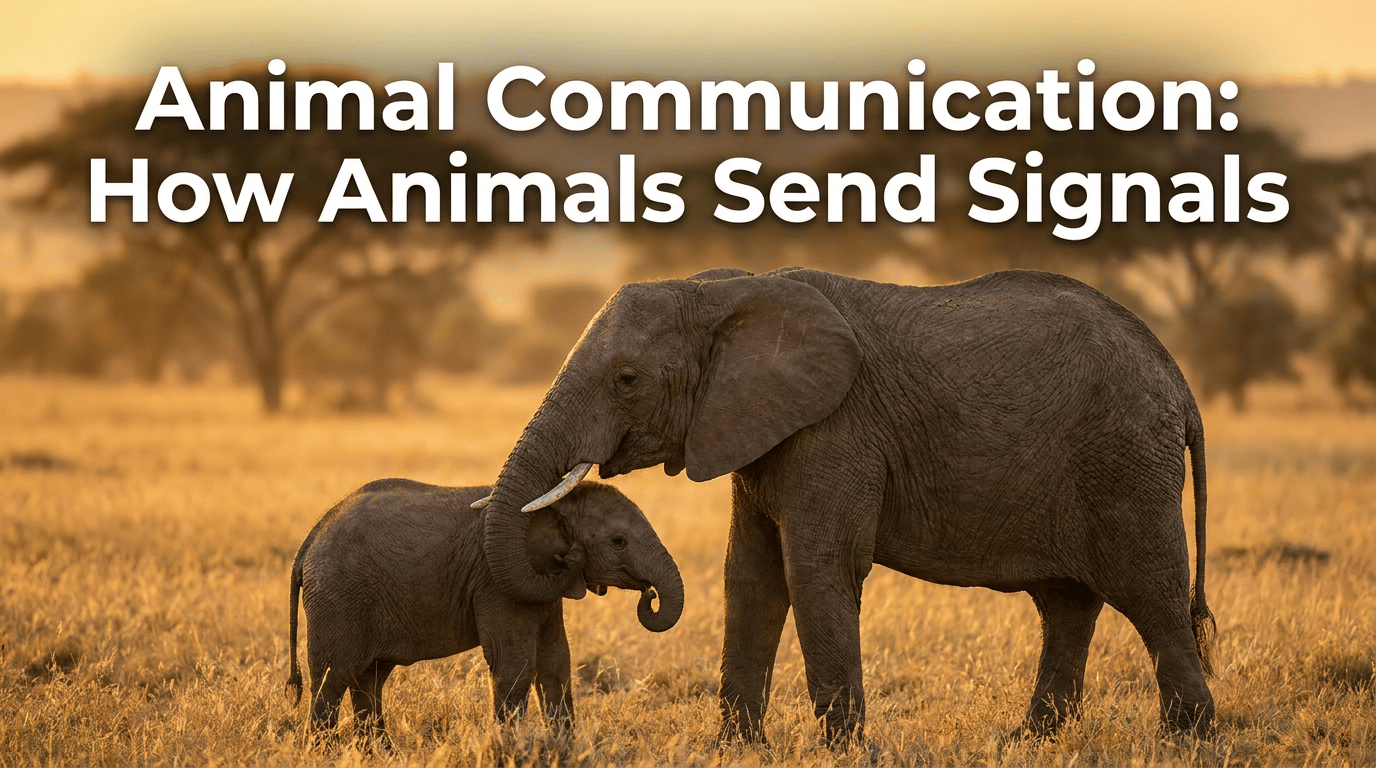
That does not mean animals communicate exactly like humans. Most animal signals are tied closely to survival, reproduction, territory, danger, food, social bonds, or movement through the environment. The meaning of a signal also depends on context. The same sound, posture, or smell may mean different things depending on the species, season, distance, body condition, and the receiver watching or listening.
Quick Overview
In simple terms, animal communication happens when a sender produces a signal and a receiver detects it, processes it, and changes behavior in response. The sender may be trying to attract a mate, warn a group, defend a territory, keep contact with young, threaten a rival, or coordinate movement. The receiver may respond by approaching, hiding, fleeing, calling back, fighting, mating, following a trail, or ignoring the signal.
The major channels are acoustic signals, visual signals, chemical signals, tactile signals, vibration signals, and, in some animals, electrical signals. A broad overview of animal communication from Britannica describes animal signals as tools used in many social contexts, including mating, conflict, and coordination. That is a useful starting point because communication is not one behavior. It is a whole system of information exchange.
One of the most important ideas is that a signal is not always a sentence-like message. A red display patch, a raised tail, a scent post, or a chirp can influence another animal without translating neatly into human words. Many signals are better understood as cues that shift probability: come closer, stay away, follow me, I am here, I am ready to breed, danger is nearby, or this space is occupied.
What Animal Communication Includes
Animal communication includes much more than the noises people notice first. A quiet animal may still be communicating constantly through scent, posture, touch, vibration, or color. A loud animal may use sound only in specific situations and rely on other signals the rest of the time. To understand animal signals, it helps to separate three related ideas: the signal itself, the sensory channel that carries it, and the context that gives it meaning.
Signals, cues, and responses
A signal is a trait or behavior that influences another animal. The signal may be a produced action, such as a call, tail slap, scent mark, dance, or display. It may also be a body feature used in communication, such as bright coloration, antlers, throat sacs, or posture. The key point is that the receiver can detect it and respond.
The response matters too. If no receiver can detect the information, it is not useful as communication. A frog call works only if potential mates or rivals can hear it. A scent mark works only if another animal can smell and interpret it. A visual display works best when light, distance, and the receiver’s vision make it noticeable.
Communication versus instinctive behavior
Many animal signals are instinctive, meaning they develop without the animal needing human-like teaching or conscious planning. But instinctive does not mean simple. Bird songs, whale vocalizations, primate facial expressions, insect pheromone trails, and mammal scent marking can all involve complex timing, anatomy, learning, or social context.
Communication also does not require human-style intention. A frightened animal may produce a distress sound. A male may display during breeding season. A young animal may beg for food. These behaviors can be automatic and still carry information that changes another animal’s behavior.
Why context changes what a signal means
Context is the difference between useful interpretation and guessing. A growl, hiss, call, bright color, or raised posture can mean different things in different animals. Even within one species, the meaning may shift with age, sex, season, distance, and the body language around it.
The Main Ways Animals Send Signals
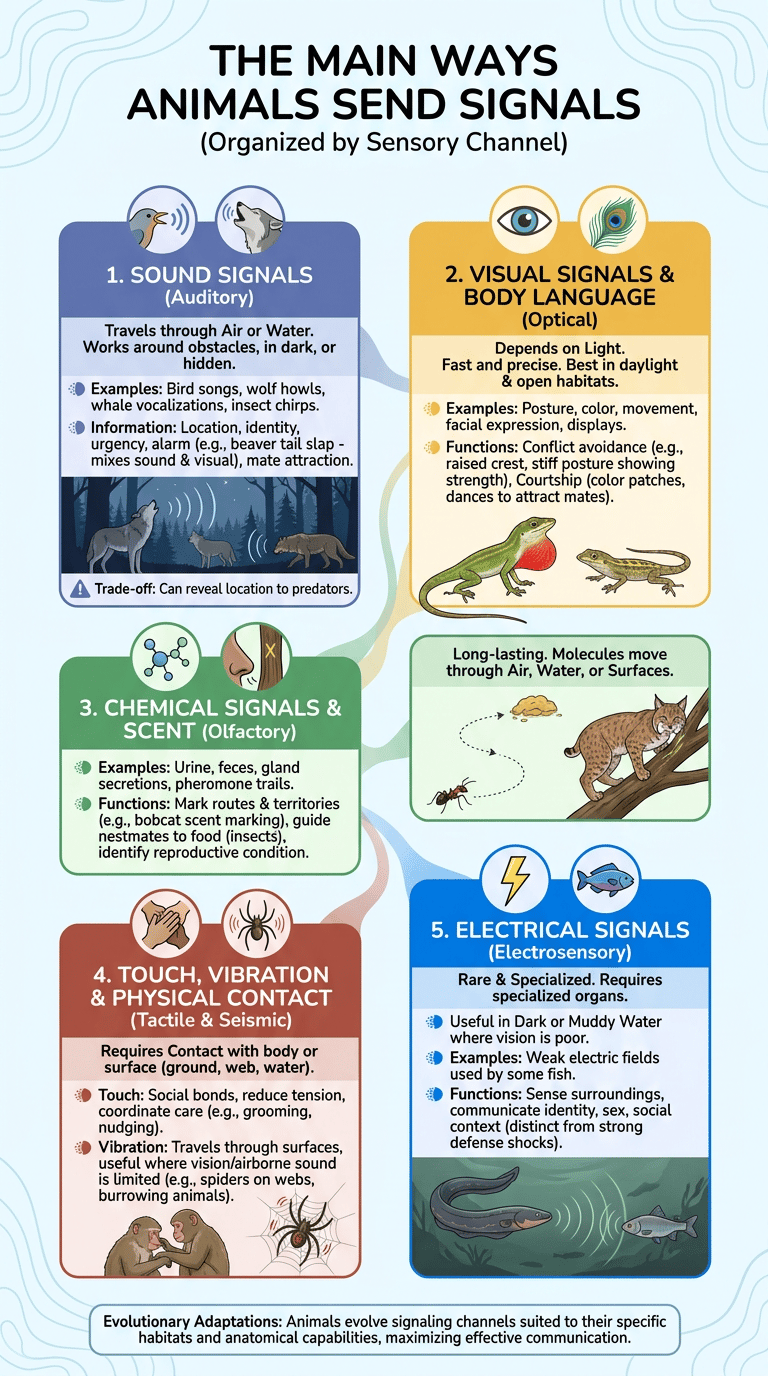
Animal signals are often grouped by sensory channel. That means the signal is organized around how it travels and how the receiver detects it. Sound travels through air or water. Odor molecules move through air, water, or surfaces. Visual signals depend on light. Touch and vibration require contact with a body, surface, water, web, burrow wall, or ground. Electric communication requires specialized organs and sensory systems.
Sound signals
Sound is one of the most familiar forms of animal communication because humans notice it easily. Birds sing, frogs call, wolves howl, insects chirp, whales vocalize, and many mammals use calls, grunts, roars, squeaks, or whistles. Sound can travel around obstacles and work when an animal cannot see the receiver. It is especially useful in forests, grasslands, water, nighttime conditions, or group settings where animals need to stay in contact.
Fast signals such as animal sounds can warn, attract, identify, or coordinate other animals over distance.
Sound can carry information about location, identity, urgency, size, motivation, or reproductive condition. It can also warn others. The Smithsonian’s beaver profile notes that a beaver tail slap on water can function as an alarm signal that alerts nearby beavers to danger. That example is useful because it mixes sound, vibration, and visual movement in one clear warning signal.
Sound is not always safe, though. A call that attracts a mate can also reveal the caller to predators. A loud territorial call can reduce the need for direct fighting, but it may also advertise where the animal is. This trade-off helps explain why some animals call mainly at certain times, from hidden positions, or only when the benefits outweigh the risks.
Visual signals and body language
Visual communication includes posture, color, movement, facial expression, feather display, tail position, body size exaggeration, flashing patterns, and bioluminescent displays. Visual signals can be fast and precise. They can show direction, size, motivation, or readiness. They are especially useful in daylight, clear water, open habitats, and close-range social encounters.
For readers who want the simpler step-by-step version, the basic ways animals communicate include sound, smell, visual signals, touch, and specialized senses.
Many animals use body language before physical conflict. A raised crest, sideways stance, open mouth, pinned ears, puffed body, expanded throat pouch, or stiff posture may reduce the need to fight by showing strength or warning. In other cases, visual signals help courtship. Color patches, dances, wing displays, and body movements can attract mates or help individuals recognize the right species.
Chemical signals and scent
Chemical communication can last long after the sender leaves. Mammals may use urine, feces, gland secretions, or body rubbing to mark routes and territories. Insects may use pheromone trails to guide nestmates to food or organize colony behavior. Reptiles and amphibians can also use chemical cues to gather information about prey, mates, or nearby individuals.
The National Zoo describes bobcats as using scent, visual signals, and vocalizations, including urine and feces placed along routes and latrine sites. That kind of scent marking can carry information about territory, reproductive condition, identity, and presence without requiring two animals to meet face-to-face.
Touch, vibration, and physical contact
Touch is important in close social relationships. Grooming, nudging, licking, leaning, antennal contact, and parent-offspring contact can reduce tension, maintain bonds, help coordinate care, or signal readiness. Social mammals often use touch among group members. Insects may use antennae to exchange information at close range.
Vibration is another powerful but often overlooked channel. Some animals send information through the ground, plant stems, spider webs, burrow walls, water surfaces, or other surfaces. A small vibration may travel better through a surface than through air in certain habitats. Animals that live underground, on webs, or on plants may rely heavily on these signals because vision and airborne sound can be limited.
Electrical signals and specialized senses
Electric communication is much rarer than sound or smell, but it is one of the most striking examples of specialized animal signaling. Some fish produce weak electric fields that help them sense their surroundings and communicate with other individuals. These signals can be especially useful in dark or muddy water where vision is limited.
The Smithsonian’s electric eel profile explains that electric eels can use low electric organ discharges for communication, separate from the stronger discharges associated with defense or prey capture. This is an important distinction because not every electric signal is a dramatic shock. In some species, weak electric pulses can carry information about identity, sex, spacing, or social context.
Electrical communication shows how animal signals evolve around habitat. If light is poor, sound is distorted, or scent behaves differently in water, animals with the right anatomy may use another information channel entirely.
Why Animals Communicate
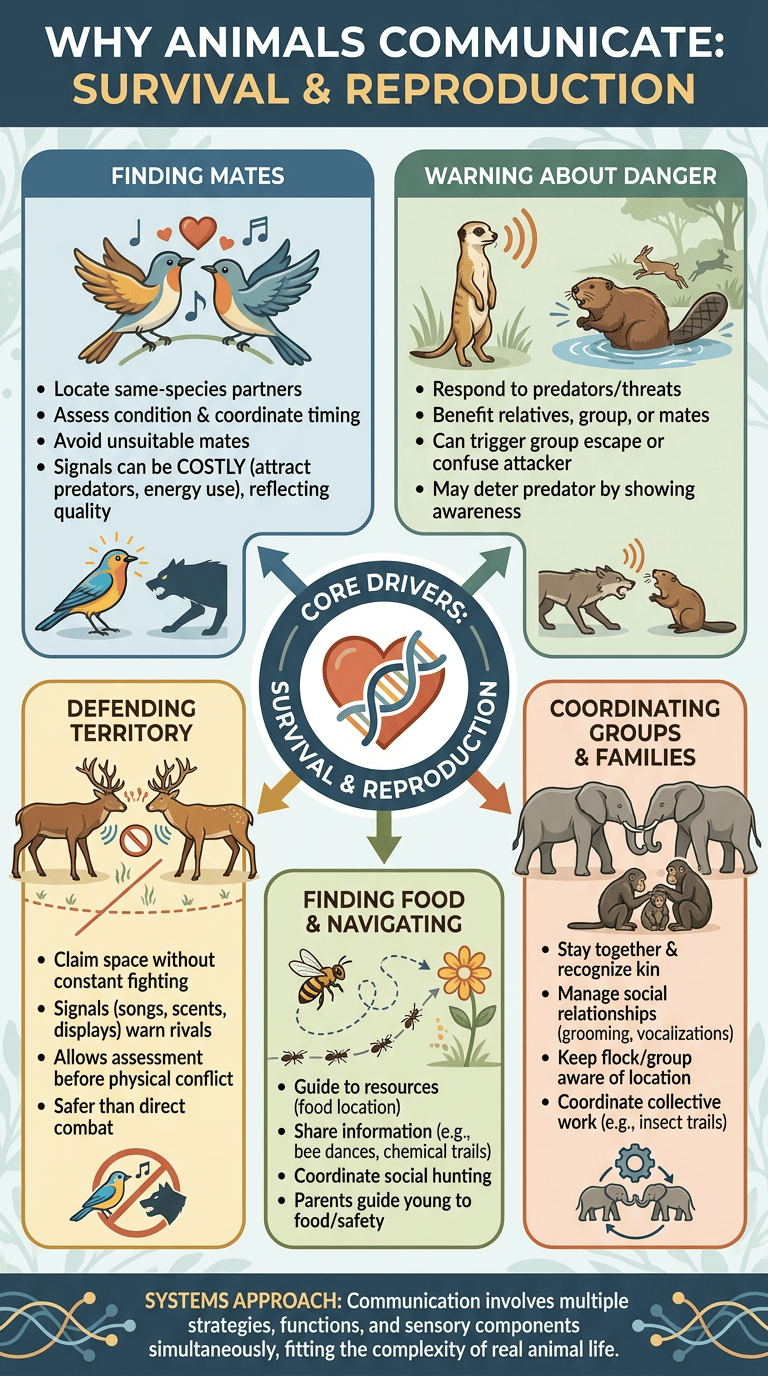
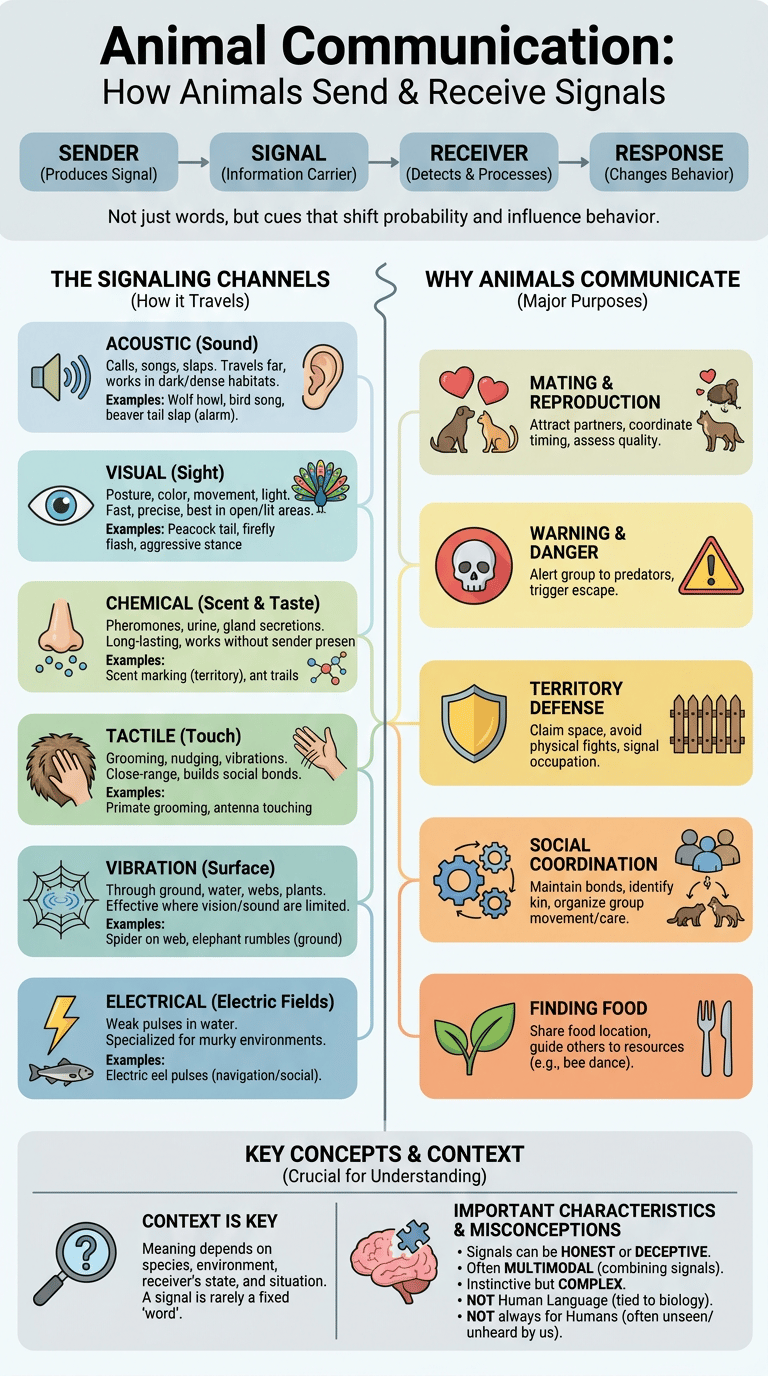
Animals communicate because information can improve survival and reproduction. A signal can help an animal find a mate, avoid a fight, warn relatives, keep a group together, defend a feeding area, identify family, or move through a complex habitat. The exact reason depends on the species and situation, but several broad purposes appear again and again across the animal kingdom.
Finding mates
Mating signals are among the best-known animal signals. Frogs call from breeding sites, many birds sing during breeding season, insects release pheromones, and mammals use scent, sound, display, or touch. These signals can help animals locate partners of the same species, assess condition, coordinate timing, or avoid wasting energy on unsuitable mates.
Mating communication can be costly. Bright colors may attract predators. Loud calls may reveal location. Strong scent marks require energy and may alert rivals. Those costs are part of why some mating signals can carry information about condition, persistence, or territory quality, although mate choice often depends on multiple signals and local conditions.
Warning others about danger
Alarm signals can help animals respond quickly to predators or other threats. Some birds and mammals give alarm calls. Beavers slap their tails. Fish may react to chemical cues from injured individuals. Insects may release alarm pheromones. A warning signal can benefit relatives, group members, mates, offspring, or even unrelated animals that happen to be nearby.
Not every alarm signal is generous in a human sense. Sometimes the caller benefits by drawing attention to the predator, triggering group escape, or confusing the attacker. Sometimes the warning is directed at the predator itself, essentially saying that the prey has noticed it and escape will not be easy. The best explanation depends on the species and situation.
Defending territory
Territorial signals help animals claim space without constant fighting. A bird song, scent mark, scratch mark, roar, display, or boundary patrol can tell rivals that an area is occupied. The receiver can then decide whether to retreat, challenge, or move elsewhere.
This is often safer than direct combat. Signals let animals assess each other before conflict becomes physical, although some signals may honestly reflect size or strength while others exaggerate.
Coordinating groups and families
Group-living animals often need signals to stay together. Parents and young may use calls, scents, or touch to recognize one another. Social mammals may use grooming, facial expressions, posture, scent, and vocalizations to manage relationships. Birds may use contact calls to keep flock members aware of each other’s location. Insects can use chemical trails or dances to coordinate work.
A review in a systems approach to animal communication emphasizes that communication can involve multiple strategies, functions, receivers, and sensory components at the same time. That systems view fits real animal life better than treating one call or display as if it works alone.
Finding food and navigating environments
Some signals guide animals toward resources. Honey bees are famous for using dance movements to share information about food location. Ants may follow chemical trails. Social hunters may use calls, posture, or movement to coordinate. Young animals may beg for food from parents, and parents may use calls or touch to guide young to safety.
Key Facts Readers Should Know About Animal Signals
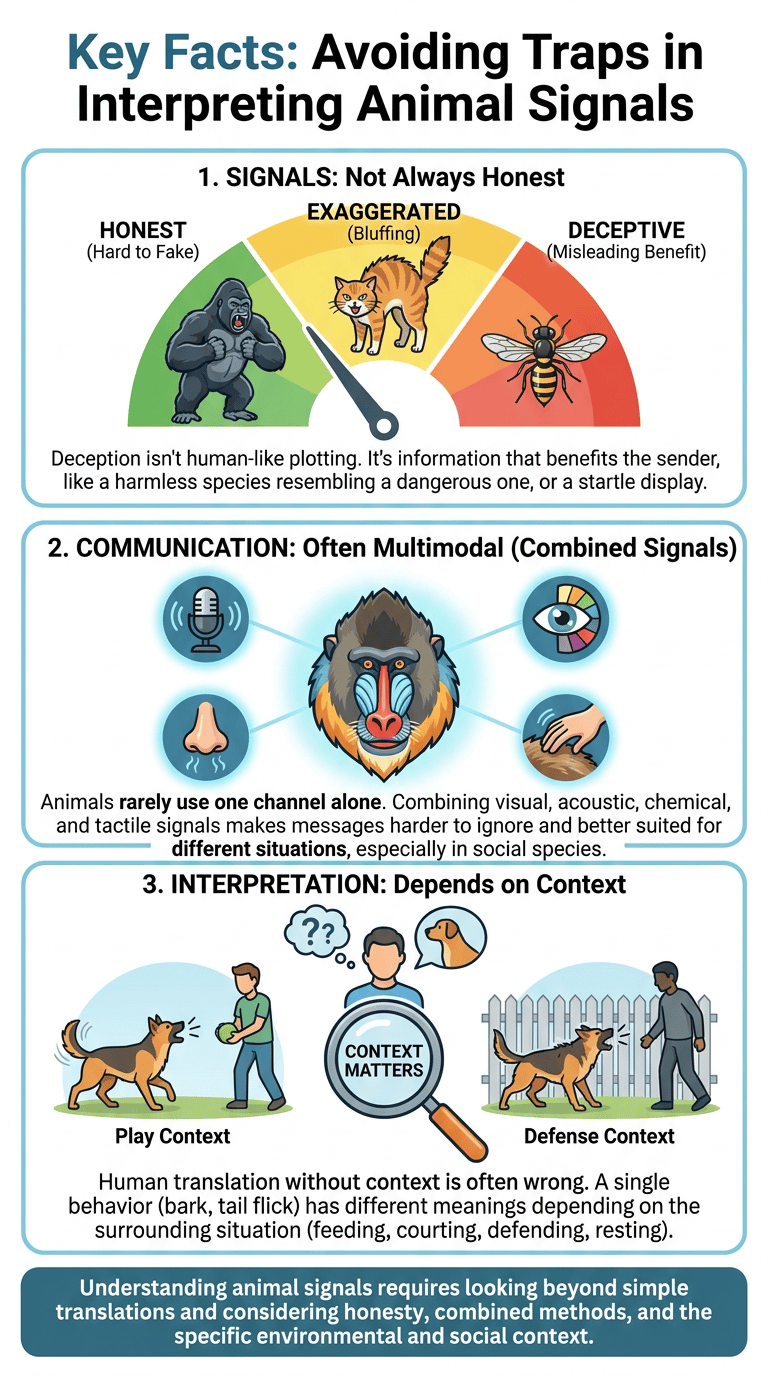
Animal communication becomes easier to understand when readers avoid three common traps: assuming every signal is honest, assuming one signal works alone, and assuming humans can interpret animal behavior without context. These ideas are especially important for pet owners, wildlife watchers, students, and anyone making educational content about animals.
Signals can be honest, exaggerated, or deceptive
Some signals are strongly tied to real condition. A deep call, large body display, or strong scent mark may be hard for a weak animal to fake completely. Other signals can exaggerate size, motivation, or danger. Animals may bluff during conflicts, mimic other species, hide cues from predators, or use signals in ways that benefit the sender more than the receiver.
Deception does not mean animals are plotting in a human way. It means the information can mislead a receiver in a way that benefits the sender. A harmless species may resemble a dangerous one. A prey animal may produce a display that startles a predator. A rival may make itself look larger than it is. These examples show why communication is shaped by both cooperation and conflict.
Many species combine several signal types
Real animal communication is often multimodal, meaning it uses more than one sensory channel. A display may combine color, movement, sound, scent, and posture. A territorial mammal may call, scent-mark, scratch, and patrol. A courting animal may use sound at a distance and touch at close range. Combining signals can make a message easier to detect or harder to ignore.
Animal Diversity Web’s mandrill profile notes communication channels that include visual, tactile, acoustic, and chemical signals. That kind of multi-channel communication is common in social animals because no single channel works perfectly in every situation.
Human interpretation can be wrong without context
Humans often want animal signals to have simple translations. A dog bark, bird call, whale song, snake tongue flick, cat tail movement, or deer posture may look like it has one fixed meaning. In reality, the surrounding context matters. Is the animal feeding, courting, defending young, avoiding a predator, resting, traveling, or interacting with a familiar individual?
How Animal Communication Connects to Survival and Adaptation
Communication is not separate from survival. Signals are shaped by anatomy, habitat, predators, mates, social structure, and the sensory abilities of receivers. A signal that works in one environment may fail in another. A signal that helps attract a mate may increase predation risk. A signal that prevents fighting may still be ignored by a desperate rival.
Predator avoidance
Animals use communication to reduce danger in many ways. Alarm calls can trigger group escape. Bright warning colors can advertise chemical defenses. Tail movements, body postures, and startle displays may interrupt a predator’s attack. Some prey species also respond to alarm cues from other species when those cues reliably signal danger nearby.
Predators use signals too. Some communicate with group members during hunting. Others use stealth, silence, or hidden cues to avoid warning prey. In predator-prey relationships, communication is often a contest over information: one side tries to send, detect, hide, or distort cues better than the other.
Social cooperation
Social animals rely on communication to avoid chaos. Group living can bring benefits such as shared vigilance, cooperative care, defense, or hunting, but it also creates competition. Signals help animals recognize individuals, reduce conflict, maintain rank, coordinate movement, and care for offspring.
Touch can be especially important in social cooperation. Grooming in primates, contact between parents and young, or antennal interactions in insects can help maintain close-range relationships. Sound may handle distance, scent may handle identity, and body language may manage tension when animals are close enough to see each other clearly.
Habitat challenges
Habitats shape signals. Dense forests can limit visibility, so sound and scent may become more useful. Open habitats can favor visual displays that carry across distance. Water changes how sound, chemicals, and light travel. Underground burrows can make vibration especially useful. Nighttime activity can reduce reliance on color while increasing the value of sound, smell, touch, or electric sensing.
This is why animal communication is also an adaptation topic. The signal is not just a behavior. It is part of how a species fits its environment. Anatomy, sensory systems, timing, and habitat all work together.
Common Myths or Misunderstandings
Animal communication is easy to oversimplify because some signals look familiar to humans while others are invisible to us. A good explanation should leave room for uncertainty, species differences, and context.
Animals do not communicate only with sounds
Sound gets attention because people hear it, but smell, movement, color, touch, vibration, and electricity can be just as important in the right species. A silent animal may be leaving chemical messages. A still animal may be using posture. An insect on a plant may be sending vibrations. A fish in muddy water may be producing weak electric pulses.
Communication is not the same as human language
Some animals have complex communication systems, and some can learn impressive signals in research or human care settings. Still, most animal communication is not open-ended human language. It is usually tied to specific biological contexts such as danger, mating, food, identity, contact, or conflict.
That does not make it less valuable. Animal communication can be highly refined without being human language. A signal does not need grammar to matter for survival.
Bright colors and loud calls are not always meant for humans
A color display or loud call may catch human attention, but humans are rarely the intended receiver. The real audience might be mates, rivals, predators, offspring, or group members. Ultraviolet patterns, ultrasonic calls, scent marks, low-frequency vibrations, and electric pulses can be meaningful to animals even when people miss them.
How This Topic Connects to Related Animal Questions
Animal communication connects naturally to many nearby topics in animal behavior and adaptations. The broad framework in this article helps readers understand those narrower questions without making every one of them the same article.
Animal sounds as warning, mating, and group signals
Animal sounds deserve close attention because they can reveal danger, breeding behavior, territory defense, group contact, parental care, and social identity. A deeper look at animal sounds can explore bird songs, whale vocalizations, frog choruses, insect chirps, wolf howls, and the limits of interpreting sounds as if they were words.
Smell and chemical messages in mammals, insects, and reptiles
Scent communication opens a different world. Mammals may mark territories. Ants may follow trails. Snakes may gather chemical information with tongue flicking and specialized sensory structures. Chemical signals can last longer than sounds, but they are shaped by wind, rain, water, temperature, and surfaces.
Echolocation, electricity, vision, and migration as specialized information systems
Some animal information systems are not ordinary communication in the narrow sense, but they help animals gather or exchange information. Echolocation uses sound to sense objects. Electric fish may use weak electric fields for both sensing and social signals. Animal vision shapes which colors and movements matter. Migration depends on environmental cues and, in some species, group coordination. These topics sit at the edge between communication, perception, and adaptation.
FAQ
What is animal communication in simple terms?
Animal communication is the exchange of information between animals through signals. A signal might be a sound, smell, movement, color, touch, vibration, or electric pulse. The signal matters because another animal can detect it and respond by approaching, leaving, hiding, mating, warning others, defending territory, or changing behavior in another way.
Do animals have languages like humans?
Most animals do not have language like humans. Many species have complex signals, and some can learn or adjust signals in impressive ways, but animal communication is usually linked to specific contexts such as food, danger, mating, territory, identity, or social contact. It is more accurate to describe most species as having communication systems rather than human-like language.
What is the most common way animals communicate?
There is no single most common way that applies to all animals. Sound is familiar to humans, but chemical communication is extremely widespread, especially among insects, mammals, reptiles, amphibians, and aquatic animals. Visual signals, touch, vibration, and electrical signals can also be central depending on the species and habitat.
Can animals communicate with different species?
Yes, animals can sometimes respond to signals or cues from other species. Prey may react to alarm calls from another species when those calls reliably indicate danger. Predators may read prey movement. Mutualistic partners may respond to each other’s signals. However, cross-species communication is usually limited to specific situations and should not be imagined as open conversation.
Final Thoughts
Animal communication is not just noise, scent, color, or movement. It is the way animals manage survival, reproduction, danger, territory, family life, and social contact in environments full of competing information. The clearest way to understand it is to ask what signal is being sent, which animal can detect it, what context surrounds it, and how the receiver changes behavior.
Seen that way, animal communication becomes one of the best windows into animal behavior. It shows how different species experience the world, what pressures shape their bodies and senses, and why a signal that seems small to humans can be life-changing to the animal that receives it.

Ethan Walker is the founder and research editor of Animal Fact Central. He creates and reviews educational animal facts content using trusted wildlife, pet care, and science-based sources. His work focuses on making animal behavior, adaptations, habitats, and species facts clear, accurate, and engaging for everyday readers.
Read More Details About Ethan Walker: https://animalfactcentral.com/ethan-walker/