
Animal sounds can mean many different things, but they are not simple word-for-word translations. A bird song may help defend a nesting territory. A frog call may advertise a male during breeding season. A wolf howl may keep a pack connected across distance. A whale song, click, whistle, or pulse may carry social, feeding, mating, or navigation information through water.
The most accurate way to understand animal sounds and what they mean is to read the sound with its context. Who made it? What was the animal doing? Was it alone, courting, caring for young, defending space, moving with a group, or reacting to danger? The same general kind of sound can mean different things in different situations, and scientists are careful not to treat every chirp, howl, bark, buzz, or song as a fixed sentence.
Quick Answer
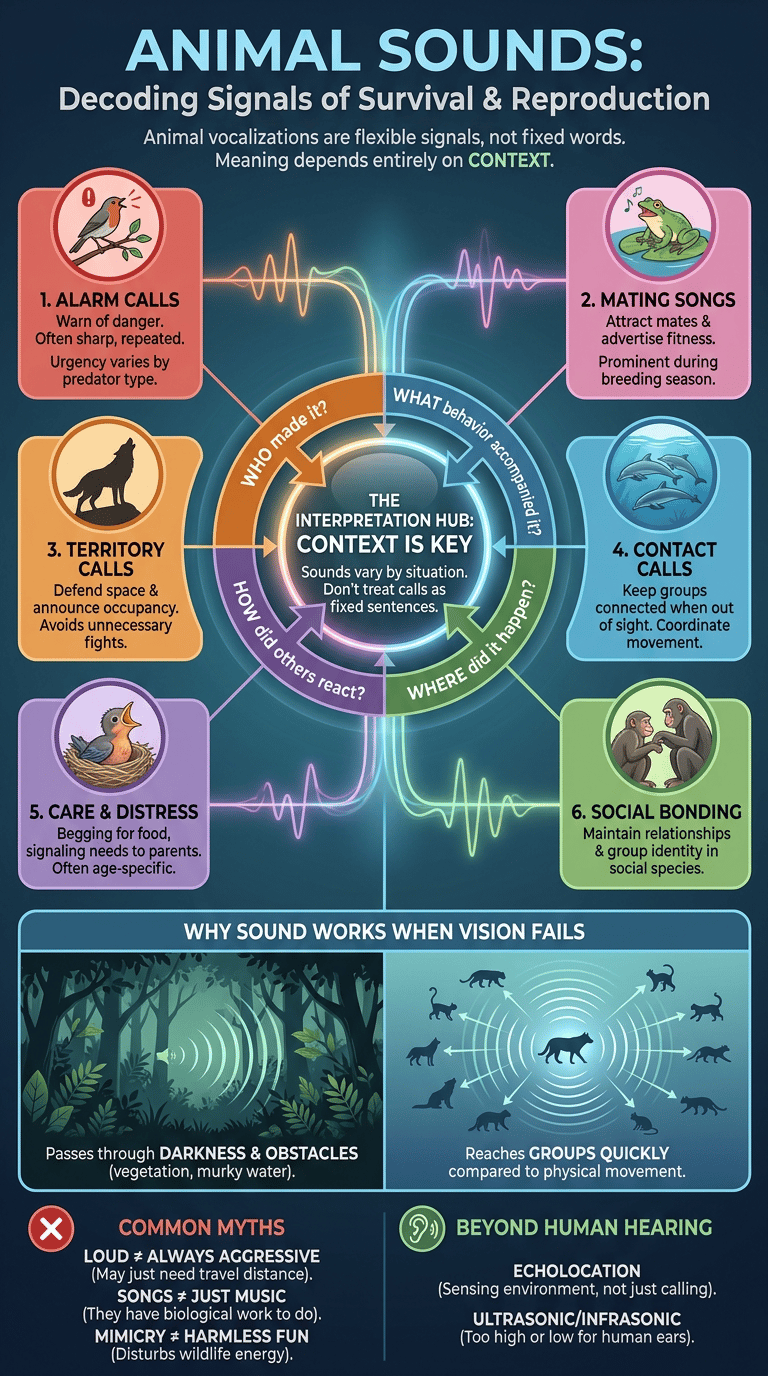
Animals make sounds to communicate information that matters for survival and reproduction. Common meanings include warning others about danger, attracting mates, defending territory, keeping group members in contact, begging for care, coordinating movement, and strengthening social bonds. Some animal sounds are also used for sensing, especially echolocation, but that is different from ordinary calling.
Sound is useful because it can travel in darkness, through vegetation, across open water, and around obstacles better than many visual signals. It also works quickly. A warning call can alert several nearby animals at once, while a contact call can help a parent, mate, calf, chick, or pack member stay located without needing direct eye contact.
Still, animal vocalizations should be interpreted cautiously. A loud sound is not always aggression, a pretty song is not only music, and a repeated call does not always have one single meaning. In many species, meaning comes from a mix of sound structure, timing, body posture, location, season, and the response of other animals nearby.
Why Animals Use Sound to Communicate

Sound travels when vision is limited
Many habitats make visual communication difficult. Forest leaves block sight lines. Murky water limits vision. Nighttime removes much of the light that daytime animals use. Tall grass, snow, burrows, reefs, and dense marsh vegetation can hide animals from each other. Sound helps solve that problem because a signal can reach around obstacles that would block a visual display.
This is one reason frogs call from ponds, birds sing from cover or elevated perches, and whales rely heavily on underwater sound. For many marine animals, sound is especially useful because light fades quickly underwater while sound can travel much farther under the right conditions.
Calls can reach groups quickly
A sound can spread through a group faster than one animal can physically approach each listener. That matters for animals that live in flocks, packs, colonies, herds, choruses, or family groups. One alarm call may make nearby animals freeze, flee, look up, gather, or become more vigilant. One contact call may help scattered individuals regroup after feeding or moving through cover.
Habitat changes how sounds evolve
Animal sounds are shaped by the places animals live. A low, carrying call may work well in open spaces or underwater. A short, sharp alarm call may be useful when danger is close. A patterned song may stand out during breeding season when many animals are competing for attention. Insects that call from grass, frogs calling from crowded wetlands, and birds singing in forests face different acoustic problems.
The Main Types of Animal Sounds
Animal sounds are easier to understand when grouped by function. These categories are not perfect boxes, but they help explain why different animals produce calls, songs, clicks, chirps, grunts, screams, howls, whistles, buzzes, and drumming sounds.
| Sound type | Common meaning | Example animals | Interpretation caution |
|---|---|---|---|
| Alarm calls | Warn about danger or disturbance | Birds, primates, squirrels, meerkats | Alarm level depends on predator type, distance, and context |
| Mating songs and calls | Attract mates or advertise fitness | Songbirds, frogs, insects, whales | Not every loud seasonal sound is aggression |
| Territory calls | Defend space or signal occupancy | Birds, wolves, coyotes, gibbons | Territory signals can overlap with mate attraction |
| Contact calls | Keep individuals or groups connected | Whales, birds, elephants, canids | The same species may use several contact call types |
| Care-related sounds | Begging, distress, nursing, or parent-offspring contact | Chicks, mammal young, seals, kittens | Distress calls can vary with age and urgency |
| Social bonding sounds | Maintain relationships or coordinate close interaction | Primates, dolphins, wolves, parrots | Meaning often depends on known social relationships |
Alarm calls and warning signals
Alarm calls are among the easiest animal sounds for people to notice because they are often sharp, repeated, and connected to visible tension. Birds may scold near a predator. Ground squirrels may chirp or whistle. Monkeys, meerkats, and other social animals can give calls that make group members look, hide, climb, or scan the area.
Warning sounds do not simply mean, “danger exists.” They can vary by urgency, predator type, and the caller’s distance from the threat. The Cornell Lab describes the black-capped chickadee’s familiar call as dynamic, with the same general call type functioning in territorial, contact, or alarm contexts, and with more “dee” notes associated with a higher level of alarm in the example lesson: Cornell Lab’s bird communication lesson.
Mating calls and songs
Many animal sounds become more noticeable during breeding season. Male frogs call from wetlands, some male birds sing repeatedly from perches, insects create rhythmic chirps or buzzes, and male humpback whales are known for elaborate songs. These sounds can help animals attract mates, advertise their presence, and sometimes compete with rivals.
Territory calls
Territory sounds announce that a space is occupied. For animals, this can reduce unnecessary fights. A bird song may tell neighboring males that a nesting area is defended. A wolf howl may help signal group presence across distance. A gibbon call may travel through forest canopy and announce a pair’s position.
Territory and mating signals often overlap. A song can advertise both a place and the animal producing it. That is why translating a sound as only “stay away” or only “come here” can be misleading. The same display may discourage rivals and attract potential mates at the same time.
Contact calls between group members
Contact calls help animals stay connected when they cannot see each other. A flock moving through brush may use small calls to keep the group together. Parent birds and chicks may exchange sounds near a nest. Whales and dolphins may use calls, whistles, or pulses to maintain social contact in water.
Contact calls are often less dramatic than alarm calls or mating songs, but they matter. They can prevent separation, help animals coordinate movement, and reduce the risk of losing young or group members. In social animals, a familiar voice or call pattern may be part of how individuals recognize one another.
Begging, distress, and care-related sounds
Young animals often use sound to get attention from parents. Nestling birds beg when adults arrive with food. Mammal infants may cry, bleat, squeak, or call when hungry, cold, isolated, or in need of care. These sounds can be costly because they may attract predators, but they can also be vital when a young animal depends on adults for food or protection.
Social bonding sounds
Some animal sounds help keep relationships stable. Primates may use soft calls during grooming or group movement. Parrots and other social birds may call to familiar companions. Wolves and coyotes may use howls, yips, whines, and other sounds in group contexts. Dolphins and whales may produce sounds that are connected to social contact and group identity.
Animal Sound Examples and Their Meanings
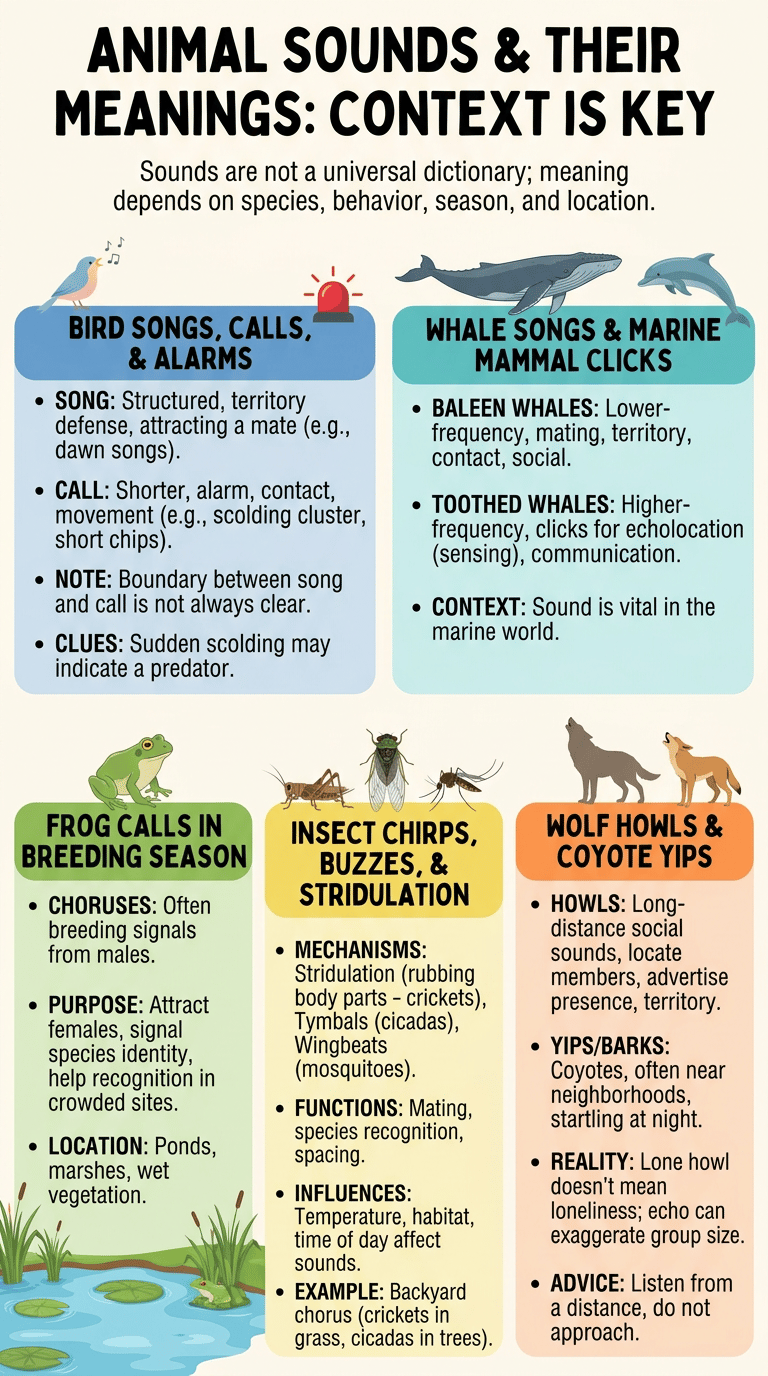
Examples make animal sounds easier to understand, but they should not be treated as a universal dictionary. The same sound category can serve different functions in different species, and the same species can use one call in several contexts.
Bird songs, calls, and alarms
Birds are one of the best everyday examples for US readers because many species vocalize around homes, parks, wetlands, forests, and farms. A bird song is usually a more structured vocalization associated with territory defense or attracting a mate. A call is often shorter and may help with alarm, contact, movement, or individual location. Cornell Lab’s Bird Academy describes this song-call distinction while also noting that the boundary is not always perfectly clear: Cornell Lab’s Bird Academy.
Bird sounds can be practical clues. A sudden cluster of scolding birds may point to an owl, hawk, snake, cat, or another disturbance. Dawn songs in spring may signal breeding activity. Short chips from birds in shrubs may be contact calls rather than full songs. The safest interpretation is to watch behavior, distance, season, and the reactions of nearby birds.
Whale songs and marine mammal clicks
Whales and dolphins live in a world where sound can be more useful than sight. Baleen whales generally make lower-frequency sounds, while toothed whales can make higher-frequency sounds, including clicks used in echolocation. NOAA Fisheries describes baleen whale sounds as commonly low-frequency and used in contexts such as mating, territory, contact calling, and social communication, while toothed whales produce higher-frequency sounds in several communication and sensing contexts: NOAA Fisheries’ ocean mammal sound resource.
Frog calls in breeding season
Frog choruses are often breeding signals. In many species, males call from ponds, marshes, temporary pools, or wet vegetation to attract females and signal species identity. The San Diego Natural History Museum explains that frog calls can help individuals recognize members of the same species in crowded breeding sites and may provide females with information about the calling male: San Diego Natural History Museum on frog calls.
Wolf howls and coyote yips
Wolf howls and coyote yips are long-distance social sounds. They can help group members locate one another, advertise presence, or coordinate movement. They may also signal territory or group identity. A lone howl may not mean loneliness, and a chorus does not necessarily mean a large number of animals. Echo, terrain, and overlapping voices can make a small group sound much bigger.
For people in North America, coyotes are often the canid sounds heard closest to neighborhoods. Their yips, barks, howls, and high-pitched group calls can be startling, especially at night. The safe response is not to approach or try to call them in. Listen from a distance, secure pets, remove attractants, and let wild canids remain wild.
Insect chirps, buzzes, and stridulation
Many insects make sound without vocal cords. Crickets and katydids can produce chirps through stridulation, which means rubbing specialized body parts together. Cicadas use sound-producing organs called tymbals. Mosquito wingbeats can create high-pitched tones, although not every buzz is meant as communication to humans or other animals.
Insect sounds are often linked to mating, species recognition, and spacing between individuals. Temperature, habitat, and time of day can affect what people hear. A backyard chorus may include crickets in grass, cicadas in trees, and katydids in shrubs, each using a different body mechanism to send acoustic information.
How Scientists Interpret Animal Sounds
Scientists study animal sounds through bioacoustics, the science of recording and analyzing biological sound. Bioacoustics can help researchers monitor hard-to-see species, study behavior, identify breeding activity, detect migration timing, and understand how human noise changes animal communication.
Recording and comparing sound patterns
Researchers often use microphones, hydrophones, automated recording units, and spectrograms. A spectrogram is a visual display of sound showing frequency, timing, and intensity. This lets scientists compare patterns that may be hard to separate by ear.
Matching sounds to behavior and context
The strongest interpretations come from matching sound recordings with observed behavior. If a bird gives a certain call when a hawk appears and nearby birds hide or mob the predator, that context supports an alarm interpretation. If male frogs call repeatedly from breeding sites while females approach, that supports a mating function. If whales call back and forth while moving as a group, researchers may study whether those sounds help maintain contact.
This is why recordings alone are not enough. A sound file can show the acoustic pattern, but behavior shows how animals use it. Good interpretation asks what happened before, during, and after the call.
Why one sound rarely has one fixed meaning
Human listeners often want a simple dictionary: this chirp means danger, this howl means loneliness, this click means food. Animal communication is usually more flexible. Meaning can change with age, sex, season, social rank, distance, predator type, and whether the listener is a mate, rival, offspring, parent, or stranger.
Even in birds, a call type may serve more than one role depending on context. In marine mammals, responses to sound can vary with activity, habitat, previous exposure, age, and the nature of the noise. A review hosted in NCBI Bookshelf describes marine mammal responses to sound as highly variable and influenced by the sound, the animal’s state, and the surrounding acoustic environment: NCBI Bookshelf review of marine mammal noise.
Common Myths About Animal Sounds
Animal sounds are easy to romanticize because they feel close to language. Some myths are harmless, but others can lead people to disturb wildlife, misread pets, or overclaim what scientists know.
A loud call is not always aggression
Loudness often means a signal needs to travel, not that an animal is angry. A frog calling loudly may be advertising to mates. A bird singing at dawn may be defending territory and attracting a mate. A whale song may carry through water over distance. A coyote chorus may be social contact rather than a sign that coyotes are about to attack.
Aggression is better judged by the whole situation: posture, distance, movement, season, young nearby, escape routes, and whether the animal is being cornered or approached. Sound alone is not enough.
Songs are not only for beauty
Humans often hear birdsong, whale song, or insect choruses as beautiful. That reaction is real for us, but the sound did not evolve for human enjoyment. Songs can help animals attract mates, defend territories, identify species, synchronize breeding, or advertise condition. Beauty is our perception of a signal that has biological work to do.
This does not make animal sounds less impressive. It makes them more interesting. A song can be both beautiful to human ears and functional in the animal’s life.
Human imitation can disturb animals
Imitating animal calls, playing recordings, or repeatedly trying to make wildlife respond can disturb animals, especially during breeding, nesting, feeding, or resting. A bird that responds to playback may spend energy defending a territory against an imaginary rival. A frog chorus can be interrupted by repeated disturbance. Marine mammals can be affected by human-made noise in ways that depend on sound level, duration, location, and behavioral state.
For casual wildlife watching, the safest rule is simple: listen without trying to force a response. Do not use playback near nests, dens, roosts, breeding sites, or sensitive wildlife areas unless it is part of permitted research or approved monitoring.
Edge Cases and Exceptions
Not all communication is loud, and not all meaningful sound is vocal. Some animals are quiet because other signal types work better. Others produce sounds outside the range most humans can hear.
Silent animals that communicate in other ways
Many animals rely heavily on scent, body posture, color, vibration, touch, or chemical cues. Snakes use scent trails and body movements more than vocal calls. Many insects use pheromones. Fish may use color, posture, electrical signals, or vibration. A quiet animal is not necessarily a simple communicator.
Sounds humans cannot hear
Some animal sounds are too high or too low for many people to hear. Bats use ultrasonic calls for echolocation. Elephants can use very low-frequency rumbles, including components below the range of typical human hearing. Some insects and rodents produce high-frequency sounds that may go unnoticed without special equipment.
Human hearing is not the measure of animal communication. A habitat may be acoustically busy even when it seems quiet to us.
Mimicry and deceptive calls
Some animals imitate sounds. Certain birds can mimic other species, environmental sounds, or even human-made noises. Mimicry may help with social interaction, mate attraction, predator confusion, or deception, depending on the species and context. A review of avian vocal mimicry notes that vocal mimicry occurs in many distantly related bird groups, while the reasons behind it can be complex and are not always fully understood: a review of avian vocal mimicry.
Deceptive sounds also remind us not to treat every call as a transparent message. A sound can influence another animal without being honest in a human sense. Communication can involve cooperation, competition, confusion, or manipulation.
How This Connects to Nearby Animal Topics
Animal sounds sit at the center of several related animal behavior topics. The clearest connections are echolocation, non-sound signals, and migration coordination.
Echolocation as sound used for sensing rather than ordinary calling
Echolocation uses sound to gather information about the environment. Bats and toothed whales send out sounds and listen for returning echoes. This can help them detect prey, obstacles, and surroundings. It is related to animal sounds, but it is not the same as a mating call, alarm call, or contact call.
That distinction matters because echolocation is partly a sensory system. A bat’s hunting call is not mainly a message to another bat. It is a way of sensing space through echoes.
Visual and scent signals that work when sound is risky
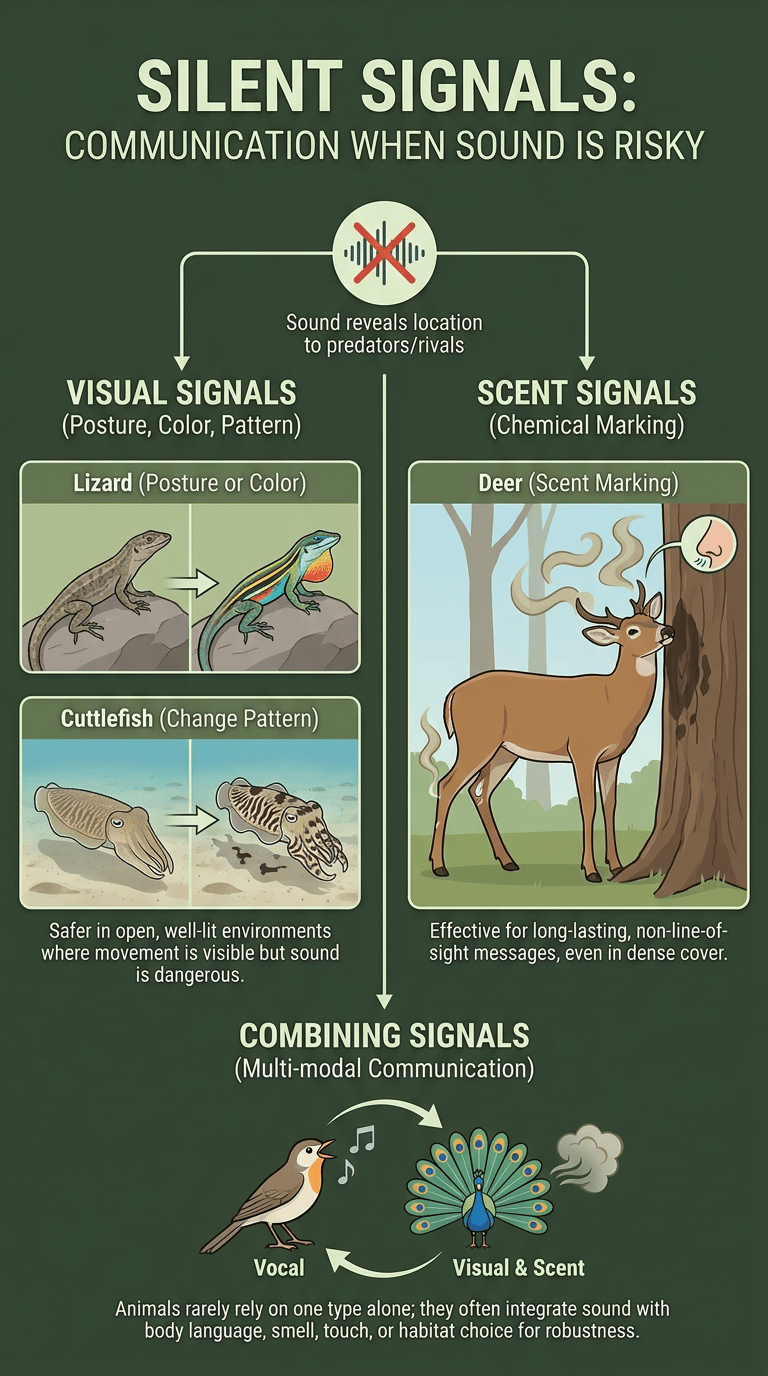
Sound can reveal an animal’s location. In some situations, scent or visual signals may be safer or more useful. A deer may use scent marking. A lizard may use posture or color. A cuttlefish may change pattern. A bird may combine song with feather displays or movement.
Animals rarely depend on one signal type alone. A vocal animal may also use body language, smell, touch, and habitat choice to communicate.
To understand why a sound matters, it helps to compare it with the broader ways animals communicate across different signal types.
Migration calls and group coordination
Some animals use calls while moving. Birds may give flight calls during migration, especially at night. Social mammals may use contact sounds while traveling. These sounds can help individuals stay near the group or maintain spacing when visibility is limited.
Migration sounds are a good reminder that animal communication is not only about courtship or danger. Sometimes the meaning is practical: stay together, keep moving, or maintain contact in a changing environment.
FAQ
Why do animals make sounds at night?
Animals make sounds at night because darkness can make sound more useful than vision. Frogs may call after rain or during breeding conditions, owls may vocalize while defending territories or contacting mates, insects may chirp or buzz in warm weather, and coyotes may use group calls after sunset. Night sounds are often about mating, territory, contact, or movement, not random noise.
Some nighttime sounds also seem louder because human activity is quieter and cooler air can change how sound travels. A call that is ordinary for the animal may feel dramatic to a person hearing it from a dark yard.
Do animal sounds always have meanings?
Not every animal sound has a clear message that humans can translate. Some sounds are direct signals to other animals, such as alarm calls or mating songs. Others may be byproducts of movement, feeding, breathing, or physical contact. Some sounds influence listeners without carrying a neat meaning like a human word.
The better question is whether the sound changes the behavior of another animal or is regularly connected with a specific situation. Scientists look for repeated patterns, context, and listener response before assigning a function.
What animal sounds warn about danger?
Warning sounds include bird alarm calls, squirrel chirps, primate alarm calls, meerkat alarms, and some canid barks or howls in defensive contexts. These sounds may tell listeners to freeze, hide, look up, gather, or move away. The response depends on the species and the kind of threat.
People should not assume that every sharp or loud sound means danger to humans. Often the warning is aimed at other members of the animal’s group, and the threat may be a hawk, snake, owl, fox, or domestic cat rather than a person.
Can animals recognize individual voices?
Some animals can recognize familiar individuals by sound. This is especially useful in social species, parent-offspring relationships, and crowded breeding colonies. A parent may need to identify its own young. A group member may need to recognize a mate, calf, chick, or companion.
Voice recognition does not mean animals use human-like names in every case. It means acoustic differences can help individuals sort familiar callers from unfamiliar ones, which can affect care, cooperation, avoidance, or reunion.
Final Thoughts
Animal sounds are best understood as flexible signals shaped by survival, reproduction, habitat, and social life. A call may warn, attract, defend, locate, beg, coordinate, or bond, but its meaning depends on context. The same sound can shift in function depending on who makes it, who hears it, where it happens, and what is happening around the animal.
For curious listeners, the most useful habit is patient observation. Notice the season, habitat, time of day, body language, and reactions of nearby animals. Listen without disturbing wildlife, and treat animal sounds as evidence of complex lives rather than a simple dictionary of noises.

Ethan Walker is the founder and research editor of Animal Fact Central. He creates and reviews educational animal facts content using trusted wildlife, pet care, and science-based sources. His work focuses on making animal behavior, adaptations, habitats, and species facts clear, accurate, and engaging for everyday readers.
Read More Details About Ethan Walker: https://animalfactcentral.com/ethan-walker/