
Animals communicate by sending signals that other animals can detect and use. A signal may be a sound, smell, color, posture, movement, touch, vibration, electrical discharge, or a combination of several cues at once. The meaning is not always as simple as a human word. A bark, flash, scent mark, or courtship dance usually makes sense only when you know the species, the setting, and what the receiver is likely to do next.
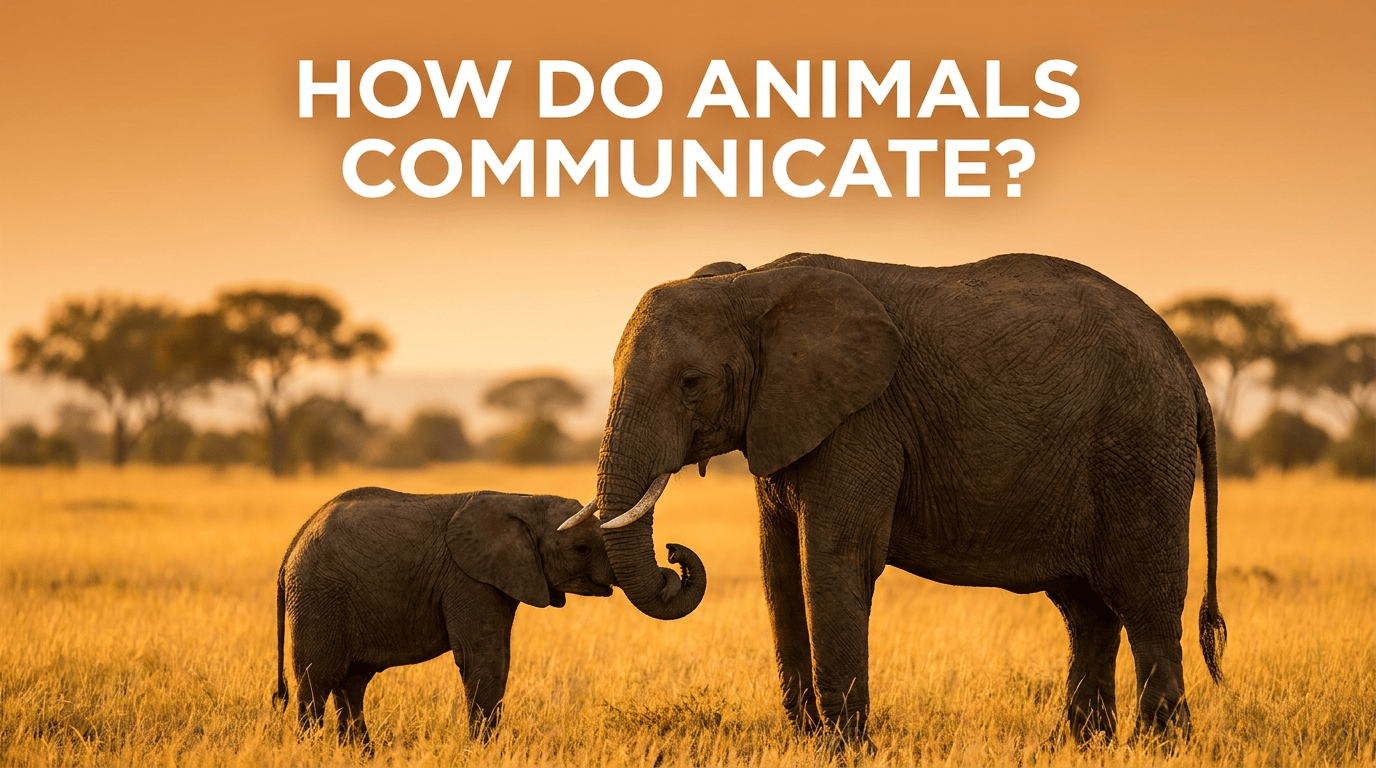
That is why animal communication is best understood as behavior in context. A bird call can warn nearby birds, attract a mate, or keep a flock together. A wolf posture can reduce fighting inside a pack. A moth pheromone can help a mate find the sender in darkness. A dolphin whistle can help maintain contact in water where visibility is limited. The same broad idea connects them all: one animal produces information, and another animal responds in a way that affects survival, reproduction, social life, or safety.
Biologists often describe animal communication as the process in which a sender provides information that a receiver can use in decision-making, and Britannica’s overview of animal communication lists sound, color, posture, movement, electrical discharge, touch, and odor among the major signal types. This article gives a direct, practical explanation of how animals communicate without turning each signal type into a separate deep dive.
Quick Answer
Animals communicate through signals that influence the behavior of other animals. The most common signal channels include sound, body language, scent, touch, color, light, vibration, and specialized senses such as electric signals in some aquatic animals. Many species use more than one channel at the same time. For example, a frog may call and inflate a vocal sac, a dog may bark while changing posture, and a bird may sing from a visible perch.
Communication can happen between members of the same species, such as courtship calls between frogs, or between species, such as warning colors that predators learn to avoid. Some signals are aimed at a clear receiver. Others are broadcast into the environment, where mates, rivals, predators, prey, or even eavesdropping animals may detect them. That makes animal communication powerful but also risky.
The safest way to interpret animal signals is to ask three questions: who is sending the signal, who is likely to receive it, and what behavior changes after the signal? A single sound or movement rarely has one universal meaning across all animals.
Why Animal Communication Matters
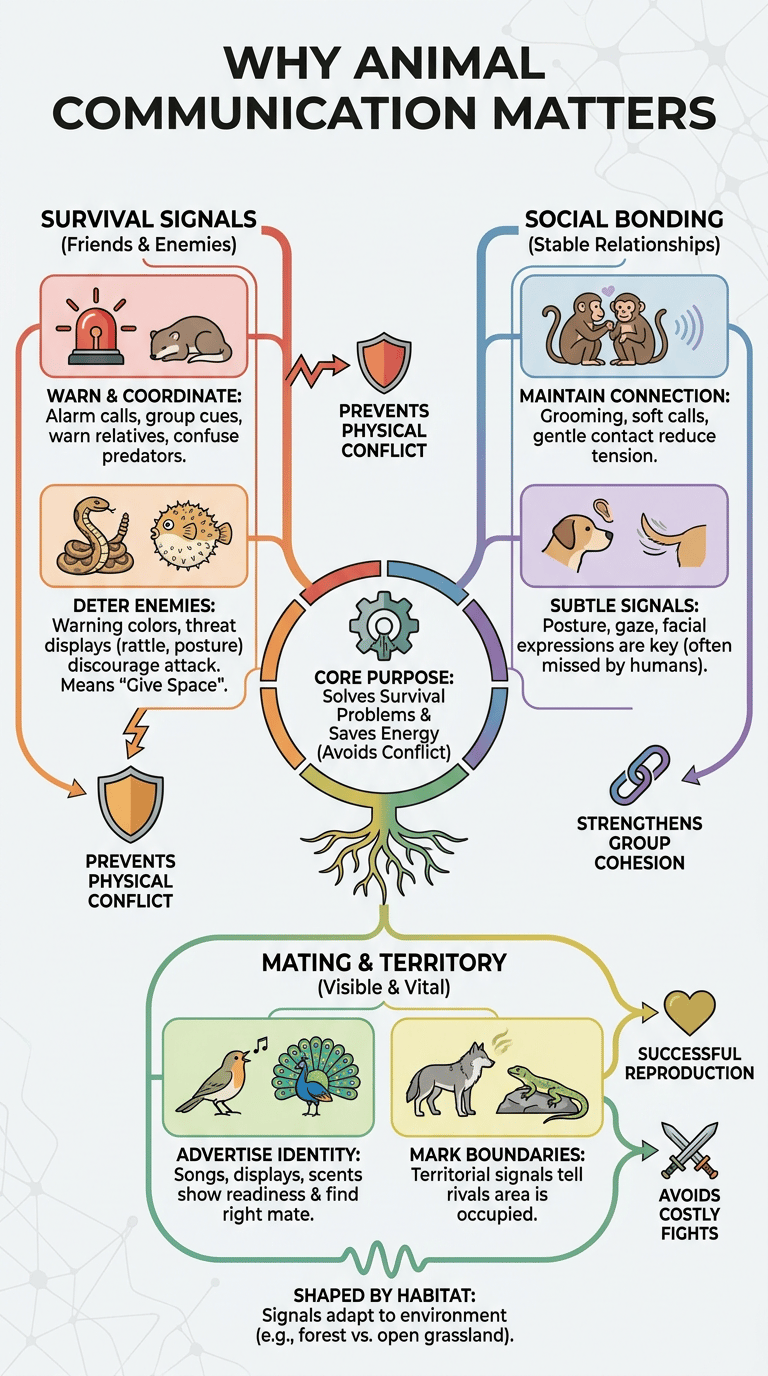
Communication is not decoration. It helps animals solve real survival problems. A signal can reduce the need for a fight, help parents care for young, keep group members together, attract mates, warn of predators, coordinate movement, or mark territory. In many cases, signals save energy because they let animals exchange information before physical conflict begins.
Communication also shapes how animals fit into their habitats. A dense forest favors different signals than an open grassland. A dark cave, muddy river, coral reef, or nighttime desert creates its own communication challenges. Animals do not all communicate the same way because they do not all face the same sensory world.
Survival signals
Survival signals include alarm calls, warning colors, threat displays, startle displays, and group coordination cues. A prey animal that spots a predator may freeze, flee, raise a tail, call, or change posture. These signals can warn relatives, confuse a predator, or tell the predator that it has been detected.
Not every survival signal is meant only for friends. Some signals are directed at enemies. A rattlesnake’s rattle, a skunk’s warning posture, or a pufferfish’s expanded body can discourage attack before direct contact happens. These examples should not be treated as invitations to approach. In real wildlife encounters, warning behavior means the animal needs space.
Social bonding
Many social animals use communication to keep relationships stable. Grooming, soft calls, gentle contact, facial expressions, and posture can help animals recognize group members and reduce tension. Primates, wolves, elephants, dolphins, parrots, and many other social animals live in worlds where relationships matter.
Social signals are often subtle. A posture that looks small to a human observer may be obvious to another animal. Ear position, tail height, gaze direction, body angle, and distance can all change the message. This is especially important in domestic animals, where people may miss stress signals because they expect communication to look human.
Mating and territory
Mating and territory are two of the most visible reasons animals communicate. Songs, scent marks, color displays, dances, antler postures, throat fans, and courtship movements can advertise identity, location, readiness to mate, or competitive ability. These signals can help animals find the right mate and avoid wasting effort on the wrong species.
Territorial signals can also prevent injuries. A song from a bird, a scent mark from a mammal, or a display from a lizard may tell rivals that an area is occupied. If the signal is strong enough to make a rival leave, both animals may avoid a costly fight.
The Main Ways Animals Communicate
The main channels of animal communication are sometimes called signal modalities. A modality is simply the sensory route a signal uses. Sound travels through air or water. Smell travels through chemicals. Visual displays require light and line of sight. Touch requires closeness. Vibration travels through ground, plants, webs, or water. Electric signals work only in animals with the right organs and receptors.
Nature Education’s introduction to animal communication explains that animals use different sensory channels, including visual, acoustic, chemical, and tactile signals, and that each channel has strengths and limits. Those limits are one reason animal communication is so diverse.
Sounds and calls
Sound is useful because it can travel around obstacles, work in darkness, and reach animals that are not looking at the sender. Birds sing, frogs call, wolves howl, whales vocalize, crickets chirp, and many mammals use grunts, squeaks, roars, or contact calls. The sound itself may carry information through pitch, rhythm, volume, repetition, and timing.
Sound is not automatically language. A call may signal danger, location, identity, motivation, territory, or mating condition without working like a sentence. Researchers interpret animal sounds by observing the setting, recording the call, and testing how receivers respond. A sound that occurs during predator approach and causes others to hide has a different function from a sound that attracts mates at a breeding site.
Body language and posture
Visual signals include body posture, facial expression, color patches, feather displays, fin movement, tail position, eye spots, and ritualized movements. These signals can be fast and detailed, especially in daylight or clear water. They are common in animals that can see each other well, such as birds, primates, reptiles, fish, insects, and domestic mammals.
Body language often works at close range. A dog that stiffens, turns away, lowers its body, or shows a tense face is communicating in a way people should take seriously. A lizard that extends a dewlap, a bird that raises feathers, or a fish that changes posture may also be sending a social or territorial signal. The exact meaning depends on the species and situation.
Smells and chemical messages
Chemical communication is one of the oldest and most widespread forms of signaling. Animals can leave chemical traces in urine, feces, gland secretions, skin compounds, or trails. These messages may last after the sender leaves, which makes scent useful for territory, mate finding, identity, and navigation.
The NCBI Bookshelf chapter on chemical signaling in vertebrates and invertebrates notes that pheromones are evolved chemical signals between members of the same species and that animals can also use variable chemical profiles to recognize individuals or groups. This is why scent can communicate more than the simple idea that an animal was nearby.
Touch and grooming
Touch works only at close range, but it can be extremely important. Grooming, nuzzling, rubbing, tapping, antennal contact, and parent-offspring contact can maintain bonds, calm conflict, coordinate care, and exchange information about social state. In social insects, antennal contact can help colony members exchange signals. In mammals, grooming can reinforce relationships as well as clean the body.
Touch signals are easy for people to underestimate because they often look gentle or routine. For the animals involved, however, contact can communicate trust, rank, care, or readiness to interact. In some species, the absence of expected contact can matter too.
Color, light, and visual displays
Some animals use color and light as signals. Bright patches can advertise a rival’s presence, a mate’s condition, or a warning to predators. Fireflies use flashes in courtship. Cuttlefish can change body patterns rapidly. Many birds use plumage and display movements together. Visual signals can be highly effective when receivers have the right eyes and the environment allows the signal to be seen.
Color signals are not always meant for humans. Some birds and insects can see ultraviolet patterns that people cannot see without special equipment. A flower, feather, or wing pattern that looks plain to us may look more detailed to the intended receiver.
Vibrations and ground signals
Vibration is a form of communication that often happens below human awareness. Spiders can detect movements through webs. Some insects send signals through plant stems. Elephants are known for low-frequency sounds and may detect vibrations through the ground in some contexts. Frogs, rodents, and other animals may also use drumming, foot stamping, or substrate vibrations.
Vibration signals are especially useful when sound or vision is limited. They can travel through surfaces where a small animal lives, such as a leaf, burrow, web, or patch of soil. For tiny animals, a plant stem can function like a communication line.
Animal Communication Examples by Signal Type

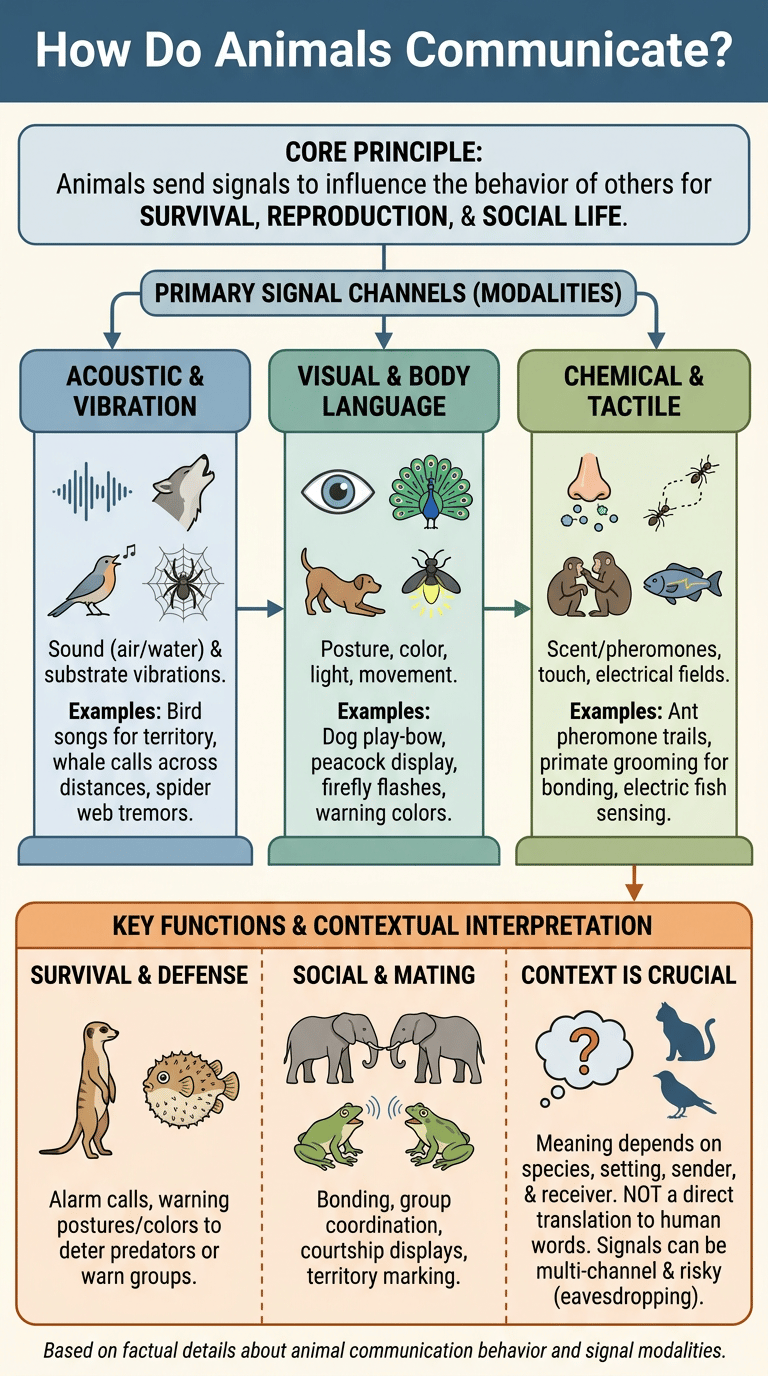
Examples make animal communication easier to understand because each signal type solves a different problem. The point is not that one channel is better than another. The point is that each animal’s body, habitat, predators, diet, and social system shape which signals work best.
Wolves, birds, whales, and frogs using sound
Wolves howl to maintain contact and advertise presence. Birds use songs and calls for territory, mate attraction, alarm, and group coordination. Frogs often call from breeding sites, where sound helps females locate males. Whales and dolphins use sound in water, where sound can travel efficiently and vision may be limited by depth, distance, or murkiness.
For birds, songs and calls can tell listeners about identity, location, danger, or social state. Cornell Lab’s bird communication lessons introduce bird songs, calls, quacks, and drumming as ways students can investigate why and how birds communicate.
In marine mammals, NOAA Fisheries describes sounds in ocean mammals in contexts such as mating, competition, contact calling, food, territory, and social communication.
Dogs, cats, primates, and reptiles using body language
Domestic dogs and cats use vocal sounds, scent, touch, and body language, but posture is especially important for people to notice. A relaxed animal, a fearful animal, and an animal preparing to defend itself may use different body tension, ear position, tail movement, gaze, and distance. Misreading those signals can lead to bites, scratches, or stress for the animal.
Primates also use facial expressions, gestures, posture, vocalizations, and grooming in social life. Reptiles may communicate with body color, head bobbing, throat fans, push-up displays, or posture. These signals are not random movements. They often appear in territorial, courtship, defensive, or social contexts.
Moths, ants, mammals, and snakes using scent
Scent is powerful because it can remain in the environment after the sender has moved on. Many mammals scent-mark with urine, feces, or gland secretions. Ants lay chemical trails that help nestmates find food or respond to colony needs. Moths can use sex pheromones that help males locate receptive females. Snakes and lizards use chemical cues to gather information from their surroundings.
Because chemical messages can be complex mixtures, people should be careful about oversimplifying them. A scent mark may carry information about species, sex, reproductive condition, identity, social group, or territory, depending on the animal. Chemical communication is not just a smell. It can be a detailed biological signal.
Bees, cuttlefish, fireflies, and birds using visual signals
Honey bees are famous for dances that help nestmates locate food, though the details are more complex than a simple map. Fireflies use light flashes in courtship, and flash timing can help individuals recognize suitable mates. Cuttlefish use rapid changes in color, contrast, and body pattern during camouflage, conflict, and courtship. Birds may use plumage, posture, wing movement, and display sites to communicate.
Visual signals often work best when the receiver has a clear view. This is why visual displays can be dramatic in open habitats, daylight courtship grounds, reef environments, or perches. In darkness, dense vegetation, or muddy water, animals often rely more heavily on sound, smell, vibration, or touch.
Elephants, spiders, insects, and fish using vibration or electricity
Some animals use channels that humans do not easily notice. Spiders read vibrations through silk. Insects can send signals through plant tissues. Elephants produce very low-frequency sounds, and vibrations may be part of how some signals move through their environment. Some fish generate weak electric fields that help them sense surroundings and communicate in dark or murky water.
Electrical communication is not the same as an electric shock defense. Some strongly electric fish use electricity for defense or prey capture, while weakly electric fish use small electric fields for sensing and signaling. This is one reason the phrase animals that use electricity needs careful explanation rather than one dramatic example.
How Scientists Interpret Animal Signals

Scientists do not simply listen to an animal sound and translate it like a dictionary. They study patterns. They ask when the signal occurs, who produces it, who responds, what changes after it, and whether the response is consistent across many observations. In controlled studies, researchers may play sounds, change visual signals, introduce scent cues, or measure receiver behavior.
A peer-reviewed paper from the Royal Society argues for a systems approach to animal communication, meaning that complex displays should be studied as interacting parts rather than isolated signals. That matters because a call, posture, scent, and movement may work together.
Context matters more than a single signal
The same signal can mean different things in different contexts, and similar-looking signals can have different meanings in different species. A raised tail may be a warning in one animal, a balance movement in another, and part of a courtship display in another. A loud sound might be an alarm, a territorial signal, or a mating advertisement.
This is why simple charts of animal meanings can be misleading. The better approach is to look for repeated patterns: the animal’s body state, the receiver’s reaction, the environment, and the likely cost or benefit of the behavior.
Signals can be honest, exaggerated, or risky
Some signals are costly enough that they can provide useful information. A strong display, loud call, bright color, or prolonged courtship effort may be difficult for a weak or unhealthy individual to maintain. Other signals can be deceptive or manipulative. Predators may eavesdrop on prey calls, and some animals mimic signals used by other species.
Animal communication is therefore not always cooperative. Sometimes the sender and receiver both benefit. Sometimes one benefits more than the other. Sometimes a third animal listens in. A frog call that attracts a mate may also attract a predator. A scent trail that guides nestmates may be followed by a competitor.
Humans often misread animal behavior
People tend to interpret animal signals through human emotions. That can be useful as a starting point, but it can also be wrong. A primate grin may not mean friendliness in the human sense. A wagging tail may not always mean a dog is relaxed. A wild animal that stays still may be frightened rather than tame.
For pets, repeated behavior changes, sudden aggression, hiding, loss of appetite, breathing difficulty, pain signs, repeated vomiting or diarrhea, or unusual lethargy should be treated as possible health or welfare concerns. A veterinarian is the right professional for medical questions. For wild animals, the safest response is distance, not handling.
Common Mistakes or Myths
Animal communication is easy to exaggerate because some signals look surprisingly human. The truth is more interesting than the myth. Animals exchange useful information, but that does not mean every animal signal works like human speech.
Myth: animals talk just like humans
Animals can have complex communication systems without using human-style language. Some species can learn signals, combine calls, recognize individuals, or respond to specific contexts. Still, most animal communication does not have the open-ended grammar, symbolic range, and flexible storytelling that human language has.
A better comparison is to think of animal communication as specialized information shaped by survival needs. It can be precise in its own way, even when it does not translate into words.
Myth: one signal has one meaning
A single signal rarely has one meaning across every situation. A growl, chirp, scent mark, raised feather, or flash may change meaning depending on who sends it, who receives it, and what is happening nearby. Even within one species, age, sex, season, social status, and past experience can influence how signals are used.
This is why careful animal behavior writing should avoid claims such as this call always means danger or this posture always means friendliness. It is more accurate to explain likely meanings and context clues.
Myth: only smart animals communicate
Communication is not limited to animals people think of as intelligent. Insects, spiders, fish, frogs, reptiles, birds, mammals, and many invertebrates use signals. A chemical trail from an ant, a flash from a firefly, or a vibration through a spider web can be highly effective without resembling human conversation.
Intelligence may shape how flexible a communication system is, but communication itself is much broader than intelligence. It is a biological tool for influencing behavior.
How This Connects to Nearby Animal Topics
Animal communication overlaps with several nearby topics, but each one asks a different question. Sound, smell, vision, electricity, and migration all connect to communication while still deserving separate explanations.
How animal sounds connect to communication
Animal sounds are one major communication channel, but they are not the whole topic. Calls and songs can warn, attract, coordinate, or identify. To understand what a sound means, readers need context such as habitat, time of year, receiver behavior, and whether the sound is used for alarm, courtship, territory, or group contact.
How scent, vision, electricity, and migration connect
Scent adds a chemical layer to communication and can leave information behind in the environment. Vision shapes color displays, body language, and the way animals see signals humans may miss. Electrical sensing and signaling appear in specialized aquatic animals. Migration navigation is related because animals use sensory cues, but finding a route is not the same user question as sending a message to another animal.
FAQ
What are the main ways animals communicate?
The main ways animals communicate are sound, body language, scent, touch, color or light displays, vibration, and specialized signals such as electric fields in some fish. Many animals combine several of these at once. A courtship display might include sound, posture, color, movement, and scent in the same interaction.
Do animals understand each other like humans do?
Animals can respond to signals in highly specific ways, but that does not mean they understand each other exactly as humans understand language. Many signals are tied to immediate contexts such as danger, mating, territory, hunger, contact, or social tension. Some species have very flexible communication, but it is usually best to avoid treating animal signals as direct human words.
Can different species communicate with each other?
Yes, different species can exchange or respond to signals, especially when the signal affects survival. Warning colors can signal danger to predators. Alarm calls from one species may alert other animals nearby. Predators may also eavesdrop on mating calls or contact calls. These interactions are often more about behavior and risk than friendly conversation.
Why do animals use smell instead of sound or sight?
Smell works well when animals are active in darkness, dense vegetation, burrows, or areas where the sender may leave before the receiver arrives. Chemical signals can last longer than a sound or gesture, and they can carry information about identity, reproductive condition, territory, or group membership. The trade-off is that chemical messages usually spread more slowly than sound or visual signals.
Are animal signals always honest?
No. Some signals are reliable because they are costly, difficult to fake, or linked to the sender’s body condition. Others may be exaggerated, deceptive, or exploited by eavesdroppers. Communication can involve cooperation, conflict, or both. That is one reason animal signaling is such an active area of behavioral research.
Final Thoughts
Animals communicate by using the senses their bodies and habitats make most useful. Some rely on calls that travel through air or water. Others leave chemical messages, flash light, change color, groom social partners, drum through surfaces, or use electric fields. The important takeaway is that animal communication is not one universal code. It is a set of signals shaped by survival, reproduction, social life, and environment. Once you look at sender, receiver, context, and response, animal behavior becomes much easier to understand.

Ethan Walker is the founder and research editor of Animal Fact Central. He creates and reviews educational animal facts content using trusted wildlife, pet care, and science-based sources. His work focuses on making animal behavior, adaptations, habitats, and species facts clear, accurate, and engaging for everyday readers.
Read More Details About Ethan Walker: https://animalfactcentral.com/ethan-walker/