
Animals use smell to communicate by leaving chemical signals in the environment or releasing odors that other animals can detect. These signals can say a lot without a sound: who has been in an area, whether an animal is ready to mate, where food may be found, whether danger is nearby, and sometimes which group or individual an animal belongs to.
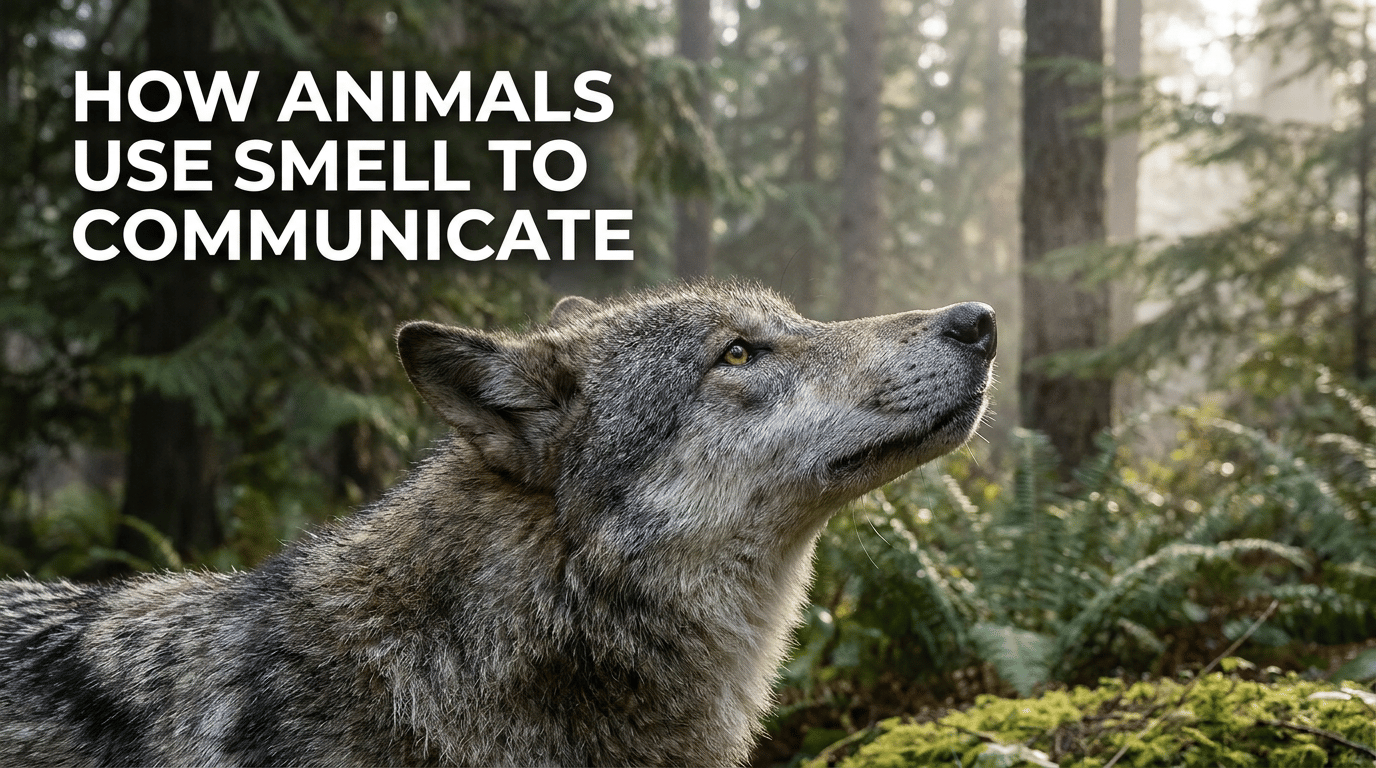
Smell-based communication is especially useful because it does not require two animals to be face to face. A fox can leave a scent mark on a trail at night. An ant can lay a chemical path to food. A snake can sample molecules on the ground after another snake has passed. The message may last minutes, hours, or longer depending on the chemical, the surface, and the weather.
The important thing is that animal smell signals are not one simple language humans can translate word for word. Chemical communication depends on species, context, season, age, sex, health, and environment. A scent mark can be a territorial advertisement in one situation, a mating signal in another, or a way to recognize neighbors and avoid direct fights.
Quick Answer
Animals use smell to communicate through scent marks, pheromones, gland secretions, urine, feces, chemical trails, body odors, alarm chemicals, and defensive odors. These chemicals are detected by noses, antennae, tongues, vomeronasal organs, or other chemosensory structures depending on the animal group.
A pheromone is a chemical signal produced by one animal and detected by another animal of the same species, causing a behavioral or physiological response. A useful overview from the NCBI Bookshelf introduction to chemical signaling explains that pheromones are one part of a broader category of information-carrying chemicals called semiochemicals.
That definition matters because not every animal odor is a pheromone. A skunk’s spray, a predator’s scent, a food smell, and a urine mark can all influence behavior, but they are not all the same kind of signal. Some are deliberate messages to other members of the same species. Others are cues that animals use even if the sender did not evolve the odor mainly as a message.
Why Smell Is Such a Powerful Animal Signal

Smell is powerful because chemical messages can persist, spread through complex habitats, and carry detailed biological information. Unlike a call that disappears almost instantly, some odors remain on leaves, rocks, soil, fur, or water after the sender has moved away.
Chemical messages can last after the sender leaves
A scent mark is a delayed message. It can be read by another animal minutes or hours later, which makes it useful for species that avoid direct meetings. Solitary mammals, for example, may use scent posts to advertise presence without physically confronting every neighbor.
That does not mean scent marks are permanent. Sunlight, rain, wind, microbial activity, surface texture, and temperature can weaken or change an odor. A fresh mark may carry different information from an older one, and many animals investigate how strong or recent a scent seems before reacting.
Smell works in darkness and dense habitats
Chemical signals work where vision is limited. Thick vegetation, burrows, nighttime conditions, muddy water, leaf litter, and underground tunnels can make visual displays difficult. In those places, smell can guide animals toward mates, nestmates, prey, trails, or territory boundaries.
Smell can also be useful at very small scales. Insects do not need a large visual sign to organize a colony path. A chemical trail on the ground can guide workers across a busy surface with remarkable efficiency.
Scent can carry identity and reproductive information
Many animals respond to chemical information about species, sex, reproductive condition, rank, or group membership. In mammals, scent marking is widespread, and Animal Diversity Web’s mammal overview notes that mammalian scent marks may come from urine, feces, or specialized glands and can communicate territory, reproductive status, individual identity, or group identity.
This is why sniffing is often more than curiosity. To an animal with a sensitive chemical sense, a patch of scent can function like a brief biological profile. It may not tell a detailed story, but it can help the receiver decide whether to investigate, avoid, follow, compete, mate, or ignore.
The Main Ways Animals Send Smell Signals
Smell communication can look very different across animal groups. A wolf lifting its leg, a cat rubbing its cheeks, an ant laying a trail, and a fish releasing chemicals into water are all using chemical information, but the delivery system and message are not identical.
Scent marking with urine or feces
Urine and feces are common scent-marking tools because they contain chemical information and can be deposited on prominent surfaces. Many carnivores mark along travel routes, territorial edges, rocks, plants, or scent posts used by several individuals.
For a receiver, the location of the mark matters. A mark placed on a high rock, path intersection, or boundary may be easier to detect than one hidden in dense vegetation. The mark’s placement can help turn an ordinary odor into a readable signal.
Gland secretions and body scent
Some animals have scent glands on the face, feet, chest, wrists, tail area, or anal region. These glands can produce oily or waxy secretions that stick to surfaces or fur. Animals may rub, scrape, drag, or press body parts against objects to place the scent exactly where others can find it.
Ring-tailed lemurs are a vivid example. The Smithsonian’s ring-tailed lemur profile describes scent glands on the wrists and chests, including male wrist glands used to mark branches and to rub secretions onto the tail during scent displays.
Pheromones and chemical trails
Pheromones are especially famous in insects. Ants, bees, moths, and termites can use chemical messages for mating, alarm, nest recognition, trail following, or colony coordination. In many social insects, chemical signals help large groups behave in organized ways without a central leader giving commands.
Ant trail pheromones are one of the easiest examples to picture. When a foraging ant finds food, it may deposit chemicals while returning to the nest, and nestmates can follow and reinforce that path. A Florida State University research summary notes that ants can self-organize around food resources using chemical pheromone trails, although real ant navigation can also involve memory and other cues.
Alarm chemicals and defensive odors
Some smell signals warn others or discourage attack. Alarm chemicals can spread information quickly in water, air, or crowded colonies. Defensive odors, such as the strong smell of skunks or some insects, may be aimed at predators more than at members of the same species.
This is one reason the word communication needs care. A defensive odor may affect another animal’s behavior even if it is not a social message in the same sense as a mating pheromone or a territory mark. It still changes the interaction between animals.
What Scent Signals Can Mean
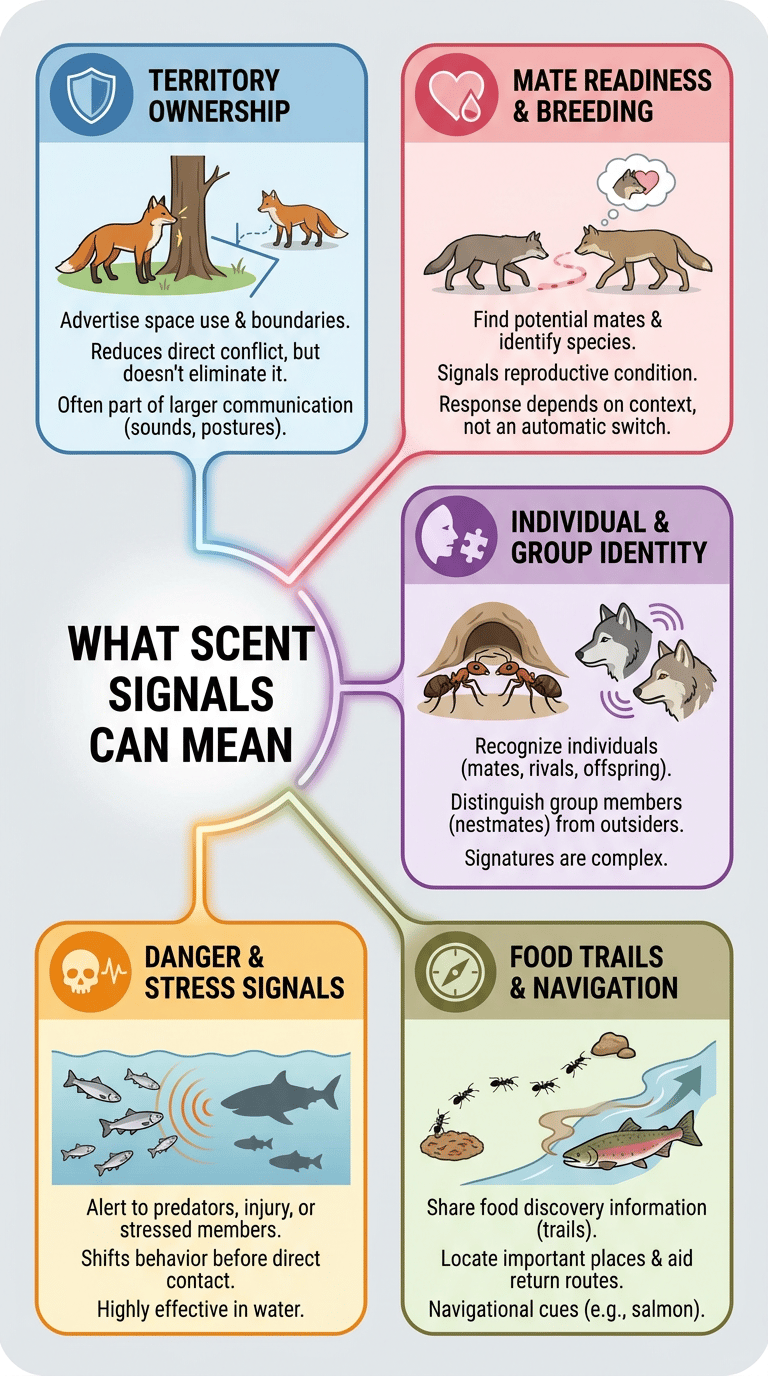
Scent signals can carry several kinds of information at once. A mark may say where an animal has been, how recently it passed, whether it is breeding, and whether it is a familiar neighbor. The receiver’s response depends on what that information means in the moment.
Territory ownership
Territorial scent marks often work like boundary signs. Instead of fighting every intruder, an animal can advertise that it uses a space. A rival may avoid the area, investigate carefully, or overmark the scent with its own signal.
This can reduce direct conflict, but it does not eliminate conflict. When competition is intense, scent marks may become part of a larger communication system that includes sounds, postures, chases, scrapes, and physical fights.
Mate readiness and breeding condition
Many animals use chemical cues during reproduction. Scent can help potential mates find each other, identify the right species, and respond to breeding condition. In some species, males follow female scent trails or investigate urine and glandular odors when females are receptive.
These signals are not magic switches. Hormones, experience, season, social context, age, and competition all affect how animals respond. In mammals especially, chemical signals often interact with behavior rather than causing the same automatic response every time.
Individual identity and group membership
Chemical signatures can help animals recognize individuals or groups. Social insects use cuticular chemicals, nest odors, and pheromones to help distinguish nestmates from outsiders. Mammals may use scent to recognize mates, offspring, rivals, or familiar neighbors.
Identity signals can be subtle. Humans may smell a strong musky odor and think of it as one scent, while another animal may detect a more complex mixture of information. The receiver’s nervous system and behavior are tuned to details that people usually miss.
Food trails and navigation
Chemical trails can turn a private food discovery into group information. Ants are the classic example, but other animals also use odors to locate food, follow routes, or return to important places. In water, chemical cues can spread differently than in air, creating gradients that fish and other aquatic animals may follow.
Smell can also overlap with navigation. Salmon are often discussed in relation to odor cues as they return toward natal waters, while sea turtle navigation research considers multiple cues, including magnetic and chemical information, depending on scale and context.
Danger and stress signals
Some animals respond to chemical cues associated with injury, predators, or stressed group members. In aquatic environments, alarm cues can be especially important because chemicals disperse through water and may alert nearby animals before a predator is visible.
These danger-related cues vary widely by species. A fish reacting to chemical alarm information in water is not the same as a deer smelling a predator on a trail or an insect colony responding to alarm pheromone. The shared theme is that smell can shift behavior before direct contact happens.
Animal Examples of Smell Communication
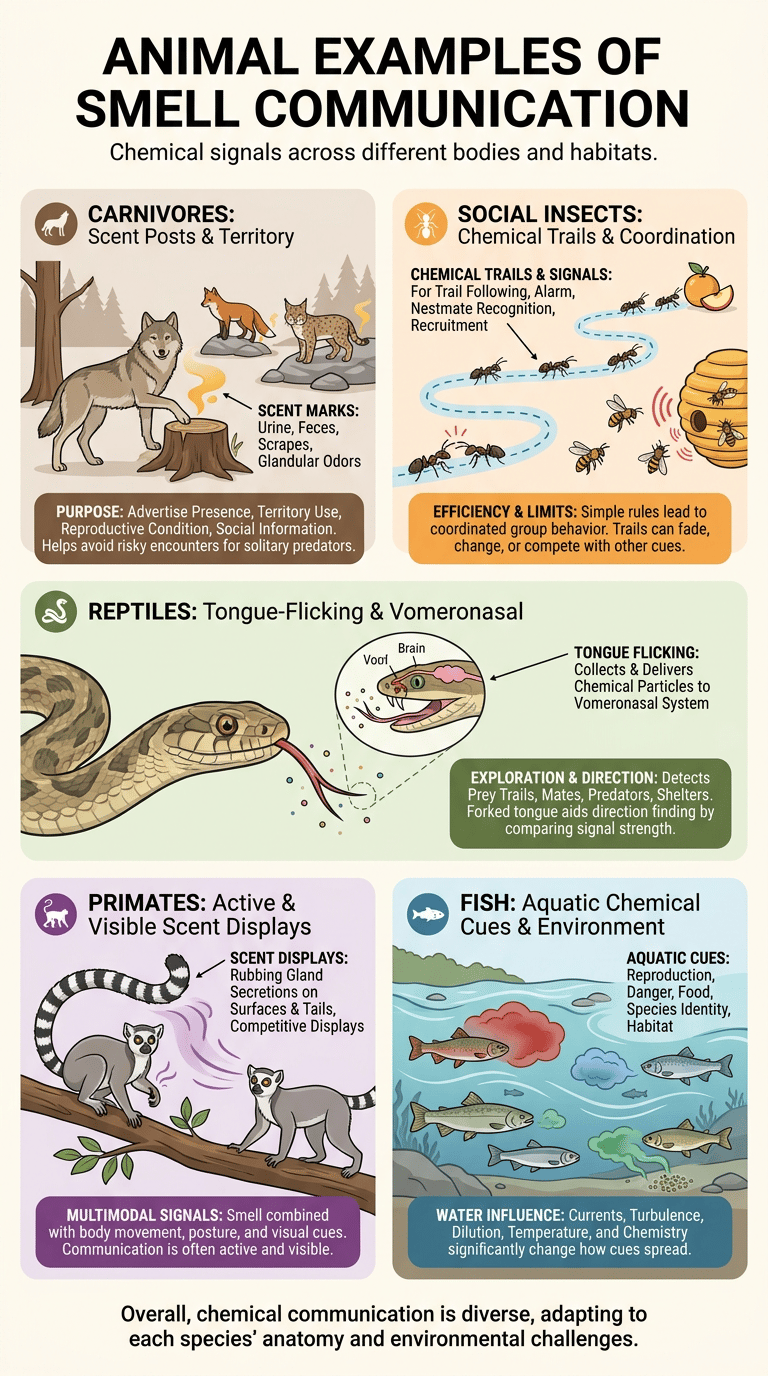
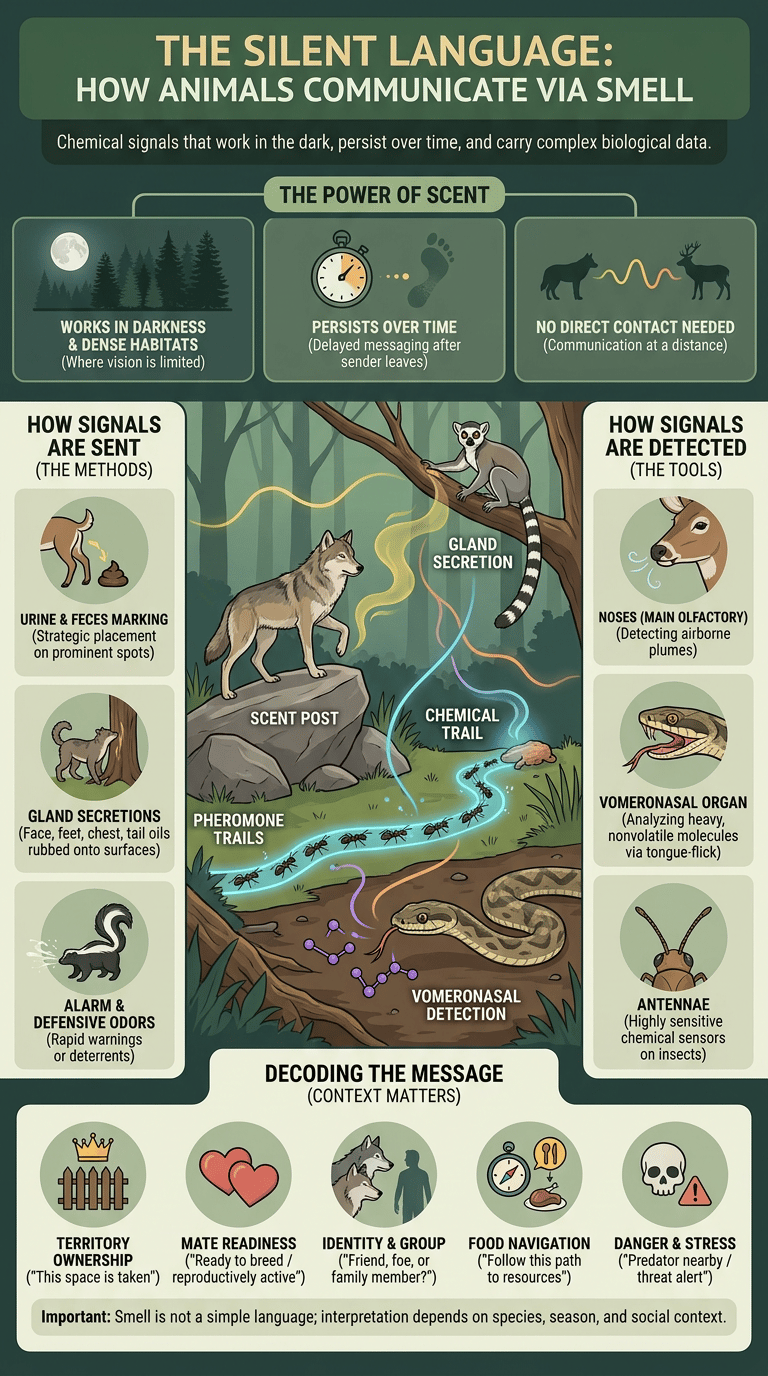
Examples make chemical communication easier to understand because the same basic idea appears in very different bodies and habitats. Mammals, insects, reptiles, and fish all use chemical information, but each group detects and sends it in a way that fits its world.
Wolves, foxes, big cats, and scent posts
Carnivores often use scent marks along travel routes. Wolves, foxes, coyotes, bobcats, and big cats may mark with urine, feces, scrapes, or glandular odors. These marks can help advertise presence, territory use, reproductive condition, and social information.
For solitary predators, scent is especially useful because meeting another adult can be risky. A scent post lets an animal gather information before deciding whether to avoid, investigate, or challenge. For social canids, scent also interacts with group movement and territorial defense.
Ants, bees, and chemical trails
Ants use chemical communication for trail following, alarm, nestmate recognition, and recruitment. Bees use chemical signals inside the colony and around defense. These systems can be highly efficient because each individual follows simple rules that scale up into coordinated group behavior.
Still, insects are not tiny robots. Chemical trails can fade, change direction, compete with other cues, or be disrupted. Social insects often combine chemical information with touch, movement, vibration, memory, and environmental feedback.
Snakes and tongue-flicking chemical detection
Snakes are famous for tongue flicking, but they are not tasting the air in the human sense. The forked tongue collects chemical particles and helps deliver them toward the vomeronasal system. Research on lizard chemosensory anatomy explains that in many squamate reptiles, the tongue helps move molecules toward the vomeronasal openings where chemical information can be processed.
This helps explain why snakes tongue-flick while exploring. Chemical information can help them detect prey trails, mates, predators, shelters, and unfamiliar objects. The forked tongue may also help compare chemical strength across two sides, which can aid direction finding.
Lemurs and scent displays
Lemurs show that smell communication can be active and visible. Ring-tailed lemurs may rub gland secretions onto surfaces, and males can rub scent onto their tails and wave them in competitive displays. In that case, smell and body movement work together.
This kind of display reminds readers that scent communication is not always hidden. Sometimes an odor signal is paired with posture, tail position, rubbing, or direct social interaction, making it a multimodal signal rather than a smell-only message.
Fish and aquatic chemical cues
Water carries chemical information differently from air. Fish may detect chemical cues related to reproduction, danger, food, species identity, or habitat. A University of Minnesota summary of fish pheromones and related cues notes that such chemicals are especially important in aquatic environments and can influence adaptive behavior.
Aquatic chemical communication also has limits. Currents, turbulence, dilution, temperature, and water chemistry can change how a cue spreads. A message in a still pond is not the same as a message in a fast river or open ocean.
How Animals Detect Smell Signals
Sending a chemical message is only half the system. The receiver must have the sensory tools to detect it and the brain or nervous system pathways to respond. Different animals solve this in very different ways.
Noses, tongues, and vomeronasal organs
Mammals usually detect many airborne odors through the main olfactory system in the nose. Some mammals also have a vomeronasal organ, often associated with detecting certain nonvolatile or social chemical cues. In many reptiles, tongue-flicking plays a major role in moving chemicals toward vomeronasal structures.
Insects often detect chemicals with antennae and other sensory structures. Fish detect dissolved chemicals through olfactory tissues exposed to water. These systems are not identical, but they all allow animals to turn molecules into information.
Why some animals sniff the air and ground differently
Airborne odors and ground odors can carry different information. An animal sniffing the air may be sampling a wide odor plume drifting from food, a predator, or another animal. An animal sniffing the ground may be following a more localized trail or investigating a specific mark.
Dogs provide a familiar example, but the principle applies beyond pets. Many wild mammals change head position, sniffing speed, and movement pattern depending on whether they are tracking a path, checking a scent post, or sampling the air for a recent odor.
Limits of what humans can detect
Humans can smell some animal odors, such as skunk spray, fox musk, cat urine, or a strong barnyard scent. But we usually cannot detect the full information that another animal may extract from the same chemical mixture.
This is why people should be cautious about interpreting animal scent behavior. A dog sniffing, a cat rubbing, a deer pausing at a scrape, or a snake tongue-flicking may be gathering information, but humans often cannot know the exact message from observation alone.
Common Myths About Animal Smell Signals
Smell communication is easy to oversimplify because it feels invisible to us. Many myths come from treating chemical signals as either simple territory labels or mysterious mind-control substances.
Scent marking is not always simple urination
Urine marking is common, but scent marking can involve glands, rubbing, scraping, feces, body posture, timing, and repeated visits to shared marking sites. The behavior around the mark can be as important as the chemical itself.
For example, a mark placed during breeding season may be interpreted differently from a routine boundary mark. A fresh overmark placed on top of another animal’s scent may carry a competitive meaning that is not obvious to a human observer.
Pheromones are not magic mind control
Pheromones can influence behavior or physiology, but they do not erase context. The same chemical may affect animals differently depending on species, sex, life stage, breeding condition, previous experience, and environmental conditions.
This is especially important in mammals, where behavior is often flexible. A chemical cue may make an animal more likely to investigate, avoid, court, or mark, but it is not usually a guaranteed command.
Strong smells are not always meant as warnings
A smell that seems strong or unpleasant to humans may not be a warning signal. It might be a normal territorial mark, a mating-related odor, a byproduct of diet, or a defensive chemical. Human noses are not reliable judges of an odor’s biological meaning.
Likewise, some important animal signals may be almost undetectable to people. A faint chemical trail may guide an insect, and a scent mark that seems old to us may still carry useful information to a sensitive receiver.
Edge Cases and Exceptions
Smell is powerful, but it is not perfect. Chemical communication has costs and limits, and some species rely more heavily on sound, sight, touch, electricity, or other senses.
When scent signals attract predators
A chemical message can be intercepted. Predators, parasites, or rivals may use scent cues to locate prey, hosts, mates, nests, or competitors. This creates a trade-off: a signal that helps an animal communicate may also reveal information to the wrong receiver.
Because of this, animals may mark at certain times, choose specific locations, use brief signals, or rely on other communication channels when scent would be risky. Communication evolves under both social pressure and predator pressure.
Smell-based signals are one branch of animal communication, alongside sound, vision, touch, and other sensory channels.
How rain, wind, and water change scent messages
Weather can reshape a chemical signal. Rain may wash scent from a surface, humidity can affect how odors persist, wind can stretch or scatter an odor plume, and water currents can dilute or transport chemical cues.
These physical limits help explain why animals often use multiple senses. A scent mark may give background information, while a call, posture, or visual display gives immediate information during a close encounter.
Species that rely more on vision or sound
Some animals communicate more visibly or acoustically than chemically. Birds may rely heavily on song and visual displays. Frogs often use calls during breeding season. Many reef fish use color and posture as important social signals.
That does not mean those animals cannot smell. It means their main communication tools match their habitat, body structure, and social life. Smell is one channel in a broader sensory toolkit.
How This Connects to Nearby Animal Topics
Smell communication sits beside sound, vision, migration, and specialized senses. Understanding scent makes those nearby topics easier because animal behavior rarely depends on one signal alone.
Body language and visual displays around scent marking
Scent marking often includes visible behavior. An animal may lift its tail, scrape the ground, rub its face, arch its body, or return repeatedly to the same place. The posture can help other animals notice the mark or interpret the social context.
For readers, this means a scent behavior should not be judged from the odor alone. The full scene matters: who is present, where the mark is placed, whether the animal is calm or tense, and whether the behavior is seasonal or repeated.
Sound signals when smell is too slow
Smell can last, but it is not always fast. Alarm calls, growls, songs, chirps, or contact calls can reach receivers quickly when immediate response matters. Many animals use sound for urgent signals and scent for longer-lasting information.
A territory, for example, may be marked chemically, defended with posture, and reinforced with calls. Each signal does a different job in the same communication system.
Migration and chemical cues in fish and sea turtles
Chemical cues can also connect to navigation. Salmon are often discussed in relation to odor imprinting and natal streams, while sea turtles are usually discussed in relation to a combination of cues that may include magnetic, visual, wave, and chemical information depending on the situation.
This is different from ordinary social communication. A migration cue may help an animal find a place rather than send a message to another animal. Still, it shows how deeply smell can shape animal movement and survival.
FAQ
Why do animals rub their bodies on things?
Animals may rub their bodies on objects to leave scent from glands, pick up environmental odors, maintain social bonds, scratch an itch, or investigate a surface. In communication contexts, rubbing can place chemical information on branches, rocks, doorways, trails, or other animals.
The meaning depends on the species and situation. A cat rubbing its cheek on furniture is not the same as a lemur marking a branch, a deer using a scent gland near a scrape, or a wild carnivore marking a trail.
What animals use pheromones to communicate?
Many animals use pheromones, including insects, fish, reptiles, and mammals. Insects provide some of the clearest examples because pheromones can guide mating, alarm, trail following, and colony organization. Fish also use pheromones and related chemical cues in aquatic environments.
Mammalian pheromones are more difficult to study because mammal behavior is often shaped by learning, social context, and multiple senses. For that reason, strong claims about mammal pheromones should be worded carefully.
Can humans smell animal communication signals?
Humans can smell some animal odors, especially strong scent marks, musk, skunk spray, urine, and feces. But smelling an odor is not the same as decoding the information it carries for another species.
Many chemical signals are too faint, too complex, or too species-specific for humans to interpret accurately. A scent that seems unpleasant, mild, or meaningless to us may be useful information to the animal that evolved to detect it.
Why do dogs and cats sniff each other?
Dogs and cats sniff each other because scent carries social information. Under relaxed conditions, sniffing can be part of greeting, recognition, and information gathering. It may help an animal learn about another animal’s identity, recent activity, or reproductive condition.
People should not force pets into close sniffing interactions. If an animal is stiff, hiding, growling, swatting, lunging, or trying to move away, give it space. Sudden changes in scent-related behavior, house soiling, pain signs, or unusual discharge should be discussed with a veterinarian rather than treated as simple communication.
Final Thoughts
How animals use smell to communicate depends on the animal, the chemical, and the environment. Scent marks, pheromones, gland secretions, chemical trails, and alarm cues can carry information about territory, mates, identity, food, danger, and movement. The strongest takeaway is that smell is not a minor backup sense for many animals. It is a major communication channel that can work in darkness, persist after the sender leaves, and reveal information humans often cannot detect.
At the same time, scent signals are not simple labels or magic commands. They are part of a larger behavior system that may include sound, vision, touch, memory, season, and social context. Reading animal behavior well starts with respecting that complexity and avoiding the urge to turn every odor into one fixed meaning.

Ethan Walker is the founder and research editor of Animal Fact Central. He creates and reviews educational animal facts content using trusted wildlife, pet care, and science-based sources. His work focuses on making animal behavior, adaptations, habitats, and species facts clear, accurate, and engaging for everyday readers.
Read More Details About Ethan Walker: https://animalfactcentral.com/ethan-walker/