
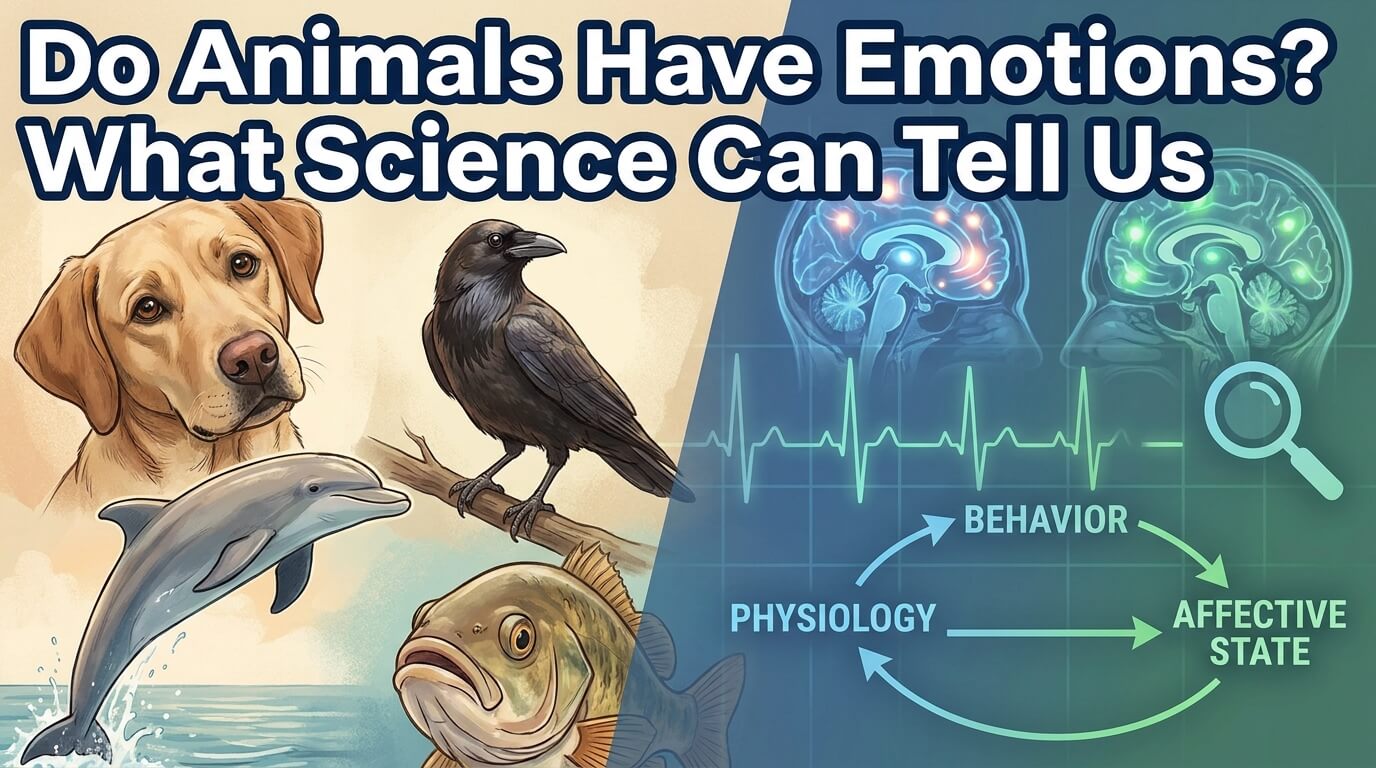
Animals show measurable emotional responses. A frightened deer becomes alert and prepares to escape. A dog anticipates a valued activity. Young mammals and birds often seek play, while bonded animals may become distressed when separated. These changes involve behavior, physiology, attention, learning, and decision-making, not just expressions that happen to look human.
The harder question is what those states feel like from the animal’s point of view. Scientists cannot ask a crow, trout, or octopus for a verbal description. They therefore combine several kinds of evidence and use cautious terms such as affective state, meaning a positive or negative state that matters to the animal. The strongest conclusion is not that every species experiences every human emotion. It is that many animals have biologically important positive and negative states, while evidence for specific complex emotions varies by species and study.
Quick Answer
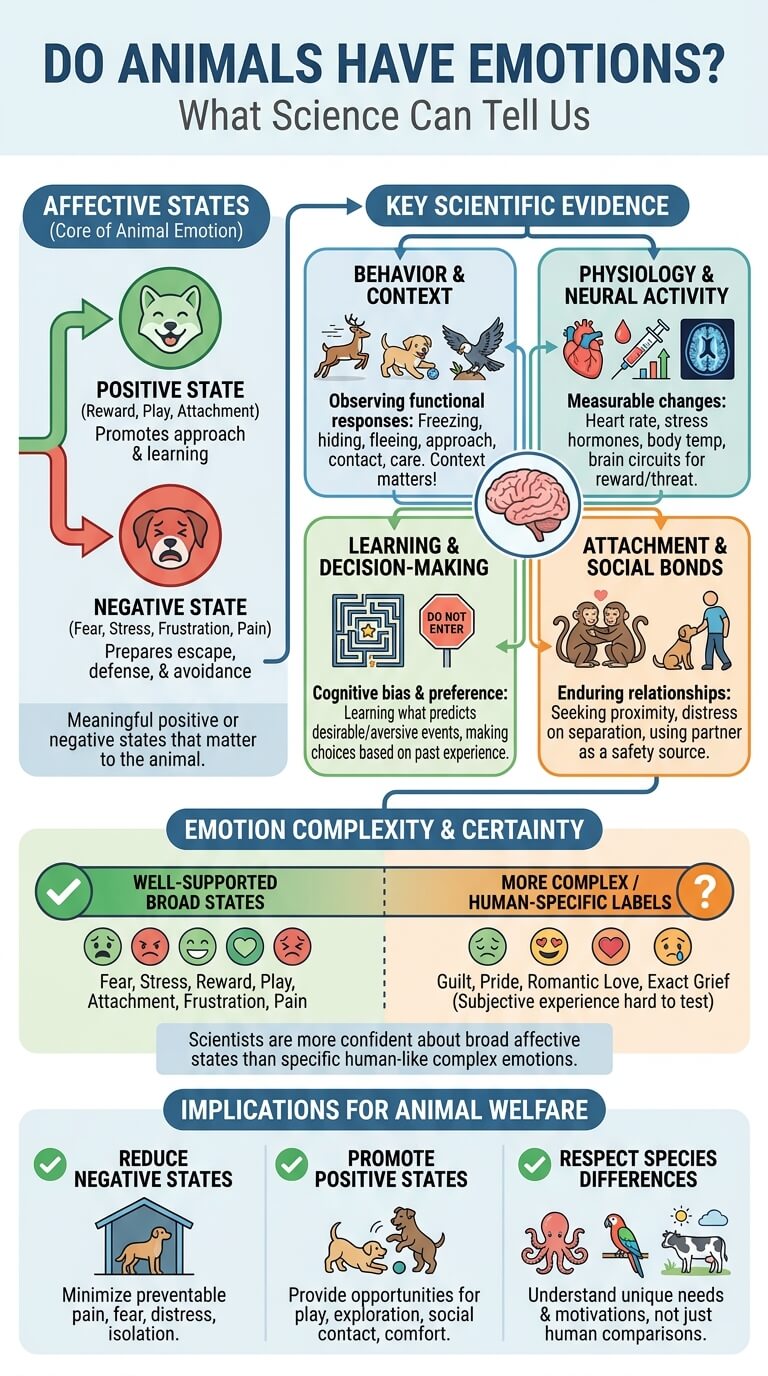
Yes, many animals have emotions in the scientific sense of coordinated states that help them respond to opportunities, threats, social partners, and changing conditions. Fear-like states prepare escape or defense. Reward-related states promote approach and learning. Attachment, frustration, social distress, and longer-lasting mood-like states are supported in several well-studied groups.
Scientists are more confident about these broad states than about claims that an animal feels guilt, pride, romantic love, or grief exactly as a human does. Similar behavior can arise through different mental processes. Strong evidence comes from patterns that agree across behavior, physiology, brain activity, learning, preferences, and later decisions.
Emotion, Feeling, Mood, and Behavior Are Not the Same Thing
Operational definitions used in animal research
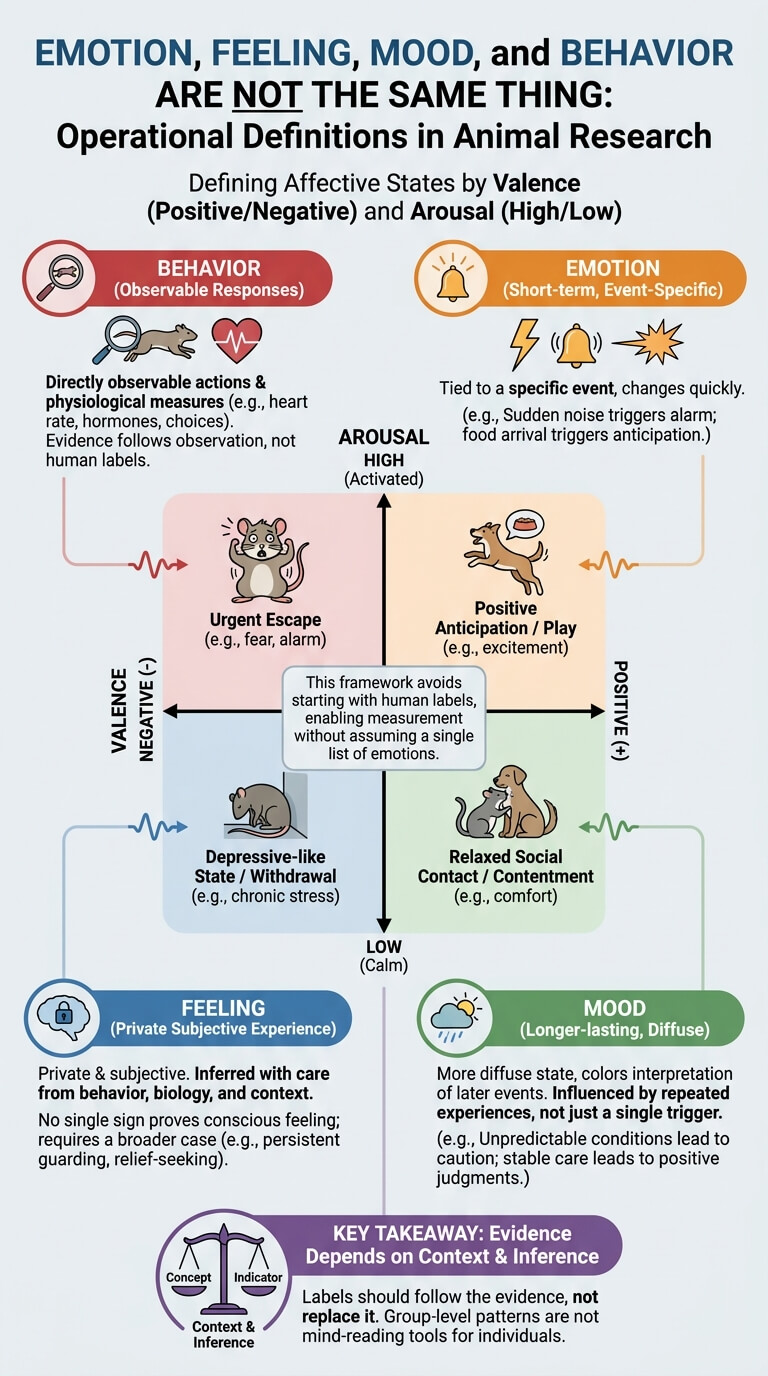
An operational definition describes how a concept will be measured. Researchers may define an affective state by its valence, meaning whether it is positive or negative, and its arousal, meaning how activated or calm the animal is. A high-arousal negative state might involve urgent escape. A low-arousal positive state might involve relaxed social contact.
This approach avoids beginning with a human label and searching for a matching facial expression. A major discussion of how scientists translate between human and animal emotion research emphasizes that evidence depends on the concept, indicator, context, and inference being used. The label should follow the evidence, not replace it.
Observable emotional responses versus private subjective experience
Behavior can be observed directly. Heart rate, stress hormones, body temperature, neural activity, and choices can also be measured. Subjective feeling is private. Even with another person, we infer feelings from speech, behavior, and shared biology. With nonhuman animals, speech is unavailable and bodies may work differently, so the inference requires more care.
This does not make the question impossible. It means that no single sign proves a conscious feeling. A withdrawal reflex shows detection of harm, but by itself it does not establish pain as an unpleasant experience. Persistent guarding, altered motivation, learned avoidance, relief-seeking, and lasting changes provide a broader case.
Short-term emotions versus longer-lasting mood states
An emotion is often tied to a particular event and changes relatively quickly. A sudden noise may trigger alarm, or the arrival of food may produce positive anticipation. A mood is more diffuse and can influence how an animal interprets later events even when the original trigger is gone. An integrative framework for animal affect describes how valence, arousal, and time can be combined without assuming one rigid list of emotions.
Researchers study this distinction because repeated experiences can change an animal’s expectations. An animal living in unpredictable or uncomfortable conditions may respond more cautiously to ambiguous cues. One receiving stable care, social contact, or enrichment may make more positive judgments. These are group-level patterns, not mind-reading tools for diagnosing one individual.
How Scientists Study Animal Emotions
Behavioral indicators and context-specific responses
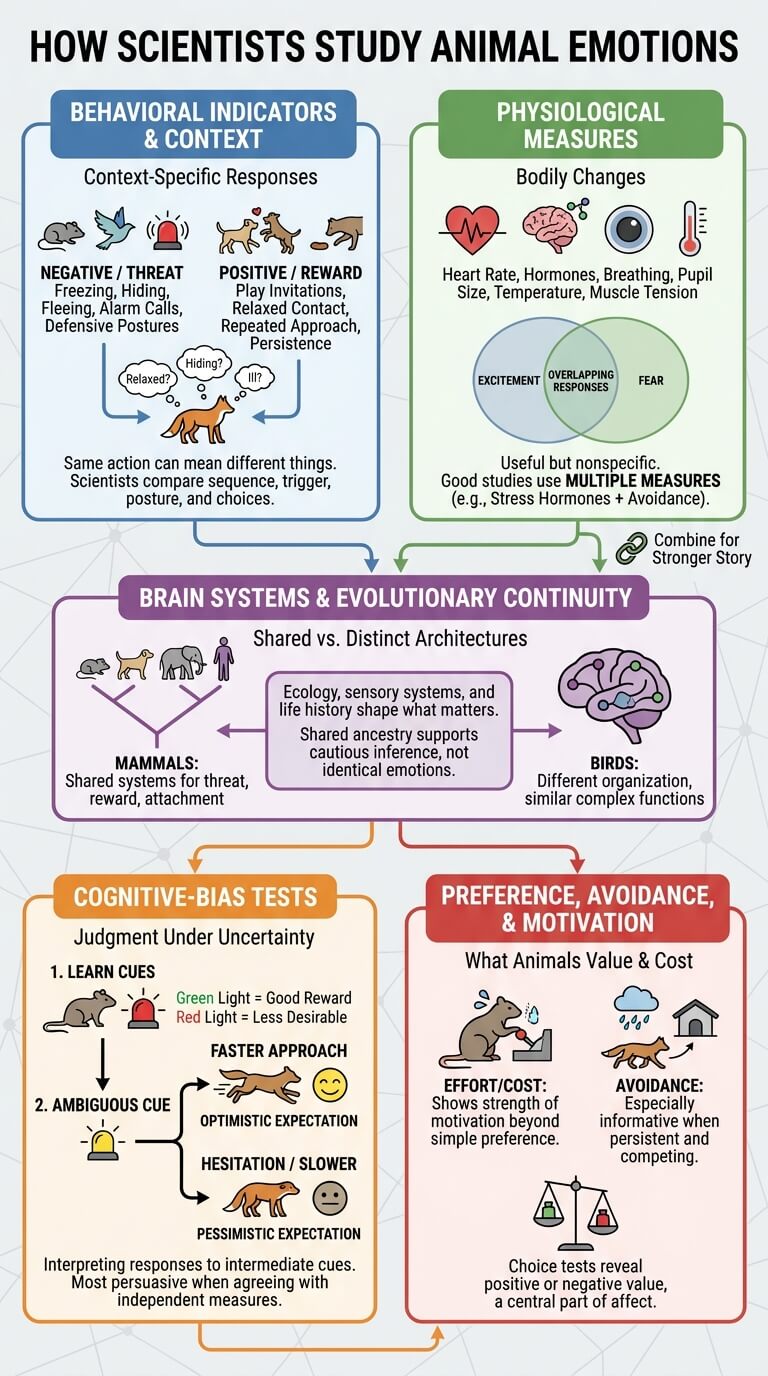
Researchers begin with behavior that has a clear function in context. Freezing, hiding, alarm calling, fleeing, defensive postures, and risk-sensitive scanning can indicate a threat-related state. Play invitations, relaxed contact, repeated voluntary approach, and persistence toward a reward can indicate positive motivation.
The same action can mean different things in different species or situations. A still animal may be relaxed, hiding, freezing in fear, conserving energy, or experiencing illness. Scientists compare the full sequence, the trigger, body posture, choices, recovery, and what happens when conditions change.
Heart rate, hormones, and other physiological measures
Emotional events can alter heart rate, breathing, pupil size, skin or surface temperature, muscle tension, and hormone levels. These measures are useful because they reveal changes that may not be obvious from behavior. They are also nonspecific. Exercise, excitement, pain, heat, and fear can produce overlapping physiological responses.
Good studies therefore use more than one measure. A rise in stress hormones paired with avoidance, vigilance, and a learned preference for safety tells a stronger story than a hormone result alone. Baseline differences among species and individuals must also be considered.
Brain systems and evolutionary continuity
Mammals share many brain and body systems involved in threat, reward, social attachment, and pain. Birds organize their brains differently but have circuits capable of complex learning, social behavior, and flexible decision-making. Similar functions can evolve in different neural architectures.
Shared ancestry supports cautious evolutionary inference, especially among related animals. It does not mean that a mouse, dog, elephant, and human have identical emotional lives. Ecology, sensory systems, development, social organization, and life history shape what information matters to each species.
Cognitive-bias tests and judgment under positive or negative states
Judgment-bias tasks ask how an animal responds to an ambiguous cue. First, the animal learns that one cue predicts something desirable and another predicts something less desirable or aversive. Researchers then present an intermediate cue. Faster approach can be interpreted as a more optimistic expectation, while hesitation can be interpreted as a more pessimistic one.
A widely used review of judgment-bias tasks describes both their promise and their limitations. Results can be affected by training, motivation, cue perception, activity level, prior experience, and study design. These tests are most persuasive when they agree with independent measures.
Preference, avoidance, and motivation experiments
Choice tests can reveal what an animal values. Researchers may measure whether it works to gain social contact, nesting material, shelter, play opportunities, a comfortable temperature, or relief from an unpleasant condition. The amount of effort or cost the animal accepts provides information beyond a simple preference.
Avoidance is especially informative when it lasts after an event and competes with another strong motivation. Still, a preference does not automatically reveal a named emotion. It shows that outcomes have positive or negative value to the animal, which is a central part of affect.
Which Emotions Have the Strongest Evidence?
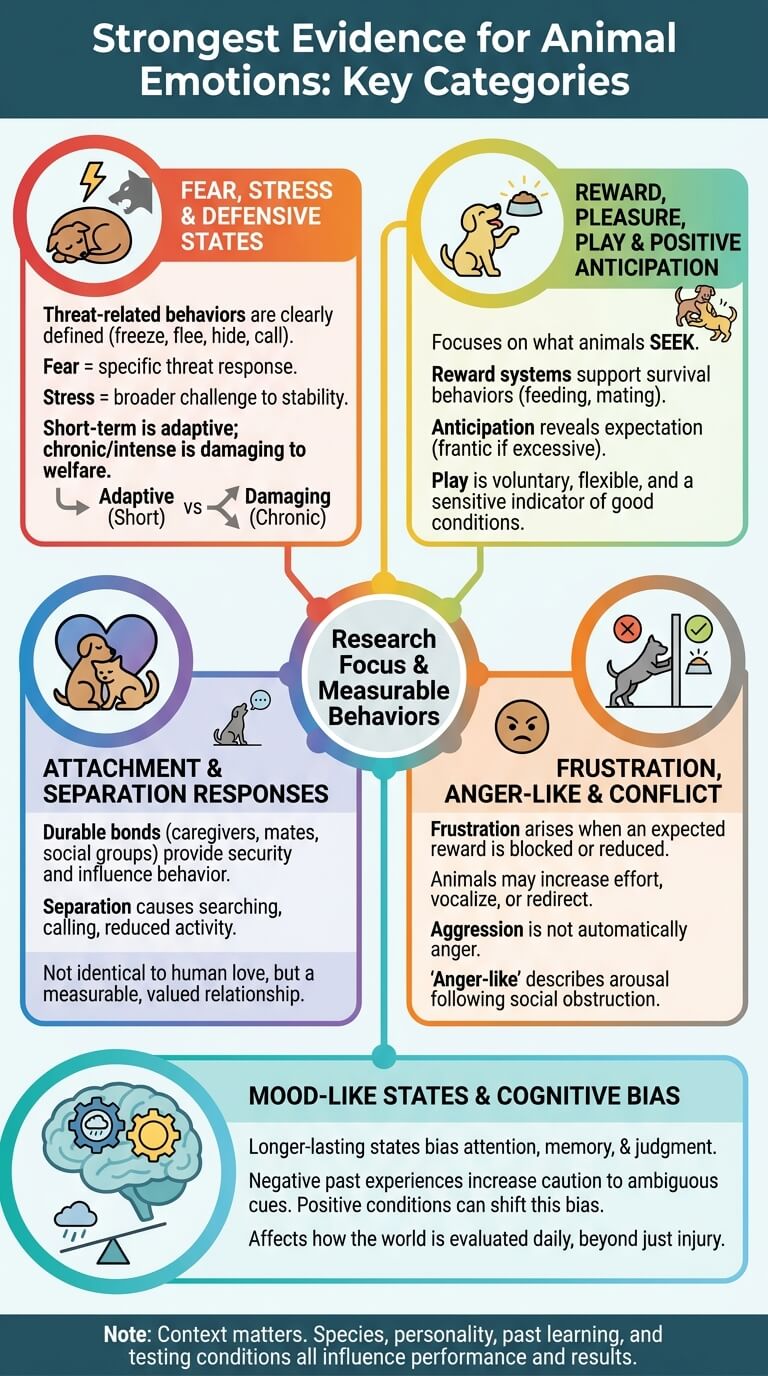
Fear, stress, and defensive states
Threat-related states are among the best studied because their behaviors and survival functions are clear. Animals detect predators, aggressive rivals, dangerous places, sudden disturbances, and signals associated with past harm. They may freeze, flee, hide, call, defend themselves, or avoid the location later.
Fear and stress are not interchangeable. Fear usually refers to a response to an identified threat. Stress is a broader physiological and behavioral response to demands that challenge stability. Short stress responses can be adaptive, while intense, repeated, or uncontrollable stress can damage welfare and alter future behavior.
Reward, pleasure, play, and positive anticipation
Positive emotion research examines what animals seek rather than only what they avoid. Reward systems support feeding, exploration, mating, caregiving, social contact, and learning. Anticipatory behavior before a predictable valued event can reveal positive expectation, although frantic activity can also reflect frustration if waiting becomes excessive.
Play is another important indicator. It is often voluntary, repeated, flexible, and sensitive to safety, health, age, and social conditions. Play does not prove that every movement is joyful, but its decline can be useful when evaluating poor conditions, and its presence can reveal opportunities for positive engagement.
Attachment and separation responses
Young mammals form attachments to caregivers, and many social species develop durable bonds with mates, relatives, group members, or human caretakers. Bonded partners can influence exploration, stress recovery, protection, feeding, and access to information. Separation may produce searching, calling, reduced activity, or changes in eating and sleep.
Attachment is not identical to human romantic love. It is a measurable relationship in which a partner has special value and can provide security or regulate behavior. The form and duration of bonds differ greatly among species.
Frustration, anger-like responses, and social conflict
Frustration can arise when an expected reward is blocked, delayed, reduced, or made unpredictable. Animals may increase effort, repeat an unsuccessful action, vocalize, redirect behavior, or eventually disengage. Researchers distinguish frustration from fear and physical pain by manipulating the expected outcome and comparing response patterns.
Aggression does not automatically mean anger. It can be defensive, territorial, competitive, parental, predatory, or learned. The phrase anger-like is safer when a study identifies arousal and approach following social obstruction but cannot establish the animal’s private experience.
Mood-like states that influence later decisions
Longer-lasting affective states can bias attention, memory, and judgment. An animal with repeated negative experiences may attend more to threats or interpret unclear cues more cautiously. Positive housing, control over the environment, or rewarding interaction can shift some measures in the opposite direction.
These findings matter because welfare is not only the absence of injury. Daily conditions can change how an animal evaluates the world. One result rarely settles the issue, since species, personality, previous learning, and testing conditions may all affect performance.
What About Complex Emotions?
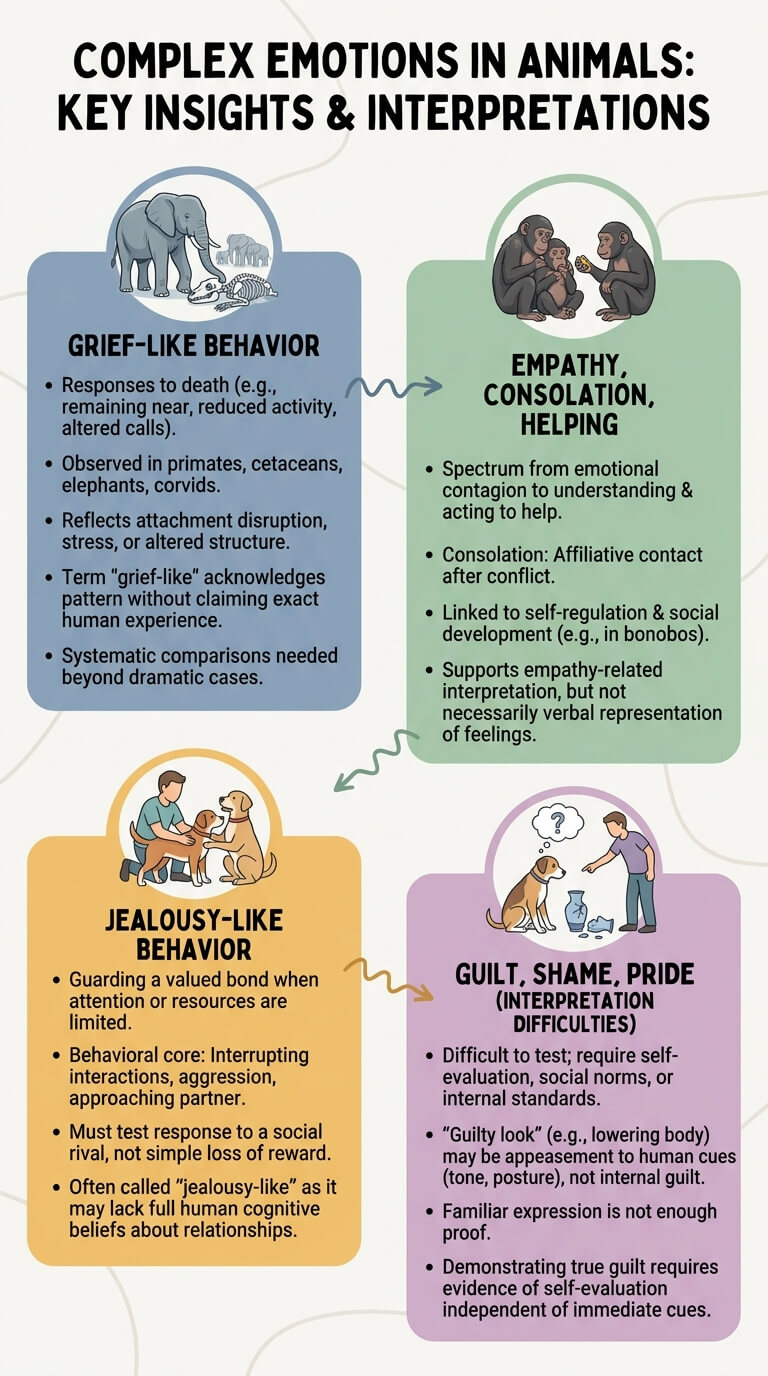
Grief-like behavior and responses to death
Animals sometimes remain near a dead group member, touch or inspect the body, carry a dead infant, alter calls, reduce activity, or change social behavior. Such responses have been reported in primates, cetaceans, elephants, corvids, and other animals. They show that death or disappearance can be socially important.
The term grief-like acknowledges the pattern without claiming an exact human experience. A prolonged change may reflect attachment disruption, searching, stress, confusion, altered group structure, or several processes together. Dramatic cases are valuable observations, but systematic comparisons are needed to learn what is typical.
Empathy, consolation, and helping behavior
Empathy can refer to several levels, from automatically matching another individual’s arousal to understanding its situation and acting to help. Emotional contagion is the simpler case. One animal’s distress changes the state or behavior of another. Consolation involves affiliative contact directed toward a distressed individual after conflict.
Research on the development of socio-emotional competence in bonobos found links among self-regulation, social development, and consolation behavior. This supports an empathy-related interpretation, but it does not show that bonobos verbally represent another’s feelings as humans might.
Jealousy-like behavior and social competition
When attention, food, mates, or social access are limited, animals may interrupt interactions, approach a valued partner, display aggression, or try to regain access. Carefully controlled studies can test whether the response depends on a social rival rather than simple loss of reward.
Researchers often say jealousy-like because human jealousy includes beliefs about relationships, rivals, and possible loss. An animal may show the behavioral core of guarding a valued bond without sharing every cognitive component of adult human jealousy.
Guilt, shame, pride, and why interpretation is difficult
These emotions are difficult to test because they may require self-evaluation, social norms, beliefs about how others judge an action, or comparison with an internal standard. A dog lowering its body, avoiding gaze, or moving cautiously after an owner discovers damage may look guilty. The behavior may instead be an appeasement response to the owner’s tone, posture, or prior experience of scolding.
This does not mean dogs have no emotions. It means a familiar expression is not enough to identify guilt. Demonstrating guilt would require evidence that the animal evaluates its own action as a violation even when human cues and immediate consequences are controlled.
Cross-Species Evidence and Important Differences

Mammals and shared affective systems
Mammals provide much of the evidence because they share many neural and hormonal systems, are often socially expressive, and have been studied in laboratories, farms, homes, and the wild. Rodents show threat learning, reward seeking, social buffering, play, and changes in judgment after different experiences. Primates, elephants, cetaceans, dogs, pigs, and other mammals add evidence from bonding, cooperation, consolation, conflict, and culture.
No mammal should be treated as a small human. A rat’s social needs, a pig’s foraging motivation, and an elephant’s relationships arise from different bodies and ecologies. Emotional capacity can be widespread while emotional priorities remain species-specific.
Birds, play, bonding, and social responses
Birds challenge the assumption that mammal-like brain anatomy is required for complex affective behavior. Parrots, corvids, geese, penguins, and many songbirds form social bonds, respond to separation, learn from social signals, engage in play, and adjust behavior after positive or negative events.
Feathers make some body signals difficult for people to read, and a bird may mask weakness around perceived threats. Interpretation should use species-specific posture, vocalization, appetite, activity, social behavior, and environmental context rather than a human-style facial expression.
Fish pain and affective-state evidence
Fish possess nociceptive systems that detect potentially damaging stimulation, but the scientific question extends beyond reflexes. Researchers examine prolonged behavioral change, guarding or rubbing, altered attention, avoidance learning, trade-offs, responses to analgesia, and whether an unpleasant event changes later choices.
A veterinary review on recognizing pain in fish concludes that multiple behavioral and physiological indicators support pain assessment, while emphasizing that indicators differ among species and settings. It is reasonable to treat fish as capable of negative affect and to minimize injury and distress, even though their experience cannot be described in human terms.
Cephalopods and uncertainty around invertebrate experience
Octopuses, squid, and cuttlefish have nervous systems that evolved along a very different path from vertebrate brains. Their learning, exploration, flexible behavior, and injury responses make them especially important in discussions of invertebrate experience. Evidence should not automatically be generalized to every invertebrate.
In one controlled study, octopuses avoided a place associated with noxious injection, preferred a place associated with local anesthetic relief, and showed lasting neural responses. The behavioral and neurophysiological evidence for pain in octopuses supports an affective component rather than a brief withdrawal reflex alone. Replication across species and conditions remains valuable.
Why Anthropomorphism Can Mislead and Also Inform
Projecting human motives onto normal animal behavior
Anthropomorphism means attributing human characteristics to nonhuman animals. It becomes misleading when a person assumes intention from appearance alone. A pet that destroys an object during isolation is not necessarily taking revenge. A snake lying still is not necessarily calm. A primate showing teeth may be signaling tension rather than smiling.
Human intuition is most useful as a question generator. It can prompt a test of whether an animal is afraid, attached, frustrated, or seeking comfort. It should not serve as the final evidence.
The opposite error of assuming animals are emotionless
Rejecting every emotional interpretation can also distort the evidence. Natural selection favors systems that help animals value food, safety, social partners, shelter, and reproductive opportunities. An organism that learns from rewarding and harmful outcomes does not need human language for those outcomes to matter.
The productive position lies between sentimental certainty and automatic denial. Researchers can ask what state best explains the full pattern, how it can be tested, and which alternative explanations remain.
Using cautious language without ignoring evidence
Terms such as fear-like, grief-like, and jealousy-like can signal that behavior resembles part of a human emotion while the subjective experience is uncertain. For better-established states such as fear, pain, reward, and distress, excessive qualification can become misleading when many independent lines of evidence agree.
A useful rule is to match confidence to evidence. Strong claims require consistent results, appropriate controls, species-relevant methods, and ideally replication by independent researchers.
Common Myths and Misunderstandings
A human-like facial expression does not prove a human-like feeling
Faces attract attention, but similar-looking expressions may have different meanings across species. Ear position, body tension, movement, sound, scent, and context may carry more information. Some animals have limited facial mobility yet show clear changes through posture or behavior.
Training and conditioning do not rule out emotion
Learning is one way emotions are studied. Fear conditioning tests how a neutral cue gains negative value. Reward learning tests approach and anticipation. A response being learned does not make it emotionless, just as human excitement about a familiar signal can be both learned and genuinely felt.
Intelligence and emotional capacity are related questions, not identical ones
Solving a puzzle and experiencing a negative or positive state are different capacities. A species does not need to pass a complex reasoning test for pain or fear to matter. Conversely, strong problem-solving performance does not prove every complex emotion. Emotional capacity is related to but distinct from animal intelligence; solving a puzzle is not a prerequisite for experiencing fear, pain, reward, or attachment.
One dramatic story cannot establish a species-wide ability
Anecdotes can reveal behaviors worth studying, especially in rare wild events. They cannot determine how often the behavior occurs, whether it has the proposed meaning, or whether most individuals can do it. Controlled tests and repeated field observations are needed to move from possibility to reliable conclusion.
How Emotion Works With Memory, Communication, and Self-Awareness
Social intelligence, communication, and emotional signaling
Animals use calls, posture, scent, touch, color change, movement, and facial action to influence others. A signal can convey threat, readiness to mate, submission, alarm, or a request for contact without functioning like a human emotion word. Receivers learn which signals predict danger, cooperation, or opportunity.
Memory as a foundation for attachment and learned fear
Emotion and memory interact. A harmful event can make a place or cue easier to remember, while a rewarding social partner can become a source of safety. Long-term bonds require recognizing individuals and updating what past interactions predict. This does not make memory itself an emotion, but memory helps emotional responses become specific and adaptive.
Self-recognition versus emotional awareness
An animal can have positive and negative states without recognizing its reflection. Mirror self-recognition tests one form of self-related cognition and favors animals that rely on vision and can act on a visible mark. It is not a requirement for fear, pleasure, attachment, pain, or distress.
Questions about whether an animal knows that it is afraid, reflects on its feelings, or evaluates itself are more difficult than showing an immediate affective response. They require different experiments and should not be assumed from emotional behavior alone.
What This Means for Animal Welfare
Why evidence of affective states changes care and research standards
If animals can experience negative and positive states, welfare includes more than physical survival. Good care reduces preventable pain, fear, frustration, social stress, and prolonged boredom. It also provides species-appropriate opportunities for comfort, control, exploration, play, foraging, and social contact where those are important.
Welfare decisions often must be made before every philosophical question is settled. When credible evidence indicates a meaningful risk of suffering, precaution can prevent harm while research continues.
Avoiding unnecessary fear, isolation, and distress
Handling, transport, housing, noise, crowding, restraint, social separation, and unpredictable routines can affect animals differently. The safest approach uses knowledge of the species, gradual acclimation where appropriate, suitable shelter, and professional guidance. Wild animals should not be captured or deliberately frightened to test their reactions.
For pets, a sudden or persistent change in activity, appetite, sleep, social behavior, posture, breathing, movement, or elimination can reflect pain, illness, fear, or another problem. Owners should not diagnose an emotional disorder from one behavior. A veterinarian can assess medical causes and recommend safe next steps.
Respecting species-specific needs rather than treating animals like humans
Respect does not require dressing every animal’s experience in human language. A rabbit needs opportunities to hide and forage. A parrot may need complex social and manipulative activity. A pig is strongly motivated to explore with its snout. An octopus requires conditions suited to a flexible marine invertebrate, not a mammal.
Species-appropriate care takes emotional evidence seriously while recognizing that animals value different things. The goal is not to make them live like people. It is to let them function safely as the kinds of animals they are.
FAQ
Can animals feel grief when another animal dies?
Some animals show prolonged, grief-like changes after the death or disappearance of a bonded individual. They may search, call, remain near a body, carry a dead infant, withdraw, or change social behavior. These observations support the idea that loss matters to them, but the exact subjective experience cannot be confirmed. Researchers also consider attachment disruption, stress, confusion, and changes in group structure.
Do animals love their mates, young, or human caregivers?
Many animals form selective, durable bonds and seek proximity, provide care, show distress during separation, or use a familiar partner as a source of safety. Those are measurable components of attachment. Calling the bond love can be reasonable in everyday speech, but science usually describes the behavior and relationship more precisely because human love includes cultural and reflective elements that are difficult to test in another species.
Do dogs feel guilt or react to human cues?
Dogs clearly respond to human tone, posture, gaze, routines, and past consequences. The crouched posture often called a guilty look can occur when an owner behaves as though the dog has done something wrong, even when the dog’s actual action is controlled. This suggests appeasement or anticipation of conflict is an important explanation. It does not prove dogs lack complex emotions, but the expression alone is not evidence of guilt.
Can fish feel pain and distress?
Evidence from nociception, lasting behavior change, avoidance learning, altered motivation, physiological responses, and pain-relief studies supports treating fish as capable of pain and distress. The strength and form of indicators vary among species. Responsible handling and care should minimize injury, prolonged air exposure, harmful water conditions, and other avoidable stressors.
Final Thoughts
Do animals have emotions? The scientific evidence supports a clear but carefully bounded yes. Many species enter positive and negative affective states that change their bodies, behavior, learning, attention, and choices. Fear, reward, distress, attachment, frustration, pain, and mood-like effects have substantial support in well-studied animals.
Uncertainty grows when a claim requires self-evaluation, social rules, or a specifically human narrative, as with guilt, pride, shame, and some interpretations of grief or jealousy. The responsible response is neither to turn animals into people nor to treat them as unfeeling machines. It is to follow converging evidence, respect species differences, and give credible risks to animal welfare the seriousness they deserve.

Ethan Walker is the founder and research editor of Animal Fact Central. He creates and reviews educational animal facts content using trusted wildlife, pet care, and science-based sources. His work focuses on making animal behavior, adaptations, habitats, and species facts clear, accurate, and engaging for everyday readers.
Read More Details About Ethan Walker: https://animalfactcentral.com/ethan-walker/