
How Climate Change Affects Animals explains why animal survival depends on more than a single threat For Students teachers parents wildlife readers animal lovers and conservation beginners who want a clear animal focused explanation of climate change impacts.
Why Climate Change Matters for Animals
The main causes behind how climate change affects animals usually interact. Habitat loss can push animals closer to people, which can raise conflict and make poaching or accidental killing more likely. At the same time, climate stress, pollution, disease, and reduced prey can make recovery slower even where legal protection exists. Readers can compare this idea with IUCN Red List, which gives a reliable reference point for the claim.
Readers comparing how climate change affects animals may also find poaching and wildlife useful for a closer look at a related endangered wildlife topic.
Readers comparing how climate change affects animals may also find why are sharks important to the ocean useful for a closer look at a related endangered wildlife topic.
Readers comparing how climate change affects animals may also find why are elephants endangered useful for a closer look at a related endangered wildlife topic.
Readers comparing how climate change affects animals may also find why are tigers endangered useful for a closer look at a related endangered wildlife topic.
For broader context, the main guide to endangered animals connects this issue with habitat pressure, poaching, climate stress, and conservation choices.
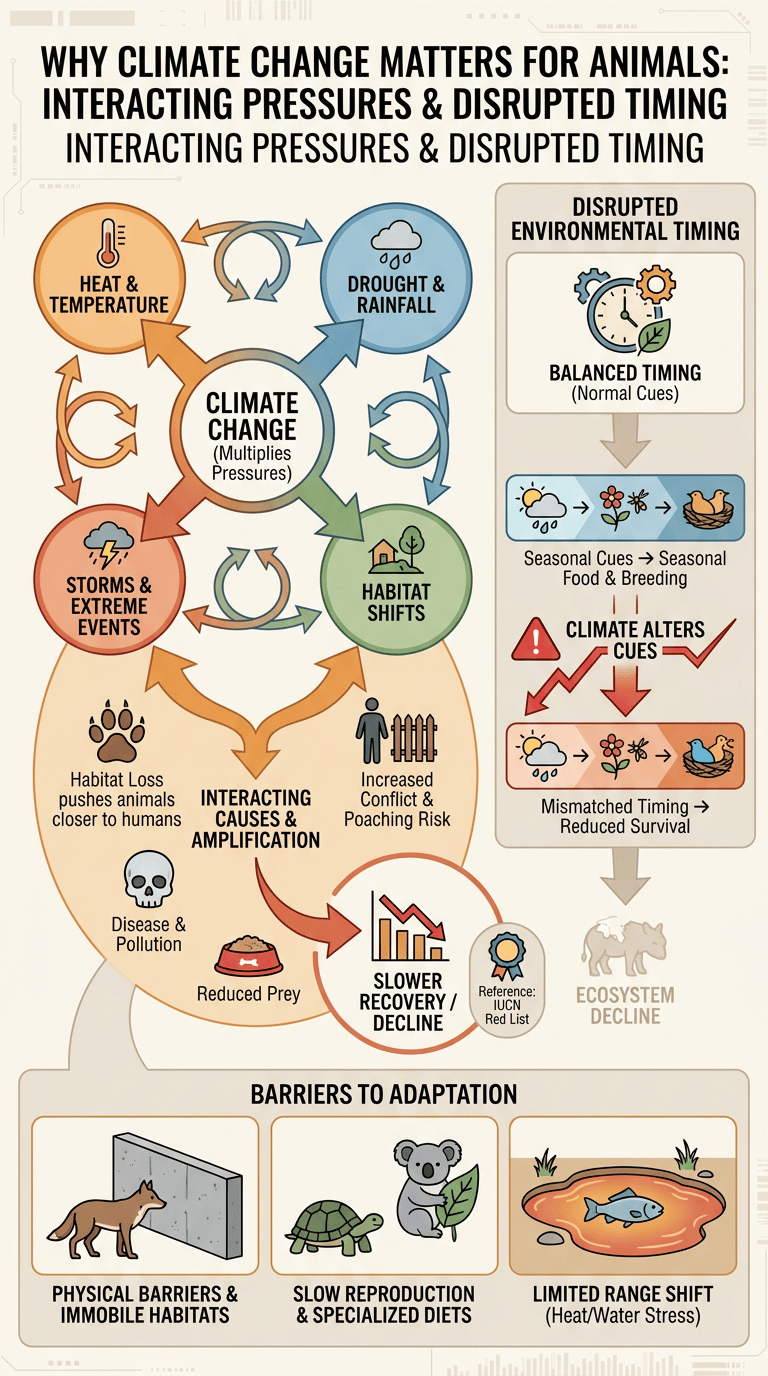
Animals depend on environmental timing
Animals depend on environmental timing is an important part of understanding how climate change affects animals. It shows how biology, habitat, human activity, and conservation decisions connect. Looking at this part carefully helps readers see why a species or ecosystem may decline and why recovery usually takes sustained work.
Temperature
For how climate change affects animals, temperature is best understood as part of why climate change matters for animals, not as a separate problem.
Rainfall
For how climate change affects animals, rainfall is best understood as part of why climate change matters for animals, not as a separate problem.
Seasonal food
For how climate change affects animals, seasonal food is best understood as part of why climate change matters for animals, not as a separate problem.
Breeding cues
For how climate change affects animals, breeding cues is best understood as part of why climate change matters for animals, not as a separate problem.
Climate change adds multiple pressures
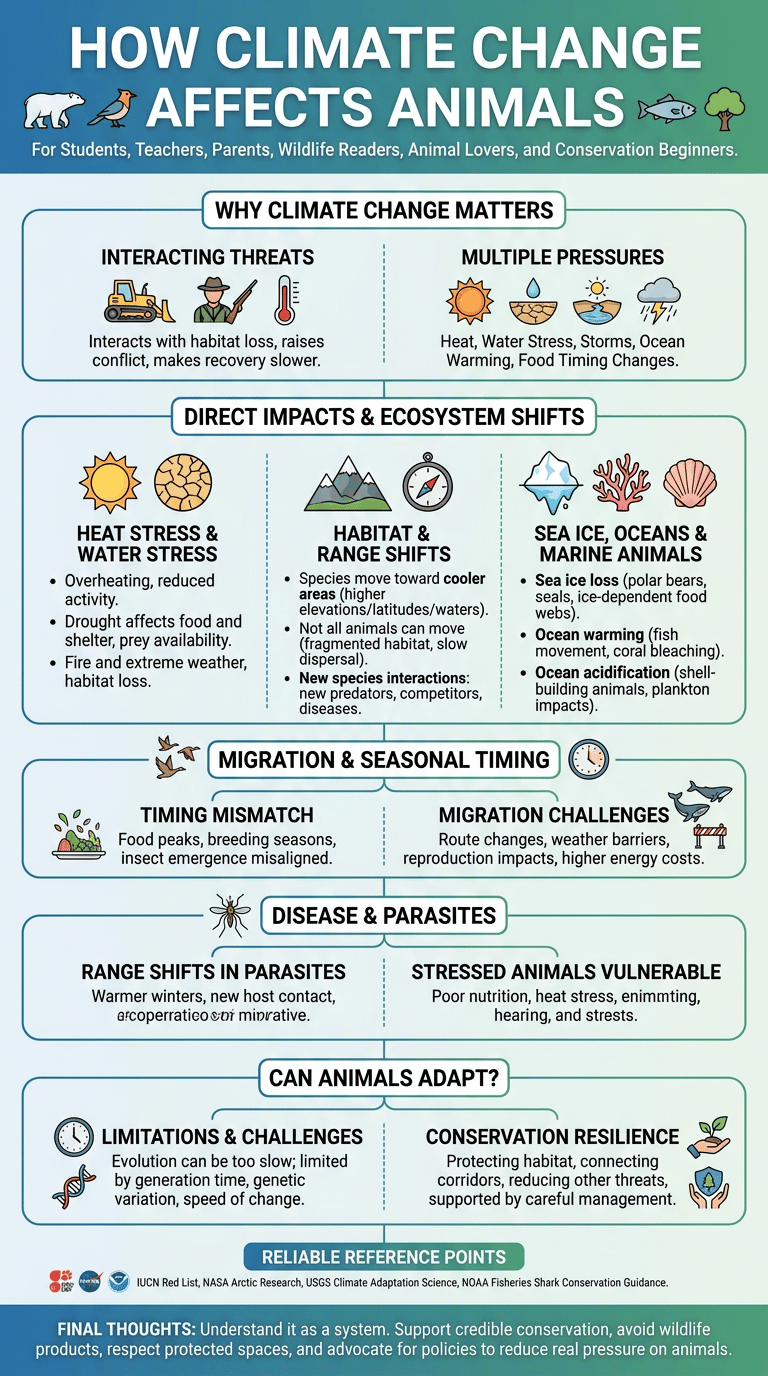
Climate change can affect animals through heat, water stress, storms, sea ice loss, ocean warming, and changes in food timing. Some species can shift range or behavior, but others are limited by barriers, slow reproduction, specialized diets, or habitats that cannot move with them.
Heat
Climate pressure can change temperature, water, food timing, and the places animals can use.
Drought
For how climate change affects animals, drought is best understood as part of why climate change matters for animals, not as a separate problem.
Storms
For how climate change affects animals, storms is best understood as part of why climate change matters for animals, not as a separate problem.
Habitat shifts
Habitat pressure reduces the space, shelter, food, and safe movement routes animals need.
Habitat Shifts
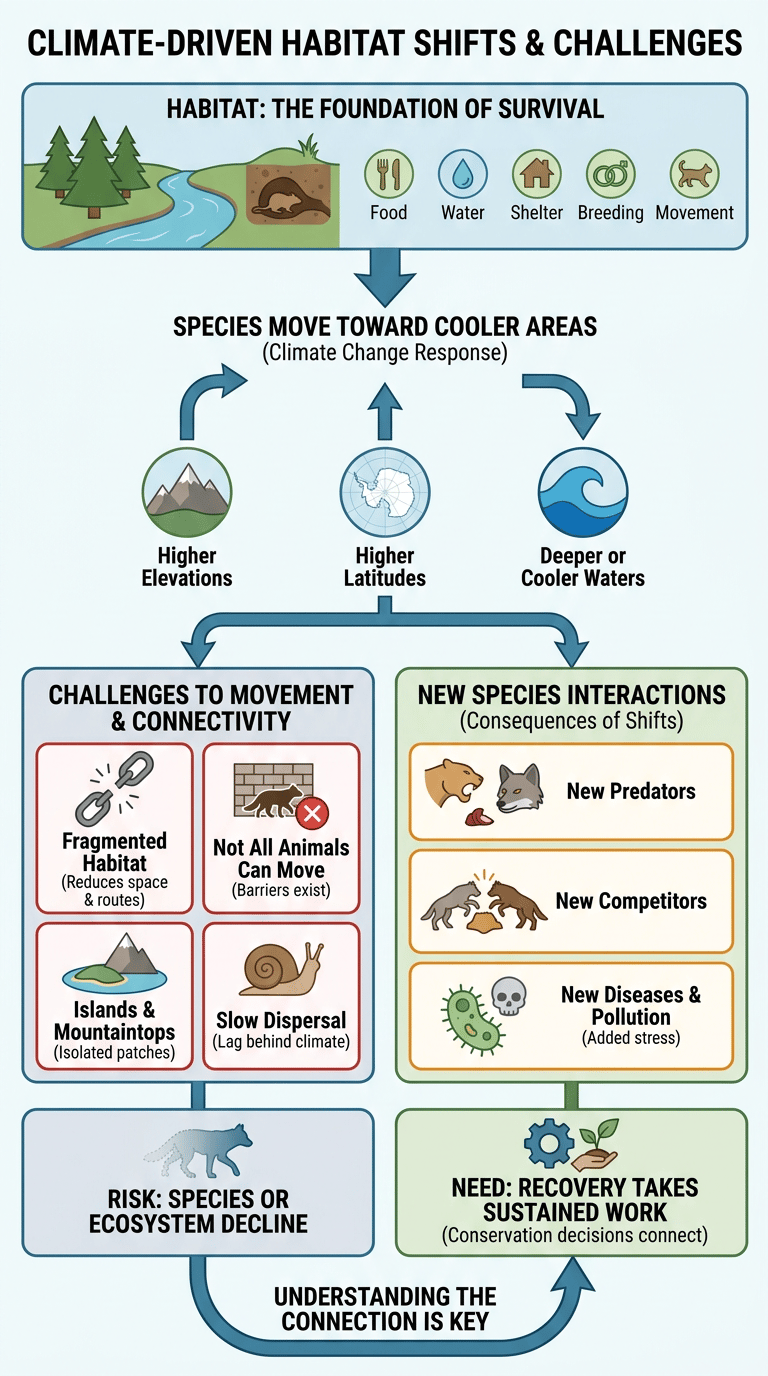
Habitat is the practical foundation of survival. Animals need space for food, water, shelter, breeding, and movement between seasonal areas. When habitat is removed, degraded, or split into small patches, even protected animals may struggle to find mates, avoid conflict, or keep populations connected.
Species may move toward cooler areas
Species may move toward cooler areas is an important part of understanding how climate change affects animals. It shows how biology, habitat, human activity, and conservation decisions connect. Looking at this part carefully helps readers see why a species or ecosystem may decline and why recovery usually takes sustained work.
Higher elevations
For how climate change affects animals, higher elevations is best understood as part of habitat shifts, not as a separate problem.
Higher latitudes
For how climate change affects animals, higher latitudes is best understood as part of habitat shifts, not as a separate problem.
Deeper or cooler waters
For how climate change affects animals, deeper or cooler waters is best understood as part of habitat shifts, not as a separate problem.
Not all animals can move
Not all animals can move is an important part of understanding how climate change affects animals. It shows how biology, habitat, human activity, and conservation decisions connect. Looking at this part carefully helps readers see why a species or ecosystem may decline and why recovery usually takes sustained work. Readers can compare this idea with NASA Arctic animal movement research, which gives a reliable reference point for the claim.
Fragmented habitat
Habitat pressure reduces the space, shelter, food, and safe movement routes animals need.
Islands and mountaintops
For how climate change affects animals, islands and mountaintops is best understood as part of habitat shifts, not as a separate problem.
Slow dispersal
For how climate change affects animals, slow dispersal is best understood as part of habitat shifts, not as a separate problem.
New species interactions
New species interactions is an important part of understanding how climate change affects animals. It shows how biology, habitat, human activity, and conservation decisions connect. Looking at this part carefully helps readers see why a species or ecosystem may decline and why recovery usually takes sustained work.
New predators
For how climate change affects animals, new predators is best understood as part of habitat shifts, not as a separate problem.
New competitors
For how climate change affects animals, new competitors is best understood as part of habitat shifts, not as a separate problem.
New diseases
Disease and pollution add stress that can make already small populations less resilient.
Heat Stress and Water Stress
Climate change can affect animals through heat, water stress, storms, sea ice loss, ocean warming, and changes in food timing. Some species can shift range or behavior, but others are limited by barriers, slow reproduction, specialized diets, or habitats that cannot move with them.
Heat affects body function
Climate change can affect animals through heat, water stress, storms, sea ice loss, ocean warming, and changes in food timing. Some species can shift range or behavior, but others are limited by barriers, slow reproduction, specialized diets, or habitats that cannot move with them.
Overheating
Climate pressure can change temperature, water, food timing, and the places animals can use.
Reduced activity
For how climate change affects animals, reduced activity is best understood as part of heat stress and water stress, not as a separate problem.
Shade and water dependence
For how climate change affects animals, shade and water dependence is best understood as part of heat stress and water stress, not as a separate problem.
Drought affects food and shelter
Drought affects food and shelter is an important part of understanding how climate change affects animals. It shows how biology, habitat, human activity, and conservation decisions connect. Looking at this part carefully helps readers see why a species or ecosystem may decline and why recovery usually takes sustained work.
Plant growth
For how climate change affects animals, plant growth is best understood as part of heat stress and water stress, not as a separate problem.
Prey availability
For how climate change affects animals, prey availability is best understood as part of heat stress and water stress, not as a separate problem.
Water sources
For how climate change affects animals, water sources is best understood as part of heat stress and water stress, not as a separate problem.
Fire and extreme weather
Fire and extreme weather is an important part of understanding how climate change affects animals. It shows how biology, habitat, human activity, and conservation decisions connect. Looking at this part carefully helps readers see why a species or ecosystem may decline and why recovery usually takes sustained work.
Habitat loss
Habitat pressure reduces the space, shelter, food, and safe movement routes animals need.
Smoke and injury
For how climate change affects animals, smoke and injury is best understood as part of heat stress and water stress, not as a separate problem.
Recovery challenges
Population trends need careful surveys because a few visible animals do not prove recovery.
Sea Ice, Oceans, and Marine Animals
Climate change can affect animals through heat, water stress, storms, sea ice loss, ocean warming, and changes in food timing. Some species can shift range or behavior, but others are limited by barriers, slow reproduction, specialized diets, or habitats that cannot move with them.
Sea ice loss
Sea ice loss is an important part of understanding how climate change affects animals. It shows how biology, habitat, human activity, and conservation decisions connect. Looking at this part carefully helps readers see why a species or ecosystem may decline and why recovery usually takes sustained work.
Polar bears
For how climate change affects animals, polar bears is best understood as part of sea ice, oceans, and marine animals, not as a separate problem.
Seals
For how climate change affects animals, seals is best understood as part of sea ice, oceans, and marine animals, not as a separate problem.
Ice-dependent food webs
Climate pressure can change temperature, water, food timing, and the places animals can use.
Ocean warming
Climate change can affect animals through heat, water stress, storms, sea ice loss, ocean warming, and changes in food timing. Some species can shift range or behavior, but others are limited by barriers, slow reproduction, specialized diets, or habitats that cannot move with them. Readers can compare this idea with USGS climate adaptation science, which gives a reliable reference point for the claim.
Fish movement
For how climate change affects animals, fish movement is best understood as part of sea ice, oceans, and marine animals, not as a separate problem.
Coral bleaching
For how climate change affects animals, coral bleaching is best understood as part of sea ice, oceans, and marine animals, not as a separate problem.
Marine food-web shifts
Marine threats often happen across large areas, so management needs monitoring and cooperation.
Ocean acidification
Climate change can affect animals through heat, water stress, storms, sea ice loss, ocean warming, and changes in food timing. Some species can shift range or behavior, but others are limited by barriers, slow reproduction, specialized diets, or habitats that cannot move with them.
Shell-building animals
For how climate change affects animals, shell-building animals is best understood as part of sea ice, oceans, and marine animals, not as a separate problem.
Plankton impacts
For how climate change affects animals, plankton impacts is best understood as part of sea ice, oceans, and marine animals, not as a separate problem.
Food chain effects
For how climate change affects animals, food chain effects is best understood as part of sea ice, oceans, and marine animals, not as a separate problem.
Migration and Seasonal Timing
Migration and Seasonal Timing is an important part of understanding how climate change affects animals. It shows how biology, habitat, human activity, and conservation decisions connect. Looking at this part carefully helps readers see why a species or ecosystem may decline and why recovery usually takes sustained work.
Timing mismatch
Timing mismatch is an important part of understanding how climate change affects animals. It shows how biology, habitat, human activity, and conservation decisions connect. Looking at this part carefully helps readers see why a species or ecosystem may decline and why recovery usually takes sustained work.
Food peaks
For how climate change affects animals, food peaks is best understood as part of migration and seasonal timing, not as a separate problem.
Breeding seasons
For how climate change affects animals, breeding seasons is best understood as part of migration and seasonal timing, not as a separate problem.
Insect emergence
For how climate change affects animals, insect emergence is best understood as part of migration and seasonal timing, not as a separate problem.
Migration route changes
Migration route changes is an important part of understanding how climate change affects animals. It shows how biology, habitat, human activity, and conservation decisions connect. Looking at this part carefully helps readers see why a species or ecosystem may decline and why recovery usually takes sustained work.
Stopover habitats
Habitat pressure reduces the space, shelter, food, and safe movement routes animals need.
Weather barriers
For how climate change affects animals, weather barriers is best understood as part of migration and seasonal timing, not as a separate problem.
Energy costs
For how climate change affects animals, energy costs is best understood as part of migration and seasonal timing, not as a separate problem.
Reproduction impacts
Reproduction impacts is an important part of understanding how climate change affects animals. It shows how biology, habitat, human activity, and conservation decisions connect. Looking at this part carefully helps readers see why a species or ecosystem may decline and why recovery usually takes sustained work.
Nesting success
For how climate change affects animals, nesting success is best understood as part of migration and seasonal timing, not as a separate problem.
Offspring survival
For how climate change affects animals, offspring survival is best understood as part of migration and seasonal timing, not as a separate problem.
Sex ratios where temperature-dependent
For how climate change affects animals, sex ratios where temperature-dependent is best understood as part of migration and seasonal timing, not as a separate problem.
Disease and Parasites
Disease and Parasites is an important part of understanding how climate change affects animals. It shows how biology, habitat, human activity, and conservation decisions connect. Looking at this part carefully helps readers see why a species or ecosystem may decline and why recovery usually takes sustained work.
Range shifts in parasites
Range shifts in parasites is an important part of understanding how climate change affects animals. It shows how biology, habitat, human activity, and conservation decisions connect. Looking at this part carefully helps readers see why a species or ecosystem may decline and why recovery usually takes sustained work.
Warmer winters
For how climate change affects animals, warmer winters is best understood as part of disease and parasites, not as a separate problem.
New host contact
For how climate change affects animals, new host contact is best understood as part of disease and parasites, not as a separate problem.
Vector-borne disease context
Disease and pollution add stress that can make already small populations less resilient.
Stressed animals may be more vulnerable
Stressed animals may be more vulnerable is an important part of understanding how climate change affects animals. It shows how biology, habitat, human activity, and conservation decisions connect. Looking at this part carefully helps readers see why a species or ecosystem may decline and why recovery usually takes sustained work. Readers can compare this idea with NOAA Fisheries shark conservation guidance, which gives a reliable reference point for the claim.
Poor nutrition
For how climate change affects animals, poor nutrition is best understood as part of disease and parasites, not as a separate problem.
Heat stress
Climate pressure can change temperature, water, food timing, and the places animals can use.
Habitat crowding
Habitat pressure reduces the space, shelter, food, and safe movement routes animals need.
Can Animals Adapt to Climate Change?
Climate change can affect animals through heat, water stress, storms, sea ice loss, ocean warming, and changes in food timing. Some species can shift range or behavior, but others are limited by barriers, slow reproduction, specialized diets, or habitats that cannot move with them.
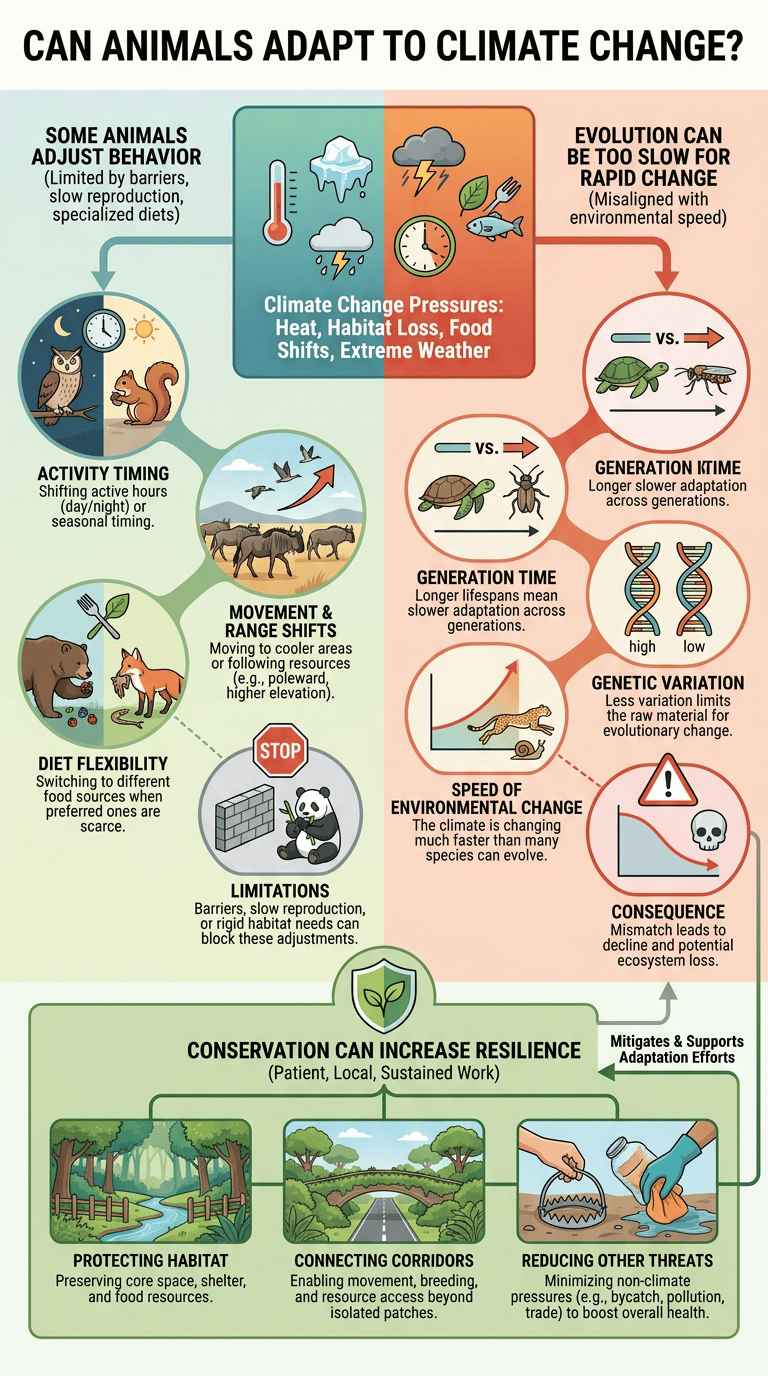
Some animals adjust behavior
Some animals adjust behavior is an important part of understanding how climate change affects animals. It shows how biology, habitat, human activity, and conservation decisions connect. Looking at this part carefully helps readers see why a species or ecosystem may decline and why recovery usually takes sustained work.
Activity timing
For how climate change affects animals, activity timing is best understood as part of can animals adapt to climate change?, not as a separate problem.
Movement
For how climate change affects animals, movement is best understood as part of can animals adapt to climate change?, not as a separate problem.
Diet flexibility
For how climate change affects animals, diet flexibility is best understood as part of can animals adapt to climate change?, not as a separate problem.
Evolution can be too slow for rapid change
Evolution can be too slow for rapid change is an important part of understanding how climate change affects animals. It shows how biology, habitat, human activity, and conservation decisions connect. Looking at this part carefully helps readers see why a species or ecosystem may decline and why recovery usually takes sustained work.
Generation time
For how climate change affects animals, generation time is best understood as part of can animals adapt to climate change?, not as a separate problem.
Genetic variation
For how climate change affects animals, genetic variation is best understood as part of can animals adapt to climate change?, not as a separate problem.
Speed of environmental change
For how climate change affects animals, speed of environmental change is best understood as part of can animals adapt to climate change?, not as a separate problem.
Conservation can increase resilience
Conservation is most useful when it matches the real pressure on the species or habitat. That may mean protected areas, wildlife corridors, trade enforcement, bycatch reduction, restoration, safer coexistence tools, or long-term monitoring. Good conservation is careful, local, and patient.
Protecting habitat
Habitat pressure reduces the space, shelter, food, and safe movement routes animals need.
Connecting corridors
Connected protection helps animals move, breed, and find resources beyond one isolated patch.
Reducing other threats
For how climate change affects animals, reducing other threats is best understood as part of can animals adapt to climate change?, not as a separate problem.
Climate Change and Animals FAQ
Climate change can affect animals through heat, water stress, storms, sea ice loss, ocean warming, and changes in food timing. Some species can shift range or behavior, but others are limited by barriers, slow reproduction, specialized diets, or habitats that cannot move with them.
How does climate change affect animals?
Climate change can affect animals through heat, water stress, storms, sea ice loss, ocean warming, and changes in food timing. Some species can shift range or behavior, but others are limited by barriers, slow reproduction, specialized diets, or habitats that cannot move with them.
Which animals are most affected by climate change?
Climate change can affect animals through heat, water stress, storms, sea ice loss, ocean warming, and changes in food timing. Some species can shift range or behavior, but others are limited by barriers, slow reproduction, specialized diets, or habitats that cannot move with them.
Can animals adapt to global warming?
Can animals adapt to global warming? is an important part of understanding how climate change affects animals. It shows how biology, habitat, human activity, and conservation decisions connect. Looking at this part carefully helps readers see why a species or ecosystem may decline and why recovery usually takes sustained work.
How does climate change affect migration?
Climate change can affect animals through heat, water stress, storms, sea ice loss, ocean warming, and changes in food timing. Some species can shift range or behavior, but others are limited by barriers, slow reproduction, specialized diets, or habitats that cannot move with them.
What can people do to help wildlife facing climate change?
Climate change can affect animals through heat, water stress, storms, sea ice loss, ocean warming, and changes in food timing. Some species can shift range or behavior, but others are limited by barriers, slow reproduction, specialized diets, or habitats that cannot move with them.
Final Thoughts
How climate change affects animals is easiest to understand when every threat is treated as part of a system. Habitat, trade, food webs, climate, and human decisions all shape the outcome. Readers can help most by learning from credible conservation groups, avoiding wildlife products, respecting protected spaces, and supporting policies and projects that reduce real pressure on animals.

Ethan Walker is the founder and research editor of Animal Fact Central. He creates and reviews educational animal facts content using trusted wildlife, pet care, and science-based sources. His work focuses on making animal behavior, adaptations, habitats, and species facts clear, accurate, and engaging for everyday readers.
Read More Details About Ethan Walker: https://animalfactcentral.com/ethan-walker/