
How animals see the world depends on the kind of eyes they have, the light in their habitat, the predators or prey they must notice, and the behaviors that matter most for survival. A hawk scanning open ground, a cat hunting at dusk, a bee visiting flowers, and a horse watching for danger are not simply seeing a sharper or blurrier version of the same scene. Their visual systems are tuned to different problems.
Some animals detect colors humans cannot see. Some notice movement faster than we do. Some sacrifice fine detail for a wider view of the landscape. Others depend on night vision, ultraviolet sensitivity, polarized light, or eyes placed in unusual positions. Vision is not one ability. It is a bundle of trade-offs.
The most useful way to understand animal vision is to stop asking which animal sees “best” and ask what each animal needs vision to do. Seeing the world like a predator, a pollinator, a nocturnal hunter, or a grazing prey animal can mean very different things.
Quick Answer
Animals do not see the world the same way humans do. Their vision can differ in color range, sharpness, night sensitivity, motion detection, depth perception, field of view, and sensitivity to ultraviolet or polarized light. Some animals see fewer colors than humans, while others detect parts of the light spectrum that are invisible to us.
A helpful overview from the Natural History Museum’s animal vision guide explains that animal eyes can vary widely in the number of cone cells they use for color, the way their brains process light, and the kind of visual information they emphasize.
That means there is no single animal-eye setting. A dog’s world is not identical to a bird’s, a bee’s, a cat’s, or a mantis shrimp’s. Each visual system reflects a different balance between detail, speed, color, light sensitivity, direction, and the animal’s daily life.
Why Animal Vision Is Different From Human Vision
Human vision is excellent for many tasks. We see fine detail, judge depth well at close range, and distinguish a rich range of colors under daylight. But our vision is not the standard that all other animals are trying to reach. It is one solution among many.
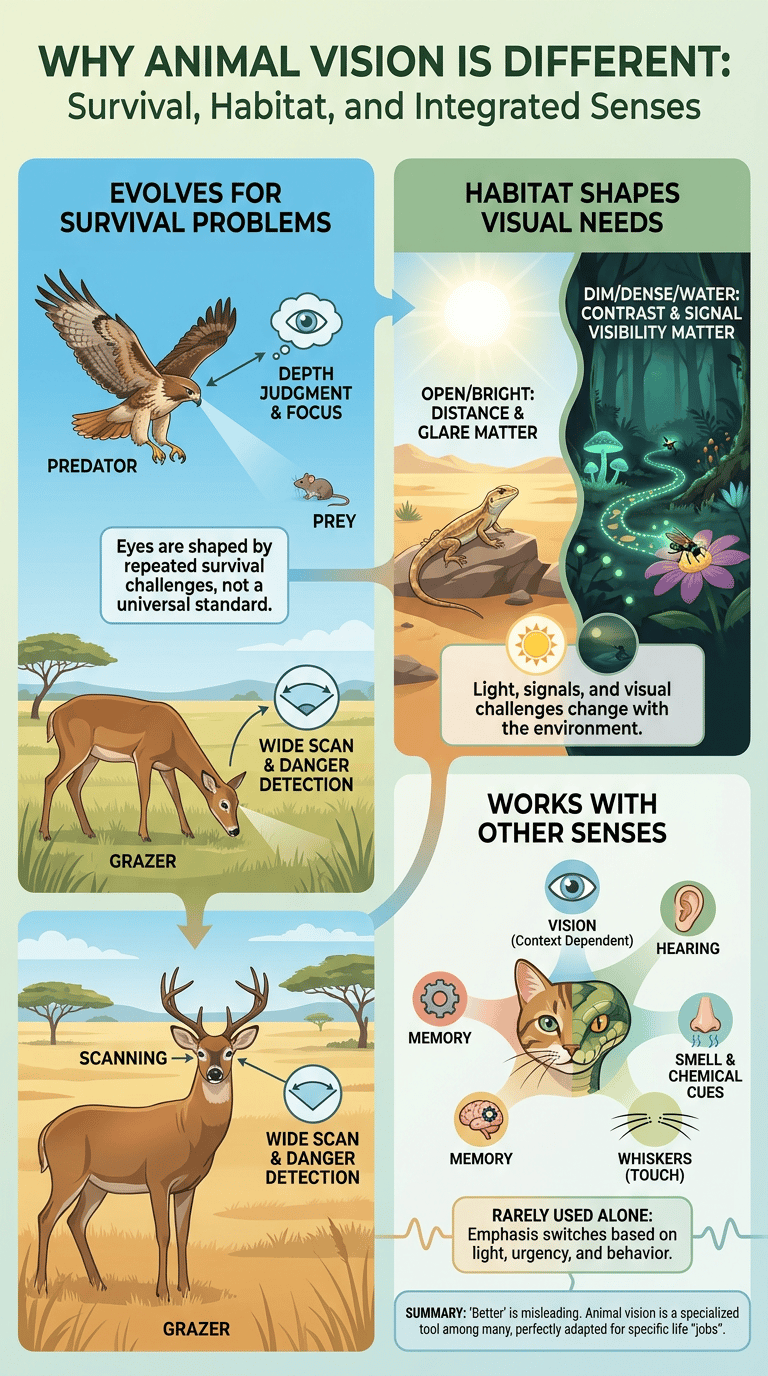
Eyes evolve for survival problems
Eyes are shaped by repeated survival problems. A predator that chases moving prey may benefit from forward-facing eyes and strong depth judgment. A grazing animal may benefit from side-facing eyes that scan a wide area for danger. A nocturnal hunter may benefit from gathering more light, even if the image is less colorful than a daytime scene.
This is why “better vision” can be misleading. Better for what? Seeing tiny prey from a perch, spotting motion at the edge of the visual field, detecting a flower’s ultraviolet pattern, or moving safely in dim forest light are different jobs. An eye that is excellent for one job may be poor for another.
Habitat affects what animals need to see
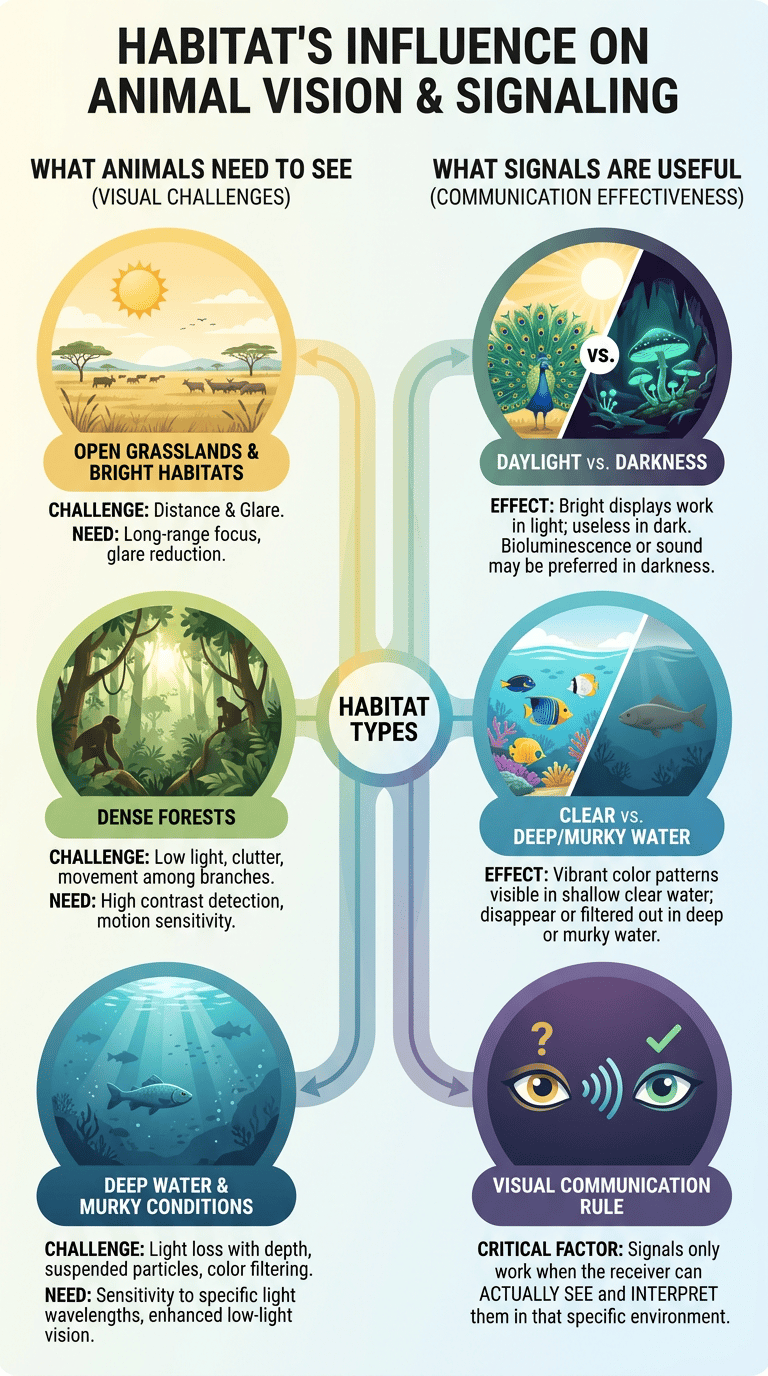
Open grasslands, dense forests, deep water, caves, deserts, and night skies create different visual challenges. In a bright open habitat, distance and glare may matter. In a forest, contrast and movement among branches may matter. Underwater, light changes with depth, suspended particles, and the way water filters colors.
Habitat also affects what signals are useful. A bright display that stands out in daylight may be less useful in darkness. A color pattern that works in clear shallow water may disappear in deeper or murkier conditions. Visual communication only works when another animal can actually see and interpret the signal.
Vision works with other senses
Animals rarely use vision alone. A snake may use sight along with chemical cues from the tongue and, in some groups, heat-sensitive pits. A cat uses vision, hearing, smell, whiskers, and memory while hunting. A migrating bird may use visual landmarks along with sun, star, magnetic, and social cues.
This matters because animal vision should not be treated as a replacement for every other sense. Many animals switch emphasis depending on light, distance, urgency, and behavior. Vision may dominate in one moment and become secondary in another.
The Main Ways Animal Vision Can Differ
Animal vision varies in several major ways. These differences explain why the same landscape can hold different information for different species.
Color vision and color blindness
Color vision depends partly on cone cells, which are light-sensitive cells involved in detecting different wavelengths. Humans usually have three cone types. Many mammals have two, which often means they distinguish fewer color categories than most humans. Some birds, reptiles, fish, and insects can detect ultraviolet light as part of their visual world.
Color blindness in animals does not mean useless vision. A dog that cannot distinguish red and green the way many humans can may still be very good at detecting brightness, motion, shape, and scent-linked information. Color is one layer of vision, not the whole system.
Ultraviolet vision
Ultraviolet light is just beyond the violet end of the spectrum visible to humans. Many animals can detect some UV wavelengths. For them, feathers, flowers, urine marks, skin patches, or reflective surfaces may carry information humans miss unless special equipment is used.
Birds are a major example. The Cornell Lab’s American Kestrel profile notes that birds can see ultraviolet light and that kestrels may use UV-reflective vole urine trails as hunting clues, based on observations from a close relative, the Eurasian Kestrel.
Night vision and low-light sensitivity
Nocturnal and crepuscular animals, meaning animals active at night or around dawn and dusk, often have eyes adapted to gather more light. Large pupils, many rod cells, and reflective structures behind the retina can help make dim scenes more usable.
Domestic cats are a familiar example. The Animal Diversity Web domestic cat account describes the tapetum lucidum, a reflective layer that intensifies light in the eye and helps cats see well in low light. That glow seen in a cat’s eyes at night comes from reflected light, not from the eyes producing light on their own.
Motion detection
For many animals, noticing movement is more important than reading fine detail. A fly avoiding a swat, a frog snapping at a small moving insect, or a deer detecting a predator’s shift in posture all rely on motion information. Fast motion detection can help an animal respond before a threat or opportunity is fully clear.
Motion sensitivity can also create blind spots in understanding. Some animals may ignore still objects but react sharply when those objects move. Others may detect movement in a wide field but not see fine detail as clearly as humans do. Vision is often tuned to action.
Field of view and depth perception
Field of view is the amount of space an animal can see without moving its head. Depth perception helps an animal judge distance. Eye placement strongly influences both. Forward-facing eyes create more overlap between the two eyes, which helps with depth judgment. Side-facing eyes give broader coverage, which helps detect danger from many directions.
Cornell Lab’s bird glossary defines binocular vision as vision produced when both eyes detect the same object, creating three-dimensional information. It also defines monocular vision as the flatter view produced when side-placed eyes see different parts of the world. These are not good and bad categories. They are different solutions.
Polarized light detection
Polarized light has waves that vibrate in particular directions. Humans do not usually notice this pattern unaided, but many animals can use it. Insects, some fish, crustaceans, and other animals may use polarization patterns for navigation, water detection, contrast, or communication.
A polarisation vision review in Philosophical Transactions B describes polarization sensitivity as widespread across many animal groups and emphasizes that modern methods have expanded what researchers can test. This is a good reminder that animal vision includes dimensions humans rarely think about.
Predator Vision Versus Prey Vision
Predator and prey vision are often compared because eye placement tells a visible story. Many predators have eyes facing forward. Many prey animals have eyes on the sides of the head. The pattern is useful, but it is not a perfect rule for every species.
Forward-facing eyes and depth judgment
Forward-facing eyes give more binocular overlap. That overlap helps animals judge distance, which is valuable when pouncing, grabbing, diving, or striking. Cats, owls, primates, and many raptors use strong depth information when targeting food or moving through complex spaces.
Cheetahs show how predator vision can be linked to hunting style. The Smithsonian National Zoo’s cheetah profile describes cheetahs as having eyes positioned for maximum binocular vision and elongated retinal foveas that support a sharp, wide-angle view while scanning and chasing prey.
Side-facing eyes and wide awareness
Side-facing eyes help many prey animals watch a wider area. Horses, deer, rabbits, and many birds can monitor much of the environment while feeding or moving. That wide awareness can reveal a predator before it gets close.
The trade-off is that wide coverage may reduce the area where both eyes overlap. A grazing animal may need to move its head to inspect something in detail. It may also react strongly to sudden movement at the edge of its vision because early detection is often more useful than waiting for a perfect image.
Trade-offs between detail and coverage
No eye can maximize every visual feature at once. Increasing field of view may reduce binocular overlap. Gathering more light may reduce sharpness or color detail. Processing extremely fast movement may emphasize speed over high-resolution detail.
This is why predator versus prey vision should be treated as a framework, not a rigid law. Some predators need broad awareness too. Some prey animals also need depth judgment for jumping, flying, climbing, or landing. The important idea is trade-off, not stereotype.
Animal Examples That See the World Differently
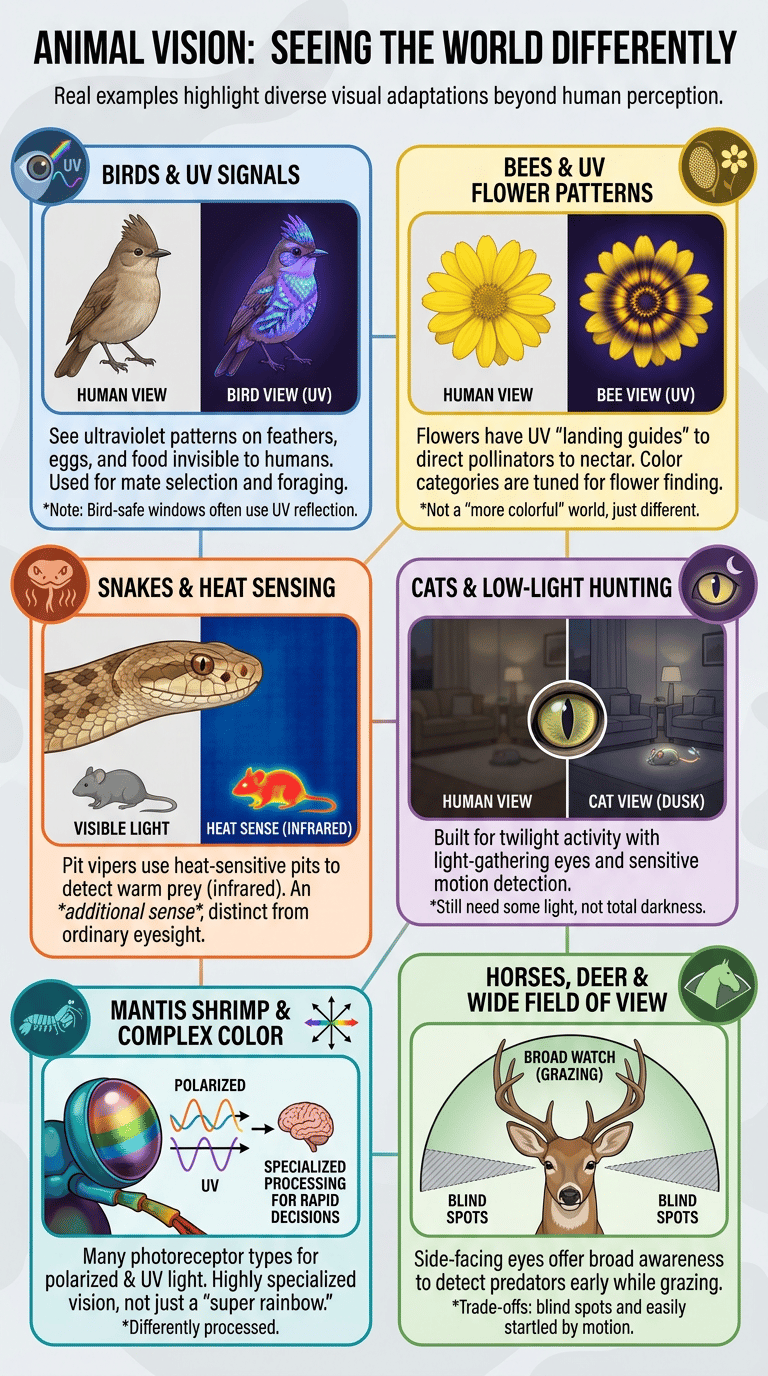
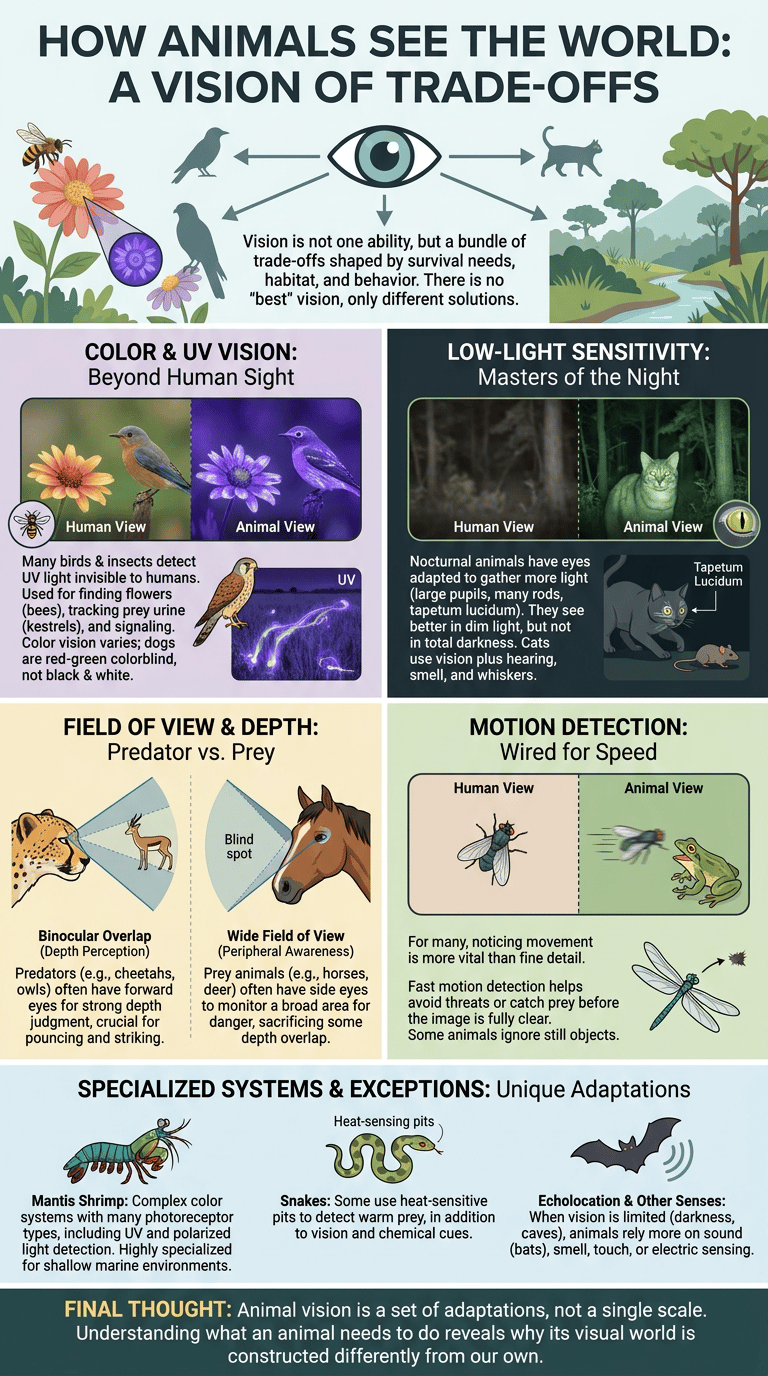
The easiest way to imagine animal vision is through real examples. Each of the animals below highlights a different visual problem.
Birds and ultraviolet signals
Many birds can see ultraviolet wavelengths that humans cannot. This can change how feathers, eggs, food, and habitat cues appear. Two birds that look nearly identical to humans may show visual differences to each other because their eyes and brains process a broader range of light.
UV sensitivity also matters for human-wildlife problems. Some window treatments designed for birds use UV-reflective ideas, but these are not perfect for every species or every lighting condition. The larger lesson is that bird vision cannot be judged only by what human eyes notice.
Bees and flower patterns
Bees are famous for using flower cues that are partly invisible to humans. Many flowers have patterns that reflect UV light and can help pollinators locate nectar or pollen. To a bee, a flower may display landing guides that do not stand out to us.
This does not mean bees see a more colorful human-style world. Their color categories are different. Their eyes and brains organize visual information around the tasks that matter to them: finding flowers, navigating, avoiding danger, and returning to a colony or nest.
Cats and low-light hunting
Cats are built for low-light activity, especially around twilight. Their eyes gather and reuse available light, and their pupils can change shape dramatically. They also detect small movements well, which is useful when prey shifts in grass, under furniture, or near cover.
However, cats do not see perfectly in total darkness. They still need some light. They also use whiskers, hearing, smell, and memory to move and hunt. The cat’s visual world is not simply “human vision plus night mode.” It is a different blend of sensitivity, motion, depth, and close-range limitations.
Snakes and infrared-related sensing context
Snake vision varies widely by species and lifestyle. Some day-active snakes have relatively good eyesight, while underground or secretive species may rely more on chemical and tactile cues. Certain snakes, including many pit vipers, pythons, and boas, also have heat-sensitive structures that help detect warm prey.
The Smithsonian National Zoo’s snake explainer notes that some snakes use heat pits to locate prey and that snake vision differs by habitat and species. It is more accurate to call this heat sensing an additional sense rather than ordinary eyesight.
Mantis shrimp and complex color systems
Mantis shrimp are often described as having extraordinary color vision because some species have many types of photoreceptors, including receptors involved in ultraviolet and polarized light detection. That makes their eyes biologically complex and scientifically fascinating.
The caution is that having many photoreceptor types does not automatically mean a mantis shrimp sees the world as a supercharged human rainbow. Research suggests their color processing may work very differently from ours. The safest takeaway is that mantis shrimp vision is highly specialized, especially for rapid visual decisions in shallow marine environments.
Horses, deer, and wide field of view
Horses and deer show the value of side-facing eyes. They can keep broad watch while grazing, which is useful for animals that may be vulnerable when their heads are down. Their visual world emphasizes wide awareness and quick detection of movement.
That wide view has trade-offs. A horse or deer may have blind spots and may need head movement to inspect something directly. Sudden approach from behind, fast motion, or unusual contrast can startle prey animals because their visual systems are tuned to notice potential danger early.
How Vision Shapes Animal Communication
Vision does not only help animals find food or avoid danger. It also shapes how they communicate. A signal only works if the intended receiver can detect it under real habitat conditions.
Bright colors and mating displays
Many animals use color, contrast, shape, and movement in courtship. Bird plumage, fish patterns, lizard displays, and insect wing colors can carry information about species identity, sex, readiness to mate, condition, or territory. What looks decorative to humans may be functional to another animal.
These signals depend on receiver vision. A display that includes UV reflectance may matter more to an animal that sees UV than to us. A flash of movement may matter more in a species highly sensitive to motion. The signal and the eye evolve together in the same environment.
Warning colors and predator learning
Warning colors, also called aposematic colors, can advertise that an animal may be toxic, venomous, distasteful, or otherwise costly to attack. Bright colors in poison frogs, wasps, some caterpillars, and other animals may help predators learn and remember what to avoid.
Color alone is not a safety guarantee. Some harmless species mimic warning patterns, and not every predator responds the same way. The meaning of a warning signal depends on the receiver’s vision, learning experience, hunger, and local ecology.
Body posture, movement, and visual signals
Not all visual communication is colorful. Raised feathers, flattened ears, arched backs, tail position, wing displays, threat postures, courtship dances, and synchronized movement can all send visual information. In many species, motion and body shape may matter as much as color.
Visual signals are one branch of animal communication, especially in courtship, warnings, threat displays, and social behavior.
This is where animal vision connects naturally to behavior. A signal is not just something an animal produces. It is something another animal can detect, interpret, and respond to in context.
Common Myths About Animal Vision
Animal vision myths are common because people often imagine other species as having either weaker human vision or superhero vision. Real animal vision is usually more interesting and more specific.
Dogs do not see only in black and white
Dogs do not see the full color range that most humans see, but that does not mean they see only black, white, and gray. Their color vision is often compared to a form of red-green color blindness in humans. Blue and yellow differences are generally more meaningful to them than red-green differences.
That is why a red toy on green grass may not stand out to a dog the way it does to a human. The toy may still be easy to find by smell, movement, brightness contrast, memory, or texture. A dog’s world is not colorless. It is color-organized differently.
Night vision does not mean perfect vision in total darkness
Many nocturnal animals see better than humans in dim light, but they do not see normally in absolute darkness. Eyes need light to work. A reflective layer, large pupil, or rod-heavy retina can improve sensitivity only when some light is available.
This myth matters for animal welfare and wildlife ethics. Shining bright lights at nocturnal animals can disturb them, and testing an animal’s night vision for curiosity can cause stress. Observe wildlife from a respectful distance and avoid interfering with normal behavior.
More color receptors do not always mean human-like color experience
It is tempting to rank animals by the number of photoreceptor types in their eyes. That number matters, but it is not the whole story. The brain also has to compare signals, process patterns, and use the information in behavior.
Mantis shrimp are the classic caution. Their eyes are complex, but that does not prove they experience color as a richer human-style rainbow. Their visual system may be optimized for fast recognition and special kinds of contrast rather than human-like color detail.
Edge Cases and Exceptions
Some animals challenge simple rules about vision. Reduced vision, unusual habitats, and alternative senses all show that seeing is only one way to understand the world.
Animals that rely more on sound or smell
Many animals use vision less than humans expect. Bats may use echolocation while still having functional eyes. Moles and burrowing animals may rely heavily on touch and smell. Many mammals use scent trails, urine marks, gland secretions, and body odor for social information.
This does not mean these animals are defective. It means their sensory priorities match their habitat. In darkness, underground tunnels, dense vegetation, or turbid water, sound, smell, touch, or electric sensing may provide better information than sight.
Blind cave animals and reduced vision
Some cave-dwelling animals have reduced eyes or no functional eyes. In stable darkness, maintaining complex eyes may bring less benefit, while energy and body development may shift toward touch, smell, taste, or other senses.
Reduced vision is not the same as weakness. A cave fish that finds food, avoids obstacles, and reproduces successfully in darkness is well matched to its world. It only seems poorly equipped if we judge it by daylight standards.
Water, fog, and darkness as visual challenges
Light behaves differently in water, fog, and darkness. Water absorbs and scatters light, so colors and contrast change with depth and clarity. Fog reduces visibility. Darkness limits all eye-based systems unless some light remains.
These conditions explain why other senses become important. Echolocation, chemical cues, lateral line systems in fish, tactile whiskers, and magnetic or celestial cues can fill gaps where vision struggles.
How This Connects to Nearby Animal Topics
Animal vision connects naturally to communication, echolocation, migration, smell, and electric senses. The connection should be light, because each topic has its own main question.
Visual signals in animal communication
Visual signals include color, shape, posture, movement, light reflection, and display behavior. They can help animals court mates, warn rivals, threaten predators, or identify their own species. Their meaning depends on what the receiver can see.
This is why animal communication cannot be understood only from the sender’s side. A signal that looks bold to humans may be even more obvious to another animal, or almost invisible under the wrong light.
Echolocation when vision is limited
Echolocation is useful when light is poor or objects are hard to see. Bats, dolphins, porpoises, and a few cave birds use echoes to gather spatial information. That does not make vision irrelevant. It means sound can handle tasks that vision cannot handle as well in certain conditions.
Comparing vision and echolocation helps prevent a common mistake: assuming that every animal’s world is mainly visual. Some animals build their surroundings from echoes, odors, water movement, heat, or electric fields as much as from light.
Migration cues from stars, sun, and polarized light
Long-distance migration uses a different set of challenges from local vision. Migrating animals may use the sun, stars, landmarks, smell, magnetic cues, polarized light patterns, or social learning. Vision can matter, but it is usually part of a larger navigation system.
Polarized light is especially interesting because it can help some animals read patterns in the sky or water that humans usually overlook. This connection belongs more to navigation than to simple eyesight, but it shows how broad animal perception can be.
FAQ
What animal has the best vision?
There is no single best-vision animal because vision has different jobs. Eagles and other raptors are often excellent at long-distance detail. Cats are strong in dim light. Flies can be extremely sensitive to motion. Many birds and insects detect ultraviolet light. Mantis shrimp have unusually complex photoreceptor systems.
A better question is which animal has the best vision for a specific task. Spotting prey from high in the sky, hunting at dusk, avoiding a swat, finding flowers, and detecting polarized light all require different visual strengths.
Can animals see colors humans cannot?
Yes. Many animals can detect ultraviolet wavelengths that humans cannot see. This includes many birds and insects, along with some fish, reptiles, and other animals. UV sensitivity can affect foraging, mate choice, navigation, or predator detection.
That does not mean every UV-seeing animal has the same visual experience. Different species have different eye structures and brain processing. Some may use UV for broad contrast, while others may use it for detailed patterns or signals.
Why do prey animals have eyes on the sides of their heads?
Side-facing eyes give many prey animals a wider field of view. That helps them detect predators while feeding, resting, or moving. Horses, deer, rabbits, and many birds benefit from monitoring a broad area without constantly turning their heads.
The trade-off is usually less binocular overlap than forward-facing eyes provide. That can affect depth judgment in some parts of the visual field. Prey animals often compensate with head movement, motion sensitivity, hearing, smell, and cautious behavior.
Do animals see the same world humans do?
No. Animals share the same physical world, but their senses filter it differently. A bee may notice UV flower patterns, a cat may notice dim movement at dusk, a horse may monitor a broad sweep of the landscape, and a snake may combine vision with chemical and heat-related cues.
Human vision is only one version of sight. Understanding how animals see the world helps explain their behavior without assuming they are responding to the same visual details we notice.
Final Thoughts
How animals see the world is shaped by survival, habitat, body design, and behavior. Some animals see ultraviolet light. Some gather more light at night. Some watch almost all around themselves, while others focus forward for depth and precision. None of these systems is simply better or worse than human vision. Each is built around trade-offs.
The main takeaway is that vision is not a single scale from weak to strong. It is a set of adaptations. When you understand what an animal needs to find, avoid, chase, attract, or recognize, its way of seeing the world starts to make much more sense.

Ethan Walker is the founder and research editor of Animal Fact Central. He creates and reviews educational animal facts content using trusted wildlife, pet care, and science-based sources. His work focuses on making animal behavior, adaptations, habitats, and species facts clear, accurate, and engaging for everyday readers.
Read More Details About Ethan Walker: https://animalfactcentral.com/ethan-walker/