
Dolphins are highly capable learners with strong social memory, flexible communication, sophisticated cooperation, and several locally learned foraging traditions. Those findings make them important subjects in the study of animal minds. They do not, however, provide a scientific basis for assigning dolphins a human IQ score or saying that a dolphin thinks like a child of a particular age.
The most convincing answer to how smart are dolphins is therefore specific rather than sensational: well-studied bottlenose dolphins can learn abstract rules, recognize familiar individuals across different senses, remember old companions for many years, coordinate with partners, and adapt behavior to changing tasks. Their abilities evolved for life in a three-dimensional ocean, where sound, social relationships, movement, and cooperation matter in ways that differ sharply from life on land.
Quick Answer
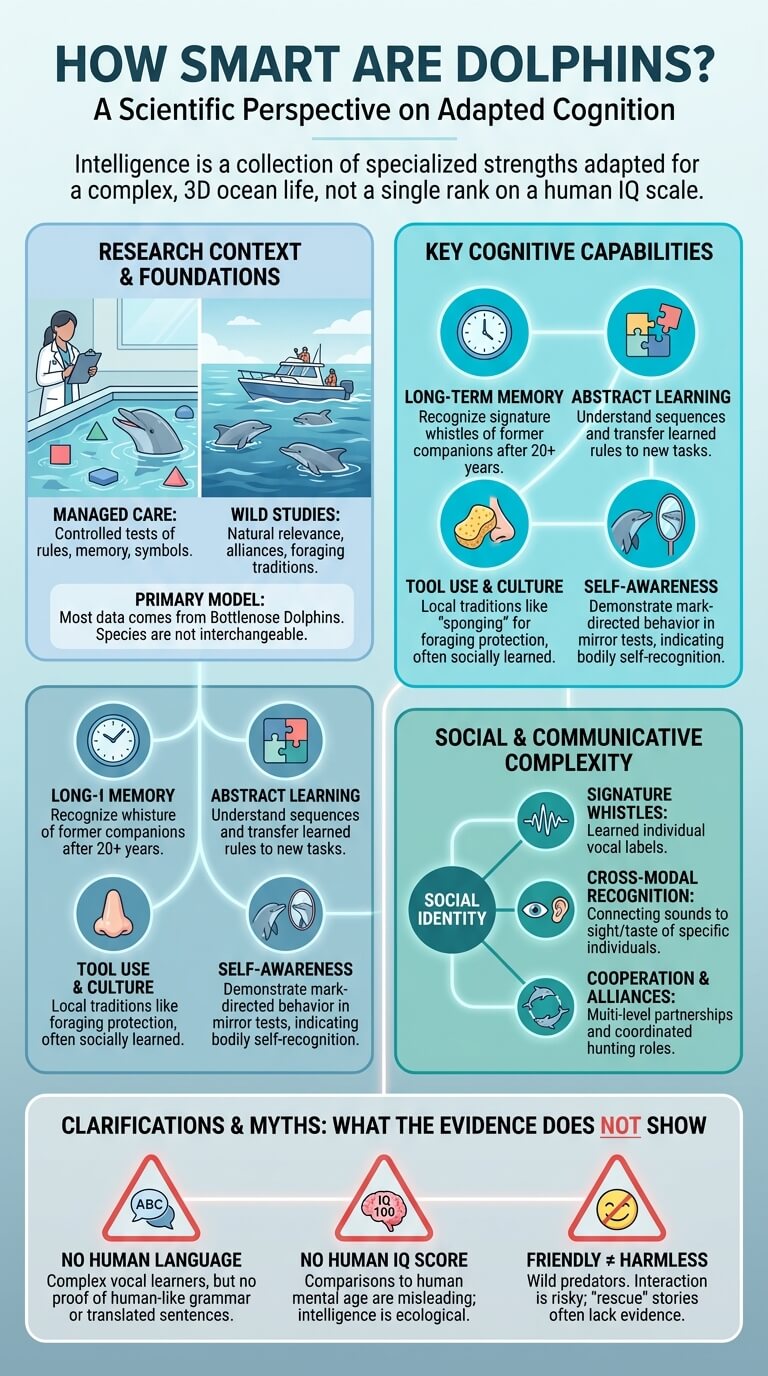
Dolphin intelligence is best understood as a collection of strengths. Bottlenose dolphins have performed well in controlled tests of rule learning, imitation, symbol comprehension, memory, and body awareness. Wild populations also show complex alliances, coordinated hunting, social learning, and specialized techniques that can spread through families or associates.
These abilities are not proof of human-like language, morality, or general reasoning in every situation. Results often come from a small number of trained bottlenose dolphins or from particular wild populations. A careful conclusion is that dolphins have evolved complex, flexible cognition suited to their sensory world and social lives, not that they rank at a fixed point on a human intelligence scale.
Which Dolphins Are Most Studied?
Bottlenose Dolphins Are the Main Research Model
Most classic experiments involve the common bottlenose dolphin, Tursiops truncatus, or the closely related Indo-Pacific bottlenose dolphin, Tursiops aduncus. Bottlenose dolphins are relatively accessible in coastal waters, adapt to carefully managed research settings, and can participate in repeated behavioral tasks. The NOAA Fisheries profile of common bottlenose dolphins also emphasizes that different coastal and offshore populations vary in habitat use, movement, and exposure to threats.
That research history creates an important wording rule. A study of two trained common bottlenose dolphins does not automatically describe every dolphin species. Even within bottlenose dolphins, individuals differ in age, experience, motivation, temperament, and prior training.
Dolphin Species Are Not Interchangeable
The dolphin family includes many species with different body sizes, habitats, prey, group structures, and sensory challenges. River dolphins navigate turbid waterways, spinner dolphins live in open tropical seas, and orcas, which are the largest members of the dolphin family, have population-specific hunting traditions. It would be misleading to assume that all have identical memory, communication, or problem-solving abilities.
Comparative work across species is growing, but the evidence remains uneven. Bottlenose dolphins dominate the literature, while many other species are difficult to study repeatedly without disturbing them. Statements about “dolphins” should often be read as statements about the particular species and population tested.
Wild and Managed-Care Studies Answer Different Questions
Controlled research can test whether a dolphin responds to a new command sequence, remembers a symbol, imitates an action, or uses a mirror under standardized conditions. Researchers can change one factor at a time and rule out some accidental cues. The trade-off is that the task may depend on training and may not resemble a natural problem.
Field studies reveal how dolphins hunt, form alliances, teach calves, and respond to changing ecological conditions. They offer greater natural relevance but less experimental control. Water visibility, group composition, prey movement, and incomplete observation can make explanations harder to separate. Strong conclusions often emerge when controlled and wild evidence point in the same direction.
What Makes Dolphin Cognition Distinctive?
A Large, Highly Folded Brain in Evolutionary Context
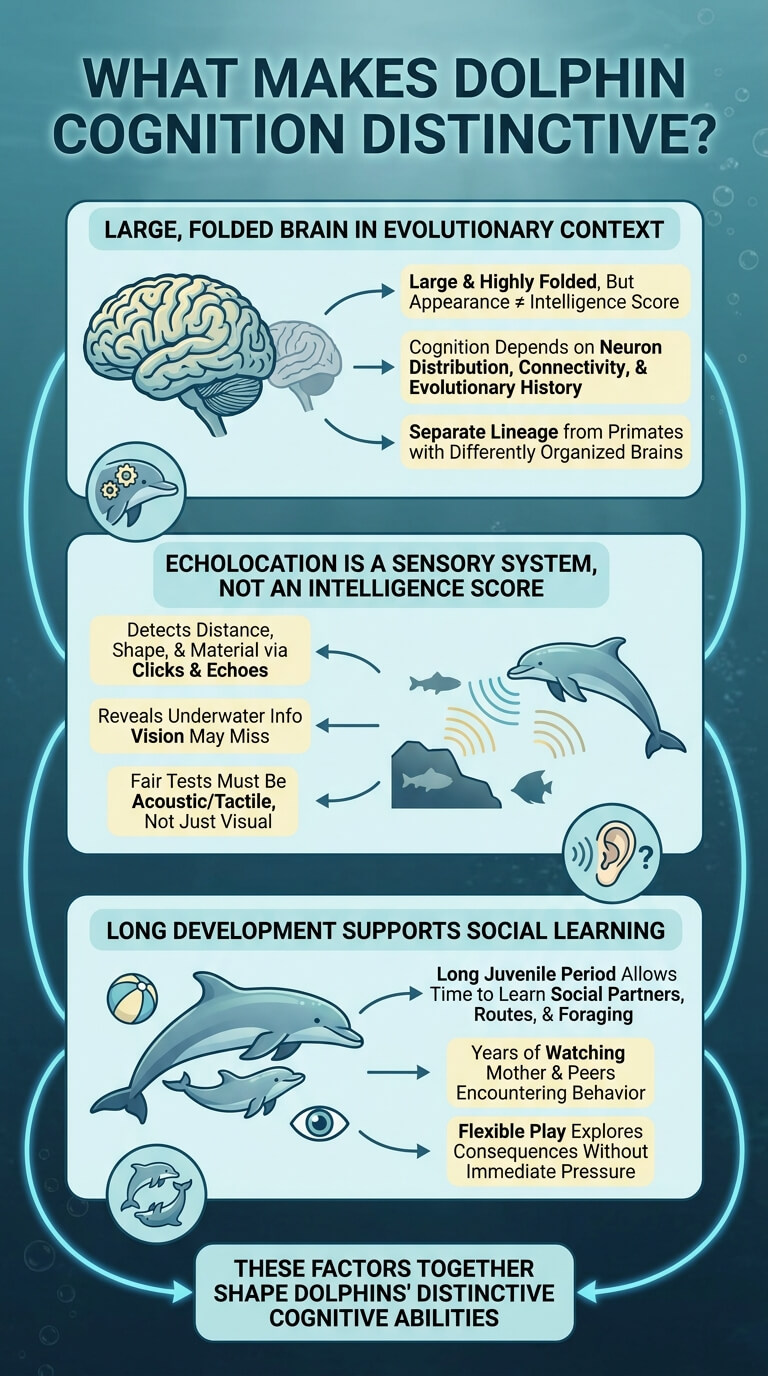
Dolphin brains are large and highly folded, but brain appearance alone is not an intelligence score. The relationship between brain structure and behavior depends on neuron distribution, connectivity, development, sensory demands, body control, and evolutionary history. Dolphins and primates reached complex cognition through separate lineages with differently organized brains.
Brain measures become useful when they are connected to behavior. Long juvenile development gives young dolphins time to learn social partners, local prey, travel routes, and foraging methods. A long period of dependence can support learning, but it does not mean that every behavior is taught or that development mirrors human childhood.
Echolocation Is a Sensory System, Not an Intelligence Score
Dolphins produce clicks and interpret returning echoes to detect objects and investigate their surroundings. Echolocation can reveal information about distance, position, shape, and material properties that vision alone may not provide underwater. It changes the kind of information available to a dolphin and therefore changes what a fair cognitive test should look like.
A dolphin that performs poorly on a visually designed task may still excel when information is acoustic or tactile. Conversely, remarkable echolocation does not by itself prove flexible reasoning. Sensory skill and cognition interact, but they are not the same thing.
Long Development Supports Social Learning
Dolphin calves spend years close to their mothers and encounter repeated opportunities to watch travel, feeding, conflict, play, and communication. Some foraging methods are acquired mainly through the mother-calf relationship. Other innovations can move among peers, showing that social learning is not limited to one pathway.
Play may also provide practice with objects, movement, and social signals. Researchers should be cautious about claiming that every playful act has a future purpose, yet flexible play offers a setting in which dolphins can explore consequences without the immediate pressure of catching prey.
Learning and Problem Solving
Learning Rules and Applying Them to New Tasks
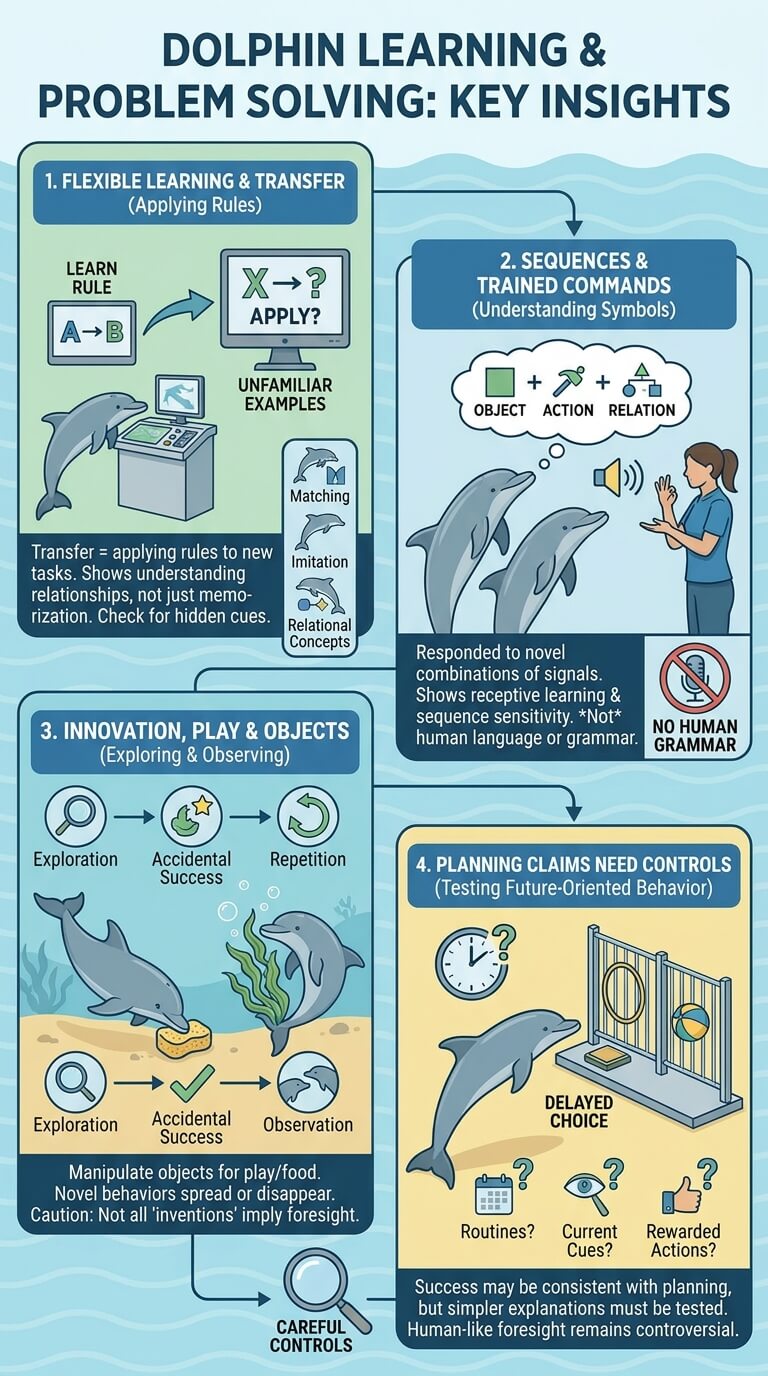
A useful sign of flexible learning is transfer. An animal first learns a rule with one set of objects or signals, then applies that rule to unfamiliar examples. Dolphins have shown abilities such as matching, imitation, responding to relational concepts, and performing actions in specified sequences under controlled conditions.
Transfer matters because simple memorization can explain success on familiar trials. Performance on new combinations suggests that the dolphin has learned something about the relationship among cues, objects, and actions. Even then, researchers must check whether the animal is following a subtle trainer movement, a familiar routine, or the most recently rewarded choice.
Understanding Sequences, Symbols, and Trained Commands
In a landmark controlled program, two bottlenose dolphins learned artificial gestural or acoustic systems in which symbol order changed the required response. The 1984 sentence-comprehension study reported that the dolphins could respond appropriately to many novel combinations of object, action, and relational signals.
This work showed impressive receptive learning and sensitivity to sequence. It did not demonstrate that dolphins naturally speak a language with human grammar, nor that they generated unlimited new sentences. The distinction between understanding a trained symbolic system and possessing human language is essential.
Innovation, Play, and Object Manipulation
Dolphins can manipulate seaweed, bubbles, shells, sponges, fish, and human-provided objects. Some actions appear playful, while others help obtain food. Novel behavior may begin with one individual and remain rare, spread through a social network, or disappear when conditions change.
Innovation is easier to identify than its mental cause. A new technique could arise through exploration, accidental success followed by repetition, observation of another dolphin, or a combination of these processes. Calling every novel act an “invention” can imply more foresight than the evidence provides.
Planning Claims Need Careful Controls
Researchers sometimes ask whether dolphins prepare for a future event, remember an instruction over a delay, or select an object needed later. Success can be consistent with future-oriented behavior, but simpler explanations must be tested. A dolphin may follow a learned routine, respond to current cues, or repeat a previously rewarded action.
Good planning research separates immediate desire from later need, varies the delay, tests new situations, and checks whether the subject can choose among alternatives. Dolphin evidence is interesting, but broad claims about human-like foresight remain more controversial than evidence for learning, memory, and social coordination.
Dolphin Communication and Social Intelligence
Signature Whistles Carry Individual Identity
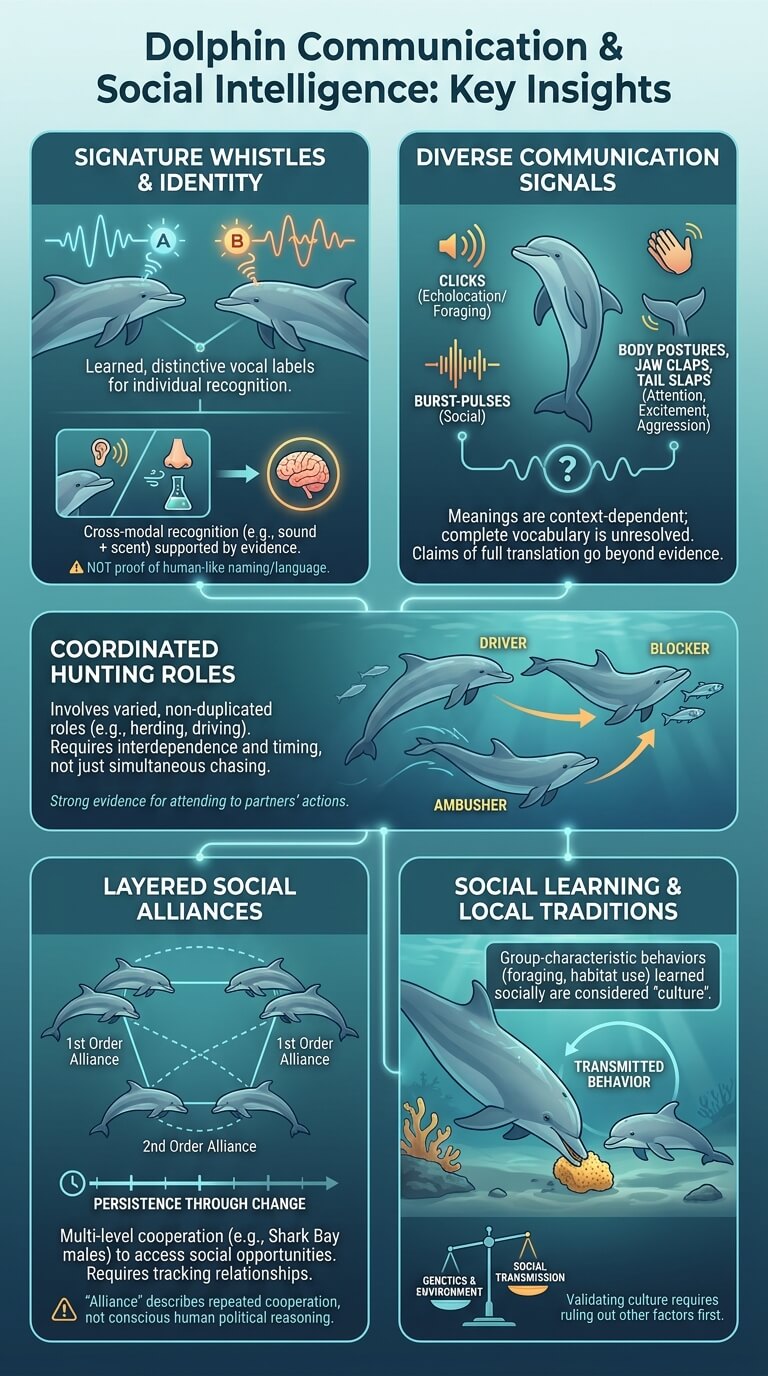
Many bottlenose dolphins develop a distinctive learned whistle pattern called a signature whistle. It can function as an identity signal, especially when animals are separated or groups meet. Researchers sometimes compare these whistles with names, but the safest wording is that they are learned vocal labels associated with individuals.
Experiments show that dolphins respond selectively to familiar signature whistles and can connect identity information across senses. In one study, dolphins investigated urine samples while hearing whistles, and the pattern of attention supported cross-modal recognition of familiar individuals. The Science Advances study of sound and taste is evidence for individual recognition, not proof that dolphin communication has the full structure of human naming and language.
Communication Is More Than Whistles
Dolphins also produce clicks, burst-pulsed sounds, body postures, jaw claps, tail slaps, and other signals. Echolocation clicks are primarily associated with sensing and foraging, although acoustic behavior can have several functions depending on context. Body movement can signal attention, excitement, aggression, courtship, or coordination.
Researchers can connect some signal types with situations, but much of the repertoire remains unresolved. A whistle recorded during travel may not carry one fixed message in every population. Claims that scientists have translated a complete dolphin vocabulary go beyond current evidence.
Coordinated Hunting Can Include Different Roles
Some dolphins herd fish toward partners, drive prey onto mud banks, cooperate with human fishers, or take different positions during a hunt. Role differentiation can reduce duplication and make coordinated action more effective. To demonstrate true cooperation, researchers look for interdependence, timing, and benefits that cannot be explained by several animals independently chasing the same prey.
Not every group hunt requires advanced planning. Local currents, prey behavior, and learned routines can organize movement. Still, repeated coordination with stable role patterns provides strong evidence that dolphins attend to partners and adjust behavior to what others are doing.
Alliances Require Tracking Relationships
Male Indo-Pacific bottlenose dolphins in Shark Bay form layered alliances that can persist through changing group membership and competition. Studies indicate that cooperation among allied groups can influence access to contested social opportunities. Such systems require individuals to recognize partners, respond to previous interactions, and coordinate at more than one social level.
It is tempting to describe these relationships using human political language. Terms such as alliance are useful scientific descriptions of repeated cooperation, but they do not prove that dolphins reason about loyalty, betrayal, or strategy in the same conscious way people do.
Social Learning Creates Local Traditions
Dolphin populations can differ in how they forage, travel, play, and use habitat. When a behavior is learned socially and remains characteristic of a group, researchers may describe it as a tradition or culture. This usage does not require art, institutions, or spoken history. It refers to information transmitted through social learning.
Culture is difficult to establish from observation alone because animals sharing a habitat also share prey and physical conditions. Researchers compare genetics, environment, family relationships, and social networks to judge whether social transmission best explains the pattern.
Tool Use and Foraging Culture
Some Dolphins Carry Sponges While Foraging
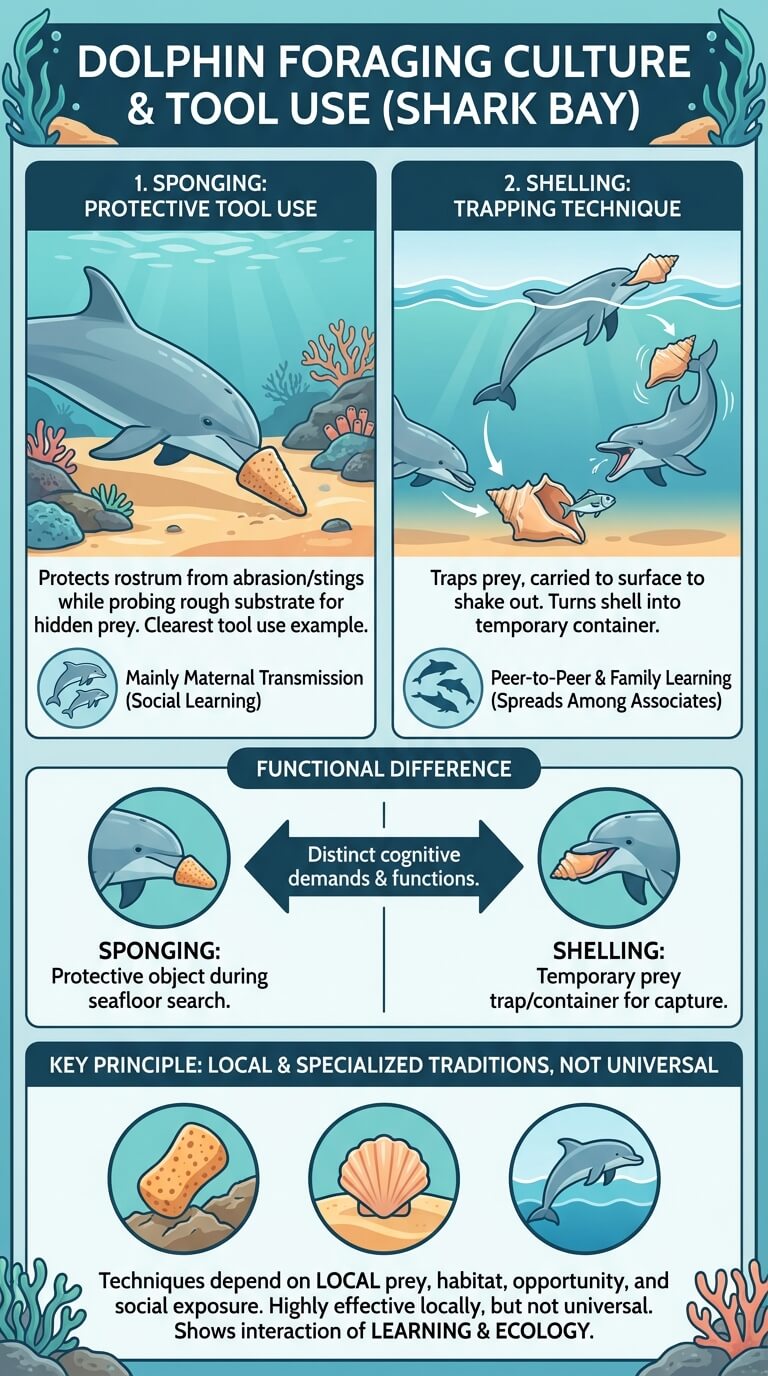
In Shark Bay, some Indo-Pacific bottlenose dolphins detach marine sponges and carry them over the rostrum while searching the seafloor. The sponge appears to protect the dolphin from abrasion or stings while it probes for prey hidden in rough substrate. This is one of the clearest examples of tool use in a wild marine mammal.
Genetic and behavioral evidence indicates that sponging is transmitted mainly along maternal lines. The PNAS study of cultural transmission supported social learning as a better explanation than genetics alone for the observed pattern.
Shelling Is a Different Specialized Technique
During shelling, a dolphin may chase prey into an empty shell, carry the shell to the surface, and shake or tip the fish into its mouth. Network analyses in Shark Bay suggest that this behavior can spread among associates as well as through family lines. That makes it a valuable example of peer-to-peer learning.
Shelling is not necessarily identical to sponge use in cognitive demands or transmission. One method involves carrying a protective object during seafloor search, while the other turns a shell into a temporary prey trap or container. Grouping both under “tool use” should not erase those functional differences.
Foraging Traditions Are Local, Not Universal
Most dolphins do not carry sponges, use shells, strand onto mud banks, or cooperate with fishers. These techniques depend on local prey, habitat, opportunity, and social exposure. A behavior that is highly effective in one bay could be useless or dangerous elsewhere.
Local specialization is itself cognitively informative. It shows how learning and ecology interact, but it does not mean a population without the technique is less intelligent. Those dolphins may face different problems and develop different solutions.
Dolphin Memory
Recognition of Familiar Individuals Can Last for Decades
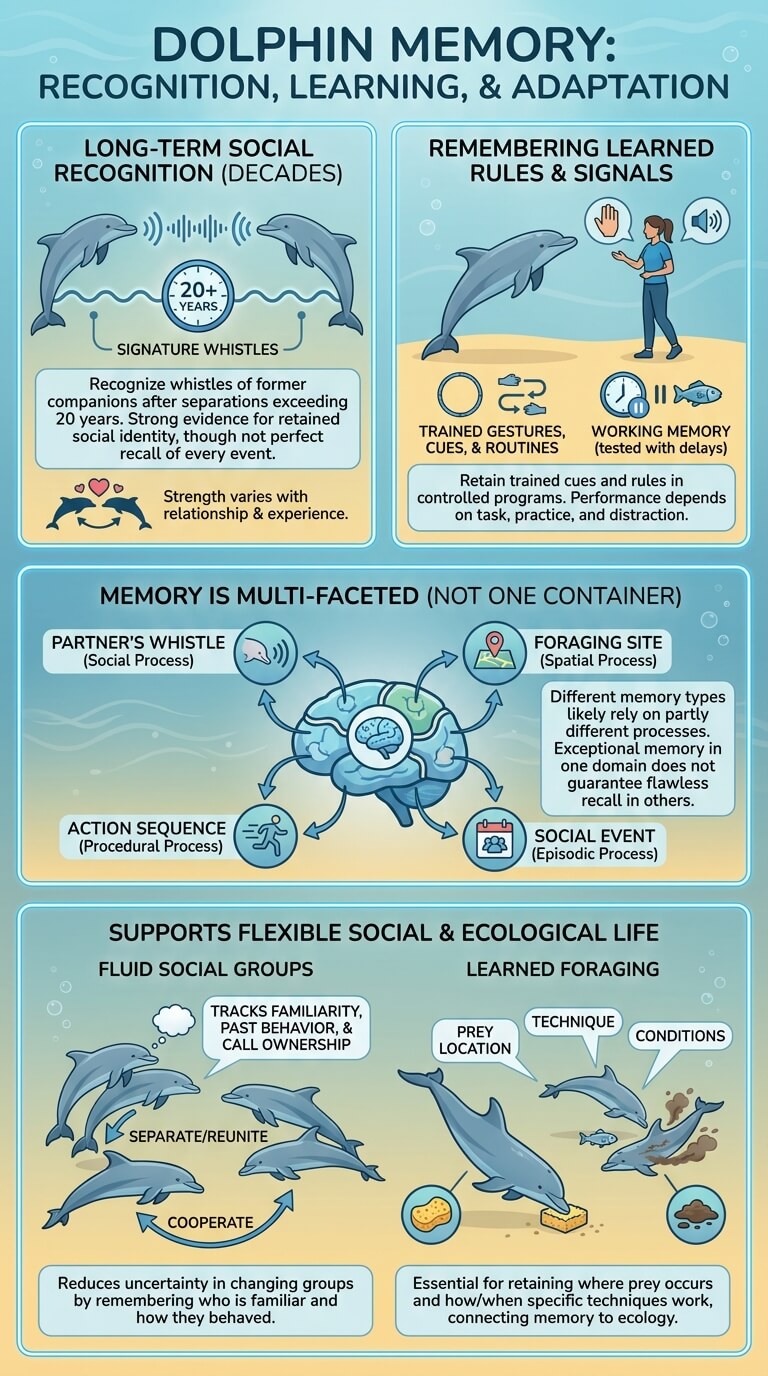
A playback study tested how bottlenose dolphins responded to signature whistles from animals they had once lived with. The dolphins showed recognition after separations that, in some cases, exceeded 20 years. The long-term social memory research provides unusually strong evidence that identity information can be retained for a large part of a dolphin’s life.
The result does not mean dolphins remember every event or individual perfectly. The experiment measured recognition of familiar vocal signatures under particular conditions. Memory strength can vary with relationship, repetition, age, and later experience.
Dolphins Remember Learned Rules and Signals
Long-term participation in controlled programs shows that dolphins can retain trained gestures, acoustic cues, action rules, and imitation routines. Researchers can also test working memory by placing delays between a signal and the required response. Performance depends on the task, distraction, practice, and the type of information being held.
Memory should not be treated as one container. Remembering a partner’s whistle, a foraging site, an action sequence, and a social event may rely on partly different processes. A dolphin can be exceptional in one domain without having flawless recall in every domain.
Memory Supports Flexible Social Life
Bottlenose dolphin groups often change composition. Individuals separate, reunite, join temporary feeding groups, or cooperate with different partners. Remembering who is familiar, how an individual behaved before, and which calls belong to which partners can reduce uncertainty in this fluid social system.
Memory also supports learned foraging. A dolphin must retain where prey occurs, how a technique works, and when conditions make the technique useful. These demands connect memory with ecology rather than making it a stand-alone party trick.
Can Dolphins Recognize Themselves?
Mirror Experiments Produced Mark-Directed Behavior
In a classic experiment, two bottlenose dolphins were exposed to mirrors and then given visible or sham marks on parts of the body they could not inspect directly. They used the mirror to position and examine marked areas more than control areas. The bottlenose dolphin mirror study interpreted this pattern as evidence of mirror self-recognition.
Dolphins cannot touch a mark with a hand, so their responses differ from those of apes. Researchers instead examine changes in orientation, repeated viewing, and use of the reflective surface to inspect the body. Species-appropriate scoring is necessary, but flexible criteria also make careful controls especially important.
Mirror Results Have Methodological Limits
The original work involved a very small number of highly experienced dolphins. Later developmental research has added evidence that young dolphins show increasingly self-directed mirror behavior, yet sample sizes remain modest compared with many human studies. Performance can also be influenced by mirror experience, visibility of the mark, motivation, and testing conditions.
A positive result supports visual self-related processing. It does not reveal the full contents of a dolphin’s private experience, prove human-like self-consciousness, or determine overall intelligence. A negative result in another species would not prove the absence of every form of self-awareness.
Self-Recognition Is One Cognitive Measure
Dolphin intelligence is better evaluated through a broad pattern of evidence: rule learning, imitation, social recognition, cooperation, memory, tool use, communication, and flexible responses to novelty. Mirror behavior adds one piece to that pattern.
Using one dramatic test as a pass-fail gate creates a distorted view. Different species rely on different senses and bodies, and cognition evolved to solve different ecological problems. A fair assessment asks what the task measures and whether the animal has a realistic reason and physical ability to perform it.
How Dolphins Compare With Humans and Other Animals
Human IQ and Mental-Age Comparisons Are Misleading
Human IQ tests are designed around human language, schooling, vision, hands, cultural knowledge, and age-based development. Dolphins cannot be placed meaningfully on that scale. Claims that a dolphin has the IQ of a particular number or the mind of a specific-aged child usually lack a validated cross-species method.
Comparative research can ask narrower questions. Can both species learn a sequence rule? Can they recognize individuals after a long separation? Can they coordinate with a partner? Similar task outcomes allow cautious comparison without pretending the underlying minds are identical.
Similar Outcomes Can Come From Different Minds
Dolphins, primates, elephants, and corvids may all solve some relational, social, or tool-related problems. They do so with different brains, limbs, senses, and ecological histories. A crow manipulates objects with its beak and feet, a chimpanzee uses hands and vision, and a dolphin acts through swimming, sound, rostrum contact, and whole-body movement.
Convergent performance is scientifically valuable because it shows that complex abilities can evolve more than once. It does not prove that every species represents the problem in the same way. Researchers need controls that separate shared outcomes from shared mechanisms.
Dolphins Show a Distinctive Set of Strengths
Dolphins are especially notable for acoustic identity signals, long-term social recognition, alliance networks, vocal learning, coordinated movement, and cultural foraging. Great apes offer stronger evidence in many manual tool and causal tasks. Corvids show remarkable object manipulation and caching-related memory. Elephants excel in large-scale social and spatial challenges.
These comparisons support a multidimensional view. Asking which species is “smarter” without specifying the problem is like asking whether hearing, vision, or touch is the best sense. The answer changes with the task and environment.
Common Myths and Exaggerations
Dolphins Do Not Have a Proven Human-Like Language
Dolphins are vocal learners with individually distinctive whistles and a varied acoustic repertoire. They can learn artificial symbols and respond to sequence changes under controlled conditions. Scientists have not demonstrated an open-ended natural language with human-like grammar, unlimited sentence generation, and fully translated meanings.
Describing signature whistles as name-like can be a helpful comparison when it is qualified. Saying dolphins speak to one another in sentences that researchers can translate is not supported by current evidence.
Brain Size Is Not a Complete Intelligence Score
Large brains require energy and can support complex processing, but simple brain weight or brain-to-body ratios cannot rank all species fairly. Body size, neuron distribution, brain organization, sensory specialization, and development all matter.
Dolphin brain anatomy is part of the evidence, not a substitute for behavioral tests. Claims that one anatomical number proves dolphins are second only to humans reduce a complicated comparison to a misleading statistic.
Friendly-Looking Behavior Does Not Mean Harmless
Wild dolphins are powerful predators and socially complex animals, not domesticated companions. Approaching, feeding, chasing, touching, or attempting to swim with them can alter behavior and create risk for people and dolphins. Habituation may increase boat approaches, begging, injury, and conflict.
Observe wild dolphins from a lawful distance and follow local marine wildlife guidance. A dolphin that approaches a vessel has not consented to being touched or fed, and curiosity should not be interpreted as an invitation.
Viral Rescue Stories Need Evidence
Stories often claim that dolphins deliberately rescue swimmers, warn people about sharks, or act from human-like compassion. Some events may involve coordinated or protective behavior, but videos and anecdotes rarely reveal motivation. Dolphins may investigate novelty, herd moving animals, respond to distress, or behave aggressively in ways that viewers misread.
The responsible approach is to describe what was observed and avoid assigning a heroic intention without controlled evidence. A memorable story is not automatically a reliable species-level fact.
What Dolphin Research Reveals About Animal Minds
Tool Use Can Be a Learned Tradition
Dolphin sponge carrying shows that an animal without hands can use an external object in a precise ecological problem. Its strong maternal transmission also shows how a skill can persist through learning rather than genetic inheritance alone.
Identity Can Be Represented Across Senses
Signature whistles, long-term recognition, and cross-modal experiments suggest that familiar individuals are more than one sound or visual image to a dolphin. The animal can combine information from different sensory channels into a stable social identity.
Communication, Memory, and Emotion Are Related but Distinct
Remembering a partner can shape communication and cooperation, and emotional state may influence attention or learning. Researchers still study these as distinct questions because one ability does not prove the others. A response to a signature whistle demonstrates recognition, not a complete understanding of the animal’s feelings.
FAQ
Are Dolphins Smarter Than Chimpanzees?
Science does not provide a single fair ranking. Chimpanzees generally have advantages in hand-based tool use and many primate-specific social or causal tasks. Dolphins show exceptional acoustic learning, social recognition, coordinated movement, and marine foraging traditions. Results depend on what is tested and whether the task fits each species.
Can Dolphins Understand Human Words or Symbols?
Trained bottlenose dolphins have learned artificial acoustic and gestural symbols, responded to ordered combinations, and applied some learned rules to new commands. That demonstrates flexible receptive learning. It does not show that dolphins understand ordinary human conversation or naturally use human-style grammar.
Do Dolphins Remember Each Other for Years?
Yes, bottlenose dolphin playback research has found recognition of former companions’ signature whistles after long separations, including periods longer than 20 years. The finding concerns recognition of familiar vocal identity signals. It should not be expanded into a claim that dolphins remember every event or relationship with perfect detail.
Are All Dolphin Species Equally Intelligent?
No evidence supports treating all dolphin species as cognitively identical. Species differ in ecology, social organization, sensory demands, and research coverage. Many conclusions come from bottlenose dolphins because they have been studied most extensively. Other dolphins may have different strengths that current tests have not measured well.
Final Thoughts
So, how smart are dolphins? Research supports a strong but carefully bounded answer. Bottlenose dolphins can learn complex rules, recognize individuals through multiple senses, remember companions for many years, cooperate in changing social groups, and acquire local foraging traditions such as sponge use and shelling. Mirror studies also provide evidence for body-related self-recognition in at least some individuals.
The best interpretation is not that dolphins possess a human IQ, speak a translated language, or outrank every other animal. Their intelligence is adapted to an acoustic, social, mobile life in the ocean. Understanding those abilities on dolphin terms produces a more accurate and more impressive picture than any viral comparison with humans.

Ethan Walker is the founder and research editor of Animal Fact Central. He creates and reviews educational animal facts content using trusted wildlife, pet care, and science-based sources. His work focuses on making animal behavior, adaptations, habitats, and species facts clear, accurate, and engaging for everyday readers.
Read More Details About Ethan Walker: https://animalfactcentral.com/ethan-walker/