
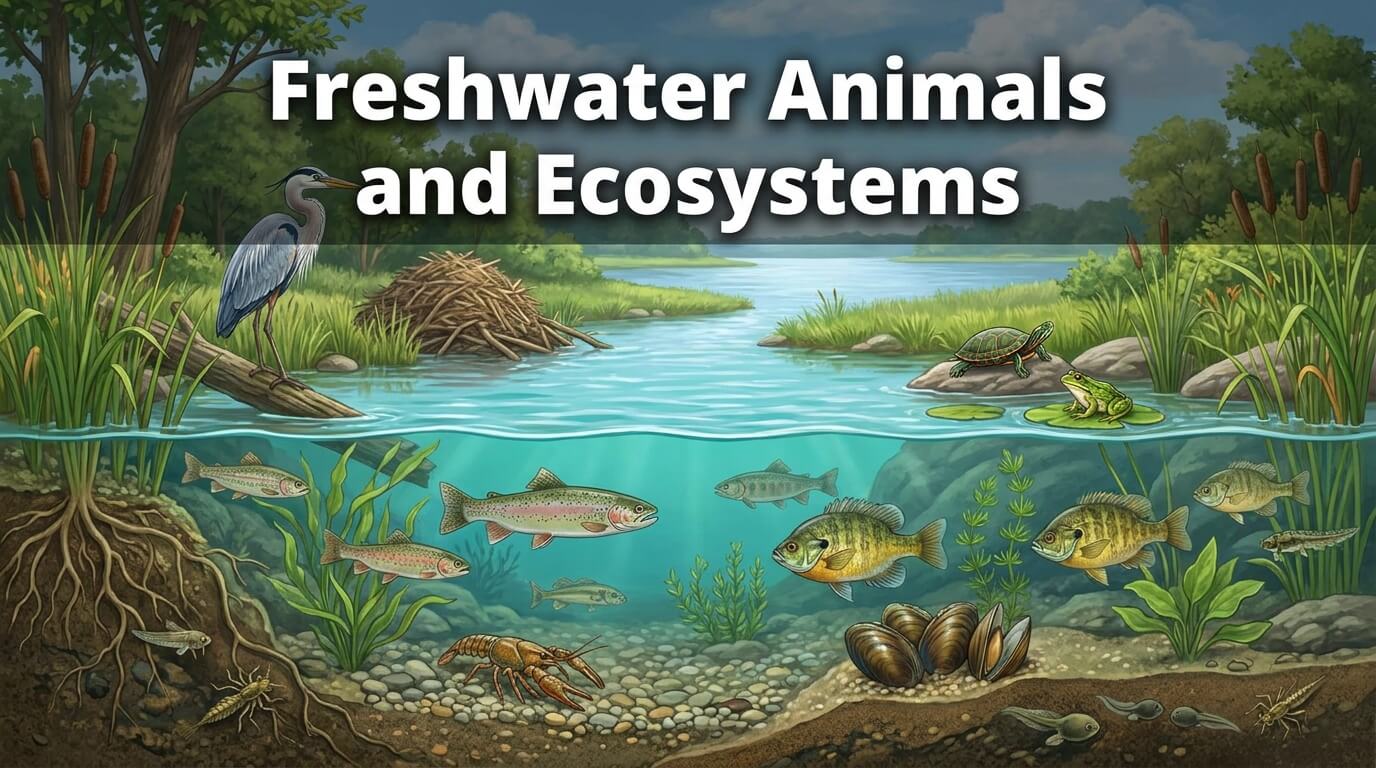
Freshwater animals live in rivers, streams, lakes, ponds, springs, wetlands, and other inland waters with very low salinity. The group includes far more than fish. Frogs breed in temporary pools, salamanders hide in cool streams, dragonfly nymphs hunt beneath the surface, mussels filter river water, turtles bask along shorelines, and beavers reshape entire valleys.
The best way to understand this diversity is not as one long list of species. Freshwater habitats contain distinct zones, flow conditions, oxygen levels, seasonal cycles, and food-web roles. Some animals spend their whole lives underwater. Others use water only for breeding, feeding, migration, or shelter. Together, they connect open water, streambeds, shorelines, wetlands, forests, and grasslands.
Quick Overview
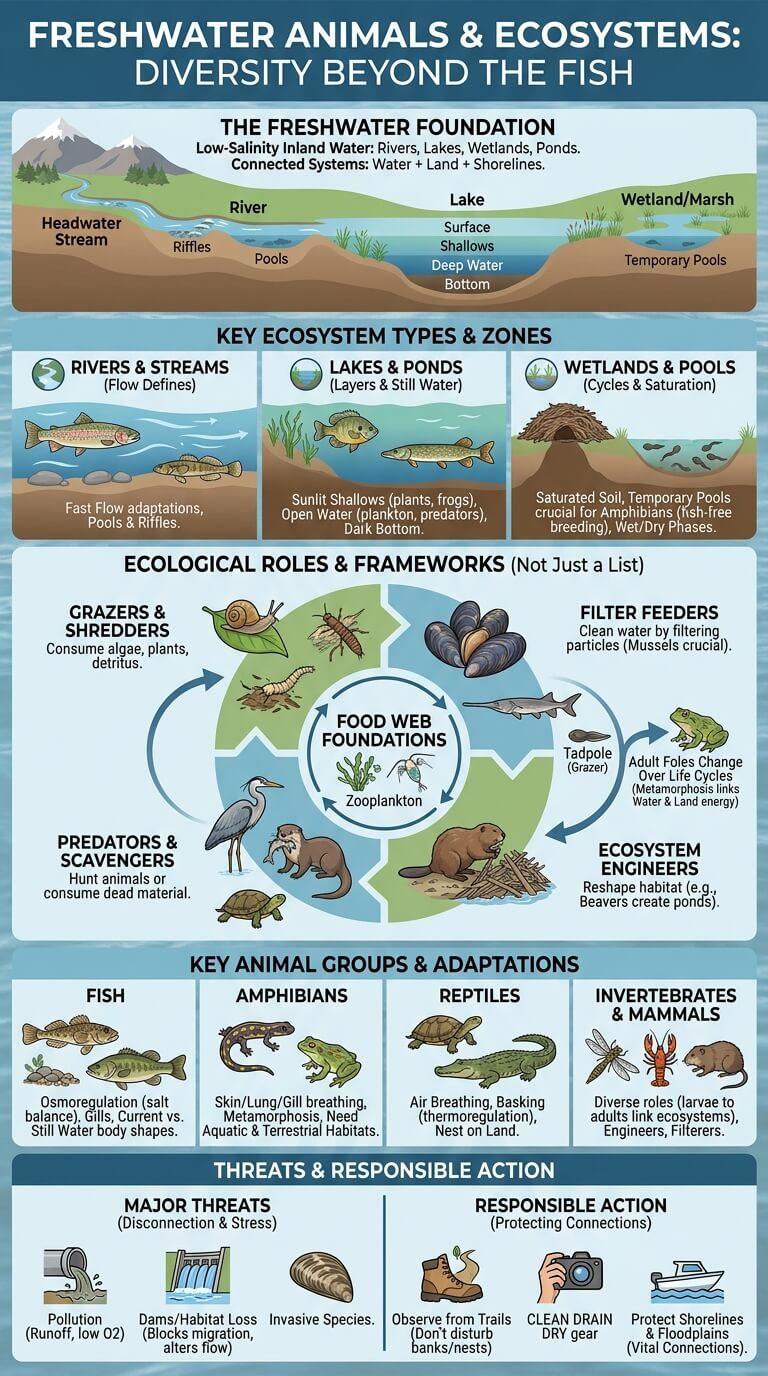
What Counts as a Freshwater Animal?
A freshwater animal is any species that depends on low-salinity inland water for an important part of its life. Permanent residents include many fish, crayfish, mussels, aquatic snails, and insect larvae. Semi-aquatic animals such as otters, beavers, turtles, and water snakes divide their time between water and land. Seasonal visitors include migratory birds and amphibians that return to ponds or wetlands to breed.
Why Freshwater Habitats Support High Biodiversity
Freshwater environments are small in area compared with oceans and land, but they contain many isolated and varied habitats. One watershed can include cold headwater streams, warm river bends, deep lakes, shallow ponds, floodplain marshes, groundwater springs, and temporary pools. Each setting favors different body shapes, feeding strategies, and life cycles.
Main Types of Freshwater Ecosystems
Rivers and Streams
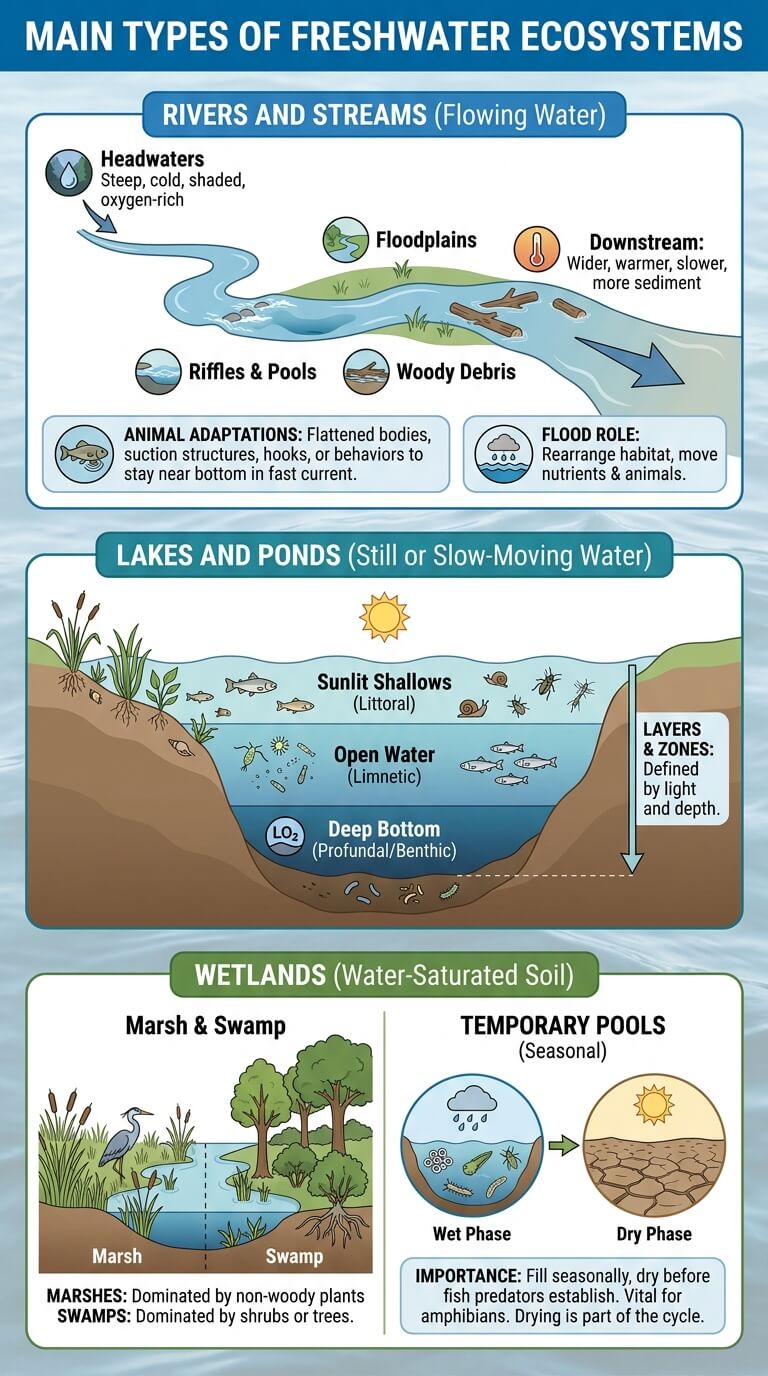
Flow defines rivers and streams. Headwaters may be cold, shaded, oxygen-rich, and steep. Farther downstream, channels often become wider, warmer, slower, and richer in suspended sediment and nutrients. Riffles, pools, undercut banks, gravel beds, woody debris, and floodplains create different living spaces within the same river.
Animals in fast current often have flattened bodies, strong fins, suction structures, hooks, cases, or behaviors that keep them close to the bottom. Pool residents may rely on deeper water, submerged roots, or overhanging vegetation. Floods can rearrange habitat, move animals, open new channels, and carry nutrients into wetlands and floodplain forests.
Lakes and Ponds
Lakes and ponds range from tiny seasonal basins to vast, deep water bodies. Their still or slow-moving water creates layers and zones. Sunlit shallows support rooted plants, insects, snails, amphibians, small fish, and feeding birds. Open water supports plankton, schooling fish, and diving predators. Deep bottom areas may be dark, cold, and low in oxygen.
Wetlands, Marshes, Swamps, and Temporary Pools
Wetlands are places where water covers or saturates the soil long enough to shape the plants, soils, and animal community. Marshes are often dominated by grasses, sedges, reeds, and other nonwoody plants. Swamps are commonly dominated by shrubs or trees. Bogs, fens, floodplain wetlands, wet meadows, and shallow seasonal pools add further variety.
Temporary pools can be especially important for amphibians and aquatic invertebrates because they may fill during rain or snowmelt and dry before fish can become permanent predators. Drying is not necessarily a sign of failure. For animals adapted to seasonal water, the wet and dry phases are part of the habitat cycle.
A Framework for Understanding Freshwater Animals
Open-Water, Bottom, Shoreline, and Surface Zones
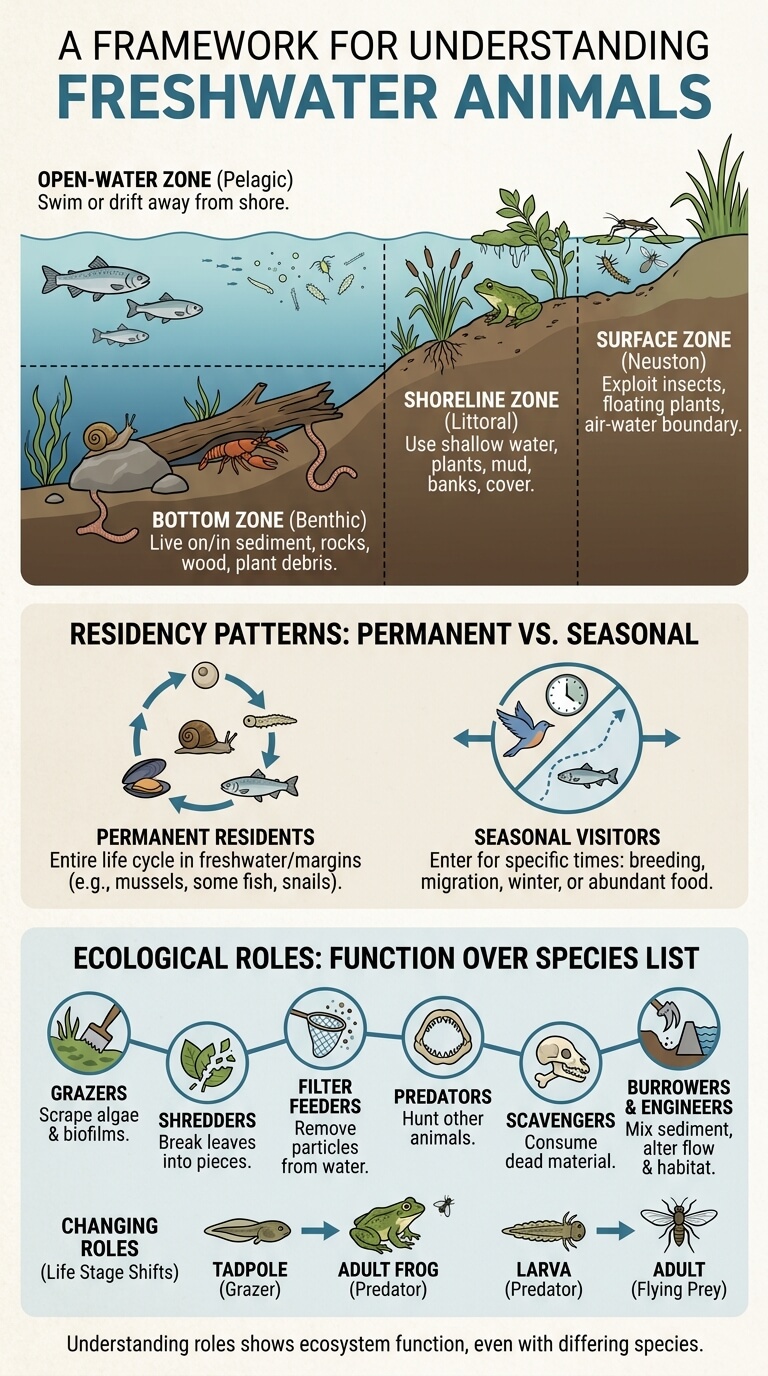
Open-water animals swim or drift away from shore. Bottom-dwelling, or benthic, animals live on or within sediment, rocks, wood, and plant debris. Shoreline animals use shallow water, rooted plants, mud, banks, and overhanging cover. Surface animals exploit insects, floating plants, or the boundary between air and water.
Permanent Residents Versus Seasonal Visitors
Permanent residents complete their entire life cycle in freshwater or along its margins. Freshwater mussels, many fish, aquatic snails, and some salamanders fit this pattern. Seasonal residents may enter only during breeding, migration, winter, or periods of abundant food.
Ecological Roles Rather Than a Flat Species List
Freshwater animals can also be grouped by what they do. Grazers scrape algae and biofilms. Shredders break leaves into smaller pieces. Filter feeders remove particles from water. Predators hunt other animals. Scavengers consume dead material. Burrowers mix sediment, while habitat engineers alter flow, depth, and vegetation.
One species may perform several roles during its life. A tadpole may graze algae, then become an adult frog that hunts insects. An aquatic insect larva may be a predator underwater and later become flying prey for birds and bats. Understanding roles shows how freshwater ecosystems function even when the species differ among regions.
Freshwater Fish
Current-Loving Stream Fish
Trout, darters, sculpins, minnows, suckers, and many other fish use flowing water. Some hold position behind rocks where current is weaker. Darters may lack or reduce the gas-filled swim bladder that would otherwise make them rise from the bottom. Sculpins have broad heads and large fins that help them stay close to streambeds.
Spawning needs can be highly specific. Some fish require clean gravel with flowing, oxygenated water around their eggs. Others use submerged plants, cavities, floodplains, or nests built by adults. Fine sediment that fills gravel spaces can reduce egg survival even when adult fish remain visible.
Lake and Pond Fish
Sunfish, bass, perch, catfish, pike, minnows, and other fish occupy ponds and lakes across North America. Their habitat use depends on water temperature, depth, oxygen, plants, prey, and season. Young fish often shelter in vegetation or shallow water, while larger predators patrol edges, open water, or deeper structure.
Not every pond naturally contains fish. Adding fish to a seasonal amphibian pool can eliminate eggs, tadpoles, and large aquatic insects. Stocking decisions should follow local laws and ecological guidance rather than the assumption that every body of water needs game fish.
Feeding Niches From Grazers to Top Predators
Fish diets include algae, plankton, insects, crustaceans, mollusks, eggs, fish, amphibians, and organic debris. Suckers and some minnows feed near the bottom. Paddlefish strain plankton from water. Bluegill take insects and small crustaceans. Northern pike ambush fish and other vertebrates.
Amphibians in Freshwater
Frogs and Toads Using Breeding Water
Many frogs and toads lay gelatinous eggs in ponds, wetlands, streams, puddles, or water held by plants. Tadpoles develop in water before metamorphosing into juveniles that may spend much of their lives on land. Other frogs remain strongly aquatic as adults.
Breeding water differs by species. Wood frogs favor temporary woodland pools. Bullfrogs use permanent ponds and lake edges. Stream frogs attach eggs or shelter larvae where current and oxygen are suitable. Protecting only open water misses the shoreline and terrestrial refuges adults need outside the breeding season.
Salamanders and Newts in Streams and Ponds
Some salamanders are permanent stream residents, some return to ponds to breed, and others live on land while laying eggs in moist terrestrial sites. Hellbenders occupy cool rivers beneath large rocks. Mudpuppies remain aquatic and retain external gills. Mole salamanders spend much of the year underground and migrate to breeding ponds.
Tadpoles as Grazers, Filterers, and Prey
Many tadpoles scrape algae, microorganisms, and biofilm from surfaces. Some filter suspended particles, consume detritus, scavenge, or prey on smaller animals. Their feeding can change algae, sediment, and nutrient movement, but no single description applies to every species.
Tadpoles are also important prey for aquatic insects, fish, turtles, snakes, birds, and other amphibians. When froglets leave the water, they transfer energy gained in the pond into forests, meadows, and shoreline food webs.
Freshwater Reptiles
Turtles and Basking Behavior
Freshwater turtles include sliders, painted turtles, map turtles, mud turtles, musk turtles, snapping turtles, and softshells. Most feed in water but must breathe air. Many bask on logs, rocks, banks, or floating vegetation to warm their bodies, dry the shell, and regulate activity.
Females usually leave the water to lay eggs on land. Roads between aquatic habitat and nesting ground can cause heavy mortality. Removing basking logs or hardening every shoreline also reduces habitat even when the water remains.
Crocodilians and Large-River Predators
American alligators live in freshwater marshes, swamps, lakes, ponds, and slow waterways, although they can enter brackish habitats. They are powerful predators, but they also dig and maintain depressions that can retain water during dry periods and provide refuge for smaller animals.
Crocodilians should be observed from a substantial distance. People should never feed, approach, corner, or attempt to move them. Feeding can cause animals to associate people with food and increase conflict.
Water Snakes and Semi-Aquatic Hunting
Water snakes hunt fish and amphibians along shorelines, in shallow water, and among rocks or vegetation. They are often mistaken for venomous cottonmouths in overlapping areas, but identification should not be attempted through close approach or handling.
Freshwater Birds and Mammals
Wading Birds, Diving Birds, and Kingfishers
Herons, egrets, ibises, rails, and bitterns search shallow water and wetland vegetation for fish, frogs, crayfish, insects, and other prey. Ducks and grebes dive or tip forward to reach plants and animals. Kingfishers watch from perches and plunge after fish.
Beavers, Otters, Muskrats, and Other Mammals
River otters hunt fish, crayfish, frogs, and other prey while using banks, logs, and shoreline cover for rest and travel. Muskrats eat aquatic plants and build lodges or bank burrows. Moose, deer, raccoons, bats, and many smaller mammals use freshwater for drinking, feeding, cooling, or movement.
Beavers are especially influential. By cutting vegetation and building dams, they can slow streams, raise local water levels, trap sediment, and create ponds and wetlands. The National Park Service profile of beavers as ecosystem engineers explains how their structures create habitat used by many other animals.
Animals That Reshape Habitat or Move Nutrients
Emerging insects move aquatic production onto land, where spiders, birds, bats, reptiles, and mammals consume them. Salmon and other migratory fish can move marine-derived nutrients into rivers and surrounding land. Freshwater boundaries are therefore crossed continually by animals and energy.
Freshwater Invertebrates
Aquatic Insects and Their Larval Stages
Mayflies, stoneflies, caddisflies, dragonflies, damselflies, mosquitoes, midges, beetles, and true bugs spend all or part of their lives in freshwater. Some graze algae, some shred leaves, some filter particles, and others are active predators.
The National Park Service summary of aquatic macroinvertebrates describes them as consumers, detritivores, predators, and prey for fish, amphibians, reptiles, birds, and mammals. Their emergence also feeds terrestrial animals and links water with land.
Crayfish, Snails, Mussels, and Worms
Crayfish consume plants, algae, detritus, carrion, and animals. Their burrows and feeding can alter sediment and shelter. Snails graze surfaces or consume decaying material. Aquatic worms process organic matter within mud and gravel.
Freshwater mussels are long-lived filter feeders anchored within river or lake bottoms. Water drawn across their gills supplies oxygen and food particles. Mussel beds also stabilize sediment and create hard surfaces and spaces used by other organisms. The U.S. Fish and Wildlife Service explanation of mussel ecosystem roles highlights filtration, reduced turbidity, nutrient processing, and support for aquatic biodiversity.
Zooplankton and Other Tiny Food-Web Foundations
Zooplankton include tiny crustaceans, rotifers, and the drifting early stages of some animals. They consume algae, bacteria, smaller particles, or other plankton and become food for insect larvae, fish, amphibians, and larger invertebrates.
How Freshwater Food Webs Work
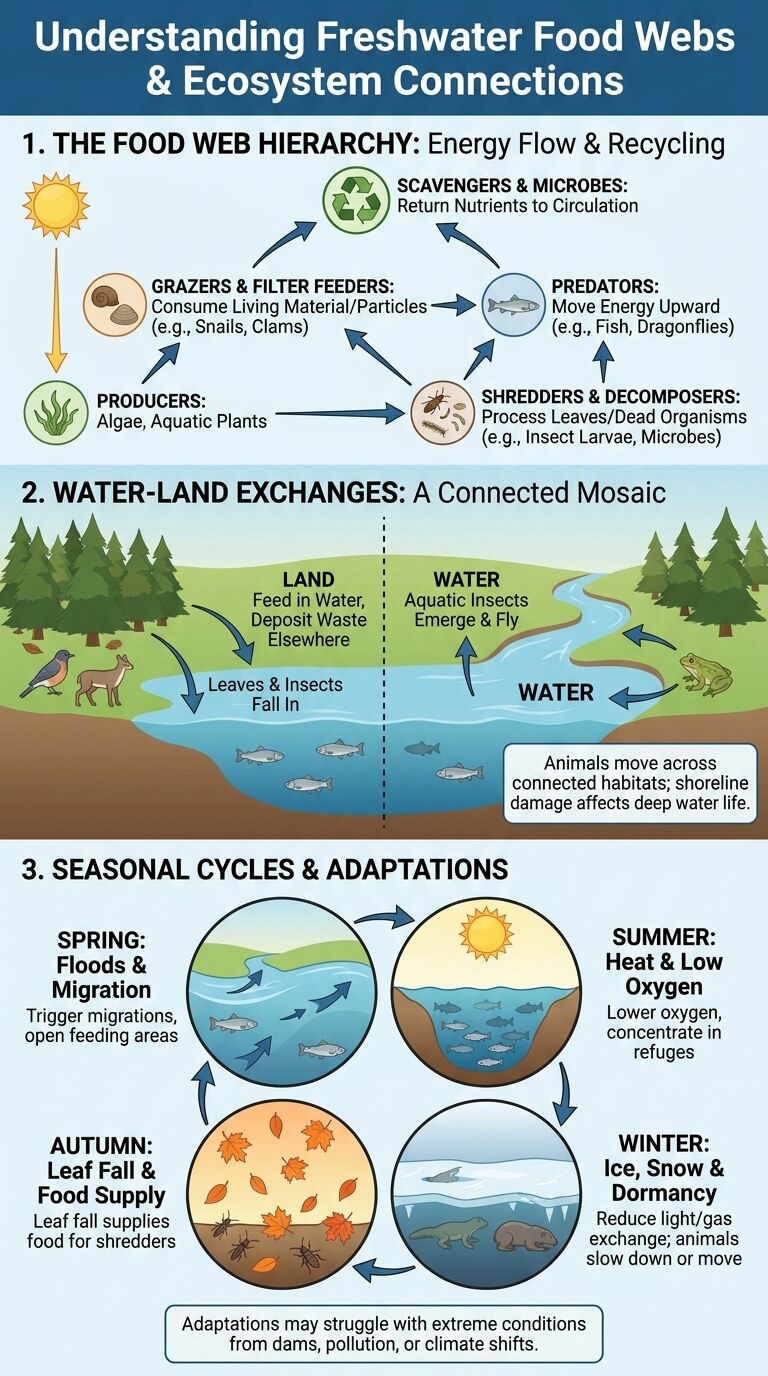
Producers, Grazers, Filter Feeders, Predators, and Scavengers
Algae, aquatic plants, and photosynthetic microbes capture energy. Grazers and filter feeders consume living material or suspended particles. Shredders and decomposers process leaves and dead organisms. Predators move energy upward through the web, while scavengers and microbes return nutrients to circulation.
Energy Moving Between Water and Land
Streams, wetlands, rivers, lakes, and ponds form connected habitat networks rather than isolated bowls. Animals move downstream, upstream, across floodplains, through groundwater, and over land. The USGS review of connected freshwater ecosystem mosaics describes how movements among streams, wetlands, ponds, rivers, and lakes provide resources needed across animal life cycles.
Leaves and insects fall into water from land. Aquatic insects emerge and fly into forests. Amphibians leave ponds. Birds and mammals feed in water and deposit waste elsewhere. These exchanges mean that damage to shorelines or floodplains can affect animals living well below the surface.
Seasonal Changes in Prey and Oxygen
Spring floods can open floodplain feeding areas and trigger migrations. Summer heat can lower dissolved oxygen and concentrate animals in deeper or flowing refuges. Autumn leaf fall supplies food for shredding insects and microbes. Winter ice and snow can reduce light and gas exchange.
Animals respond by moving, slowing metabolism, changing diet, breeding, entering dormancy, or leaving the habitat. Species adapted to natural seasonal variation may still struggle when dams, withdrawals, drought, pollution, or rapid temperature shifts push conditions beyond their normal range.
Freshwater Survival Adaptations
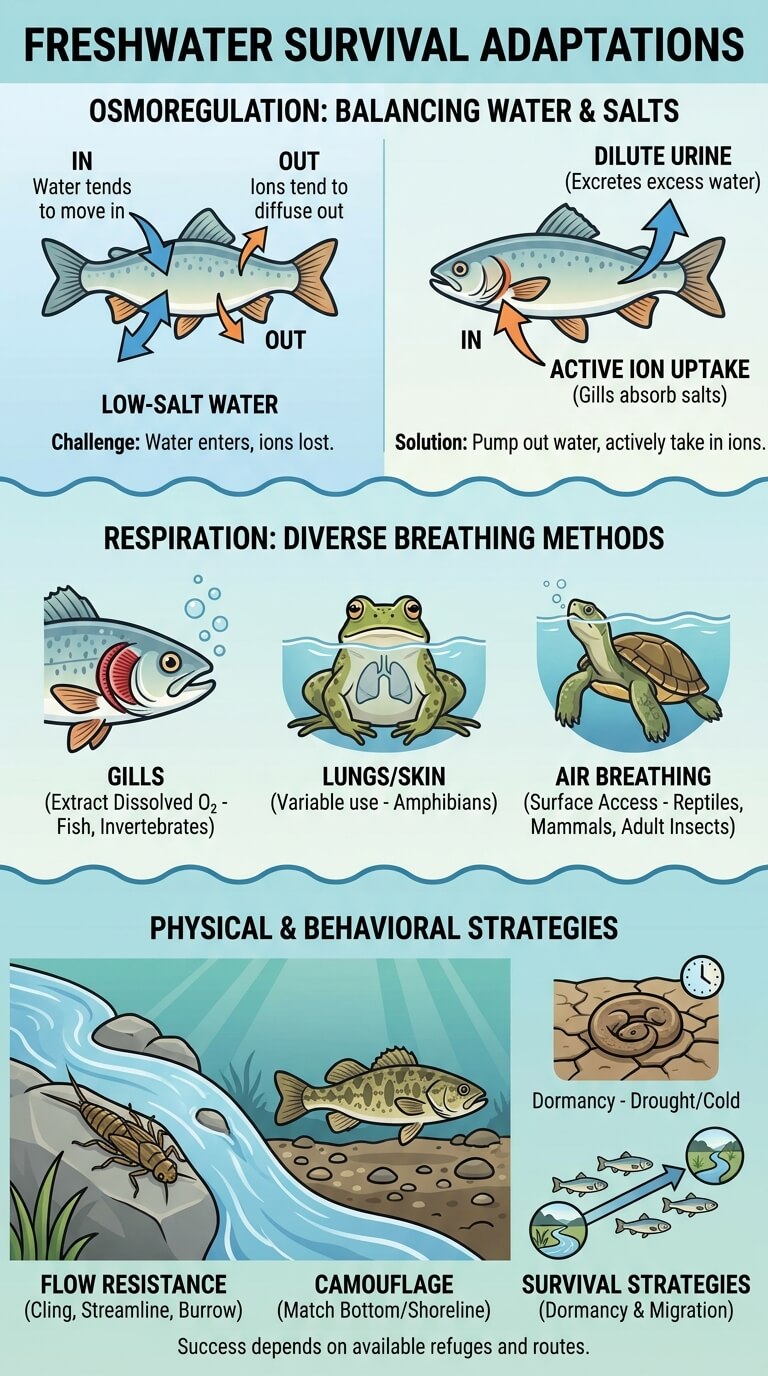
Osmoregulation and Life in Low-Salt Water
Freshwater is less salty than the body fluids of most aquatic vertebrates. Water tends to move into their bodies, while important ions tend to diffuse outward. Freshwater fish compensate by producing large amounts of dilute urine and actively taking up ions through specialized cells in the gills.
Breathing With Gills, Lungs, Skin, or Air Stores
Fish and many invertebrates use gills to extract dissolved oxygen. Frogs and salamanders may use lungs, skin, mouth lining, or gills depending on species and life stage. Turtles, birds, mammals, and adult aquatic insects breathe air and must reach the surface.
Flow Resistance, Camouflage, Dormancy, and Migration
Stream animals cling, flatten, hide behind stones, build weighted cases, burrow, or use streamlined shapes. Bottom animals match gravel, mud, wood, or plants. Shoreline predators rely on stillness and sudden strikes.
Dormancy allows animals to survive cold, drought, or temporary pool drying. Migration connects feeding, spawning, nursery, and winter habitats. These strategies work only when the necessary refuges and routes remain available.
Major Threats to Freshwater Animals
Pollution and Nutrient Runoff
Freshwater receives runoff from the surrounding watershed. Fertilizer, manure, sewage, road salt, sediment, pesticides, metals, oil, and other pollutants can enter through streams, storm drains, groundwater, and direct discharge.
Excess nitrogen and phosphorus can stimulate heavy algal growth. When algae die and decompose, oxygen may fall to levels that stress or kill aquatic animals. The EPA explanation of nutrient pollution and oxygen loss also notes that blooms can block light and harm underwater plants.
Dams, Channel Change, Water Withdrawal, and Habitat Loss
Dams can block migration, change temperature, trap sediment, alter flood timing, and convert flowing river into reservoir habitat. Channelization removes bends, woody cover, shallow margins, and floodplain connections. Water withdrawal reduces depth and flow, concentrates pollutants, and can isolate pools.
Wetland drainage, shoreline hardening, vegetation removal, gravel mining, and development remove breeding, nesting, feeding, and refuge areas. The effect depends on the species. A structure that benefits a reservoir fish may harm a current-dependent mussel, darter, or salamander.
Invasive Species, Disease, and Climate Stress
Introduced fish, crayfish, mussels, plants, and pathogens can prey on native animals, compete for resources, alter habitat, or spread disease. Released bait and aquarium animals are common pathways. Once established, removal may be difficult and can create additional disturbance.
How to Observe Freshwater Wildlife Responsibly
Watch From Stable Banks and Trails
Use established trails, boardwalks, docks, and stable banks. Avoid steep, muddy, flooded, or fast-current areas. Water depth, current, cold, unstable sediment, hidden drop-offs, wildlife, and contamination can make wading dangerous.
Binoculars, a camera, and patient observation reveal more natural behavior than close pursuit. Never feed wildlife or approach large reptiles and mammals. Keep children and pets under control near water.
Avoid Moving Animals, Rocks, Nests, Eggs, or Larvae
Turning rocks can crush eggs, expose hidden animals, disturb current, and remove shelter. If a permitted educational activity involves lifting a small rock, it should be replaced gently in its original orientation. Casual visitors should leave nests, mussels, crayfish, tadpoles, salamanders, fish, and turtles where they are.
Do not move wildlife between water bodies. Healthy-looking animals can carry pathogens, parasites, invasive organisms, or locally distinct genes. Collection rules also vary by species and location.
Prevent Bait, Pet, and Aquarium Releases
Never release aquarium fish, snails, plants, crayfish, frogs, turtles, or unused live bait into natural water. A released animal may become invasive, carry disease, hybridize with native populations, or die because the habitat is unsuitable.
Use local disposal and surrender options. Clean, drain, and dry boats and gear according to agency instructions to reduce movement of invasive species between lakes and rivers.
Common Myths and Mistakes
Freshwater Does Not Mean Perfectly Pure Water
Freshwater contains dissolved minerals, nutrients, organic matter, microbes, and suspended particles. The term refers mainly to low salinity, not sterile or drinkable water. A clear stream can contain pathogens or contaminants, while naturally dark wetland water may support a healthy ecosystem.
Water quality must be evaluated with measurements appropriate to the location and purpose. Appearance, smell, or the presence of one animal species cannot provide a complete diagnosis.
Semi-Aquatic Animals Are Not Always Permanent Water Residents
Frogs, turtles, snakes, birds, beavers, otters, and other animals may depend on land for nesting, feeding, shelter, dispersal, or winter survival. Seeing an animal in water does not mean it can be relocated to any pond.
Shorelines and surrounding uplands are part of freshwater habitat. Roads, lawns, walls, and cleared banks can interrupt life cycles even when the water itself remains.
Small Ponds Can Support Complex Food Webs
A shallow pond may hold algae, microbes, zooplankton, insect larvae, snails, crayfish, tadpoles, salamanders, turtles, snakes, birds, and mammals. Drying can remove fish and favor species adapted to temporary water.
How Amphibians Fit Into Freshwater Life
Amphibian Life Cycles and Breeding Habitats
Freshwater explains only part of an amphibian’s life. Many frogs and salamanders begin in water, then feed, shelter, migrate, or overwinter on land. Temporary pools, permanent ponds, streams, springs, and plant-held water support different reproductive strategies.
The connection makes amphibians sensitive to changes on both sides of the shoreline. Protecting breeding water without movement routes and terrestrial refuge may not sustain the population.
Why Frogs Matter Within Food Webs
Tadpoles graze, filter, scavenge, or prey within aquatic systems. Adult frogs consume invertebrates and small vertebrates. Eggs, larvae, juveniles, and adults feed many predators.
When young frogs leave water, they carry aquatic energy onto land. When adults return to breed, they bring nutrients and prey relationships back to freshwater. Their importance comes from this changing role across life stages.
Winter Survival and Amphibian Population Decline
Winter survival depends on underwater oxygen, frost-buffered soil, leaf litter, stream refuges, or species-specific freeze tolerance. A pond that loses oxygen or freezes to the bottom can fail as a refuge. A cleared forest floor can expose terrestrial amphibians to drying and cold.
Habitat loss, disease, pollution, invasive species, climate stress, and blocked movement can act together. Amphibian decline is therefore one part of the wider challenge of keeping freshwater habitats connected, clean, seasonally functional, and biologically diverse.
FAQ
What Are the Main Groups of Freshwater Animals?
The major groups include fish, amphibians, reptiles, birds, mammals, insects, crustaceans, mollusks, worms, zooplankton, and many microscopic animals. Some are permanent aquatic residents, while others use freshwater only during one life stage or season.
Grouping by ecological role is also useful. Freshwater systems contain grazers, filter feeders, shredders, predators, scavengers, burrowers, migrators, and habitat engineers.
Which Freshwater Animals Can Live Both in Water and on Land?
Frogs, toads, many salamanders, turtles, crocodilians, water snakes, beavers, muskrats, otters, and numerous birds use both environments. Aquatic insects also cross the boundary when underwater larvae become flying adults.
The amount of time spent in each place varies. A hellbender is almost entirely aquatic, while a pond-breeding salamander may spend most of the year underground on land.
Why Are Freshwater Mussels Important?
Freshwater mussels filter algae, microbes, detritus, and suspended particles from water. They move nutrients between the water column and bottom, stabilize sediment, create habitat with their shells, and provide food for fish, birds, mammals, and other animals.
Many mussel larvae must attach temporarily to a suitable host fish before becoming juveniles. This makes mussel survival dependent on water quality, river habitat, and the presence and movement of particular fish species.
What Is the Difference Between Freshwater and Brackish Habitats?
Freshwater has very low salinity. Brackish water is a mixture or transition between fresh and salt water, commonly found in estuaries where rivers meet the sea. Salinity can change with tides, rainfall, river flow, drought, and season.
Some animals tolerate a wide salinity range, while others are restricted to fresh or salt water. A species found near an estuary should not automatically be labeled a permanent freshwater resident.
Final Thoughts
Freshwater animals form communities shaped by flow, depth, oxygen, salinity, season, plants, sediment, and connections with land. Fish, amphibians, reptiles, birds, mammals, insects, mussels, crayfish, snails, worms, and plankton occupy different zones and perform different ecological jobs.
The most important lesson is that freshwater habitat extends beyond visible water. Shorelines, floodplains, forests, wetlands, migration routes, groundwater, and seasonal cycles all support animal life. Protecting those connections, preventing releases, reducing pollution, and observing wildlife without disturbance help preserve the complex food webs of rivers, streams, lakes, ponds, and wetlands.

Ethan Walker is the founder and research editor of Animal Fact Central. He creates and reviews educational animal facts content using trusted wildlife, pet care, and science-based sources. His work focuses on making animal behavior, adaptations, habitats, and species facts clear, accurate, and engaging for everyday readers.
Read More Details About Ethan Walker: https://animalfactcentral.com/ethan-walker/