
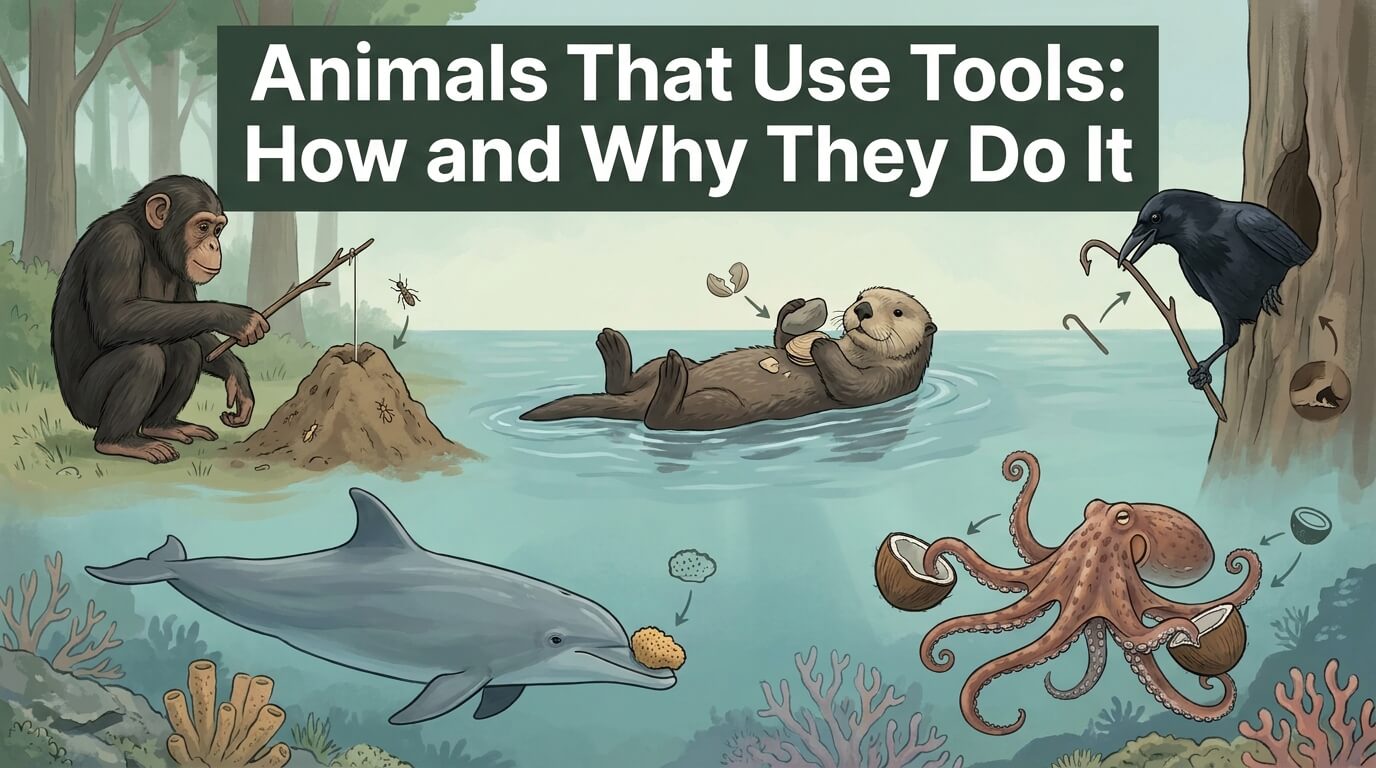
Animals that use tools include chimpanzees, orangutans, capuchin monkeys, New Caledonian crows, woodpecker finches, sea otters, bottlenose dolphins, wrasses, octopuses, and even some ants. Their tools are not miniature copies of human technology. They are sticks, stones, leaves, sponges, shells, plant fibers, and other objects that help an animal reach food, protect its body, or solve a practical problem.
The interesting question is not simply whether an animal touches an object. Researchers ask whether it selects the object for a goal, carries it to the right place, changes its shape, uses several objects in order, or learns the technique from experience and other animals. Those details separate a striking anecdote from strong evidence of animal tool use.
Quick Answer: Which Animals Use Tools?
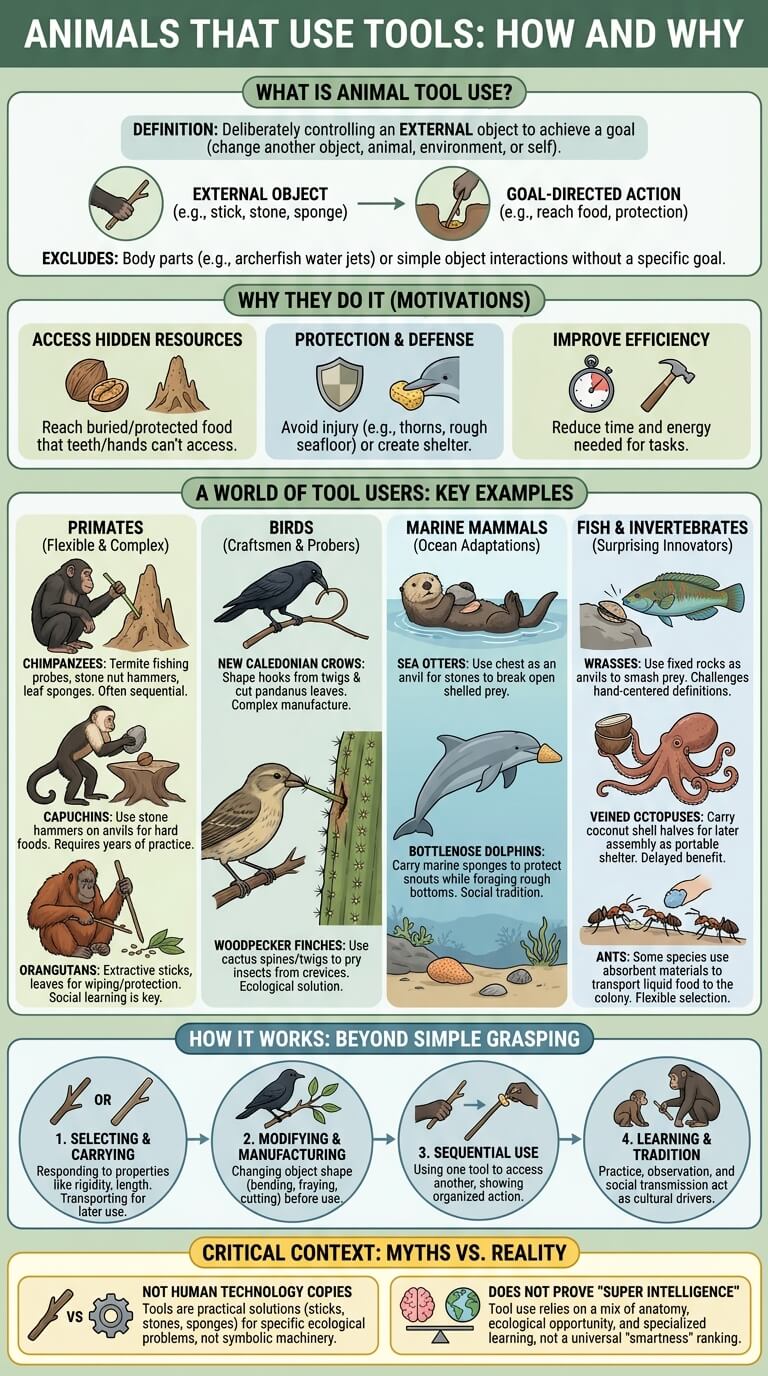
Tool use occurs in many branches of the animal kingdom. Great apes probe holes, collect insects, crack nuts, and process plant materials. Some monkeys hammer hard foods with stones. Several birds use probes or manufacture shaped implements. Sea otters break open prey against rocks, while some dolphins protect their snouts with marine sponges as they forage along the seafloor.
Fish strike shellfish against fixed rocks. Veined octopuses carry shell halves that later become shelter. Certain ants load portable material with liquid food and return it to the colony. These behaviors differ in flexibility, so they do not imply identical mental abilities.
What Counts as a Tool in Animal Behavior Research?

External objects used to achieve a goal
A practical definition starts with an object outside the animal’s body. The animal deliberately controls that object to change the condition of another object, another animal, the environment, or its own body. A chimpanzee inserting a twig into a termite mound fits clearly. A sea otter positioning a clam on its chest and striking it with a stone also fits because the stone changes the prey in a goal-directed way.
Definitions keep changing as animals use objects in unexpected ways. A major review of tool use as an adaptation emphasizes ecological problems, anatomy, costs, and benefits rather than assuming every tool user needs human-like reasoning.
The difference between tool use, construction, and body-based behavior
Nest building can involve careful material selection, but construction is often separated from tool use because the finished structure is the goal rather than an implement used to act on something else. A bird weaving grass into a nest is building. A woodpecker finch holding a cactus spine to pry an insect from bark is using an implement. The distinction is useful even though nature does not always provide a perfectly sharp boundary.
Body parts are usually not classified as tools. An archerfish shoots a controlled jet of water from its mouth to knock prey from vegetation, but the water is produced and directed through the animal’s body. Some researchers see this as tool-like projectile use, while stricter definitions exclude it because the fish does not first select and manipulate a detached object.
Why definitions vary among researchers
A definition that is too broad could label nearly every interaction with an object as tool use. A definition that is too narrow could exclude meaningful behavior simply because the animal lacks hands or uses a fixed environmental object. Fixed anvils are a common problem. A wrasse may carry a mollusk to a particular rock and smash it repeatedly, yet the rock is not detached or held.
Researchers therefore describe what happened before making large claims. Did the animal choose among materials, move or alter the object, and adjust when conditions changed? These features are more informative than a simple yes-or-no label.
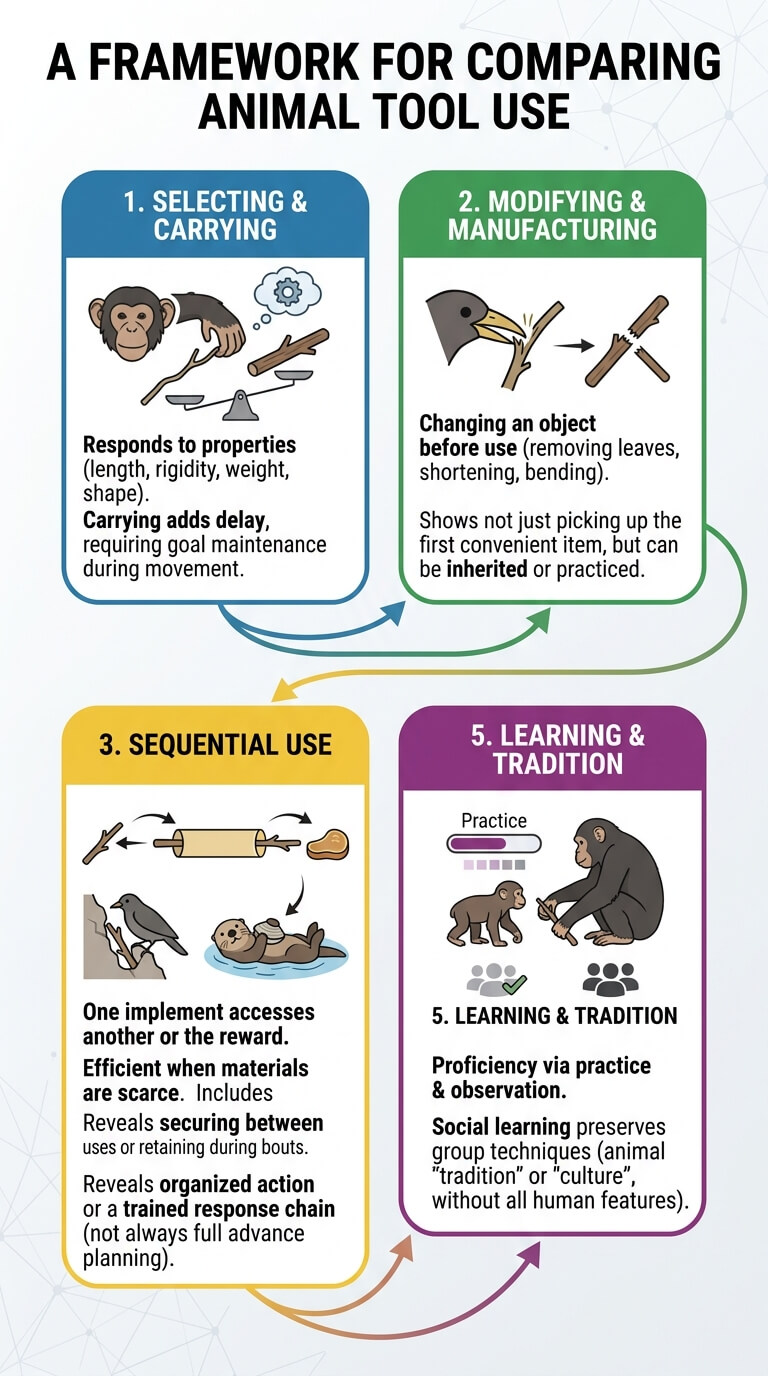
A Framework for Comparing Animal Tool Use
Selecting and carrying a tool
Selection requires the animal to respond to useful properties such as length, rigidity, weight, shape, texture, or absorbency. A tool may work only if it can enter a crevice, survive repeated blows, or protect a sensitive body part. Carrying adds a delay between finding the object and using it, which may require the animal to maintain a goal while moving elsewhere.
Modifying or manufacturing a tool
Modification occurs when an animal removes leaves, shortens a stick, bends a material, frays an end, or otherwise changes an object before use. Manufacture is especially informative when the final shape is not immediately available in the environment. It shows that the user is not merely picking up the first convenient item, although the behavior can still depend on inherited tendencies and extensive practice.
Using multiple tools in sequence
Sequential use means one implement provides access to another or to the final reward. An animal may use a short stick to retrieve a longer one that can reach food. This can reveal organized action, but repeated training can also produce a response chain without proving full advance planning.
Reusing, storing, or transporting tools
Reusing a tool is efficient when materials are scarce or costly to prepare. Some birds secure tools between uses. Sea otters may retain a rock during a feeding bout and can hold food or objects in loose skin folds beneath the forelimbs. The claim that every otter owns one lifelong favorite rock goes beyond the evidence.
Learning through practice, observation, or tradition
Young animals often need time to become proficient. Practice improves motor control, while observation can direct attention to useful objects or locations. Social learning may preserve group-specific techniques. Researchers may call a persistent learned behavior an animal tradition or culture, without implying all the features of human technology.
Primates That Use and Make Tools

Chimpanzee termite fishing, nut cracking, and probing
Wild chimpanzees have one of the broadest known tool repertoires outside humans. They insert plant stems into termite nests, use longer probes for ants, hammer nuts with stones or wood, puncture underground bee nests, and make leaf sponges for collecting water. The exact set of behaviors differs among communities because local materials, prey, opportunities, and learned traditions all matter.
Tool use can involve a prepared sequence. A chimpanzee may select a plant, remove side leaves, change the end, carry the implement, and adjust it after testing the opening. Recent research on the distribution of complex chimpanzee toolsets found that ecology and connections among populations help shape where complicated combinations occur. The result supports a mixed explanation involving environment, population history, and social transmission.
Orangutan extractive tools and flexible materials
Wild orangutans use sticks to extract insects, seeds, and other foods from places that teeth and fingers cannot easily reach. They also use leaves for protection, wiping, or altering sounds. Repertoires differ among populations, so no single technique should be treated as universal.
Their semi-solitary lives show that social learning does not require a constantly cohesive group. Young orangutans spend years near their mothers, watching feeding choices and object handling. Skill can combine observation, exploration, growth, and repeated encounters with the same problem.
Capuchin stone tools and food processing
Some robust capuchin monkeys use stones as hammers and exposed rock surfaces or roots as anvils. They crack palm nuts and other resistant foods that would otherwise be difficult to open. The task requires choosing a suitable hammer, positioning the food, controlling repeated impacts, and sometimes transporting heavy stones relative to body size.
Young capuchins take years to become consistently effective. They watch others, handle stones and nuts, and improve posture, aim, force, and sequence. This does not by itself prove teaching, but it shows that skill develops through experience.
Birds with Sophisticated Tool Behavior

New Caledonian crows making hooked tools
New Caledonian crows are famous because wild birds do not merely pick up straight sticks. They shape twigs and cut tools from pandanus leaves to extract prey from holes. A landmark description of hook-tool manufacture by New Caledonian crows documented distinct tool forms, including hooked twigs and stepped-cut leaf tools.
Hook shape can improve extraction efficiency, but the cognitive interpretation requires care. The species has body features suited to controlled tool handling, including a relatively straight bill and strong binocular overlap. Its performance probably reflects an interaction among inherited predispositions, anatomy, ecological opportunity, individual learning, and experience with tool materials.
Woodpecker finches using probes
Woodpecker finches in the Galápagos use twigs, leaf stems, or cactus spines to dislodge arthropods from crevices. A bird may shorten a probe or remove side projections that interfere with insertion. Tool use becomes especially valuable in dry conditions or places where prey is hidden inside wood and cannot be reached directly with the bill.
Not every individual uses tools at the same rate. Habitat, available prey, and alternative feeding opportunities affect how useful the technique is. This is a good example of tool behavior as an ecological solution rather than a general demonstration that the species can solve every kind of problem.
Ravens, rooks, and problem-solving experiments
Rooks and ravens have solved laboratory tasks involving stones, water levels, string pulling, object choice, and tool modification. Rooks are particularly interesting because they are not known as habitual tool users in the wild, yet captive birds can manipulate objects effectively when a task creates the opportunity.
Laboratory performance shows behavioral flexibility, but it should not be confused with a naturally evolved tool tradition. A bird that receives repeated trials, human-provided materials, and an obvious food reward faces a different problem from a wild bird deciding whether to manufacture and carry a tool during normal foraging.
Parrots manipulating objects to reach goals
Several parrots can combine, insert, tear, or exchange objects in controlled experiments. Goffin’s cockatoos have manufactured splinters and strips from available materials, while other parrots have learned tasks involving tokens or multiple components. Strong bills and feet give parrots unusual control over objects, but individual experience strongly affects success.
Researchers distinguish spontaneous solutions from actions built through step-by-step training. Both can reveal learning, but they answer different questions. A spontaneous solution may show that an animal can reorganize familiar actions for a new goal. A trained solution shows what the animal can learn under structured conditions.
Marine Mammals That Use Tools

Sea otters using stones and hard surfaces
Sea otters use loose stones and fixed hard surfaces to open mussels, clams, snails, crabs, and other armored prey. An otter may place prey on its chest and strike it with a rock, or pound the prey against a rock or other hard object. Tool use helps overcome shells that teeth alone may process less efficiently.
Tool use is not equally common in every otter or habitat. It depends partly on prey type and opening difficulty. Research published in 2024 found that tool use can broaden prey access and reduce tooth damage, with variation among individuals. The behavior can therefore change both feeding opportunities and physical costs.
Bottlenose dolphins carrying marine sponges while foraging
In Shark Bay, Australia, some bottlenose dolphins place basket sponges over their rostrums while searching along the seafloor. The sponge appears to protect the dolphin as it probes rough substrate for concealed prey. Only part of the population uses this method, and calves spend years accompanying their mothers during the long process of learning to forage.
A long-term study of sponge-tool use in Shark Bay dolphins found that users preferentially associated with other users after researchers accounted for factors such as location, sex, and maternal relationships. The behavior is widely regarded as one of the best documented cases of a socially learned foraging tradition in a wild cetacean.
Other marine mammals and the limits of interpretation
Marine mammals sometimes carry kelp, shells, sponges, or other objects during play, courtship, display, or feeding. Male Australian humpback dolphins, for example, have been observed presenting marine sponges in social displays. This is intriguing object use, but the function and evidence differ from the protective foraging tools of Shark Bay dolphins.
Calling every carried object a tool would hide those differences. Researchers look for controlled use toward a specific mechanical or functional goal. Play may help animals learn object properties, yet an object used only as a plaything is not automatically a tool.
Fish and Invertebrates That Use Objects as Tools
Wrasses using anvils to open prey
Several wrasse species carry hard-shelled prey to rocks and strike it until it breaks. The rock acts as an anvil even though it remains fixed. A review of tool use by aquatic animals shows why some definitions call this fixed-tool use. Functionally, it lets the fish process prey that resists direct biting.
Similar anvil behavior has been reported in other fishes. These cases challenge hand-centered ideas about technology. A fish can create a repeated mechanical relationship among its mouth, a food item, and a stable feature of the environment without ever grasping the anvil itself.
Archerfish and the debate over projectile-like water use
Archerfish aim water jets at insects above the surface, adjusting the shot for distance and the optical distortion created by the air-water boundary. The behavior is highly controlled and can involve learning. Whether it is tool use depends on the definition applied.
The fish does not select a detached external object, so strict definitions exclude the jet. Broader functional definitions may treat the controlled water as an environmental medium used to act at a distance. The debate is valuable because it reveals how definitions designed around hands and solid objects may overlook other bodies and habitats.
Octopuses carrying shells for later shelter
Veined octopuses have been observed stacking and carrying coconut shell halves across open seafloor, then assembling the halves into shelter when needed. Carrying makes movement awkward and offers no immediate protection. The delayed benefit is one reason the behavior attracted attention as defensive tool use.
The original report of coconut-shell carrying by octopuses emphasized transport and later assembly. Some researchers still prefer to call the shells portable shelters rather than tools. Either description should preserve the important observation: the animal accepts an immediate cost to move material that becomes useful in a later situation.
Insect examples and the boundary between fixed and flexible behavior
Some ants drop soil particles, leaf fragments, or absorbent materials into liquid food, then carry the loaded pieces to the nest. Experiments show that certain species adjust material choices according to absorbency, buoyancy, availability, or the properties of the liquid. This flexibility makes the behavior a stronger tool-use candidate than an unchanging action performed with one object type.
Other insect behaviors are harder to classify. Building with wax, silk, mud, or plant fibers can be complex but is normally treated as construction. A behavior may also be highly effective while being largely species-typical and triggered by a narrow set of cues. Tool use does not have to be insightful, but evidence of flexible selection and adjustment helps distinguish technology from fixed action patterns.
Why Tool Use Evolves
Accessing hidden or protected food
Many tools solve an access problem. Termites live behind walls, larvae hide in wood, nuts have resistant shells, and benthic prey may be buried beneath rough sediment. The tool extends the reach of a bill, hand, mouth, or arm, or it applies force in a way the body cannot safely or efficiently produce alone.
Reducing injury and improving efficiency
A tool can protect teeth, skin, fingers, bills, or the sensitive tip of a dolphin’s rostrum. It can also reduce the time needed to extract a food item. These benefits must exceed the costs of finding material, preparing it, carrying it, and learning the technique. A sophisticated tool may disappear from a population if easier food becomes available.
Ecological opportunity, anatomy, and available materials
Intelligence alone cannot produce tool behavior if the environment offers no useful materials or problems worth solving. Anatomy matters too. Crows control tools with bills, primates use hands and mouths, otters coordinate forepaws and chest, dolphins manipulate sponges with the rostrum, and octopuses use flexible arms and suckers. Different bodies make different technologies possible.
Innovation, learning, and social transmission
A new technique may begin with exploration by one animal, but persistence depends on learning. Others may copy actions, become attracted to the same objects, or discover the method while watching the results. Social tolerance can create more opportunities for young animals to observe skilled users. Environmental stability also matters because a technique is easier to retain when the same materials and food problems recur.
Does Tool Use Prove an Animal Is Intelligent?
What tool use can reveal about planning and causal understanding
Tool behavior can reveal attention, memory, motor control, inhibition, and sensitivity to physical relationships. Carrying an object for later use may be consistent with planning, while choosing a rigid stick may show attention to function. Each interpretation still needs tests against simpler explanations. Tool behavior is one window into animal intelligence, but it cannot measure every form of learning, communication, memory, or social cognition.
Why sophisticated tool use can coexist with narrow specialization
A species may be exceptionally skilled with one natural tool while showing ordinary performance in unrelated tasks. Specialized behavior can emerge because a recurring ecological challenge favors a particular combination of anatomy, motivation, and learning. That does not make the achievement less impressive. It simply means tool skill is not a universal intelligence score.
The difference between trained performance and spontaneous behavior
Training reveals what animals can learn under controlled conditions. Spontaneous behavior shows what occurs without step-by-step shaping. Wild observations establish ecological relevance but reduce experimental control. Strong conclusions often combine all three approaches.
Common Myths and Mistakes
Humans are not the only animals that make tools
Many animals modify raw materials before use. Crows shape hooks, chimpanzees strip and fray stems, and some parrots cut pieces from larger materials. Human technology remains distinctive in its scale, cumulative complexity, symbolic instruction, and dependence on large cooperative networks, not because every nonhuman animal merely picks up unmodified objects.
Not every object interaction is tool use
Carrying a toy, decorating a nest, rolling on a scented object, or collecting shells may have important functions without meeting a tool definition. The animal should control the object toward a specific goal that changes another object, organism, environment, or its own condition. Clear description is better than labeling behavior for dramatic effect.
A famous anecdote is not the same as repeatable evidence
An unusual observation can inspire research, but one event may reflect accident, prior training, or an idiosyncratic individual. Researchers look for repeated behavior, clear video or field records, comparison conditions, and evidence that the action changes appropriately when the problem changes.
Tool use does not create a simple smartest-species ranking
Species solve different physical problems. Some rely on habitual wild tools, while others manipulate objects mainly in experiments. Ranking them requires arbitrary choices about manufacture, transport, learning, efficiency, novelty, and variety. A profile of strengths is more defensible than a single ladder. Using tool variety alone to rank the smartest animals in the world would favor species with bodies and habitats suited to object manipulation.
What Tool Use Reveals About Memory and Learning
Crow tool manufacture depends on more than clever hands
Crows must coordinate vision, bill movements, material choice, and extraction technique. Repeated routines can depend on remembering productive sites and useful plant materials. Young birds also need experience before their movements become efficient. Tool manufacture therefore sits at the meeting point of anatomy, development, ecology, and learning.
Dolphin sponge carrying is a learned foraging tradition
Sponge use shows how a feeding technique can persist within family lines and social groups. A young dolphin must learn where the method works, how to obtain a suitable sponge, how to hold it, and how to detect prey while the rostrum is covered. The behavior is closely tied to habitat rather than being a general trick used everywhere.
Memory helps turn repeated actions into skilled routines
Tool users must remember object locations, material properties, action sequences, and past outcomes. Practice can make a routine faster without making it rigid. Skilled animals often adjust when a tool breaks or when the target changes. That balance between memory and flexibility is more informative than simply counting how many tools a species uses. Animal memory helps skilled tool users retain material properties, action sequences, productive locations, and past outcomes.
FAQ
Do sea otters really keep favorite rocks?
Some sea otters retain or reuse rocks during feeding and can carry objects in loose skin folds beneath their forelimbs. Tool habits can be consistent, but the claim that otters generally keep one favorite rock for life is not well established. Some individuals repeatedly use suitable stones when processing hard prey.
Do octopuses use tools or only shelters?
Veined octopuses carry shell halves and assemble them as shelter later. Researchers who emphasize detached objects, transport, and delayed use often classify this as defensive tool use. Others prefer portable shelter because the object becomes the protective structure itself. The disagreement concerns terminology, not the documented carrying and assembly behavior.
Are tool-using animals born knowing what to do?
Inherited tendencies can make an animal interested in particular objects or movements, but skilled tool use often develops through practice. Young chimpanzees, capuchins, dolphins, and birds may spend months or years observing, handling objects, and improving technique. The contribution of observation and direct copying differs among species and behaviors.
Can insects use tools?
Yes, under widely used definitions, some insects can. Certain ants use particles or absorbent material to collect and transport liquid food, and they may adjust their choices to the task. Researchers remain careful because many insect construction and object-handling behaviors are highly species-typical. Flexibility and goal-sensitive selection strengthen the case for calling an action tool use.
Final Thoughts
Animals that use tools show that practical technology has evolved in many bodies and habitats. A chimpanzee’s probe, a crow’s hook, an otter’s hammer stone, a dolphin’s sponge, a wrasse’s anvil, and an octopus’s portable shelter solve different ecological problems. Their value lies not in proving which species is smartest, but in revealing how anatomy, opportunity, memory, practice, and social learning can combine to produce skilled behavior.
To understand animal tool use, look beyond the object. Ask how it was chosen, changed, carried, used, and learned. Those questions turn a list of clever animals into a deeper view of behavioral evolution.

Ethan Walker is the founder and research editor of Animal Fact Central. He creates and reviews educational animal facts content using trusted wildlife, pet care, and science-based sources. His work focuses on making animal behavior, adaptations, habitats, and species facts clear, accurate, and engaging for everyday readers.
Read More Details About Ethan Walker: https://animalfactcentral.com/ethan-walker/