
The smartest animals in the world cannot be placed in one fully objective ranking. Chimpanzees solve physical and social problems, dolphins manage complicated relationships, crows manufacture tools, parrots learn symbolic labels, elephants retain socially useful information, dogs read human signals, and octopuses explore objects with a nervous system unlike that of any mammal. Each example reflects a different kind of cognitive strength.
A better list asks what an animal can do, whether the behavior is flexible, how well the result has been replicated, and whether the test suits the animal’s senses and body. That approach still identifies animals with impressive abilities, but it avoids pretending that intelligence is a single ladder with one species at the top.
Quick Answer: Is There One Smartest Animal?
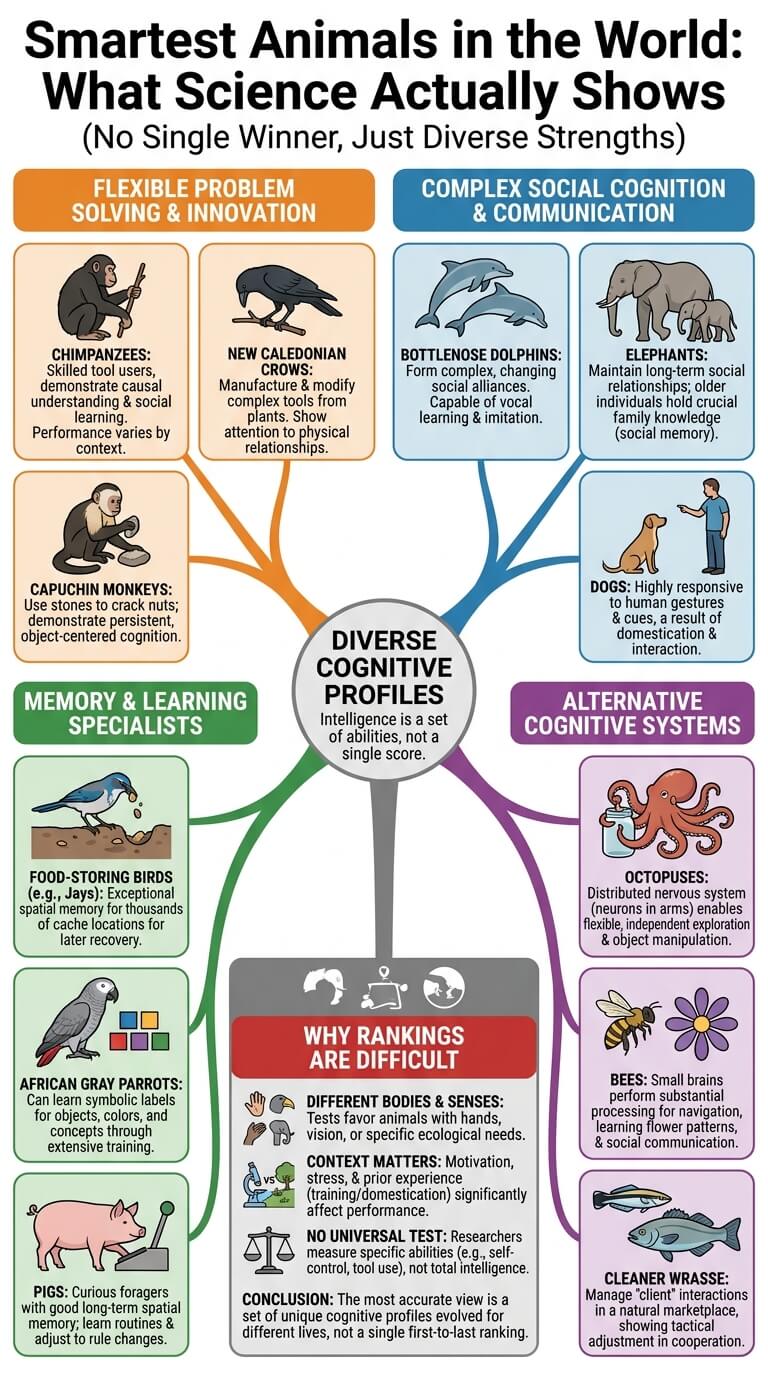
No single nonhuman animal has been proved to be the smartest across every cognitive domain. Great apes are among the strongest all-around performers in many laboratory tasks, but birds can rival primates in tool use and planning-related experiments. Dolphins excel in vocal learning and social coordination. Dogs are unusually responsive to human gestures. Food-storing birds may outperform other animals on memory tasks that match their natural lives.
Humans also influence the comparison. Researchers often design tasks that reward vision, hand-like manipulation, patience, or comfort with artificial equipment. Those conditions may favor some species while hiding the strengths of others. The most defensible answer is therefore a set of cognitive profiles rather than a precise first-to-last ranking.
How We Selected the Animals on This List
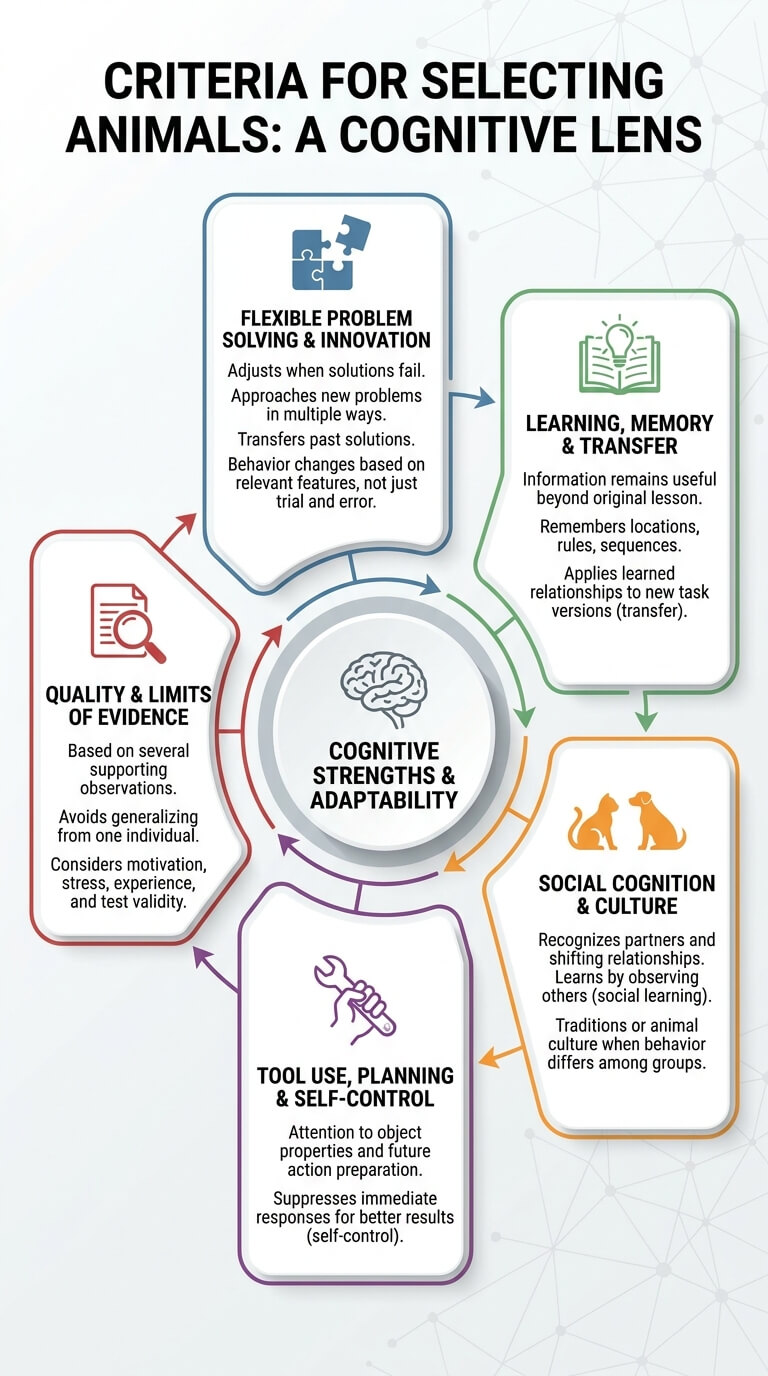
Flexible problem solving and innovation
An animal earns attention when it can adjust after a familiar solution stops working, approach a new problem in more than one way, or transfer part of an earlier solution to a different situation. Persistence alone is not enough. Strong evidence shows that behavior changes in response to relevant features of the problem rather than repeated trial and error alone.
Learning, memory, and transfer to new situations
Learning matters most when information remains useful beyond the original lesson. Researchers may test whether an animal remembers locations, individuals, rules, or action sequences. They also look for transfer, which occurs when a learned relationship helps the animal solve a new version of a task. A species may have exceptional memory in one domain without possessing unusually strong memory in every domain.
Social cognition, communication, and culture
Group living can require recognizing partners, competitors, offspring, and shifting relationships. Social learning occurs when one animal acquires behavior by observing or interacting with another. When socially learned behavior persists within a community and differs among groups, researchers may cautiously describe it as a tradition or animal culture. The term does not imply that animal culture has all the features of human culture.
Tool use, planning, and self-control
Tool use can reveal attention to object properties, motor control, learning, and sometimes preparation for a future action. Self-control tasks test whether an animal can suppress an immediate response when waiting or choosing differently leads to a better result. A large comparative study tested multiple species on two self-control tasks, but even that work measured one cognitive dimension rather than total intelligence. The cross-species study of self-control is a useful example of how researchers compare a shared ability without creating an overall IQ table.
Quality and limits of the available evidence
Animals were included when several observations or experiments support a meaningful cognitive strength. Results from one trained individual can be valuable, but they do not automatically describe an entire species. Motivation, prior experience, stress, sensory access, and familiarity with people can all change performance. A review of animal cognitive test validity explains why a low score may reflect the testing situation as much as the ability being studied.
A Better Way to Compare Animal Intelligence
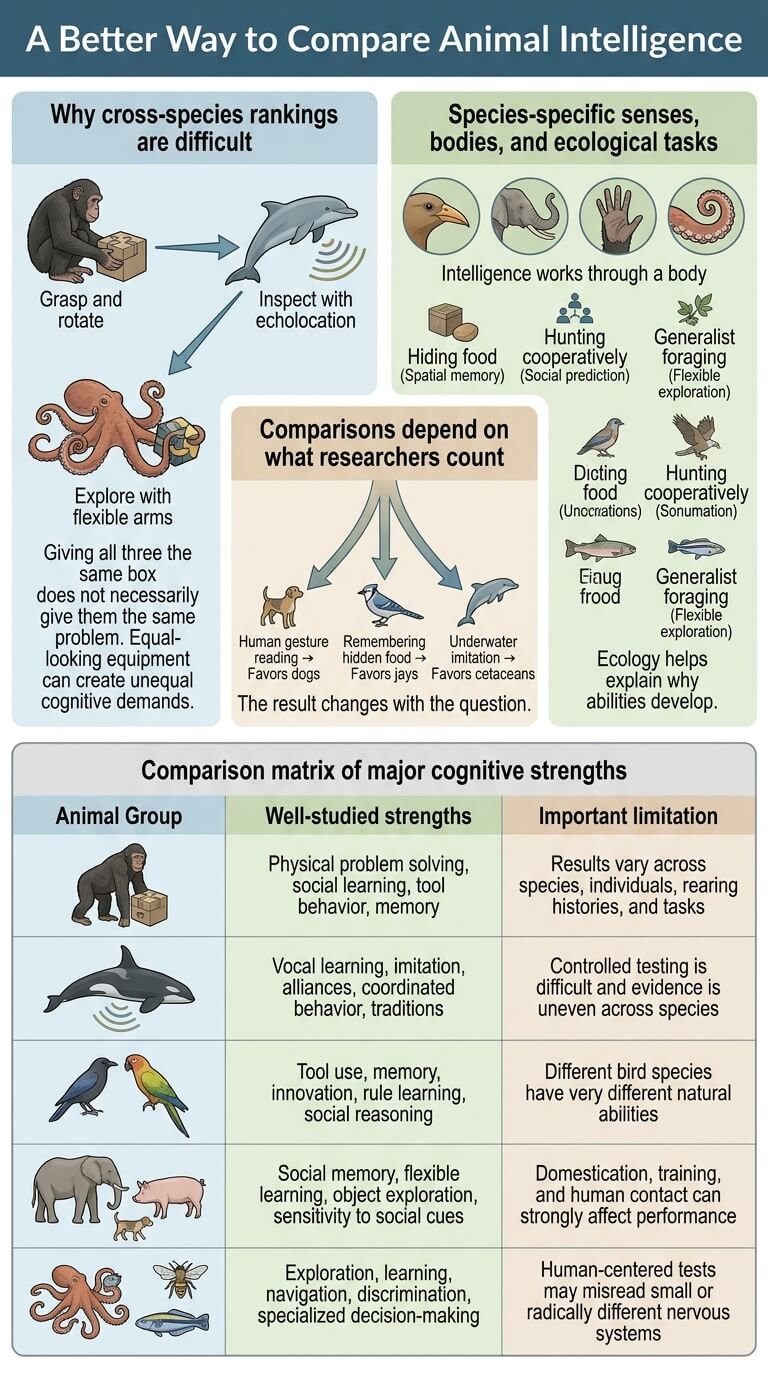
Why cross-species rankings are difficult
A chimpanzee can grasp and rotate an object, a dolphin can inspect it with echolocation, and an octopus can explore it with flexible arms lined with sensitive suckers. Giving all three the same box does not necessarily give them the same problem. Equal-looking equipment can create unequal cognitive demands.
Comparisons also depend on what researchers count. A ranking based on human gesture reading would strongly favor dogs. A ranking based on remembering hidden food caches could favor certain jays. A ranking based on underwater imitation would favor cetaceans. The result changes with the question.
Species-specific senses, bodies, and ecological tasks
Intelligence works through a body. A bird’s beak, an elephant’s trunk, a primate’s hands, and an octopus’s arms create different opportunities for manipulating the environment. Sensory priorities also differ. Vision-centered tests can overlook animals that rely heavily on scent, vibration, touch, or sound.
Ecology helps explain why abilities develop. Animals that hide food may benefit from detailed spatial memory. Predators that hunt cooperatively may need coordination and social prediction. Generalist foragers often encounter changing food types and may benefit from flexible exploration. These patterns are useful hypotheses, not simple rules that determine how smart a species must be.
Comparison matrix of major cognitive strengths
| Animal group | Well-studied strengths | Important limitation |
|---|---|---|
| Great apes | Physical problem solving, social learning, tool behavior, memory | Results vary across species, individuals, rearing histories, and tasks |
| Dolphins and orcas | Vocal learning, imitation, alliances, coordinated behavior, traditions | Controlled testing is difficult and evidence is uneven across cetacean species |
| Corvids and parrots | Tool use, memory, innovation, rule learning, social reasoning | Different bird species have very different natural abilities |
| Elephants, pigs, and dogs | Social memory, flexible learning, object exploration, sensitivity to social cues | Domestication, training, and human contact can strongly affect performance |
| Octopuses, bees, and cleaner wrasse | Exploration, learning, navigation, discrimination, specialized decision-making | Human-centered tests may misread small or radically different nervous systems |
Primates Known for Flexible Problem Solving
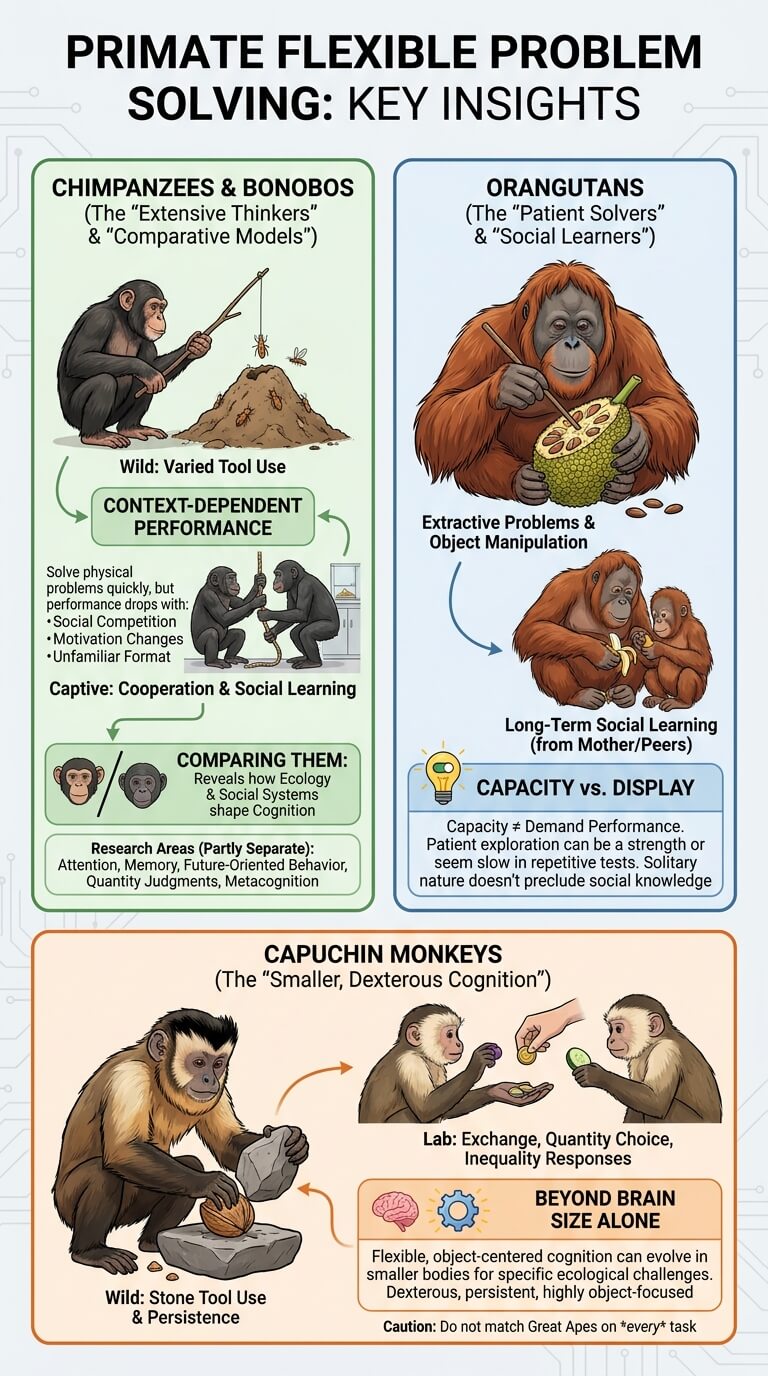
Chimpanzees and bonobos
Chimpanzees are among the most extensively studied nonhuman problem solvers. Wild populations use varied foraging techniques, and captive studies have examined memory, cooperation, tool choice, causal cues, and social learning. Their performance is not uniformly excellent. They may solve one physical problem quickly yet struggle when social competition, motivation, or an unfamiliar testing format changes the situation.
Bonobos share a close evolutionary relationship with chimpanzees but differ in social behavior, development, and patterns of performance on some tasks. Comparing the two helps researchers ask how ecology and social systems shape cognition. A broad review of primate cognition shows why attention, memory, future-oriented behavior, quantity judgments, and metacognition must be treated as partly separate research areas.
Orangutans
Orangutans are skilled at manipulating objects and solving extractive problems in which food must be removed from a container or natural structure. In the wild, young orangutans spend years learning feeding techniques and local behavior from their mothers and nearby individuals. Their relatively solitary social pattern does not mean they lack social learning or social knowledge.
Studies of orangutans also illustrate the difference between possessing a capacity and displaying it on demand. An individual may understand useful object relationships but show little interest in a repetitive test. Patient exploration can be a strength in one setting and look like slow performance in another.
Capuchin monkeys
Capuchins are smaller than great apes but are dexterous, persistent, and highly interested in manipulating objects. Some wild bearded capuchins use stones to crack hard foods. Laboratory research has examined exchange, quantity choice, tool use, social learning, and responses to unequal rewards.
They are often presented as proof that brain size alone cannot settle intelligence. That conclusion needs care. Capuchins do not match great apes on every task, but they show that flexible object-centered cognition can evolve in a smaller-bodied primate with its own ecological challenges.
Marine Mammals with Complex Social Cognition
Bottlenose dolphins
Bottlenose dolphins live in fluid societies in which group membership can change over short periods. Individuals use learned vocal signals, recognize familiar companions, coordinate movement, and in some populations adopt socially transmitted foraging methods. Certain males form long-lasting alliances that can involve cooperation at more than one social level.
Dolphins have also been studied in imitation, rule learning, object matching, and communication experiments. Much of the detailed experimental evidence comes from a limited number of managed animals, while field research provides a wider view of natural social behavior. A review of cetacean brains and cognition argues for interpreting their enlarged brains together with behavioral and evolutionary evidence, not as proof by brain size alone.
Orcas and culturally learned behavior
Orcas, also called killer whales, are dolphins with population-specific diets, calls, movement patterns, and hunting traditions. Some communities specialize on fish, while others hunt marine mammals or other prey. Young animals learn within stable social groups, and traditions can persist across generations.
These differences make orcas a strong example of social learning in the wild. They do not show that every orca can instantly invent every hunting method. Specialized traditions may increase success in one environment while making rapid adjustment harder when prey or conditions change.
Birds That Challenge Mammal-Centered Ideas of Intelligence
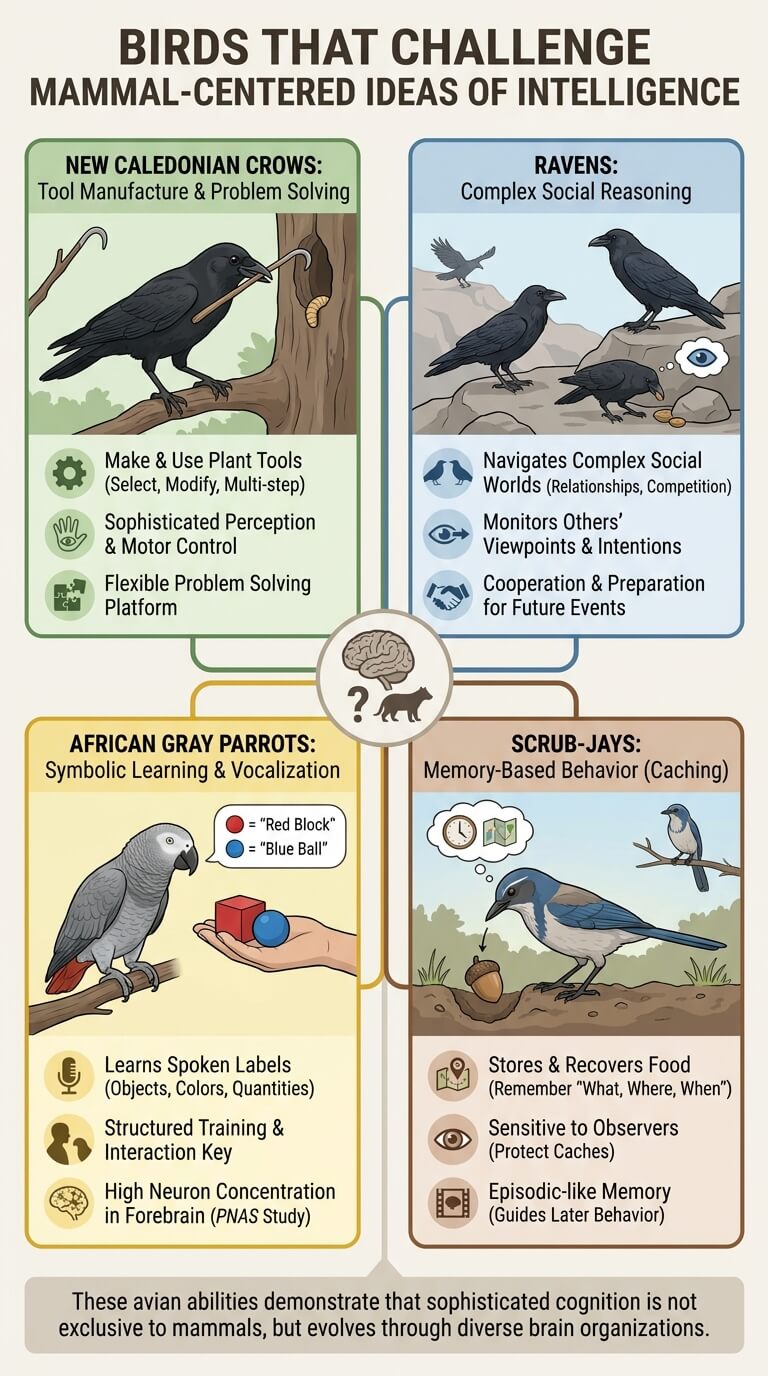
New Caledonian crows and tool manufacture
New Caledonian crows are famous for using and manufacturing plant tools to extract prey from crevices. They can select objects with useful dimensions, modify materials, and solve some multi-step laboratory problems. Young birds have species-typical tendencies toward handling suitable materials, while experience and social exposure help refine technique.
The strongest interpretation is not that these crows think exactly like humans. Their behavior shows a sophisticated combination of perception, motor control, learning, and attention to physical relationships. Tool expertise may be both an ecological specialization and a platform for flexible problem solving.
Ravens and social reasoning
Ravens live in complex social worlds. Young nonbreeders may gather in groups, form relationships, compete over food, and monitor what other birds can see. Experiments have tested their memory for social partners, sensitivity to observation, cooperation, and preparation for later events.
Some findings are debated because apparently strategic behavior can have simpler explanations. Careful experiments must separate learned behavioral rules from richer interpretations such as attributing knowledge or intentions to another bird. Ravens remain important because they perform flexibly across both physical and social tasks.
African gray parrots and symbolic learning
African gray parrots have demonstrated that vocal learning can support more than mimicry. In structured training, particular individuals have learned spoken labels for objects, colors, shapes, materials, quantities, and relational concepts. Their achievements came through extensive human interaction and should not be assumed for every parrot.
Parrots combine a strong vocal system with object manipulation and long social development. Their brain organization differs from a mammal’s, yet parrots and some songbirds concentrate large numbers of neurons in the forebrain. The PNAS study of neuron numbers in bird forebrains helps explain why a relatively small bird brain can support demanding information processing.
Scrub-jays and memory-based behavior
Scrub-jays store food in many locations and later recover it. Research has examined whether they remember what was stored, where it was placed, and how long ago caching occurred. Western scrub-jays, now commonly split taxonomically into species including the California scrub-jay and Woodhouse’s scrub-jay, have also been studied for cache protection and sensitivity to possible observers.
The results are relevant to episodic-like memory, a term used because animals cannot verbally report a remembered experience. Their performance does not prove that a jay relives the past in the human sense. It does show that memory can integrate several features of an event and guide later behavior.
Large-Brained Social Mammals
Elephants and social memory
Elephants maintain long-term relationships in societies where family knowledge can influence movement, social contact, and responses to danger. Older females may provide useful experience, especially in recognizing social and environmental conditions. Elephants can also discriminate among some calls, scents, and human-related cues.
The popular phrase “an elephant never forgets” is too absolute. Elephants forget information and vary as individuals. Their reputation has a real basis in long lifespan, extensive movement, rich social networks, and evidence that they retain information useful to group life.
Pigs and flexible learning
Domestic pigs are curious foragers that learn locations, routines, object relationships, and discrimination tasks. They can adjust choices after rules change and use spatial information to search efficiently. Their snout-centered exploration and motivation for food make them active participants in some tasks, but can also create testing biases.
Pigs are sometimes described as being “as smart as” dogs or young children. Such comparisons are usually too broad. Pigs and dogs have different sensory priorities, histories with humans, and behavioral strengths. The evidence supports calling pigs capable, flexible learners without assigning them a human age or a single cross-species score.
Dogs and sensitivity to human cues
Dogs are especially skilled at using information from people. Many can follow pointing gestures, attend to gaze and posture, learn household routines, and associate words or signals with actions and objects. Domestication and individual experience both contribute, and performance varies widely among dogs.
This human-oriented ability can make dogs look better than wolves or other animals in cooperative tasks with people. In problems that require independent physical reasoning, the pattern may change. Dog intelligence is therefore best understood as a mixture of social sensitivity, learning history, motivation, breed-related tendencies, and individual experience.
Invertebrate and Small-Brain Intelligence
Octopuses and object-based problem solving
Octopuses can learn visual and tactile discriminations, explore unfamiliar objects, navigate spaces, and solve some container or detour problems. Their nervous system is distributed differently from a vertebrate system, with a large share of neurons associated with the arms. This arrangement supports local sensory processing and flexible control, but it does not mean that each arm has a separate mind.
Octopus research is challenging because species differ, individuals may be reluctant to participate, and laboratory conditions can strongly influence behavior. A scientific overview of cephalopod brains describes the neural organization researchers use to compare learning and behavior without treating the octopus as a mammal in disguise.
Bees and compact neural systems
Bees learn flower colors, odors, locations, timing, and routes. Experiments with honey bees and bumblebees have also tested category learning, quantity-related choices, social learning, and flexible solutions to artificial tasks. These results show that small nervous systems can perform substantial information processing.
They do not show that a bee has general intelligence equal to a primate. Many bee abilities are tightly connected to navigation and foraging, and laboratory performance may rely on mechanisms different from those used by vertebrates. Bees matter because they challenge the assumption that complex-looking behavior requires a large brain.
Cleaner wrasse and controversial cognition tests
Bluestreak cleaner wrasse manage repeated interactions with larger client fish that visit to have parasites and damaged tissue removed. Cleaners may alter behavior according to client type, audience, and opportunity. This natural marketplace has made them useful for studying cooperation, choice, and tactical adjustment.
Cleaner wrasse have also produced debated results in mirror-related experiments and comparative learning tasks. Their performance is scientifically interesting, but claims of human-like self-awareness remain contested. The safest conclusion is that these fish can solve specialized social and perceptual problems and that the meaning of any one test depends on controls and interpretation.
What Each Animal Appears to Be Best At
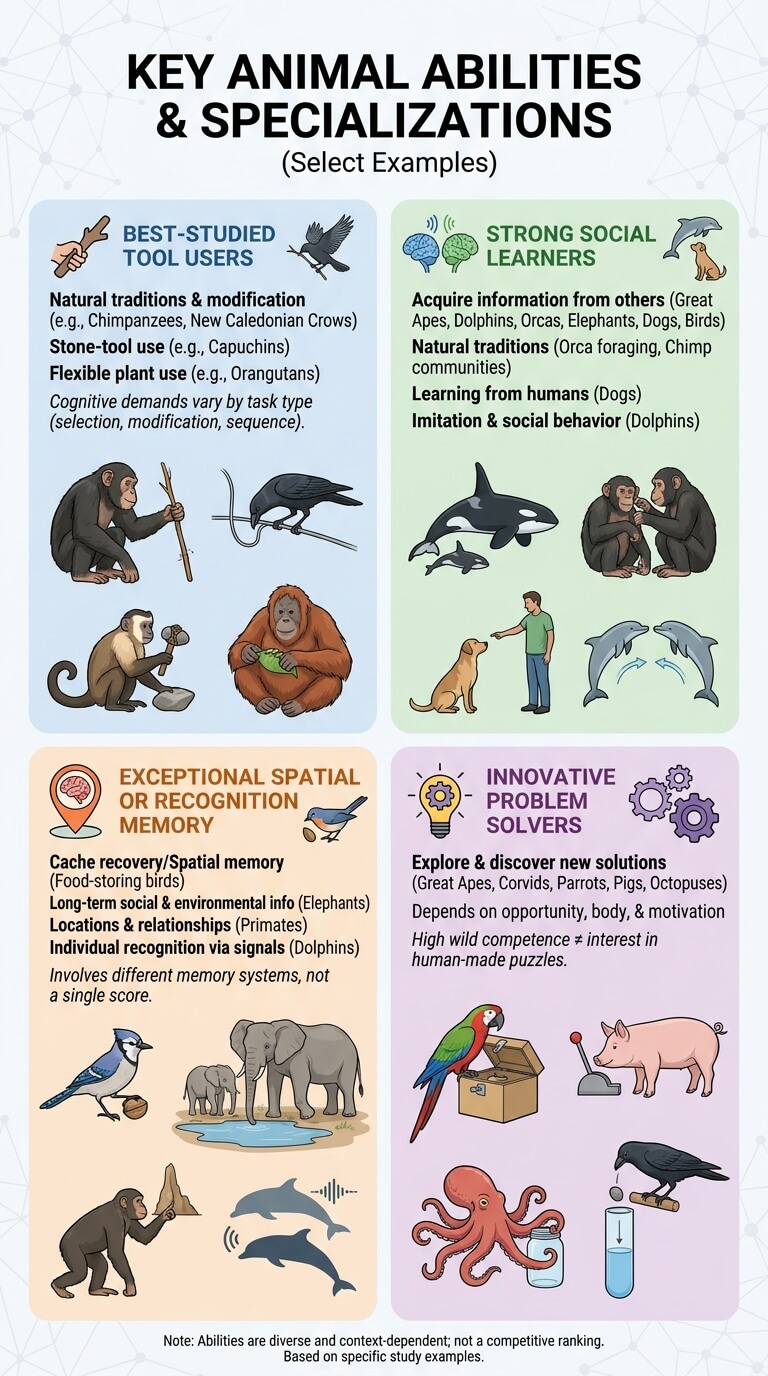
Best-studied tool users
Chimpanzees and New Caledonian crows provide some of the richest evidence for natural tool traditions and tool modification. Capuchins add a strong stone-tool example, while orangutans show flexible use of plant materials. Tool use is not a championship event, however. The cognitive demands differ between selecting a ready-made object, modifying it, carrying it, and using several tools in sequence.
Strong social learners
Great apes, dolphins, orcas, elephants, dogs, and several birds acquire useful information from others. Orca foraging traditions and chimpanzee community differences are especially valuable because they occur in natural populations. Dogs stand out for learning from humans, while dolphins are notable for imitation and socially maintained behavior.
Exceptional spatial or recognition memory
Food-storing birds are strong candidates for spatial memory tied to cache recovery. Elephants retain socially and environmentally relevant information over long lives. Primates remember locations and relationships, while dolphins can recognize familiar individuals through distinctive signals. These examples involve different memory systems and cannot be reduced to one memory score.
Innovative problem solvers
Great apes, corvids, parrots, pigs, and octopuses often appear in innovation research because they explore objects and sometimes discover new solutions. Innovation depends partly on opportunity. An animal must encounter a solvable problem, have the body to act on it, and be motivated to persist. A species can be highly competent in the wild yet uninterested in a human-made puzzle.
Common Ranking Mistakes and Myths
Treating brain size as an intelligence score
Large brains can provide more neural tissue, but body size, neuron density, connectivity, internal organization, and the proportion devoted to different functions all matter. A whale’s brain is larger than a crow’s, yet that fact alone does not predict which animal will solve a particular task. Brain measures are evidence to interpret, not a ready-made league table.
Equating one spectacular behavior with general intelligence
A remarkable tool sequence or memory result may reveal a genuine ability. It does not prove excellence in communication, social reasoning, inhibition, navigation, or every other domain. Researchers need multiple tasks and alternative explanations before concluding that a result reflects broad cognitive flexibility.
Ignoring training, ecology, and experimental design
Animals with long histories of human contact may understand equipment and cues that confuse wild or less-studied species. Food deprivation, stress, group separation, reward type, and repeated testing can also alter performance. Fair research minimizes these problems and reports the conditions clearly.
Turning disputed findings into settled facts
Mirror tests, future-planning experiments, numerical tasks, and interpretations of animal culture often generate debate. Disagreement is not proof that the animal lacks the ability. It means that methods and explanations require further testing. Responsible summaries distinguish established patterns from plausible but unsettled interpretations.
Why Different Studies Produce Different Winners
Tool use measures only part of cognition
Animals with grasping hands, strong beaks, trunks, or flexible arms have obvious opportunities to manipulate objects. Species without those structures may solve difficult problems through navigation, communication, or coordinated movement instead. A tool-based list will overlook many capable animals.
Dolphins and crows reveal convergent solutions
Dolphins and crows are separated by a vast evolutionary distance and live in radically different environments. Both include species known for innovation, learning, social complexity, and flexible behavior. Their similarities show that demanding cognition can evolve in different brain designs, not that a dolphin mind and crow mind work identically.
Memory and self-recognition answer different questions
A memory task asks how information from the past guides behavior. A mirror task asks how an animal responds to reflected visual information about its body. Success in one says little about likely success in the other. Combining separate measures creates a fuller profile without pretending that every ability belongs on the same scale.
FAQ
What is the smartest nonhuman animal?
There is no scientifically settled winner. Chimpanzees and other great apes show broad performance across many physical and social tasks, so they are often strong candidates when people ask for one answer. Dolphins, elephants, corvids, parrots, and octopuses show different combinations of advanced abilities. The answer depends on whether the comparison emphasizes tools, communication, memory, social learning, self-control, or innovation.
Are birds as intelligent as mammals?
Some birds perform at levels comparable to some mammals on particular tasks. Corvids and parrots have shown sophisticated tool behavior, memory, rule learning, and social cognition. This does not mean every bird is equal to every mammal. Birds and mammals contain thousands of species with very different ecological demands and cognitive profiles.
Is an octopus smarter than a dog?
The comparison has no single answer. Dogs are highly responsive to human social signals and learn routines through prolonged interaction with people. Octopuses are independent marine invertebrates with flexible arms, strong exploratory behavior, and a differently organized nervous system. A dog would probably dominate a human-gesture task, while an octopus may be better suited to tactile exploration underwater.
Can scientists give animals an IQ score?
Researchers can create test batteries and compare performance on carefully defined tasks, but a human-style IQ score is not currently a fair universal measure for different species. Tests must account for sensory systems, anatomy, motivation, development, prior experience, and ecology. A profile of strengths and limitations is more informative than one number.
Final Thoughts
The smartest animals in the world are not members of a simple top-ten ladder. Great apes, cetaceans, corvids, parrots, elephants, pigs, dogs, octopuses, bees, and cleaner wrasse demonstrate that cognition can take many forms. Some excel at manipulating objects, some at reading social situations, some at remembering places, and some at learning specialized rules.
Science gives the clearest picture when it compares specific abilities, uses tests suited to each species, and treats surprising results with both curiosity and caution. The most valuable lesson is not which animal wins. It is that evolution has produced many different ways to learn, remember, communicate, and solve the problems of being alive.

Ethan Walker is the founder and research editor of Animal Fact Central. He creates and reviews educational animal facts content using trusted wildlife, pet care, and science-based sources. His work focuses on making animal behavior, adaptations, habitats, and species facts clear, accurate, and engaging for everyday readers.
Read More Details About Ethan Walker: https://animalfactcentral.com/ethan-walker/