
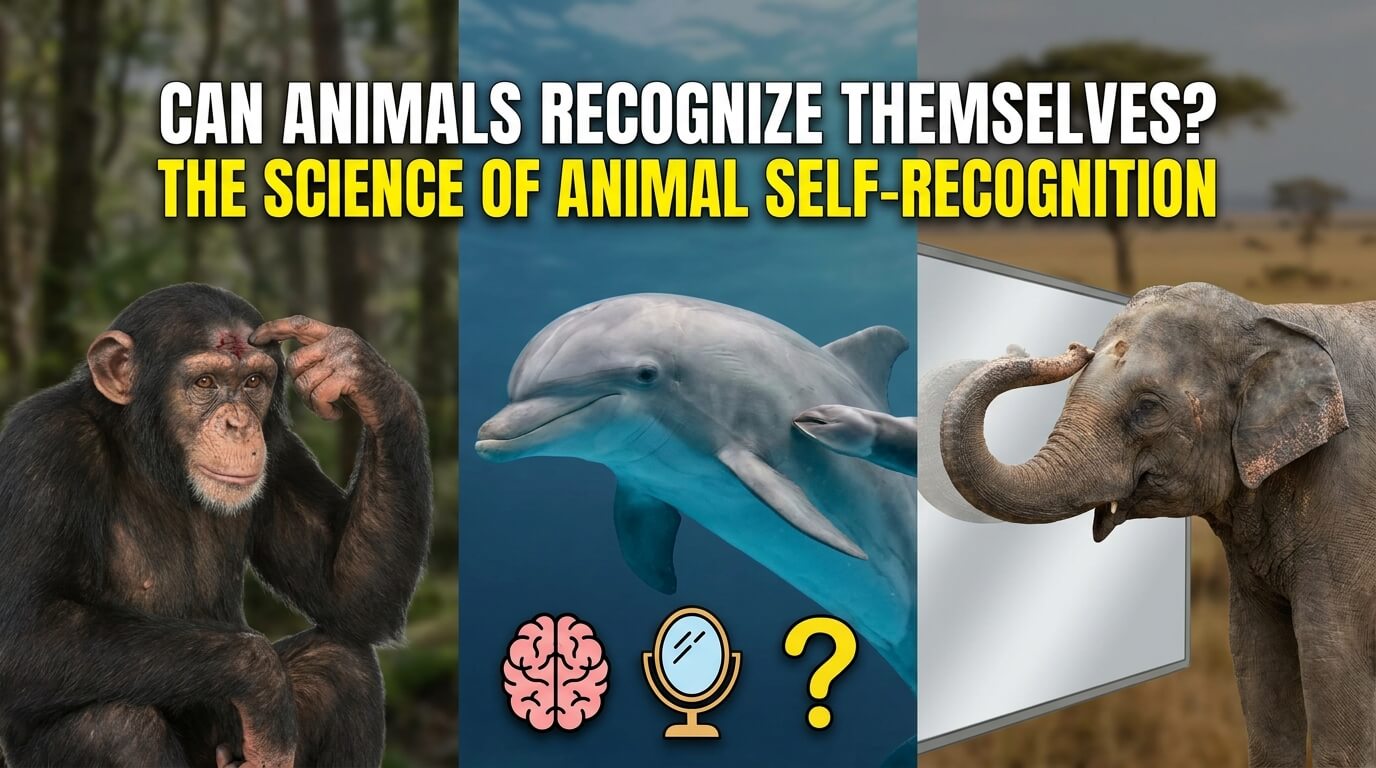
Some animals behave in front of a mirror as though they understand that the reflection is connected to their own body. Chimpanzees may inspect hidden body parts, dolphins may position themselves to view a mark, and an elephant may touch a visible mark on her own head. These findings support animal self-recognition, but they do not prove that an animal thinks about identity, personality, or consciousness in the same way a human does.
The best answer is therefore careful rather than dramatic: certain animals have shown convincing or suggestive evidence that they can use reflected information about themselves. Other species appear to recognize aspects of their own bodies, actions, odors, or uncertainty without passing a visual mirror test. Researchers increasingly treat the sense of self as a collection of abilities, not a single mental switch that is either present or absent.
Quick Answer
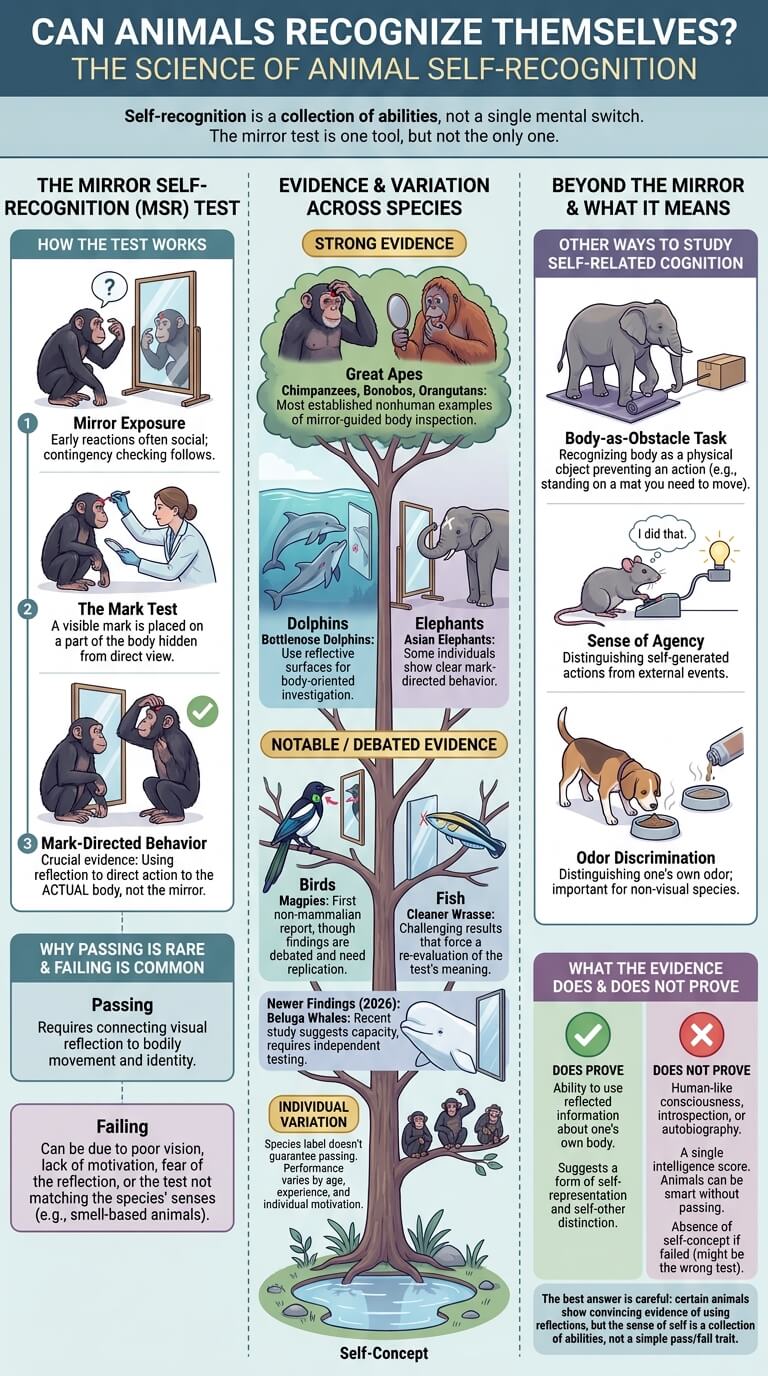
Yes, some animals can recognize themselves in limited, testable ways. The strongest evidence for spontaneous visual mirror self-recognition comes from humans and several great apes, especially chimpanzees. Bottlenose dolphins and at least one Asian elephant have also produced mark-directed behavior under controlled conditions. Magpies, cleaner wrasse, and recently studied beluga whales have produced notable results, but the strength and interpretation of those findings remain debated or require broader replication.
A mirror result measures whether an animal can use a reflection as information about its own body. It is not an intelligence score, and it is not a complete test of self-awareness. An animal may fail because the task is poorly matched to its senses, body, motivation, or previous experience. A pass is important evidence, but it does not demonstrate human-like introspection.
What Does Self-Recognition Mean?
Recognizing One’s Body or Image
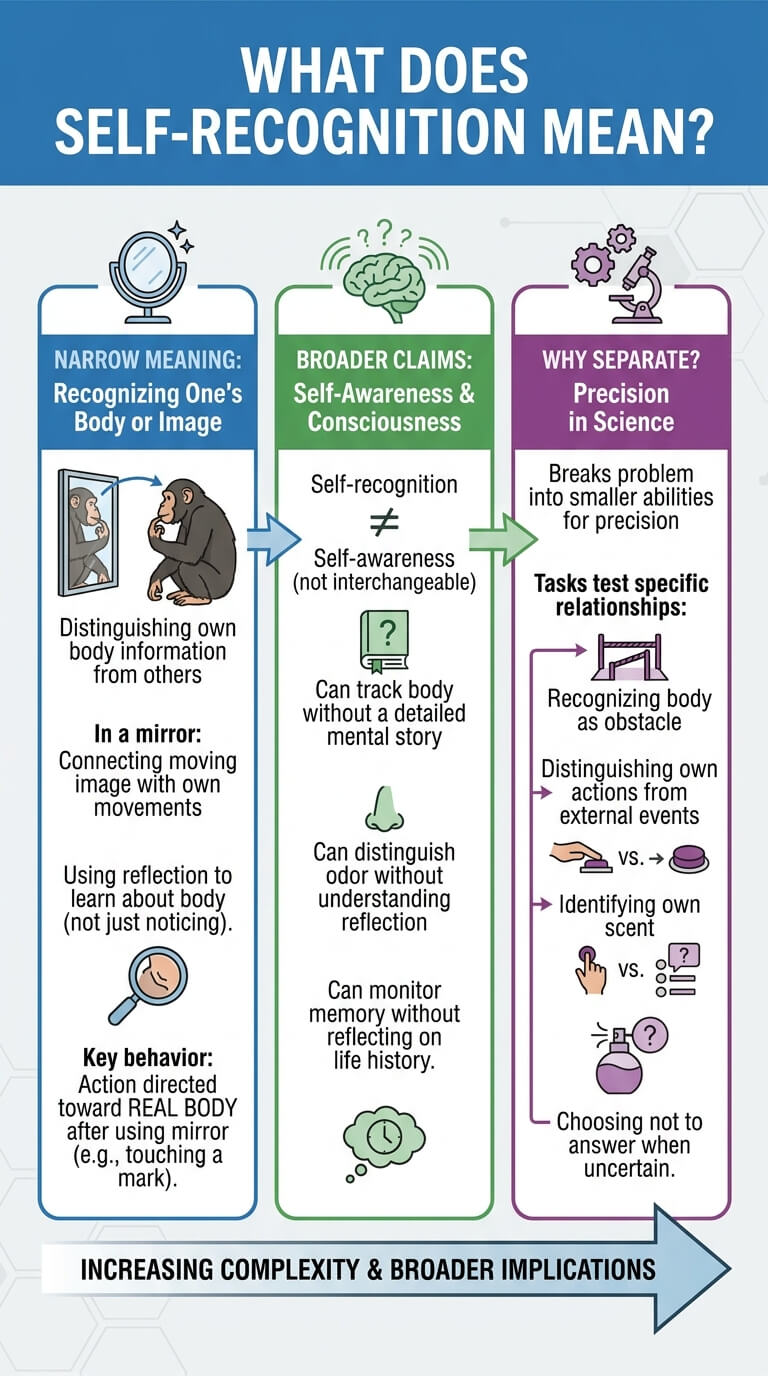
At its narrowest, self-recognition means distinguishing information produced by one’s own body from information produced by another animal or object. In a mirror, that requires connecting the moving image with one’s own movements and then using the reflection to learn something about the body that cannot be seen directly.
This is more demanding than noticing a reflection. Many animals look at mirrors, attack them, court them, avoid them, or search behind them. Those reactions show that the image is meaningful, but they do not by themselves show that the animal understands, “That body is mine.” Researchers look for behavior that is specifically directed toward the animal’s real body after it has used the mirror.
Self-Awareness, Self-Knowledge, and Consciousness Are Broader Claims
Self-recognition is often discussed as a sign of self-awareness, but the words should not be treated as interchangeable. A creature might track its body in space without possessing a detailed mental story about itself. It might distinguish its own odor without understanding a visual reflection. It might monitor whether it remembers something without reflecting on its life history.
Why Researchers Separate Different Kinds of Self-Related Cognition
Breaking the problem into smaller abilities makes the science more precise. Researchers can ask whether an animal recognizes its body as an obstacle, distinguishes its actions from external events, identifies its own scent, or chooses not to answer when uncertain. Each task tests a different relationship between the animal and information about itself.
How the Mirror Self-Recognition Test Works

Mirror Exposure and Contingency Checking
The classic sequence begins with access to a mirror. Early reactions often look social because the animal may treat the reflection as another individual. With experience, a potential self-recognizer may stop threatening or greeting the image and begin testing the link between its own actions and the reflection. Repetitive head movements, unusual poses, or viewing normally hidden body regions can be signs of this contingency checking.
Gordon Gallup’s foundational 1970 experiment reported that chimpanzees shifted from social responses toward mirror-guided inspection and then touched marks placed where they could not see them directly. The original chimpanzee self-recognition study established the basic logic that later researchers adapted for animals with very different bodies.
The Mark Test and Its Expected Behavior
In a standard mark test, researchers place a visible mark on a part of the body that the subject cannot inspect without a mirror. The mark should not have an obvious odor or provide a distinctive tactile sensation. When the mirror is available, researchers record whether the animal looks at the reflection and then touches, investigates, scrapes, or positions the marked area on its real body.
The crucial action is not touching the mirror or looking at the reflected mark. It is using reflected information to direct behavior toward the actual body. A convincing result should occur more often when a visible mark and a usable mirror are present than during comparison conditions.
Necessary Controls for Touch, Odor, Training, and Social Responses
A mark can accidentally alert an animal through skin sensation, odor, handling, or irritation. Researchers therefore use sham marks that reproduce the handling and touch but are not visually distinctive. They may compare mirror and nonreflective conditions, record baseline grooming, and verify that behavior begins after the subject views the reflection.
Why Passing and Failing Are Both Easy to Misinterpret
A negative result is equally difficult to interpret. The subject may not care about the mark, may be unable to reach it, may avoid eye contact, or may consider the mirror threatening. Failure can mean that the animal did not understand the reflection, but it can also mean that the test failed to reveal an ability.
Animals with Strong or Repeated Mirror-Test Evidence

Great Apes and Individual Variation
Chimpanzees provide the most established nonhuman example. Multiple studies have documented mirror-guided body inspection and mark-directed responses, although not every chimpanzee passes. Age, social history, mirror experience, rearing conditions, and individual motivation can affect performance.
Bonobos and orangutans have also shown positive mirror behavior in published work. Gorilla findings are less consistent. One proposed complication is that direct staring can be socially uncomfortable for gorillas, which may reduce the kind of prolonged visual inspection the task requires. The important lesson is that a species label does not guarantee identical performance among all individuals.
Bottlenose Dolphins and Body-Oriented Mirror Behavior
Dolphins cannot reach a body mark with fingers, so researchers evaluate positioning, turning, and repeated presentation of marked areas to the mirror. In a controlled study of two bottlenose dolphins, both animals used reflective surfaces for body-oriented investigation and behaved consistently with using the mirror to inspect marked regions. The bottlenose dolphin mirror study is important because dolphin and ape brains have very different evolutionary histories and structures.
Asian Elephants and Mark-Directed Responses
Elephants require an unusually large and durable mirror that allows them to inspect their whole body. In a study of three Asian elephants, all explored the mirror, while one individual named Happy repeatedly touched a visible mark on her own head. The Asian elephant self-recognition experiment provided a well-known positive result, but it also demonstrated individual variation because two subjects did not show the critical mark-directed response.
Beluga Whales and New Evidence from 2026
A peer-reviewed study published on May 20, 2026 tested four beluga whales with a mirror, transparent control surface, marks, and sham marks. Two whales displayed a notable range of self-directed mirror behavior. One adult female showed mark-directed behavior and passed one of the initial mark tests in a series. The authors presented this as evidence for the capacity of mirror self-recognition in belugas.
The 2026 beluga whale study expands the cetacean evidence, but it is new and based on a small social group. It should be treated as an important finding that needs independent testing rather than as the final word on all belugas.
Controversial or Mixed Evidence
Magpies and the Need for Replication
A 2008 experiment with five Eurasian magpies reported that two birds showed significantly more mark-directed behavior when a colored throat mark was visible in a mirror. The birds used their beaks or feet on their own bodies, and the behavior stopped after the mark was removed. The magpie mirror experiment was the first widely cited report of mark-test performance in a nonmammalian species.
Cleaner Wrasse and Debate over What the Test Measures
Cleaner wrasse produced one of the most challenging results in this field. In the initial study, fish first reacted socially to mirrors, later performed unusual movements, and then scraped their throats against a surface when they could view a colored mark in the mirror. Follow-up experiments addressed some objections and explored whether fish could distinguish their own faces.
The 2019 cleaner wrasse mark-test research forced scientists to confront two possibilities. Either the fish met the behavioral criteria commonly used for other animals, or those criteria do not uniquely demonstrate the rich form of self-awareness often attributed to mirror passing. Many researchers accept the behavior as remarkable while disagreeing about the mental process behind it.
Other Fish, Birds, and Mammals with Inconsistent Outcomes
Claims have been made for several other animals, including some monkeys, parrots, corvids, horses, manta rays, and additional cetaceans. In many cases, animals use mirrors to locate objects, inspect hidden areas, or change social responses without producing a reliable mark-directed pattern. Such abilities are cognitively meaningful even when they do not meet the classic criteria.
Researchers should also distinguish a single positive individual from replicated evidence across different laboratories. A promising result can justify more research without being treated as a settled species-wide fact.
How Training Can Change the Meaning of a Result
Some monkeys that initially fail can learn mirror-related actions after structured training. This demonstrates behavioral flexibility and the ability to connect visual feedback with bodily movement. What it does not necessarily show is spontaneous recognition under the same conditions used for untrained chimpanzees.
Why a Positive-Looking Behavior May Have Alternative Explanations
Mark touching is most persuasive when it is specific to the visible mark, begins after mirror viewing, exceeds sham-mark behavior, and occurs without direct sensory cues. If those controls are missing, ordinary grooming, irritation, curiosity, or prior reinforcement can imitate a pass.
Video clips rarely show all comparison conditions. A thirty-second recording may capture the most impressive response while hiding hours of attacks, avoidance, or random touching. Controlled data matter more than how human-like a moment appears.
Why Many Animals May Fail the Mirror Test
Vision May Not Be the Species’ Primary Sense
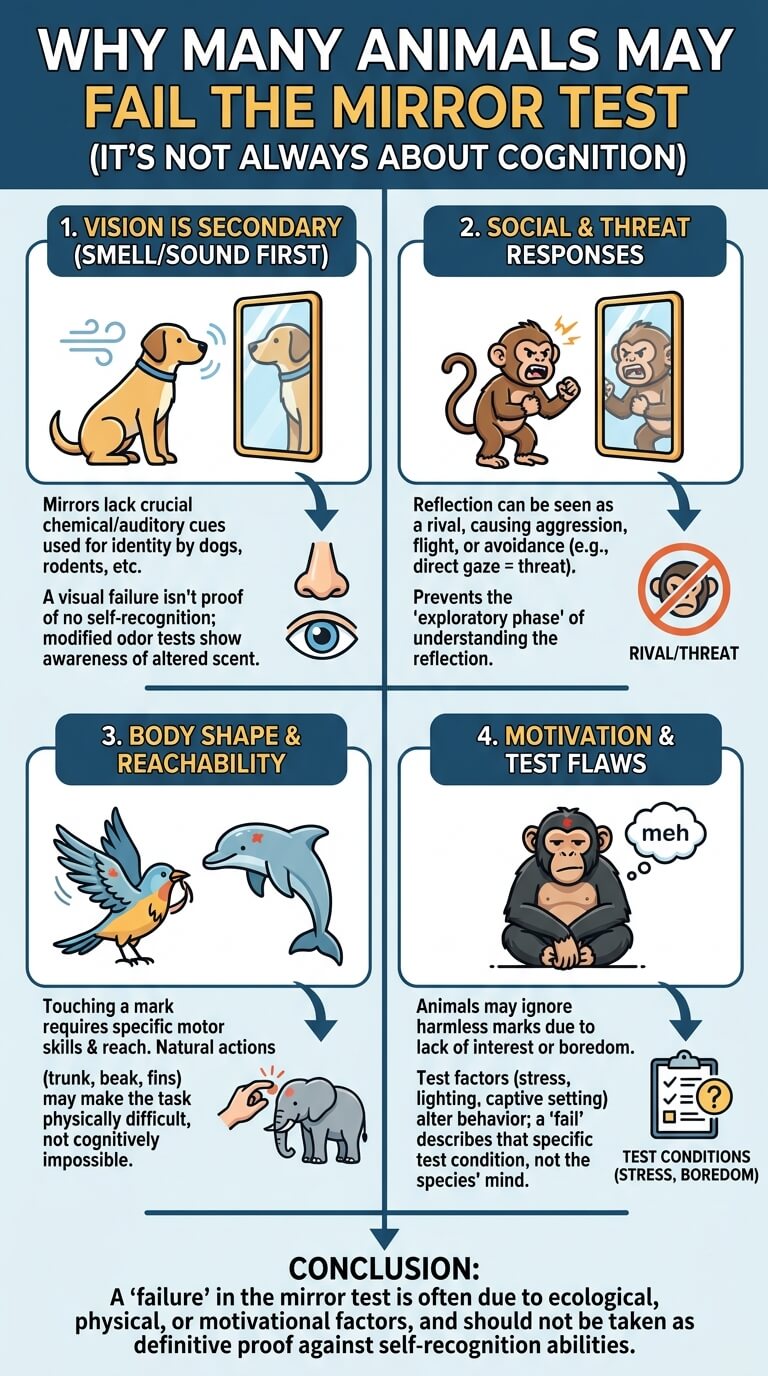
The mirror test privileges animals that rely heavily on vision and can interpret a flat reflected image. Dogs, many rodents, and numerous nocturnal mammals gather crucial identity information through smell. A clean mirror provides little of the chemical information they normally use to distinguish individuals.
Modified odor tests suggest that dogs notice when their own scent has been altered, but researchers debate whether this is equivalent to visual self-recognition. At minimum, the work shows that a visual failure should not be treated as proof that dogs cannot distinguish self-related information.
Mirrors Can Trigger Social, Threat, or Avoidance Responses
An animal that sees an unfamiliar apparent rival may display, flee, freeze, or avoid looking. Those responses can persist even when the image moves in perfect synchrony. The subject may never reach the exploratory phase needed to discover how the mirror works.
Social rules also matter. Direct gaze can signal aggression in some species. Solitary animals may have little reason to analyze another-looking individual, while territorial species may remain focused on defense. These reactions reflect normal ecology, not necessarily limited cognition.
Body Shape and Motor Ability Affect Mark Touching
A chimpanzee can touch a forehead mark with a hand. A dolphin must rotate and inspect. A bird may need to preen a difficult location. An elephant uses a trunk, while a fish may have to scrape against the environment. These actions differ in effort and precision.
A poorly positioned mark can make a capable subject look unsuccessful. Researchers must choose a location that is hidden without the mirror, visually noticeable, physically reachable, and behaviorally relevant to that species.
Motivation and Test Design Can Hide an Ability
An animal might understand the reflection but have no interest in a harmless mark. Some humans also ignore minor marks once they realize the mark has no consequence. Repeated exposure can produce boredom, while too little exposure may not allow learning about the reflective surface.
Captive setting, stress, social separation, lighting, mirror size, observer presence, and testing time can all alter behavior. A fair conclusion describes what happened under the tested conditions rather than turning one outcome into a permanent statement about the mind of a species.
Other Ways to Study Self-Related Cognition
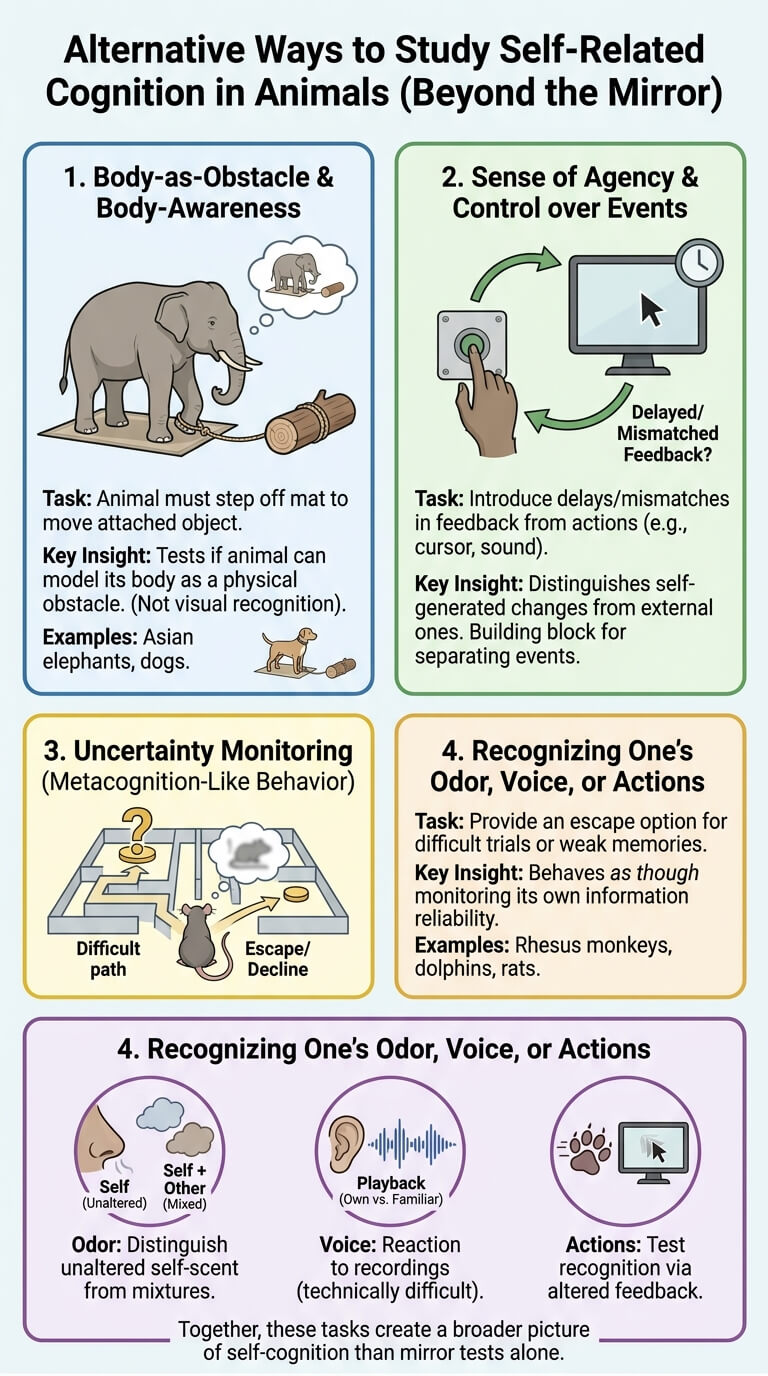
Body-as-Obstacle and Body-Awareness Tasks
In a body-as-obstacle task, an animal stands on a mat attached to an object it must hand over. Success requires stepping off the mat because the animal’s own weight prevents the object from moving. Asian elephants and dogs have succeeded in versions of this task, suggesting that they can represent their bodies as physical obstacles.
This ability is not visual mirror recognition. It tests whether the animal can include its body in a practical model of the problem. Such tasks may reveal forms of bodily self-awareness that are useful during climbing, squeezing through gaps, manipulating objects, or coordinating movement.
Sense of Agency and Control over Events
Agency is the distinction between changes caused by one’s own action and changes caused from outside. An animal may learn that moving a limb changes a cursor, pressing a panel produces food, or turning its head controls an image. Researchers can then introduce delays or mismatched feedback to see whether the subject notices the loss of control.
Agency may be a building block for mirror use because a reflection normally moves in exact synchrony with the observer. Detecting that relationship does not require a verbal concept of identity, but it can help the animal separate self-generated events from independent ones.
Uncertainty Monitoring and Metacognition-Like Behavior
Some animals choose an escape option or decline a difficult trial when their memory is weak or a discrimination is uncertain. Rhesus monkeys, dolphins, rats, and other animals have been tested in variations of this design. Researchers describe some results as metacognition-like because the animal behaves as though it is monitoring the reliability of its own information.
Alternative explanations remain possible. An animal may learn which external cues predict difficulty without representing an internal state such as “I do not know.” Strong studies vary the task and controls to separate flexible uncertainty monitoring from simple reinforcement history.
Recognizing One’s Odor, Voice, or Actions
Self-related recognition does not have to be visual. Scent-based animals may distinguish their unaltered odor from a version mixed with another smell. Social animals may react differently to recordings of familiar individuals, although recognizing one’s own voice is technically difficult to demonstrate because production and playback contexts differ.
Action recognition can be tested by showing an animal delayed or altered feedback from its own movements. Together, odor, body, agency, and uncertainty tasks create a broader picture than any one mirror result.
What the Evidence Does and Does Not Prove
Self-Recognition Is Not the Same as General Intelligence
A species can excel at navigation, tool use, memory, communication, or social learning without passing a mirror test. A mirror result measures a particular visual and bodily problem. It should not be used to rank an octopus, crow, dog, dolphin, or ape on a single ladder of intelligence.
Ecological success often depends on specialized abilities. A food-caching bird may remember thousands of locations, while a social mammal may track alliances. Neither strength guarantees interest in a reflected mark. The broader study of animal intelligence includes learning, memory, communication, problem solving, and social cognition, none of which can be reduced to a mirror result.
A Mirror-Test Pass Does Not Prove Human-Like Consciousness
A pass supports the conclusion that the animal used a reflection as information about its own body. It may also suggest a self-representation rich enough to distinguish self from other in that setting. It does not show that the animal reflects on mortality, narrates an autobiography, or possesses every form of conscious thought.
Consciousness is a broader scientific and philosophical question involving subjective experience. Behavior can provide evidence and constrain explanations, but no single task can reveal the complete contents of another mind.
A Failure Does Not Prove the Absence of a Self-Concept
Failure shows that the animal did not meet the criteria in that test. It cannot by itself reveal whether the subject lacks visual self-recognition, was unmotivated, misunderstood the setup, or relies on another sensory route to identify itself.
This is why scientists compare multiple tasks and look for converging evidence. Body awareness, agency, scent discrimination, social memory, and uncertainty monitoring may be present in species that do not touch a mirror-visible mark.
Species, Individuals, Development, and Experience All Matter
Young animals may not yet possess the necessary coordination or experience. Older individuals may respond differently. Captive animals familiar with reflective surfaces may have an advantage over animals encountering a mirror for the first time. Temperament can influence whether a subject explores or avoids the setup.
Researchers should therefore report age, history, housing, training, sensory condition, and individual results. Saying that an entire species “passes” can hide the fact that evidence may come from a small subset of tested animals.
Common Myths and Mistakes
The Mirror Test Is Not an Animal IQ Test
The task does not measure vocabulary, numerical ability, memory capacity, innovation, or social skill. It is possible to perform well on many complex problems and still fail to use a mirror for body inspection. Calling mirror passing proof of being “smarter” than another species stretches the evidence beyond what was measured.
Every Animal That Looks in a Mirror Is Not Recognizing Itself
Looking, vocalizing, threatening, or searching behind the glass can occur without self-recognition. These behaviors may show curiosity or understanding that the image is unusual. Researchers need self-directed use of the reflection and appropriate controls before making a stronger claim.
Dogs and Cats Reacting to Mirrors Do Not Settle the Question
A dog that stops barking at a mirror may have learned that the image is harmless rather than recognized itself. A cat that watches a reflection may be tracking movement. At present, neither ordinary household behavior nor viral clips provide robust evidence that dogs or cats spontaneously pass the classic visual mark test.
Pet owners should not place marks on animals, restrain them in front of mirrors, or provoke reactions. Home experiments lack controls and can cause stress, especially when an animal interprets the reflection as an intruder.
Viral Videos Are Not Controlled Experiments
Online videos are selected for surprise and entertainment. They rarely show baseline behavior, sham conditions, prior training, repeated trials, or unsuccessful subjects. They can inspire good questions, but they cannot establish what mental process caused the behavior.
Self-Recognition Alongside Memory, Agency, and Social Cognition
Dolphin Cognition and Mirror Research
Dolphins are valuable in comparative research because they combine complex social lives, flexible learning, vocal communication, and a brain organization unlike that of primates. Mirror findings are one part of this picture. They should be considered alongside imitation, social learning, memory for individuals, and responses to human gestures rather than treated as the single reason dolphins are cognitively impressive.
Crow and Bird Cognition Beyond the Mirror Test
Corvid intelligence is supported by work on memory, caching, tool behavior, planning-like choices, and social inference. The disputed strength of magpie mirror evidence does not erase those abilities. Likewise, strong crow problem solving does not automatically predict mark-test success because each experiment presents a different challenge.
Memory, Agency, and Emotional Awareness Are Separate Questions
Memory lets an animal retain information about places, individuals, and past events. Agency concerns whether it detects control over an outcome. Emotional processing concerns positive and negative states and how they guide behavior. These systems can interact with self-related cognition, but evidence for one does not automatically prove all the others.
A more accurate picture of an animal mind comes from combining many well-designed tasks with field observation. The goal is not to decide whether an animal is secretly human-like. It is to understand the particular ways that species represents its body, actions, social world, and environment.
FAQ
Which Animals Have Passed the Mirror Test?
Chimpanzees have the strongest and most repeated nonhuman evidence. Positive findings have also been reported for bonobos, orangutans, bottlenose dolphins, an Asian elephant, magpies, cleaner wrasse, and beluga whales, among other debated cases. The wording matters because evidence differs in sample size, replication, controls, and interpretation. It is safer to say that particular individuals produced mark-test-consistent behavior than to claim every member of a species passes.
Can Dogs Recognize Themselves by Smell?
Studies using modified odor tests suggest that dogs distinguish their own scent from versions altered with another odor. This supports self-related scent discrimination, but researchers debate whether it is directly equivalent to recognizing a visual reflection. Dogs may possess an odor-based representation of self that the classic mirror test is poorly designed to detect.
Do Cats Know They Are Looking at Themselves?
There is no robust controlled evidence showing that domestic cats consistently pass the classic mark test. Cats may look behind a mirror, track movement, threaten the reflection, or lose interest. These reactions do not allow a confident conclusion about whether an individual cat understands that the image is itself.
Does Self-Recognition Prove Consciousness?
No. Mirror self-recognition is evidence that an animal can use reflected visual information about its own body. It may reveal an important form of self-other distinction, but consciousness includes far more than visual recognition. A positive result does not prove human-like reflection, while a negative result does not prove the absence of subjective experience.
Final Thoughts
Animal self-recognition is real enough to study but too complex for a simple pass-or-fail list. Chimpanzees provide the clearest nonhuman mirror evidence, while dolphins, elephants, magpies, cleaner wrasse, and belugas show how varied and debated the phenomenon can be. The mirror test remains useful when it includes strong controls and species-appropriate behavior, yet it captures only one form of self-related cognition.
The most responsible conclusion is that animals can represent themselves in different ways. Some use reflections, some track their bodies as physical objects, some distinguish self-generated actions, and some may recognize altered versions of their own odor. Understanding those abilities requires multiple methods, careful replication, and respect for the sensory world of each species.

Ethan Walker is the founder and research editor of Animal Fact Central. He creates and reviews educational animal facts content using trusted wildlife, pet care, and science-based sources. His work focuses on making animal behavior, adaptations, habitats, and species facts clear, accurate, and engaging for everyday readers.
Read More Details About Ethan Walker: https://animalfactcentral.com/ethan-walker/