
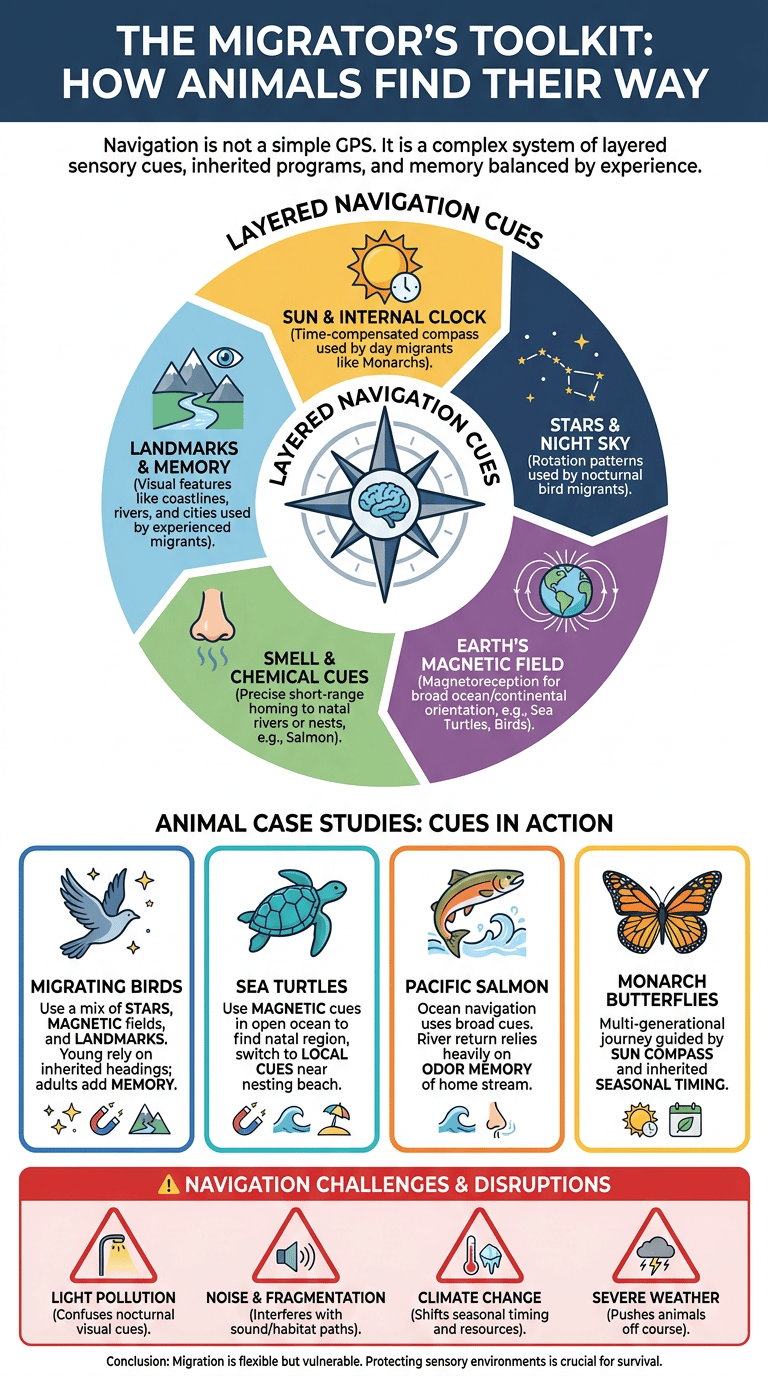
How animals find their way during migration is one of the most impressive questions in animal behavior. A bird may cross a continent at night, a sea turtle may return to a nesting region after years at sea, a salmon may move from ocean feeding grounds back toward its natal river, and a monarch butterfly may fly toward overwintering sites it has never seen before. These journeys are not guided by one simple animal GPS. They are guided by layered cues that include the sun, stars, Earth’s magnetic field, smell, landmarks, currents, wind, memory, and inherited orientation programs.
The best answer is that migrating animals usually combine several kinds of information. Some cues work like a compass, helping an animal keep a direction. Others work more like a map, helping it recognize where it is or whether it is getting closer to a goal. Different species weigh those cues differently depending on habitat, age, weather, season, and whether the animal has made the journey before.
Quick Answer
Animals find their way during migration by using a mix of navigation cues. Birds can use the sun, stars, polarized light, landmarks, wind, smell, and magnetic information. Sea turtles and salmon appear to use magnetic and chemical cues during long-distance homing. Monarch butterflies use a time-compensated sun compass and inherited seasonal behavior. Whales likely rely on a combination of memory, sound, seafloor and coastline features, prey patterns, currents, and other ocean cues.
Migration navigation is not perfect. Storms, light pollution, habitat loss, noise, shifting seasons, and unusual environmental conditions can push animals off course. Scientists still do not fully understand every mechanism, especially magnetoreception, which is the ability to detect Earth’s magnetic field. Still, research shows migration is flexible, not a single automatic route.
Why Migration Navigation Is So Difficult
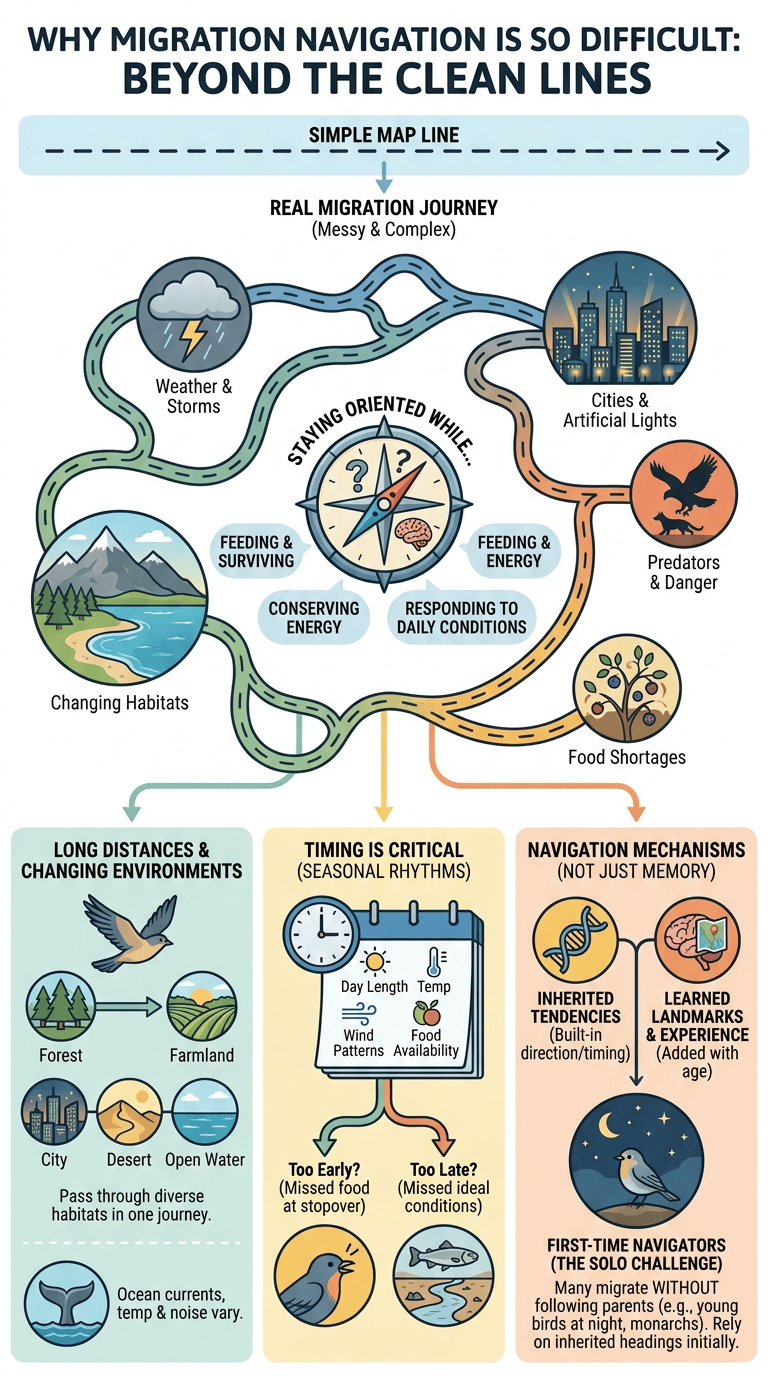
Migration looks simple on a map because the lines are clean. Real animals do not travel through clean lines. They move through changing air, water, weather, predators, cities, mountains, coastlines, rivers, storms, artificial lights, and food shortages. A migrating animal must stay oriented while also feeding, avoiding danger, conserving energy, and responding to conditions that can change from day to day.
Long distances and changing environments
Long-distance migrants may pass through several habitats in one journey. A bird that starts in northern forests may cross farmland, cities, coastlines, deserts, or open water. A whale may move between feeding and breeding areas while ocean temperatures, prey patches, currents, and noise conditions vary along the route. A salmon moving from ocean to river must switch from broad ocean movement to much finer-scale river navigation.
This is why migration navigation cannot be understood as simple memorization. Some animals do learn landmarks and routes, especially after repeated journeys. Others start with inherited directional tendencies. Many use both. A young migrant may have a built-in direction and timing program, while an older migrant may add experience and memory from earlier trips.
Weather, seasons, and timing
Timing is part of navigation because the same route can be safe or dangerous depending on season. Migrating animals often respond to day length, temperature, food availability, wind patterns, reproductive timing, and inherited seasonal rhythms. A bird leaving too early may reach a stopover before food is available. A fish returning too late may miss ideal river conditions for spawning. A butterfly moving during poor weather may burn energy without making much progress.
Young animals navigating for the first time
First-time migration is especially fascinating because many young animals migrate without having followed a parent the whole way. Some young birds migrate at night on inherited headings. Many juvenile sea turtles enter oceanic habitats long before returning as adults. Monarchs that travel south in fall are not simply copying parents that have flown the same route beside them.
The Main Cues Animals Use to Navigate
The sun and time of day
The sun can act as a directional cue, but only if the animal also accounts for time. Because the sun’s position changes across the day, a migrant using it as a compass needs an internal clock. This is why the phrase time-compensated sun compass appears in migration research. It means the animal is not just flying or swimming toward the bright spot in the sky. It is using the sun’s position together with body timing to maintain a direction.
Monarch butterflies are a famous example. A review of monarch butterfly navigation mechanisms describes the fall migration as relying heavily on a time-compensated sun compass, with skylight cues processed through the eyes and time compensation linked to circadian clocks in the antennae. That does not mean the sun is the only cue monarchs use, but it is central to how they orient southward in fall.
Stars and night skies
Many birds migrate at night, when cooler air, fewer predators, and calmer winds can make travel easier. Night migration raises an obvious question: how do birds stay oriented in darkness? For some species, the night sky provides useful directional information.
The Cornell Lab explains that birds do not simply memorize a fixed star map. In classic experiments, young indigo buntings learned orientation from the rotation pattern of stars around the northern sky. The Cornell Lab’s migration navigation overview also emphasizes that birds use multiple cues, including celestial cues, magnetic information, landmarks, and learned experience. That mix matters because clouds, moonlight, weather, and habitat can change what is available on any given night.
Earth’s magnetic field
Earth’s magnetic field can provide directional information, and in some animals it may also help with broader position sense. This ability is called magnetoreception. It has been studied in birds, sea turtles, salmon, insects, and other animals, but the biological details are still an active research area. Scientists should be careful about claiming that any animal has a fully understood magnetic GPS.
For marine migrants, magnetic information is especially interesting because the open ocean may lack obvious landmarks. A Journal of Experimental Biology review on natal homing describes the geomagnetic imprinting hypothesis, which proposes that sea turtles and salmon may learn magnetic characteristics of their home region when young and use them later when returning as adults. The evidence is strongest as a broad explanation for homing tendencies, not as proof that every individual finds an exact point by magnetism alone.
Smell and chemical cues
Smell can be a powerful navigation tool, especially when an animal is close enough for chemical cues to carry useful information. In water, odor plumes can be shaped by currents, flow, temperature, and turbulence. In air, scents can be carried, mixed, or weakened by wind and weather. Smell usually works best as part of a layered navigation system, not as a single long-distance route line.
Pacific salmon are one of the best-known examples of smell-based homing. NOAA Fisheries describes fish olfaction and homing research showing that juvenile salmon imprint on odors associated with their natal stream before going to sea, then use retained odor memories as adults during their return migration. Salmon can stray, and different species and populations vary, so it is better to describe this as a strong homing tendency supported by smell rather than a perfect return system.
Landmarks, coastlines, and memory
Landmarks become more useful when an animal can see or otherwise detect them and has enough experience to recognize them. Birds may use coastlines, rivers, mountain ranges, forest edges, city light patterns, or familiar stopover areas. Marine mammals may follow continental shelves, seamount regions, coastline shapes, or predictable feeding areas, although the exact cues vary and are hard to test in the open ocean.
Memory can improve navigation over time. Older birds often show more efficient routes than inexperienced individuals. Whales that return to seasonal feeding grounds may rely on learned routes and social knowledge. Herd animals, cranes, geese, and some mammals may benefit from traveling with experienced individuals, although not every migrant learns the route socially.
Sound, currents, wind, and social cues
Some cues do not look like navigation tools at first. Wind direction can help or hinder flying migrants. Ocean currents can influence swimming routes. Sound can matter in marine environments where visibility is limited and low-frequency sound can travel far. Group calls may help flying animals maintain contact during night migration or poor visibility, even when the calls are not a full navigation map.
Social cues can be important for animals that migrate in groups. Young cranes, geese, caribou, and some whales may learn routes, stopovers, or timing from older individuals. But social learning is not universal. Monarch butterflies and many young songbirds show that inherited orientation can be powerful even when parents are not leading the way.
Animal Examples of Migration Navigation
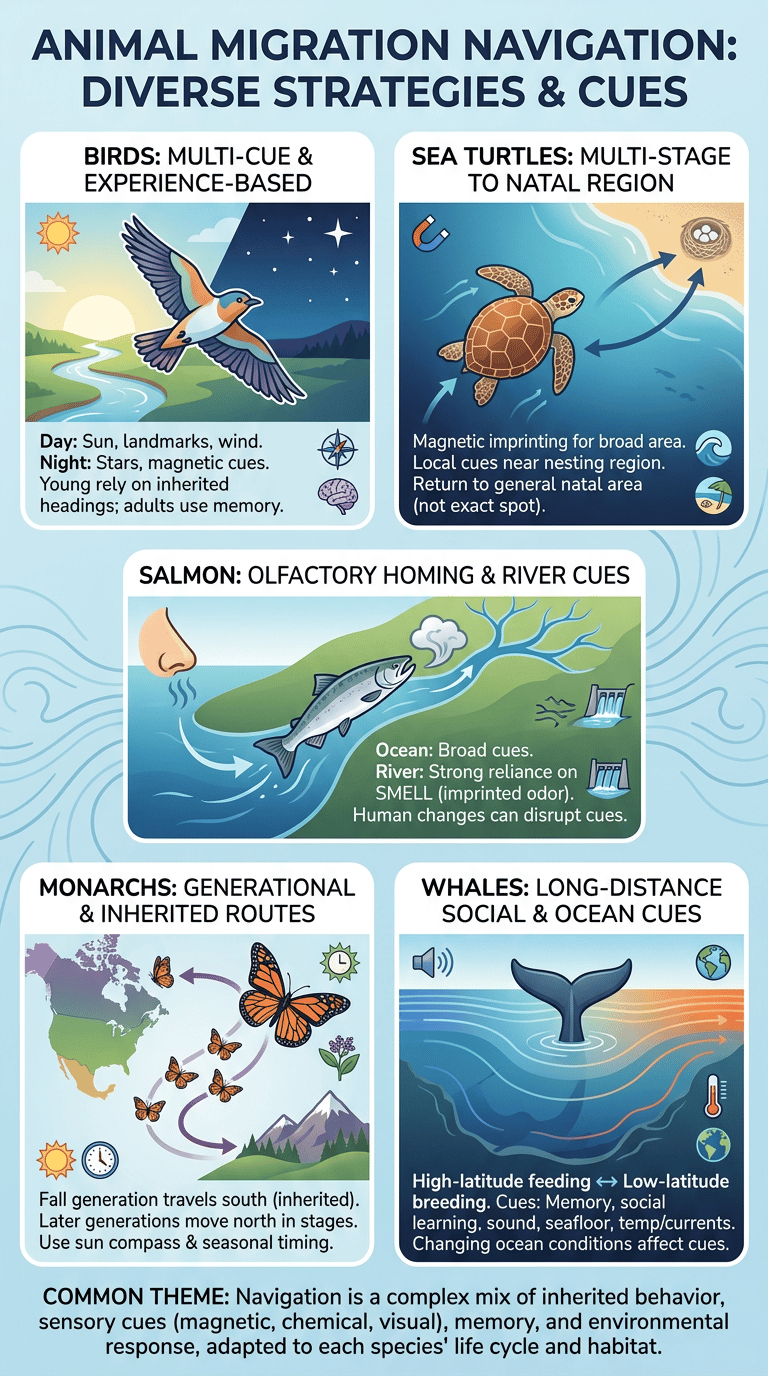
The easiest way to understand migration navigation is to compare different animals without pretending they all solve the problem the same way. Birds, sea turtles, salmon, monarch butterflies, and whales each show a different mix of inherited behavior, sensory cues, memory, and environmental response.
Birds using stars, sun, landmarks, and magnetic cues
Migrating birds are not all using the same route or the same senses. Some travel by day and can use the sun, horizon, terrain, coastlines, rivers, and wind. Many songbirds migrate at night, when star patterns, magnetic cues, and calls may become more important. Birds that have already migrated may rely more on experience, while young birds may depend more heavily on inherited headings and broad compass systems.
Sea turtles returning to nesting beaches
Sea turtles often migrate between feeding areas and nesting areas, and females of many species show strong nesting site fidelity. Popular descriptions sometimes say they return to the exact beach where they hatched. That can be broadly true in many cases, but the careful version is that adult females often return to their natal region or nesting area, with accuracy that varies by species, population, and available cues.
Magnetic imprinting is one leading explanation for how turtles find the right broad area after years at sea. Local cues may then help near the nesting region. It is unlikely that one cue explains the whole journey from ocean basin to beach. Turtles move through currents, coastlines, temperature zones, food areas, and changing ocean conditions, so their navigation is best understood as multi-stage.
Salmon using smell and river cues
Salmon migration is a classic example of changing navigation tools across distance. In the ocean, salmon may use broader directional and environmental cues. Near rivers, chemical cues become extremely important. Juvenile salmon imprint on the odor signature of their home stream, and adults later use smell to help locate their way back toward spawning areas.
Smell is often discussed as communication, but odor cues may also help some animals orient during movement.
This does not mean every salmon returns exactly to its birthplace. Some straying is normal and can even help salmon colonize or recolonize habitat over long time periods. Human changes such as dams, pollution, altered flow, warming water, or habitat damage can make the return more difficult by changing the river environment the fish must interpret.
Monarch butterflies and inherited routes
Monarch migration is unusual because the individuals that travel south in fall are not simply retracing a route they personally used before. In eastern North America, the fall migratory generation travels toward overwintering sites in Mexico, while later generations move northward in stages during spring and summer. Western monarchs use overwintering sites along the California coast.
The Monarch Joint Venture’s migration overview explains that monarch migration unfolds over generations and depends on overwintering habitat with specific conditions. The navigation story is therefore both sensory and life cycle based. Sun compass orientation, seasonal timing, reproduction, milkweed availability, nectar resources, and overwintering habitat all shape the migration system.
Whales and long-distance ocean movement
Whale migration is hard to study because whales move through huge ocean spaces and spend much of their lives underwater. Some species travel between high-latitude feeding areas and lower-latitude breeding or calving areas. The exact navigation cues may include memory, social learning, sound, seafloor features, oceanographic conditions, prey distribution, temperature, and currents.
NOAA Fisheries notes in its humpback whale species profile that humpback whales migrate seasonally and that changing water temperature and currents could affect environmental cues important for navigation and migration. This is a cautious but important point: when ocean conditions change, the cues animals use may change too.
How Scientists Study Animal Navigation
Migration navigation is difficult to study because the most important behavior often happens far away, at night, underwater, or across borders. Scientists use several methods together because no single tool captures the whole journey.
Tracking devices and banding
Bird banding, leg flags, radio transmitters, satellite tags, GPS tags, acoustic tags, geolocators, radar, and citizen science observations can all reveal pieces of migration. Larger animals can carry more precise devices. Small birds, bats, and insects are harder because the tag must be light enough not to interfere with movement or survival.
Orientation experiments
Orientation experiments help test which cues animals use. Researchers may change star patterns in a planetarium, alter magnetic fields in controlled settings, shift an animal’s internal clock, release animals from unfamiliar places, or compare groups exposed to different cues. These experiments do not recreate the full wild journey, but they can isolate one cue at a time.
For example, bird star compass experiments helped show that some young birds orient by the apparent rotation of stars rather than by a memorized star picture. Salmon imprinting studies help show the role of natal stream odors. Sea turtle magnetic experiments have helped test whether hatchlings respond to magnetic conditions similar to those found in different ocean regions.
Genetic, sensory, and environmental evidence
Scientists also compare genetics, sensory anatomy, population patterns, and environmental data. If animals return to certain places generation after generation, genetic patterns may show whether individuals from different nesting or spawning areas mix or remain separate. Sensory studies can test whether animals detect light, smell, magnetic fields, or sound in ways that support navigation.
Environmental evidence matters because a route that looks mysterious may make sense when wind, current, food, temperature, river flow, or stopover habitat is included. The strongest migration studies often combine tracking data with experiments, field ecology, and environmental records.
What Can Disrupt Animal Navigation
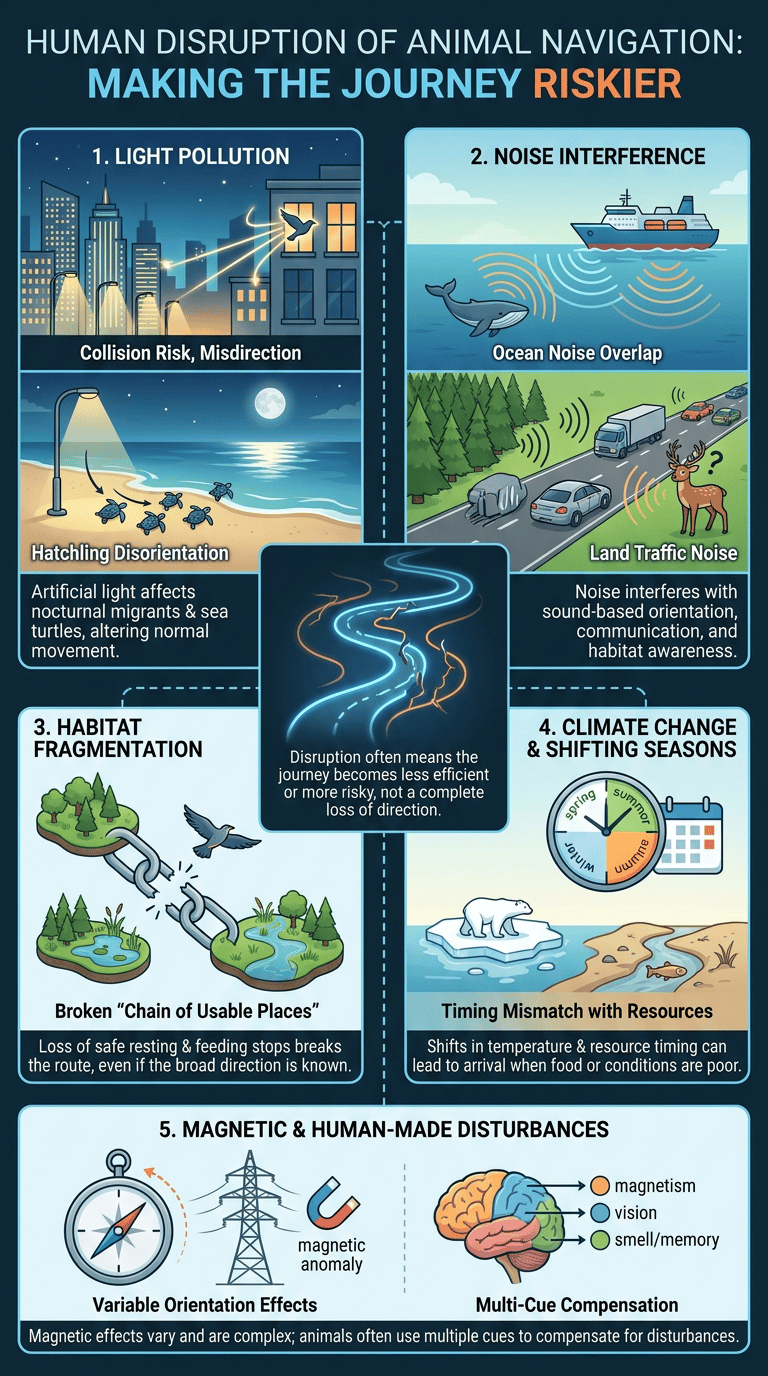
Migration depends on cues being available and reliable. Human activity can change those cues, remove stopover habitat, add confusing signals, or make the journey more dangerous. Disruption does not always mean an animal loses its compass completely. Often it means the journey becomes less efficient or more risky.
Light pollution
Artificial light can affect nocturnal migrants, especially birds moving through cities at night. Bright lights can draw birds toward buildings, increase collision risk, or change normal movement. Lights near beaches can also create problems for sea turtle hatchlings, which normally move toward ocean horizons rather than inland light sources.
Noise and habitat fragmentation
Noise can interfere with animals that use sound for contact, orientation, or habitat awareness. Ocean noise from ships, sonar, construction, and industrial activity can overlap with the sound world of whales and other marine animals. On land, traffic noise can affect communication and may influence how animals use habitat near roads.
Habitat fragmentation creates a different problem. A migrant may still know the broad direction but lose the safe resting, feeding, nesting, or spawning areas needed along the way. A route is not only a line between two endpoints. It is a chain of usable places.
Climate change and shifting seasons
Climate change can affect migration by shifting temperatures, food timing, water flow, storm patterns, ice cover, ocean currents, and plant or insect availability. Some animals may adjust timing or routes. Others may arrive when food is less available than expected. The risk is not that every migrant suddenly forgets where to go, but that the conditions tied to old timing cues may no longer match the best survival window.
This is especially important for animals that depend on seasonal pulses, such as insects emerging, flowers blooming, river flow, sea ice, or prey aggregations. Navigation and timing are linked. A correct route can still become costly if the season along that route changes.
Magnetic and human-made disturbances
Because some animals use magnetic information, people often ask whether power lines, buildings, or magnetic anomalies can confuse migration. The answer is not simple. Magnetic disturbances may affect orientation in some contexts, but effects vary by species, distance, strength, and whether other cues are available.
It is safer to avoid sweeping claims. Magnetoreception is real in several animals, but the mechanisms and real-world sensitivity differ. Most migrants are not using magnetism alone, so a disturbance that affects one cue may be partly balanced by vision, smell, memory, social cues, or environmental information.
Common Myths About Migration Navigation
Migration is often described in dramatic language, but the truth is more interesting than the myth. Animals are not following a perfect invisible road. They are using flexible biological systems that have limits.
Animals do not use only one built-in compass
A common myth is that every migrant has one internal compass that solves everything. In reality, animals often use a toolkit. The sun may help by day, stars by night, magnetic cues under some conditions, landmarks near familiar places, and smell near rivers or nesting areas.
This layered system is why many migrants can keep moving even when one cue is weak. It also explains why navigation can fail when several cues are disrupted at the same time.
Migration is not always perfectly accurate
Another myth is that migrating animals never get lost. Vagrancy, straying, overshooting, storm drift, and wrong turns happen. Birdwatchers sometimes notice rare birds far outside their usual range. Young migrants may be more likely to make errors. Weather can push animals into unexpected regions.
Errors are not proof that navigation is poor. They are part of a natural system operating in a changing world. Over many generations, a system can be successful even if some individuals make mistakes.
Not every animal learns the route from parents
Some animals do learn from parents or experienced group members, but not all. Cranes and geese can show strong social learning. Whales may pass migratory knowledge through social groups. Many songbirds, sea turtles, salmon, and monarch butterflies show important inherited or early-life imprinting components.
This matters because conservation efforts may need to consider culture and learning in some species, while protecting habitat and sensory cues may be more important for others. Migration biology is not one-size-fits-all.
Edge Cases and Exceptions
Not every migrant fits the classic picture of a long, predictable journey between two points. Migration can be partial, flexible, interrupted, or unusual depending on species and conditions.
Partial migration
In partial migration, only some individuals in a population migrate while others stay in the same general area. This can happen when food, weather, age, sex, competition, or individual condition affects the payoff of moving. A species may be migratory in one region and more resident in another.
First-time migrants
First-time migrants are special because they may have little or no route memory. Their success often depends on inherited orientation, timing, broad environmental cues, and local adjustments. Young animals may be more vulnerable to bad weather or habitat loss because they have less experience choosing stopovers or correcting errors.
Still, many first-time migrants complete remarkable journeys. That success shows how powerful natural selection can be in shaping seasonal timing and directional behavior, even before an animal has personal experience.
Animals that wander off route
Wandering off route can happen for many reasons. Storms may displace birds. Ocean currents may carry young turtles. Unusual winds may redirect insects. Young animals may make orientation errors. Disease, injury, hunger, or habitat disruption can also change movement.
Some off-route movements are dead ends. Others can occasionally lead to new routes, new breeding areas, or range shifts over long periods. Migration is stable enough to be recognizable, but flexible enough to change.
How This Connects to Nearby Animal Topics
Migration navigation sits at the intersection of animal senses, behavior, habitat, and survival. It connects naturally to vision, smell, sound, magnetic sensing, and communication without being identical to any one of those topics.
Animal vision and celestial cues
Vision matters because animals may use the sun, star rotation, horizon glow, polarized light, landmarks, coastlines, rivers, and habitat patterns. Even when a species is not using vision alone, visual information can help correct direction or recognize familiar areas.
This is why animal vision is not just about sharpness or color. For migrants, seeing the world can include detecting sky patterns, movement, light angle, and landscape structure in ways humans may overlook.
Smell communication and chemical navigation
Smell can communicate information between animals, but it can also help with navigation. A scent mark may signal territory or reproductive status. A river odor can help a salmon identify a place. A seabird or sea turtle may use chemical cues in water or air as part of a larger orientation system.
Migration navigation is not the same as animal communication, but both depend on animals detecting and responding to information.
Sound, group calls, and orientation
Sound can help animals stay in contact during migration, especially in groups or at night. Flight calls in birds may help maintain spacing or group awareness. Whale sounds may help individuals communicate across dark ocean environments, although sound is only one part of marine movement.
Sound-based orientation should not be confused with echolocation unless returning echoes are involved. Most migrating animals that use sound are not echolocating. They are using calls, environmental noise, or social information as part of a broader movement system.
FAQ
How do birds know where to migrate?
Birds use a combination of inherited direction, seasonal timing, celestial cues, magnetic information, landmarks, smell, wind, and experience. The exact mix varies by species and age. Young birds may rely more on inherited orientation, while experienced adults can use memory and familiar routes to improve accuracy.
Can animals sense Earth’s magnetic field?
Yes, several animals can detect or respond to Earth’s magnetic field, including many birds, sea turtles, salmon, and some insects. The ability is called magnetoreception. The exact biological mechanisms are still being studied, so it is best to say that magnetic cues are part of navigation for some animals rather than calling them a fully understood GPS system.
How do sea turtles find the same beach?
Sea turtles likely use multiple cues. Magnetic imprinting may help them return to the broad natal region, while local cues may help near the nesting area. Many females show strong nesting site fidelity, but accuracy can vary. It is more careful to say they often return to natal or familiar nesting regions rather than claiming every turtle finds the exact grain of sand where it hatched.
Why do some migrating animals get lost?
Migrating animals can get lost because of storms, unusual winds or currents, inexperience, poor condition, habitat changes, light pollution, or sensory disruption. Navigation systems are impressive, but they are not perfect. Most migrants rely on several cues, and mistakes become more likely when conditions are unusual or multiple cues are confusing.
Final Thoughts
How animals find their way during migration has no single answer because migration is not one behavior. It is a family of movement strategies shaped by species, habitat, age, season, memory, and sensory ability. Birds may combine stars, sun, landmarks, and magnetic cues. Salmon may use smell when returning to rivers. Sea turtles may use magnetic information and local cues. Monarch butterflies show how inherited timing and a sun compass can guide a journey across generations. Whales show how ocean migrants may rely on memory, sound, currents, prey, and changing seascapes.
The most useful takeaway is that migrating animals navigate through layers of information. When one cue is weak, another may help. When humans change light, noise, habitat, rivers, coastlines, or climate patterns, those layers can become harder to read. Understanding migration navigation is not just about marveling at long journeys. It is also about protecting the sensory and habitat conditions that make those journeys possible.

Ethan Walker is the founder and research editor of Animal Fact Central. He creates and reviews educational animal facts content using trusted wildlife, pet care, and science-based sources. His work focuses on making animal behavior, adaptations, habitats, and species facts clear, accurate, and engaging for everyday readers.
Read More Details About Ethan Walker: https://animalfactcentral.com/ethan-walker/