
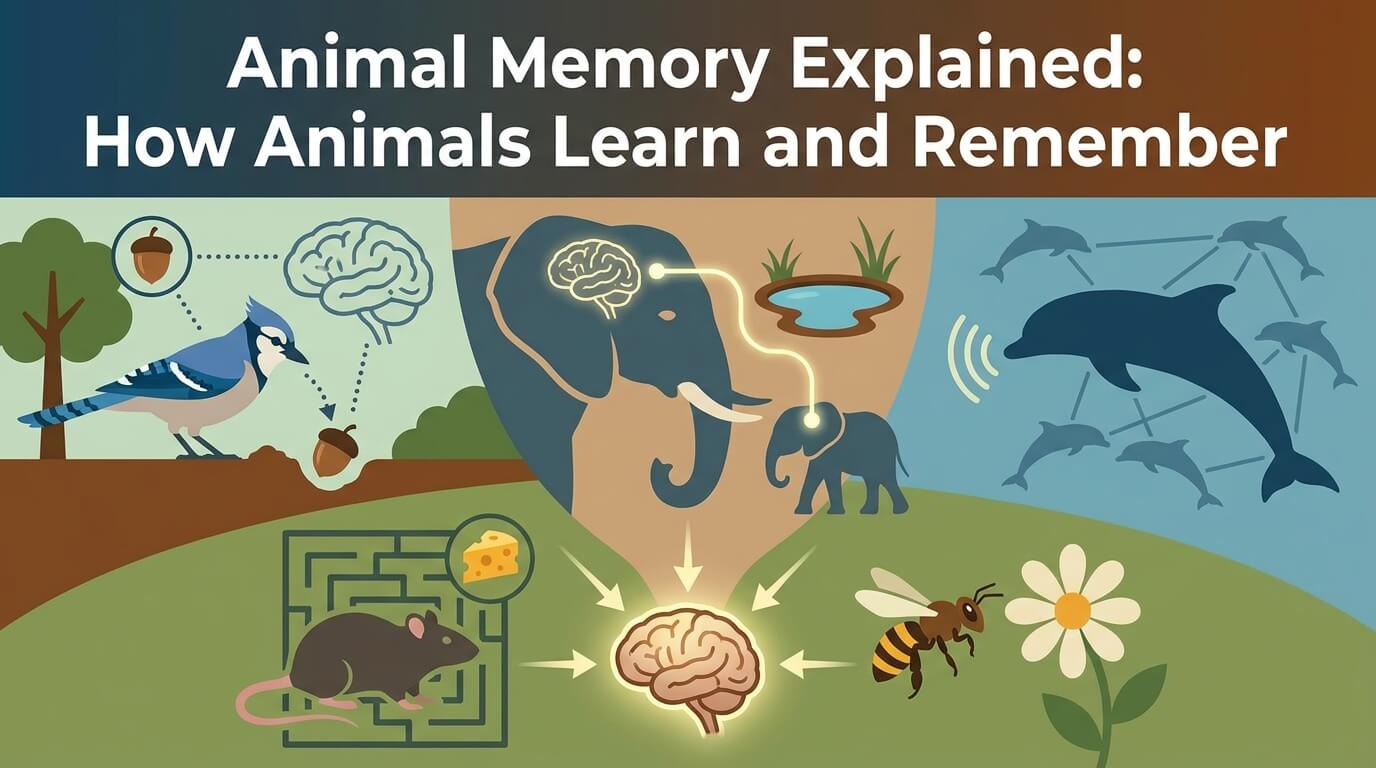
Animal memory is the ability to retain information from experience and use it later. It allows a chickadee to relocate hidden seeds, a dolphin to recognize a former companion’s whistle, a fish to repeat a learned choice, and a predator to avoid prey that was difficult or dangerous to capture. Memory is not one single capacity. It includes short-lived working information, long-term knowledge, recognition of individuals, spatial maps, learned routines, and evidence of memory for particular past events.
There is no sound ranking of the animal with the “best memory.” A memory system is useful when it solves the recurring problems of that animal’s life. Remembering thousands of food locations, keeping track of social partners, following a migration route, and learning a motor routine place different demands on the brain. Researchers therefore compare specific abilities with tests designed around each species’ senses, body, motivation, and ecology.
Quick Answer
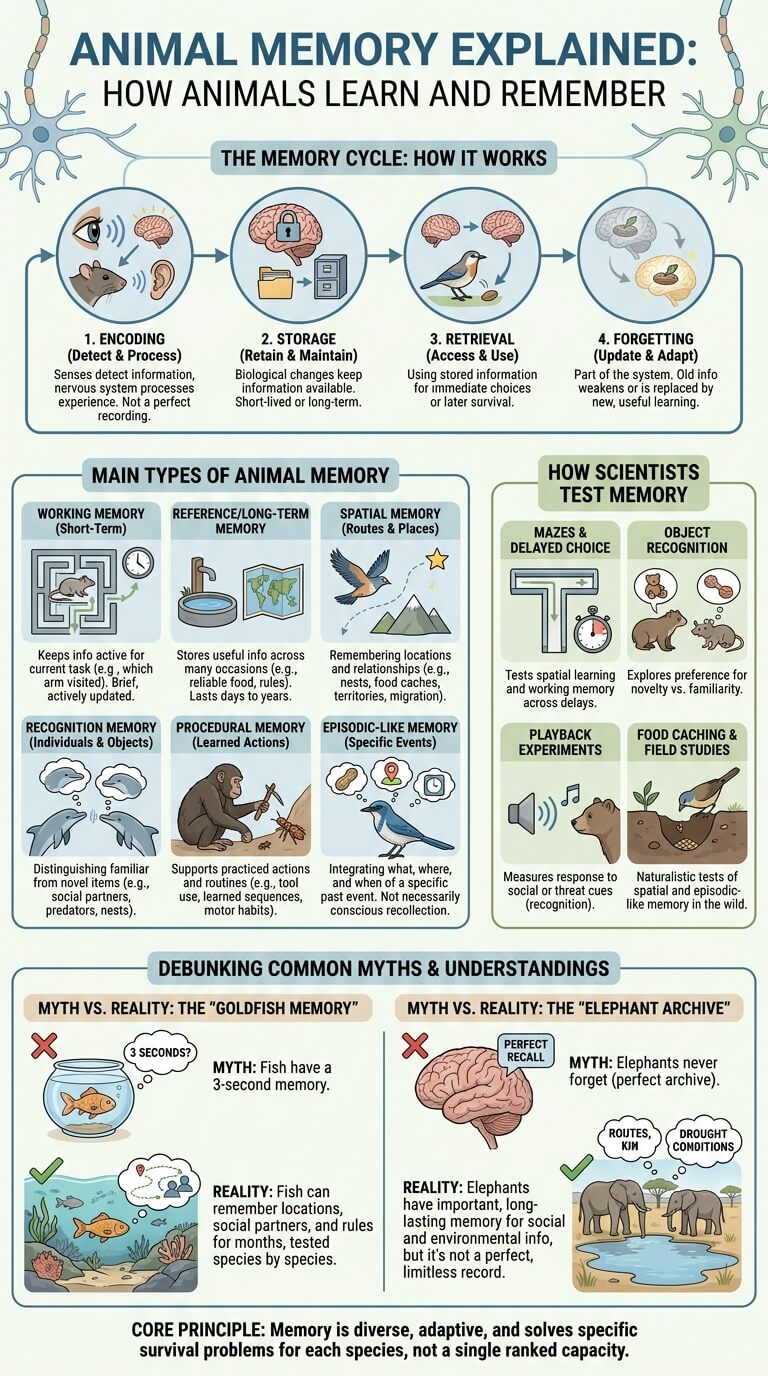
Animals learn and remember by encoding information, retaining some of it, and retrieving it when a later situation makes it useful. The length of retention can range from seconds to years, but duration alone does not reveal how detailed, flexible, or important a memory is. A short memory may guide an immediate choice, while a long-term memory may support seasonal travel, social recognition, or avoidance of a known threat.
Evidence from mammals, birds, fish, insects, and cephalopods shows that memory is widespread across the animal kingdom. The strongest conclusions come from controlled tests and natural observations that rule out simpler explanations such as following odor, repeating a trained response, reading an unintended human cue, or choosing a familiar location without recalling a specific event.
What Is Memory in Animals?
Encoding, storage, retrieval, and forgetting
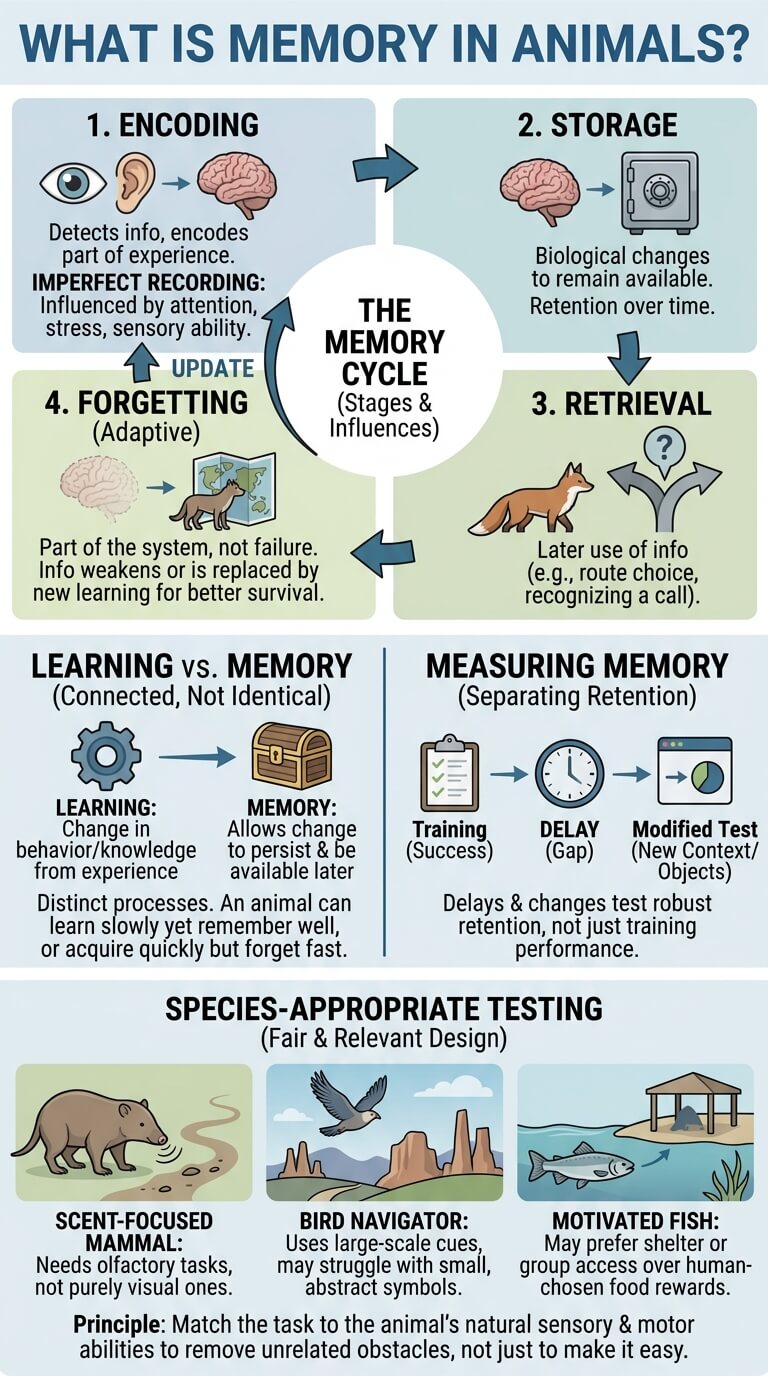
Memory begins when an animal detects information and its nervous system encodes part of that experience. Encoding does not create a perfect recording. Attention, stress, hunger, sensory ability, and previous experience influence what enters memory. Storage refers to the biological changes that allow information to remain available. Retrieval is the later use of that information, such as choosing a route, recognizing a call, or avoiding a location.
Forgetting is part of the system rather than proof that memory has failed. Information may weaken, become difficult to retrieve, or be replaced by newer learning. An animal that updates an old feeding location after conditions change may survive better than one that keeps returning to an empty site.
Learning is not identical to memory
Learning is a change in behavior or knowledge produced by experience. Memory is what allows that change to persist or become available later. The two processes are closely connected, but they are not interchangeable. An animal may learn a rule slowly over many trials and then remember it well. Another may acquire information after one event but lose access to it quickly.
Researchers separate learning from retention by introducing a delay after training. They may also change the location, objects, or order of choices. If performance survives the delay and transfers to a modified problem, the result tells scientists more than repeated success during training alone. Memory is a central component of animal intelligence, but cognitive ability also includes attention, communication, inhibition, innovation, and social reasoning.
Why memory should be measured with species-appropriate tasks
A fair memory test must match how the animal normally gathers and acts on information. A scent-focused mammal may perform poorly in a visually demanding task even when it has excellent memory for odors. A bird may recognize a location from panoramic landmarks but struggle with a small symbol on a flat screen. A fish may be motivated by shelter or group access rather than the food reward chosen by a human experimenter.
Species-appropriate design does not mean making every test easy. It means removing obstacles unrelated to the memory question. Body structure, sensory range, development, captivity, stress, and prior experience can all change performance.
The Main Types of Animal Memory
Working memory for short-term information
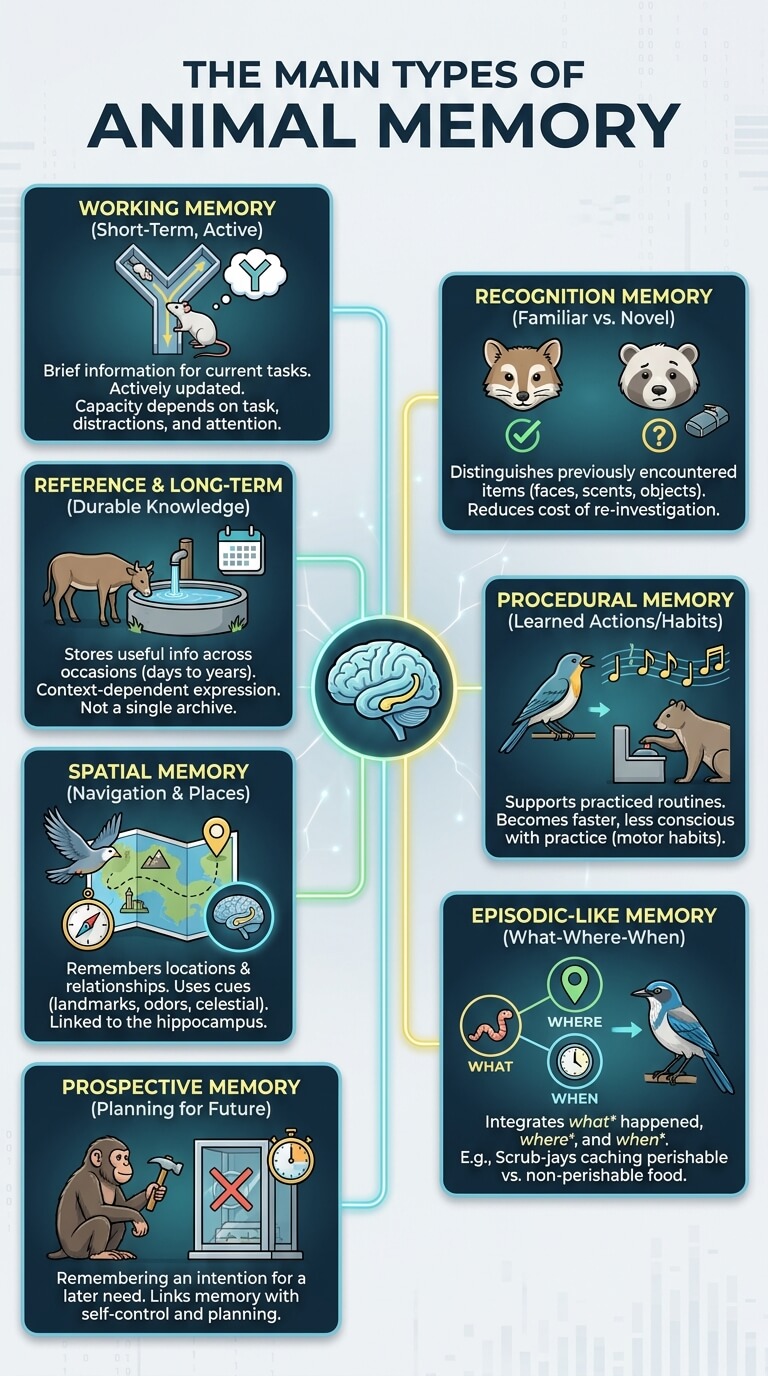
Working memory keeps information available while an animal completes a current task. A rat choosing arms in a maze may need to remember which arms it visited moments earlier. A bird searching several compartments must avoid returning immediately to an emptied one. The information can be brief but still requires active updating.
Working memory is not defined by one universal number of seconds. Its capacity depends on the material, distractions, training, and task. It also overlaps with attention and decision-making, which is why researchers use several delays and control choices rather than treating one failure as a fixed memory limit.
Reference and long-term memory
Reference memory stores information that remains useful across many occasions. It can include the location of a stable water source, the meaning of a familiar signal, the rule that one type of object predicts food, or the route through a known territory. These memories may last days, months, or longer when the information remains valuable and is occasionally refreshed.
Long-term memory is not a single permanent archive. Some memories are strong because they are repeatedly used. Others become durable after one highly important event. Their expression may also depend on context. An animal can retain information but fail to show it when motivation, stress, or environmental cues differ from the original experience.
Spatial memory for routes, territories, and food
Spatial memory helps animals remember where places are and how locations relate to one another. It supports navigation between nest and feeding sites, movement around a territory, return to breeding areas, and recovery of stored food. Animals may use landmarks, odors, celestial cues, path integration, local geometry, or combinations of these signals.
The hippocampus, a brain region studied extensively in mammals and birds, contributes to flexible relationships among locations and events. A scientific review of the hippocampus in navigation and memory emphasizes that spatial maps are part of a broader ability to organize relationships, not a separate mental GPS that works without other memory processes.
Recognition memory for individuals, objects, and places
Recognition memory allows an animal to distinguish something encountered before from something novel. The remembered item may be a face, scent, voice, nest entrance, feeding container, partner, rival, or predator. Recognition can reduce the cost of investigating every encounter from the beginning.
Strong studies test whether recognition survives changes in signal, setting, or social context.
Procedural memory for learned actions and routines
Procedural memory supports practiced actions. Examples include a bird’s learned song pattern, a primate’s tool routine, a rodent’s sequence through an apparatus, or a trained animal’s response to a cue. Practice can make a sequence faster and less dependent on deliberate attention to every movement.
A smooth routine does not reveal exactly what the animal understands. It may reflect a motor habit, a learned sequence, or flexible knowledge of a goal. Researchers change tools or interrupt the order of steps to determine whether the behavior is rigid or adaptable.
Episodic-like memory and the what-where-when framework
Human episodic memory includes recollection of particular personal events and the conscious sense of mentally revisiting the past. Scientists cannot directly ask a nonhuman animal about that subjective experience. They therefore study episodic-like memory through observable features, especially whether the animal integrates what happened, where it happened, and when it happened.
In a classic experiment, scrub-jays cached preferred wax moth larvae and less perishable peanuts in different locations. Their later searches reflected both food type and how much time had passed. The scrub-jay cache-recovery study provided influential evidence that birds could use integrated information about a specific past caching event.
The term episodic-like remains important. Remembering what, where, and when does not by itself prove the same conscious recollection humans describe.
Prospective memory and remembering to act later
Prospective memory concerns remembering an intention or selecting something for a later need. An animal may retain a tool until an apparatus becomes available, return to a location when food is expected, or delay an action until a social partner is present. Such behavior links memory with self-control and planning.
Experiments must distinguish future-oriented choice from a trained chain. Novel situations, changed delays, distracting rewards, and choices between currently useful and later useful objects help reveal whether the animal is using information about a delayed goal.
How Scientists Test Animal Memory
Mazes, delayed-choice tasks, and object recognition
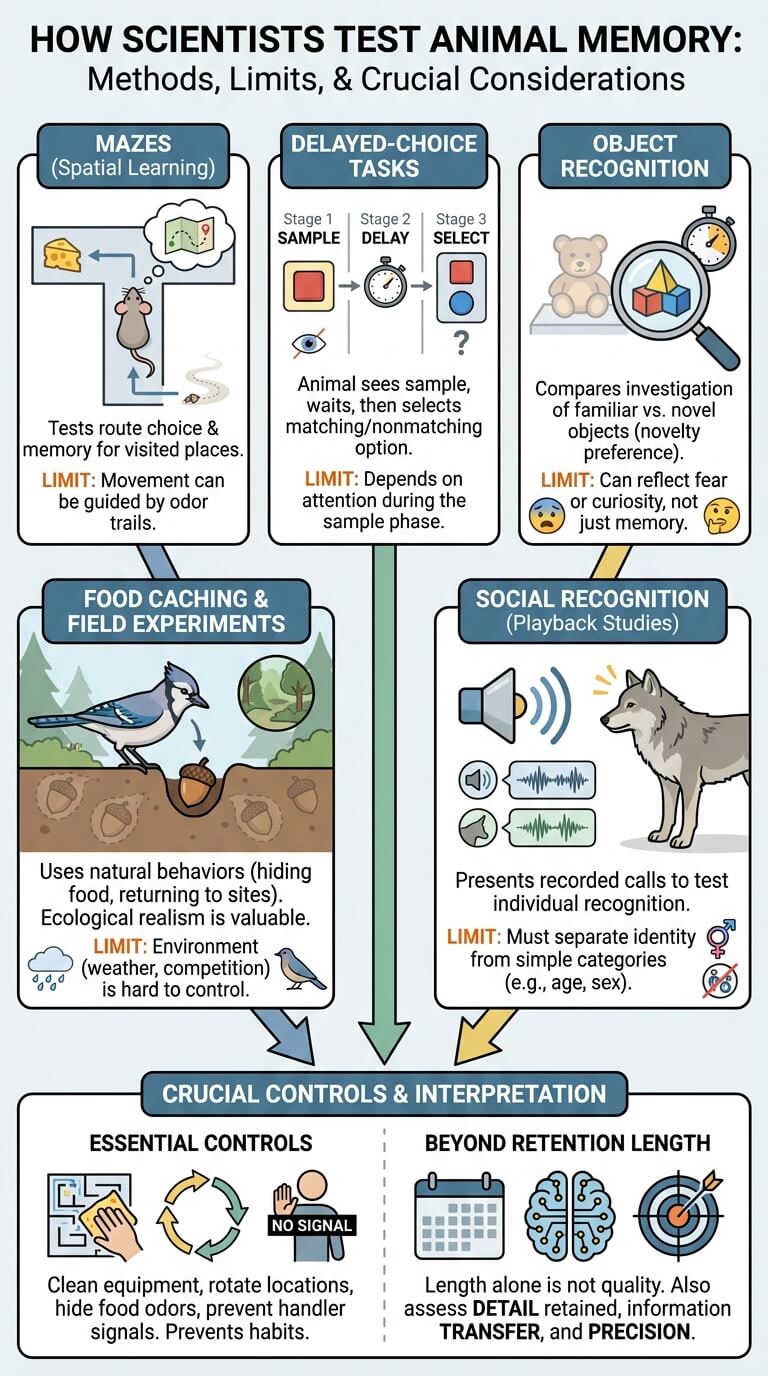
Mazes can test spatial learning, route choice, or memory for recently visited places. In a delayed-choice task, an animal sees a sample, waits through a delay, and then selects a matching or nonmatching option. Object-recognition tests compare investigation of familiar and novel objects, based on the expectation that many animals spend more time examining novelty.
Each method has limits. Movement through a maze can be guided by odor trails. Novel-object investigation can reflect fear or curiosity as well as memory. Delayed-choice performance can depend on attention during the sample phase. Controls and repeated variations are necessary before the result can be assigned to one memory process.
Food caching and naturalistic field experiments
Food-storing birds provide an unusually natural way to study memory. Researchers can allow birds to hide food themselves, alter the delay, change which foods remain edible, or control whether another bird watched. The task grows from behavior the birds already perform rather than requiring a completely artificial skill.
Field experiments can also test return to feeding sites, nests, territories, or seasonal resources. Their ecological realism is valuable, but the environment is harder to control. Weather, competition, previous visits, scent, and unobserved experience may affect the outcome.
Social recognition and playback studies
Playback experiments present recorded calls while controlling the speaker’s location and the listener’s access to other cues. Researchers measure orientation, approach, calling, avoidance, or changes in group behavior. When an animal responds differently to familiar and unfamiliar calls, the result can support social recognition.
Visual and odor-based tests use similar logic. The experiment should separate individual identity from simple categories such as age, sex, group membership, or threat level.
Controls for smell, repeated cues, motivation, and training
A memory result is only as strong as its controls. Researchers clean equipment, rotate locations, hide food odors, balance the side of the correct choice, and prevent handlers from signaling the answer. They record training history because extensive practice can create a reliable habit without the flexible recollection being tested.
Motivation also matters. A frightened, tired, or uninterested animal may appear to forget, so researchers compare conditions and individuals.
Why retention length alone does not measure memory quality
A headline may celebrate a memory lasting months or years, but a long interval answers only one question. Researchers also ask how much detail was retained, whether the information transfers, how many experiences created the memory, and whether the response remains accurate when cues change.
A very long recognition memory for one important social partner does not imply equally strong spatial or procedural memory. A short-lived working memory can still be highly precise and essential for a rapid decision.
Animals with Specialized Memory Abilities
Food-caching birds and detailed spatial memory
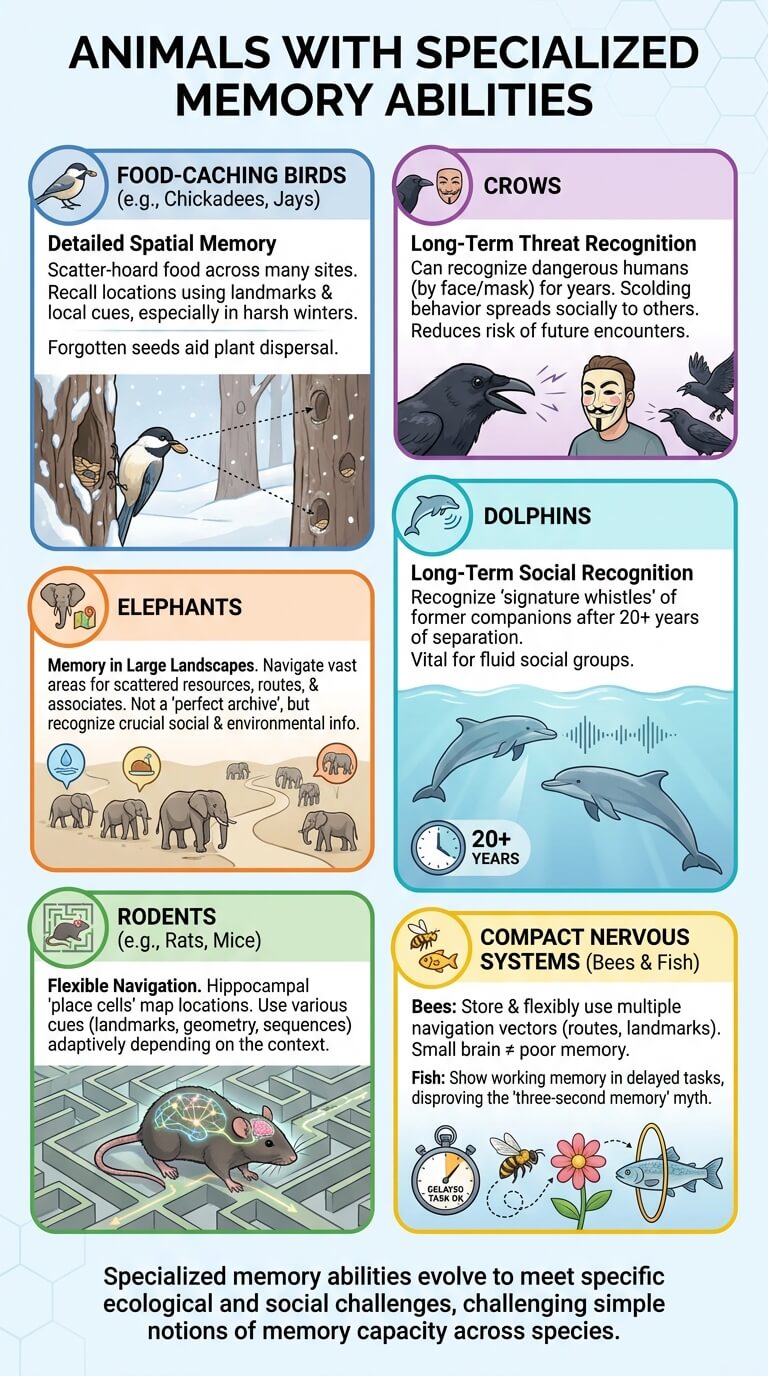
Chickadees, nutcrackers, jays, and other scatter-hoarding birds hide food across many sites and recover a useful portion later. Spatial memory helps narrow the search, while landmarks and local cues guide the final approach. Different species vary in how heavily they depend on stored food, and populations facing harsher winters may experience stronger selection on caching and retrieval performance.
These birds combine memory with search rules, landmarks, and repeated experience. Forgotten seeds can also contribute to plant dispersal.
Crows and long-term recognition of threats
Wild American crows have learned to discriminate a human mask associated with capture and later scolded people wearing that mask. Responses persisted for years and spread to birds that had not experienced the original capture. The controlled field study of crow recognition supports long-term visual memory for a dangerous appearance.
Calling this a human-like grudge adds an untested moral story. Threat recognition is already a powerful explanation: remembering a risky person can reduce the chance of another dangerous encounter.
Dolphins and long-term social recognition
Bottlenose dolphins develop individually distinctive signature whistles. In playback experiments, dolphins responded strongly to whistles of former companions even after long separation. The bottlenose dolphin social-memory study included separations extending beyond 20 years.
The finding concerns recognition of familiar acoustic identities, not a universal record of everything that happened during those relationships. It is especially relevant in a species whose social associations can change over time and distance.
Elephants and memory in large social landscapes
Elephants live in physically and socially demanding environments. They encounter scattered water and food, changing seasons, extended movement routes, family members, associates, rivals, and humans. Observations and experiments suggest that experience can help elephants recognize social and environmental information.
The proverb that elephants never forget goes far beyond the evidence. A recent scientific review of elephant memory concluded that direct empirical research remains limited despite many findings from elephant cognition and behavioral ecology. Elephants should be described as animals with important memory abilities, not as perfect biological archives.
Rodents and flexible navigation
Rats and mice have played a major role in memory research because scientists can test controlled navigation, object recognition, timing, and learned rules. Hippocampal neurons called place cells become active in relation to locations, while broader neural networks represent routes, contexts, and relationships.
Rodent studies also show that navigation is flexible. Animals can use landmarks, turn sequences, odors, geometry, or map-like relationships depending on training and available cues. Success in a maze is not one ability; different maze designs can ask different memory questions.
Bees, fish, and memory with compact nervous systems
Honey bees learn floral odors, colors, landmarks, directions, and profitable routes. Recent neural research indicates that bees can store multiple navigation vectors in long-term memory and use them flexibly. Their small brains show that nervous-system size alone does not determine whether useful memory is possible.
Fish also learn places, social partners, feeding schedules, predators, and task rules. Adult zebrafish have performed delayed matching tasks that require keeping sample information across a pause. The zebrafish working-memory experiment is one of many findings incompatible with a universal three-second fish memory.
Memory, Ecology, and Survival
Remembering seasonal food and migration routes
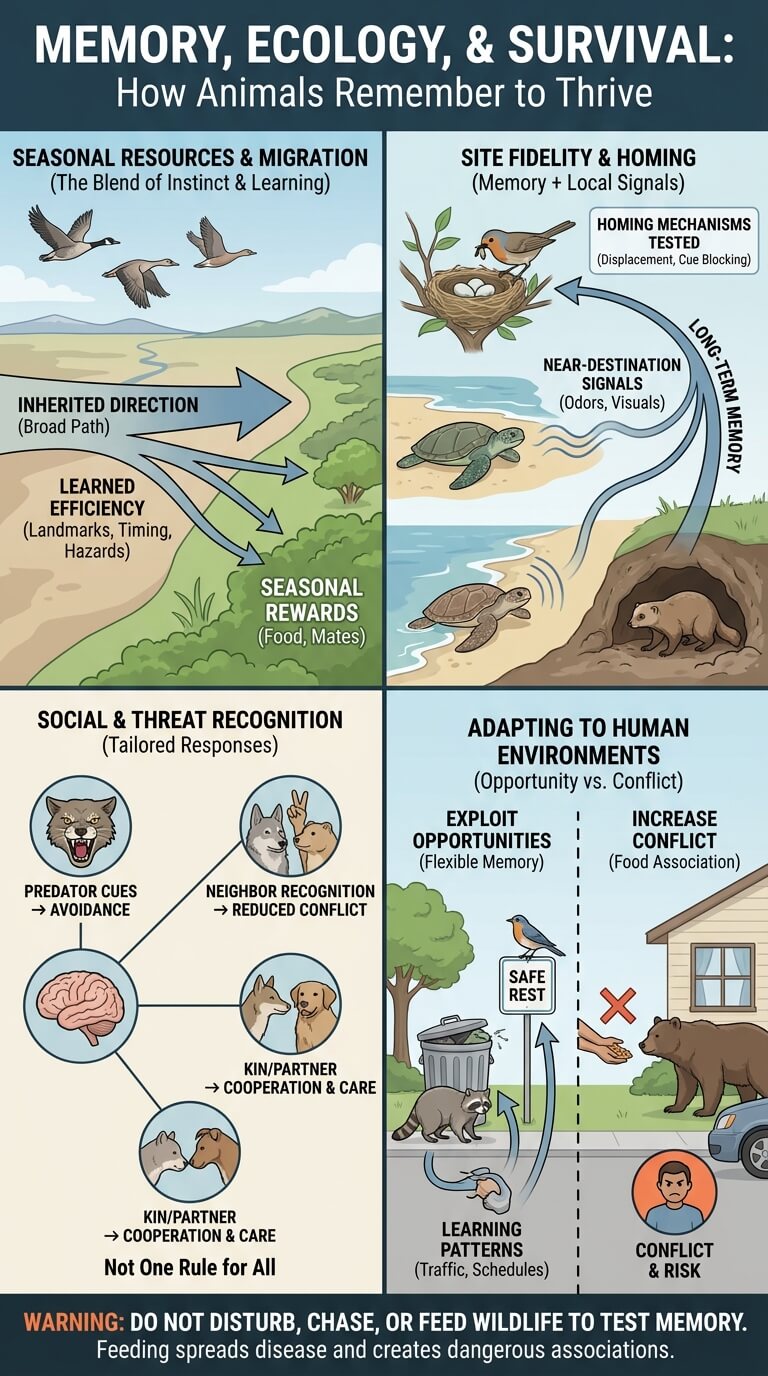
Seasonal environments reward animals that connect time, place, and resource availability. Migratory birds, fish, marine mammals, and hoofed mammals may return to productive areas using combinations of learned landmarks, inherited directional tendencies, odors, magnetic information, celestial cues, and social guidance.
It is usually misleading to label a long journey as either instinct or memory. Inherited programs can provide a broad direction, while learning improves route efficiency, stopover choice, hazard avoidance, and timing.
Recognizing predators, rivals, mates, and family
Social and threat memories let animals respond differently to individuals rather than using one rule for every encounter. Recognizing a neighbor may reduce needless territorial fighting. Remembering a reliable partner can support cooperation. Identifying kin may influence care, alliance, or mating decisions. Remembering a predator’s appearance, odor, or call can trigger faster avoidance.
The useful content depends on the species. Some animals recognize particular individuals; others mainly remember categories or locations associated with risk.
Returning to nests, dens, reefs, or breeding sites
Many animals revisit important sites after absences. Birds return to nest areas, sea turtles and fish show natal or regional homing, mammals reuse dens or water points, and reef animals learn shelter networks. Repeated return can combine memory with environmental signals that are available only near the destination.
Homing does not prove one internal map. Researchers test the mechanism by displacing animals, changing landmarks, blocking odors, shifting apparent time, or tracking how routes improve with experience.
Learning human-dominated environments
Animals living near people learn traffic patterns, garbage schedules, safe resting places, feeding behavior, and the appearance of threatening or tolerant humans. Flexible memory can help wildlife exploit opportunities, but it can also increase conflict when animals associate homes, vehicles, or people with food.
People should not capture, chase, repeatedly disturb, or deliberately frighten wildlife to test its memory. Feeding can crowd animals, spread disease, and teach them to approach dangerous situations.
Do Animals Remember the Past Like Humans?
Episodic memory versus episodic-like evidence
Humans can describe the subjective feeling of remembering a personal event. Nonhuman animals cannot provide that verbal report. Scientists therefore identify behavioral criteria that can be tested without assuming the internal experience in advance.
What-where-when tasks, unexpected questions about a recent event, and memory for incidental details can show flexible use of event information. These results challenge the idea that all animals live only in the present, but they do not reveal whether recollection feels the same across species.
Future planning and memory-based decisions
Memory supplies information for decisions about what comes next. Animals can use past outcomes to choose a route, save a tool, avoid a competitor, or return when a resource is likely to be available. Some experiments attempt to separate a future need from the animal’s current state, which makes the evidence more persuasive.
Planning claims remain sensitive to training and task design. A repeated association between an object and later reward can guide choice without a human-like mental scene of the future.
Why researchers avoid claiming human-style autobiographical memory
Autobiographical memory involves a personal narrative and conscious self-reference. Behavior can demonstrate event memory without establishing that full package. Even mirror recognition, social identity, and what-where-when performance do not automatically combine into a human-like life story.
Cautious wording protects the strength of the evidence. Animals can remember complex information even when scientists cannot determine the exact form of subjective awareness.
Why Animals Forget
Interference, stress, and changing environments
New information can interfere with old information, especially when many similar events occur. A food cacher that stores the same item in nearby places faces interference between locations. Stress can sharpen memory for some threats while disrupting attention, learning, or retrieval in other situations. The effect depends on intensity, timing, and species.
Environmental change can also remove retrieval cues. A landscape altered by fire, construction, flood, or vegetation growth may make a familiar route harder to recognize even when parts of the memory remain.
Adaptive forgetting and updating old information
Remembering everything would create its own problem. Animals need to prioritize current, predictive information. Forgetting an exhausted food patch or reducing a fear response after repeated safe encounters can prevent wasted effort. Extinction learning, in which a once-predictive cue stops producing the old response, often adds new learning rather than erasing the original memory completely.
This is why an old response can sometimes return after time, stress, or a change in context.
Age, development, and individual differences
Memory changes as nervous systems develop and age. Young animals gain experience and improve some skills, while older individuals may benefit from accumulated ecological knowledge. Aging can reduce performance in certain tasks, but effects vary among memory systems, species, environments, and individuals.
Nutrition, health, early-life conditions, social experience, sleep, and opportunity to practice also contribute. One exceptional animal should not be treated as the standard for its species.
Common Myths and Misunderstandings
Fish do not have a universal three-second memory
The three-second claim cannot explain fish learning in laboratory or natural settings. Fish can retain task rules, locations, social information, and danger associations beyond a few seconds. Different fish species and memory tasks produce different retention periods, just as they do in birds and mammals.
Replacing the myth with “all fish remember for months” would create another error. The accurate statement is that fish possess several forms of memory and should be tested species by species.
Elephants are not proven to remember everything
Elephants can use learned information in complex social and spatial environments, but the popular slogan is absolute and untestable. Scientific evidence does not show perfect storage, flawless retrieval, or equal strength across every kind of memory.
The better question is which information elephants retain, for how long, under which conditions, and how that knowledge affects movement, social decisions, and conflict with people.
Long retention does not automatically mean greater general intelligence
A dolphin recognizing a whistle after decades demonstrates exceptional retention in a social recognition task. It does not settle how that dolphin would perform in every problem-solving, spatial, quantity, or tool task. Specialized memory may be highly adaptive without forming a general intelligence ranking.
Comparisons should match memory type, difficulty, sensory demands, and ecological relevance.
Instinctive navigation and learned memory can interact
Migration, homing, and orientation often involve inherited tendencies as well as learning. A young animal may begin with a directional program, then refine its path through landmarks, social travel, and experience. Treating instinct and memory as opposites hides how biological systems actually work.
The balance can differ even within a species according to age, route, population, and environmental reliability.
How Memory Supports Other Animal Abilities
Memory as a foundation for problem solving and tool routines
Problem solving depends on retaining what has worked, what has failed, and which object properties matter. Tool users need procedural memory for handling actions and may need working memory to organize several steps. Flexible performance appears when an animal can retrieve past information without repeating the old solution blindly.
Social memory in dolphins and crows
Dolphins and crows illustrate different kinds of social recognition. Dolphins can retain acoustic information about companions, while crows can learn and spread information about a risky human appearance. In both cases, memory changes future behavior toward a socially relevant signal.
Recognition memory versus self-recognition
Recognizing a familiar individual, place, or object is not the same as recognizing oneself. Mirror tests ask whether an animal relates a reflection to its own body. Recognition memory can support the task, but passing or failing a mirror test does not summarize the animal’s total memory capacity.
Emotional states and their effects on learning and recall
Fear, reward expectation, social attachment, and stress can influence attention and the strength of learning. An emotionally important event may be remembered strongly, while high stress can interfere with flexible retrieval. Researchers measure behavior and physiology rather than assuming that every visible reaction maps directly onto a named human emotion. Research into whether animals have emotions shows how fear, reward, attachment, and stress can shape attention, learning, and recall.
FAQ
Which animal has the best memory?
Science does not support one winner across all forms of memory. Food-caching birds excel at spatial recovery, dolphins show remarkable long-term social recognition, and many mammals, fish, insects, and cephalopods perform strongly in tasks matched to their ecology. A fair comparison must specify whether it is testing working, spatial, recognition, procedural, or event memory.
How long can animals remember people?
The answer varies by species, individual, relationship, and experience. American crows retained recognition of a threatening mask for years in a controlled field study. Domestic animals may recognize familiar people through combinations of voice, appearance, odor, routine, and past interaction. A strong emotional or repeated history can increase retention, but anecdotes cannot establish a universal limit.
Do fish really forget after three seconds?
No. Controlled studies show that fish can learn and retain information for longer than three seconds. Some tasks examine working information across short delays, while others test long-term associations, places, schedules, and social recognition. The exact duration depends on the species and the kind of information being measured.
Can animals remember specific past events?
Several species have shown episodic-like memory, including the ability to use integrated information about what occurred, where it occurred, and when. Other experiments ask unexpected questions about a recent event or test incidental details. These findings support memory for event content, but researchers remain cautious about claiming the same conscious autobiographical experience reported by humans.
Final Thoughts
Animal memory is not a single storage tank or a contest for the longest retention. It is a collection of systems that keep useful information available at different timescales. Working memory guides immediate choices. Spatial memory organizes routes and resources. Recognition memory tracks individuals and places. Procedural memory supports practiced actions, while episodic-like research examines how animals integrate details of particular past events.
The clearest way to understand how animals remember is to ask what information matters in their lives, how researchers ruled out simpler explanations, and whether the memory remains flexible when conditions change. That approach replaces myths about perfect elephants, forgetful fish, and one “best” memory with a more accurate picture of diverse minds solving diverse survival problems.

Ethan Walker is the founder and research editor of Animal Fact Central. He creates and reviews educational animal facts content using trusted wildlife, pet care, and science-based sources. His work focuses on making animal behavior, adaptations, habitats, and species facts clear, accurate, and engaging for everyday readers.
Read More Details About Ethan Walker: https://animalfactcentral.com/ethan-walker/