
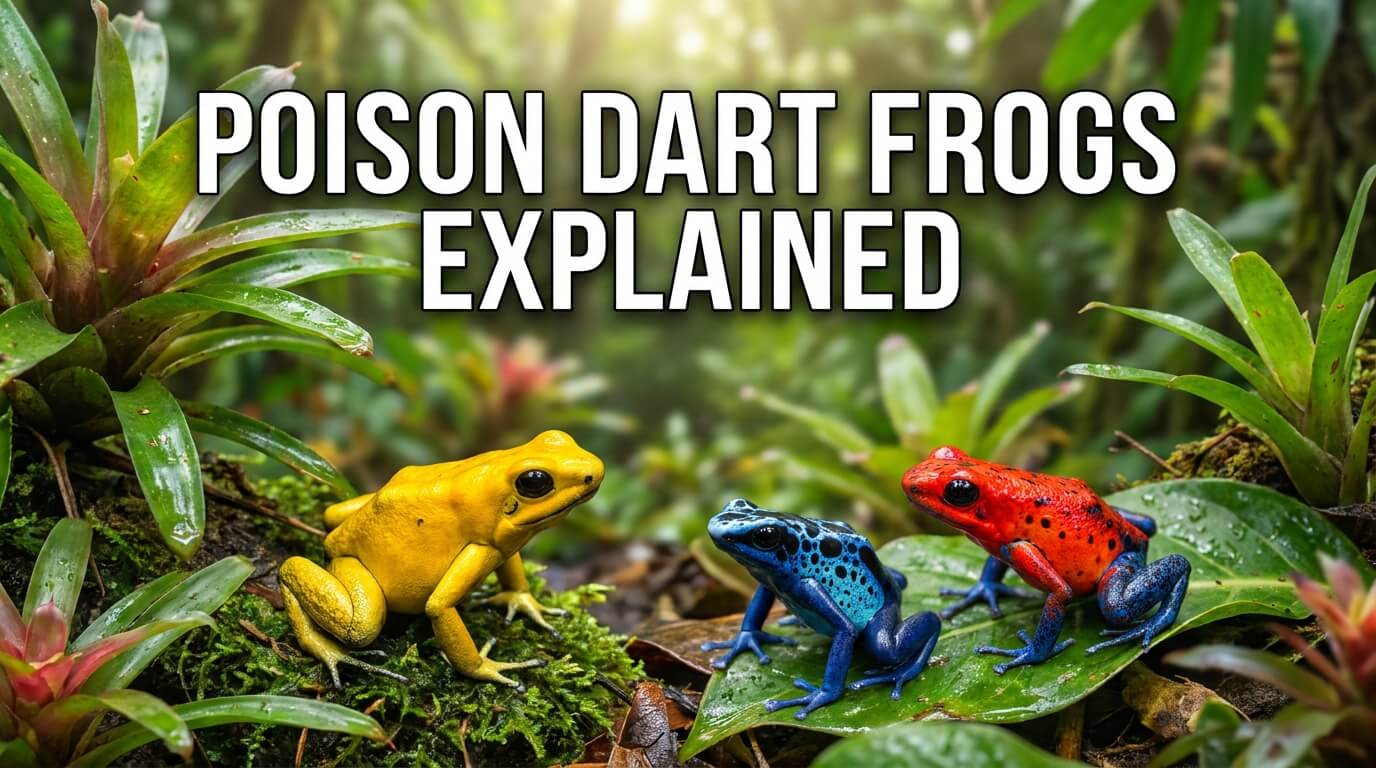
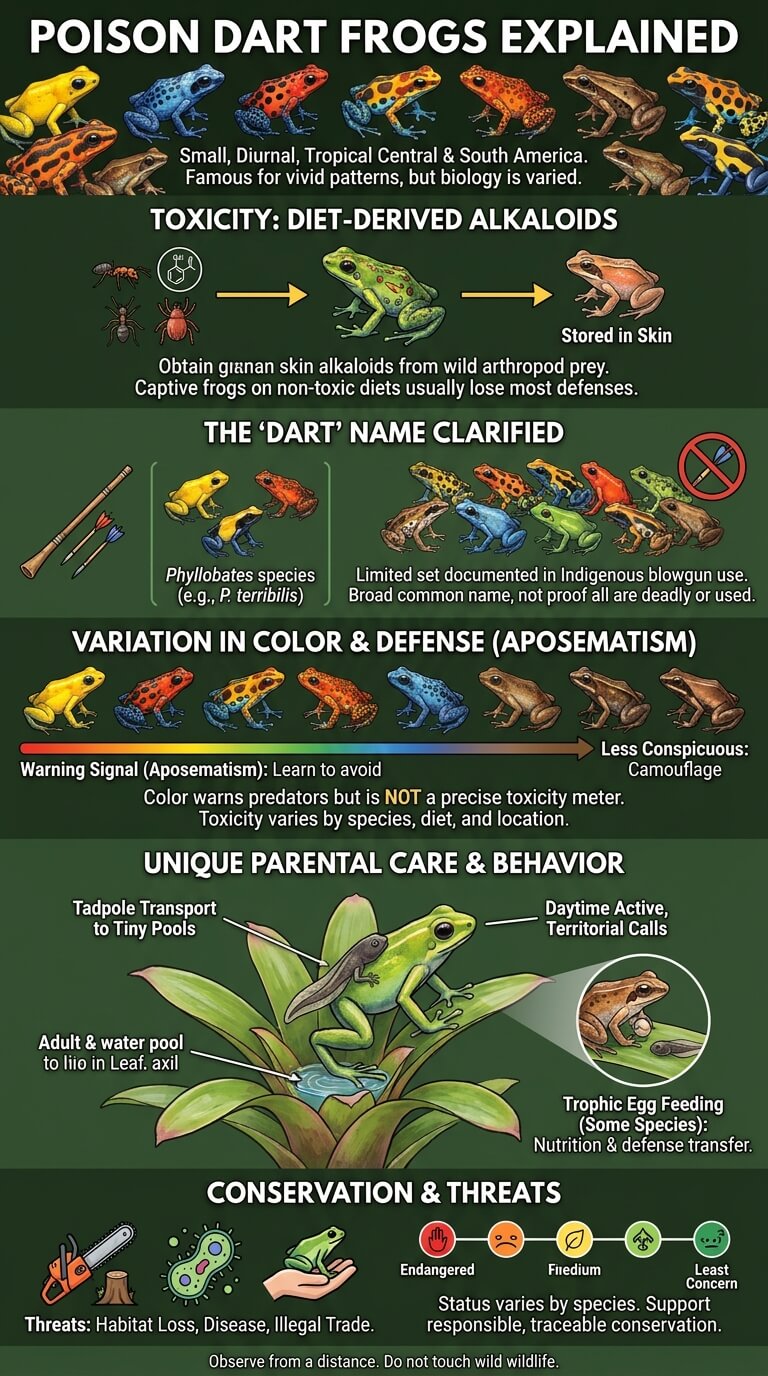
Poison dart frogs are small, mostly daytime-active frogs from tropical Central and South America. They are famous for vivid yellow, orange, red, green, blue, and black patterns, but their biology is more varied than the name suggests. Some species carry powerful skin alkaloids in the wild, others have much weaker chemical defenses, and several members of the same family are brown or otherwise inconspicuous.
Their toxins are closely tied to diet. Chemically defended species obtain many of their alkaloids from tiny arthropods, especially certain ants and mites, then store those compounds in skin glands. Frogs raised on captive diets that lack the relevant prey usually lose most or all of those alkaloid defenses. This is one reason a captive-bred dart frog and a wild frog of the same species may be chemically very different.
Only a limited set of species has been documented in Indigenous hunting practices involving blowgun darts. The phrase “poison dart frog” is therefore a broad common name, not proof that every colorful frog was used on a dart or is capable of killing a person.
Quick Poison Dart Frog Facts
What the Name Refers To
Poison dart frogs belong to the family Dendrobatidae. They are also called poison frogs, dart-poison frogs, or poison-arrow frogs. The family includes brightly colored species with strong chemical defenses as well as less conspicuous species with weaker defenses or no known alkaloid load comparable to the famous forms.
According to the current AmphibiaWeb Dendrobatidae listing, the family contained 214 recognized species in 16 genera in July 2026. Taxonomic totals can change when new species are described, populations are split or combined, and evolutionary relationships are revised.
Why Toxicity Varies Widely
Toxicity differs among species, populations, individuals, seasons, and diets. A frog must encounter suitable alkaloid-bearing prey, absorb the compounds, transport them safely, and store them in skin glands. Differences at any step can change the chemical profile.
The word poisonous describes a substance that causes harm when eaten, absorbed, or contacted in a harmful way. Venom is delivered through a specialized bite, sting, spine, or similar structure. Poison dart frogs are poisonous, not venomous. Their normal defense is to make a predator regret biting or swallowing them, not to inject toxin during an attack.
Classification and Diversity
The Family Dendrobatidae
Dendrobatidae is part of the frog order Anura. The family is divided into several lineages and genera, including Phyllobates, Dendrobates, Oophaga, Ranitomeya, Ameerega, Andinobates, Epipedobates, and others. Scientific names are important because common names may be reused for different species or retained after taxonomy changes.
Many dendrobatids share daytime activity, eggs laid on land, small body size, territorial calls, and parental transport of tadpoles. These traits are not identical in every species. Courtship, clutch size, preferred breeding container, parental sex, tadpole diet, and degree of toxicity vary considerably.
Major Color and Size Variation
Many poison dart frogs are only a few centimeters long. Their small size allows them to move through leaf litter, roots, moss, bromeliads, and narrow spaces where tiny prey are abundant. Compact bodies and adhesive toe pads help some species climb vegetation, while stronger ground-dwelling forms spend more time on the forest floor.
Color patterns range from nearly uniform golden yellow to black bodies crossed by bright bands, spotted blue-and-black forms, red frogs with blue legs, green marbling, bronze tones, and cryptic brown stripes. One species can contain strikingly different regional color forms. A photograph without location, call, and other features may not be enough for reliable identification.
Why Common Names Can Be Confusing
The name dart frog is often applied to the whole family, even though the strongest historical association with poisoned darts involves three species in the genus Phyllobates. Other dendrobatids may still be chemically defended, but they were not all used in the same way.
Some animals commonly called poison frogs were moved into different genera after taxonomic studies. Older books and websites may use former scientific names. A familiar color form may also be sold under a nickname that is not an official species name. Current scientific sources are safer than relying on trade labels alone.
Where Poison Dart Frogs Live
Central and South American Range
Poison dart frogs are native to the Neotropics. Their natural distribution extends through parts of Central America and northern and tropical South America. Species occur from lowland rainforests to mountain forests, depending on the lineage.
Rainforest Floor, Streamsides, Trees, and Leaf Litter
Many species move through damp leaf litter, where ants, mites, beetles, springtails, and other small prey live. Others stay near streams, seepages, tree roots, rocky banks, fallen logs, or forest gaps. Tiny species may climb trunks and vegetation to reach water held by bromeliads or tree holes.
The rainforest is not a uniformly wet room. Sunlight, elevation, slope, canopy cover, soil, rainfall, and distance from water create many microhabitats. A frog may defend a small calling site, use another place for egg laying, and transport tadpoles to separate pools.
Moisture, Temperature, and Tiny Breeding Pools
Amphibian skin loses water readily, so humid shelter is important. Poison frogs often remain active during the day because rainforest shade and moisture reduce drying compared with exposed environments. Activity may still shift with rainfall, temperature, and local humidity.
Breeding water can be remarkably small. Tadpoles may develop in puddles, tree holes, leaf axils, bromeliad cups, fallen palm structures, or slow stream pools. Tiny containers can reduce exposure to some aquatic predators, but they may dry out, contain little food, or become fiercely contested.
Bright Colors and Warning Signals
Aposematism
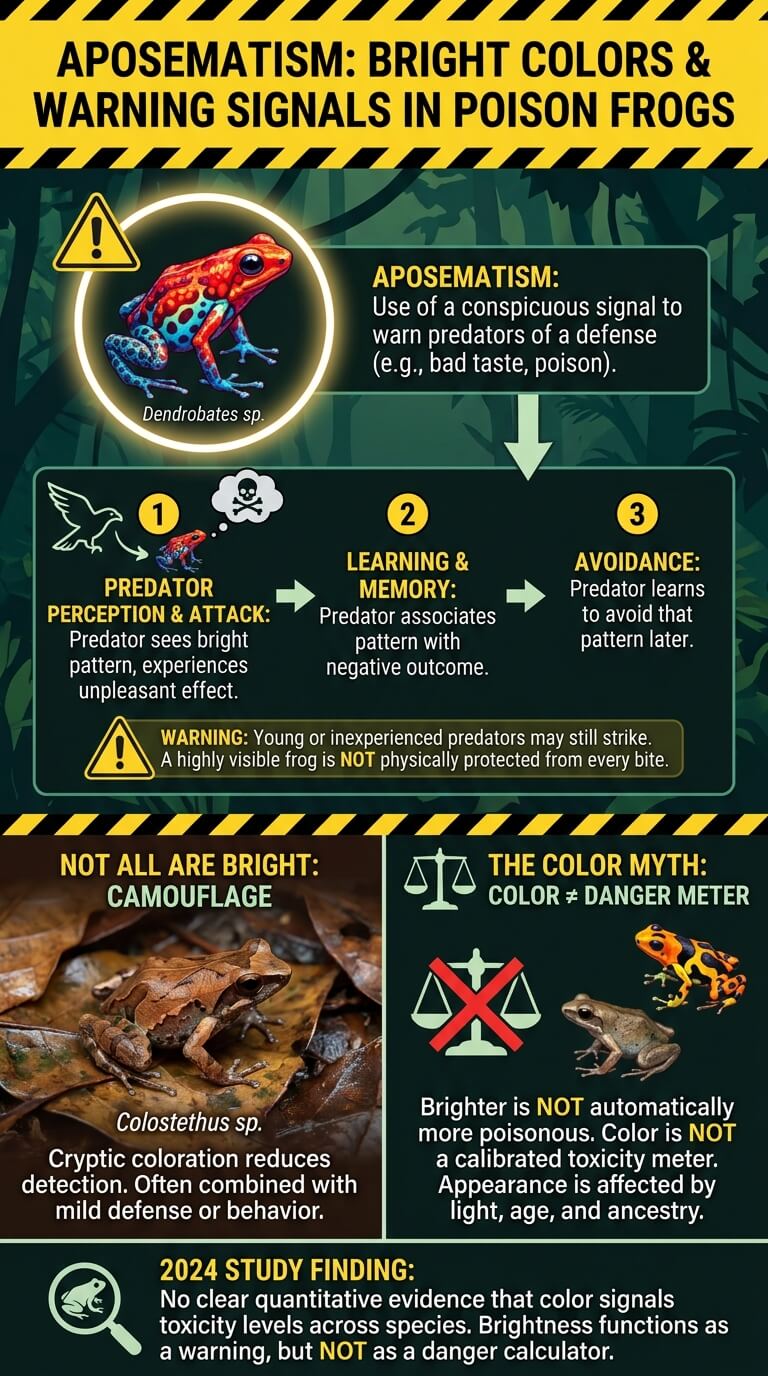
Aposematism is the use of a conspicuous signal that warns predators about a defense. In poison frogs, bright colors and contrasting patterns can make the animal easier to recognize. A predator that experiences an unpleasant taste or physiological effect may learn to avoid that pattern later.
Warning signals work through predator perception, learning, memory, local prey communities, and the cost of making an attack. A young or inexperienced predator may still strike. A highly visible frog is not physically protected from every bite simply because its colors advertise danger.
Camouflage in Less Conspicuous Species
Not every dendrobatid is bright. Brown, bronze, gray, and striped species can blend with wet leaves, roots, and soil. Cryptic coloration reduces the chance of being detected rather than warning an attacker after detection.
Some lineages show an evolutionary association between stronger chemical defense and more conspicuous appearance, but the family contains exceptions. A frog may combine partial camouflage, movement, hiding behavior, territoriality, and mild chemical defense rather than relying on one strategy.
Why Color Alone Does Not Measure Danger
Color is not a calibrated toxicity meter. A brighter individual is not automatically more poisonous than a duller individual, and the same color can appear in species with different alkaloid profiles. Lighting, age, sex, body condition, local ancestry, and camera processing can also change how vivid a frog appears.
A 2024 comparative study found no clear evidence that poison frog color quantitatively signals toxicity across the examined species. Bright coloration can still function as a warning, but it should not be used to calculate how dangerous a frog is.
Where Their Toxins Come From
Alkaloids Obtained Through Wild Diets
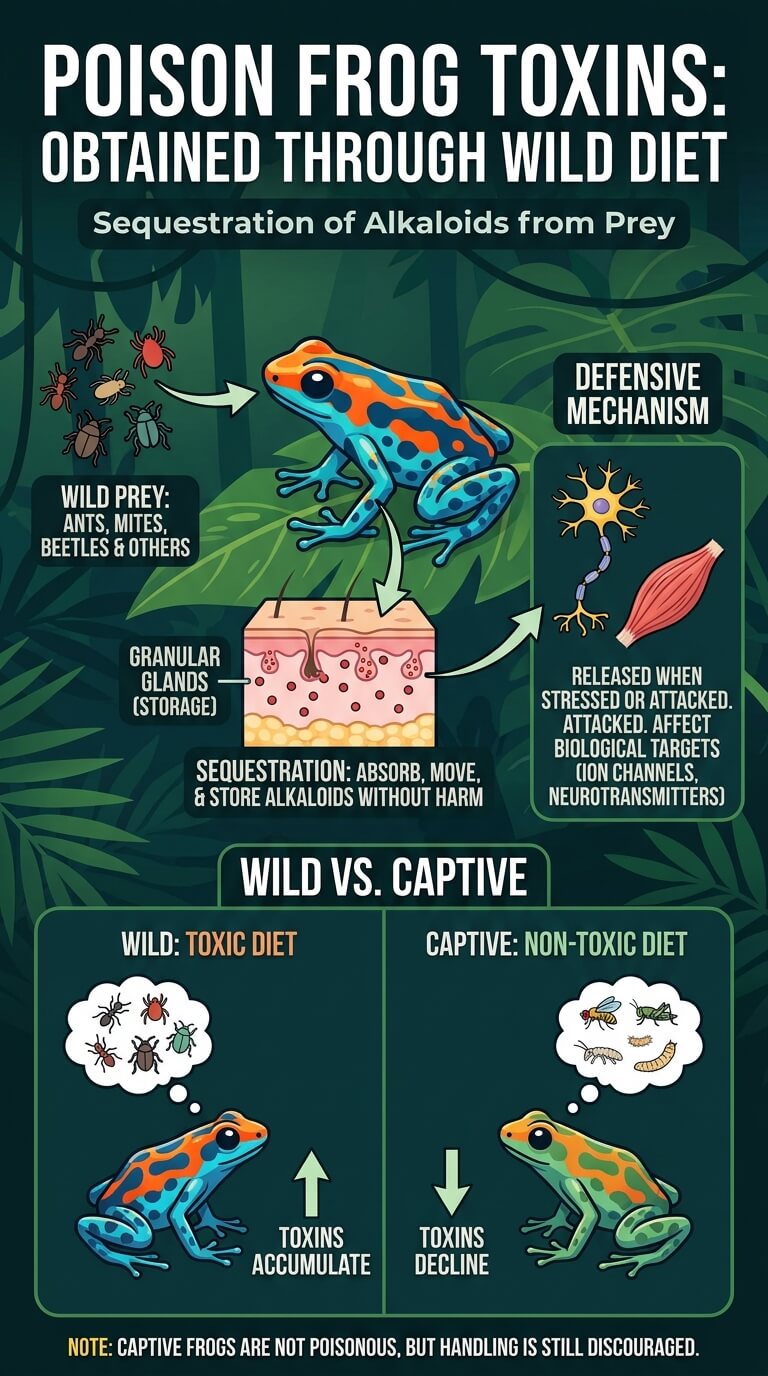
Many chemically defended poison frogs sequester alkaloids. Sequestration means taking a compound from food, moving it through the body, and storing it without being poisoned by the normal exposure. The compounds accumulate in granular glands in the skin and can be released when the frog is stressed or attacked.
Researchers have identified hundreds of alkaloid variants across poison frog species and populations. They affect biological targets such as ion channels and neurotransmitter systems in different ways. A 2023 review of poison frog chemical ecology explains how diet, geography, prey chemistry, transport, storage, and metabolism contribute to this diversity.
The Role of Ants, Mites, and Other Small Prey
Certain ants and mites are major suspected or demonstrated sources of frog alkaloids. Beetles and other arthropods may contribute additional compounds. The prey may obtain the chemicals from plants, fungi, microbes, or their own food webs before the frog consumes them.
Poison frogs do not simply eat any ant and become toxic. The prey must contain compounds that the frog can absorb and store. The local mix of arthropods changes with forest type, elevation, season, and disturbance, so two populations of the same frog species may carry different alkaloid profiles.
Why Many Captive Frogs Lose Much of Their Toxicity
Captive-bred frogs are usually fed fruit flies, small crickets, springtails, beetle larvae, and other cultured prey that lack the wild alkaloid mixture. Without a continuing dietary source, defensive compounds decline or disappear over time.
The Smithsonian National Zoo poison frog profile explains that frogs in human care on non-toxic insect diets are not poisonous like wild individuals. This does not make handling a good idea. Amphibian skin is delicate, human skin may carry harmful residues, and captive animals can still carry microbes or other irritants.
Are All Poison Dart Frogs Dangerous?
Variation Among Species and Populations
No. Some wild species contain potent alkaloids, some are moderately defended, and others have weak or poorly documented chemical protection. Toxicity can also vary within a species because local prey communities differ.
Human risk depends on the compound, amount, exposure route, skin condition, and the individual frog. Touching intact skin briefly is not the same as swallowing a frog, putting secretions into the eyes or mouth, or contacting broken skin. The safest wildlife rule is still to observe without touching.
The Exceptional Potency of Some Phyllobates Species
The genus Phyllobates includes the best-known batrachotoxin-bearing frogs. Batrachotoxins interfere with voltage-gated sodium channels, which are essential for normal nerve and muscle signaling. These compounds are exceptionally potent, but their quantity and composition vary among species and populations.
The golden poison frog, Phyllobates terribilis, is widely described as the most toxic known frog. That label refers to wild chemical defense and should not be turned into a casual human-lethality calculation. Reported toxin loads, body size, exposure assumptions, and laboratory methods vary, and real human poisoning records are limited.
Why the Dart-Poison Story Applies to a Limited Subset
Three Phyllobates species have been documented in connection with poisoning blowgun darts in Colombia: P. terribilis, P. bicolor, and P. aurotaenia. Methods and cultural practices differ, and simplified retellings often remove the specific Indigenous context.
Most of the more than 200 dendrobatid species were not documented in this use. Calling every member a dart frog is a naming convention, not a statement about its historical relationship with hunting technology.
Diet and Daily Behavior
Tiny Invertebrate Prey
Adult poison frogs hunt ants, mites, termites, springtails, small beetles, flies, and other tiny invertebrates. They usually capture prey with a quick tongue strike. Their diet reflects what is small enough to swallow and active within the frog’s foraging area.
Diet is important for both energy and defense. A chemically defended frog must find enough prey to support growth, territorial behavior, courtship, egg production, parental transport, and alkaloid storage. Habitat disturbance that changes arthropod communities can therefore affect more than the number of calories available.
Daytime Activity and Territorial Calls
Most poison frogs are diurnal, which means active during daylight. Males call to advertise territories and attract mates. Calls may sound like buzzes, whistles, chirps, trills, or clicks, depending on species.
Territorial conflicts can include calling contests, chasing, pushing, or wrestling. These behaviors are shaped by access to food, humid shelter, egg-laying surfaces, and tadpole pools. A small patch of forest structure may be valuable because it contains several resources close together.
Movement Through Complex Rainforest Microhabitats
Poison frogs may look slow in a still photograph, but many move actively through cluttered habitat. Short strong limbs support hopping and climbing. Toe pads improve grip on wet leaves, bark, and smooth plant surfaces.
Parents transporting tadpoles may travel from a terrestrial nest to a stream, tree hole, or plant-held pool. A route only a few meters long can include exposed ground, predators, steep stems, and competing frogs. Forest simplification can remove safe pathways even when some canopy remains.
Reproduction and Parental Care
Courtship, Eggs, and Guarding
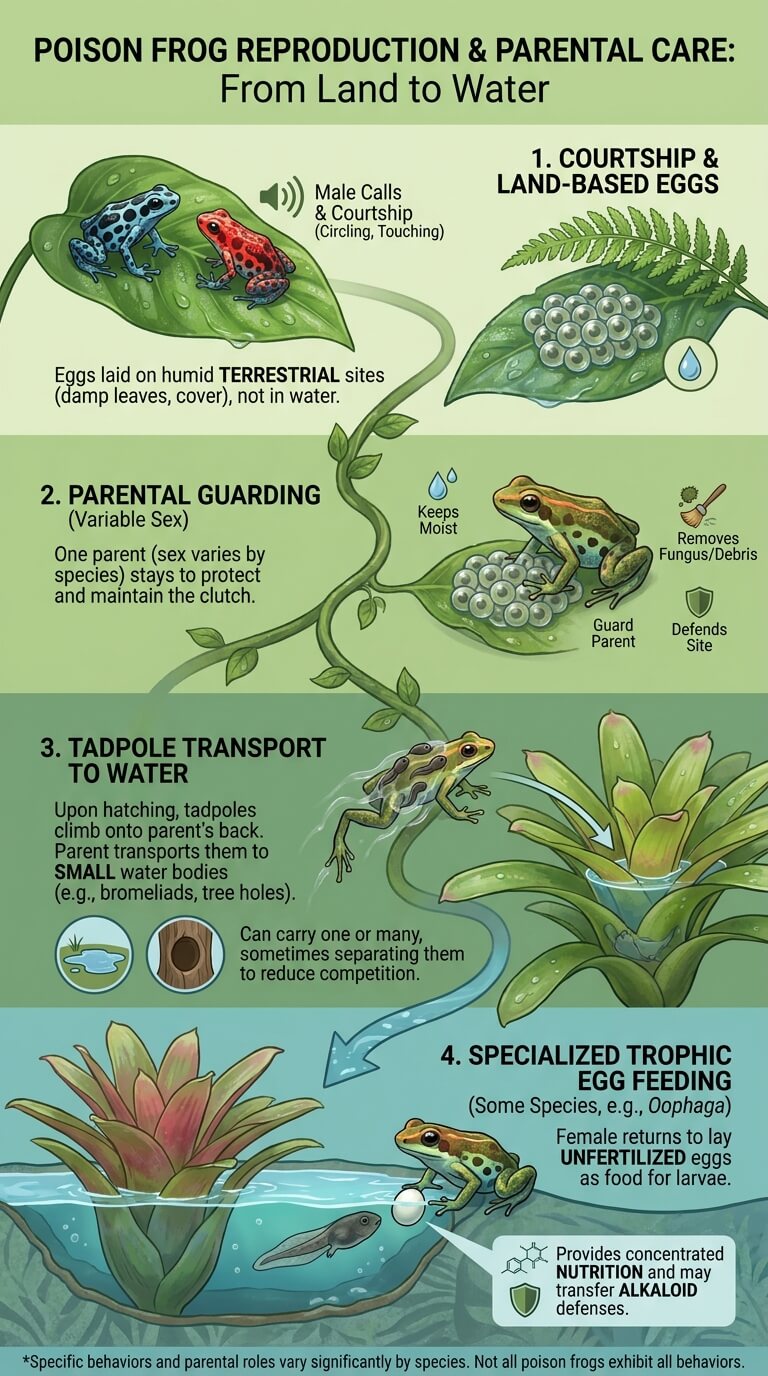
Male calls help females locate a territory. Courtship can involve following, touching, circling, and inspection of possible egg sites. Eggs are often placed on damp leaves, under cover, or in another humid location above or beside water.
One parent commonly guards or revisits the clutch. The adult may keep eggs moist, remove fungus or debris, or defend the site. Parental sex differs by species. In some, the male performs most egg care and transport. In others, the female or both parents contribute.
Carrying Tadpoles to Water
When the eggs hatch, tadpoles climb onto a parent’s back. Mucus and the tadpoles’ flattened bodies help them remain attached during transport. The parent deposits them in a stream pool, puddle, tree hole, bromeliad, or other small water body.
Some species carry many tadpoles at once, while others move one or a few. Separating tadpoles can reduce competition or cannibalism, but it demands repeated trips and accurate memory of multiple nursery sites.
Specialized Egg Feeding in Some Species
In several Oophaga species, a female returns to tadpole pools and lays unfertilized eggs for the larvae to eat. This is called trophic egg feeding. The eggs supply concentrated nutrition and may also transfer defensive alkaloids to developing tadpoles.
Research on strawberry poison frogs found that mothers can provision tadpoles with alkaloid-based chemical defenses through trophic eggs. This behavior is specialized and should not be generalized to every poison frog.
Predators and Survival
Chemical Defense and Predator Learning
A predator may smell, taste, or experience the physiological effects of a defended frog and avoid similar patterns later. Birds, snakes, spiders, and other predators differ in sensory systems, tolerance, experience, and willingness to attack.
The defense works best when the warning is recognizable and the predator survives the encounter well enough to learn. This creates an evolutionary balance. A frog benefits when predators hesitate, but it still faces risk during the first attack.
Species That Tolerate or Bypass Defenses
No defense is absolute. Some snakes and other predators can consume chemically defended frogs or avoid the most toxic tissues. Predators may attack young frogs before alkaloid stores are fully developed, select less-defended individuals, or use handling behavior that limits exposure.
Parasites, disease, drought, falls, territorial fights, and starvation are not stopped by skin toxins. Chemical defense reduces one category of danger rather than solving every survival problem.
Costs and Limits of Toxin-Based Protection
Finding alkaloid-bearing prey requires time and habitat. Transporting and storing biologically active compounds also requires physiological mechanisms that protect the frog from self-poisoning. Some resistance adaptations may involve trade-offs in normal receptor or ion-channel function.
Toxin supply can fall when prey communities change. A frog moved to a different habitat, raised in captivity, or living in a disturbed forest may retain its color while losing part of its chemical defense. Warning appearance can therefore persist longer than a particular toxin profile.
Conservation and Wildlife Trade
Habitat Loss and Fragmented Ranges
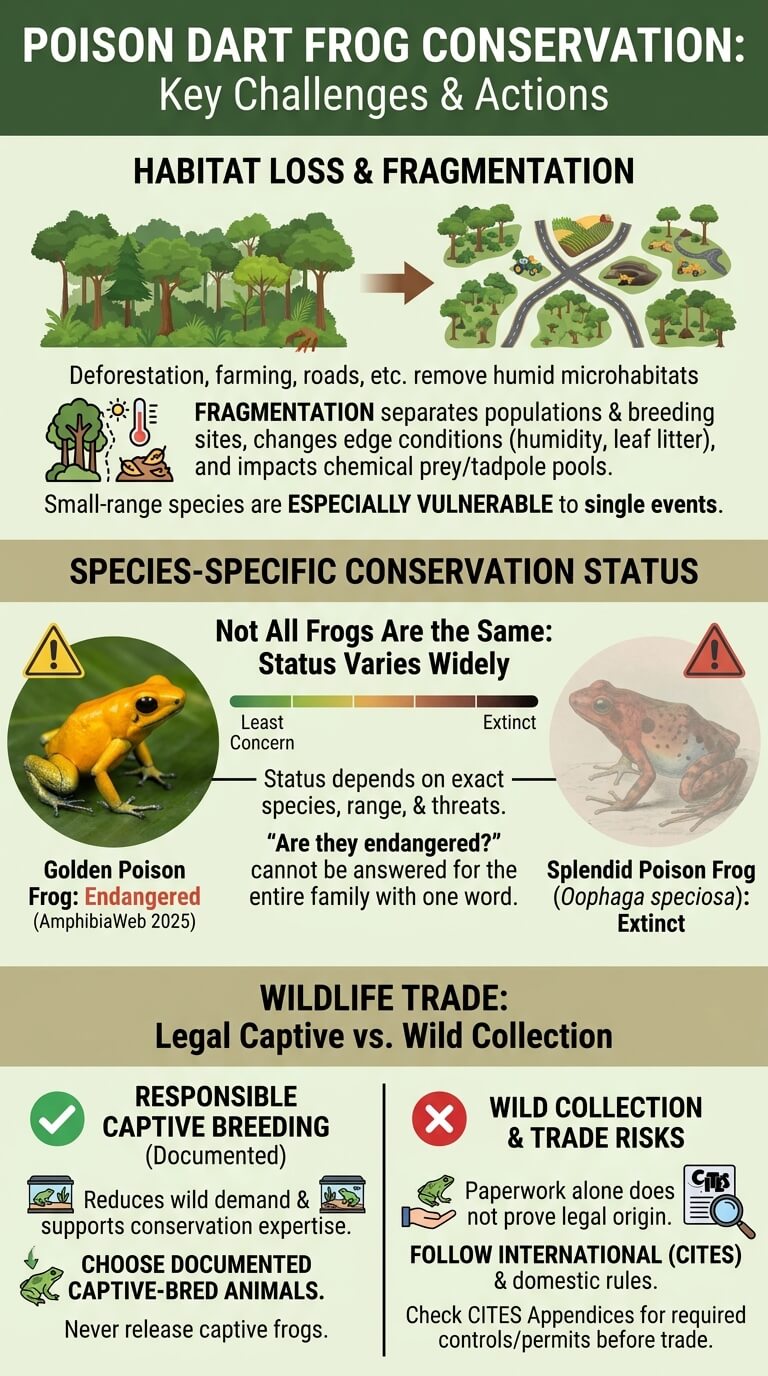
Deforestation, farming, mining, roads, fire, urban growth, and stream alteration can remove humid forest microhabitats. Small-range species are especially vulnerable because one project or disease outbreak may affect much of their known distribution.
Fragmentation separates breeding sites, feeding areas, and local populations. It also changes humidity, temperature, leaf litter, and arthropod communities along forest edges. A patch that still contains trees may no longer provide the same chemical prey or tiny tadpole pools.
Species-Specific Conservation Status
Poison dart frogs do not share one conservation category. Some are assessed as Least Concern, while others are Vulnerable, Endangered, Critically Endangered, Data Deficient, or Extinct. Status depends on the exact species, assessment date, range, trend, and threats.
For example, the AmphibiaWeb golden poison frog account reported an Endangered IUCN status updated in September 2025. The splendid poison frog, Oophaga speciosa, has been assessed as Extinct. These examples show why “Are poison dart frogs endangered?” cannot be answered for the entire family with one word.
Legal Captive Breeding Versus Wild Collection
Responsible captive breeding can reduce demand for wild collection and support conservation expertise, but paperwork and a seller’s claim are not enough by themselves to prove legal origin. International and domestic rules vary by species, country, and transaction.
The current CITES Appendices are the official starting point for checking whether international trade in a listed poison frog taxon requires controls or permits. Buyers should also follow national and state laws and choose documented captive-bred animals rather than wild-caught frogs. Captive frogs must never be released.
Common Myths and Mistakes
Not Every Dart Frog Was Used on Darts
The dart story is based on documented use of three Colombian Phyllobates species. It does not describe the cultural history of every poison frog in Central and South America.
Repeating the broad name without this context can turn a diverse frog family and specific Indigenous knowledge into a sensational myth. A more accurate explanation separates the common name from the limited documented practice.
Captive-Bred Frogs Are Not Equivalent to Wild Frogs Chemically
A captive frog may retain bright colors, territorial behavior, and parental care while carrying few or none of the wild alkaloids. Appearance and genetics do not recreate a local rainforest prey community.
This difference does not justify touching captive frogs. Their skin can be harmed by oils and chemicals, and improper handling causes stress. Captive status also does not make release safe because pathogens, genetics, climate, and species identity may be unsuitable.
Bright Color Does Not Guarantee Extreme Toxicity
Color can warn predators, but the relationship is not precise enough to rank individual frogs by danger. Some vivid frogs are strongly defended, some are moderately defended, and some less conspicuous species also contain alkaloids.
The correct field response is simple: do not test the claim. Photograph from a respectful distance, avoid blocking the frog’s path, and do not touch, lick, collect, or encourage a pet to investigate it.
Poison Dart Frogs in Rainforest Ecosystems
Amphibian Skin and Chemical Defense
Poison frogs show how amphibian skin can perform several jobs at once. It helps with water balance and gas exchange while also holding mucus and defensive compounds. That same living surface makes frogs sensitive to drying, contaminants, rough handling, and disease.
Predators, Prey, and Nutrient Movement
Adult dart frogs consume large numbers of tiny arthropods, while eggs and tadpoles feed aquatic and terrestrial predators. Parents move nutrients when they carry tadpoles from the forest floor into plant pools or streams.
Trophic egg feeding creates another transfer. A female gathers energy and alkaloids from her own diet, packages them into eggs, and delivers them to tadpoles in isolated water containers. The behavior connects rainforest arthropods, adult foraging, parental care, and larval defense.
Broader Amphibian Conservation Pressures
Habitat loss, climate shifts, pollution, wildlife trade, introduced species, and chytrid disease affect poison frogs in species-specific ways. A highly toxic frog is not protected from a cleared forest, a drying nursery pool, or an emerging pathogen.
Conservation must preserve more than colorful adults. It also needs leaf litter, prey communities, calling territories, egg sites, tadpole water, movement routes, and genetic connections among populations.
FAQ
Can Touching a Poison Dart Frog Kill a Person?
Casual contact is not a reliable or safe experiment. Most captive-bred dart frogs lack the wild alkaloid load associated with natural diets, while wild species and populations vary greatly. Risk rises when secretions enter the mouth, eyes, broken skin, or digestive system.
Do not touch wild frogs. If exposure causes numbness, weakness, breathing difficulty, abnormal heartbeat, severe irritation, or other concerning symptoms, seek emergency medical help and provide the most accurate identification possible without handling the animal again.
Why Are Poison Dart Frogs So Colorful?
In many species, contrasting colors function as an aposematic warning that tells predators the frog may be unpleasant or harmful to attack. Predator learning can reduce future attacks on frogs with a recognizable pattern.
Color also varies through ancestry, sexual selection, local environments, and mimicry. It does not provide a precise measurement of toxin strength.
Do Poison Dart Frogs Make Their Own Poison?
Many species obtain defensive alkaloids from wild arthropod prey and then sequester those chemicals in their skin. The frog’s body supplies the transport, resistance, storage, and release mechanisms, but many important alkaloids originate in the food web.
This is why captive frogs fed cultured insects generally lose much of the chemical defense seen in wild animals. The process is more accurately described as dietary acquisition and sequestration than simple toxin manufacture.
Are Poison Dart Frogs Endangered?
Some are, and some are not. Conservation status must be checked for the exact species and current assessment. The family includes widespread species, narrowly distributed threatened species, species with uncertain data, and at least one species assessed as Extinct.
Habitat loss, fragmentation, disease, climate conditions, pollution, and collection can affect species differently. A frog’s popularity in captivity does not prove that its wild population is secure.
Final Thoughts
Poison dart frogs are a diverse family of small Neotropical frogs, not a single uniformly deadly animal. Their colors can warn predators, their alkaloids are strongly influenced by diet, and their toxicity varies among species, populations, and environments. Only three Phyllobates species are documented in the famous dart-poison tradition.
Their most remarkable traits extend beyond poison. They defend territories, carry tadpoles on their backs, use tiny pools as nurseries, and in some species feed developing young with unfertilized eggs. Protecting these frogs means protecting rainforest microhabitats, arthropod food webs, breeding sites, and legal, traceable wildlife trade while leaving wild animals untouched.

Ethan Walker is the founder and research editor of Animal Fact Central. He creates and reviews educational animal facts content using trusted wildlife, pet care, and science-based sources. His work focuses on making animal behavior, adaptations, habitats, and species facts clear, accurate, and engaging for everyday readers.
Read More Details About Ethan Walker: https://animalfactcentral.com/ethan-walker/