
Crows are highly capable problem solvers, social learners, and long-term observers of their surroundings. Some can recognize individual people, learn which situations are risky, remember useful locations, and adjust their behavior when familiar strategies stop working. New Caledonian crows go further in a specialized domain: they manufacture hooked tools and can solve carefully designed multi-step tasks.
That does not mean every crow has the same abilities, that crows think exactly like humans, or that one experiment proves a general intelligence score. The strongest answer to “how smart are crows?” is that several crow species show impressive but different cognitive strengths shaped by their bodies, habitats, social lives, and feeding problems.
Quick Answer
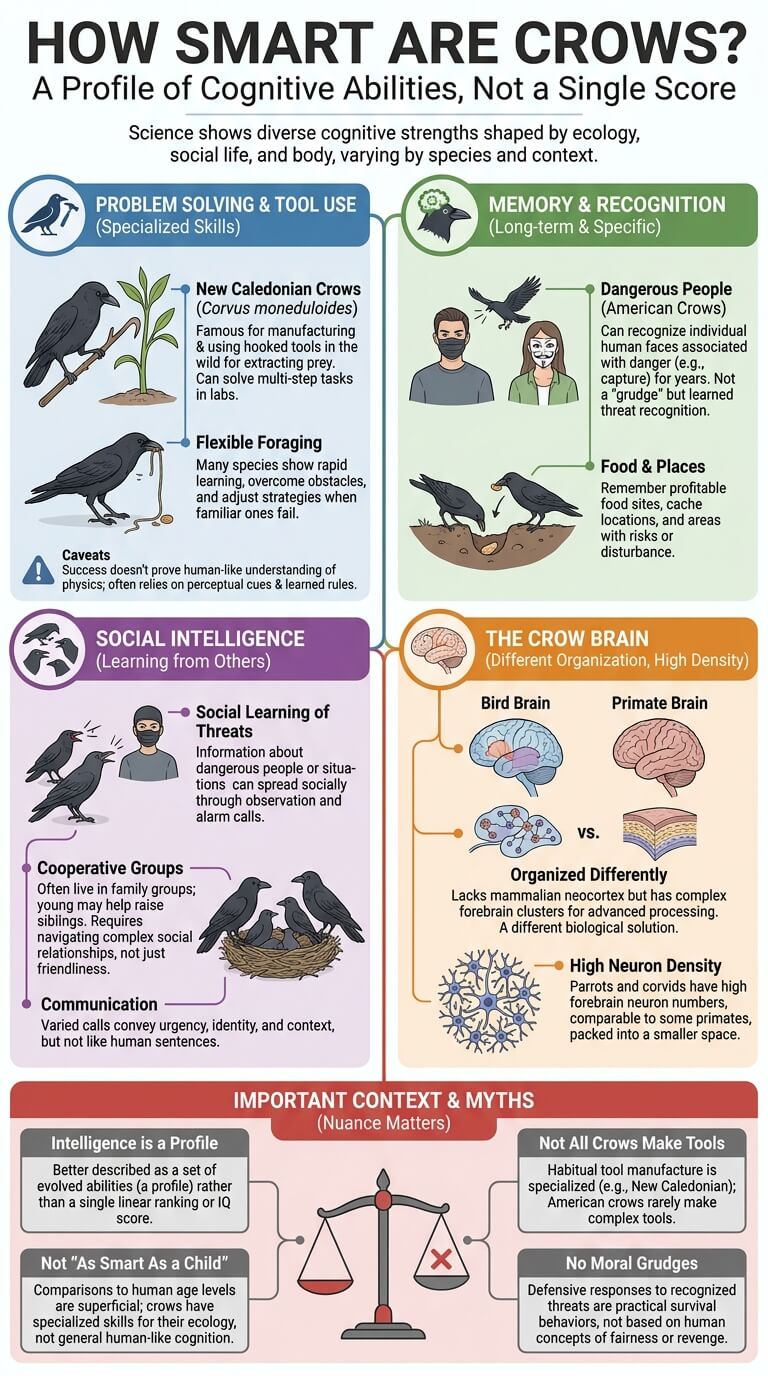
Crows rank among the best-studied birds in comparative cognition. Their documented strengths include rapid learning, flexible foraging, memory for individuals and places, social transfer of threat information, and, in certain species, sophisticated tool behavior. American crows are especially well known for social living and recognition of dangerous people. New Caledonian crows are famous for making and using plant tools to extract prey.
Scientists still avoid declaring crows “as smart as” a child, ape, or dolphin in a general sense. Different animals are tested with different senses, motivations, and motor abilities. A crow that excels at choosing a functional stick may not face the same problem as a parrot learning labels or a primate reading social gestures. Intelligence is better described as a profile of abilities than a single ladder.
Which Crows Are Researchers Talking About?
American crows, carrion crows, and New Caledonian crows
The word crow covers many species in the genus Corvus. American crows, Corvus brachyrhynchos, are familiar across much of the United States and southern Canada. They thrive in open woods, farmland, suburbs, and cities. Carrion crows, Corvus corone, occur across much of Europe and Asia and are common subjects in laboratory cognition work. New Caledonian crows, Corvus moneduloides, live on islands in the southwest Pacific and are unusually specialized tool users.
These species share a family resemblance, but their natural histories create different research questions. The Cornell Lab profile of American crow life history describes adaptable omnivores that often remain in cooperative family groups and forage in human-altered landscapes. New Caledonian crows are studied more often for extracting hidden invertebrate prey with tools.
Crows, ravens, rooks, and jackdaws are related but not interchangeable
Crows belong to the corvid family, which also includes ravens, rooks, jackdaws, jays, magpies, and nutcrackers. These birds share evolutionary history and often show strong learning or memory, but a result from one species cannot automatically be assigned to another. Ravens are generally larger than the birds commonly called crows, yet body size is not the only difference. Social systems, diets, caching habits, developmental experiences, and preferred habitats also vary.
This distinction matters because popular accounts often combine a raven planning experiment, a scrub-jay caching study, and a New Caledonian crow tool task into one claim about “crows.” Such comparisons can reveal common corvid patterns, but they should retain the species names. Otherwise, readers may assume that an American crow beside a parking lot routinely carves hooked tools or that every crow stores food in the same way as a specialized caching jay.
Why species and study setting matter
A wild bird deciding whether to approach a trash container faces a different challenge from a captive bird choosing among objects in a controlled apparatus. Field studies reveal how cognition works under natural risk, competition, and changing weather. Laboratory or aviary studies allow researchers to control what the bird saw, which choices were available, and whether scent, accidental cues, or prior training could explain a result.
Strong conclusions usually come from converging evidence, not one dramatic video or one unusually successful individual.
The Crow Brain and a Different Route to Intelligence
Bird brain organization versus mammal brain organization
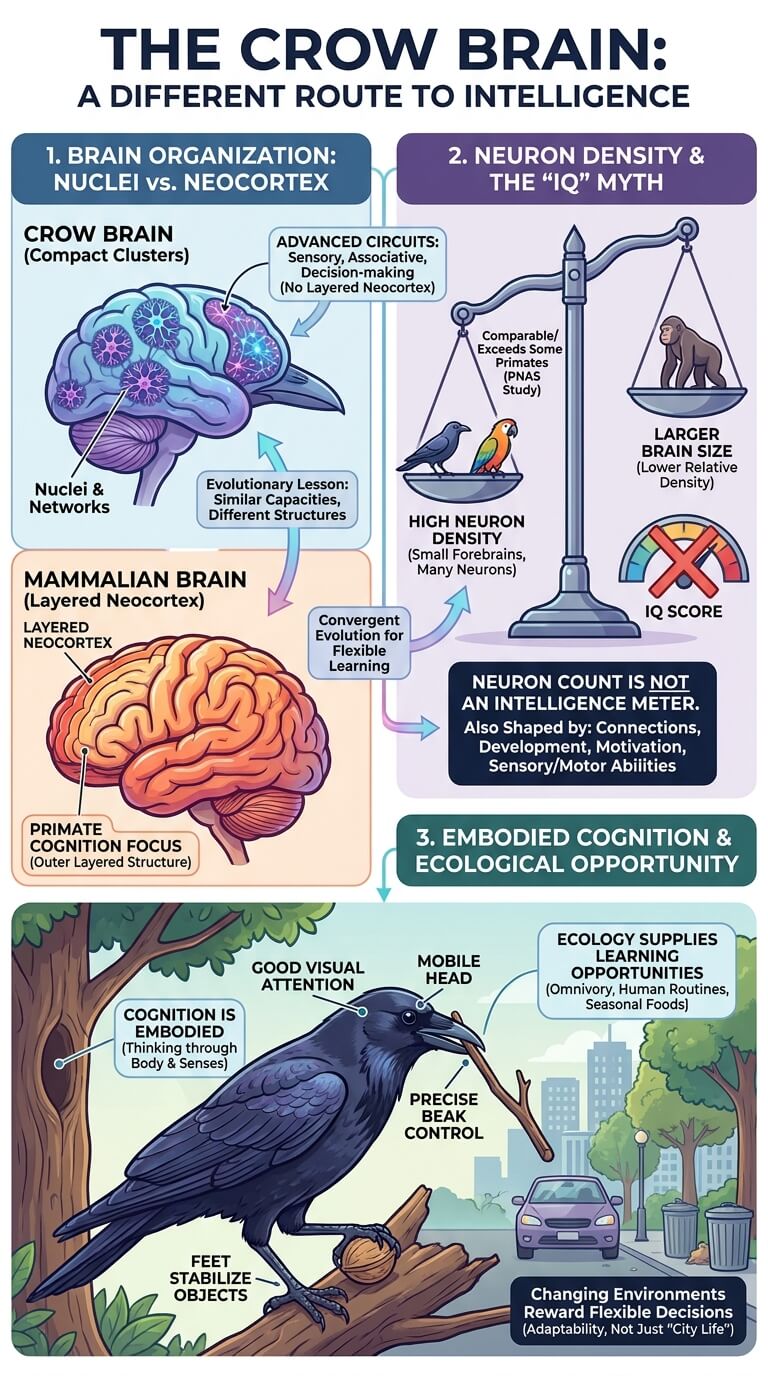
Birds do not have a mammalian neocortex, the layered outer brain structure often emphasized in discussions of primate cognition. Their forebrains are organized differently, with clusters and networks of neurons that can perform complex processing. Older descriptions treated the bird forebrain as mostly simple or instinctive. Modern anatomy and physiology show that it contains advanced sensory, associative, and decision-making circuits.
This is a useful evolutionary lesson. Similar behavioral capacities do not require identical brain structures. Corvids and primates separated from a distant common ancestor hundreds of millions of years ago, yet both lineages evolved flexible learning and problem solving. Their brains are not copies. They are different biological solutions to some overlapping information-processing demands.
High neuron density and why neuron counts are not a simple score
Parrots and songbirds, including corvids, pack many neurons into relatively small forebrains. A major comparative analysis reported that some large-brained parrots and corvids have forebrain neuron numbers comparable to or exceeding those of primates with much larger brains. The PNAS study of avian forebrain neurons helped explain how a compact bird brain can support demanding cognition.
Neuron count is still not an intelligence meter. Connections, development, motivation, and sensory or motor abilities also shape performance. Brain data help explain crow cognition, but they do not produce a valid crow IQ.
Visual attention, beak control, and ecological opportunity
Crows have good visual attention, a mobile head, precise beak control, and feet that can stabilize objects. Those physical abilities matter when a bird manipulates sticks, selects food, watches a competitor, or inspects a new device. Cognition is embodied, meaning that thinking works through the animal’s body and senses rather than in isolation from them.
Ecology supplies repeated opportunities to learn. An omnivorous crow may open nuts, inspect containers, follow other animals, avoid traffic, exploit seasonal foods, and monitor human routines. A changing environment rewards flexible decisions. This does not mean city life created crow intelligence from nothing. It means adaptable cognition can be especially visible where new problems appear frequently.
Crow Problem Solving
Solving novel food-access tasks
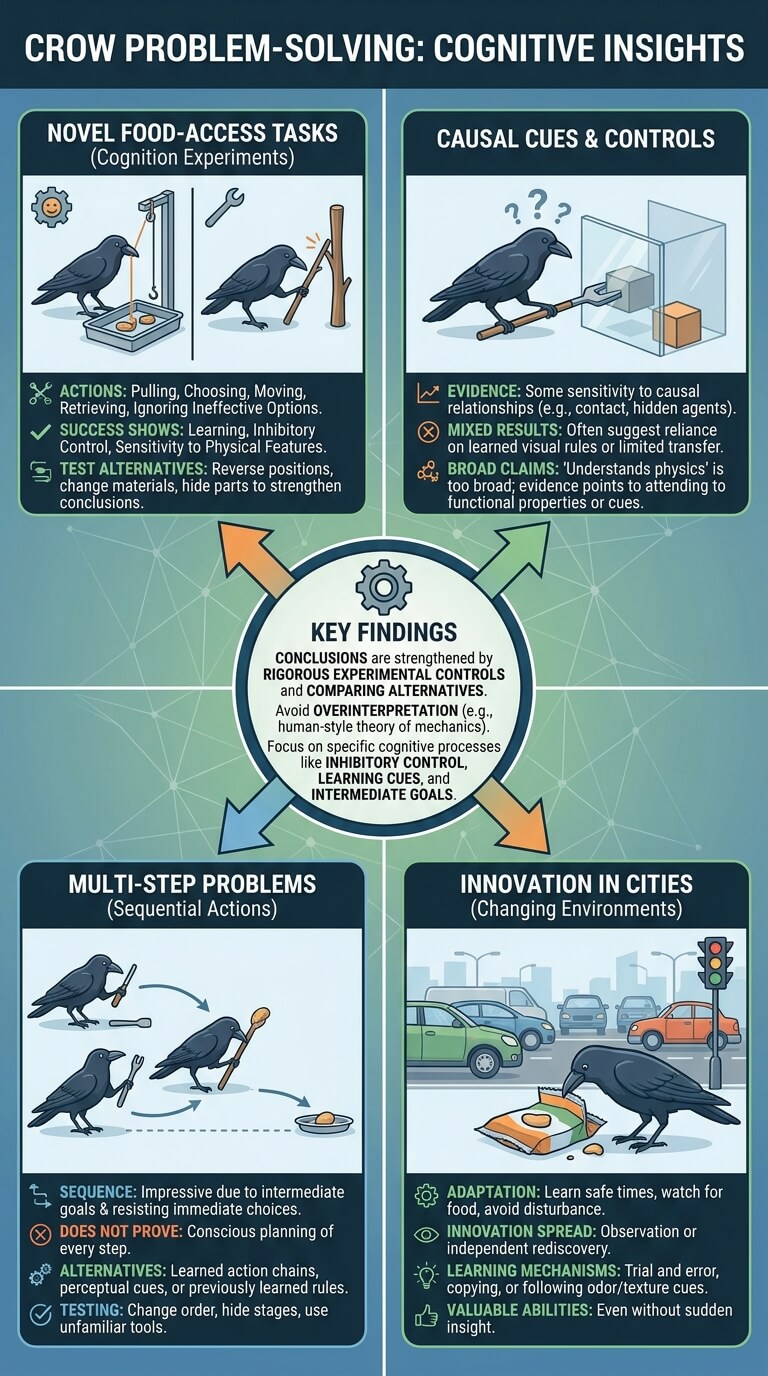
In cognition experiments, crows may need to pull a string, choose a suitable object, move a barrier, retrieve one tool with another, or ignore a tempting but ineffective option. Success can demonstrate learning, inhibitory control, or sensitivity to physical features. Repeated trials also show whether a solution transfers when the apparatus changes.
The most informative tests compare alternatives. Researchers reverse positions, change materials, hide parts of the setup, or include nonfunctional controls. Reliable performance across these changes strengthens the conclusion.
Causal cues, object choice, and experimental controls
Some New Caledonian crow studies suggest sensitivity to causal relationships, such as whether an object can contact a reward or whether a visible agent explains movement behind a screen. Other experiments have produced mixed results. A crow may solve one physical task while failing a slightly altered version, which can indicate limited transfer, a mismatch with natural experience, or reliance on learned visual rules.
For that reason, phrases such as “understands physics” are too broad. Evidence may show that birds attend to particular functional properties, infer some hidden causes, or learn which cues predict success. It does not show that they possess a human-style theory of mechanics. Competing explanations should remain open when the control conditions do not separate them cleanly.
Multi-step problems and what they do not necessarily prove
A multi-step task can require a crow to use a short tool to obtain a longer tool and then use the longer one to reach food. Completing the sequence is impressive because the first action does not deliver the reward directly. It may require holding an intermediate goal in mind and resisting an immediately available but useless choice.
Yet a successful sequence does not automatically prove conscious planning of every step. Birds can learn action chains through experience, use perceptual cues, or apply previously learned rules. Researchers test these alternatives by changing the order, hiding stages, introducing unfamiliar tools, and measuring first-trial choices. The best interpretation depends on the exact design, not the visual complexity alone.
Innovation in cities and changing environments
Urban crows frequently encounter food packaging, vehicles, trash systems, pets, pedestrians, and altered nesting sites. They can learn safe times to approach a road, watch where food appears, or abandon a location after disturbance. Some innovations may spread through observation, while others are rediscovered independently because many birds face the same opportunity.
A crow opening a bag may learn by trial and error, copy another bird, or follow odor and texture cues. Those are still valuable cognitive abilities, even without a sudden flash of insight.
Tool Use and Tool Manufacture
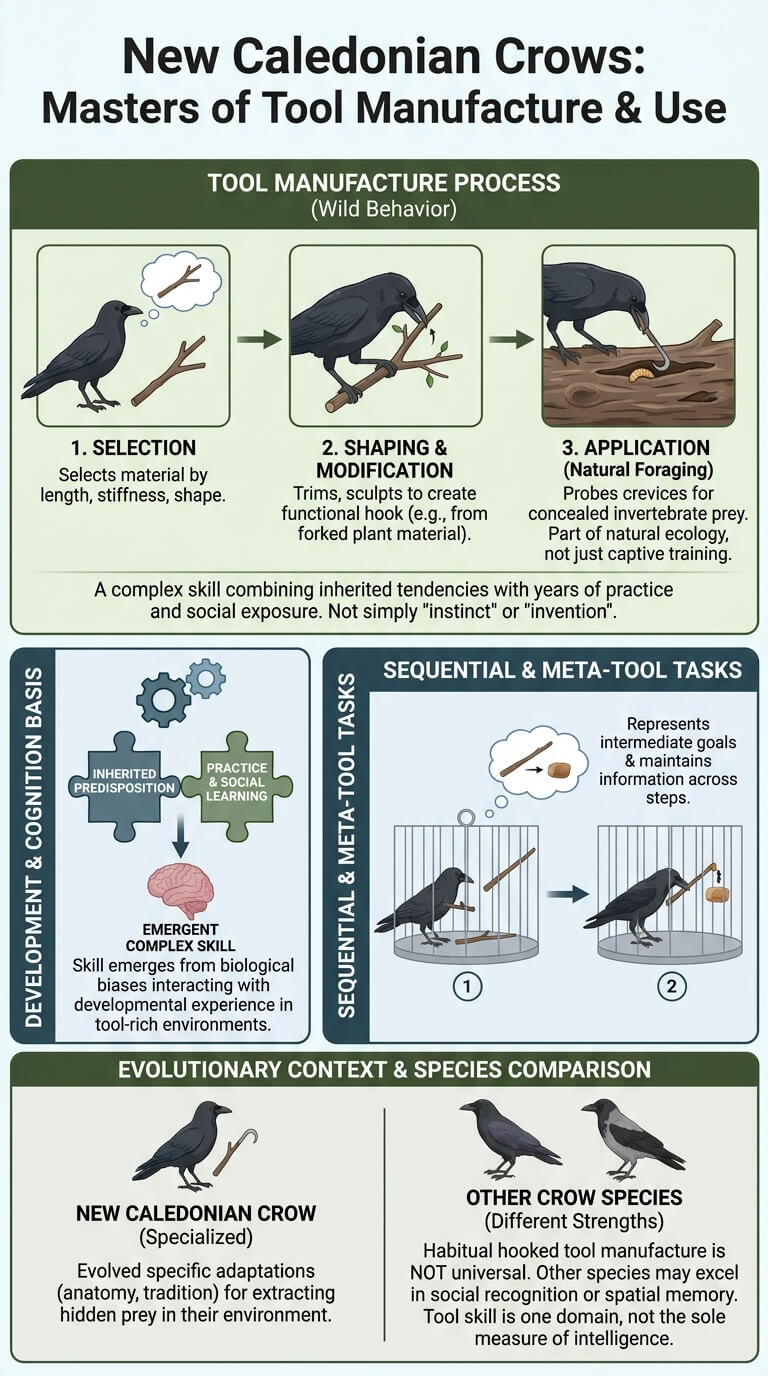
New Caledonian crow stick and hooked tools
Wild New Caledonian crows use sticks and leaf-based tools to probe crevices for invertebrate prey. They can select forked plant material, remove unwanted branches, and shape a functional hook. Gavin Hunt’s landmark field report described distinct hooked-twig and barbed pandanus tool types. The Nature report on New Caledonian crow hook tools established that this behavior occurs in free-living birds, not only in trained captives.
Tool use is part of this species’ natural foraging ecology, combining inherited tendencies with years of practice during development.
Selecting materials and shaping tools
Making a tool involves more than picking up any object. A crow may need material of suitable length, stiffness, thickness, and shape. It can trim leaves or twigs, orient the working end, and adjust the tool during use. Studies also show individual variation, so not every bird makes tools with equal skill or the same technique.
Young New Caledonian crows develop around tool-using adults and tool-rich vegetation. Their behavior likely combines species-typical predispositions, practice, and social exposure. Describing the result as either “pure instinct” or “pure invention” creates a false choice. Complex animal skills often emerge from inherited biases interacting with learning.
Sequential or meta-tool tasks and interpretation limits
In a meta-tool task, a bird uses one object to obtain another tool that can reach the final reward. New Caledonian crows have solved versions in which tools and apparatuses are partly hidden, suggesting that they can represent intermediate goals and maintain relevant information while moving through a sequence.
Task history still matters. First-trial performance, transfer to new arrangements, and error patterns help separate flexible recombination from memorized routines.
Why most crow species should not be assumed to show identical tool skills
American crows and carrion crows can manipulate objects and occasionally use tools, but habitual manufacture of specialized hooked tools is not a universal crow trait. New Caledonian crows evolved in an ecological setting where extracting concealed prey with plant material is especially important. Their anatomy, development, and traditions support that specialization.
This is similar to comparing athletes with different training histories. A species that rarely makes tools may still excel at social recognition, spatial decisions, or flexible foraging. Tool manufacture provides strong evidence about one domain, but it should not become the sole definition of crow intelligence.
Crow Memory and Face Recognition
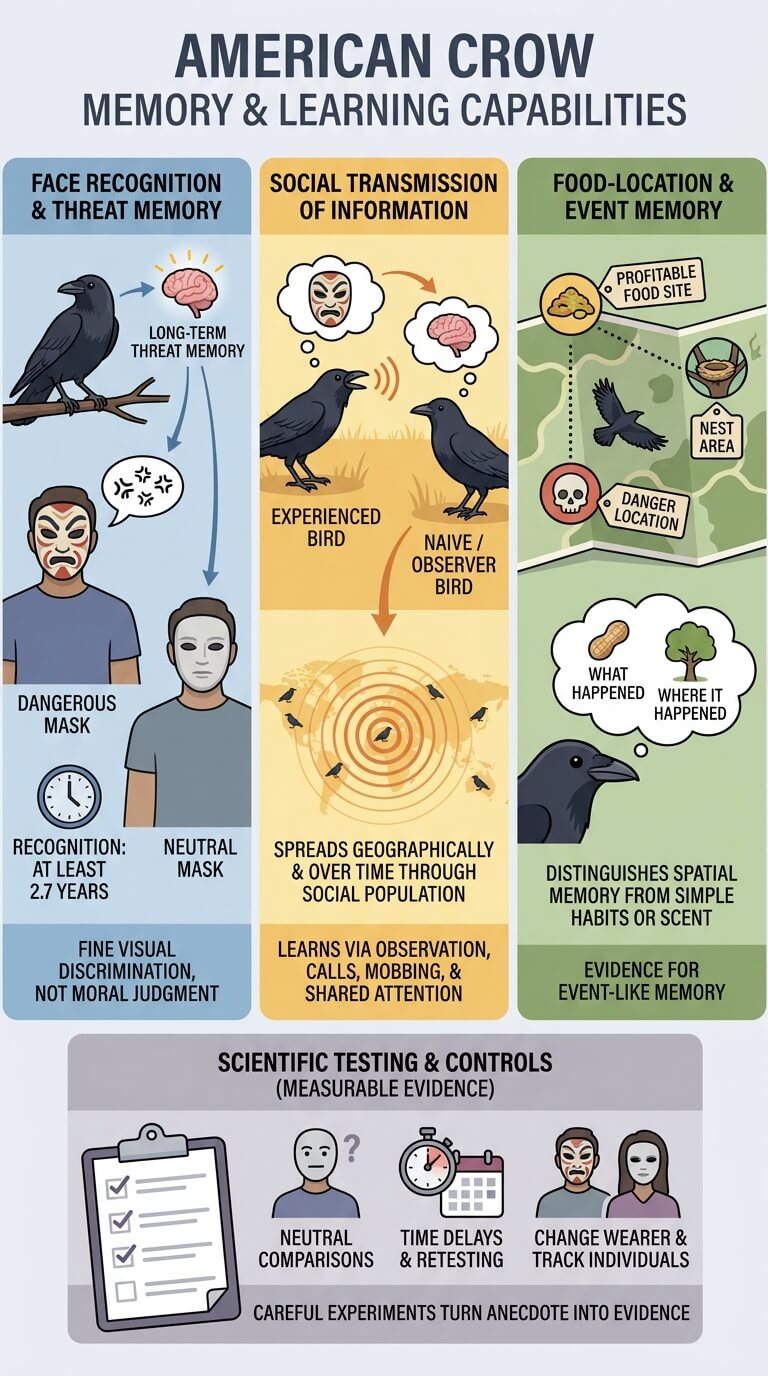
Remembering risky people and places
American crows can learn that a particular human appearance predicts danger. In a field experiment near Seattle, researchers wore distinctive masks while capturing and releasing a small number of birds. Crows later scolded and followed people wearing the dangerous mask more than people wearing neutral masks, even when different individuals wore the masks.
The original study documented recognition lasting at least 2.7 years. The study of lasting recognition in wild American crows supports fine visual discrimination and long-term threat memory. It does not show that crows make moral judgments about a person’s character.
Social transmission of threat information
Crows that were not directly captured can learn to react to a dangerous-looking person by observing the alarm behavior of experienced birds. Young birds may also acquire the response from parents. In one long-term field project, scolding spread geographically and increased over time, showing that information about a threat can move through a social population.
The American crow social-learning study distinguished birds with direct experience from birds learning through others. This is more precise than saying crows “tell stories” about humans. The information may spread through calls, mobbing, attention to where others look, and repeated association between a face and group alarm.
Food-location and event memory
Crows remember profitable food sites, nest areas, roost routes, and locations associated with danger. Some corvids cache food, but caching intensity and memory demands differ among species. A crow may remember where it hid an item, where another bird found food, or when a location tends to be disturbed.
Scientists separate spatial memory from simple scent following or repeated route habits by moving landmarks, controlling odor, and testing after delays. They may also ask whether the bird remembers what happened, where it happened, or which individual was present. Evidence can support event-like memory without proving human autobiographical recollection.
How long-term recognition is tested
Long-term studies require known individuals, neutral comparisons, and enough time between exposure and retesting. Researchers must also consider whether nearby alarm callers influence the response.
Careful experiments track which birds were originally present and compare reactions across places. They also change the wearer so clothing, movement, sex, or body size cannot explain the discrimination. These controls turn an appealing anecdote into measurable evidence.
Social Intelligence and Communication
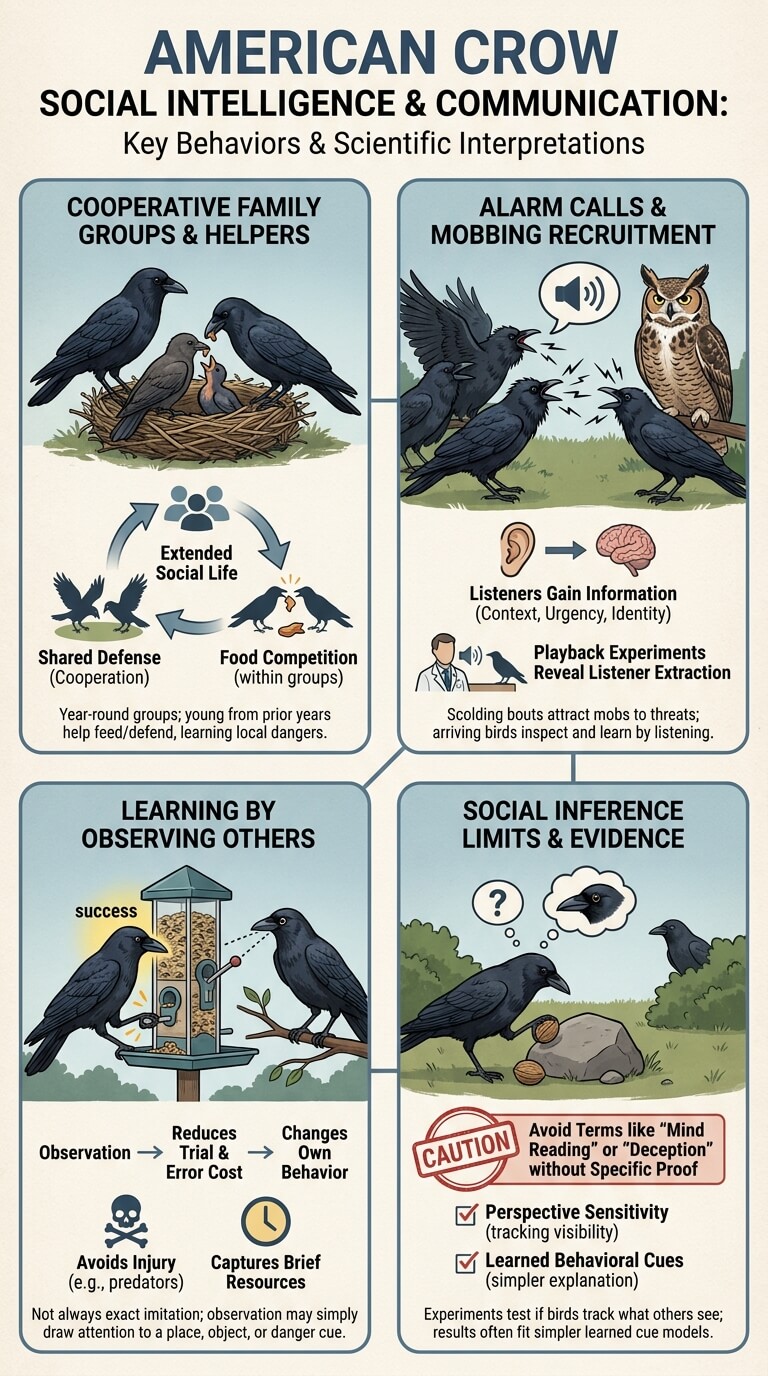
Family groups, helpers, and cooperative behavior
American crows often live in year-round family groups. Young from earlier nesting seasons may remain with their parents and help feed or defend later broods. This extended social life creates repeated opportunities to recognize relatives, coordinate actions, learn local dangers, and observe experienced foragers.
Cooperation does not eliminate competition. Family members may share defense while competing over food, and large winter roosts can mix many unrelated birds. Social intelligence includes knowing when to approach, avoid, recruit, tolerate, or challenge others, not simply being friendly.
Alarm calls, recruitment, and audience effects
Crows produce varied calls in feeding, contact, territorial, and danger contexts. A loud scolding bout can attract other crows, creating a mob around a predator or threatening person. The arriving birds gain information by listening and by inspecting what the callers are watching.
A call can carry information about urgency, identity, or context without functioning like a human sentence. Controlled playback experiments help reveal what listeners extract.
Learning by watching other crows
Observation can reduce the cost of personal trial and error. A crow watching another bird avoid a person, open a food source, or respond to a predator may change its own behavior. Social learning is especially useful when mistakes could lead to injury or when resources appear briefly.
Copying is not always exact imitation. A bird may simply have its attention drawn to a place or object, become more willing to approach, or learn that a cue predicts danger. Researchers distinguish these mechanisms because they require different kinds of information processing.
Social inference claims and evidence limits
Corvid experiments test whether birds track what another individual can see or who witnessed a caching event. Some results fit perspective sensitivity, while others can be explained by learned behavioral cues.
Terms such as mind reading or deception should therefore be used carefully. A crow can make socially strategic choices without possessing the full human concept of beliefs. The scientific question is not whether the behavior looks sophisticated, but which information the bird actually used.
Do Crows Plan for the Future?
Caching, re-caching, and protecting food
Some crows and other corvids hide food and later retrieve it. A bird may move a cache after being watched, choose a concealed location, or delay returning while a competitor remains nearby. These behaviors can depend on memory, sensitivity to theft risk, and learned rules about who was present.
Re-caching is not automatically proof that a bird imagines another mind. It may reflect an association between being observed and later loss. Experiments vary observer identity, visibility, prior pilfering experience, and delay to identify which cues control the decision.
Future-oriented experiments in corvids
A 2020 study tested whether New Caledonian crows would save a tool for a specific task that occurred after a delay. Birds learned a sequence in which they saw a baited apparatus, later chose among objects, and only afterward regained access to the apparatus. They often selected and retained the tool that would be useful.
The New Caledonian crow future tool-use study provides evidence for prospective decision-making tied to a particular future problem. It is stronger than merely carrying a familiar object, because the useful choice had to be made before the apparatus was available.
Why planning claims remain method-sensitive
Researchers debate how to distinguish future planning from learned associations. If a bird has practiced the sequence repeatedly, it may learn that a certain object predicts later reward. Tests become more persuasive when they include new tools, changed delays, distracting choices, or situations in which the currently most attractive option is not useful later.
The safest conclusion is that some New Caledonian crows can make present choices based on a delayed tool need under controlled conditions. Whether their subjective experience resembles human imagination of the future is not directly measurable.
How Crows Compare with Ravens, Parrots, and Primates
Shared corvid strengths and species differences
Crows and ravens often show strong social learning, memory, object manipulation, and behavioral flexibility. Ravens have been prominent in studies of social relationships and future-oriented choice. New Caledonian crows dominate research on habitual tool manufacture. Clark’s nutcrackers and some jays are famous for spatial caching memory. These are related strengths, not interchangeable species profiles.
Parrots combine manipulative beaks with vocal learning and, in some studies, symbolic label use. Primates use hands, vision, and social experience in different ways. Comparison is informative when researchers ask the same functional question with fair, species-appropriate tasks.
Similar performance does not imply identical mental processes
A crow and a chimpanzee might both solve a tube problem, yet reach the answer through different sensory cues, prior experiences, or internal representations. Matching success rates reveal behavioral convergence, not identical thought. Researchers inspect error patterns, transfer tests, response times, and brain activity to understand the mechanism.
Crow cognition matters because it shows what a flying, beaked, socially observant bird can do, not because it recreates a primate mind in feathers.
Why human IQ comparisons fail
Human IQ tests rely on language, education, culturally shaped instructions, and tasks designed for human bodies and development. A crow cannot meaningfully receive the same score. Claims that a crow has the intelligence of a particular age child usually come from superficial comparison on one puzzle.
Children and crows may sometimes produce similar choices, but that does not make their overall abilities equivalent. Human children have broad language, imitation, teaching, and cultural learning systems. Crows bring specialized attention, memory, flight, object handling, and ecological knowledge. A multidimensional comparison is more accurate than an age label.
Common Myths and Exaggerations
Crows do not literally hold grudges in the human moral sense
When crows remember and scold a person associated with capture, people often call it a grudge. The behavior is better described as learned threat recognition and defensive response. The bird does not need to judge fairness, seek revenge, or replay an emotional offense in the human sense.
This wording matters because moral labels add an untested mental story. The documented facts are already remarkable: crows can discriminate a dangerous appearance, retain the association, and spread the response socially.
Every crow does not use manufactured tools
Tool videos frequently feature New Caledonian crows, but captions may simply say “crow.” Habitual manufacture of hooked plant tools is a specialized behavior. American crows can manipulate objects and occasionally use simple tools, yet they should not be expected to display the full New Caledonian repertoire.
Individual differences also matter. Age, experience, motivation, and access to material affect performance. One gifted captive bird does not establish what every member of a species does in nature.
Gift-giving stories need individual context
Some people report receiving small objects after regularly feeding crows. Such observations do not prove a universal gratitude ritual.
Regular feeding can create crowding, dependency, and conflict. Observe from a distance, and do not approach nests, handle young birds, trap crows, or provoke alarm displays.
A viral puzzle video is not automatically scientific evidence
Online clips often omit training history, failed attempts, edits, food placement, and cues from people behind the camera. A crow may still be solving a real problem, but viewers cannot tell which information was available or how many trials occurred.
Scientific studies publish the procedure, controls, sample size, and analysis so others can evaluate or repeat the result. A video is useful for generating questions. It is rarely enough to settle the mechanism by itself.
Why Crow Intelligence Matters Beyond Crows
Tool use is one form of flexible cognition
Crow tools show how anatomy, ecology, learning, and material choice can combine into complex behavior. They also demonstrate why tool use should not stand alone as the definition of intelligence. A species can be cognitively flexible without making tools, and a skilled tool user may still be specialized.
Memory and social learning help animals handle change
Recognizing dangerous people, remembering food locations, and copying alarm responses are practical survival abilities. They become especially useful in cities and farmland, where opportunities and risks change quickly. Crow research helps explain how wildlife adapts behaviorally without requiring immediate genetic change.
Crows broaden the ways scientists study intelligence
Corvids show that complex cognition can evolve in a brain organized differently from a primate brain. Their strengths support cross-species comparison while warning against a single smartest-animal ranking. The important question is not whether a crow is a feathered ape, but how its own nervous system solves the recurring problems of crow life.
FAQ
Do crows remember human faces?
American crows can learn to discriminate a human face or mask associated with a threatening capture experience and retain that response for years. They may also learn from other crows that a particular appearance predicts danger. This does not mean every passing crow memorizes every person, or that the bird holds a human-style personal grudge.
Can crows count or understand numbers?
Controlled studies with carrion crows and other corvids show sensitivity to quantity and neurons that respond selectively to different numerosities. Some trained crows can match quantities or numerical symbols under laboratory conditions. These findings support a nonverbal number sense, not human arithmetic, counting language, or an understanding of advanced mathematics.
Are crows smarter than ravens?
There is no fair universal score that makes all crows smarter or less smart than all ravens. Ravens often excel in social and future-oriented studies, while New Caledonian crows are exceptional tool manufacturers. Species, task design, rearing history, and individual experience influence the result. Crows and ravens share many corvid strengths but also have distinct ecologies.
Do crows teach their young?
Young crows learn extensively around parents and other group members. They can acquire information by following, watching, and responding to adult alarm behavior. Calling this teaching requires stricter evidence that an experienced bird changes its behavior specifically to help a learner and accepts a cost or receives no immediate benefit. Social learning is well supported; deliberate teaching is a narrower claim.
Final Thoughts
How smart are crows? Research shows a rich combination of flexible foraging, social learning, recognition memory, attention to causal cues, and species-specific technical skill. American crows provide strong evidence for long-term recognition of danger and social spread of information. New Caledonian crows reveal extraordinary natural tool manufacture and can choose tools for delayed problems under controlled conditions.
The most accurate picture is neither “ordinary bird” nor miniature human genius. Crow intelligence is a set of evolved abilities suited to a visual, mobile, manipulative, and socially complex way of life. Keeping the species, experiment, and alternative explanations in view makes their real achievements more impressive, not less.

Ethan Walker is the founder and research editor of Animal Fact Central. He creates and reviews educational animal facts content using trusted wildlife, pet care, and science-based sources. His work focuses on making animal behavior, adaptations, habitats, and species facts clear, accurate, and engaging for everyday readers.
Read More Details About Ethan Walker: https://animalfactcentral.com/ethan-walker/