
Animals that use electricity are not science fiction. Some fish generate electric fields with specialized organs, while other animals detect tiny electric fields produced by muscles, nerves, and movement in water. For electric eels, electric rays, and electric catfish, electricity can help with hunting or defense. For sharks, rays, platypuses, and many weakly electric fish, electrical sensitivity can help reveal prey that would be hard to see, smell, or hear.
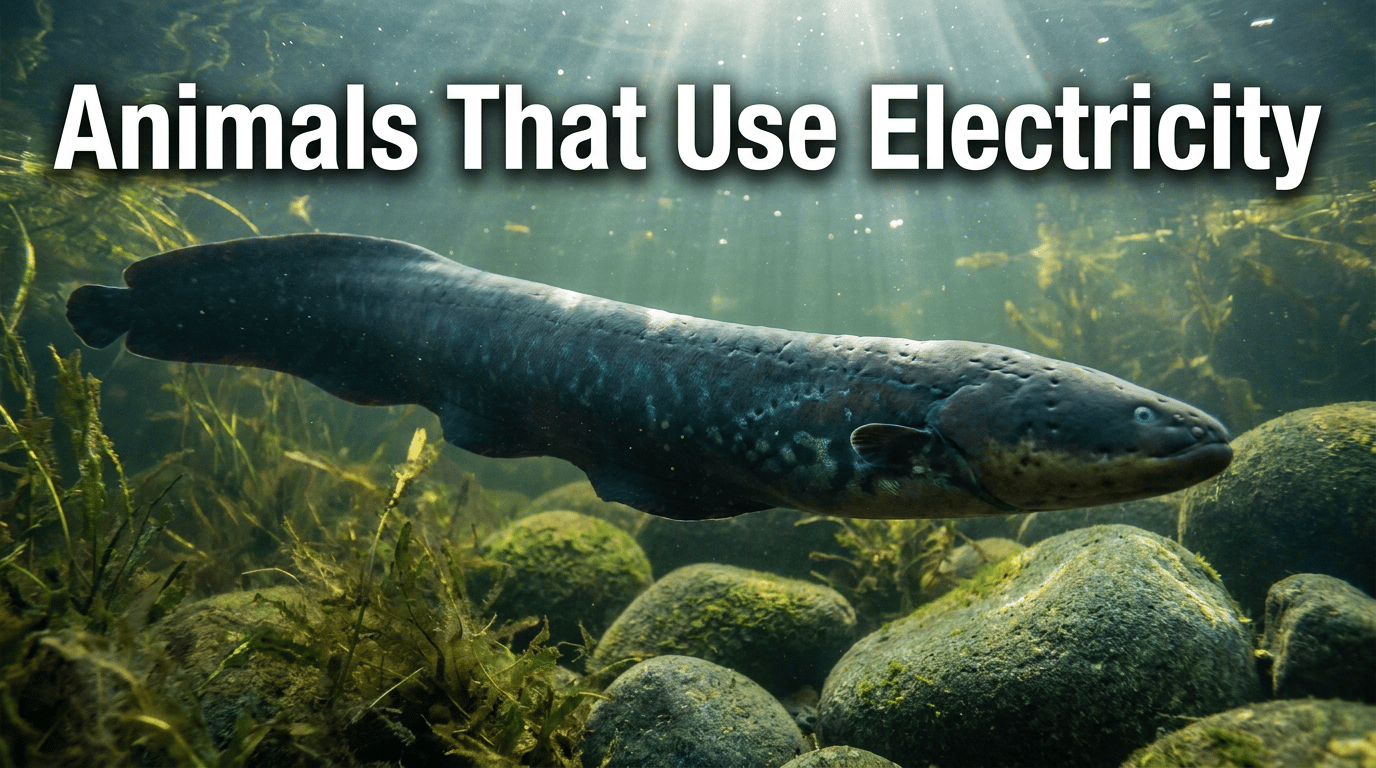
The most useful way to understand electric animals is to separate two ideas. Some animals produce electric signals. Some animals sense electric fields. A smaller group does both. Once that difference is clear, the whole topic becomes much easier to understand.
Quick Answer
The best-known animals that use electricity include electric eels, electric rays, electric catfish, weakly electric knifefish, elephantfish, sharks, rays, and platypuses. Electric eels, electric rays, and electric catfish can produce strong electric discharges. Weakly electric fish generate lower-voltage fields that help them explore, identify nearby objects, and communicate. Sharks and rays do not shock prey with electricity, but they can detect weak electric fields through specialized sense organs.
Most electric animals are aquatic because water conducts electric signals far better than air. That does not mean electricity works like a magical radar. Electric signals weaken with distance, vary by species, and depend heavily on water conditions. In real biology, electricity is one tool in a larger sensory toolkit that also includes smell, touch, vision, vibration, and sound.
What It Means When Animals Use Electricity
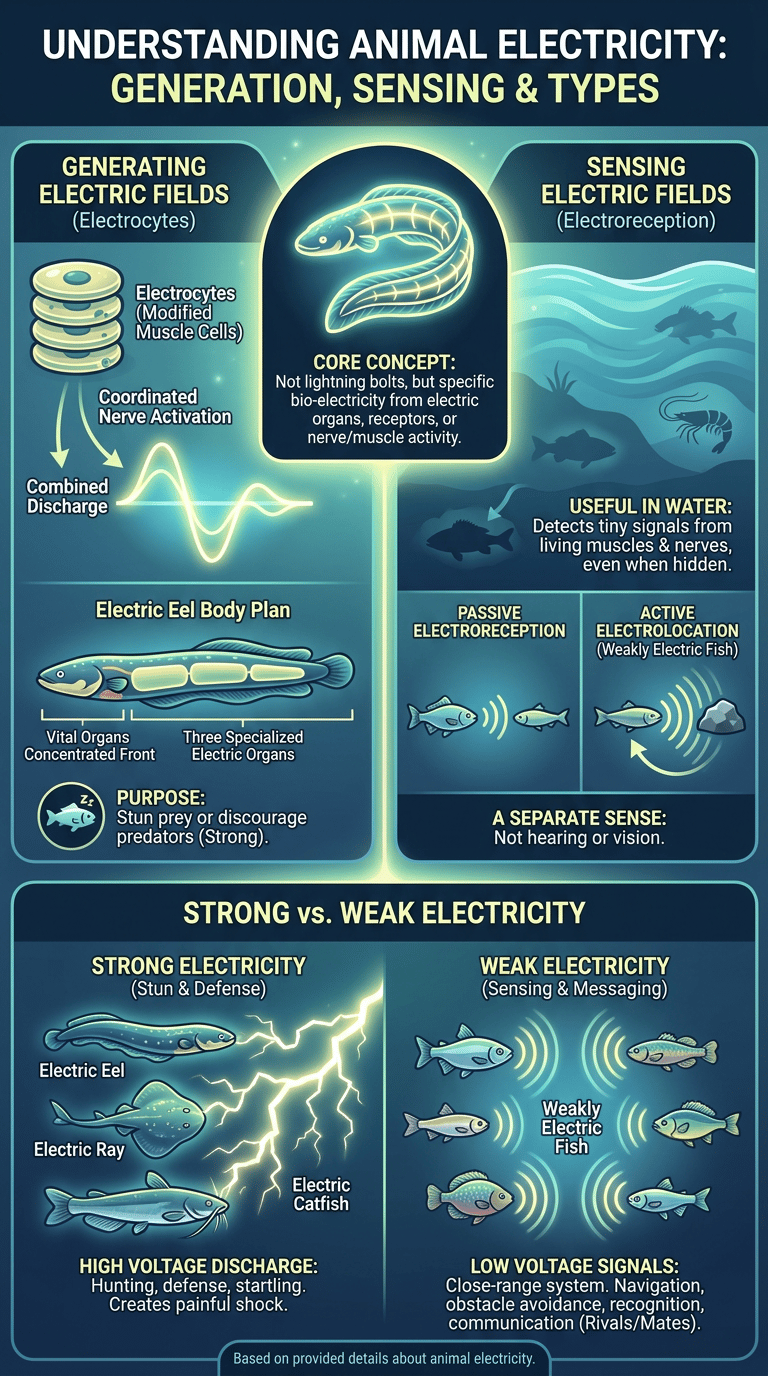
Animal electricity can sound mysterious because people often imagine lightning bolts or dramatic shocks. In living animals, electrical ability is usually much more specific. It may come from electric organs, sensory receptors, or normal nerve and muscle activity that other animals can detect.
Generating electric fields
Animals that generate electric fields use specialized cells called electrocytes. These cells are often modified muscle cells arranged in stacks. When the nervous system activates them in a coordinated way, their small electrical differences add together. In strong electric fish, that combined discharge can be powerful enough to stun prey or discourage a predator.
Electric eels are the classic example. The Smithsonian National Zoo’s electric eel profile explains that three specialized electric organs make up most of the fish’s body, while the vital organs are concentrated toward the front. That body plan is why an electric eel looks long and simple from the outside but is highly specialized inside.
Sensing electric fields
Electroreception means detecting electric fields. It is especially useful in water because every living animal with working muscles and nerves produces tiny electrical signals. A buried fish, a shrimp hidden in sand, or a small animal moving in muddy water may be difficult to see, but its body can still disturb the electrical environment around it.
Electroreception is not the same as hearing or vision. It is a separate sensory channel. Some animals use passive electroreception, which means they detect fields produced by other living things. Weakly electric fish also use active electrolocation, sending out their own electric field and sensing how nearby objects distort it.
Electric sensing is different from echolocation, but both show how animals can detect the world without relying only on vision.
Strong electricity versus weak electricity
Strong electric animals are the ones people usually notice because their discharges can stun prey or create a painful shock. Electric eels, electric rays, and electric catfish belong in this category. Their electricity is mainly associated with hunting, defense, or startling nearby animals.
Weakly electric fish are different. Their signals are not designed to stun a large animal. Instead, their electric fields act more like a close-range sensing and messaging system. Weakly electric signals can help fish navigate at night, avoid obstacles, recognize individuals, or adjust their behavior around rivals and mates.
Why Electricity Helps Animals Survive
Electricity is not useful in every habitat. It is most valuable where water, darkness, mud, or cover make other senses less reliable. Many electric animals live in rivers, lakes, coastal seafloors, or murky aquatic habitats where visibility can change quickly.
Hunting hidden prey
Predators that sense electricity can find prey even when the prey is still or partly buried. A shark searching over sand may not see a buried animal clearly, but nearby muscle contractions and body currents can create detectable clues at close range. This helps explain why electroreception is so common among sharks and rays.
Animals that generate electricity can use it more directly. A strong discharge may startle or stun prey long enough for the predator to grab it. Electric eels can also use lower-level signals while exploring, then stronger discharges during attack or defense.
Defending against predators
Electric discharges can make a predator hesitate. A painful or startling shock is not a shield against every threat, but it can give the electric animal time to escape or make itself less worth attacking. This matters most for species that are slow, live near the bottom, or have body shapes that do not rely on speed alone.
Electric rays are a good example because they often rest on or near the seafloor. A predator that bites or harasses one may receive a strong warning. Human divers should also treat electric rays with respect and should not touch, corner, or provoke them.
Navigating murky water
Weak electric fields can help fish make sense of nearby space. When an object enters an electric field, it changes the pattern around the fish. Conductive objects, nonconductive objects, living bodies, plants, rocks, and mud can affect the field in different ways. The fish’s nervous system can use those changes as information about the world immediately around it.
This is not long-distance navigation like a bird crossing a continent. It is close-range mapping. For a fish moving through a dark stream or muddy river, that kind of near-body awareness can be extremely useful.
Communicating in dark aquatic habitats
Electric signals can also carry social information. In weakly electric fish, the timing, rhythm, waveform, and pauses of electric organ discharges can change during courtship, aggression, social spacing, or individual recognition. The signals are not words, but they can still influence how another fish responds.
A peer-reviewed review of weakly electric fish electric organ discharge describes electric organ discharge as a key feature in African weakly electric fish and connects it to communication and species differences. This is one reason weakly electric fish are important in neuroethology, the study of nervous systems in natural behavior.
Animals That Generate Electric Signals
Only a limited set of animals can generate electric signals strong enough to be obvious to humans. Most of them are fish. Their electric organs evolved in different lineages, which makes electric animals a useful example of convergent evolution, where unrelated groups arrive at similar biological solutions.
Electric eels
Electric eels are among the most famous animals that use electricity, but the name is misleading. They are not true eels. They are South American freshwater fish related to knifefish. Their long bodies contain electric organs that can produce different kinds of discharges for sensing, hunting, and defense.
For a long time, many popular references treated the electric eel as a single species. Modern research has changed that. A Nature Communications study describing three electric eel species reported that one species, Electrophorus voltai, produced a recorded discharge of 860 volts under study conditions. That number is impressive, but it should not be used to imply that every electric eel produces the same shock in every situation.
Electric eels use electricity in more than one way. Lower-level discharges can help with sensing their surroundings. Stronger discharges can be used when attacking prey or defending themselves. They are air-breathing fish that live in freshwater habitats, so their behavior is shaped by oxygen availability, water conditions, prey, shelter, and the need to surface.
Electric rays
Electric rays are cartilaginous fish related to sharks and other rays. They have paired electric organs in the disc-shaped body area, which can produce shocks used in prey capture and defense. Unlike many fast-swimming predators, electric rays often have rounded bodies and spend time near the bottom, where a shock can be a useful close-range tool.
The Monterey Bay Aquarium’s Pacific electric ray profile describes a species found from British Columbia to central Baja California and notes that it can produce an electric current strong enough to stun prey and discourage predators. That does not mean people should fear every ray in the ocean. It means electric rays deserve space, especially if seen resting on the seafloor.
Electric rays also show why the phrase electric animal can be too broad. A manta ray is a ray, but it is not an electric ray in the same sense. The ability to generate strong shocks belongs to particular groups, not to every animal with ray in its name.
Electric catfish
Electric catfish are freshwater fish found in parts of Africa. Their electric organs differ in placement and structure from those of electric eels, but the result is similar in function: they can generate shocks that help with defense and prey capture. These fish are another example of how electricity evolved more than once in fish.
The Animal Diversity Web electric catfish account places Malapterurus electricus in African freshwater systems and describes the broader genus across western and central tropical Africa and the Nile region. Because common names can be messy, it is best to treat electric catfish claims at the species or genus level rather than assuming every catfish with an electric reputation behaves identically.
Electric catfish are sometimes mentioned in lists of shocking animals, but they should not be reduced to a novelty. Their electrical ability is connected to habitat, feeding, social spacing, and survival in freshwater systems where visibility may be limited.
Weakly electric fish
Weakly electric fish include many South American knifefish and African elephantfish. They produce electric fields, but not the dramatic shocks associated with electric eels or electric rays. Their electric signals are usually used for sensing and communication rather than overpowering prey.
Some weakly electric fish produce pulse-type signals. Others produce wave-type signals. The details differ, but the basic idea is that electric output becomes part of the animal’s sensory world. A fish can detect changes in its own field and can also detect signals from nearby individuals.
This is one of the most elegant parts of animal electricity. In a dark or cluttered aquatic habitat, a weak electrical signal can help answer several questions at once: What is near me? Is it alive? Is it another fish like me? Is it a rival, a mate, or an object I should avoid?
Animals That Sense Electricity
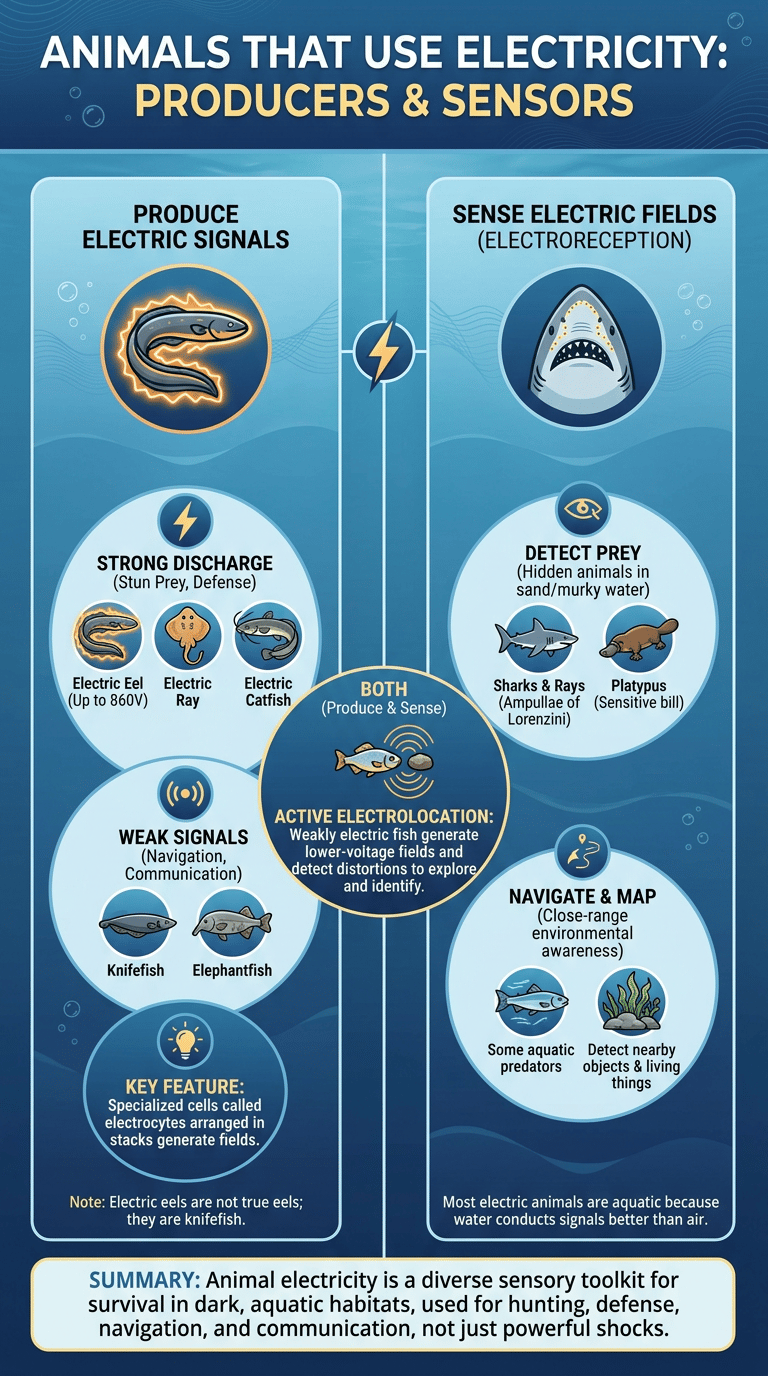
Many animals that use electricity do not produce a noticeable shock. They sense electrical fields instead. This difference matters because it prevents common mistakes, especially with sharks, rays, and platypuses.
Sharks and rays
Sharks and rays can detect weak electric fields using sensory pores called ampullae of Lorenzini. These organs are concentrated around the head and snout area. They help the animal detect close-range electrical cues from prey and may also play a role in orientation in the marine environment.
The Florida Museum’s shark biology guide explains that the ampullae of Lorenzini detect weak electric fields and help sharks locate cryptic prey such as animals buried in sand. This is powerful, but it is not unlimited. A shark still depends on many senses, including smell, hearing, lateral line detection, and vision.
This distinction is important for safety writing. Sharks do not use electricity to zap people. Their electroreception works at close range and helps interpret their environment. People should still avoid harassing sharks or rays, but the reason is wildlife respect and safety, not a fictional electric attack.
Platypuses
The platypus is one of the best-known mammals with electroreception. When it hunts underwater, it closes its eyes, ears, and nostrils and uses its sensitive bill to detect prey movements and weak electric fields. That ability helps it search through muddy freshwater habitats where vision would not be enough.
Platypus electroreception is passive. The animal is not shocking its prey. It is detecting cues from small aquatic animals such as insect larvae, crustaceans, and worms. This makes the platypus a useful reminder that electric sensing is not limited to fish, even though fish dominate the topic.
Some fish and aquatic predators
Electroreception occurs in several aquatic lineages. Some fish use it actively by generating fields and reading the distortions. Others use it passively by detecting fields produced by prey. In both cases, the ability works best in water and at relatively close range.
Scientists also study these animals because electric sensing connects behavior to the nervous system in a measurable way. Electric organ discharges can be recorded without touching the fish, which helps researchers study timing, spacing, social interactions, and sensory processing.
How Electric Communication Works in Fish
Electric communication is not the same as human language, but it is communication in the biological sense: a signal from one animal changes the behavior or state of another. In weakly electric fish, the message is carried through patterns in electrical output.
Signal timing and identity
Electric fish signals can differ in timing, frequency, pulse interval, waveform, and duration. Those differences can help fish distinguish species, individuals, sex, motivation, or social status, depending on the species and situation. A fish may not need a complex visual display if a nearby electric signal already carries useful information through the water.
For readers, it helps to think of electric communication as a pattern system rather than a vocabulary. The signal does not translate neatly into a sentence. It is more like a biological cue that another fish’s nervous system is adapted to read.
Avoiding signal interference
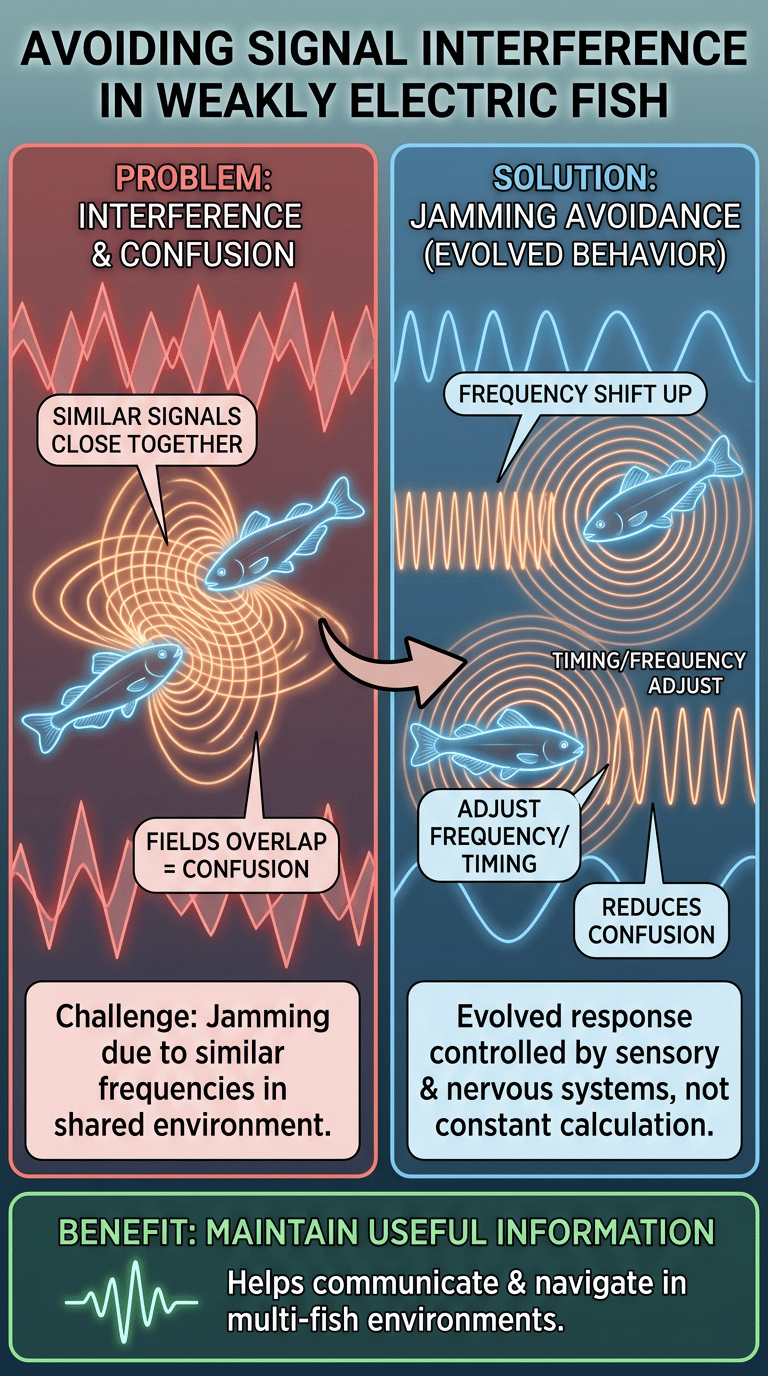
One challenge for weakly electric fish is interference. If two fish produce similar signals close together, their fields can overlap. Some species adjust signal frequency or timing in ways that reduce confusion. This is often discussed as jamming avoidance.
That does not mean every electric fish constantly calculates like a machine. The adjustment is an evolved behavior controlled by sensory and nervous systems. It helps maintain useful information in an environment where several fish may be signaling at once.
Why water makes electric signals useful
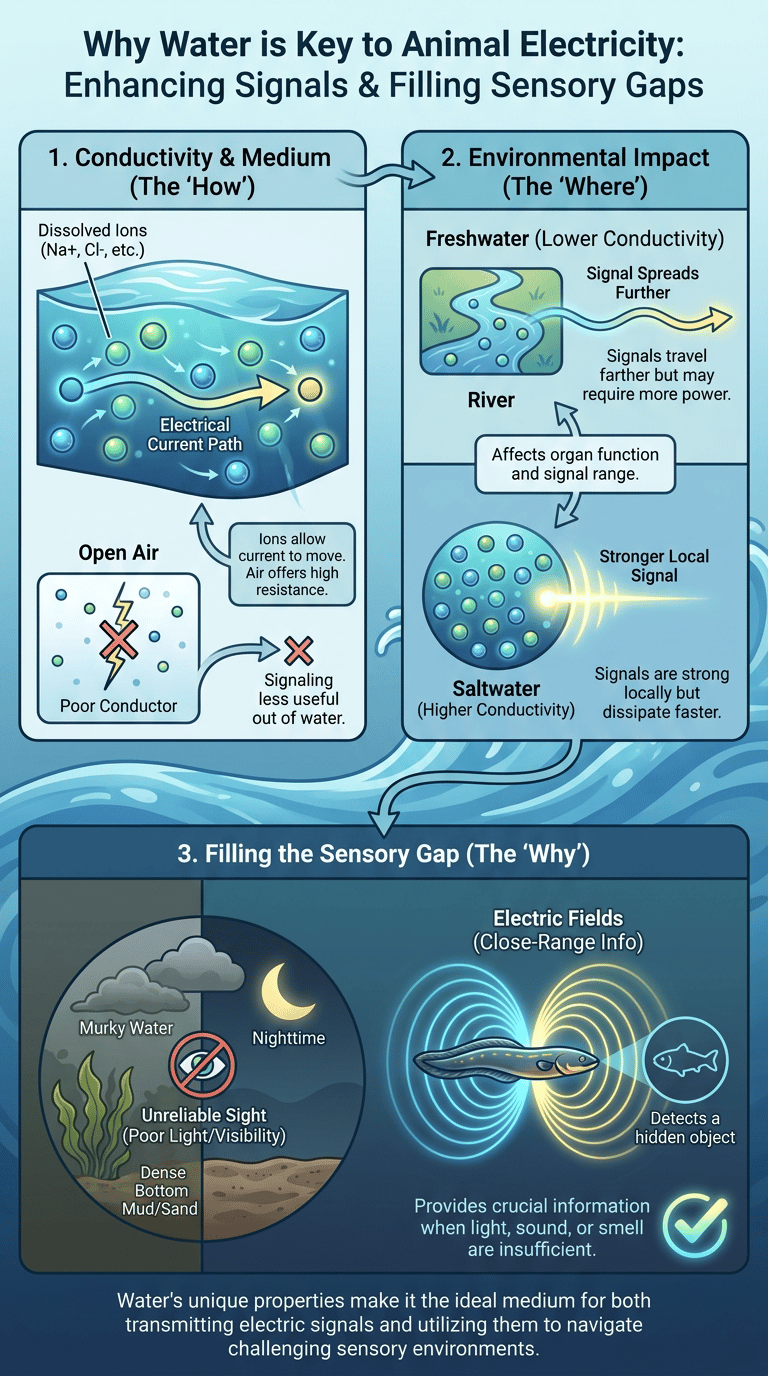
Water makes animal electricity useful because dissolved ions allow electrical currents to move through the environment. Freshwater and saltwater differ in conductivity, which affects how signals spread and how electric organs work. This is one reason electric animals are usually aquatic and why electric signaling is much less useful in open air.
Water also creates situations where electricity fills a sensory gap. Murky rivers, nighttime habitats, dense vegetation, bottom mud, and sandy seafloors can make sight unreliable. Electric fields can provide close-range information when light is poor and sound or smell alone does not solve the problem.
Common Myths About Electric Animals
Electric animals are easy to exaggerate because the topic feels dramatic. Good explanations should keep the wonder while removing the myths.
Electric eels are not true eels
The name electric eel is traditional, but it is biologically misleading. Electric eels are freshwater knifefish, not true eels. Their long body shape explains the name, but relatedness is based on anatomy and evolutionary history, not just appearance.
This matters because common names often hide real animal relationships. A sea horse is a fish. A starfish is better called a sea star in many educational settings. An electric eel is a fish with an eel-like body shape, not a member of true eel families.
Not every electric animal shocks prey
Many electric animals do not produce dangerous shocks. Sharks, rays with electroreception, platypuses, and many weakly electric fish use electricity mainly as a sensing system. They are not swimming batteries waiting to discharge at anything nearby.
Even animals that can shock do not use maximum output all the time. Electric discharge depends on context. Hunting, defense, exploration, body size, species, and the position of nearby animals can all affect what happens.
Sharks do not use electricity like a superpower
Shark electroreception is remarkable, but it has limits. It works mainly at close range and is part of a broader sensory system. Sharks also use smell, hearing, pressure and movement detection through the lateral line, vision, and body orientation cues.
Calling it a superpower can make the animal seem less real. A better description is that sharks have a specialized close-range sense that helps them detect living prey in water. That is impressive without being exaggerated.
Edge Cases and Exceptions
Electricity in animals exists on a spectrum. Some cases are obvious, like electric rays. Others are subtle, like the normal electrical activity inside muscles and nerves.
Bioelectricity inside all animal bodies
All animals rely on electrical activity inside the body. Nerves transmit signals through changes in ion flow. Muscles contract after electrical and chemical events. Hearts beat through coordinated electrical activity. This internal bioelectricity is not the same as having an electric organ or an electrosensory system.
So, in one sense, every animal is electrical. In the context of this article, though, animals that use electricity means animals that generate external electric fields or detect electric fields as a specialized survival sense.
Difference between sensing electricity and producing shocks
Sensing electricity and producing shocks are separate abilities. A shark can detect weak fields but does not shock prey. An electric ray can produce shocks. A weakly electric fish may do both, but at a low level used for sensing and social signaling.
This difference is the key to avoiding confusion. Electric animals should not be grouped only by how dramatic they seem to humans. They should be grouped by what the electrical ability actually does for the animal.
Limits of electric signals on land
Electric sensing is much more common in water than on land because water conducts signals better than air. Land animals still have internal electrical activity, but external electric communication or hunting is far less practical in open air.
The platypus is a special case because it is a mammal that hunts underwater. Its electroreception works in an aquatic feeding context. That is very different from a land mammal using electricity across dry ground.
How This Connects to Nearby Animal Topics
Electricity connects naturally to other animal sense topics, but it should not be mixed together carelessly. Each sensory system solves a different problem.
Underwater senses compared with echolocation
Echolocation and electroreception both help animals detect things when vision is limited, but they work in different ways. Echolocation uses sound and returning echoes. Electroreception uses electric fields. Dolphins and toothed whales are famous echolocators, while sharks and many electric fish are better examples for electric sensing.
Animal communication through specialized signals
Electric communication is part of the larger world of animal signals. Some animals communicate with calls, colors, scent, posture, vibration, touch, or light. Weakly electric fish add another channel: patterns of electric organ discharge that nearby fish can detect.
That makes electric communication especially useful for understanding how flexible animal signaling can be. Communication is not limited to sounds we can hear or colors we can see. It can happen through sensory channels that humans barely notice without instruments.
Vision and smell when water is dark or cloudy
Electricity often becomes useful when vision is limited. Murky water, nighttime activity, bottom sediment, vegetation, and low light can all reduce what an animal can see. Smell may help, but odor spreads through water in changing currents and may not give exact close-range position.
Some animals use electric fields in environments where animal vision may be limited by darkness, mud, or murky water.
Electroreception can fill that final gap. It gives some aquatic predators and foragers a way to detect living bodies nearby, especially when the last few inches or feet matter more than long-distance awareness.
FAQ
What animals can produce electric shocks?
The best-known animals that can produce noticeable electric shocks are electric eels, electric rays, and electric catfish. Some other fish generate weaker electric fields for sensing and communication, but they are not usually described as shocking animals in the same way. Shock strength varies by species, body size, context, and measurement method.
How strong is an electric eel shock?
Electric eel shock strength varies. Research describing Electrophorus voltai reported a recorded discharge of 860 volts under study conditions, while other electric eel references commonly discuss lower values for other species or contexts. It is safest to say that electric eels can produce powerful shocks, but not every discharge from every individual is the same.
Can sharks sense electricity?
Yes. Sharks can detect weak electric fields using ampullae of Lorenzini, sensory organs around the head and snout area. This helps them find prey at close range, including animals hidden in sand or low-visibility water. It does not mean sharks shock prey or detect electricity at unlimited distances.
Do electric animals use electricity to talk?
Some weakly electric fish use electric signals for communication. Their signals can vary in timing, rhythm, and pattern, and those changes can affect social behavior. It is not talking in the human sense, but it is a real form of animal communication because one animal’s signal can change how another animal responds.
Final Thoughts
Animals that use electricity show how creative evolution can be without needing exaggeration. Electric eels, electric rays, and electric catfish generate strong discharges that can help them hunt or defend themselves. Weakly electric fish use lower-level fields for sensing and communication. Sharks, rays, and platypuses show the other side of the story by detecting tiny electric fields rather than producing dramatic shocks.
The main takeaway is simple: animal electricity is not one ability. It is a set of adaptations shaped by water, darkness, prey, predators, and communication. When you separate strong shocks from weak signals and electric sensing, the strange world of electric animals becomes clearer, more accurate, and even more impressive.

Ethan Walker is the founder and research editor of Animal Fact Central. He creates and reviews educational animal facts content using trusted wildlife, pet care, and science-based sources. His work focuses on making animal behavior, adaptations, habitats, and species facts clear, accurate, and engaging for everyday readers.
Read More Details About Ethan Walker: https://animalfactcentral.com/ethan-walker/