
Animals that use echolocation send out sounds and listen for the returning echoes to locate objects, prey, obstacles, or habitat features. It is one of nature’s most impressive sensing systems, but it is not magic and it is not the same as ordinary animal calls. Echolocation is active listening: the animal makes a signal, the signal bounces back, and the echo carries information.
The best-known echolocation animals are bats and toothed whales, including dolphins and porpoises. A smaller number of birds also use echo-based navigation in dark caves, and some small mammals such as shrews and tenrecs are discussed as simpler or more limited examples. These animals do not all use the same kind of sonar. A bat hunting a moth at night, a dolphin searching underwater, and a swiftlet flying through a cave are solving similar problems with different bodies and different environments.
The most useful way to understand echolocation is to see it as a survival adaptation. It helps animals operate where vision alone is not enough: in darkness, cluttered forests, caves, turbid water, deep ocean, or fast hunting situations. It also shows why animal senses cannot be ranked in a simple way. For an echolocating animal, sound can reveal parts of the world that human eyes would miss.
Quick Answer
The main animals that use echolocation are bats, dolphins, porpoises, and other toothed whales. Some birds, especially oilbirds and several swiftlets, also use echolocation to navigate dark caves. A few small terrestrial mammals, including some shrews and tenrecs, may use simpler echo-based orientation, but their systems are not as specialized as the biosonar of bats and toothed whales.
Echolocation works by sending out a sound, then using the echo that returns from nearby objects. The National Park Service echolocation overview explains the basic bat version clearly: bats produce sound waves above human hearing, those waves bounce off objects, and the returning sounds are recognized by ears tuned to those calls.
That simple pattern can become extremely refined. An echolocating animal may adjust its call rate, frequency, direction, and timing as it approaches prey or moves through a complicated space. The result is not a picture in the human visual sense, but it can still provide useful information about distance, direction, movement, size, and texture.
What Echolocation Is and How It Works
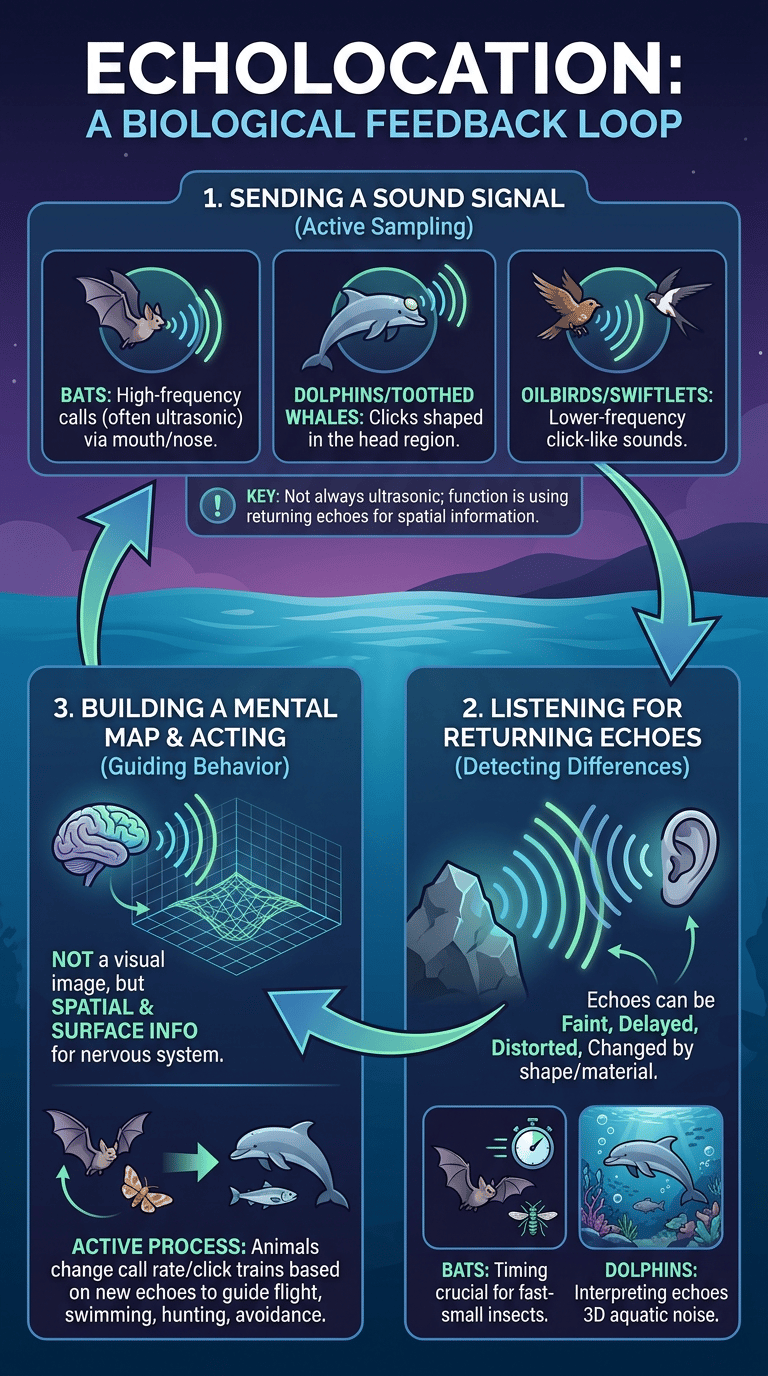
Echolocation is often compared with sonar, but animal echolocation is not just a machine-like ping. It is a biological feedback loop between sound production, hearing, movement, and behavior. The animal acts, listens, updates its next movement, and often changes the next sound it produces.
Sending a sound signal
The first step is making a sound that can travel into the surrounding environment. Bats usually produce high-frequency calls through the mouth or nose. Dolphins and other toothed whales produce clicks in the head region and shape those sounds before they pass into the water. Oilbirds and swiftlets produce click-like sounds that are generally lower in frequency and less detailed than the ultrasonic systems of many bats and toothed whales.
Frequency matters, but it should be handled carefully. Many bat and dolphin echolocation sounds are ultrasonic, meaning they are above the usual upper limit of human hearing. However, not every echolocating animal uses ultrasound, and not every ultrasonic sound is echolocation. The function depends on whether the animal is using returning echoes to gain spatial information.
Listening for returning echoes
Once the signal leaves the animal, it travels until it hits an object or surface. Some of the sound reflects back. The returning echo may be faint, delayed, distorted, or changed by the object’s shape, movement, and material. The animal’s hearing system must detect those differences quickly enough to guide behavior.
For bats, timing is especially important because they may be flying fast while tracking small insects. For dolphins and porpoises, the challenge is different: sound travels efficiently underwater, but echoes must be interpreted in a three-dimensional aquatic environment full of moving animals, bubbles, bottom surfaces, and background noise.
Building a mental map from sound
People sometimes say echolocating animals can “see with sound.” That phrase can be helpful as a shortcut, but it should not be taken too literally. Echoes do not create a human-like visual image. Instead, they provide spatial and surface information that the animal’s nervous system can use to guide flight, swimming, hunting, or obstacle avoidance.
A bat approaching prey may increase its call rate as the target gets closer. A dolphin may produce click trains while investigating objects or prey. In both cases, the animal is not only listening passively. It is actively sampling the world and changing its behavior as new echoes come in.
Why Echolocation Evolved

Echolocation appears in animals that face a recurring problem: they need information about objects they cannot easily see. That problem can happen at night, inside caves, in muddy water, in deep ocean, or in dense vegetation. The adaptation is valuable because sound can travel around obstacles, work in low light, and reveal the presence of hidden targets.
Hunting in darkness
Many bats hunt insects at night, when vision is limited and prey may be small and fast. Echolocation lets them detect flying insects, judge movement, and close the distance during a chase. The system is not identical in every bat. Some bats hunt in open air, some near vegetation, and some listen for sounds made by prey before using echolocation at close range.
The Smithsonian bat facts page notes that the saying “blind as a bat” is false and that insectivorous bats use echolocation to locate and catch prey. That distinction is important: echolocation complements vision, smell, touch, and memory rather than replacing every other sense.
Navigating caves, forests, and murky water
Caves and cluttered forests create echo-rich environments. Walls, branches, leaves, rocks, and other animals all reflect sound. For a bat or cave bird, these echoes can help avoid collisions and find safe routes. In water, dolphins and porpoises face a different version of the same challenge. Visibility can be reduced by depth, turbidity, darkness, or distance.
Echolocation is not always about dramatic hunting. Sometimes it is basic navigation. A swiftlet returning to a cave roost needs to avoid other birds and cave walls. A dolphin moving through complex coastal water may combine echolocation with vision, social sounds, memory, and passive listening.
Avoiding obstacles and coordinating movement
An animal moving quickly through a cluttered space needs more than a warning that something exists. It needs to know where the obstacle is, how far away it is, and whether it is moving. Echoes can provide that information at close range, especially when an animal can update its signals rapidly.
Group movement adds another layer. Bats may share airspace with other bats, dolphins may move in social groups, and cave birds may fly near dense roosts. Echolocation does not remove every collision risk, but it gives animals a way to read the space around them while moving.
The Best-Known Animals That Use Echolocation
Echolocation is best understood through examples because different animals use it for different jobs. The examples below are not just a list of unusual species. They show how environment shapes the same basic idea into different sensory systems.
Bats
Bats are the classic echolocation animals. Many species use high-frequency calls to navigate and hunt insects in darkness. Some call through the mouth, while others call through the nose. In nose-calling species, facial structures such as nose leaves may help shape the outgoing sound.
Not all bats use echolocation in the same way. Some rely heavily on rapid sonar during aerial insect hunting. Others use quieter calls, listen for prey-made sounds, feed on fruit or nectar, or combine vision and smell with sound. The key point is that bats are not blind machines following a single pattern. They are mammals with varied feeding styles, habitats, and sensory strategies.
Dolphins
Dolphins use echolocation underwater, especially when locating prey or investigating objects. Their clicks can help them gather information in places where sight is limited. The NOAA Fisheries dolphins and porpoises overview describes dolphins and porpoises as using complex communication and echolocation, including squeaks, buzzes, whistles, and clicks.
Dolphin echolocation is not the same as dolphin whistles. Whistles and other social sounds can be part of communication, while echolocation clicks are used to sample the environment. The two systems can overlap in the life of the animal, but they should not be treated as the same signal.
Toothed whales
Toothed whales, also called odontocetes, include dolphins, porpoises, sperm whales, beaked whales, belugas, and other species. Unlike baleen whales, toothed whales are the whale group known for echolocation. Their clicks can help with navigation and foraging in underwater habitats where light may be weak or absent.
Sperm whales are a striking example because they forage at great depths where sunlight is extremely limited. Beaked whales and other deep-diving toothed whales also rely on sound in environments humans rarely see directly. Scientists often study these animals with underwater microphones because their clicks can reveal presence and behavior even when the animals remain out of sight.
Porpoises
Porpoises are smaller toothed cetaceans and are among the most specialized underwater echolocators. Harbor porpoises and related species produce narrowband high-frequency clicks. These signals are useful for finding prey and may also reduce detection by some predators, although the details vary by species and situation.
Porpoises remind us that echolocation is not limited to famous dolphins. Some of the most refined acoustic systems belong to animals many people rarely notice. Their small size, fast movements, and often shy behavior make sound especially valuable for monitoring and studying them.
Oilbirds and swiftlets
Bird echolocation is real, but it is more limited than bat or toothed whale echolocation. Oilbirds in South America and several swiftlet species use audible clicks to navigate dark caves. A review of echolocation in oilbirds and swiftlets explains that bird echolocation is generally lower in frequency and has poorer resolution than the ultrasonic biosonar of most bats and toothed whales.
That does not make it unimportant. For a bird flying inside a cave, a lower-resolution echo system can still be enough to avoid walls, locate nest areas, and move through darkness. The adaptation fits the job. Oilbirds do not need to track tiny flying insects the same way many bats do.
Shrews and tenrecs as partial or debated examples
Some small mammals, including certain shrews and tenrecs, are often mentioned in discussions of echolocation. They may produce clicks or twittering sounds that help with close-range orientation. However, their systems are usually described more cautiously than bat or dolphin echolocation because the evidence and function can be more limited.
A study on shrew echo-based orientation found that shrew-like calls can provide useful echo scenes for close-range habitat assessment, while also emphasizing that this is not the same as the high-performance prey-targeting echolocation seen in bats. That careful wording helps avoid overstating the ability.
Echolocation in Air Versus Water

Air and water change how sound behaves. That is why bat echolocation and dolphin echolocation can be based on the same principle while looking very different in anatomy, signal type, and distance.
Why sound behaves differently underwater
Sound generally travels faster in water than in air, and water can carry sound over long distances under the right conditions. This makes sound especially important for marine animals. Light fades quickly with depth, but sound can still provide information in places where vision is weak.
Underwater sound also faces challenges. Reflections from the seafloor, bubbles, other animals, waves, and human-made noise can complicate the acoustic scene. An echolocating marine mammal must separate useful echoes from background sound and other signals.
How bats and dolphins produce signals differently
Bats are flying mammals, so their sonar system must work in air while they flap, turn, and chase prey. Many bat calls are produced through the larynx and emitted through the mouth or nose. The ears then receive returning echoes, and the bat adjusts its flight and call pattern.
Dolphins and other toothed whales produce clicks inside the head region rather than through vocal cords like terrestrial mammals. The forehead structure often called the melon helps shape sound transmission. The details vary among toothed whale species, but the basic function is to send focused clicks into water and receive echoes that help guide behavior.
Why ocean echolocation can work over distance
Marine echolocation can be useful because water transmits sound efficiently. NOAA Fisheries notes that many whale and dolphin sounds are outside human hearing, and a NOAA Fisheries explanation of echolocation clicks describes many echolocation clicks as short, broadband signals, often ultrasonic and above 20 kHz.
Even so, distance depends on species, signal strength, frequency, water conditions, object size, and background noise. It is better to say that underwater echolocation can work effectively in the right conditions than to claim that every marine mammal can detect every object from far away.
What Echolocation Can Reveal
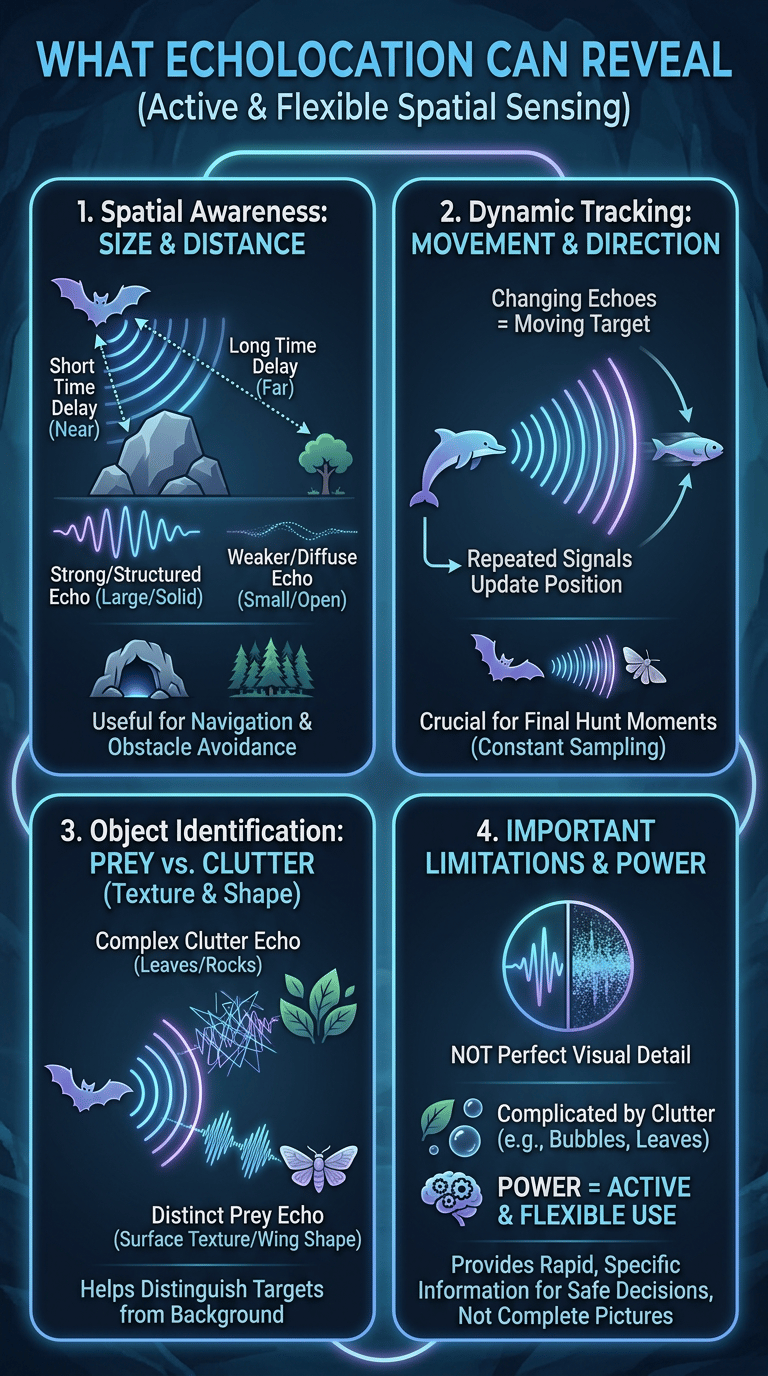
Echolocation does not reveal everything, but it can provide specific kinds of information very quickly. That makes it useful for hunting, navigation, and avoiding obstacles.
Size and distance of objects
The time delay between the outgoing sound and returning echo helps the animal estimate distance. Echo strength and structure can also help indicate whether an object is large or small, near or far, open or solid.
This is why echolocation is useful in caves, forests, and underwater habitats. An animal does not need perfect visual detail to avoid a wall, find a gap, or close in on prey. It needs enough spatial information to make the next movement safely.
Movement and direction
Echoes can change as a target moves. A flying insect, swimming fish, or shifting obstacle produces different information over time. Echolocating animals often send repeated signals so they can update the target’s position.
This matters during the final moments of a hunt. A bat closing in on an insect may increase call repetition as distance decreases. A dolphin approaching prey may change click timing as the chase becomes more precise. The animal is constantly sampling and correcting.
Prey location and surface texture
In some situations, echoes can reveal more than position. Surface texture, shape, wing movement, or object structure can change how sound returns. This can help animals distinguish prey from background clutter or identify objects worth investigating.
The ability has limits. Leaves, rocks, bubbles, waves, and nearby animals can produce complicated echoes. Echolocation is powerful because animals use it actively and flexibly, not because it gives perfect information every time.
Common Myths About Echolocation
Echolocation is easy to exaggerate because it feels so different from human everyday perception. The most common myths usually come from treating echolocation as either supernatural vision or ordinary sound-making.
Echolocation does not mean an animal is blind
Bats are the best example of this myth. Bats can see, and many use vision along with echolocation. Some species rely more on sight than others, especially fruit bats that feed in different ways from many insect-hunting bats.
The same principle applies to dolphins and birds. Echolocation does not erase other senses. It adds another way to gather information when light, distance, clutter, or water conditions make vision less reliable.
Not all bats use echolocation the same way
There is no single bat sonar style. Some species hunt in open spaces and use calls that travel differently from those used by bats hunting close to leaves or branches. Some bats listen for prey sounds, some glean insects from surfaces, and some use echolocation in combination with smell or vision.
This variation matters for readers because simplified bat facts often make every bat sound identical. In reality, echolocation is shaped by diet, habitat, flight style, prey type, and evolutionary history.
Echolocation is not ordinary talking
Echolocation sounds can be produced by animals that also communicate vocally, but the functions are different. A dolphin whistle may carry social information. A bat social call may affect another bat. An echolocation click or pulse is primarily used to probe the environment.
Echolocation can overlap with animal communication, but its main function is often sensing the environment rather than sending a social message.
That does not mean echolocation has no social side. Animals may hear each other’s echolocation sounds, and some research explores how individuals respond to those sounds. Still, it is more accurate to separate echolocation from communication unless the specific behavior clearly involves sending information to another animal.
Edge Cases and Exceptions
The boundary around echolocation is not always clean. Some animals listen passively, some use weak echo-based orientation, and some combine sound with other senses so tightly that it is misleading to give one sense all the credit.
Animals that use passive listening instead
Passive listening means using sounds made by the environment, prey, predators, or other animals without producing a sonar signal first. Owls can locate prey by sound. Some bats listen for prey-generated noises. Marine mammals may listen for calls, surf, ice, prey, or other environmental sounds.
This is different from echolocation because the animal is not sending a signal and waiting for an echo. Passive listening can be extremely sensitive, but it is not the same active sound-and-echo loop.
Animals that combine vision and echolocation
Many echolocating animals still use vision. Bats may use sight for long-range orientation, light levels, landmarks, or navigation outside tight hunting situations. Dolphins use vision when conditions allow. Swiftlets and oilbirds may use vision near cave entrances and echolocation in darker areas.
This blend of senses is normal. Animals rarely depend on one channel for every task. Echolocation is strongest when it is viewed as part of a sensory toolkit that may also include smell, touch, vision, memory, magnetoreception, and social cues.
Human noise pollution and echolocation challenges
Human-made noise can complicate acoustic life for animals. Boat traffic, sonar systems, construction, industrial activity, and other noise can change how animals detect sounds or move through habitats. The impact depends on the species, sound type, distance, exposure, and habitat.
This topic requires caution because not every noise affects every echolocating animal in the same way. Still, acoustic disturbance is a serious conservation and welfare concern for many marine mammals and some terrestrial wildlife. The safe takeaway is simple: people should not play artificial sounds at wildlife, disturb roosts, approach protected marine mammals, or enter sensitive habitats for curiosity.
How This Connects to Nearby Animal Topics
Echolocation belongs to a larger family of animal sensory and communication topics. Understanding it helps readers separate sound-based communication, vision, navigation, and other specialized senses without blending them together.
Animal sounds and why echolocation is different from calls
Many animals make sounds, but only some use self-produced sounds to analyze returning echoes. A bird song can attract mates or defend territory. A frog call can help females locate males. A dolphin whistle can be social. Echolocation is different because the main receiver is often the animal itself.
That difference prevents confusion. Echolocation is sound-based, but it is not simply another animal noise with a meaning. It is a sensing method that uses sound as a tool to investigate space.
How animals see the world when sound is only one sense
Animals do not experience the world through human senses scaled up or down. A bat’s world may include echoes, airflow, smell, vision, and memory. A dolphin’s world may include water pressure, sound, social signals, vision, and touch. A swiftlet’s world may shift between daylight vision and cave clicks.
That is why questions about animal vision and echolocation naturally connect. Both are ways of gathering spatial information, but each works best under different physical conditions.
Migration navigation and long-distance orientation
Echolocation is usually most useful at short to moderate distances, especially for object detection, prey tracking, and obstacle avoidance. Migration navigation is a different problem. Migrating animals may use stars, sun position, Earth’s magnetic field, smell, landmarks, currents, wind, memory, or social learning.
Some animals use sound during movement, but echolocation should not be treated as the main answer to long-distance migration. It is better understood as close-range environmental sensing that can work alongside broader navigation cues.
FAQ
Which animal has the best echolocation?
There is no single best echolocation animal because “best” depends on the job. Bats are extraordinary at tracking small flying insects in air. Dolphins and porpoises are highly specialized for underwater echolocation. Sperm whales and beaked whales use sound in deep ocean conditions. Each system fits a different environment.
A fair answer is that bats and toothed whales have the most sophisticated known echolocation systems, while birds such as oilbirds and swiftlets use simpler systems mainly for cave navigation. Shrews and tenrecs are usually treated as limited or partial examples rather than top performers.
Do all bats use echolocation?
No. Many bats use echolocation, especially insect-hunting bats, but bat sensory biology varies. Some fruit bats rely strongly on vision and smell, and bat groups differ in how they produce and use sounds. It is safer to say that echolocation is widespread and highly important in bats rather than claiming every bat uses it the same way.
Even among echolocating bats, the details vary. Habitat, prey type, flight style, and hunting strategy shape the calls. A bat flying high in open air does not face the same acoustic challenge as a bat hunting close to leaves and branches.
Can dolphins see with sound?
Dolphins can use echolocation to detect and investigate objects underwater, so “seeing with sound” is a useful simple phrase. However, it is not identical to human vision. Echoes provide information about distance, direction, shape, movement, and sometimes object qualities, but the dolphin’s perception is not a human-like picture.
Dolphins also use other senses and social signals. They can use vision in clear water, touch during social behavior, and whistles or other sounds for communication. Echolocation is one powerful part of a broader sensory system.
Is echolocation harmful to prey or humans?
Typical animal echolocation is not a weapon aimed at people. Bats using echolocation near humans are usually navigating or hunting insects, not attacking. Dolphins and porpoises use clicks to investigate underwater surroundings and prey. The sound may be intense in some species and contexts, but everyday wildlife encounters should not be treated as dangerous because of echolocation alone.
The bigger safety and ethics issue goes the other direction: humans should avoid disturbing echolocating animals. Do not enter bat roosts, shine lights into colonies, play artificial calls at wildlife, approach marine mammals, or try to test an animal’s hearing or sonar. Wildlife should be observed from a safe and legal distance.
Final Thoughts
Animals that use echolocation show how different the sensory world can be from our own. Bats, dolphins, porpoises, toothed whales, oilbirds, swiftlets, and some small mammals use echoes to solve problems that vision alone cannot handle. They hunt in darkness, move through caves, search underwater, avoid obstacles, and gather spatial information from sound.
The main takeaway is that echolocation is not ordinary communication, blindness, or a superpower without limits. It is an active sensing adaptation shaped by habitat, anatomy, behavior, and physics. When readers understand that, the subject becomes more interesting and more accurate: echolocating animals are not mysterious because they break the rules of nature. They are remarkable because they use those rules so well.

Ethan Walker is the founder and research editor of Animal Fact Central. He creates and reviews educational animal facts content using trusted wildlife, pet care, and science-based sources. His work focuses on making animal behavior, adaptations, habitats, and species facts clear, accurate, and engaging for everyday readers.
Read More Details About Ethan Walker: https://animalfactcentral.com/ethan-walker/