
What makes an animal a reptile is not one simple feature such as scales, egg laying, or being “cold-blooded.” Reptiles are best understood through evolutionary ancestry plus a pattern of biological traits. Living non-avian reptiles are vertebrate amniotes that breathe with lungs, have strongly keratinized outer body coverings, and are ectothermic, while reproduction, body shape, habitat, and visible scales vary widely across the group.
This matters because many familiar shortcuts break down as soon as you compare a snake, turtle, crocodilian, gecko, and tuatara. Snakes have no ordinary walking limbs. Some reptiles give birth to live young. Sea turtles spend most of their lives in the ocean. Crocodilians are more closely related to birds than to lizards or snakes. The most accurate reptile definition therefore comes from a combination of ancestry and shared biology, not a checklist in which every species looks the same.
Quick Answer: What Biologists Mean by a Reptile
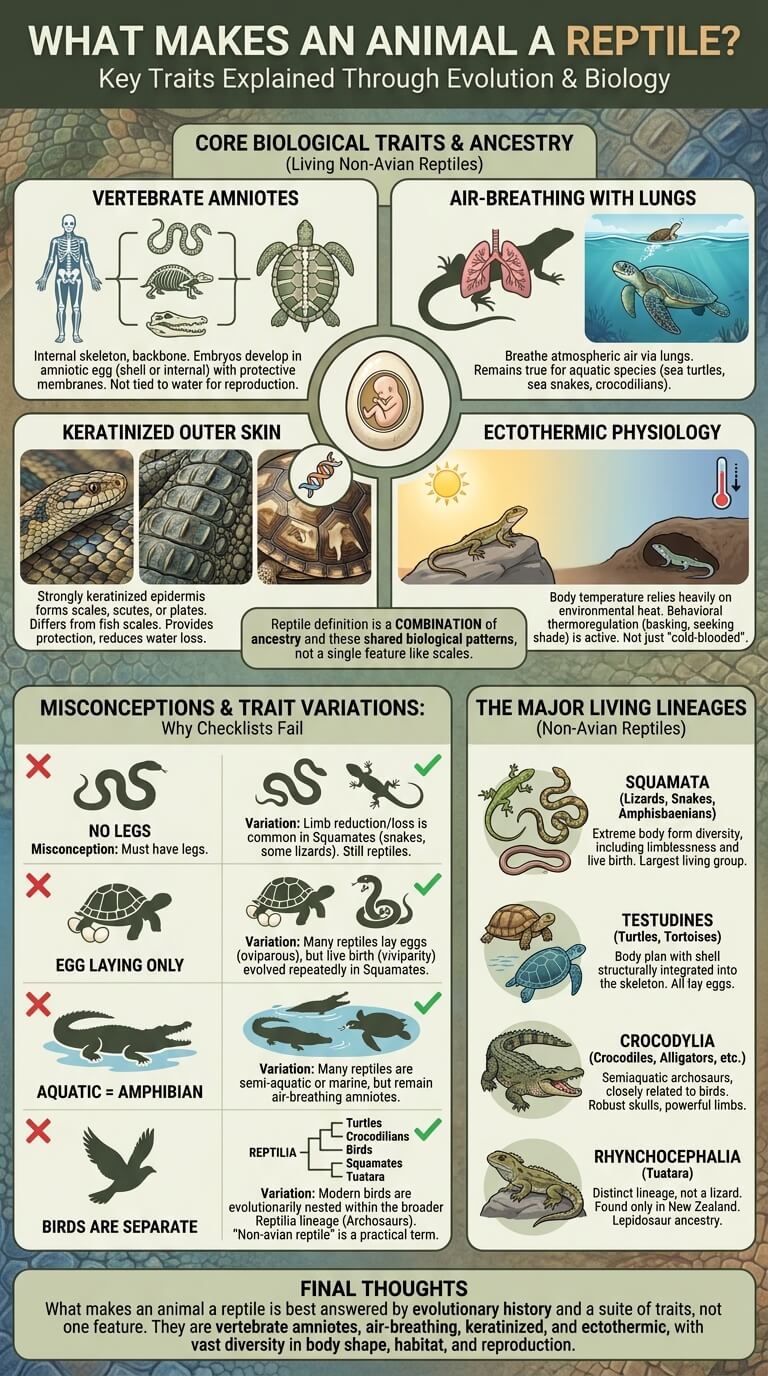
Practical meaning: living non-avian reptiles
For everyday animal education, the clearest practical meaning of reptile is a living non-avian member of the reptilian lineage. That includes squamates, which contain snakes, amphisbaenians, and the many lineages commonly called lizards; turtles and tortoises; crocodilians; and tuatara. The Reptile Database tracks living reptile taxonomy and includes these familiar non-avian groups. Those defining features make more sense when placed within the broader overview of reptile diversity , where anatomy, behavior, habitats, and adaptations can be compared across lineages.
The phrase “non-avian” is useful because modern evolutionary classification places birds within the broader reptilian family tree. In everyday school and wildlife writing, birds and reptiles are often discussed separately because living birds have a distinctive body plan, feathers, and a very different ecological profile. Both usages can be understood as long as the evolutionary relationship is stated accurately.
Why ancestry matters more than one visible trait
An animal does not stop being a reptile because one familiar reptile feature is reduced, modified, or absent. Snakes remain reptiles even though they lack ordinary walking limbs. A softshell turtle is still a reptile even though its outer shell covering differs from the hard scutes people associate with many turtles. A marine reptile remains a reptile even though it spends much of its life in water.
This is the same reason appearance alone can mislead. Animals from unrelated lineages can evolve similar shapes or lifestyles when they face similar environmental problems. Classification based on shared ancestry helps biologists separate superficial resemblance from genuine evolutionary relationship.
Reptiles Are Vertebrate Amniotes
Backbone and internal skeleton
Reptiles are vertebrates, so they have a vertebral column and an internal skeleton. Their skeletons may look very different depending on the lineage. A snake has hundreds of vertebrae supporting an elongated body. A turtle has a shell that is structurally integrated with its skeleton. Crocodilians have robust skulls and limbs suited to both land and water. Lizards range from long-limbed runners to burrowers with reduced limbs.
The backbone is useful for recognizing where reptiles fit in the animal kingdom, but it does not define reptiles by itself. Fish, amphibians, birds, and mammals are also vertebrates. Reptile identity becomes clearer when vertebrate ancestry is combined with the amniote condition and other reptile-associated traits.
The amniote lineage and why it matters for reproduction on land
Reptiles belong to Amniota, the vertebrate lineage whose embryos develop with extraembryonic membranes that include the amnion. These membranes help create a controlled developmental environment around the embryo. The amniote condition was a major evolutionary change because reproduction no longer depended on the same exposed aquatic egg arrangement characteristic of many amphibians.
Amniote does not mean “reptile only.” Birds and mammals are amniotes too. The Animal Diversity Web overview of Reptilia describes reptiles as amniotes and also notes the evolutionary inclusion of birds within Reptilia. That broader context is why one feature, even an important one such as the amniotic egg, cannot by itself identify an animal as a living non-avian reptile.
Amniote reproduction also does not require every species to lay a shelled egg outside the body. In live-bearing reptiles, embryonic development is retained within the female for much longer. The underlying amniote developmental heritage remains even when the reproductive mode changes.
The Trait Framework for Living Non-Avian Reptiles
Air breathing through lungs
Living reptiles breathe air with lungs. This remains true for reptiles that are highly aquatic. Sea turtles must surface to breathe, crocodilians breathe air even though they spend long periods in water, and sea snakes also depend on lungs for respiration. Aquatic adaptation changes how these animals manage breathing, diving, buoyancy, and gas exchange, but it does not turn them into gill-breathing animals like most fishes.
Lung structure varies across reptile lineages, so it is better to treat lung breathing as a broad feature rather than imagine that every reptile has the same respiratory anatomy. Body shape, activity level, diving behavior, and evolutionary history all influence how a reptile’s respiratory system works.
Keratinized epidermal structures such as scales and scutes
Reptile skin has a strongly keratinized outer epidermis. Keratin is a tough structural protein also found in structures such as claws, hair, feathers, and human nails. In reptiles, the outer covering can form scales, scutes, specialized plates, and other surface structures that help protect the body and reduce water loss.
These coverings are not uniform. Squamate scales, turtle scutes, and crocodilian skin differ in organization and function. Some crocodilians have bony osteoderms within the skin beneath the outer covering. Turtle shells include bone integrated with the skeleton, and many species have keratinous scutes over that bony structure. A turtle shell is therefore not simply a layer of oversized scales.
Keratinized skin is a useful part of the reptile trait framework, but it should not be turned into the rule “reptiles have scales, therefore anything with scales is a reptile.” Fish have structures also called scales, but their anatomy and developmental origin differ from reptile epidermal scales. The similarity in everyday vocabulary can hide major biological differences.
Ectothermic physiology with active behavioral thermoregulation
Living non-avian reptiles are ectothermic, meaning environmental heat contributes heavily to their body temperature and physiological performance. Ectothermy is often described as “cold-bloodedness,” but that phrase can be misleading. A reptile basking in sunlight may have a warm body, while another individual of the same species may cool itself in shade, water, a burrow, or a rock crevice.
Behavior is central to this process. Reptiles can shift between sun and shade, change posture, choose different surfaces, alter activity times, or move into thermally buffered shelters. Research on ectotherms shows that behavioral thermoregulation can narrow the range of temperatures an animal actually experiences even when the surrounding habitat varies widely. A useful overview of this principle is provided in research on thermoregulatory behavior in ectotherms.
Ectothermy therefore does not mean a reptile’s body temperature simply equals air temperature. The animal’s body size, exposure to sunlight, surface temperature, wind, water, shelter, posture, and behavior all affect heat exchange.
Internal fertilization as the predominant living-reptile pattern
Internal fertilization is characteristic of living reptiles. Sperm is transferred within the female reproductive tract rather than eggs and sperm simply being released together into the surrounding water. Reproductive anatomy differs among lineages, but internal fertilization is part of the broad reproductive pattern that separates reptiles from the external fertilization familiar in many amphibians and fishes.
This does not mean reproduction is otherwise uniform. Some reptiles lay eggs soon after substantial shell formation, some retain developing eggs longer, and many squamates give birth to live young. Nesting behavior, egg structure, incubation, sex determination, and parental care can also differ sharply among species.
Traits That Vary More Than Many People Expect
Limbs, claws, and body form
A four-legged, clawed lizard may match the popular image of a reptile, but that body plan cannot define the group. Snakes have lost ordinary functional limbs, and limb reduction has also evolved in several lizard lineages. Some burrowing squamates have extremely reduced limbs or none visible externally. Other reptiles retain strong limbs adapted for walking, digging, climbing, paddling, or rapid terrestrial movement.
Claws are equally unreliable as a universal test. Many lizards, turtles, and crocodilians have claws on their digits, but snakes do not have ordinary walking feet with claws. Certain snakes retain tiny external spurs associated with remnants of the pelvic region, but these are not equivalent to a normal set of clawed limbs.
Body form is shaped by ecology. A sea turtle’s front limbs are modified into flippers. A gecko may have specialized toe structures for climbing. A crocodilian combines short powerful limbs with a laterally compressed tail that provides propulsion in water. These differences show why reptile identity cannot be reduced to one silhouette.
Eggs versus live birth
Egg laying is widespread in reptiles, but it is not universal. Turtles, crocodilians, and tuatara lay eggs, as do many squamates. Live birth has also evolved repeatedly within squamate reptiles, including many lizards and snakes. A modern review of reproductive evolution notes numerous independent origins of viviparity, or live birth, within squamates, showing how often this reproductive shift has appeared in their evolutionary history. The review is available through research on the evolution of reptile viviparity.
The important lesson is not to memorize one reproduction rule. Reptiles share a deep amniote heritage, but individual lineages have evolved different ways of retaining, protecting, and nourishing embryos. Egg laying and live birth are alternative outcomes within that broader history.
Aquatic, terrestrial, arboreal, and fossorial lifestyles
Reptiles occupy far more than dry land. Tortoises are strongly terrestrial, while many turtles live in freshwater or marine environments. Crocodilians are semiaquatic. Sea snakes spend much of their lives in the ocean. Lizards can be ground-dwelling, tree-dwelling, rock-climbing, burrowing, or partly aquatic. Amphisbaenians are highly specialized for life underground.
Even within one broad lineage, ecology can change drastically. A desert lizard may regulate heat by moving among sun, shade, and burrows, while a rainforest gecko may spend much of its time on vegetation. A sea turtle may travel through open ocean yet must return to land for nesting. Habitat is therefore a result of adaptation, not a defining test for reptile identity.
Why Scales Alone Do Not Define a Reptile
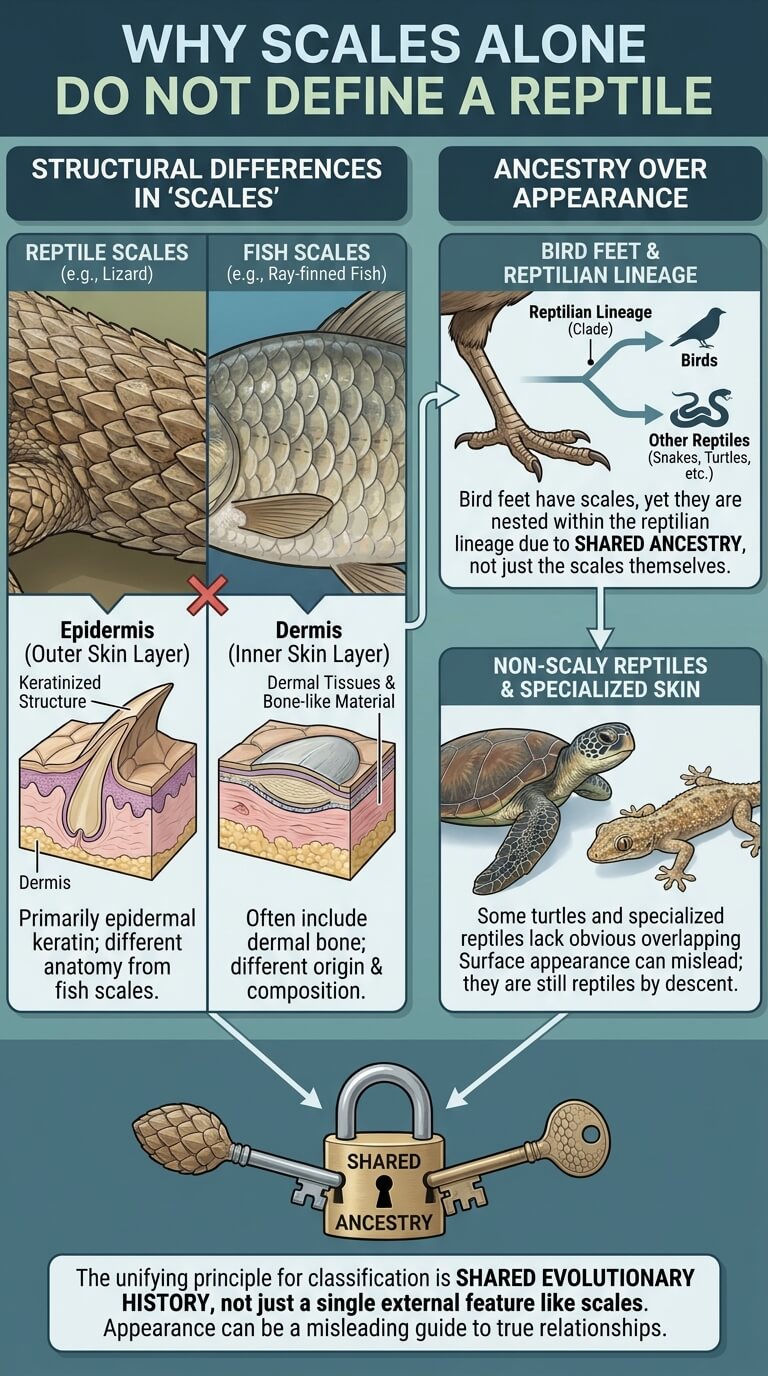
Reptile epidermal scales and scutes versus fish scales
The word “scale” describes several kinds of biological covering that are not all structurally equivalent. Reptile scales are primarily keratinized structures of the epidermis, the outer layer of skin. Many fish scales, by contrast, include dermal tissues and can contain bone-like material. Animal Diversity Web’s overview of ray-finned fish scales describes the layered structures found in major fish scale types.
This distinction is a useful reminder that names based on appearance can hide different anatomy. A lizard scale and a fish scale can both protect the body, but they are not simply the same structure placed on two different animals.
Bird feet, reptilian ancestry, and why surface appearance can mislead
Bird legs and feet often show obvious scales, yet birds are usually taught separately from reptiles in everyday education. Evolutionary classification makes the picture more interesting because birds are nested within the broader reptilian lineage. Their scaly feet are not the reason birds belong there. Shared ancestry is.
The same principle works in the other direction. An animal without obvious scales does not automatically fall outside reptiles. Some turtle surfaces look very different from the overlapping scales of a snake, and highly specialized reptile skin can depart from the familiar textbook image.
Why Egg Laying Does Not Define a Reptile
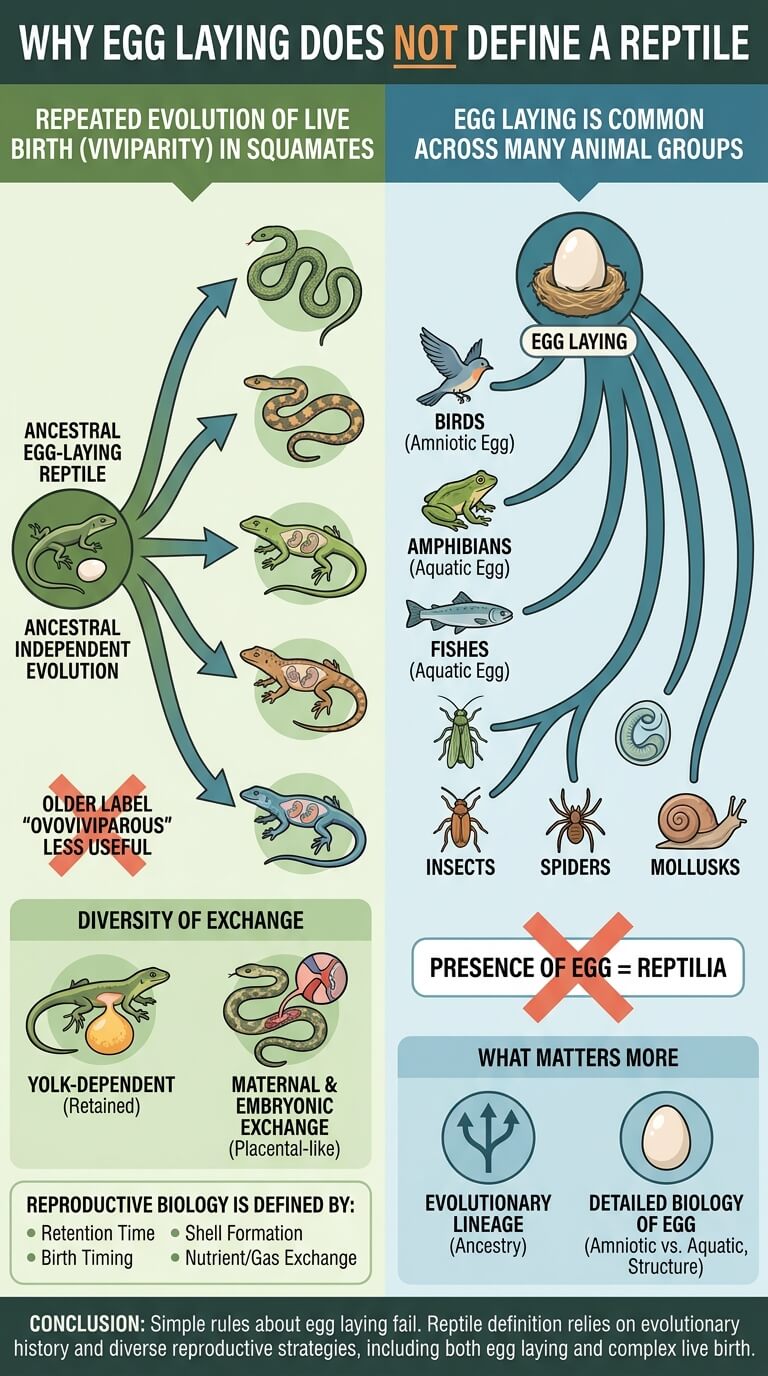
Repeated evolution of live birth in reptiles
Live birth is especially important for understanding why simple reptile rules fail. Squamates have evolved viviparity many times independently. In these lineages, embryos remain within the female through development instead of being deposited early as externally incubated eggs. Some species still depend heavily on yolk, while others show more extensive maternal and embryonic exchange.
That diversity also makes the older label “ovoviviparous” less useful when it is applied loosely. Reproductive biology is better described by what actually happens: how long embryos are retained, whether an eggshell forms, when birth or egg laying occurs, and how nutrients and gases are exchanged.
Egg laying in birds and many other animals
Egg laying is common far beyond reptiles. Birds lay eggs, as do amphibians, fishes, insects, spiders, many mollusks, and numerous other animals. The presence of an egg therefore tells you very little about whether the adult belongs to Reptilia.
What matters more is the animal’s evolutionary lineage and the detailed biology of the egg. An amniotic egg differs in fundamental ways from the exposed aquatic eggs familiar in many amphibians. Even among amniotes, however, egg structure varies, and live birth can evolve from egg-laying ancestors.
Why Ectothermy Does Not Define a Reptile by Itself
Many non-reptiles are ectothermic
Most fishes, amphibians, and invertebrates are also ectothermic, so ectothermy cannot be used as a reptile-only label. A frog and a lizard may both depend strongly on environmental heat, yet they belong to different vertebrate lineages and differ in skin biology, reproduction, development, and ancestry.
This is why “cold-blooded animal” is not a taxonomic category. It describes a broad thermal strategy, and even that strategy contains substantial variation. An ectotherm can regulate its temperature quite actively by changing where and when it moves.
Reptiles can regulate body temperature behaviorally
A reptile may bask to gain heat, retreat to shade to avoid overheating, enter a burrow where temperatures fluctuate less, or change its daily activity to match favorable conditions. Aquatic reptiles can also use water depth, surface basking, and movement between land and water as part of their thermal behavior.
These behaviors matter because temperature influences many biological processes, including movement, digestion, and reproduction. The details vary by species, so there is no single “reptile body temperature” that applies to every animal in the group.
Reptiles, Birds, and Modern Phylogeny
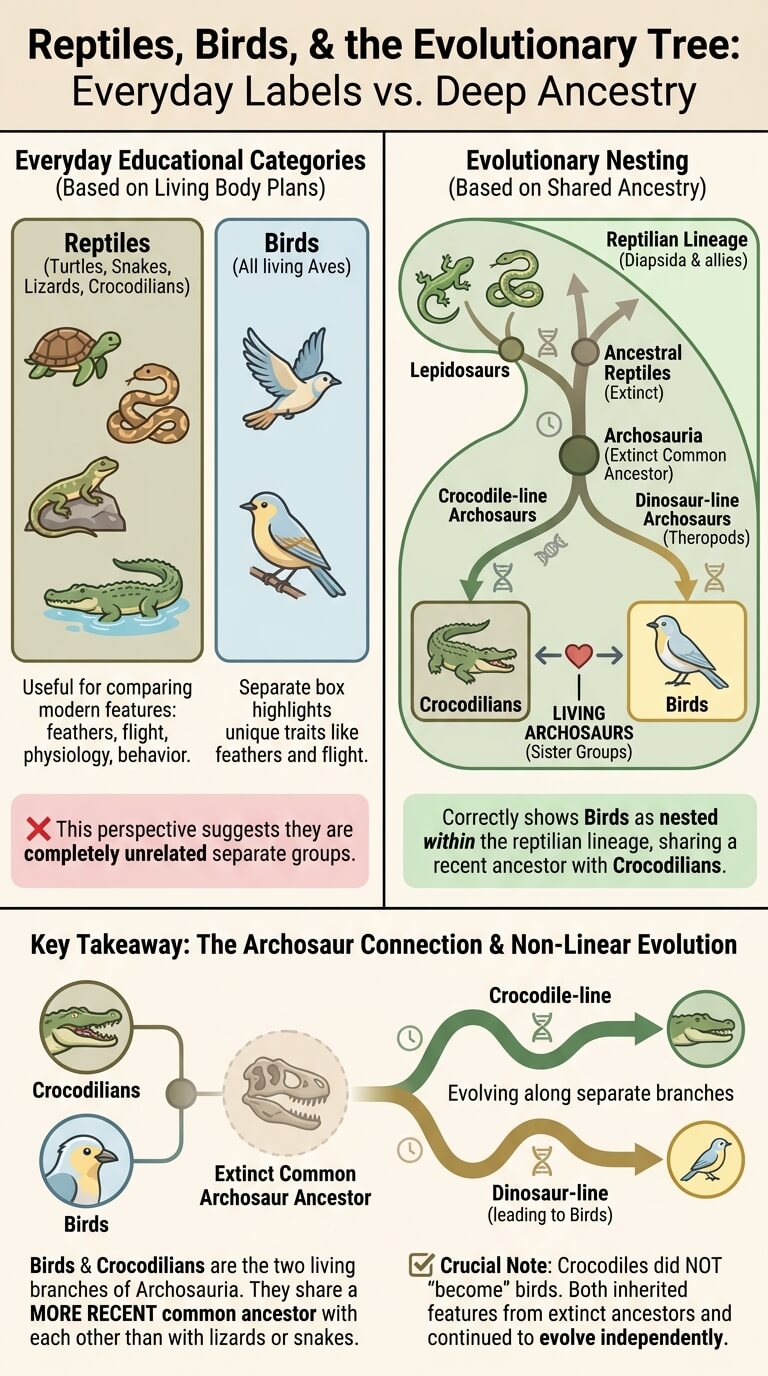
Everyday educational categories versus evolutionary nesting
Many introductory diagrams place reptiles and birds in separate boxes. That is useful when comparing living body plans, because modern birds differ greatly from turtles, snakes, crocodilians, and lizards in feathers, flight adaptations, physiology, and behavior. Evolutionary classification asks a different question: which groups share the most recent common ancestors?
Under that approach, birds fall within the broader reptilian lineage rather than standing completely outside it. This is why the phrase “living non-avian reptiles” is useful when discussing the familiar reptile groups without pretending that birds are evolutionarily unrelated.
Birds and crocodilians as living archosaurs
Birds and crocodilians are the two living branches of Archosauria. That means a crocodilian shares a more recent common ancestor with birds than with lizards or snakes. A Smithsonian summary of archosaur relationships describes archosaurs as a reptile group that includes today’s crocodiles and birds.
This relationship should not be turned into a linear story in which modern crocodiles became birds. Birds and crocodilians inherited features from extinct common ancestors, then continued along separate branches. Birds evolved within the dinosaur lineage, while crocodilians represent the living crocodile-line archosaurs.
Reptile Identity Across the Four Major Living Lineages
Squamates show extreme body-form diversity
Squamata is a good example of why reptile identity has to survive dramatic changes in body form. The group contains snakes, amphisbaenians, geckos, skinks, iguanas, chameleons, monitors, and many other lineages commonly described as lizards. Some have long limbs, some have tiny limbs, and others are completely limbless.
Snakes are therefore not a separate kind of vertebrate standing outside lizards and other reptiles. They evolved within squamate diversity. At the same time, the everyday term “lizard” does not describe one simple formal branch that neatly includes every non-snake squamate. Modern relationships within Squamata are more complex than that familiar split suggests.
Turtles, crocodilians, and tuatara express the reptile body plan differently
Turtles are instantly recognizable because of their shells, but their skeletons, lungs, skin, and reproductive biology still reflect reptile ancestry. Tortoises are terrestrial members of turtle diversity, not a separate order from turtles. Aquatic turtles are still air-breathing amniotes even when much of their daily life occurs underwater.
Crocodilians combine heavy armor, semiaquatic habits, strong sensory systems, and distinctive limb mechanics. They include crocodiles, alligators, caimans, and gharials. Calling every member of Crocodylia a “crocodile” can therefore blur real taxonomic differences.
Tuatara provide another useful lesson. They resemble some lizards superficially but belong to Rhynchocephalia, a different reptile lineage. Calling a tuatara a lizard confuses appearance with ancestry. It is more accurate to describe tuatara as the living representatives of a distinct branch closely related to squamates within Lepidosauria.
Common Mistakes About What Counts as a Reptile
Reptiles did not evolve from modern amphibians
Reptiles and modern amphibians share ancient tetrapod ancestry, but living amphibians are not the ancestors of living reptiles. Evolution branches. The lineage leading to amniotes separated from other early tetrapod lineages deep in vertebrate history, while frogs, salamanders, and caecilians continued along their own evolutionary paths.
Saying “reptiles evolved from amphibians” can sound as if a modern salamander-like animal gradually turned into a modern lizard. That is not how the relationship should be pictured. Both groups descend from much older ancestors that were unlike today’s species.
Turtles are not amphibians and tuatara are not lizards
Turtles are sometimes mistaken for amphibians because many species live in ponds, lakes, rivers, wetlands, or the ocean. Habitat does not determine vertebrate ancestry. Turtles are amniote reptiles with lungs, keratinized body coverings, internal fertilization, and a shell integrated with their skeleton.
Tuatara create the opposite problem. They look enough like lizards that the common label can seem reasonable, yet their ancestry places them in Rhynchocephalia rather than Squamata. The distinction shows why correct classification often depends on anatomy and evolutionary history that are not obvious at a glance.
Not all reptiles crawl, live on land, lay eggs, or have claws
Reptiles can crawl, walk, run, climb, burrow, swim, and glide. Snakes move without limbs using several locomotor mechanisms. Some lizards sprint or climb vertical surfaces. Crocodilians can raise their bodies into a high walk on land and propel themselves through water with their tails. Sea turtles use flipper-like limbs for powerful swimming.
The same diversity applies to habitat and reproduction. Some reptiles are almost entirely terrestrial, others spend much of their lives in water, and some are specialized for trees or underground spaces. Many lay eggs, many squamates give live birth, and limb or claw structure ranges from prominent to absent.
How the Main Reptile Traits Fit Together
Major reptile groups show why ancestry comes first
The four major living non-avian reptile lineages make the central point clear. Squamates can be limbed or limbless. Turtles are defined by a body plan built around the shell. Crocodilians are semiaquatic archosaurs. Tuatara represent a distinct lepidosaur lineage. These animals look different because hundreds of millions of years of separate evolution have modified the same deep reptilian heritage in different directions.
A useful reptile definition therefore combines lineage with a trait framework. Backbone, amniote ancestry, lung breathing, keratinized outer tissues, internal fertilization, and ectothermy all help describe living non-avian reptiles. None should be treated as a magic single test.
Skin, temperature biology, and reproduction reveal the exceptions
Three topics are especially good at exposing oversimplified rules. Reptile skin shows that scales and scutes vary in structure. Thermoregulation shows that ectotherms are active participants in controlling their body temperature. Reproduction shows that amniote ancestry can support both egg laying and live birth.
Looking at these systems separately also prevents one familiar animal from becoming the model for the whole group. A snake’s shedding pattern should not define turtle skin. A basking desert lizard should not define every reptile’s temperature strategy. A turtle nest should not be used to claim that all reptiles lay eggs.
Reptiles and amphibians differ for more than one reason
Reptiles and amphibians are often compared because both include many ectothermic, ground-dwelling vertebrates. The deeper distinction involves ancestry and a suite of traits, including the amniote condition, skin structure, water balance, reproductive biology, and development. Amphibians generally have more permeable, glandular skin and many species have aquatic larval stages, although important exceptions exist within Amphibia.
Temperature strategy alone does not separate the two groups because both are primarily ectothermic. Nor does simply living near water. The most reliable comparison looks at multiple biological systems together.
FAQ
Is a snake a reptile if it has no legs?
Yes. Snakes are reptiles because they belong within Squamata, a major reptile lineage. Their lack of ordinary walking limbs is an evolutionary specialization, not evidence that they fall outside reptiles. Limb reduction and limb loss have occurred in multiple squamate lineages, so legs are not required for an animal to be a reptile.
Are turtles reptiles even though many live in water?
Yes. Turtles are reptiles in the order Testudines. Freshwater and marine lifestyles do not make them amphibians. Turtles breathe with lungs, are amniotes, reproduce through internal fertilization, and have a shell integrated with their skeleton. Aquatic species are simply reptiles that evolved strong adaptations for life in water.
Are birds reptiles scientifically?
In modern phylogenetic classification, birds are nested within the broader reptilian lineage. Birds and crocodilians are living archosaurs, and birds evolved within dinosaurs. In everyday educational writing, birds and non-avian reptiles are often discussed separately because their living forms are so distinct. The phrase “non-avian reptiles” makes that practical distinction without denying their shared evolutionary history.
Is being cold-blooded enough to make an animal a reptile?
No. Ectothermy, the more precise term, occurs in many animals that are not reptiles, including amphibians, most fishes, and many invertebrates. Reptiles are identified through evolutionary ancestry plus a combination of biological traits. Ectothermy is one part of that pattern, not a standalone definition.
Final Thoughts
What makes an animal a reptile is best answered with a combination of ancestry and biology. Living non-avian reptiles are vertebrate amniotes that breathe with lungs, have strongly keratinized outer tissues, reproduce through internal fertilization, and rely heavily on environmental heat, but they vary enormously in body form, habitat, reproductive mode, movement, and visible covering. Scales, egg laying, claws, crawling, and “cold-bloodedness” are useful clues only when they are understood as parts of a much larger pattern.
That broader view explains why a legless snake, a swimming sea turtle, an armored crocodilian, a climbing gecko, and a tuatara can all belong within reptile diversity while looking and living so differently. It also explains why birds require special wording: they are usually separated from reptiles in everyday educational use, yet modern evolutionary classification places them inside the wider reptilian tree.

Ethan Walker is the founder and research editor of Animal Fact Central. He creates and reviews educational animal facts content using trusted wildlife, pet care, and science-based sources. His work focuses on making animal behavior, adaptations, habitats, and species facts clear, accurate, and engaging for everyday readers.
Read More Details About Ethan Walker: https://animalfactcentral.com/ethan-walker/