
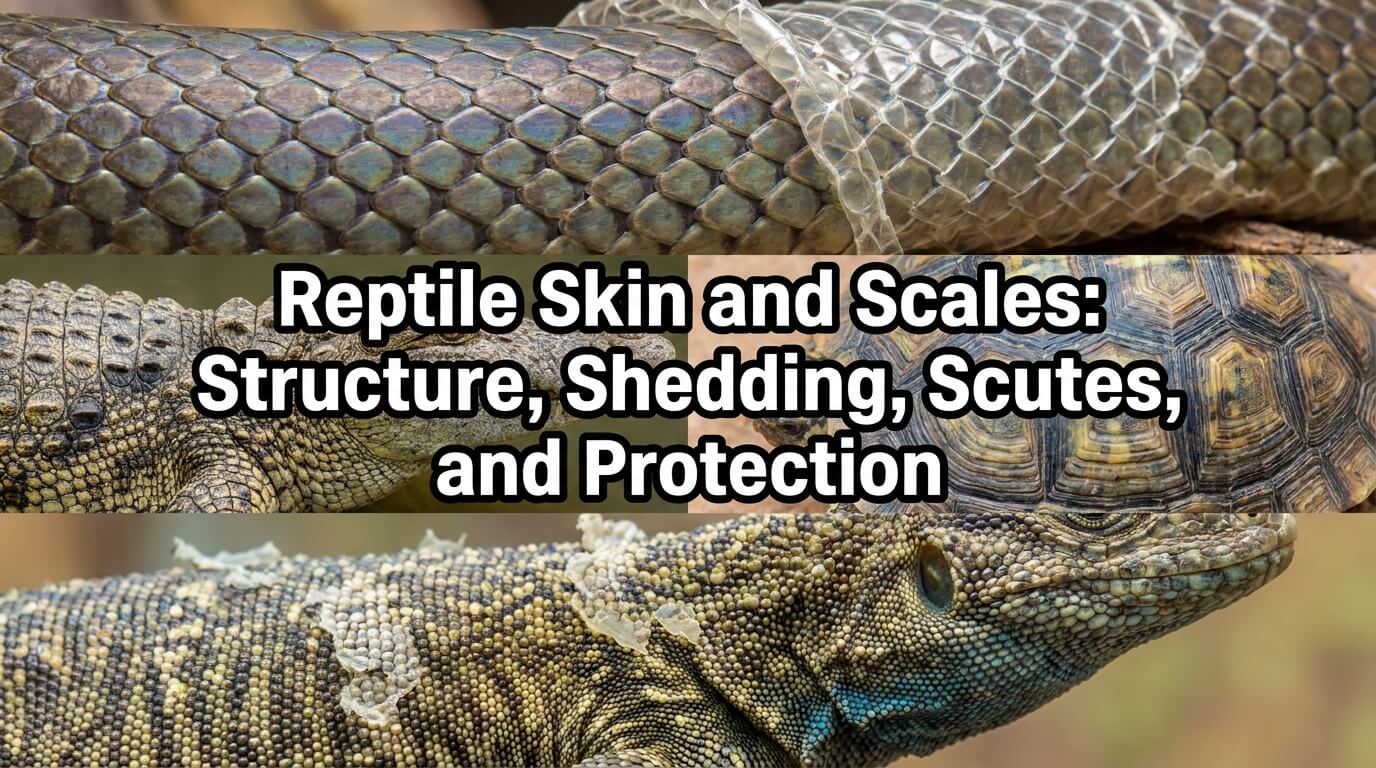
Reptile skin does far more than make a snake look glossy or an alligator look armored. In living non-avian reptiles, the outer skin forms a tough, keratinized barrier that helps limit water loss, resists abrasion, carries color and display patterns, and in some species even contains highly specialized sensory structures. Yet reptile skin is not built the same way in every lineage. Snake scales, lizard scales, turtle shell scutes, and crocodilian armor all reflect different body plans and ecological demands.
The biggest misconception is that every reptile is wrapped in one identical type of “scale” and sheds it the way a snake does. That is not how reptile integument works. Integument is the biological term for skin and its associated structures. Reptiles continually renew their outer tissues, but the pattern can range from a snake releasing a relatively continuous outer layer to a lizard shedding in patches, while turtles and crocodilians renew keratinized surfaces in very different ways.
Quick Answer: What Reptile Skin Does
Protection, water balance, sensory roles, and visual signaling
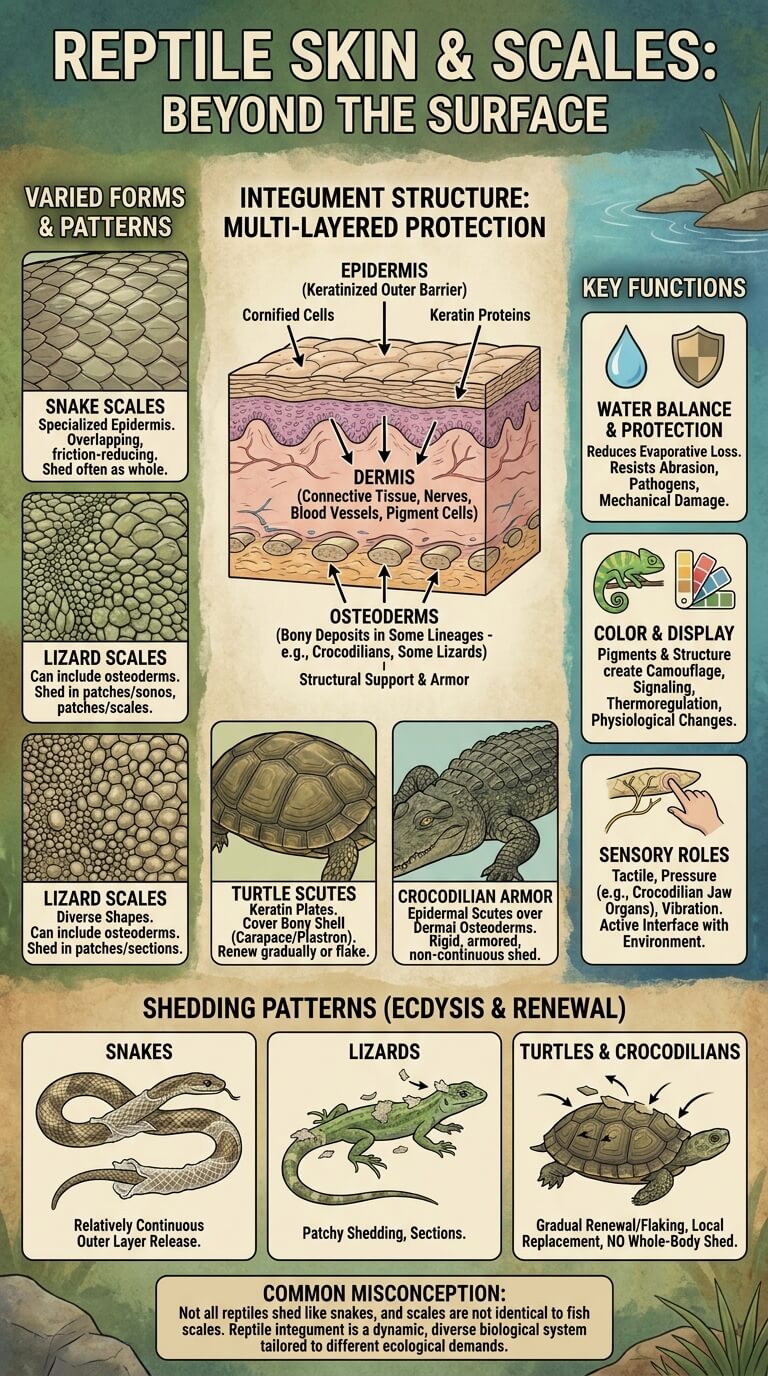
Reptile skin combines protection with flexibility. Its outer epidermis is strongly cornified, meaning cells near the surface become packed with structural proteins and form a durable outer layer. This barrier reduces evaporative water loss compared with the more permeable skin of amphibians, while also helping protect the body from scratches, soil, vegetation, prey struggles, and ordinary wear.
That barrier is not a simple waterproof wrapper. Water still moves across reptile skin, and permeability differs among species, body regions, and environmental conditions. A major review of tetrapod skin notes that reptile integument can be highly resistant to water movement while still showing substantial variation among turtles, crocodilians, and lepidosaurs such as snakes and lizards. The Journal of Experimental Biology review of tetrapod integument is especially useful for understanding that variation.
Skin also contributes to appearance and communication. Pigment cells and structural properties create colors and patterns used for camouflage, display, species recognition, and sometimes physiological color change. In crocodilians, specialized skin organs can detect mechanical stimuli. In many lizards, scales may carry microscopic structures associated with touch, traction, or specialized movement. Reptile skin is therefore not passive armor. It is an active interface between the animal and its environment.
The Basic Structure of Reptile Skin
Epidermis, keratinization, and the outer barrier
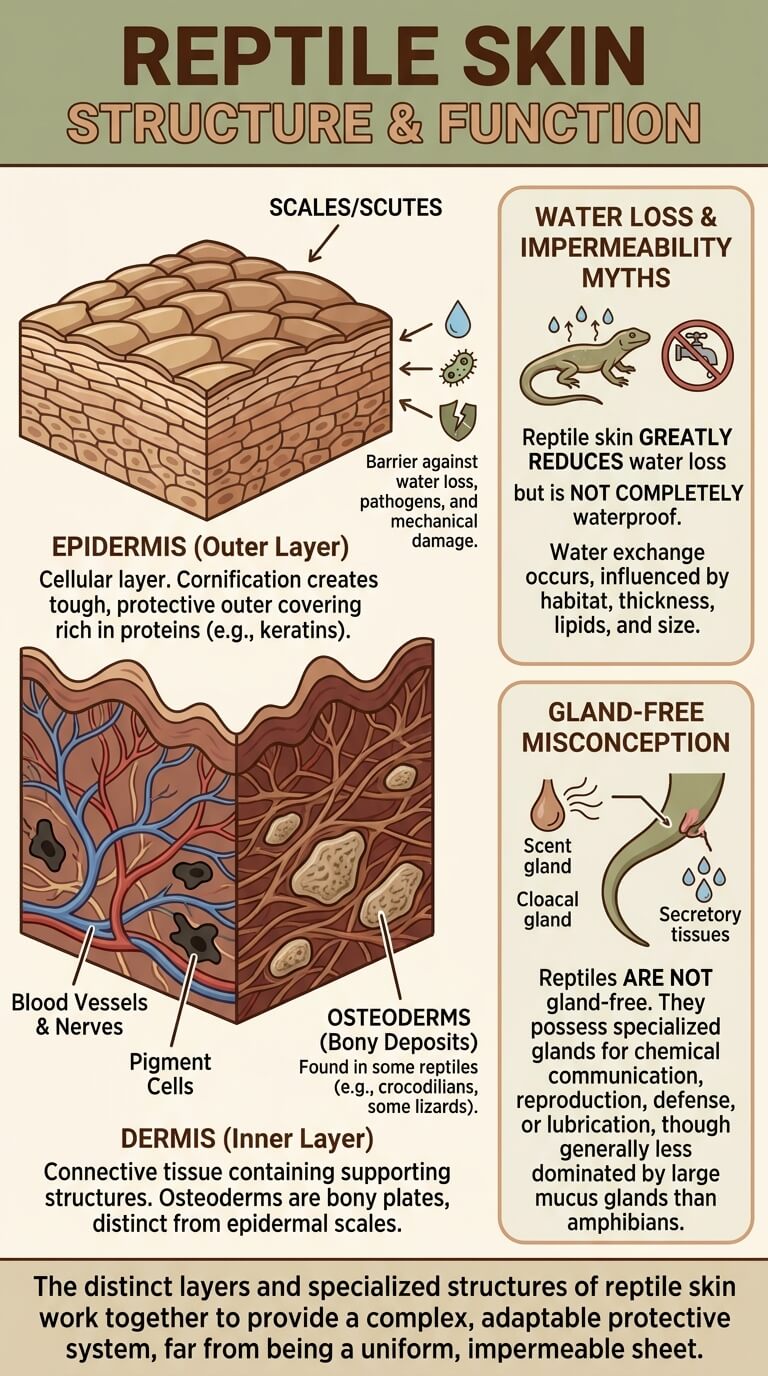
The epidermis is the outer cellular layer of the skin. In reptiles, its superficial cells undergo a process often called cornification, producing a tough outer covering rich in corneous proteins. Older literature often refers broadly to alpha- and beta-keratin, while modern molecular work uses more detailed terminology for the proteins involved. For a general reader, the key point is that reptile epidermis can become much harder and more resistant than the flexible living layers underneath it.
A recent review of reptile epidermal development describes reptile skin as a protective barrier against water loss, pathogens, and mechanical damage. It also emphasizes that scales and scutes are specialized epidermal structures rather than one uniform sheet of armor. The review of reptile skin development and structure compares these features across major reptile lineages.
Dermis and deeper supporting tissues
Beneath the epidermis lies the dermis, a connective-tissue layer containing blood vessels, nerves, pigment cells, and other supporting structures. In some reptiles, the dermis can also contain bone. These bony deposits are called osteoderms, and they are especially conspicuous in crocodilians, though osteoderms also occur in some lizards.
This distinction matters because a visible surface scale and a deeper bony plate are not the same thing. The surface belongs to the epidermal covering. An osteoderm forms within the dermis. They can occur together, creating a layered protective system, but using the words scale, scute, and osteoderm interchangeably can hide important anatomy.
Why reptile skin is not completely waterproof or gland-free
Reptile skin greatly reduces water loss compared with a thin, highly permeable body surface, but it is not completely impermeable. Water exchange still occurs, and some species can absorb or lose water through particular regions more readily than others. Habitat, skin thickness, lipids, body size, and behavior all influence how much water a reptile loses.
Reptiles also are not literally gland-free. Their skin is generally less dominated by large mucus and poison glands than amphibian skin, but many reptiles have specialized glands. Scent glands, femoral or precloacal glandular structures, cloacal glands, and other secretory tissues occur in different groups. These can contribute to chemical communication, reproduction, defense, or lubrication depending on the species. The contrast becomes especially useful when examining reptiles and amphibians , whose skin differs in permeability, glandularity, and protective structure.
Reptile Scales Are Not the Same as Fish Scales
Epidermal origin and keratinized covering
The word scale is used for several kinds of animal coverings, but a reptile scale is not simply the land version of a fish scale. Most reptile scales are specialized structures of the epidermis and are strongly cornified. Many fish scales, by contrast, are primarily dermal structures made from mineralized or collagen-rich tissues beneath the epidermis.
This is one reason visible texture alone cannot determine evolutionary relationships. A snake and a trout are both described as scaly, yet the developmental origin, material, and arrangement of their coverings differ substantially. Even within fishes there are multiple scale types, including the thin scales of many bony fishes and the tooth-like dermal denticles of sharks and rays.
Why the shared word scale can hide different structures
Common language groups together body coverings that look similar, but anatomy separates them more carefully. Reptile scales are part of a cornified epidermal system, while fish scales usually involve deeper dermal tissues.
For readers, the safest approach is to treat “scale” as a useful descriptive word that still requires anatomical context. Two animals can both have scales without those scales being homologous in every detail or built from the same tissues.
Scales, Scutes, and Osteoderms
What biologists mean by scales and scutes
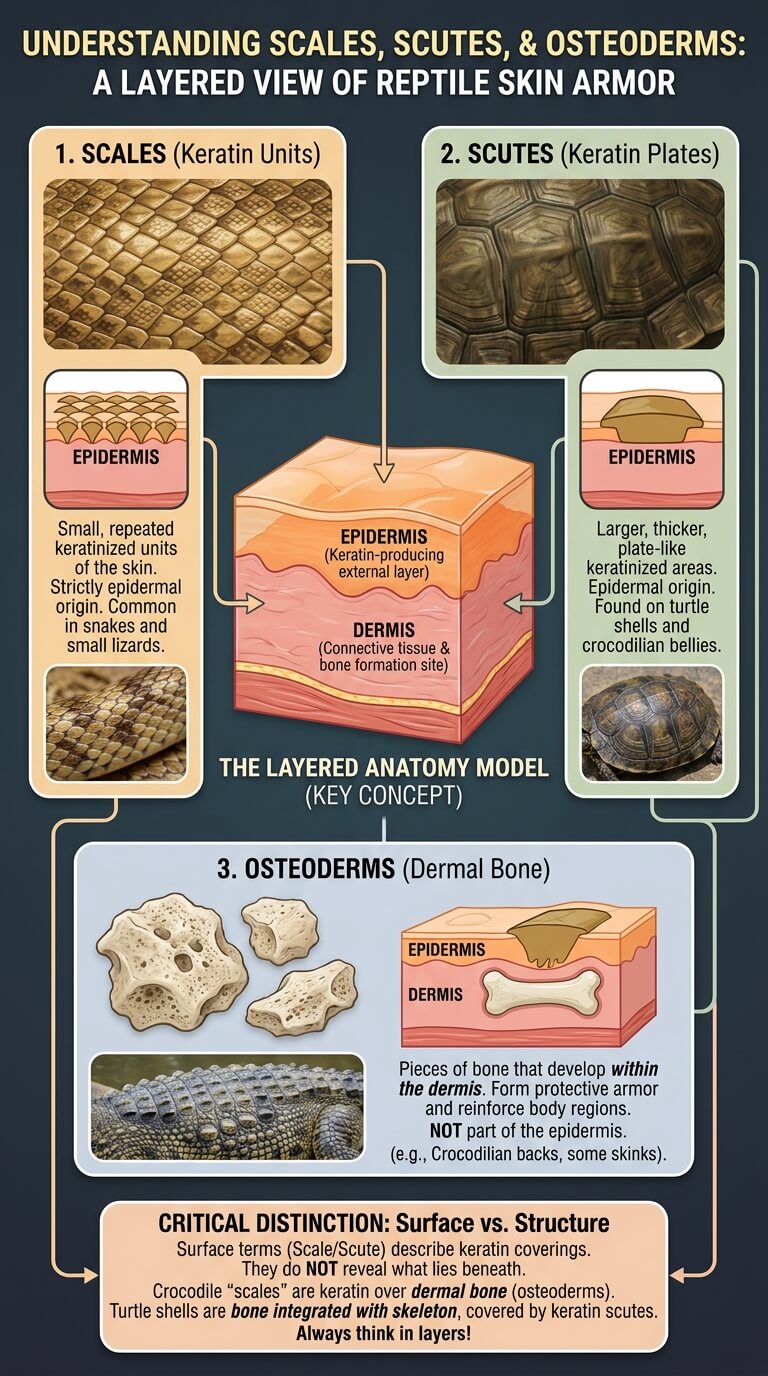
Scale and scute are partly descriptive terms, and usage can differ across groups. A scale usually refers to a smaller repeated keratinized unit of the skin. A scute often refers to a larger, thicker plate-like area. Turtles commonly have named scutes covering much of the shell surface, while crocodilians are often described as having scutes overlying armored areas of the body.
The terms are helpful, but they do not automatically reveal what lies beneath. A keratinized scute may sit over ordinary connective tissue, over shell bone, or above an osteoderm depending on the animal and body region. That is why a surface diagram and a skeletal diagram can look different even when they describe the same patch of body.
Bony osteoderms beneath the skin in crocodilians and some other reptiles
Osteoderms are pieces of bone that develop within the dermis. They can form protective plates, reinforce body regions, and in some species may have additional physiological roles. In American alligators, the back is armored with embedded bony plates, a feature described in the Smithsonian’s American alligator profile.
Osteoderms are especially familiar in crocodilians because the dorsal body surface is so heavily armored. They also occur in various lizards, including some skinks, anguids, and other lineages. Their presence, thickness, and distribution vary, so a lizard with osteoderms should not be treated as a miniature crocodilian.
External keratinized covering versus dermal bone
A useful mental model is to imagine layers. The external surface is made by the epidermis. Below it sits the dermis. If an osteoderm is present, that bone is embedded in the dermis rather than replacing the epidermis. This layered anatomy is why it is inaccurate to say that crocodile “scales are made of bone.” The animal can have keratinized surface structures associated with deeper bony armor.
The same caution applies to turtles. Their shells are not simply oversized scales and are not equivalent to crocodilian osteoderms. Turtle shell bone is deeply integrated with the skeleton, while keratinous scutes cover the surface in many species.
How Reptile Skin Renews Itself
Ecdysis and replacement of keratinized layers
The outer surface of reptile skin wears down and must be replaced. In squamates, which include snakes, lizards, and amphisbaenians, periodic shedding of the outer epidermal generation is called ecdysis. A newer layer forms underneath before the older outer layer is released.
The word ecdysis is often associated with a snake leaving behind a recognizable skin, but the broader biological process is more varied. Lizards can shed sections at different times. Geckos may remove loose skin with the mouth, and some consume the shed material. The timing of shedding can change with growth, season, nutrition, reproductive condition, and other biological factors.
Growth, wear, and routine skin renewal
Growth is one reason a young reptile may shed frequently, but it is not the whole explanation. The outer surface is exposed to abrasion, dirt, parasites, and microscopic damage. Replacing that surface renews the functional barrier. Research on geckos, for example, has examined how ecdysis can restore the performance of adhesive toe surfaces after contamination or damage.
Skin renewal also does not mean every surface cell waits for a dramatic shedding event. Different reptile groups renew outer tissues in different patterns. The visible shed that catches human attention is only one expression of a continuous biological need to maintain the body surface.
Why shedding is not simply caused by outgrowing the skin
A common explanation says reptiles shed because their skin cannot grow. That is too simple. Living skin grows and changes with the animal. What is periodically replaced is the older outer cornified layer or epidermal generation. Growth can influence how often renewal occurs, especially in juveniles, but surface wear and normal tissue cycling matter too.
This distinction also helps explain why adults continue to renew skin even after their fastest growth period is over. A mature reptile still needs a functional barrier, intact scales, and healthy surface tissues.
How Shedding Patterns Differ Among Reptiles
Snakes and relatively continuous sheds as one pattern
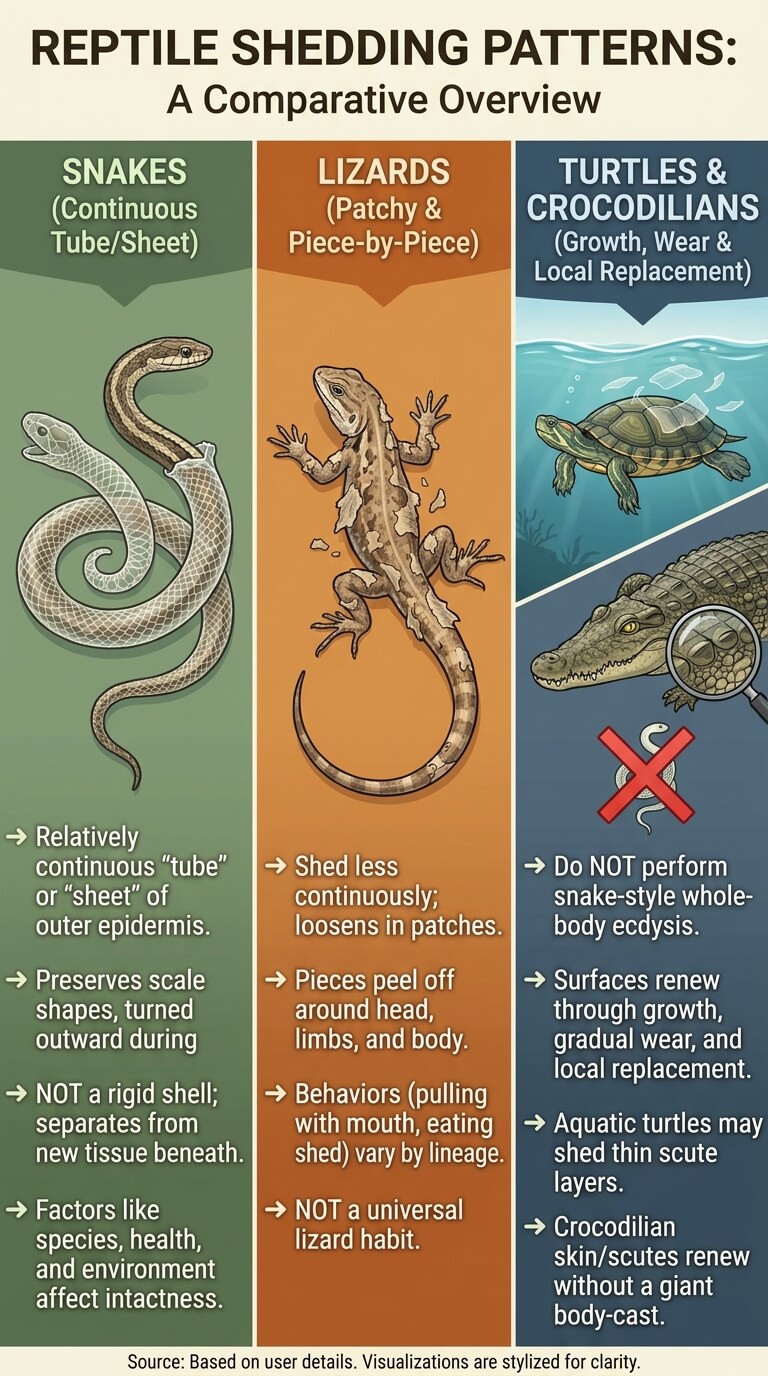
Many snakes release the old outer epidermal layer as a relatively continuous tube or sheet. That familiar shed preserves the shape of individual scales and can include thin coverings from specialized areas. It is one striking version of squamate ecdysis, not the template for every reptile.
The process should not be confused with a snake crawling out of a rigid shell. The outer epidermal layer separates from newer tissue beneath it and is turned outward as the animal works free. Species, health, age, and environmental conditions can affect whether the shed comes away neatly or breaks into pieces.
Lizards and patchy or piece-by-piece shedding patterns
Many lizards shed less continuously than snakes. Old skin may loosen in patches around the head, limbs, tail, and body rather than peeling away as one complete covering. Some lizards pull at loosened sections with the mouth, and some eat shed skin. These behaviors vary by lineage and should not be treated as universal lizard habits.
Turtles and crocodilians: why snake-style whole-body shedding is the wrong model
Turtles and crocodilians do not normally perform the snake-like whole-body ecdysis familiar from squamates. Their keratinized surfaces renew through growth, wear, and local replacement. Some aquatic turtles periodically shed thin layers from shell scutes, while other turtle surfaces may flake or wear more gradually.
Crocodilian skin and scutes also renew without producing one giant body-shaped cast. Their heavily armored dorsal regions combine keratinized covering with underlying bone, so thinking of the whole animal as enclosed in a replaceable snake-style skin is anatomically inaccurate.
Turtle Shell Coverings Without Oversimplification
Shell bone integrated with the skeleton
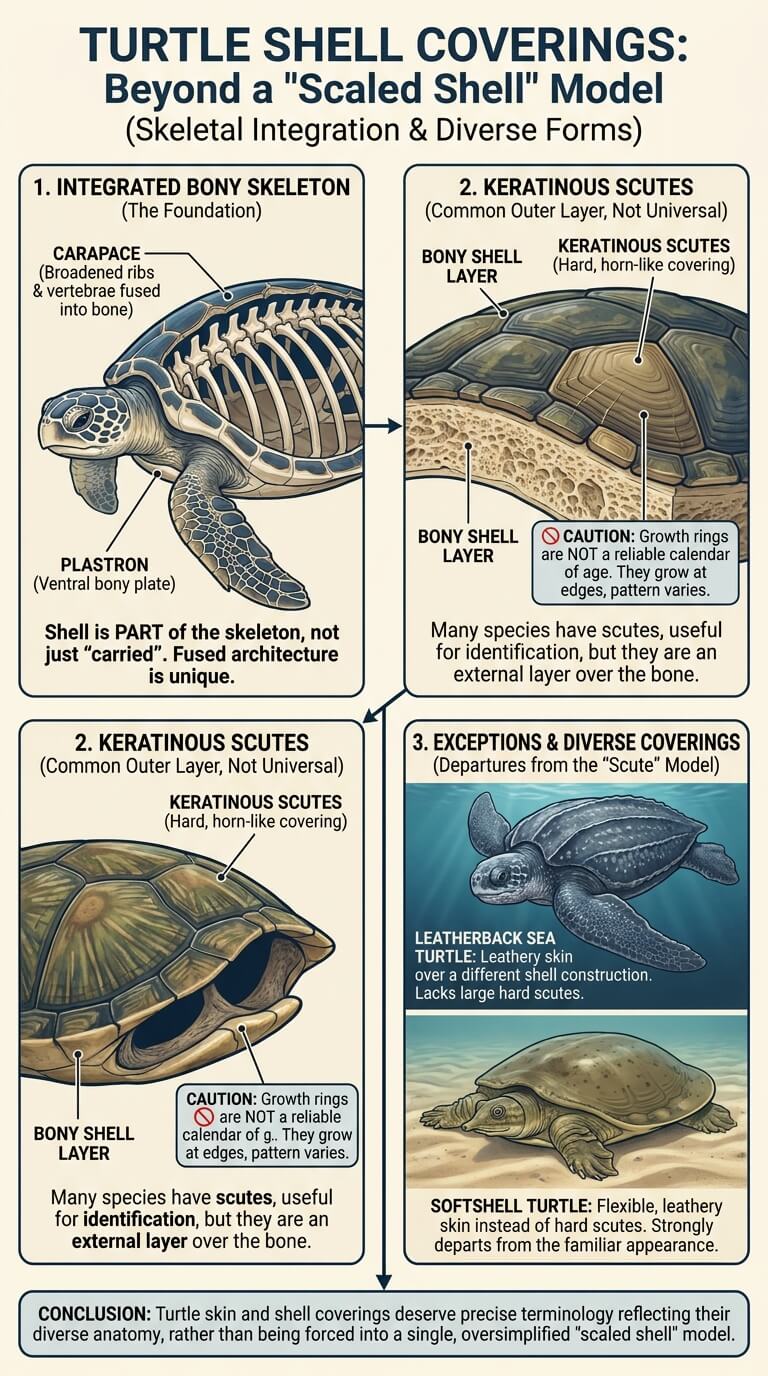
A turtle shell is part of the skeleton. The upper shell, or carapace, includes broadened ribs and vertebral elements incorporated into a bony structure. The lower shell is the plastron. This architecture is one of the most distinctive body plans among living vertebrates.
The Smithsonian Ocean overview of sea turtle shells describes a bony layer fused with the ribs and a protective outer covering in species with scutes. This is why saying a turtle “carries a shell made of scales” misses the most important part of the anatomy.
Keratinous scutes in many species and exceptions in external coverings
Many turtles have keratinous scutes over the bony shell. The arrangement of these scutes can be useful for describing body regions and sometimes for identification. They can grow at their edges and may show visible rings or patterns, but those marks should not be treated as a perfectly reliable calendar of age.
Not all turtle shells have the same outer covering. Leatherback sea turtles, for example, lack the large hard scutes typical of many other sea turtles and instead have a more leathery skin over a different shell construction. Softshell turtles also depart strongly from the familiar hard-scute appearance. Turtle skin and shell covering therefore deserve their own terminology rather than being forced into a single “scaled shell” model.
Crocodilian Armor and Sensory Skin
Scutes and osteoderms
Crocodilian backs are covered by prominent scutes, many associated with underlying osteoderms. This combination creates a stiff, rugged surface along much of the dorsal body while the skin around joints, flanks, and underside remains more flexible. The tail also carries enlarged scutes that contribute to its distinctive ridged profile.
Hard dorsal plates coexist with more flexible skin around mobile regions, showing how much one reptile’s integument can vary across the body.
Integumentary sensory structures where supported
Crocodilians have small sensory organs embedded in the skin, especially around the jaws. Research comparing alligators and crocodiles found that these integumentary sensory organs are richly innervated and respond to mechanical stimuli, including water movement and direct touch. The peer-reviewed study of crocodilian integumentary sensory organs documents both their distribution and their mechanosensory function.
The distribution is not identical across every crocodilian. Alligators and caimans concentrate many of these organs around the face, while true crocodiles and gharials can have sensory structures extending onto more of the body. That variation is a good reminder that even closely related reptiles can use their skin differently.
Color, Camouflage, and Display
Pigmentation and structural effects
Reptile colors arise from pigment cells in the skin and, in some species, microscopic structures that reflect or scatter light. Different combinations can create blacks, browns, reds, yellows, greens, blues, and iridescent effects. Patterns can break up the body outline, warn rivals, attract mates, or make an animal less conspicuous against bark, sand, leaves, or water.
Color is not always fixed. Skin appearance can change with age, season, reproductive condition, temperature, stress, or social context. A juvenile may look very different from an adult, and males and females may differ. For this reason, a single photograph rarely captures the complete color range of a species.
Color change as camouflage, signaling, physiology, or temperature context depending on species
Chameleons are famous for color change, but the popular idea that they simply copy whatever background they sit on is incomplete. Color change can contribute to camouflage, but it is also used in social signaling and can reflect physiological state or temperature. Other lizards, including anoles and some geckos, can change brightness or hue as well. Color, pattern, and skin structures can also play roles in display and defense, making them part of the wider picture of reptile behavior .
The mechanism and function differ among species. Some changes happen through movements or reorganization of pigments and reflective structures in specialized skin cells. It is therefore safer to ask what a particular species uses color change for rather than assume every changing reptile is trying to disappear into the background.
Skin as a Sensory Surface
Touch and specialized sensory structures
Every reptile’s skin contains nerve endings that contribute to touch and body awareness, but some groups have particularly specialized surface structures. Crocodilian sensory organs are one well-studied example. Certain lizards also have scale-associated sensory structures, while the microscopic architecture of gecko toe pads is specialized for adhesion rather than ordinary touch alone.
These systems let the integument contribute to information gathering as well as protection, whether the animal is pressing through soil, gripping a surface, or moving its jaws through water.
How skin supports ecology without replacing the other senses
Skin-based sensation works alongside vision, smell, hearing, and other sensory systems. It should not be treated as a reptile’s single dominant sense. A snake’s tongue-flicking chemoreception, a turtle’s vision, and a crocodilian’s pressure-sensitive jaw organs solve different sensory problems.
Likewise, a scale itself is not automatically a sensory organ. Some scales contain or are associated with specialized receptors, while others mainly provide protection, traction, or structural support. Function has to be established for the specific structure and species.
Skin and Habitat Adaptation
Reducing water loss on land
A strongly cornified epidermis was important to the success of amniotes on land because it limits uncontrolled water loss. For reptiles in dry environments, that barrier works together with behavior. Desert species may shelter in burrows, become active during cooler periods, or reduce exposed surface area. Skin alone does not make an animal drought-proof.
Even reptiles from humid forests or wetlands benefit from limiting evaporation, unlike amphibians whose more permeable skin often places tighter constraints on moisture balance.
Aquatic, desert, forest, and fossorial trade-offs
Aquatic reptiles still have keratinized skin even though they spend much of their lives in water. Sea turtles, sea snakes, freshwater turtles, and crocodilians all retain air-breathing reptile physiology, but their skin and body surfaces are shaped by swimming, salt exposure, drag, and repeated movement between water and air.
Forest and arboreal reptiles may benefit from flexible skin, gripping surfaces, color patterns, or display structures. Fossorial reptiles that push through soil often have smooth, reinforced, or compact body coverings that reduce snagging and abrasion. Desert reptiles may have surface textures and behaviors that help them cope with hot ground and dry air. No single skin design is optimal for every habitat.
Common Myths and Mistakes
All reptiles shed in one piece
Snakes make this myth easy to understand because a complete shed is so memorable. In reality, shedding patterns vary. Many lizards shed in sections, turtles may shed thin layers from scutes or renew surfaces gradually, and crocodilians do not leave behind an intact crocodile-shaped skin.
Reptile scales are identical to fish scales
They are not. Reptile scales are primarily specialized cornified epidermal structures, while most fish scales are largely dermal. The same everyday word describes coverings that differ in tissue origin and evolutionary history.
Reptile skin has no glands
Reptile skin is less glandular than amphibian skin, but many reptiles possess specialized scent or secretory glands. Depending on the species, these structures can play roles in chemical communication, reproduction, lubrication, or defense.
Turtle shells are just collections of scales
A turtle shell contains bone integrated with the skeleton. Many species have keratinous scutes over that bone, but the scutes are only the outer covering. Some turtles also lack the familiar arrangement of hard shell scutes, so the “giant scales” description fails both anatomically and comparatively.
How Skin Relates to Other Parts of Reptile Biology
Skin helps define reptiles, but no single surface trait is enough
Keratinized skin is one of the major features associated with living non-avian reptiles, but it should not be used as a one-step identification rule. Different reptile lineages modify the integument in different ways, and other vertebrates also produce keratinized structures. Reptile identity depends on evolutionary ancestry and a combination of biological traits, not on whether an animal simply looks scaly.
Skin affects sensation, temperature, movement, and habitat use
Surface anatomy intersects with many other systems. Darker or lighter coloration can influence heat absorption in some contexts. Scale texture can change friction during movement. Sensory structures provide information about touch or water movement. Water-resistant skin broadens the range of places a reptile can use, while flexible hinges and specialized pads allow different styles of locomotion.
Snake shedding is one specialized example within broader reptile skin biology
Snake ecdysis is worth understanding because it is visually dramatic and biologically distinctive, but it should not define how readers imagine reptile skin as a whole. Snakes are one branch within Squamata. Lizards, turtles, crocodilians, and tuatara all add different versions of keratinized skin, surface renewal, armor, coloration, and sensory function.
Keeping that broader view prevents a snake-centered picture of reptiles and makes the diversity of reptile integument much easier to understand.
FAQ
Do all reptiles shed their skin?
All reptiles renew outer skin tissues, but they do not all shed in the same visible way. Snakes and other squamates undergo periodic ecdysis of an outer epidermal generation. Many lizards shed in patches. Turtles and crocodilians renew keratinized surfaces through different patterns of growth, wear, flaking, or local replacement rather than producing one complete body-shaped shed.
Why do snakes often shed differently from lizards?
Snake skin is organized over a long, limbless body in a way that often allows the older outer epidermal layer to separate as a relatively continuous covering. Lizards have limbs, joints, and more varied surface regions, and many shed in multiple pieces. The exact pattern also differs among lizard lineages, so patchy shedding is a useful generalization rather than an absolute rule.
Are turtle shells made of scales?
No. A turtle shell is mainly a bony skeletal structure involving modified ribs and vertebral elements, plus the plastron below. Many turtles have keratinous scutes covering the shell, which can look scale-like, but those scutes are the surface layer rather than the shell’s entire structure. Some turtles, including leatherbacks and softshell turtles, have very different external coverings.
Are crocodile scales made of bone?
Not exactly. Crocodilians have keratinized surface structures, and many dorsal scutes are associated with bony osteoderms embedded in the dermis. The visible outer covering and the underlying bone are distinct layers. Saying the scales themselves are simply made of bone collapses those layers into one structure.
Final Thoughts
Reptile skin and scales are best understood as a diverse anatomical system, not a single universal covering. Keratinized epidermis helps protect the body and reduce water loss, while scales, scutes, flexible skin, osteoderms, pigments, and sensory structures vary greatly among snakes, lizards, turtles, crocodilians, and other reptiles. Snakes may shed a relatively continuous outer layer, many lizards shed in patches, turtles combine skeletal shell bone with surface coverings, and crocodilians pair armored skin with sensitive mechanoreceptors. Seeing those differences makes reptile anatomy more accurate and much more interesting than the simple idea that reptiles are animals covered in scales.

Ethan Walker is the founder and research editor of Animal Fact Central. He creates and reviews educational animal facts content using trusted wildlife, pet care, and science-based sources. His work focuses on making animal behavior, adaptations, habitats, and species facts clear, accurate, and engaging for everyday readers.
Read More Details About Ethan Walker: https://animalfactcentral.com/ethan-walker/