

Ocean conservation is the work of protecting marine animals, ocean habitats, and the natural processes that keep saltwater ecosystems alive. It is not only about saving one famous animal. It is about coral reefs, seagrass beds, mangroves, beaches, estuaries, the open ocean, deep-sea habitats, fisheries, tiny plankton, giant whales, nesting sea turtles, seabirds, shellfish, and the people who depend on healthy seas.
The main idea is simple: ocean life needs safe places to live, enough food, clean water, and room to reproduce. When pollution, overfishing, habitat damage, climate stress, vessel strikes, or accidental capture push those systems too far, animals can decline and ecosystems can lose balance. Good ocean conservation tries to reduce several pressures at once instead of treating each problem as if it exists alone.
For animal lovers, this topic matters because ocean animals are tied together in ways that are easy to miss. A reef fish may depend on coral structure. A sea turtle may depend on beaches, seagrass, and open-water migration routes. A whale may feed far from shore but still move nutrients through the sea. Protecting marine life means thinking about animals, habitats, food webs, and human activity as one living system.
Quick Overview

Ocean conservation focuses on keeping marine ecosystems healthy enough for animals to survive, reproduce, migrate, feed, and recover from stress. It includes habitat protection, pollution reduction, responsible fishing, rescue and monitoring of protected wildlife, restoration of damaged areas, and rules that limit harm in sensitive places.
No single action can protect the entire ocean. A beach cleanup may reduce plastic hazards near shore, but it will not solve bycatch. A fishing rule may help rebuild one fish stock, but it will not cool warming waters. A marine protected area may reduce certain local pressures, but it still needs good design, enforcement, and surrounding water quality. Ocean conservation works best when many tools support each other.
It also has to be specific. The needs of a coral reef are different from the needs of a kelp forest, a salt marsh, a deep-sea coral community, or the open ocean. Even within one animal group, threats can vary by species and location. A sea turtle nesting beach needs dark, undisturbed sand and safe nearshore waters. A whale population may need quieter migration routes, fewer ship strikes, and less entangling gear. A reef fish may need healthy coral, grazing balance, and fishing limits.
What Ocean Conservation Includes

Ocean conservation can sound like one giant subject, but it becomes easier to understand when it is divided into animals, habitats, and human pressures. These three pieces constantly interact. Animals use habitats for food and shelter. Habitats depend on living animals to stay healthy. Human actions can either damage those relationships or help them recover.
Ocean animals and food webs
A food web is the feeding network that moves energy through an ecosystem. In the ocean, that network can begin with microscopic algae and bacteria, then move through zooplankton, small fish, squid, larger fish, seabirds, marine mammals, and scavengers. Some animals eat plants or algae. Some filter tiny organisms from the water. Some hunt. Some clean up dead material and recycle nutrients.
Conservation has to account for these connections. Removing too many predators, grazers, or forage fish can change how the ecosystem works. For example, animals that graze algae can help keep some reefs from being smothered by fast-growing algae. Small schooling fish may feed larger fish, seabirds, and marine mammals. Scavengers return nutrients to the system by consuming dead animals. Each group has a job, even when it is not as famous as dolphins or sea turtles.
Marine habitats from reefs to open ocean
The ocean is not one habitat. Coral reefs, rocky shores, kelp forests, estuaries, sandy beaches, mangroves, seagrass meadows, polar seas, the deep ocean, and the open water all create different survival challenges. Light, temperature, oxygen, currents, salinity, pressure, wave action, and shelter can change from one place to another.
That matters because animals are shaped by where they live. Reef fish often use cracks, coral branches, and color patterns for shelter. Sea otters depend on coastal kelp forests. Many young fish and invertebrates use estuaries or seagrass meadows as nursery habitat. Deep-sea animals may rely on darkness, pressure tolerance, slow growth, or food drifting down from above. When conservation protects only a single animal but ignores the habitat it needs, the protection is incomplete.
Human activities that change ocean ecosystems
People affect the ocean through fishing, shipping, coastal construction, tourism, energy development, plastic use, wastewater, greenhouse gas emissions, and everyday choices made far from the coast. Some effects are direct, such as a turtle caught in fishing gear. Others are indirect, such as warmer water stressing corals or runoff changing water quality before it reaches the sea.
A Simple Framework for Understanding Ocean Conservation
Most ocean conservation efforts fit into four practical goals: protect habitats, reduce direct harm to animals, keep food webs balanced, and support recovery through research and monitoring. These goals overlap, but separating them helps explain why different tools are needed.
Protect habitats
Habitat protection means keeping the places animals use for feeding, breeding, resting, growing, nesting, or migration in good condition. A habitat can be physical, such as coral structure, rocky tide pools, sandy nesting beaches, or seagrass beds. It can also include water conditions, such as temperature, clarity, oxygen levels, and currents.
Protecting habitat can involve preventing damage before it happens, restoring damaged areas, or reducing stress around sensitive places. For example, mangroves and salt marshes can be restored after damage. Coral nurseries can support some reef restoration projects. Beach lighting rules can help nesting sea turtles in some regions. Anchoring restrictions can protect seagrass or coral from physical damage.
Reduce direct harm to animals
Direct harm happens when animals are injured, killed, displaced, or disturbed by human activity. Examples include entanglement in discarded or active fishing gear, vessel strikes, harassment of marine mammals, collection of wildlife, nesting disturbance, and accidental capture during fishing.
Reducing direct harm often requires practical changes. Fishing gear can be modified to lower unwanted catch. Vessel speed rules can reduce collision risk in certain areas. Wildlife viewing guidelines can keep people from crowding dolphins, seals, nesting birds, or sea turtles. Rescue teams can respond to stranded or entangled animals, but rescue is not a substitute for prevention.
Keep ocean food webs balanced
Food web protection means managing harvest and habitat so prey, predators, grazers, and scavengers can continue their ecological roles. This is why responsible fishing matters beyond the fish on a plate. If too many fish are removed, the effects can move through the ecosystem. If too few grazers remain on some reefs, algae can gain an advantage. If forage fish decline, animals that feed on them may struggle.
Support recovery and monitoring
Recovery depends on knowing what is happening. Scientists and managers use surveys, tagging, satellite data, fishery reports, animal health studies, genetic tools, and long-term monitoring to track changes in marine life. This information helps identify which populations are declining, which threats matter most, and which actions are working. Conservation status can vary by species, population, region, and assessment date.
Key Facts Readers Should Know About Ocean Animals and Habitats
Ocean conservation becomes clearer when readers understand a few basic facts about marine life. These facts help explain why a small change in water quality, fishing pressure, or habitat structure can affect many animals at once.
The ocean is not one habitat
Different ocean habitats create different animal communities. Coral reefs are shallow, sunlit, structure-rich systems in warm waters. Kelp forests are cooler coastal habitats built by large brown algae. Estuaries mix fresh and salt water and often serve as nursery areas. The open ocean may have little shelter but huge migration routes. The deep sea has darkness, high pressure, and limited food.
Because habitats are so different, conservation tools cannot be one-size-fits-all. A rule that helps a nesting beach may not help a deep-sea coral. A fishery closure may protect one spawning aggregation but not reduce plastic waste. A reef restoration project may help local coral structure but still struggle if heat stress and water pollution remain severe.
Small organisms support large animals
Many ocean giants depend on tiny life. Phytoplankton, which are microscopic photosynthetic organisms, form the base of many marine food webs. Zooplankton feed on them, small fish and filter feeders eat the zooplankton, and larger animals feed higher up the chain. Even whales can depend indirectly on tiny organisms through krill, fish, and other prey.
This is one reason pollution, warming, acidification, and nutrient changes matter. They can affect the smaller organisms that larger animals rely on. Ocean conservation is not only about the biggest animals. It also protects the living foundation beneath them.
Conservation often works best when threats are managed together
An animal population can face several threats at once. A sea turtle may be affected by beach disturbance, plastic ingestion, boat strikes, bycatch, illegal harvest in some regions, and climate-related changes to nesting beaches. A coral reef may face heat stress, pollution, disease, damaging fishing practices, and physical breakage.
When several pressures combine, solving only one may not be enough. That is why conservation plans often include a mix of laws, local management, restoration, public education, monitoring, and industry changes. The most useful question is not just, “What is the threat?” It is, “Which threats are acting together, and which actions can reduce the most harm?”
Major Threats to Ocean Life

Threats to ocean animals vary by place, species, and human activity. Still, several pressures appear again and again in marine conservation: plastic pollution, bycatch, overfishing, climate stress, habitat loss, and disturbance. None of these affects every animal in the same way.
Plastic pollution and entanglement
Plastic pollution can harm animals through entanglement, ingestion, smothering of habitats, and the spread of debris through currents. Bags, lines, nets, packing bands, bottle caps, and broken fragments can persist long enough to move far from where they were used. The problem begins on land as well as at sea because rivers, stormwater, wind, and poor waste handling can carry trash into waterways.
The scale is large. UNEP’s marine litter and plastic pollution summary reports that millions of tonnes of plastic waste leak into aquatic ecosystems each year. For animals, the danger depends on size, shape, location, and exposure. A sea turtle may mistake some plastic for food. A seal or whale may become entangled in rope or netting. Seabirds may feed plastic pieces to chicks. Microplastics create additional concerns because they are small enough to move through food webs.
Bycatch and accidental capture
Bycatch happens when fishing catches animals that were not the target. It can include unwanted fish, sea turtles, seabirds, marine mammals, and other species that are hooked, netted, trapped, or entangled. Some bycaught animals are released alive, while others are injured or die. The level of risk depends on the gear type, location, season, target fishery, and animal involved.
NOAA Fisheries describes bycatch as a complex issue for sustainable fisheries and marine life protection. Reducing it can involve gear changes, time-area closures, observer programs, electronic monitoring, turtle excluder devices, acoustic deterrents in some cases, and better handling practices. Bycatch is separate from overfishing, but the two can overlap when fishing pressure affects both target and non-target animals.
Overfishing and food web pressure
Overfishing occurs when fish are caught faster than a population can replace itself. The result can be fewer adult fish, smaller average size, lower reproduction, and less food for predators that depend on those fish. Overfishing can also alter habitats when damaging gear is used in sensitive areas.
Science-based fishery management is designed to reduce that risk. NOAA Fisheries explains sustainable fisheries through stock assessments, catch limits, rebuilding plans, bycatch reduction, and long-term monitoring. A well-managed fishery is not simply about catching less. It is about matching harvest to what the population can support while considering habitat, protected species, and ecosystem health.
Climate stress and habitat loss
Climate change affects ocean life through warming water, sea-level rise, shifting currents, ocean acidification, and changes in storms and oxygen conditions. These effects do not look the same everywhere. Some species may shift their ranges. Some habitats may lose structure. Some prey may move at different times or to different places, forcing predators to adjust.
NOAA Fisheries’ climate change overview notes that changing ocean conditions affect marine life, ecosystems, fisheries, protected resources, and coastal communities. For coral reefs, heat stress can cause bleaching. For shell-building animals, acidification can make it harder to build or maintain calcium carbonate structures. For nesting beaches and coastal marshes, sea-level rise and stronger storms can change the available habitat.
How Ocean Animals Help Keep Marine Ecosystems Working
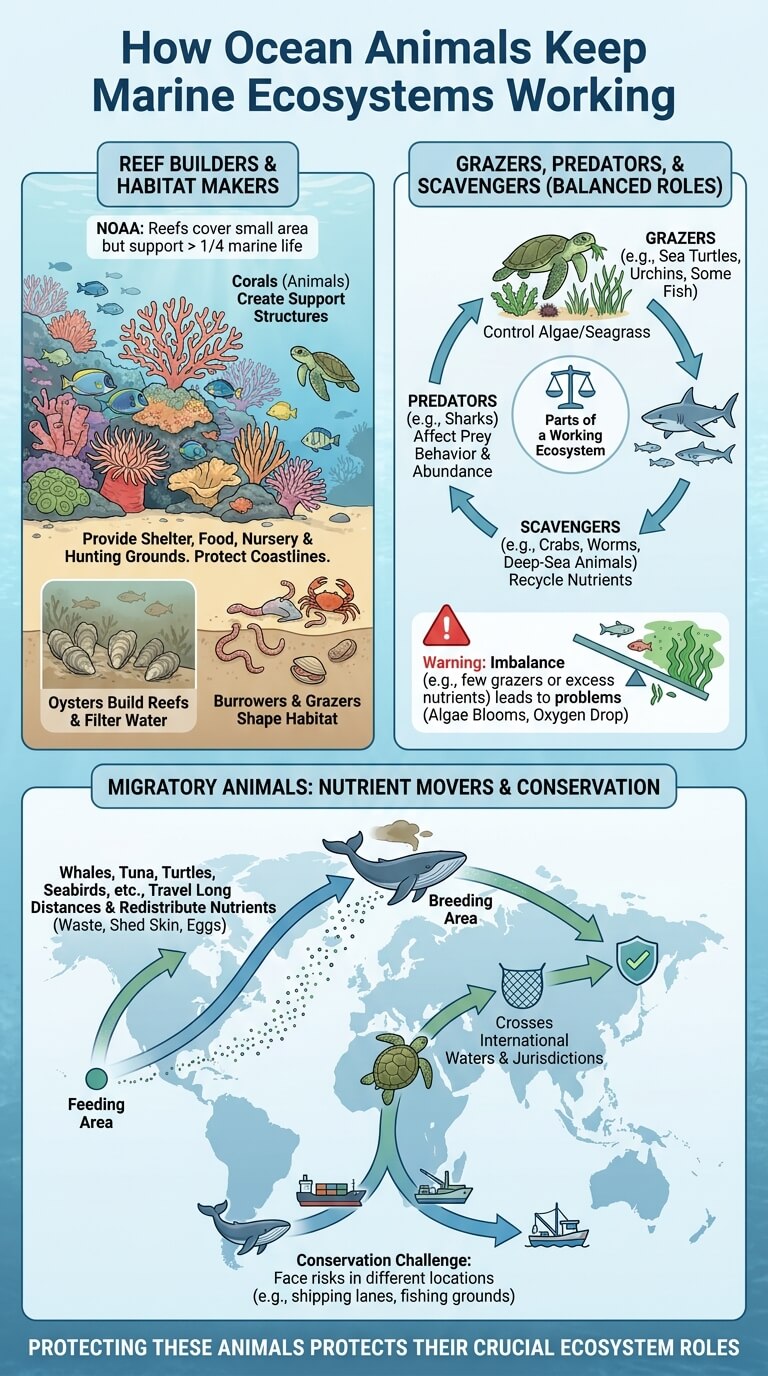
Marine animals are not just residents of the ocean. Many help shape the ecosystems around them. Some build habitat. Some graze algae. Some move nutrients across long distances. Some control prey populations. Some clean up dead material. These roles help explain why protecting animals can also protect habitats.
Reef builders and habitat makers
Corals are animals, and reef-building corals create hard structures that support many other species. Reefs provide shelter, feeding space, nursery habitat, and hunting grounds. They also help protect some coastlines from wave energy. According to NOAA’s coral reef tutorial, coral reefs cover a small part of the ocean but provide habitat for at least a quarter of marine life.
Other animals also shape habitats. Oysters build reefs that can filter water and create surfaces for other life. Burrowing animals move sediment. Grazing animals can keep algae in check. Even animals that seem small or hidden may change the structure and function of a habitat.
Grazers, predators, and scavengers
Grazers such as some fish, sea urchins, and sea turtles can influence how algae and seagrass grow. Predators can affect prey behavior and abundance. Scavengers such as crabs, worms, fish, and deep-sea animals help recycle nutrients by consuming dead material. These roles are not good or bad by themselves. They are parts of a working ecosystem.
Problems often appear when one role is weakened or overamplified. If too many grazers disappear, algae may expand in some habitats. If predator numbers change sharply, prey behavior and food web structure may shift. If nutrient loads from land become too high, algae blooms can reduce oxygen and stress marine life. Conservation looks at these roles together instead of treating each animal as isolated.
Migratory animals that move nutrients
Many marine animals travel long distances. Whales, tuna, sea turtles, seabirds, salmon, and some sharks move between feeding, breeding, and resting areas. During those movements, animals carry nutrients through waste, shed skin, eggs, carcasses, and predator-prey interactions. A whale feeding in one region and releasing waste in another can help redistribute nutrients near the surface.
Migration also creates conservation challenges. An animal may be protected in one location but face risk in another. A sea turtle can hatch on one beach, drift through ocean currents, feed in coastal areas, and cross international waters. A whale can move through shipping lanes, fishing grounds, and protected areas during the same year. Protecting migratory animals often requires cooperation across regions.
Conservation Tools People Use to Protect the Ocean
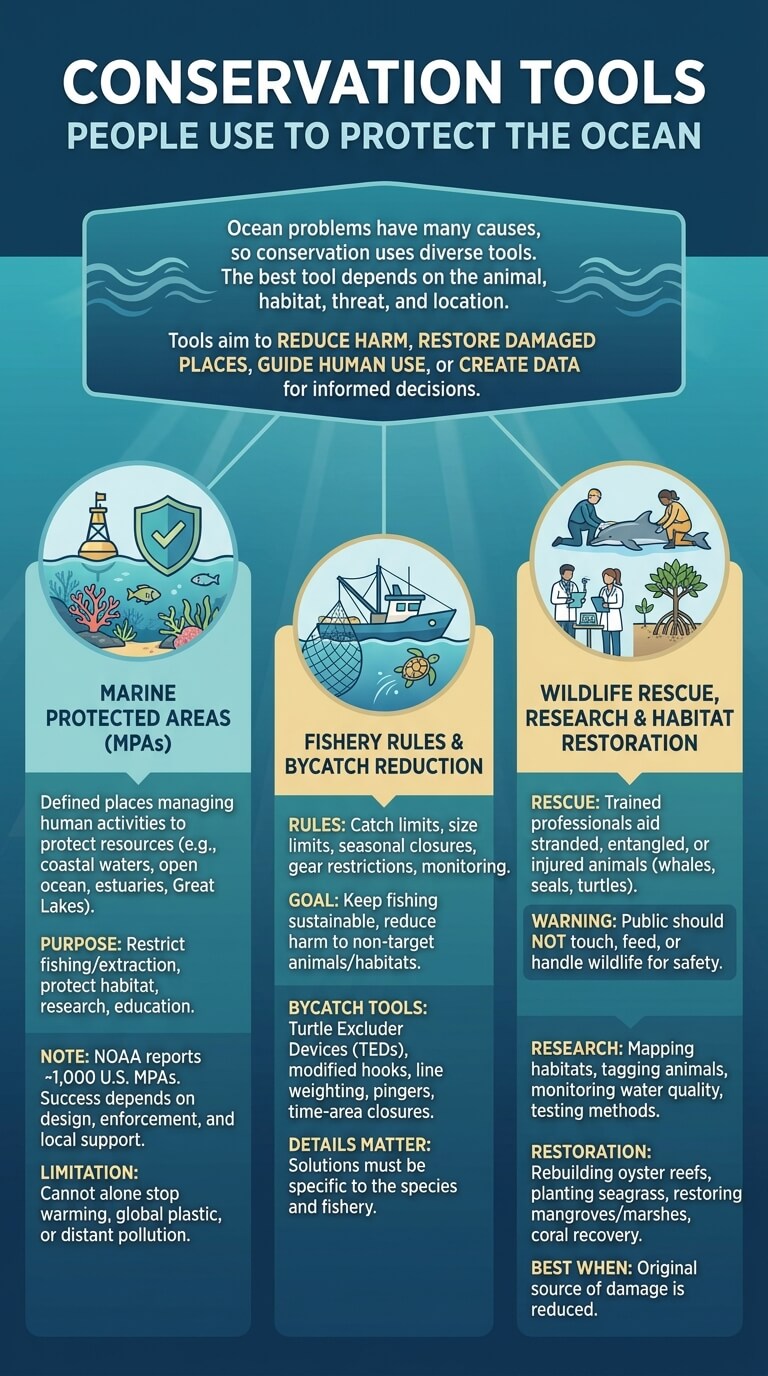
Ocean conservation uses many tools because ocean problems have many causes. The best tool depends on the animal, habitat, threat, and location. Some tools reduce harm. Some restore damaged places. Some guide human use. Some create data that helps managers adjust decisions over time.
Marine protected areas
Marine protected areas are defined places where human activities are managed to protect natural or cultural resources. They can include coastal waters, open ocean areas, intertidal zones, estuaries, sanctuaries, reserves, and even Great Lakes sites. Some restrict fishing or extraction. Others focus on habitat protection, research, education, or cultural resources.
NOAA’s explanation of marine protected areas notes that these areas span many habitat types and that the United States has about 1,000 such areas. Their success depends on design, enforcement, local support, ecological goals, and the threats outside their boundaries. A protected area can help reduce local pressure, but it cannot by itself stop warming, global plastic flow, or pollution arriving from far upstream.
Fishery rules and bycatch reduction
Fishery rules can include catch limits, size limits, seasonal closures, gear restrictions, rebuilding plans, protected species rules, and monitoring requirements. The goal is to keep fishing within levels that fish populations can replace while reducing harm to other animals and habitats.
Bycatch reduction is especially important because non-target animals can be affected even when the target fishery is otherwise managed. Turtle excluder devices in some trawl fisheries, modified hooks, line weighting, pingers in some circumstances, and time-area closures are examples of tools used to lower accidental capture. The details matter. A gear change that helps one species in one fishery may not solve another bycatch problem elsewhere.
Wildlife rescue, research, and habitat restoration
Rescue teams can help stranded, entangled, injured, or distressed marine animals when trained professionals are available and when intervention is safe and legal. This work is especially visible with whales, dolphins, seals, sea turtles, and seabirds. The public should not try to push, drag, feed, ride, touch, or disentangle marine wildlife. These animals can be injured by well-meant handling, and people can be hurt as well.
Research and restoration work are less visible but just as important. Scientists map habitats, tag animals, test restoration methods, monitor water quality, and study how animals respond to changing conditions. Restoration can include rebuilding oyster reefs, planting seagrass, restoring mangroves or marshes, removing invasive species in some habitats, or supporting coral recovery projects. Restoration works best when the original source of damage is reduced.
Common Myths or Misunderstandings About Ocean Conservation
Ocean conservation is often simplified in ways that make the real work harder to understand. A few myths come up often, especially online. Correcting them helps readers see conservation as practical, specific, and evidence-based.
Myth: conservation means closing the whole ocean
Conservation does not mean every beach, fishery, shipping route, or coastal area must be closed. It means human activity should be managed so ecosystems can keep functioning. Some sensitive areas may need strong protection. Other places may allow fishing, tourism, shipping, or recreation with rules that reduce harm.
The important question is not whether people can use the ocean. People already do, and many coastal communities depend on it. The question is how that use can happen without destroying the habitats and animal populations that make ocean life possible.
Myth: only famous animals matter
Charismatic animals such as whales, sea turtles, dolphins, penguins, and sharks often bring attention to ocean conservation. They matter, but they are not the whole story. Plankton, corals, seagrasses, oysters, crabs, worms, forage fish, squid, sponges, and algae also help support marine ecosystems.
Protecting only famous animals while ignoring their food, shelter, migration routes, and breeding areas would miss the point. Ocean conservation works best when it protects the systems those animals rely on, including the less familiar life forms that keep food webs moving.
Myth: individual choices are the whole solution
Individual choices can help. Reducing single-use plastic, choosing responsibly sourced seafood, respecting wildlife viewing rules, saving energy, supporting habitat restoration, and disposing of fishing line properly all matter. They can reduce local pressure and show public support for better ocean stewardship.
But individual choices are not the whole solution. Ocean problems also require waste systems, fishery management, shipping practices, climate action, coastal planning, enforcement, science funding, and international cooperation. The most honest message is both practical and collective: people can make better choices, and larger systems also need to change.
Where the Big Ocean Issues Overlap
The biggest ocean questions often overlap. Coral reefs, plastic pollution, bycatch, endangered sea turtles, whale ecology, overfishing, and marine protected areas can be studied separately, but in real ecosystems they affect one another. Understanding those overlaps helps readers avoid thinking of each issue as a separate problem with a single fix.
Why coral reefs matter for many marine species
Coral reefs are living structures built by animals. They offer shelter, feeding areas, nursery spaces, and coastline protection. Reef health can be affected by heat stress, pollution, disease, physical damage, and fishing pressure. This makes reefs a good example of why conservation has to consider habitat, animals, water quality, and human activity together.
How plastic pollution harms animals differently
Plastic does not harm every animal in the same way. A turtle may ingest flexible plastic. A seal may become entangled in packing bands or fishing line. A seabird may pick up small pieces while feeding. A coral reef can be damaged when debris rubs against living tissue. The shape, size, buoyancy, and location of debris all affect risk.
Why bycatch and overfishing are separate but linked
Bycatch is about animals caught unintentionally. Overfishing is about catching a target population faster than it can replace itself. They are different problems, but they can happen in the same fishery. A fishery can harm non-target wildlife through bycatch while also placing pressure on the target species or on the wider food web.
Why sea turtles and whales show different conservation challenges
Sea turtles and whales are both powerful symbols of marine conservation, but their needs are not identical. Sea turtles depend on nesting beaches, coastal feeding grounds, and safe migration routes. Whales may need prey availability, quieter waters, reduced entanglement, and lower vessel strike risk. Their differences show why species-specific conservation plans still need a broad ecosystem view.
FAQ
What is ocean conservation in simple terms?
Ocean conservation means protecting the animals, habitats, and natural processes that keep ocean ecosystems healthy. It includes reducing pollution, managing fishing, protecting important habitats, restoring damaged areas, monitoring wildlife, and lowering direct harm to marine animals.
Why is ocean conservation important for animals?
Ocean animals need suitable habitat, clean water, enough food, and safe places to reproduce or migrate. When those needs are disrupted, populations can decline. Conservation helps protect the conditions animals depend on, from coral structure and nesting beaches to prey populations and migration routes.
What is the biggest threat to ocean life?
There is no single biggest threat everywhere. Climate change, overfishing, bycatch, plastic pollution, habitat loss, vessel strikes, and water pollution can all be major threats depending on the animal and location. Many animals face several pressures at once, which is why conservation often works best when threats are managed together.
Can ocean conservation actually work?
Yes, conservation can work when the action matches the problem and is supported over time. Fish stocks can rebuild under science-based management. Protected habitats can reduce local pressure. Bycatch can decrease when better gear and rules are used. Restoration can help damaged habitats recover in some places. Results vary, so long-term monitoring is essential.
Final Thoughts
Ocean conservation is about more than saving a few well-known animals. It is the practical work of keeping marine habitats, food webs, and animal populations healthy enough to keep functioning. The ocean is made of many habitats, from coral reefs and seagrass beds to open water and deep-sea environments, and each one supports animals in different ways.
The most useful way to understand ocean conservation is to look for connections. Plastic pollution can harm turtles, whales, seabirds, and reefs in different ways. Bycatch and overfishing can affect both individual animals and food webs. Climate stress can change habitats and prey patterns. Marine protected areas, fishery rules, restoration, rescue, research, and better waste systems all have roles, but none works perfectly alone.
For readers, the takeaway is clear: healthy oceans depend on safe habitats, responsible human use, cleaner water, and careful attention to how marine animals live. Protecting the ocean means protecting the living systems that make ocean animal life possible.

Ethan Walker is the founder and research editor of Animal Fact Central. He creates and reviews educational animal facts content using trusted wildlife, pet care, and science-based sources. His work focuses on making animal behavior, adaptations, habitats, and species facts clear, accurate, and engaging for everyday readers.
Read More Details About Ethan Walker: https://animalfactcentral.com/ethan-walker/