

Marine protected areas explained in simple terms are parts of the ocean, coast, estuary, or Great Lakes that have extra protections for natural resources, cultural places, or important habitats. Some allow fishing, boating, tourism, research, and other uses. Others are much stricter. The main idea is not just to draw a line on a map, but to reduce certain pressures so ocean animals have safer places to feed, breed, grow, migrate, or recover.
A marine protected area, often shortened to MPA, can protect coral reefs, kelp forests, seagrass beds, deep sea canyons, shipwrecks, spawning areas, or places used by vulnerable species. It can help fish, invertebrates, seabirds, sea turtles, whales, and many smaller animals people rarely notice, but it cannot stop warming seas, global plastic movement, or all fishing pressure outside its boundary by itself.
The best way to understand marine protected areas is to think of them as one tool in ocean conservation. A well designed MPA can reduce harm in a specific place. A weakly managed one may provide little real protection. The difference depends on its goals, rules, enforcement, community support, and whether the animals it is meant to protect actually use that area.
Quick Answer

A marine protected area is a defined ocean or coastal place managed for long term conservation. NOAA Ocean Exploration describes MPAs as regions designated and managed to conserve marine resources, ecosystem services, or cultural heritage. That broad definition matters because two MPAs can look very different in practice.
One MPA might be a multiple-use area where fishing is allowed under rules. Another might be a marine reserve where extractive activities such as fishing or collecting are restricted. A third might be a sanctuary that protects both wildlife and historic resources. The name alone does not tell you everything. The real question is what activities are allowed, what habitats are being protected, who manages the area, and whether the rules are actually followed.
For ocean animals, MPAs can matter because they protect places, not just individual species. A reef fish needs reef structure. A sea turtle may need a healthy seagrass bed or nesting beach. A young fish may need a nursery area with shelter. Protecting the place can protect the life stages that happen there.
What Is a Marine Protected Area?
Basic definition
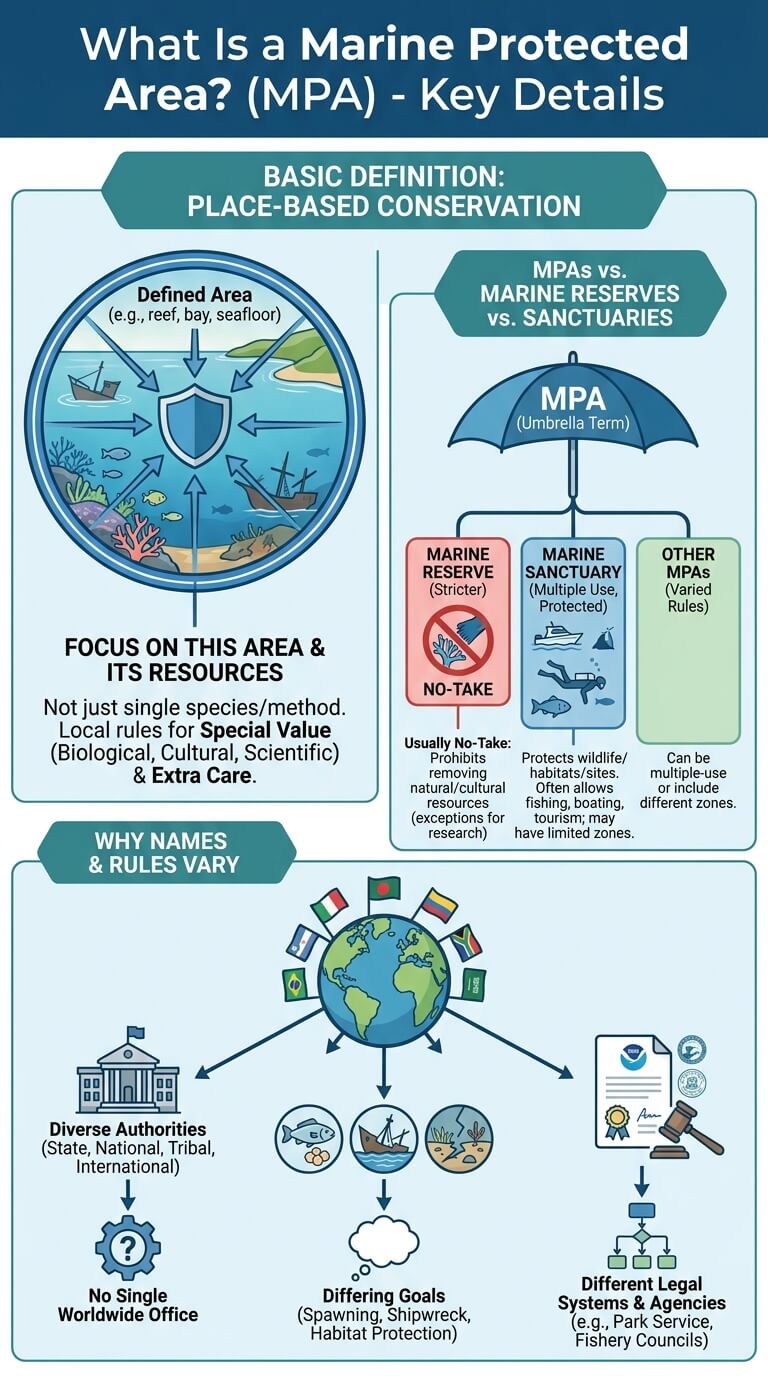
A marine protected area is a place-based conservation tool. Instead of managing only a species, a fishing method, or a single pollutant, it focuses on a defined area. The area may include open water, the seafloor, a reef, a bay, an estuary, a shoreline, a wetland, or part of the Great Lakes. Its rules are written around the resources inside that space.
This makes MPAs different from broad ocean rules that apply everywhere. A catch limit might apply to a fishery across a large region. A speed rule might apply to boats in places used by whales. A pollution law might apply across many waters. An MPA is more local. It says, in effect, this particular place has special biological, cultural, scientific, or historic value, so human activities here need extra care.
MPAs vs marine reserves vs sanctuaries
People often use MPA, marine reserve, and sanctuary as if they mean the same thing, but they are not always identical. MPA is the broad umbrella term. A marine reserve is usually stricter. In many contexts, a reserve is a no-take area, meaning animals, plants, rocks, shells, or other resources cannot be removed except under tightly controlled research or management exceptions.
The National Marine Protected Areas Center notes that a marine reserve or no-take MPA is a highly protected type of MPA where removing or destroying natural or cultural resources is prohibited. It also explains that other MPAs can be multiple-use areas or can include different zones with different rules.
A marine sanctuary may protect wildlife, habitats, cultural resources, or historic sites. Some sanctuaries allow fishing, boating, diving, and tourism. Others include zones where certain activities are limited. In the United States, national marine sanctuaries are managed under their own legal system, while other MPAs may be managed by states, tribes, territories, federal fishery councils, the National Park Service, the U.S. Fish and Wildlife Service, or other authorities.
Why names and rules vary by country and agency
MPA names vary because ocean management is not handled by one worldwide office. A coastal state, a national government, a tribal authority, a territory, an international agreement, or a local agency may all create different kinds of protected areas. Their goals can also differ. One area may protect a spawning aggregation. Another may protect a shipwreck. Another may reduce habitat damage from a certain gear type.
Why Marine Protected Areas Are Created
Protecting habitats
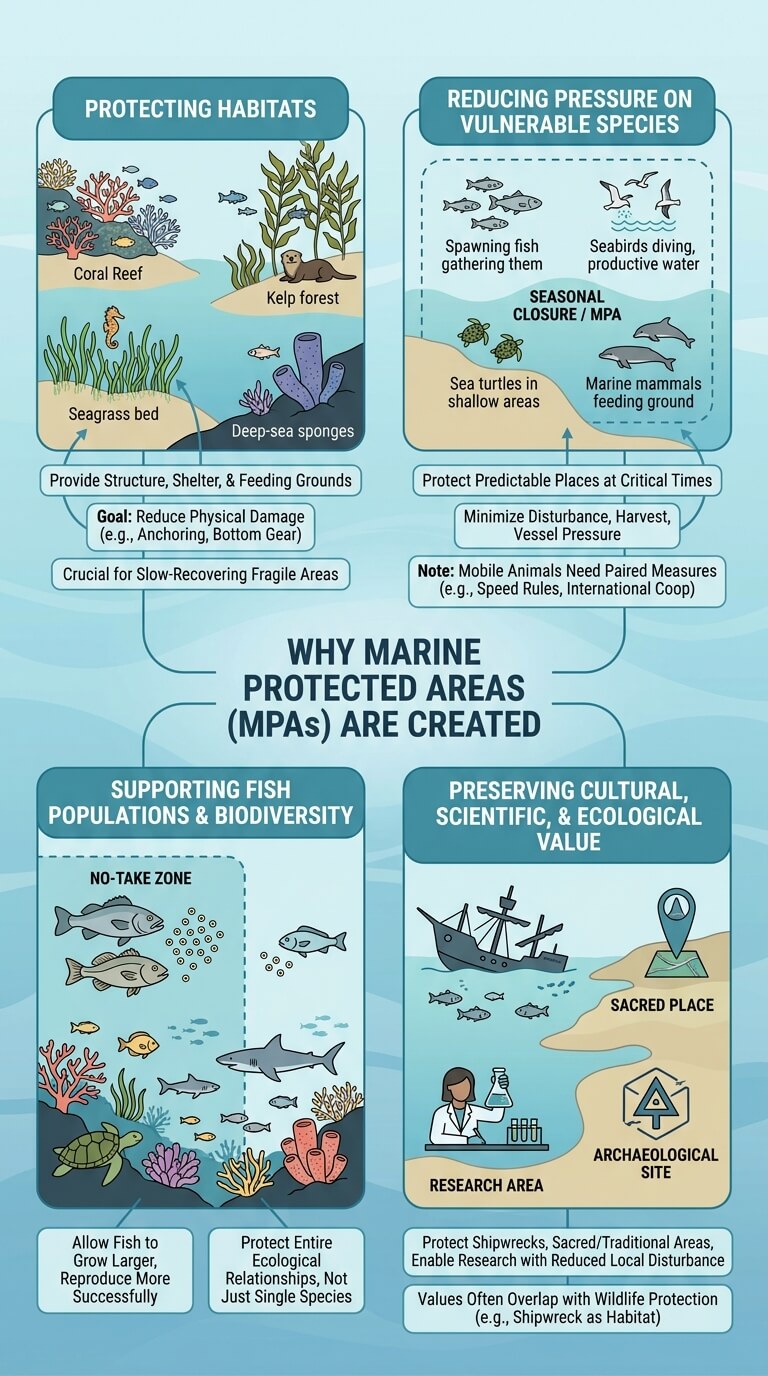
Many ocean animals depend on habitat structure. Coral branches can shelter small reef fish. Seagrass blades can hide juvenile animals. Kelp forests can give sea otters, fish, invertebrates, and seabirds a productive feeding environment. Deep sea coral and sponge communities can provide three-dimensional structure on an otherwise open seafloor.
When an MPA is designed around habitat, the goal is often to reduce direct physical damage. That may mean limiting anchoring on reefs, restricting bottom-tending gear, protecting nursery grounds, or guiding tourism away from fragile areas. Habitat protection is especially important when the habitat grows slowly or recovers poorly after damage. A seagrass bed may return if stress is reduced, but recovery can take time. Some deep sea coral communities can be far slower to recover.
Reducing pressure on vulnerable species
Some animals use predictable places at predictable times. Fish may gather to spawn. Seabirds may feed near certain productive waters. Sea turtles may use shallow seagrass areas. Marine mammals may return to seasonal feeding grounds. When managers know these patterns, an MPA or a seasonal closure can reduce disturbance, harvest, vessel pressure, or gear conflict in the places animals need most.
That does not mean an MPA protects every individual all year. Mobile animals move across boundaries. A whale can leave a sanctuary. A sea turtle can swim through protected water and later enter a fishing area. A seabird can feed inside an MPA and nest somewhere else. For wide-ranging animals, protected areas usually work best when paired with other measures, such as gear rules, vessel speed rules, protected species recovery plans, and international cooperation.
Supporting fish populations and biodiversity
Well protected areas can give some fish and invertebrates a place to grow larger, reproduce more successfully, or rebuild after heavy pressure. This is one reason no-take zones are often discussed in fishery science. Larger adult fish of some species can produce more eggs than smaller adults, so reducing harvest in a suitable place can help rebuild age and size structure inside the protected area.
MPAs can also help biodiversity by protecting many species together. A reef is not only a fish habitat. It can include corals, sponges, algae, worms, mollusks, crustaceans, sea cucumbers, sea stars, turtles, sharks, rays, and visiting birds or mammals. A protected place can give managers a way to protect ecological relationships, not just a single target species.
Preserving cultural, scientific, and ecological value
Marine protected areas are not only about animals. Some protect shipwrecks, sacred places, traditional harvest areas, archaeological sites, or culturally important seascapes. Others protect research areas where scientists can study ecosystems with reduced local disturbance. These values can overlap with wildlife protection. A shipwreck can become fish habitat. A culturally important reef can also be a nursery for young animals.
Types and Levels of Protection

Multiple-use protected areas
Many MPAs are multiple-use areas. This means several activities may continue, but under rules. A multiple-use MPA may allow fishing, boating, diving, research, tourism, or cultural use. It may still restrict certain gear, prohibit seabed damage, set seasonal limits, ban collecting, or create smaller zones with stronger protection.
No-take zones
A no-take zone is stricter because it usually bans removal of living and nonliving resources. That can include fishing, collecting shells, taking corals, removing plants, or extracting minerals. The purpose is to let the ecosystem function with far less direct human removal.
No-take zones are often useful for sedentary species, reef communities, nursery habitats, and places where animals gather to reproduce. They can also make research easier because scientists can compare areas with and without harvest pressure. However, a no-take zone still needs enforcement. A line on a map cannot protect a reef if people continue to fish, anchor, collect, or damage habitat inside the boundary.
Seasonal or activity-specific closures
Some protected areas are not closed in the same way all year. A seasonal closure might protect spawning fish during a key breeding period, reduce disturbance at a seabird feeding area, or limit certain vessel activities when marine mammals are present. An activity-specific closure might ban bottom trawling but allow hook-and-line fishing, or restrict anchoring but allow snorkeling.
Highly protected areas
Highly protected areas allow little or no extractive activity and aim to keep human impacts low. The Protected Planet Report 2024 found that although 8.4 percent of the global ocean was in MPAs of some kind, only 5.7 percent was in MPAs that were implemented or actively managed, and only 2.8 percent was in fully or highly protected MPAs. Its Protected Planet Report 2024 highlights why protection quality matters as much as total area.
This distinction is important for readers. A country may report a large protected area network, but the ecological outcome depends on what protection actually means in the water. Strong rules, good design, monitoring, enforcement, and local support all affect whether animals experience real relief from pressure.
How MPAs Can Help Ocean Animals
Safe breeding, feeding, or nursery areas
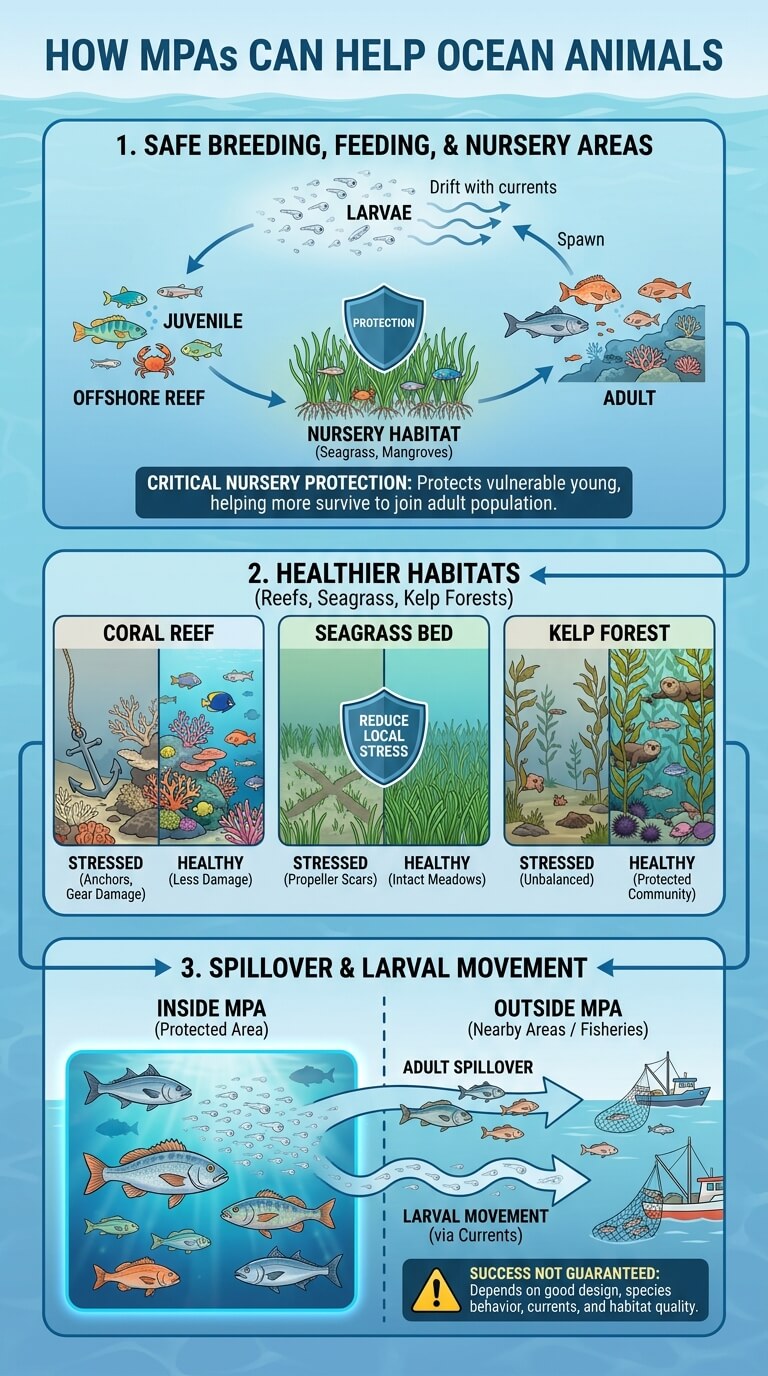
Many animals need different places at different life stages. Tiny larvae may drift with currents. Juveniles may hide in seagrass, mangroves, oyster reefs, or shallow rocky habitat. Adults may feed offshore and return to a particular area to spawn. An MPA can protect one or more of these important life stages if it is placed where animals actually use the habitat.
Nursery protection is especially easy to understand. Young animals are often small, vulnerable, and dependent on shelter. If a nursery area is damaged or heavily harvested, fewer young may survive long enough to join the adult population. Protecting the nursery does not solve every problem, but it can remove one major pressure from a critical stage of life.
Healthier habitats such as reefs, seagrass, and kelp forests
MPAs can help habitats by reducing local stress. On reefs, that may mean fewer broken corals, less collecting, and less damage from anchors or some gear. In seagrass beds, rules may reduce propeller scars, dredging, or destructive anchoring. In kelp forests, management may protect the broader community of animals that feed, graze, shelter, or hunt there.
Spillover and larval movement explained carefully
One often discussed benefit of MPAs is spillover. In simple terms, spillover happens when adult animals, juveniles, or larvae produced inside a protected area move outside it. This can sometimes help nearby fisheries or surrounding habitats. Larval movement is especially important because many marine animals begin life as tiny drifting forms that can travel with currents before settling.
Spillover is not guaranteed. It depends on species behavior, currents, habitat quality, MPA size, fishing pressure, and the location of the protected area. A fish that stays close to one reef may respond differently from a species that migrates long distances. A protected area placed in poor habitat may not produce much benefit. Good MPA design tries to match boundaries and rules to the biology of the animals involved.
What MPAs Cannot Fix by Themselves
Climate change and warming seas
MPAs can reduce local stress, but they cannot block warming water, marine heat waves, ocean acidification, or sea level rise at their boundaries. A coral reef inside a protected area can still bleach during extreme heat. A kelp forest inside a protected area can still be affected by warming, storms, or changes in grazing pressure linked to larger ecosystem shifts.
The IUCN climate brief on MPAs explains that protected areas can support resilience and adaptation, but reducing climate impacts on the ocean still requires broader cuts in greenhouse gas emissions and wider sustainable ocean practices. In other words, MPAs can help animals cope with some local pressures, but they are not a substitute for climate action.
Plastic pollution moving across boundaries
Plastic does not respect protected lines on a map. Bags, bottles, fishing line, packaging, and microplastics can move with rivers, wind, tides, currents, and storms. A beach or reef inside an MPA can receive debris from far outside the protected area. Animals can also carry plastic impacts with them if they feed outside the boundary and later return.
This does not make MPAs useless for plastic pollution. Some protected areas have cleanup programs, visitor rules, waste controls, and education efforts. But plastic prevention has to happen upstream too. Reducing plastic at the source, improving waste systems, recovering lost gear, and changing product use are broader solutions that MPAs alone cannot deliver.
Migratory animals leaving protected zones
Some ocean animals move too widely for one protected area to cover their whole life. Sea turtles cross ocean basins. Whales may travel between feeding and breeding areas. Sharks, tuna, seabirds, and many marine mammals can move across national waters and into the high seas. For these animals, an MPA may protect a feeding ground, nesting area, or migration bottleneck, but not every risk along the route.
Protected areas can still be important for mobile animals when they overlap with high-use areas. A whale feeding ground, turtle nesting beach, or seabird foraging zone can be worth protecting even if the animals leave later. The key is to avoid overselling the boundary. Mobile animals often need a network of protections, including safer fishing gear, reduced vessel strikes, pollution control, and international agreements.
Weak enforcement or unclear rules
An MPA works only if people know the rules and those rules are followed. Weak enforcement can turn a protected area into a paper park, a place that exists legally but offers little real-world protection. Unclear signs, confusing boundaries, limited patrol capacity, weak penalties, or lack of local support can all reduce effectiveness.
Marine Protected Areas and Fisheries
How MPAs relate to overfishing
MPAs can reduce fishing pressure in defined places, especially where fishing is restricted or banned. This can help animals that stay within the protected area, use it for spawning, or depend on habitat inside it. It can also protect parts of an ecosystem from gear impacts, which matters when the habitat itself helps fish populations recover.
But overfishing is usually a wider management problem. A no-take zone may protect one area, while fishing pressure shifts elsewhere. If catch limits are too high outside the MPA, or if illegal fishing continues, the larger population may still struggle. This is why MPAs work best as part of fishery management, not as a replacement for it.
Why MPAs are not the same as catch limits
Catch limits control how many animals can be removed. Gear rules control how animals are caught and what habitat is disturbed. Protected areas control where certain activities can happen. These tools overlap, but they are not the same.
The NOAA MPA frequently asked questions describe MPAs as an additional tool that works best with other management measures, including fishery regulations and pollution controls. That practical point is important. A fish population may need catch limits, habitat protection, bycatch reduction, and protected spawning areas at the same time.
Community involvement and compliance
Fishing communities are not all the same. Some depend on small-scale local fishing. Others use large commercial vessels. Some have generations of knowledge about currents, seasons, spawning areas, and habitat changes. If MPA planning treats every fisher as a problem, it can miss useful knowledge and create resistance.
Strong planning asks which activities cause which risks, who will be affected, and how conservation goals can be met fairly. Community involvement does not mean every activity continues unchanged. It means people affected by the rules have a real chance to understand the science, share knowledge, raise concerns, and help shape practical solutions. Compliance is easier when rules are clear, fair, and visibly connected to conservation goals.
Common Mistakes or Myths About MPAs
Myth: every MPA bans all fishing
This is one of the most common misunderstandings. Some MPAs are no-take zones, but many are multiple-use areas. Fishing may be allowed in some places, restricted in others, or limited by gear, season, species, or zone. Recreational diving, boating, wildlife viewing, education, and research may also be allowed depending on the site.
The only way to know what is allowed is to check the specific rules for that protected area. A visitor should not assume that a sanctuary, park, reserve, or monument has the same rules as another site with a similar name. Local signs, official maps, and management agencies matter.
Myth: a protected line on a map guarantees protection
A boundary is only a starting point. Real protection depends on rules, staffing, funding, enforcement, monitoring, and public support. A line drawn around a reef does not stop illegal fishing. A name on a map does not prevent heat stress. A large area with weak rules may protect less biodiversity than a smaller area with strong rules in the right place.
This is why scientists and conservation groups increasingly focus on quality, not just area. How much of the ocean is protected matters, but so does the level of protection. Are damaging activities reduced? Is the site actively managed? Are outcomes monitored? Are local communities treated fairly? These questions determine whether animals are likely to benefit.
Myth: MPAs only help fish
Fish often receive the most attention because fishing is easy to connect with protected areas. But MPAs can also help invertebrates, corals, sponges, seagrasses, kelp, seabirds, turtles, marine mammals, and the habitats that support them. A protected reef may help coral structure, grazing animals, plankton-feeding fish, predators, and shelter-seeking juveniles all at once.
MPAs can also protect cultural and scientific value. A deep sea area may contain species that are poorly known. A coastal wetland may buffer storms while supporting fish nurseries and birds. A shipwreck may be both a historic site and a living reef-like structure. Thinking only about fish misses much of what ocean protected areas can do.
Where MPAs Fit in Ocean Conservation
Coral reefs as common MPA habitats
Coral reefs are often included in MPAs because they are biologically rich and physically vulnerable. A reef can be damaged by anchors, careless diving, destructive fishing gear, sediment, pollution, heat stress, and disease. Local protection can reduce some of these pressures, even though it cannot stop global warming on its own.
For reef animals, the value of an MPA is often habitat stability. Small fish need shelter. Corals need space and suitable conditions to grow. Grazers help shape algae growth. Predators influence food webs. When a protected area reduces local damage, it can give that community a better chance to function.
Sea turtles and whales need broader protections too
Sea turtles and whales show both the promise and limits of MPAs. A protected seagrass bed may help green turtles feed with less disturbance. A sanctuary may reduce some risks in an important whale feeding area. A protected beach may help nesting turtles if lights, vehicles, pets, and human disturbance are controlled.
Yet these animals also move widely. They may face vessel strikes, entanglement, bycatch, noise, plastic, climate shifts, and habitat change outside any one protected area. MPAs can protect key places along their lives, but mobile animals usually need layered protections across larger routes.
Bycatch and overfishing often need rules outside MPAs
MPAs can reduce bycatch and fishing pressure inside their boundaries when fishing is restricted. They can also protect habitats from damaging gear. But bycatch and overfishing can continue outside protected areas, especially for animals that move across boundaries or fisheries that operate over large regions.
That is why ocean conservation often uses several tools together. Protected areas can guard key places. Catch limits can address harvest levels. Gear changes can reduce accidental capture. Pollution controls can reduce debris and runoff. Protected species rules can focus on animals that need special care. Together, these approaches are usually stronger than any one tool alone.
High seas protection is still developing
Many MPAs are in national waters because countries have clearer authority near their coasts. The high seas are harder to manage because they lie beyond any single country. Protected Planet explains that national waters make up 39 percent of the global ocean and areas beyond national jurisdiction make up 61 percent, while protection in those beyond-national areas remains much lower than in national waters. Its page on marine protected and conserved areas also notes that the BBNJ Agreement entered into force in January 2026, creating a new framework for area-based conservation beyond national waters.
For animals that migrate through the open ocean, this matters. Tuna, sharks, whales, seabirds, turtles, and many other species do not stop at national borders. Stronger high seas cooperation could make it easier to protect important feeding areas, migration corridors, seamounts, and deep ocean habitats that have historically been difficult to manage.
FAQ
What is allowed in a marine protected area?
It depends on the specific area. Some MPAs allow fishing, boating, diving, research, tourism, and cultural uses under rules. Others restrict certain gear, seasons, species, or zones. No-take areas are much stricter and usually prohibit removing natural or cultural resources. Visitors should check the official rules for the exact site before fishing, collecting, anchoring, or entering restricted zones.
Do marine protected areas really work?
They can work when they are well designed, well managed, enforced, and matched to the biology of the animals and habitats they are meant to protect. Strongly protected areas often show clearer ecological benefits than weakly protected areas. MPAs are less effective when they exist only on paper, allow high-impact activities, lack enforcement, or are placed where they do not match the conservation problem.
What is the difference between an MPA and a no-take zone?
An MPA is the broad category. It can include many levels of protection, including multiple-use areas where some fishing or recreation may continue. A no-take zone is a stricter type of protected area where extractive activities such as fishing, collecting, or removing resources are generally prohibited. All no-take zones are protected areas, but not all protected areas are no-take zones.
Can marine protected areas protect whales and sea turtles?
Yes, but only for the places and risks the protected area actually covers. An MPA can protect a feeding ground, nesting beach, resting area, migration bottleneck, or habitat used by whales or sea turtles. It cannot protect the entire life of a highly migratory animal by itself. These animals usually need MPAs combined with vessel rules, bycatch reduction, pollution control, habitat protection, and cooperation across regions.
Final Thoughts
Marine protected areas are best understood as protected places with specific goals, rules, and limits. They can help ocean animals by safeguarding habitats, reducing local pressure, protecting nursery or breeding areas, and giving ecosystems room to recover. They are strongest when the protection is real in the water, not just written on a map.
The most important takeaway is balance. MPAs can be powerful, but they cannot solve every ocean problem alone. Climate change, plastic pollution, bycatch, overfishing, and wide animal migrations often require broader action beyond a single boundary. When protected areas are well designed, enforced, and connected to other conservation tools, they can give marine life a better chance in a changing ocean.

Ethan Walker is the founder and research editor of Animal Fact Central. He creates and reviews educational animal facts content using trusted wildlife, pet care, and science-based sources. His work focuses on making animal behavior, adaptations, habitats, and species facts clear, accurate, and engaging for everyday readers.
Read More Details About Ethan Walker: https://animalfactcentral.com/ethan-walker/