

Plastic pollution affects marine animals in several connected ways: animals may swallow plastic, become trapped in it, suffer wounds from it, lose healthy habitat to it, or encounter tiny plastic particles in the food web. The problem is not limited to one famous image of a turtle and a plastic bag. It can involve a seabird feeding fragments to a chick, a whale dragging rope, a crab pot that keeps catching animals after it is lost, or zooplankton encountering tiny particles mixed with normal food.
The most useful way to understand ocean plastic is to follow the path from object to animal. A plastic bag, bottle cap, fishing line, foam fragment, or synthetic fiber can move through currents, break into smaller pieces, sink, float, snag on habitat, or be eaten by mistake. Some pieces cause immediate harm. Others create longer, quieter pressure by staying in the environment and being encountered again and again.
Quick Answer

Plastic pollution harms marine animals mainly through ingestion, entanglement, injury, habitat damage, and exposure to microplastics. Large plastic debris can block digestion, create a false feeling of fullness, restrict movement, cut into skin, or make it harder for an animal to swim, breathe, feed, or escape predators. Smaller plastic fragments and fibers can be eaten by fish, shellfish, zooplankton, and other animals, although scientists are still studying how different particles affect different species in real ocean conditions.
NOAA Ocean Service explains that marine debris affects an estimated 700 wildlife species, including plankton, invertebrates, fish, whales and dolphins, sea turtles, and seabirds, while also noting that many ocean areas are still poorly explored. That means the known problem is already broad, but the full picture is still developing. NOAA Ocean Service’s marine debris overview
The biggest misunderstanding is that plastic only matters when an animal swallows a visible object. Swallowing is serious, but entanglement, lost fishing gear, habitat smothering, and microplastic exposure can also affect survival. Another misunderstanding is that every plastic problem has the same fix. Reducing single-use plastic helps, but so do better waste systems, fishing gear recovery, product design changes, stormwater controls, and careful cleanup that does not put animals or people at risk.
Why Ocean Plastic Is a Conservation Problem

Plastic becomes a conservation problem when it changes the chances that animals can feed, move, reproduce, avoid predators, and survive in their normal habitat. A single bottle cap does not affect the ocean the same way as a lost net, but both can become part of a larger pattern of waste moving through coastal and offshore environments.
Plastic lasts long enough to move through habitats
Plastic is useful to people partly because it is lightweight, durable, and inexpensive. Those same traits make it a long-lasting problem when it escapes into rivers, beaches, harbors, and the open ocean. Wind, storm drains, flooding, tides, ships, fishing activity, and beach litter can all move debris from human spaces into animal habitat.
The UN Environment Programme reports that millions of tonnes of plastic waste leak into aquatic environments each year, including rivers, lakes, and seas. That number should not be treated as a precise count of pieces floating on the ocean surface, but it shows the scale of the flow that waste systems and prevention efforts must address. the UN Environment Programme’s marine litter summary
Marine debris can harm animals before it breaks down
Plastic does not need to become a microplastic before it causes harm. A loop of packing band, a balloon ribbon, a fishing line, a six-pack ring, or a discarded net can affect an animal while it is still large and recognizable. That is why beach cleanups often focus on removing items that might entangle wildlife, not just items that look ugly to people.
Large debris can also harm habitat directly. Heavy objects can crush organisms on the seafloor. Nets can snag on reefs or seagrass beds. Plastic sheets and bags can cover small patches of bottom habitat, reducing the water flow and light that some organisms need. On nesting beaches, plastic litter can make it harder for hatchlings to move cleanly across sand, although the exact impact depends on the type and amount of debris.
Microplastics create different risks from large debris
Microplastics are tiny plastic particles, often defined as less than five millimeters in size. They include fragments from larger objects, synthetic fibers shed from textiles and ropes, foam pieces, and small manufactured particles. Their small size changes the problem. A whale may swallow a large plastic sheet by accident, but a small fish or mussel may encounter tiny plastic particles mixed with food-sized material.
EPA notes that plastic can fragment into microplastics and nanoplastics, and that these particles are now found across ecosystems. The agency also describes marine species facing higher risks of ingestion, suffocation, or entanglement from plastic pollution. EPA’s plastic pollution summary
The scientific challenge is that microplastics are not one thing. Their size, shape, polymer type, surface chemistry, attached pollutants, and location in the water can vary. A fiber may interact with an animal differently from a hard fragment. A laboratory exposure study may not translate perfectly to every wild population. Careful wording matters because the evidence is strong that exposure happens, but the exact effects vary by animal, particle, dose, and environment.
The Main Ways Plastic Hurts Marine Animals

Plastic affects animals through physical harm, feeding mistakes, movement restriction, habitat damage, and possible chemical or food web effects. These pathways can overlap. An animal tangled in line may also become weaker because it cannot feed well. A bird that eats plastic may also have less room for real food. A trap that keeps catching animals can injure both target and non-target species.
Eating plastic by mistake
Many marine animals feed quickly in water where sight, smell, motion, and texture all help them decide what is food. Plastic can interfere with those cues. A floating bag may resemble gelatinous prey from a distance. Small fragments may mix with fish eggs, plankton, or other drifting food. Plastic can also pick up biological material that makes it smell more food-like to some animals.
Swallowed plastic can harm an animal in several ways. It can block the digestive tract, scrape or puncture internal tissue, reduce the urge to eat, or take up space that would normally hold food. NOAA’s Marine Debris Program describes ingestion as a problem that can lead to injury, loss of nutrition, intestinal blockage, starvation, or death, depending on the animal and the debris. NOAA’s Marine Debris Program ingestion page
Entanglement in bags, lines, nets, and packaging
Entanglement happens when debris wraps around an animal or traps part of its body. Fishing line can tighten around a flipper, bill, neck, wing, or tail. Nets can hold animals underwater. Packing bands can cut into growing animals as their bodies increase in size. Even thin material can become dangerous when it restricts movement or creates a wound.
Entangled animals may waste energy dragging debris, lose the ability to feed normally, become easier for predators to catch, or drown if they cannot surface to breathe. Marine mammals and sea turtles are especially vulnerable when rope or netting prevents normal swimming or surfacing. Birds can become tangled while feeding, nesting, or collecting material.
For people who find an entangled animal, the safest response is usually to report it to local wildlife authorities, a marine mammal stranding network, park staff, or a licensed rescue group. Pulling debris from a live animal can tighten a line, worsen injuries, or put the person close to a stressed wild animal. Even small animals can bite or struggle, and large animals such as seals, dolphins, or turtles require trained responders.
Injuries from sharp or restrictive debris
Plastic debris can injure animals even when it is not swallowed or wrapped around the entire body. Hard fragments may cut skin. Broken plastic can scrape soft tissue. Tight loops can create deep wounds as the animal grows or moves. A wound that starts small can become infected or interfere with feeding and swimming.
Habitat damage in reefs, beaches, seagrass, and the seafloor
Plastic pollution affects animals not only by touching their bodies, but also by changing the places they depend on. Coral reefs, seagrass beds, mangrove edges, sandy beaches, rocky shores, and seafloor habitats all support feeding, shelter, reproduction, or nursery areas for different animals.
Debris can scrape, smother, shade, or break living habitat. A net caught on a reef may abrade corals. A plastic sheet on seagrass can reduce light. A lost trap can damage bottom habitat while also catching animals. Beach litter can alter nesting or hatchling movement for some coastal species. These habitat effects matter because many marine animals depend on particular places at particular life stages.
Animals Most Often Used as Examples

Sea turtles, seabirds, whales, dolphins, fish, and invertebrates are often used to explain plastic pollution because they show different pathways of harm. No single animal tells the whole story. The best examples reveal how body shape, feeding style, habitat, and movement change the way plastic becomes dangerous.
Sea turtles and floating plastic
Sea turtles are commonly associated with plastic pollution because some species feed on or near the surface, migrate long distances, and encounter coastal and open-ocean debris. Floating plastic bags and films can be mistaken for prey, especially when they move in water. Fishing line, rope, and netting can also tangle turtles and restrict swimming.
Plastic risk is not the same for every turtle in every place. Diet, age, habitat, and local debris patterns matter. A young turtle in floating mats of seaweed may encounter small fragments. An adult near fishing activity may face a higher chance of rope or net entanglement. This is why plastic should be discussed as one threat among several, not as the only reason sea turtles face conservation trouble.
Seabirds and mistaken food
Seabirds may collect food across large ocean areas and bring it back to chicks. Some species feed by picking items from the surface, where plastic fragments can mix with fish eggs, squid, crustaceans, or other small prey. Plastic pieces may also carry odors from marine organisms, which can make them harder for birds to distinguish from food cues.
When adult birds feed plastic to chicks, the problem can affect growth and body condition. A chick with plastic in its stomach may have less room for nutritious food. Sharp pieces can injure tissue. As with other animal groups, outcomes vary, but seabirds show how plastic pollution can move from the ocean surface into reproduction and chick survival.
Whales, dolphins, and large debris
Whales and dolphins can be affected by both ingestion and entanglement. Baleen whales filter large volumes of water and prey, so they may take in plastic while feeding. Toothed whales and dolphins may swallow plastic items directly or encounter fishing line and nets. Large animals can also drag debris for long distances, which can cause exhaustion or wounds.
It is tempting to focus only on dramatic cases of whales found with large amounts of plastic in the stomach. Those cases are important, but they should not be used to imply that every whale death is caused by plastic. Strandings and deaths can involve disease, vessel strikes, starvation, harmful algal toxins, fishing gear, noise, or unknown causes. Plastic is one serious pressure within a broader set of risks.
Fish and invertebrates exposed to microplastics
Fish, mussels, oysters, crabs, shrimp, worms, corals, and zooplankton can encounter microplastics in water, sediment, or food. Some may ingest particles while filtering water. Others may eat prey that already contains small plastic pieces. Bottom-dwelling animals may encounter particles that settle into sediment.
Microplastics and the Ocean Food Web
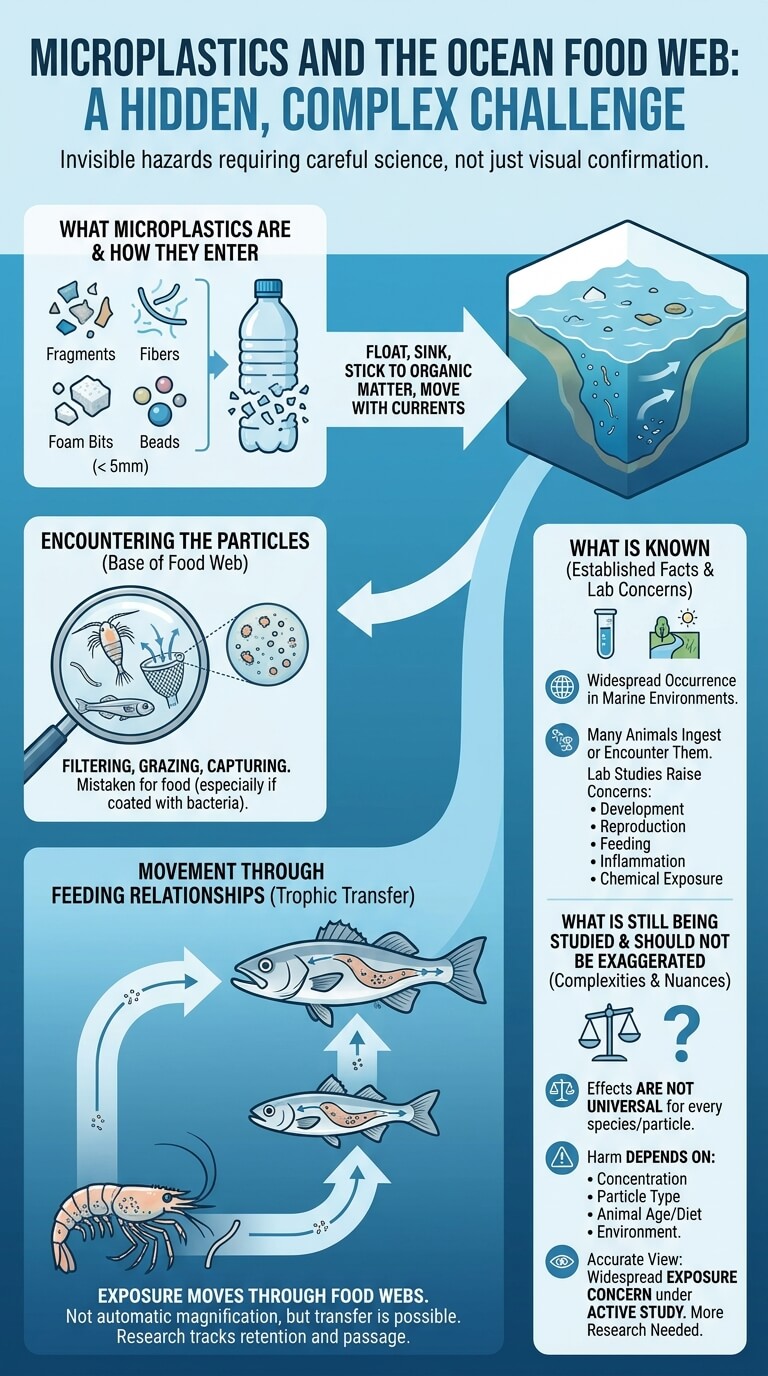
Microplastics raise different questions from large debris. A plastic bag can be seen, removed, photographed, and understood as a physical hazard. A tiny fiber in sand or a fragment in plankton is harder to track. That does not make it less important. It means the science needs careful sampling, lab work, field observations, and cautious interpretation.
What microplastics are
Microplastics are small plastic particles. Some are made small, while others form when larger plastic breaks apart. Common types include fragments, fibers, foam bits, and beads. In the ocean, these particles can float, sink, stick to organic matter, or be moved by waves and currents.
NOAA Ocean Service describes microplastics as small enough to be mistaken for food by wildlife, including fish, mussels, whales, and zooplankton, and notes that more research is needed to understand exactly how different animals are affected. NOAA Ocean Service’s microplastics explainer
How small animals encounter plastic particles
Small ocean animals often feed by filtering, grazing, or capturing tiny particles suspended in water. Zooplankton, larval fish, and filter-feeding invertebrates may encounter microplastics because the particles fall within the size range of normal food. If particles are coated with bacteria or organic matter, they may become even harder to distinguish from natural material.
Particles can also move through food webs when one animal eats another. A tiny crustacean may ingest a fiber, then be eaten by a fish, which may be eaten by a larger predator. That pathway does not mean plastic automatically magnifies in the same way as some chemical pollutants. It means exposure can move through feeding relationships, and researchers need to study what is retained, passed through, or transferred between tissues.
What is known, what is still being studied, and what should not be exaggerated
It is well established that microplastics occur in marine environments and that many animals can ingest or encounter them. Laboratory studies have raised concerns about development, reproduction, feeding, inflammation, and chemical exposure in some organisms. Field studies show exposure across many habitats.
What remains harder is turning that evidence into a simple universal statement about harm for every species. Effects can depend on concentration, particle type, animal age, diet, temperature, disease, and other environmental stress. It is more accurate to say that microplastics are a widespread exposure concern under active study than to claim that every particle has the same effect on every animal.
Ghost Gear and Lost Fishing Equipment
Lost or abandoned fishing gear is one of the most dangerous forms of plastic pollution for animals because much of it was designed to catch animals in the first place. Nets, traps, pots, lines, ropes, and hooks can keep working after fishers lose control of them. This is different from a bottle or bag because the object’s original function creates continuing risk.
Why fishing gear can keep catching animals
Ghost gear can drift through the water, snag on habitat, or rest on the seafloor while still trapping animals. A net can entangle fish, turtles, birds, or mammals. A crab pot can continue attracting animals. Rope can wrap around a whale or seal. Gear may also damage reefs, seagrass, or bottom habitat as currents move it.
NOAA Ocean Service defines ghost fishing as what happens when discarded, lost, or abandoned fishing gear continues to fish, trap animals, entangle marine life, smother habitat, and create navigation hazards. NOAA Ocean Service’s ghost fishing explanation
How ghost gear differs from bycatch
Bycatch usually refers to animals unintentionally caught during active fishing. Ghost gear is different because the gear is no longer under a fisher’s control. It may continue catching animals after a storm, equipment failure, vessel accident, or illegal dumping event. The two topics overlap because both can harm non-target animals, but ghost gear is specifically a marine debris problem.
This distinction matters for solutions. Reducing bycatch may involve gear changes, fishing area rules, escape devices, time-area closures, or changes in fishing practice. Reducing ghost gear may involve gear marking, reporting systems, retrieval programs, port disposal options, stronger materials management, and designs that become less harmful if lost.
Why removal is difficult and sometimes risky
Removing lost gear can be difficult because it may be heavy, snagged, hidden, deep, or located in rough water. A net on a reef may need to be cut away carefully so the removal does not cause more damage than the gear itself. A line on a whale requires trained responders because a frightened or injured whale can injure people, and an untrained rescue attempt can worsen the entanglement.
That is why prevention is so important. Once gear is lost, it can be expensive and dangerous to recover. Reporting lost gear, providing disposal points, using gear marking, and supporting recovery programs can reduce the amount that remains in the water.
Common Mistakes and Myths About Ocean Plastic
Plastic pollution is easy to picture, but some popular ideas about it are misleading. Clear explanations help readers understand the problem without spreading myths or making the solution sound simpler than it is.
Myth 1: The ocean has one giant floating island of trash
People often imagine a solid island of bottles and bags that someone could stand on. Real ocean garbage patches are not like that. They are areas where currents concentrate floating debris, much of it small, scattered, and mixed through the water. There can be larger objects too, but the patch is not a single solid platform.
This matters because cleanup is not as simple as sailing to one spot and scooping up a visible island. Plastic can be spread across surfaces, shorelines, sediments, water columns, and animal bodies. Prevention at the source is often more effective than trying to collect every piece after it has dispersed.
Myth 2: Plastic only harms animals if they swallow it
Swallowing plastic is one major pathway, but it is not the only one. Entanglement, wounds, restricted movement, habitat smothering, ghost gear, and microplastic exposure all matter. A turtle caught in line may be harmed without swallowing anything. A coral colony scraped by debris may be affected even though it did not eat the plastic. A mussel may filter tiny particles rather than consume a recognizable object.
Thinking beyond ingestion also improves prevention. Cutting loops before disposal, securing trash, avoiding balloon releases, reporting lost gear, and keeping fishing line out of waterways can reduce entanglement risks, not just ingestion risks.
Myth 3: Recycling alone solves the problem
Recycling can help when items are accepted, clean enough, and actually processed, but it is not a complete solution. Some plastic is hard to recycle. Some items are contaminated by food or mixed materials. Some communities lack strong recycling systems. And some plastic becomes litter before it ever reaches a bin.
Better solutions work earlier in the chain. Use fewer unnecessary disposable items, design products and packaging that are easier to reuse or recover, improve waste collection, prevent stormwater litter, support fishing gear return programs, and keep trash secure near rivers and coasts. Recycling is one tool, not the whole toolbox.
What Helps Marine Animals Most
The most helpful actions reduce plastic before animals encounter it. Cleanup matters, especially in beaches, rivers, harbors, and fishing areas, but prevention reduces repeated exposure. The goal is not perfection from one person. It is fewer dangerous items entering animal habitat over time.
Reducing plastic before it reaches water
Plastic prevention starts on land. Much ocean plastic begins as land-based waste that escapes through littering, overflowing bins, storm drains, rivers, floods, or poorly managed disposal sites. Choosing reusable items where practical, skipping unnecessary packaging, keeping trash lids secure, and picking up litter near waterways can reduce the flow.
Some actions matter more in specific places. Coastal communities may focus on beach litter, fishing line bins, storm drain filters, and visitor education. Inland communities still matter because rivers can carry debris to the sea. A plastic wrapper dropped far from the ocean can move through drainage systems during storms.
Better waste systems and fishing gear management
Individual choices help, but waste systems decide whether millions of items are captured or lost. Reliable trash collection, recycling that matches local capacity, product redesign, deposit systems, and rules for problem items can reduce leakage. Fishing gear management is especially important because lost gear can keep harming animals after it leaves human control.
Useful fishing gear strategies include marking gear so owners can be identified, creating simple reporting systems, offering convenient disposal for old gear, supporting retrieval programs, and testing designs that reduce long-term harm if gear is lost. These approaches protect animals while also helping fishers avoid lost equipment and damaged habitat.
Wildlife-safe cleanup and reporting
Cleanups are most helpful when they are safe for people and wildlife. Wear gloves, follow local rules, and avoid disturbing nests, resting animals, or sensitive plants. Do not pull line, rope, or netting from a live animal. Report entangled or stranded wildlife to the proper local authority or rescue network.
For anglers and boaters, simple habits can make a difference. Collect cut fishing line. Dispose of hooks safely. Secure loose gear before storms. Bring back trash from boats and beaches. If gear is lost, report it where reporting systems exist. These steps are practical because they target some of the debris types most likely to injure animals.
FAQ
How does plastic pollution affect marine animals the most?
The main effects are eating plastic by mistake, becoming entangled, suffering wounds, losing healthy habitat, and encountering microplastics in food or water. The most severe pathway depends on the animal. A sea turtle may be harmed by floating plastic or line, a whale may be injured by rope, a seabird may feed plastic to chicks, and small filter feeders may encounter microplastic particles.
What happens when marine animals eat plastic?
Plastic can block the digestive tract, scrape internal tissue, reduce feeding, or create a false feeling of fullness. Some plastic may pass through an animal, but some can stay, injure, or contribute to starvation. The outcome depends on the type of plastic, its shape, the amount eaten, the animal’s size, and the animal’s health.
Are microplastics worse than large plastic debris?
They are different problems rather than simple opposites. Large debris can entangle animals, block digestion, or damage habitat. Microplastics are harder to see and can be encountered by small animals, filter feeders, fish, and invertebrates. Large pieces may cause more visible injuries, while microplastics raise complicated questions about long-term exposure and food webs.
Which marine animals are most affected by plastic pollution?
Many groups can be affected, including sea turtles, seabirds, marine mammals, fish, shellfish, corals, crabs, and zooplankton. The type of harm varies by feeding style, habitat, and body shape. Animals that feed near the surface, filter large volumes of water, nest on polluted beaches, or swim through fishing areas may face different risks.
Can cleaning beaches save marine animals?
Beach cleanups can help by removing debris before it washes back into water, breaks into smaller pieces, or traps wildlife. They work best when combined with prevention, better waste systems, fishing gear recovery, and public reporting of dangerous debris. Cleanups should be done carefully so people do not disturb nesting animals, resting wildlife, dunes, or sensitive shoreline habitat.
What should I do if I see an animal tangled in plastic?
Keep your distance and contact local wildlife authorities, park staff, a marine mammal stranding network, or a licensed rescue group. Do not try to pull line, rope, or netting from a live wild animal. Entanglement can involve hidden injuries, tight loops, hooks, or a stressed animal that may move suddenly.
Final Thoughts
How plastic pollution affects marine animals depends on the animal, the debris, and the habitat, but the main pattern is clear. Plastic can turn into mistaken food, a trap, a wound, a habitat problem, or tiny particles that move through feeding relationships. The most effective response is to reduce plastic before it reaches water, manage fishing gear carefully, improve waste systems, and treat entangled wildlife as a job for trained responders. Plastic pollution is not the only ocean threat, but it is one that people can reduce through better design, better habits, and better protection of the places marine animals live.
Reducing this pressure is one practical part of protecting ocean animals and habitats.

Ethan Walker is the founder and research editor of Animal Fact Central. He creates and reviews educational animal facts content using trusted wildlife, pet care, and science-based sources. His work focuses on making animal behavior, adaptations, habitats, and species facts clear, accurate, and engaging for everyday readers.
Read More Details About Ethan Walker: https://animalfactcentral.com/ethan-walker/