
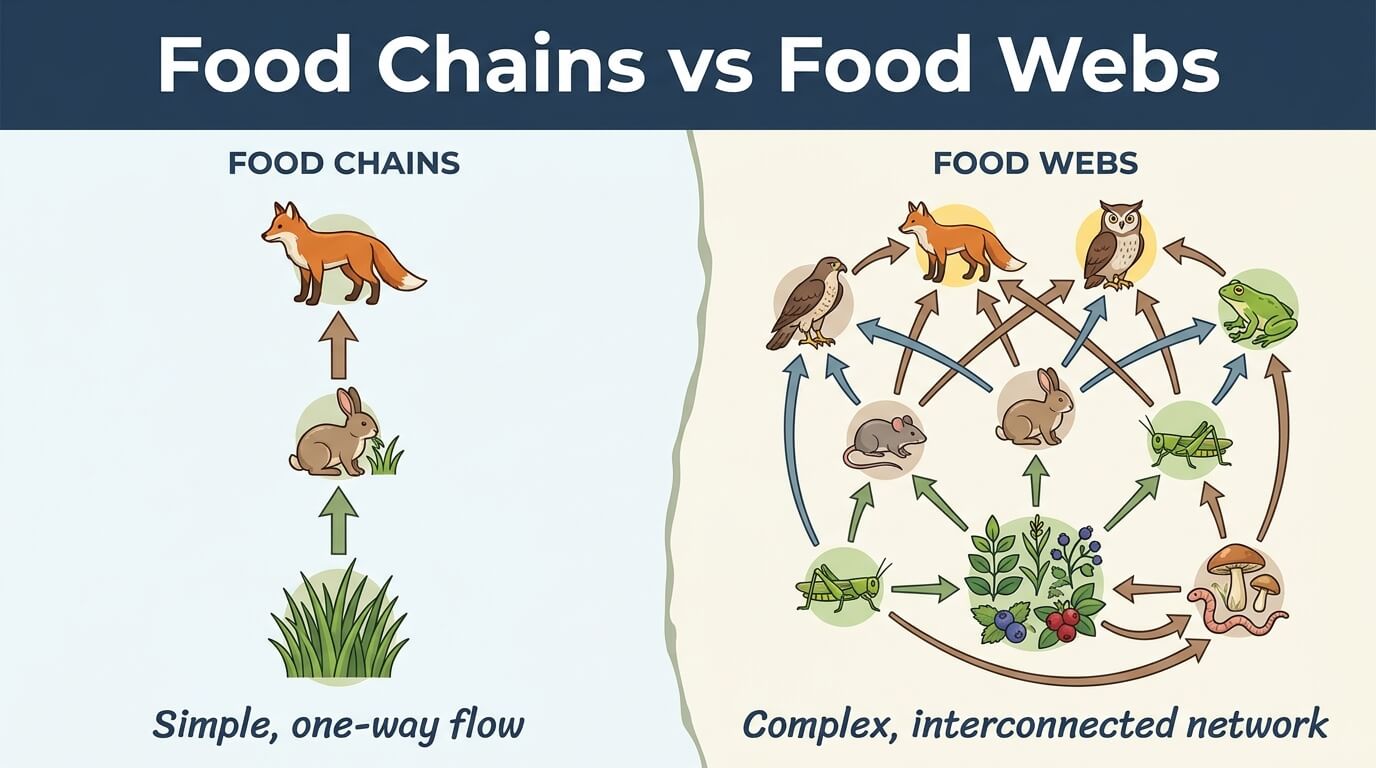
A food chain is a simple line that shows who eats whom. A food web is a wider map that shows how many food chains overlap inside a real ecosystem. Both are useful, but they do not show nature in the same amount of detail.
That difference matters because animals rarely fit into one neat line. A mouse may eat seeds, berries, insects, and fungi. An owl may eat mice, voles, small birds, insects, and snakes. A fox may eat rabbits one day and fruit or carrion the next. When those feeding relationships overlap, the ecosystem starts to look less like a ladder and more like a net.
This guide explains the difference between food chains and food webs in plain English. You will learn how energy moves from plants and algae to animals, why trophic levels are helpful but simplified, and how changes to one species can ripple through many others.
Quick Difference

A food chain shows one pathway of energy flow, such as grass to rabbit to fox. A food web shows many connected pathways, such as grass, seeds, insects, rabbits, mice, foxes, hawks, fungi, bacteria, and scavengers all interacting. Food chains are easier to learn first. Food webs are more realistic because most animals have more than one food source and more than one predator.
Why Food Chains and Food Webs Matter
Food relationships are not just about what an animal eats for dinner. They help explain why plants support herbivores, why predators can shape prey behavior, why scavengers and decomposers matter, and why ecosystems may change when a species becomes rare or overly abundant.
The National Oceanic and Atmospheric Administration describes a food web as a structure with multiple trophic levels, including producers such as plants and algae, consumers, and decomposers. That basic model helps readers see how energy moves through living systems without treating animals as isolated facts. NOAA’s aquatic food webs resource is especially useful for understanding this framework in marine ecosystems.
Food chains and food webs also make animal behavior easier to understand. Hunting, grazing, scavenging, filtering, storing food, and avoiding predators are all connected to the same larger question: how do living things get energy, and what happens when that energy moves through an ecosystem?
What Is a Food Chain?

A food chain is a sequence that shows energy moving from one organism to another. It usually starts with a producer, then moves to a plant-eater or other primary consumer, then to one or more predators. A simple chain might look like this: grass is eaten by a grasshopper, the grasshopper is eaten by a frog, the frog is eaten by a snake, and the snake is eaten by a hawk.
Food chains are helpful because they make cause and effect easier to see. If grass becomes scarce, grasshoppers may lose food. If grasshopper numbers drop, frogs may have less to eat. The chain gives a beginner a clean path to follow.
Producers, consumers, and decomposers
Most food chains begin with producers. Producers are organisms that make their own food, usually through photosynthesis. On land, that often means plants. In water, algae and phytoplankton often fill the same role.
Consumers get energy by eating other organisms. Primary consumers eat producers. Secondary consumers eat primary consumers. Tertiary consumers eat secondary consumers. Decomposers, such as bacteria and fungi, break down dead material and waste, returning nutrients to the environment.
The National Park Service describes decomposers as organisms that reduce dead material into simpler forms and help enrich soil, which supports plant growth again. The NPS Web of Life guide is a clear classroom-friendly explanation of how producers, consumers, and decomposers fit together.
Simple energy flow from one organism to another
A chain is easiest to understand when each step has one clear eater and one clear food source. Sunlight supports grass. Grass supports a rabbit. The rabbit supports a fox. The fox eventually dies, and decomposers help return nutrients to the soil.
That line is not false, but it is simplified. The rabbit may eat many plants. The fox may eat many animals and some fruit. Decomposers do not wait politely at the end of a chain, since waste and dead material enter the system constantly. Still, the chain gives readers a starting point for energy flow.
Example food chains from land and water
A grassland food chain could be: grass to grasshopper to lizard to hawk. A forest food chain could be: oak leaves to caterpillar to songbird to owl. A pond food chain could be: algae to zooplankton to small fish to heron. An ocean food chain could be: phytoplankton to krill to fish to seal to orca.
These examples are useful because they show the same pattern in different habitats. A producer captures energy, a consumer eats the producer, and other consumers continue the transfer. The organisms change, but the basic pathway stays recognizable.
What Is a Food Web?

A food web is a network of connected food chains. Instead of showing one path, it shows many possible feeding paths at once. A food web might include plants, seeds, insects, mice, rabbits, snakes, owls, foxes, fungi, bacteria, vultures, beetles, and worms.
This is closer to how ecosystems work. Most animals do not eat only one thing, and most animals are not eaten by only one predator. Food webs show overlap, backup food sources, competition, scavenging, and the many small links that keep an ecosystem functioning.
Many connected food chains
Imagine a meadow. Grass feeds rabbits, grasshoppers, deer, and mice. Grasshoppers feed frogs, birds, spiders, and lizards. Mice feed snakes, owls, hawks, and foxes. When a dead deer remains on the landscape, vultures, beetles, coyotes, bacteria, and fungi may all take part in the next phase of energy and nutrient movement.
Each of those paths could be drawn as a food chain. Together, they form a food web. The more species and feeding relationships you add, the more the picture begins to match real life.
Animals with multiple food sources
Many animals are flexible eaters. A raccoon may eat fruit, eggs, insects, crayfish, carrion, and human food scraps. A bear may eat berries, fish, insects, roots, carrion, and mammals depending on the season and location. A gull may eat fish, marine invertebrates, eggs, carrion, and discarded food.
Food webs make room for that flexibility. They show that one animal can connect several parts of an ecosystem instead of sitting on a single fixed step. Omnivores, scavengers, and opportunistic feeders often make food webs especially complex.
How food webs show real ecosystem complexity
A web does more than show diet. It shows possible ripple effects. If a prey species declines, predators may switch to another prey. If a plant becomes abundant, herbivores that use it may increase. If a predator disappears, some prey may become more common, which can affect plants and smaller animals.
Food webs do not predict every outcome perfectly, but they help explain why ecological changes are rarely isolated. When one strand moves, other strands may tighten, loosen, or shift.
Food Chain vs Food Web Comparison Table

| Feature | Food Chain | Food Web |
|---|---|---|
| Basic idea | One path showing who eats whom | Many connected feeding paths in one ecosystem |
| Best for | Learning energy flow step by step | Understanding real ecosystem connections |
| Detail level | Simple and easy to follow | More detailed and more realistic |
| Animal diets | Often shows one food source per animal | Can show multiple foods, predators, and roles |
| Weakness | Can make ecosystems look too simple | Can become crowded and harder to read |
| Example | Grass to rabbit to fox | Grass, seeds, insects, rabbits, mice, foxes, hawks, fungi, and scavengers |
Structure
The structure of a food chain is linear. It moves in one direction from one organism to the next. The structure of a food web is networked. It may have many arrows, many species, and several possible routes for energy to move.
Accuracy
A food chain is accurate as a simplified model. It can show one real feeding pathway, but it leaves out many others. A food web is more accurate when the goal is to understand an ecosystem as a whole, because it can include multiple diets, predators, scavengers, and decomposers.
Best use for learning ecosystems
Food chains are usually better for first learning. Food webs are better for deeper understanding. A student might start with a chain to understand the basic direction of energy flow, then build a web to see why real habitats are more connected than a single line can show.
Trophic Levels Explained Simply

Trophic levels describe where organisms fit in feeding relationships. The idea is useful, but it is not always as neat as a diagram makes it look. Some animals feed at more than one trophic level, especially omnivores and animals whose diets change as they grow.
NOAA’s ocean food web materials explain trophic level as the distance along a producer-consumer chain, with producers at the first level and consumers higher up the chain. The NOAA trophic levels activity gives a clear version of this idea for ocean ecosystems.
Primary producers
Primary producers form the base of most food chains and food webs. They include land plants, algae, cyanobacteria, and phytoplankton. These organisms turn sunlight or chemical energy into forms that other living things can use.
In the ocean, phytoplankton are tiny but extremely important. NOAA explains that phytoplankton form the base of several aquatic food webs and provide food for many sea creatures in balanced ecosystems. NOAA’s phytoplankton overview helps show why microscopic producers can support much larger animals.
Primary, secondary, and tertiary consumers
Primary consumers eat producers. Rabbits, deer, caterpillars, grasshoppers, manatees, and many zooplankton fit this role when they feed on plants, algae, or phytoplankton. Secondary consumers eat primary consumers. Frogs, small fish, insect-eating birds, and many reptiles can fit this level depending on the food source.
Tertiary consumers eat other consumers higher in the web. Hawks, large predatory fish, big cats, orcas, crocodiles, and some snakes may act as top predators in certain systems. The exact label depends on what the animal is eating in that moment, not just what species it is.
Decomposers, detritivores, and scavengers
Decomposers break down dead organisms and waste chemically. Fungi and bacteria are classic decomposers. Detritivores, such as earthworms, millipedes, some beetles, and certain crustaceans, eat dead organic material and break it into smaller pieces. Scavengers, such as vultures, hyenas, ravens, crabs, and many insects, feed on dead animals.
These roles are sometimes grouped together, but they are not identical. A vulture does not decompose a carcass the same way bacteria do. A beetle larva may physically consume dead tissue, while fungi and microbes complete much of the chemical breakdown. Together, they help move nutrients back into soil, water, and living food webs.
How Animal Diets Shape Food Webs
Animal diets determine where species fit inside a web. A grazing animal links plants to predators. A filter feeder links plankton to fish, whales, birds, or other consumers. A scavenger links carcasses to insects, microbes, and larger animals that rely on leftovers.
Herbivores moving plant energy upward
Herbivores are one of the main routes by which plant energy moves into animal bodies. Deer convert leaves and shoots into muscle and fat that can support wolves, cougars, ticks, flies, scavengers, and decomposers. Caterpillars convert leaves into food for birds, wasps, spiders, and small mammals.
This is why plant abundance and plant diversity matter for animal life. If a habitat loses certain plants, the effects may not stop with herbivores. Predators, parasites, pollinators, seed dispersers, and decomposers may also feel the change.
Carnivores and predator-prey relationships
Carnivores can shape food webs by affecting prey numbers and prey behavior. A predator does not only remove prey by eating it. Its presence may also change where prey feed, how long they stay in open areas, and how much pressure they place on plants.
Yellowstone National Park describes photosynthesis, predation, decomposition, climate, and precipitation as processes that help facilitate the flow of energy and materials in the Greater Yellowstone Ecosystem. Yellowstone’s cycles and processes overview is a useful example of how feeding relationships connect with larger ecosystem processes.
Omnivores, filter feeders, and scavengers as connectors
Some animals connect many parts of a web because they eat across categories. Omnivores may feed on plants, animals, fungi, eggs, carrion, or stored food. Filter feeders may collect tiny organisms from water and transfer that energy to larger animals. Scavengers move energy from dead animals into new consumers rather than leaving carcasses outside the web.
These connector species make food webs harder to draw but more realistic. They also show why a simple label can miss the bigger role of an animal. A bear is not only a predator. A crab is not only a scavenger. A whale is not only a large marine mammal. Each can link several feeding pathways depending on season, age, habitat, and available food.
What Happens When a Food Web Changes

Food webs are flexible, but they are not unbreakable. When a species declines, invades, disappears, or becomes unusually abundant, other species may respond. The response is not always immediate or easy to predict.
Removing predators
When predators are removed, some prey species may increase. That can lead to heavier grazing or browsing, which may change plant communities. In other cases, another predator may take over part of the role, or prey may still be limited by food, weather, disease, or competition.
The key point is nuance. Removing a predator does not create the same result everywhere. The effect depends on habitat size, prey behavior, alternative predators, human activity, and the number of other links in the food web.
Losing pollinators, prey, or plant species
Food webs can also change when organisms that are not top predators decline. If certain insects disappear, birds that feed nestlings on insects may struggle. If flowering plants decline, pollinators may lose food. If prey fish decline, seabirds, larger fish, and marine mammals may need to switch diets or move.
These changes are often harder to notice than the loss of a large predator, but they can be just as important. Small organisms can hold large parts of a web together.
Invasive species and ecosystem imbalance
Invasive species can alter food webs by becoming new predators, competitors, grazers, or disease carriers. Some may eat native species that have few defenses. Others may outcompete native animals for food or habitat. Still others may change plant communities, which then affects herbivores and the animals that depend on them.
Not every non-native species causes major harm, but invasive species that spread aggressively can rearrange feeding relationships. Food webs help explain why the impact may reach beyond the first species affected.
Common Mistakes and Myths
Food chains and food webs are simple ideas on the surface, but several misunderstandings can make ecosystems seem more rigid than they are. These are the most common mistakes to avoid.
Food chains are not wrong, but they are simplified
A food chain is not a bad model. It is a first step. The problem comes when readers treat one chain as the whole story. Grass to rabbit to fox may be true in one pathway, but the rabbit probably eats several plants, the fox probably eats several foods, and both connect to parasites, scavengers, decomposers, and competitors.
Energy does not recycle the same way nutrients do
Energy generally flows through ecosystems and is lost as heat along the way. Nutrients, such as carbon, nitrogen, and phosphorus, cycle through living things, soil, water, and air. This is why diagrams often show energy moving in one direction while nutrients move in cycles.
Britannica’s overview of food chains describes how food energy moves from one organism to another through feeding relationships. Britannica’s food chain entry is a concise reference for this basic ecological idea.
Top predators are still connected to many smaller species
A top predator may sit near the top of a diagram, but it is not separate from the rest of the ecosystem. A wolf depends on prey, which depend on plants, which depend on soil, water, sunlight, fungi, microbes, and weather. An orca may depend on fish, seals, or other prey that are linked to plankton and smaller marine animals.
Being at the top does not mean being independent. It often means depending on many lower connections staying strong.
Edge Cases and Exceptions
Some food webs do not fit the classic classroom picture of green plants, herbivores, and predators. These exceptions are not side notes. They show how creative and varied feeding relationships can be.
Detritus-based food webs
Some ecosystems rely heavily on detritus, which is dead organic material such as fallen leaves, dead wood, waste, and carcass remains. Forest floors, wetlands, streams, and deep-sea environments can all have important detritus-based pathways.
In these systems, energy may move from dead material to fungi, bacteria, worms, insect larvae, crustaceans, fish, birds, and mammals. A fallen leaf can become part of a long feeding sequence after it dies.
Marine food webs built on plankton
Many marine food webs begin with plankton. Phytoplankton act as producers, while zooplankton feed on phytoplankton or smaller animals. Fish, whales, seabirds, squid, jellyfish, and many other animals can depend directly or indirectly on plankton.
This is one reason large marine animals can depend on very small organisms. A whale may be huge, but its food web may trace back to microscopic life drifting near the ocean surface.
Human impacts on food webs
Humans can affect food webs through habitat loss, pollution, overfishing, climate change, invasive species, and nutrient runoff. For example, excess nutrients can fuel algal blooms, which may block sunlight and contribute to low-oxygen conditions when algae die and decompose.
NOAA explains eutrophication as a process that begins when excess nutrients enter lakes and oceans, causing algae growth that can affect sunlight, plants, and oxygen conditions. NOAA’s eutrophication explanation shows how a change at the producer level can spread through aquatic systems.
Why This Helps Explain Other Feeding Questions
Once you understand food chains and food webs, many animal diet questions become easier to place in context. A diet is not only a menu. It is also a position inside a living network.
Predator and prey relationships
Predator and prey relationships are easier to understand when you see them as part of a web. A predator may control one prey species, compete with another predator, scavenge occasionally, and be affected by plant growth through its prey. The relationship is direct, but the consequences can spread outward.
Scavengers and decomposers
Scavengers and decomposers keep dead material from being an endpoint. They move energy and nutrients into other parts of the ecosystem. Without them, food webs would miss one of the most important forms of cleanup and recycling in nature.
Filter feeding and ocean food webs
Filter feeders show why food webs often start small. Baleen whales, oysters, mussels, flamingos, some fish, and many invertebrates can feed by straining tiny organisms or particles from water. That feeding method can connect microscopic producers and plankton to much larger animals.
Key Takeaways
- A food chain shows one feeding path, while a food web shows many connected feeding paths in the same ecosystem.
- Food chains are useful for learning the direction of energy flow, but food webs are better for showing real ecological complexity.
- Producers form the base of most food webs, and consumers move that energy through herbivores, carnivores, omnivores, scavengers, and decomposers.
- Trophic levels are helpful labels, but many animals feed at more than one level depending on age, season, and available food.
- Changes to one species can affect many others, especially when that species is a major predator, prey, plant, pollinator, scavenger, or ecosystem connector.
FAQ
Which is more realistic, a food chain or a food web?
A food web is more realistic because most animals eat more than one food and are connected to more than one predator, competitor, scavenger, or decomposer. A food chain is still useful because it shows one pathway clearly, but it leaves out much of the overlap found in real ecosystems.
What is an example of a food web?
A pond food web might include algae, aquatic plants, zooplankton, insect larvae, snails, small fish, frogs, turtles, herons, raccoons, bacteria, fungi, and decomposers. Algae may feed zooplankton and snails. Small fish may eat zooplankton and insect larvae. Herons may eat fish and frogs. Dead organisms may support bacteria, fungi, insects, and scavengers.
Why do food webs have more than one food chain?
Food webs have more than one food chain because ecosystems have many species with overlapping diets. A single plant may feed several herbivores. One herbivore may feed several predators. One predator may eat many prey species. Those overlapping lines create a web instead of a single straight chain.
Can one animal be in more than one trophic level?
Yes. Omnivores and flexible feeders can occupy different trophic levels depending on what they eat. A bear eating berries is acting as a consumer of plant material. The same bear eating fish or carrion is connected to a different part of the food web.
Are decomposers part of food chains or food webs?
Yes. Decomposers are often drawn separately in simple diagrams, but they are part of ecosystem feeding relationships. They break down dead organisms and waste, helping return nutrients to the environment so producers can keep supporting the rest of the web.
Final Thoughts
The easiest way to remember the difference is this: a food chain is a single route, and a food web is the whole road map. Chains help you learn the basic direction of energy flow. Webs help you understand why animals, plants, fungi, microbes, water, soil, and climate are tied together.
Next time you see a simple diagram that says grass to rabbit to fox, use it as a starting point. Then ask what else the rabbit eats, what else eats the rabbit, what happens to dead material, and which tiny organisms support the whole system. That shift turns a simple animal fact into a much deeper view of how nature works.
Food webs also change when animals that store food hide, recover, lose, or share cached resources.
Ethan Walker is the founder and research editor of Animal Fact Central. He creates and reviews educational animal facts content using trusted wildlife, pet care, and science-based sources. His work focuses on making animal behavior, adaptations, habitats, and species facts clear, accurate, and engaging for everyday readers.
Read More Details About Ethan Walker: https://animalfactcentral.com/ethan-walker/