

Bird nest identification starts with clues you can see without disturbing the birds: where the nest is, what shape it has, what materials it uses, how the adult birds behave nearby, and what season it is. A nest in a porch corner, a mud cup under an eave, a twig platform in a tree, and a hidden grass cup in a shrub all point to different nesting strategies. The safest answer is usually a careful one: a nest can narrow the possibilities, but it rarely proves the exact species by itself.
Quick Answer

To identify a bird nest, first note the location: tree branch, shrub, ground, cavity, ledge, porch, building, cliff, marsh vegetation, or nest box. Then look at the shape from a distance: cup, platform, scrape, cavity, dome, pendant pouch, woven basket, mud cup, or loose stick tray. Next, observe materials such as grass, twigs, mud, moss, bark strips, plant fibers, feathers, hair, leaves, or spider silk. Finally, watch adult birds from a respectful distance, because the bird returning to the nest is often a stronger clue than the nest alone.
A good bird nest identification process uses several clues together. A cup-shaped nest in a shrub could belong to many songbirds. A loose twig platform might suggest a dove, hawk, heron, or other platform nester depending on size and placement. A round entrance in a tree cavity could point toward a woodpecker, chickadee, nuthatch, bluebird, or other cavity-using bird. A mud nest under an eave may suggest a swallow, but exact identification still depends on shape, location, region, and adult bird behavior.
Safety and Ethics Before Identifying a Bird Nest

A nest is not just a clue. It is an active breeding site or a former breeding site, and the way you investigate it can affect the birds. Some birds may tolerate quiet observation from a distance. Others are more sensitive, especially during early incubation, bad weather, or when young birds are close to leaving the nest. Anyone considering a camera should first review how to use trail cameras for wildlife without crowding an active nest or creating a predator path.
Observe from a distance
Start farther away than you think you need to be. Use binoculars or a camera zoom rather than walking directly up to the nest. Watch from a place where the adult birds can still approach, feed, or sit without repeatedly flushing away. Cornell Lab’s NestWatch advises minimizing disturbance, avoiding unnecessary approaches, and being especially cautious when young birds are close to fledging through its NestWatch code of conduct.
Distance matters because your presence can change what birds do. A parent may leave the nest when you approach, exposing eggs or young to temperature stress or predators. Repeated visits can also create a visible path that predators may follow. If you are taking notes, step away first and write down what you saw after you are no longer near the nest.
Avoid touching eggs, chicks, or nest materials
Do not lift, open, poke, turn, or rearrange a nest. Do not pick up eggs to compare color or markings. Do not remove lining material to see how the nest was built. Eggs can crack, nestlings can be injured, and a nest that looks sturdy may be more fragile than it appears.
There is also no need to test whether a nest is active by touching it. Activity is usually better judged by adult bird behavior, fresh-looking materials, droppings below the nest, soft calls from young birds, or repeated feeding visits. If you are not sure, treat the nest as active and leave it alone.
Understand that many native birds are legally protected
In the United States, many native migratory birds are covered by federal law. The U.S. Fish and Wildlife Service overview of the Migratory Bird Treaty Act explains that the law is intended to conserve protected migratory bird species and prohibits take without proper authorization. Practical nest questions can also involve state or local rules, so homeowners should not assume that a nest can be removed just because it is inconvenient.
Legal details vary by species, nest activity, location, and permit status. A nonnative species may be treated differently from many native birds, but guessing incorrectly can create legal and ethical problems. If a nest is in a dangerous place, such as inside active machinery, a vent, or an area where people may be harmed, contact a local wildlife agency, licensed wildlife rehabilitator, or qualified professional before taking action.
How to Identify a Bird Nest by Location
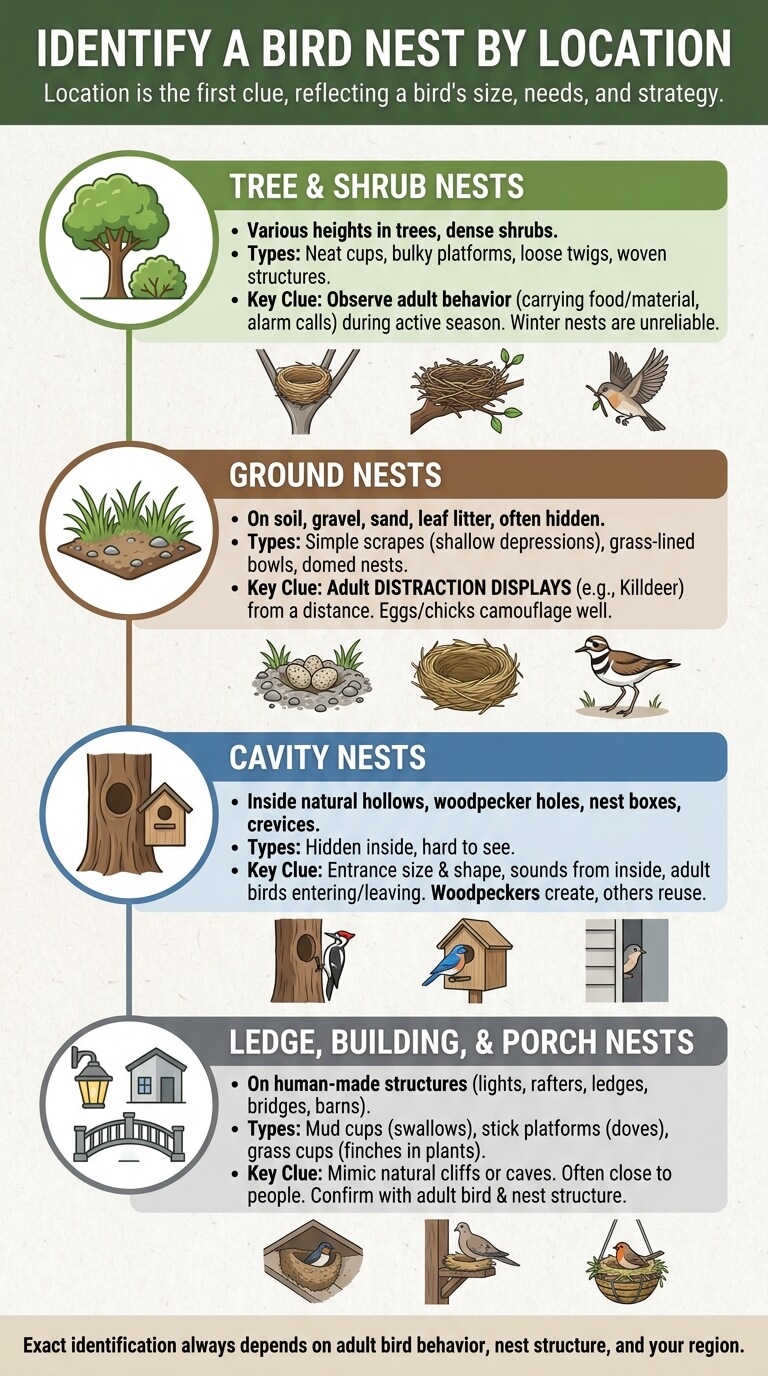
Location is often the first useful clue because birds choose nesting sites that match their body size, flight style, predator risk, food needs, and nesting strategy. A nest in a dense shrub suggests a different set of birds than a nest in a tree cavity, on a porch light, in a grass clump, or under a bridge.
Tree and shrub nests
Many familiar backyard birds build nests in trees or shrubs. These can include neat cups, bulky stick platforms, loosely arranged twig nests, or hidden woven structures. Height matters, but it does not identify a bird by itself. Some species nest low in shrubs, others use mid-level branches, and larger birds may choose tall trees or sturdy limbs.
Tree and shrub nests are often easier to notice after leaves fall, but an empty winter nest does not always tell you exactly who built it. Weather, reuse by other animals, and plant growth can change the nest’s appearance. During the active season, adult bird behavior is usually more helpful than a bare nest alone. Watch for repeated trips to the same branch, carrying insects, carrying nesting material, or giving alarm calls when predators move nearby.
Ground nests
Ground nests can be surprisingly hard to spot. Some are simple scrapes, which are shallow depressions in soil, gravel, sand, or leaf litter. Others are grass-lined bowls, domed nests, or hidden sites under vegetation. Ground nesting is common among many shorebirds, waterbirds, grassland birds, nightjars, game birds, and some songbirds. Mammal or bird footprints near the site can add context, and a careful animal track identification method can help interpret them.
Because ground nests are so vulnerable to trampling, the best identification clue may be the adult bird’s behavior from a distance. A Killdeer, for example, is famous for using distraction displays when a threat approaches its nest area. Many ground-nesting birds rely on camouflage, so eggs and chicks may blend with gravel, grass, marsh plants, or leaf litter.
Cavity nests
Cavity nests are built or placed inside holes. These can be natural tree cavities, old woodpecker holes, dead snags, nest boxes, fence posts, building gaps, or crevices. Cavity nesters include many woodpeckers, chickadees, titmice, nuthatches, bluebirds, wrens, some owls, and some ducks.
A cavity nest may not let you see much of the nest itself. In that case, identification depends on the entrance size and shape, the surrounding habitat, sounds from inside, and adult birds entering or leaving. Woodpeckers often create or enlarge cavities, while many other birds use existing holes. Nest boxes add another clue, because entrance hole size and box placement are often designed for particular species.
Ledge, building, and porch nests
Some birds take advantage of human-made structures. Porch lights, rafters, beams, ledges, bridge supports, gutters, signs, barns, and building corners can mimic cliffs, caves, tree limbs, or sheltered ledges. These nests are often noticed because they are close to people.
Building nests may be mud cups, stick platforms, grass cups, or loosely arranged materials tucked into corners. Swallows often use mud-based nests on walls, under eaves, or beneath bridges. Doves may use shallow platforms on beams or ledges. House finches may build cups in hanging plants, wreaths, or sheltered porch spaces. Exact identification still depends on the adult bird, the nest structure, and your region.
How to Identify a Bird Nest by Shape and Materials
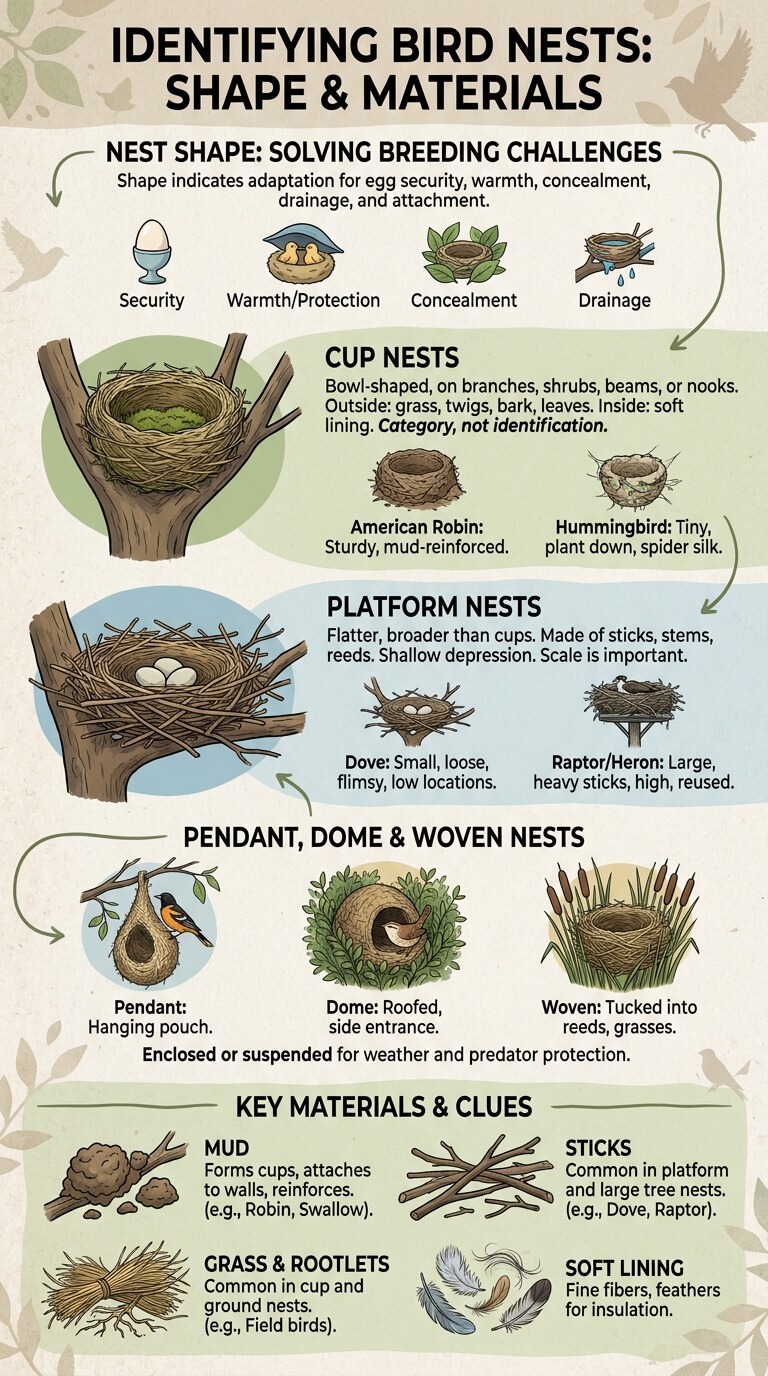
Nest shape shows how a bird solves basic breeding challenges: holding eggs in place, keeping chicks warm, hiding from predators, draining rain, gripping a branch, fitting into a cavity, or attaching to a wall. Materials show what was available nearby and what the bird can carry, weave, pack, or mold.
Cup nests
Cup nests are the classic bowl-shaped nests many people picture when they think of songbirds. They may sit on a branch, in a fork, inside a shrub, on a beam, or in a protected nook. The outside may include grass, twigs, bark strips, leaves, moss, rootlets, pine needles, or plant fibers. The inside is often lined with softer material.
Many different birds build cup nests, so a cup is a category, not a final identification. An American Robin cup may look sturdy and mud-reinforced, while a hummingbird cup is tiny and can include plant down and spider silk. A cardinal cup in a shrub looks different from a phoebe cup on a ledge, but both can be broadly cup-like.
Platform nests
Platform nests are usually flatter and broader than cups. They may be made from sticks, twigs, stems, reeds, or other coarse material. Some have only a shallow depression where eggs rest. Platform nests can be used by doves, raptors, herons, ospreys, crows, and other birds, depending on size and location.
Scale is important. A small, loose platform on a porch beam may suggest a dove, while a large stick platform high in a tree may suggest a hawk, crow, or heron depending on habitat. Some large platform nests may be reused or added to over time, while smaller platforms may look flimsy and short-lived.
Pendant, dome, and woven nests
Some nests are more enclosed or suspended. Pendant nests hang like pouches. Domed nests have a roof or side entrance. Woven nests may be tucked into reeds, grasses, shrubs, or branch forks. These designs can protect eggs from weather, make predator access harder, or help the nest blend into vegetation.
In North America, orioles are known for hanging pouch-like nests, while wrens and some ground or marsh birds may use domed or covered structures. Marsh birds may weave nests into reeds, cattails, or sedges. The exact builder depends heavily on region and habitat.
Mud nests, stick nests, grass nests, and lined nests
Materials can add important clues. Mud can help form a cup, attach a nest to a wall, or reinforce a structure. Sticks often appear in platform nests and large tree nests. Grasses and rootlets are common in cups and ground nests. Soft lining may include fine plant fibers, hair, feathers, or other flexible material.
Mud alone does not always identify a bird. Robins may use mud in cup nests, while some swallows build mud nests on vertical surfaces or under shelter. Stick nests also vary widely, from loose dove platforms to large raptor nests. Grass nests can belong to many species that live in fields, wetlands, yards, and shrublands.
Common Backyard Bird Nest Examples

The examples below are not a complete species key. They are practical patterns that can help you narrow possibilities while staying cautious. For exact identification, combine the nest with adult bird appearance, song, range, season, habitat, and repeated behavior, then compare your notes with NestWatch common nesting birds information.
Robins and other open-cup nesters
American Robins often come to mind because their nests are visible around yards, trees, shrubs, and buildings. A robin nest is commonly a cup built with grasses and twigs and often reinforced with mud. It may sit on a branch, ledge, gutter, light fixture, or other supported site.
However, many birds build open cups. Cardinals, catbirds, mockingbirds, thrushes, flycatchers, finches, and warblers can all build cup-like nests in different places. A blue egg in a cup may make people think of a robin, but eggs should not be handled or used as the main identification method.
Mourning doves and loose platform nests
Mourning Dove nests often look loose compared with the neat cups people expect. They may be shallow platforms of twigs on branches, ledges, gutters, beams, or other supports. This can surprise homeowners who find a thin-looking nest in a place that seems exposed.
Doves are not the only platform nesters, so size and location matter. A small porch platform with an adult dove nearby is a different clue from a bulky stick nest high in a tree. Mourning Doves are common in many US neighborhoods, but local bird communities vary, so the adult bird is still the strongest clue.
Woodpeckers, chickadees, and cavity nesters
Cavity nests can be harder to identify because the nest is hidden inside. Instead of seeing the cup or lining, you may see a round or oval entrance in a tree, snag, nest box, or building gap. Woodpeckers are primary cavity excavators, meaning many species can create holes in wood. Other birds often use existing cavities.
Chickadees, titmice, nuthatches, wrens, bluebirds, tree swallows, some owls, and some ducks may use cavities or boxes. Entrance size, habitat, box design, and adult behavior help separate possibilities. A small bird carrying moss into a box suggests a different story than a woodpecker excavating a dead branch.
Swallows and mud-based nests
Swallow nests are often noticed under eaves, bridges, barns, cliffs, or other sheltered overhangs. Some swallows build mud cups or mud gourd-shaped nests, while others use cavities or nest boxes. Mud pellets, repeated flights to a wall or beam, and fast-flying adults nearby can be strong clues.
Species differ in nest shape and placement. Barn Swallows often build open mud cups attached to sheltered vertical surfaces. Cliff Swallows build more enclosed mud nests, often in colonies. Tree Swallows are cavity nesters and may use nest boxes. This is why mud is a clue, not a final answer by itself.
What Nest Clues Can and Cannot Tell You
Bird nest identification is strongest when you combine evidence. Shape, location, materials, season, habitat, adult birds, calls, and behavior all matter. A single clue can be useful, but it can also mislead you.
Why nest shape rarely proves the species alone
Many unrelated birds solve the same nesting problem in similar ways. A cup is good for holding eggs. A cavity is good for shelter. A scrape works in open ground where eggs are camouflaged. A platform can support larger birds. Because these designs are useful, multiple species may use similar forms.
That means a nest type narrows the possibilities rather than confirming one bird. A cup in a shrub could be a cardinal, catbird, mockingbird, thrasher, or another shrub-nesting species depending on region. A stick platform could be a dove, crow, hawk, or heron depending on size and site. A cavity could involve a bird that excavated the hole or a bird that simply moved into it later.
Why eggs should not be used as the main ID method
Egg color, pattern, and number can help trained researchers, but they are risky for casual backyard identification. Looking closely at eggs often requires getting too close to an active nest. Egg appearance also varies within species and can overlap between species. Lighting, shadows, and camera color can mislead you.
There is another problem: focusing on eggs can tempt people to touch, photograph too closely, or compare nests in ways that disturb birds. For most readers, adult bird behavior is safer and more useful.
How adult bird behavior helps from a distance
Adult behavior can be one of the best clues. Watch for birds repeatedly entering a shrub, carrying grass or twigs, carrying insects, removing fecal sacs from the nest, singing nearby, giving alarm calls, or perching with food before approaching. These actions can reveal which bird is using the nest without requiring close inspection.
Patience helps. Spend a few quiet minutes watching from far enough away that adults continue normal activity. If the birds do not return while you are present, you may be too close. Step farther back or leave the area and try again another day from a safer distance.
Common Mistakes and Myths
Bird nests attract curiosity, but curiosity can lead to mistakes. The goal is not to solve the mystery at any cost. The goal is to learn while giving the birds the best chance to finish their nesting cycle.
The myth that birds always abandon touched nests
One common myth says adult birds will always abandon eggs or chicks if a human touches them. That is too simple. Many birds have a limited sense of smell compared with mammals, and human scent is not usually the main issue. The real problem is disturbance, injury, exposure, and legal or ethical risk.
Even though the myth is exaggerated, that does not mean touching nests is harmless. Eggs can be damaged, nestlings can be hurt, and adult birds may be stressed by repeated visits. The right lesson is not that touching is always instantly fatal. The right lesson is that touching is unnecessary and often risky.
Why moving a nest is usually not a simple fix
People sometimes want to move a nest from a porch, door wreath, hanging basket, grill, mailbox, gutter, or construction area. In many cases, moving an active nest is not a simple or legal do-it-yourself fix. Adult birds choose nest sites based on familiar landmarks and may not accept a moved nest. Eggs or young can be exposed during the move, and the new site may be less safe.
If a nest is truly in a hazardous location, contact a licensed wildlife professional, local wildlife agency, or rehabilitator for guidance. If the nest is merely inconvenient, the safest option is often to give it space until the young leave, then prevent future nesting in that exact spot before the next breeding attempt.
Why empty nests may not be abandoned forever
An empty nest is not always available for removal right away. Adults may be away feeding, eggs may not have been laid yet, chicks may be hidden low in the cup, or the nest may be between visits. Some species may reuse a site or build again nearby.
Before assuming a nest is inactive, observe over time from a distance. Look for adult visits, fresh material, droppings, sounds, or seasonal timing. If you are unsure, treat it as active. Once you are confident the nest is old and empty, check local rules before removing it from a building or yard feature.
Unusual Situations and Exceptions
Not every nest fits a neat backyard chart. Some birds reuse old sites. Some nonnative birds may fall under different legal rules. Storms can knock nests down. Young birds can leave the nest before they fly well. These situations require extra caution because a quick assumption may be wrong.
Old nests and reused sites
Many songbirds build a new nest for a new nesting attempt, but some birds reuse nests or return to the same general site. Larger birds may add material to old platforms. Cavity nesters may use the same cavity or box again. A porch or beam that worked once may attract birds in later seasons.
Invasive or nonnative species context
Some birds commonly found around buildings in the United States are nonnative, including House Sparrows, European Starlings, and Rock Pigeons. Their legal treatment can differ from many native birds, but identification mistakes are easy, especially for beginners.
Do not use this category as a reason to disturb an active nest on a guess. A small brown bird in a building gap is not automatically a House Sparrow. A cavity nest is not automatically a starling nest. If action may be needed, confirm the species with a qualified local source and follow local rules.
Storm-damaged nests and fledgling confusion
Storms, wind, pruning, predators, and accidents can damage nests. A fallen nest with eggs or tiny young is different from a fully feathered fledgling on the ground. Nestlings are very young birds that usually have little feathering and should still be in the nest. Fledglings are older young birds that have left the nest and may hop on the ground while parents continue feeding them.
Cornell Lab’s All About Birds explains that many young birds found by people are fledglings and often do not need intervention beyond keeping pets away and moving the bird only if it is in immediate danger, as described in its advice on what to do if you find a baby bird.
Other Wildlife Clues Around Bird Nests
A bird nest does not exist in isolation. The area around it may show other signs, including bird droppings, feeding scraps, feathers, tracks, chew marks, predator activity, or repeated travel paths. These clues can help you understand what is happening, but they can also reveal nest locations to predators if humans create too much disturbance.
Backyard wildlife signs near nests
Common nest predators can include snakes, raccoons, squirrels, cats, crows, jays, and other animals depending on region and habitat. You may notice disturbed vegetation, broken shells, feathers, claw marks, or mammal tracks near a nest. These signs can explain a failed nest, but they do not always identify the exact predator.
Do not set traps, handle snakes, chase wildlife, or try to guard a wild nest by staying beside it. Your presence can add stress and may draw more attention to the nest. Instead, reduce human-related risks where you can: keep cats indoors, leash dogs, avoid trimming active nesting areas, and give birds quiet space.
Cameras and careful observation
Trail cameras and small nest cameras can be useful, but only if they do not increase disturbance. Installing equipment near an active nest can cause stress, create a predator trail, or require repeated battery and memory card visits. If a camera is not already in place before nesting begins, it may be better to observe with binoculars instead.
FAQ
How can you tell what bird made a nest?
You can narrow the possibilities by combining nest location, shape, materials, size, surrounding habitat, season, and adult bird behavior. The adult bird returning to the nest is often the strongest clue. A nest by itself can be misleading because many species build similar cups, platforms, cavities, or ground nests.
Is it illegal to remove a bird nest?
It can be illegal to remove or disturb an active nest of many native birds in the United States, especially if it contains eggs, chicks, or attending adults. Rules can vary by species and situation, and some nonnative species may be treated differently. Because mistakes are common, homeowners should not remove active nests without proper guidance.
What should you do if you find a baby bird near a nest?
First decide whether it looks like a nestling or a fledgling. A nestling is very young, often sparsely feathered, and should usually be in the nest. A fledgling is more feathered, alert, and may hop on the ground while parents continue caring for it nearby.
Can you identify a bird nest by its eggs?
Egg color and pattern can sometimes help trained observers, but eggs should not be the main clue for casual identification. Getting close enough to inspect eggs can disturb the adults, chill eggs or young, or expose the nest to predators. Egg appearance can also vary and overlap between species.
Do birds reuse the same nest?
Some birds may reuse a nest, add to an old nest, or return to the same nesting area. Others build a new nest for each attempt. Larger platform nests and cavity sites are more likely to be reused than many small open cups, but there are exceptions.
Final Thoughts
Bird nest identification works best when you think like a careful observer instead of a collector. Location tells you where the bird chose to raise young. Shape and materials show how the nest holds eggs, hides chicks, or fits the site. Adult behavior often gives the clearest clue to the species, while eggs and close inspection are usually the least appropriate tools for beginners.

Ethan Walker is the founder and research editor of Animal Fact Central. He creates and reviews educational animal facts content using trusted wildlife, pet care, and science-based sources. His work focuses on making animal behavior, adaptations, habitats, and species facts clear, accurate, and engaging for everyday readers.
Read More Details About Ethan Walker: https://animalfactcentral.com/ethan-walker/