
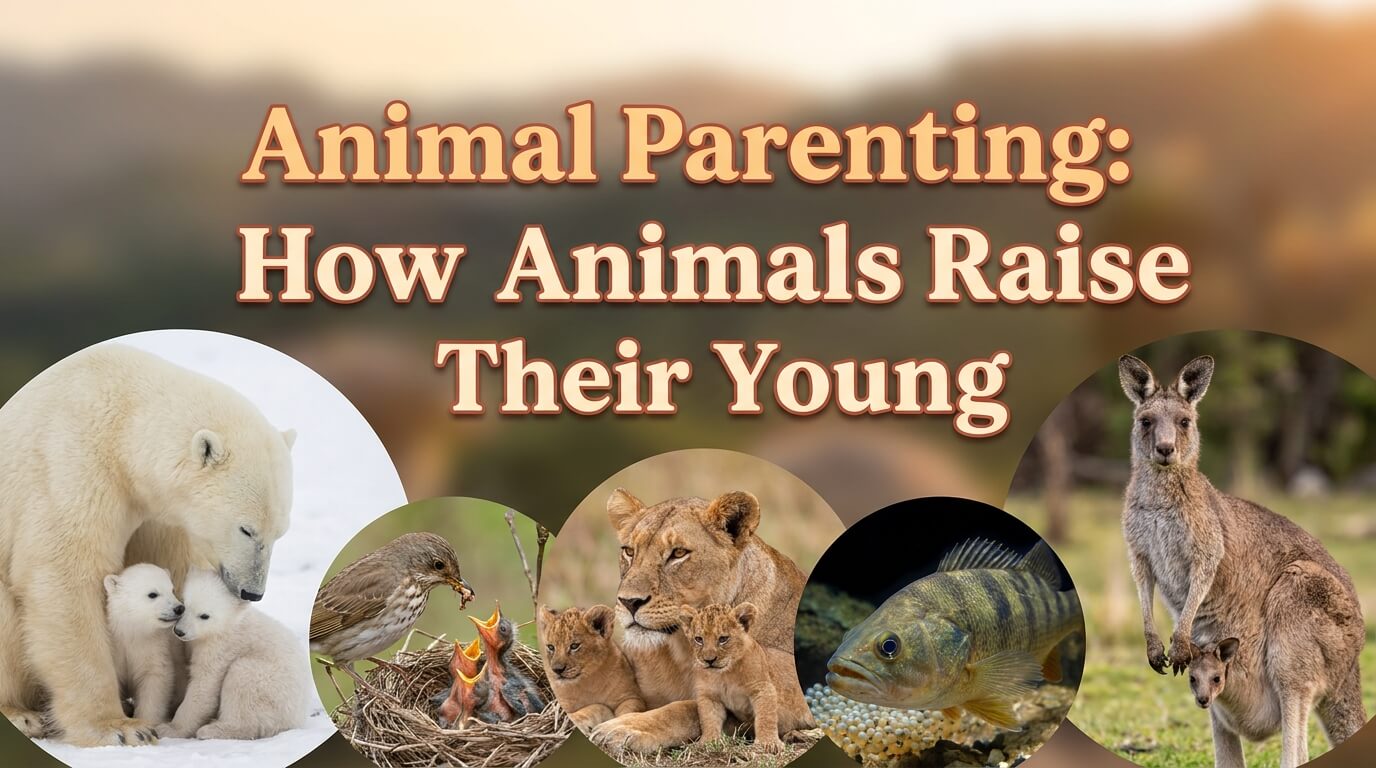
Animal parenting includes far more than feeding a hungry baby. Across the animal kingdom, adults may prepare a safe place before birth, guard eggs, warm hatchlings, carry young through dangerous terrain, provide milk or captured food, teach difficult skills, and gradually reduce care as offspring become independent. Other species provide little direct care after eggs are laid or young are born. Both approaches can succeed because each fits a different combination of body size, habitat, food supply, predator pressure, and developmental speed.
Parental care is best understood as an investment, not as a measure of affection or moral worth. A behavior counts as care when it improves an offspring’s chance of surviving, developing, or eventually reproducing, while requiring time, energy, or risk from the caregiver. The caregiver may be a mother, a father, both parents, older siblings, unrelated group members, or even an entire colony.
Quick Overview of Animal Parenting

Animal parenting can begin before fertilization and continue beyond the point when a juvenile can feed itself. It includes preparing eggs with nutrients, choosing a safe breeding site, building or defending a nursery, incubating or brooding eggs, protecting embryos, feeding young, controlling their temperature, carrying them, cleaning them, defending them, and helping them learn.
Care does not need to be constant to matter. A parent may visit hidden young only briefly, stand guard nearby rather than touch them, or leave offspring alone while searching for food. In other species, the young receive nearly continuous attention. What matters is whether the behavior changes the young animal’s prospects and whether the adult pays a cost in energy, time, lost feeding opportunities, or increased exposure to danger.
Biologists study these benefits and costs because care can improve survival, growth, or development while limiting what a parent can invest elsewhere. A review of the benefits of parental care emphasizes that care can affect several parts of offspring performance, not survival alone.
What Animal Parenting Includes
Care Before Birth or Hatching
Some of the most important parenting decisions happen before young are visible. An adult may select a place with suitable temperature, moisture, cover, or access to food. Birds may build nests, crocodilians may prepare and guard mounds or holes, insects may place eggs directly on a host plant, and mammals may prepare dens or nests for birth.
Care can also involve provisioning an egg before it is laid. Egg yolk supplies energy and building materials for the developing embryo. In mammals, pregnancy transfers resources through different reproductive systems, followed by milk after birth or hatching. These early investments can be costly, but they give developing young a better starting point.
Guarding eggs is another form of prenatal or pre-hatching care. A parent may defend the clutch, fan water over eggs, remove fungus or debris, turn eggs, shade them, or adjust their position. Such behavior can reduce predation, improve oxygen flow, or keep conditions within a range the embryos can tolerate.
Care After Birth or Hatching
After birth or hatching, care often shifts toward feeding, warmth, transport, hygiene, and defense. Mammals produce milk, many birds bring food to nestlings, and some fish guard clouds of fry. Parents may also lick, groom, or clean young, which can help maintain the nest area and stimulate normal body functions in certain newborn mammals.
Protection does not always mean fighting. Concealment can be safer than confrontation. A parent may hide young in vegetation, place them in a burrow, lead predators away, move the family to another nursery, or use alarm calls that cause juveniles to freeze or seek cover.
Learning, Weaning, and Independence
Young animals need more than calories. They may have to learn what to eat, where to travel, how to recognize social signals, how to avoid predators, and how to handle difficult prey. Much of this learning happens by following, watching, practicing, playing, or responding to adult signals.
Weaning is the gradual transition away from milk or direct feeding. It may overlap with solid food for weeks, months, or longer, depending on the species. Independence is also not a single moment. A juvenile may feed itself but still depend on adults for protection, territory access, social status, migration knowledge, or occasional food. These transitions are part of broader animal life cycles, which can include direct development, larval stages, metamorphosis, weaning, dispersal, and sexual maturity.
The Main Animal Parenting Strategies

Many Offspring With Little or No Direct Care
Some animals produce large numbers of eggs or young and provide little care after release or laying. This is common in many aquatic animals and invertebrates, although there are many exceptions. When offspring face high and unpredictable mortality, producing many may increase the chance that at least some reach adulthood.
This strategy does not mean the adults invest nothing. Energy has already gone into producing eggs, sperm, embryos, protective coatings, yolk, or a well-chosen laying site. A female sea turtle, for example, selects a nesting area and buries eggs, but she does not remain to raise the hatchlings. The survival strategy is built around numbers, timing, and the young animals’ own behaviors.
Short-Term Guarding and Provisioning
Many species provide concentrated care during the most vulnerable stage and stop once the young can move, feed, or avoid danger more effectively. A fish may guard eggs and newly swimming fry. A reptile may protect a nest and remain near hatchlings for a limited period. An insect may clean eggs, defend a brood chamber, or lead offspring to food.
The end of care can look abrupt to human observers. Yet if the offspring have reached the developmental stage at which independent survival is normal, leaving is part of the species’ reproductive pattern rather than a failure of parenting.
Extended Care, Teaching, and Social Learning
Extended care is especially useful when young need time to grow large brains, strong bodies, complex hunting skills, social knowledge, or reliable travel routes. Primates, elephants, many carnivores, some birds, and other long-lived animals may remain associated with parents or family groups well after basic feeding independence.
Learning may be incidental, as when a youngster follows an experienced adult and observes what it eats. Teaching is a narrower scientific idea because the experienced animal must change its behavior in a way that helps a less experienced learner. Wild meerkats provide a well-studied example. Older group members alter how they provide difficult prey as pups develop, giving younger pups safer prey and older pups more demanding practice. Research on teaching by meerkats shows that contributions differ among helpers, reminding us that even within one group, care is not perfectly equal.
Cooperative and Communal Care
In cooperative breeding systems, individuals other than the biological parents help raise young. Helpers may guard, carry, feed, babysit, warm, or teach offspring. They can be older siblings, close relatives, or other group members. This arrangement may allow parents to forage more, defend a larger area, or raise young under difficult conditions.
Fathers can make major contributions in some species. Smithsonian’s profile of bat-eared fox family life describes males participating heavily in early care while females devote energy to nursing. This is one example, not a rule for all foxes or mammals.
Why Parental Care Evolves
The Trade-Off Between Offspring Number and Investment
Every reproductive strategy operates under limits. Energy spent producing many eggs cannot also be spent guarding each one for months. Time devoted to feeding one dependent juvenile may delay another breeding attempt. The balance is often described as a trade-off between offspring number and investment per offspring.
Species at one end may produce many small young with limited direct care. At the other end, adults may produce fewer young, each receiving more nutrition, protection, and learning opportunities. Most animals fall somewhere between these simplified extremes, and the balance can change with age, food availability, weather, or social conditions.
How Predators, Climate, Food, and Development Shape Care
Predator pressure can favor hidden nests, guarded nurseries, alarm systems, group defense, or young that become mobile quickly. Climate can favor brooding, shading, burrowing, seasonal birth, or synchronized breeding. Food distribution influences whether a parent can remain near young or must travel far to feed.
Developmental needs matter just as much. Young born with limited mobility and poor temperature control usually require more immediate assistance than young able to walk, swim, or feed soon after birth. Still, mobile young may need protection, guidance, milk, or help finding suitable feeding areas.
The Costs of Parenting for Adults
Caregiving can reduce feeding time, drain body reserves, increase exposure to predators, cause injuries during defense, and limit opportunities to mate again. Producing milk is particularly energy-demanding for mammals, while incubation can restrict how long a bird or reptile can forage.
The young have their own interests. A juvenile may beg for more food or remain dependent longer than is best for the parent’s future survival and reproduction. Parent-offspring conflict does not imply conscious manipulation. It describes different biological interests at a stage when resources are limited.
How Animals Protect, Feed, Carry, and Shelter Their Young
Defense, Concealment, and Group Protection
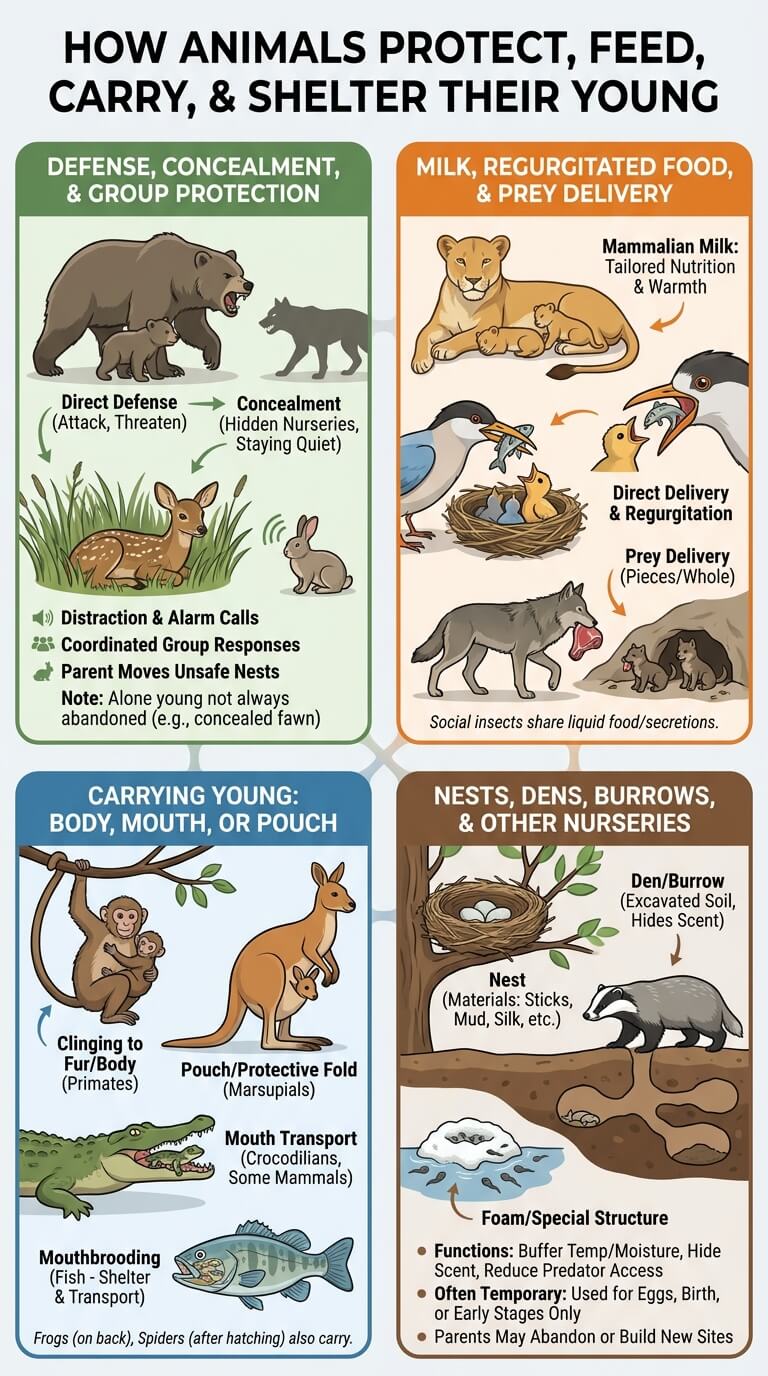
Direct defense is the most visible form of care, but it is only one option. Large adults may threaten or attack predators, while smaller animals rely on alarm calls, distraction displays, hidden nurseries, or coordinated group responses. Some parents move young when a nest becomes unsafe.
Concealment often requires the parent to stay away for long periods. A hidden fawn, hare, or rabbit may remain quiet while its mother feeds elsewhere. Frequent visits could leave scent trails or draw attention. A young animal found alone is therefore not automatically abandoned.
Milk, Regurgitated Food, Prey Delivery, and Other Feeding Methods
Mammalian milk supplies water, energy, protein, fats, and other components suited to the species and developmental stage. Nursing also keeps young close enough for warmth, grooming, and protection. Milk composition and nursing schedules vary greatly, so one mammal’s pattern should not be treated as universal.
Bird parents may deliver insects, seeds, fish, or other food directly, while some regurgitate partly processed food. Carnivorous mammals may bring pieces of prey or whole prey to young. Social insects can transfer liquid food among colony members, and some parents provide secretions or specially prepared food.
Carrying Young on the Body, in the Mouth, or in a Pouch
Carrying lets a parent move dependent young away from danger or keep them close while traveling. Primates may have infants that cling to fur. Some mammals pick up young with the mouth. Marsupials continue much of early development while young remain attached to a teat, often within a pouch or protective fold.
Transport is not limited to mammals. Crocodilians may carry hatchlings gently in their jaws, frogs can move tadpoles on their backs, and some spiders carry young after hatching. Mouthbrooding fish shelter eggs or fry inside the mouth, sometimes interrupting their own feeding while care continues.
Nests, Dens, Burrows, and Other Nurseries
A nursery changes the environment around developing young. It may buffer temperature, retain moisture, provide shade, hide scent, reduce access for predators, or hold offspring close to food. Materials range from sticks and leaves to mud, silk, foam, saliva, stones, feathers, fur, and excavated soil.
Not every nursery is a permanent home. Many are used only for eggs, birth, nursing, or an early juvenile stage. Adults may abandon the structure once it no longer offers enough benefit, and some species build a new site for each breeding attempt.
From Birth or Hatching to Independence
Helpless Young Versus Young Born Ready to Move
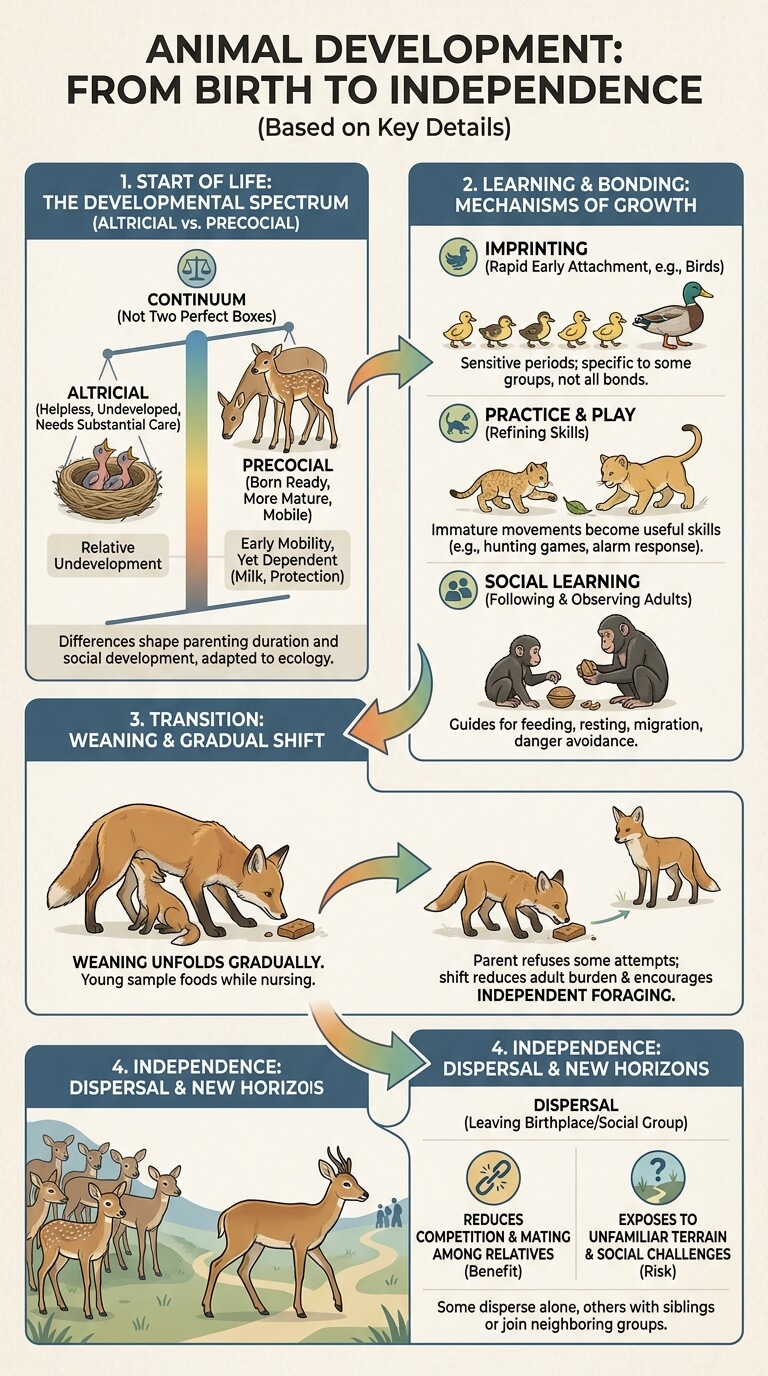
Altricial young are born or hatched relatively undeveloped and usually need substantial care. Precocial young are more mature and mobile at the same stage. These are ends of a continuum rather than two perfect boxes. An animal can walk early but still depend on milk, warmth, guidance, or protection.
The altricial-precocial spectrum helps explain why parenting duration and social development differ among species. A helpless nestling and a mobile hoofed mammal begin life with very different abilities, but both may rely on adults in ways suited to their ecology.
Imprinting, Practice, Play, and Social Learning
Some young form rapid early attachments or preferences during sensitive developmental periods. Imprinting is best known from certain birds, but the term should not be used for every parent-young bond. Different learning mechanisms operate across animal groups.
Following adults can teach young where to feed, rest, drink, migrate, or avoid danger. Practice turns immature movements into useful skills. A young predator may begin with stalking games, while a herd animal learns when to respond to alarm signals and how closely to remain with the group.
Weaning, Dispersal, and Leaving the Family Group
Weaning usually unfolds gradually. Young sample other foods while continuing to nurse, and the parent may refuse some feeding attempts as the juvenile becomes more capable. This shift reduces the adult’s energetic burden and encourages independent foraging.
Dispersal means leaving the birthplace or social group. It can reduce competition and mating among close relatives, but it also exposes young animals to unfamiliar terrain and new social challenges. Some disperse alone, while others leave with siblings or join neighboring groups.
Parenting Patterns Across Major Animal Groups

Mammals and Extended Dependency
All mammals produce milk, making post-birth or post-hatching feeding a defining form of maternal investment. Beyond nursing, mammal care may include warming, carrying, grooming, guarding, food delivery, and extended social learning. The amount varies from brief nursing visits to years of association.
The Animal Diversity Web overview of mammals notes that many mammalian young are relatively undeveloped and use dens or nests, while others can move soon after birth. It also describes male care as variable, ranging from none to defense and provisioning.
Birds Without Reducing Parenting to Nest Feeding
Bird parenting may begin with courtship, nest selection, construction, egg production, and incubation. After hatching, adults can brood, shade, guard, feed, clean the nest, lead mobile chicks, or defend a territory. The division of labor differs among species.
Some chicks hatch naked or sparsely covered, with limited mobility and a strong need for feeding. Others leave the nest soon after hatching and follow an adult while finding much of their own food. Even these mobile chicks may rely on warmth, warning calls, route guidance, and defense.
Reptiles, Amphibians, and Fish
These groups contain both minimal-care species and some of the most inventive caregivers. Crocodilian females may guard nests, respond to hatchling calls, uncover eggs, transport young, and remain nearby after hatching. Some frogs guard eggs, carry tadpoles, or place young in small water-filled sites.
Fish care can be maternal, paternal, shared, or absent. Adults may fan and clean eggs, defend territories, build nests, carry offspring, or guide fry. The Animal Diversity Web account of cichlids describes both substrate guarding and mouthbrooding, with care performed by females, males, or both depending on the species.
Insects and Other Invertebrates
Many invertebrates lay eggs and provide no further attention, but others guard, clean, carry, feed, or shelter offspring. Earwigs tend eggs and young nymphs. Wolf spiders carry egg sacs and later transport spiderlings. Giant water bug males can carry eggs attached to their backs in species where females place them there.
Social insects take collective care to another level. Worker ants, bees, wasps, and termites may regulate nest conditions, feed larvae, move brood, defend the colony, and respond to changing needs. The biological parent may have little direct contact with each individual offspring.
Common Myths and Misunderstandings
Myth: All Good Animal Parents Stay With Their Young
Long presence is not the only effective strategy. Some parents reduce visits to keep a nursery hidden. Others stop care when young reach a normal stage of independence. Still others invest heavily in eggs or birth but provide little post-hatching attention.
Judging care by how closely it resembles human parenting leads to mistakes. A parent that remains away may be avoiding predators, feeding nearby, or following a schedule adapted to hidden young. Intervention can make the situation worse if people approach, move, or feed a healthy juvenile.
Myth: Mating for Life Always Means Equal Parenting
A long-term pair bond does not automatically mean both adults incubate, feed, guard, or teach equally. One partner may provide most direct care while the other defends territory. Roles may also shift between breeding attempts or change as young develop.
Myth: Abandonment Is Always Cruel or Accidental
Animals do not make parenting decisions through human moral systems. Care may stop because a parent dies, resources collapse, a nursery becomes unsafe, offspring are already independent, or further investment would severely reduce the adult’s survival and future reproduction.
Sometimes what looks like abandonment is ordinary behavior. A hidden youngster may be waiting for a parent to return. People should observe from a distance, keep pets away, and contact a licensed wildlife rehabilitator or local wildlife authority when there is clear injury, confirmed death of the parent, or immediate danger.
How Parenting Shapes Survival and Development
Young Animals Face Different Risks at Each Stage
Eggs, newborns, mobile juveniles, and nearly independent young do not face the same problems. Eggs may need stable temperature and protection from fungus or predators. Newborns may struggle with warmth and feeding. Older juveniles need practice, safe space, and information about the wider habitat. These changing risks are central to how animal babies survive in the wild, because the safest strategy for an egg may be useless for a mobile juvenile.
Carrying and Nest Building Solve Different Problems
Carrying is useful when young must move with the parent or when a nursery becomes unsafe. Nests and dens are useful when young need a stable microclimate or when adults can return to one protected site. Some species combine both, keeping newborns in a nest and later carrying or leading them.
Pair Bonds and Reproductive Biology Influence Care
Shared care is more likely to be useful when raising young requires more effort than one adult can easily provide, but ecology and mating opportunities also matter. A stable pair may defend a territory and provision young together. In another species, one parent may provide nearly all care while the other seeks additional mates.
Reproductive biology sets additional limits. Mammalian milk makes the nursing parent essential early in life, while egg guarding or food delivery can more easily be performed by either sex in many birds, fish, amphibians, reptiles, and invertebrates. These patterns are tendencies, not universal rules.
Independence Is a Process, Not a Single Day
An animal can be physically mobile before it can find enough food. It can feed itself before it recognizes every predator. It can reach adult size before gaining reproductive or social status. Parenting often tapers across these milestones rather than ending all at once.
This gradual transition explains why some young continue begging, following, playing with, or sleeping near adults after they appear capable. It also explains why parents sometimes reject nursing or feeding attempts while still offering protection and social access.
FAQ
Which Animals Provide the Longest Parental Care?
Some long-lived mammals provide care and social support for many years, especially when young must learn complex feeding, movement, or group behavior. Great apes, elephants, and certain whales are often discussed in this context. Exact duration varies by species and by what counts as care, such as nursing, food sharing, protection, or continued association.
Long care is not automatically better. It works where delayed maturity and extensive learning fit the species’ ecology. Animals with short generations may succeed through much briefer care.
Do Animal Fathers Help Raise Young?
Yes, fathers provide care in many animal groups, but their roles vary. They may incubate eggs, guard nests, defend territories, carry young, bring food, warm offspring, or share teaching and protection. Paternal care is particularly prominent in some birds and fish, and it also occurs in selected mammals, amphibians, reptiles, insects, and other invertebrates.
It is not safe to generalize from one species to its relatives. Closely related animals can differ because their food, mating system, habitat, and offspring needs are different.
Is Parental Care More Common in Mammals and Birds?
Visible and extended care is widespread in mammals and birds, partly because many young require feeding, warmth, and protection. However, parental care also occurs across fish, amphibians, reptiles, insects, spiders, crustaceans, and other animals.
The apparent contrast can be exaggerated because researchers and the public more easily notice familiar behaviors such as nursing and nest feeding. Egg guarding, oxygenating embryos, carrying larvae, or maintaining colony nurseries are also forms of care.
How Do Young Animals Know When They Are Independent?
There is no universal signal. Independence emerges through development, hunger, changing parental responses, practice, hormonal changes, seasonal conditions, and social behavior. A parent may feed less, spend more time away, block nursing, or become less tolerant. The young may roam farther, catch food, join peers, or disperse.
In many species, adults and young respond to one another. The timing is therefore a negotiation shaped by the juvenile’s abilities and the parent’s condition, not a fixed decision made on one day.
Final Thoughts
Animal parenting is a flexible set of strategies for helping offspring survive and develop. It can begin with egg provisioning or site choice, continue through feeding, guarding, carrying, shelter, and learning, then taper as young become capable of living on their own. Mothers often provide care, but fathers, siblings, helpers, and colonies can also play major roles.
The most useful way to compare these systems is not to ask which animal is the best parent. Instead, ask what challenge the young face, what the caregiver does to reduce that challenge, and what the care costs. That approach makes room for both long family bonds and brief, highly targeted care, while avoiding myths and human moral judgments. When wild young appear alone, the same perspective supports a cautious response: observe from a distance, avoid handling, and seek qualified local help only when there is clear evidence of danger or distress.

Ethan Walker is the founder and research editor of Animal Fact Central. He creates and reviews educational animal facts content using trusted wildlife, pet care, and science-based sources. His work focuses on making animal behavior, adaptations, habitats, and species facts clear, accurate, and engaging for everyday readers.
Read More Details About Ethan Walker: https://animalfactcentral.com/ethan-walker/