

Amphibians are vertebrates whose lives are closely shaped by water, moisture, and temperature. The group includes frogs, toads, salamanders, newts, and caecilians. Many begin life in water and later use land, but that familiar pattern is only one version of amphibian life. Some species skip a free-swimming larval stage, some remain aquatic as adults, and others spend nearly all their lives hidden in soil or damp forest cover.
What unites these animals is not a simple rule such as “living on land and in water.” Amphibians share an evolutionary history and a set of biological features that often include permeable skin, eggs without a hard shell, ectothermy, and major changes between life stages. Those features give them remarkable flexibility, but they also make many species sensitive to drying, pollution, disease, and habitat disturbance.
Understanding amphibians means looking beyond the image of a frog beside a pond. Their skin can exchange gases and water, their diets can change dramatically as they grow, and their defenses range from camouflage to unpleasant or toxic skin secretions. They also occupy important positions in freshwater and land food webs, where they act as both predators and prey.
Quick Overview
What Makes an Animal an Amphibian?
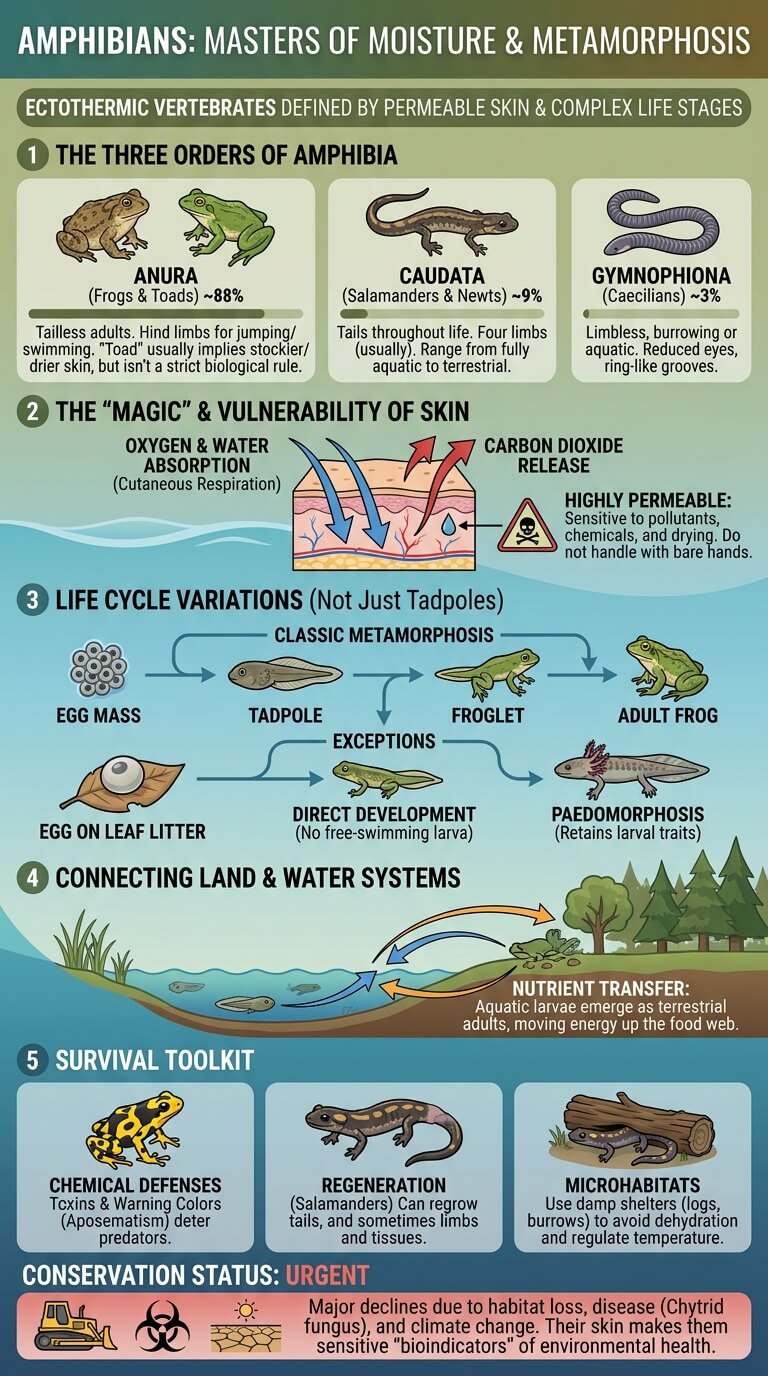
Amphibians belong to the vertebrate class Amphibia. Living species are divided into three major orders: Anura, which contains frogs and toads; Caudata, which contains salamanders and newts; and Gymnophiona, which contains caecilians. The balance among those groups is extremely uneven. AmphibiaWeb’s current species count listed 9,079 recognized amphibian species on July 14, 2026, including 8,009 frogs and toads, 837 salamanders and newts, and 233 caecilians. Taxonomy changes as researchers describe new species and revise relationships, so the total should be treated as a dated count rather than a permanent number.
Most amphibians are ectotherms, meaning that outside conditions strongly influence their body temperature. Unlike reptiles, they generally do not have a covering of dry scales that reduces water loss. Their skin contains glands, blood vessels, pigments, and other structures that can contribute to hydration, gas exchange, defense, and communication.
There is no single life cycle shared by every species. The classic frog sequence of egg, tadpole, froglet, and adult is common, but not universal. Direct-developing frogs and salamanders hatch from eggs as small versions of adults, while some aquatic salamanders retain larval traits such as external gills after reaching reproductive maturity.
Why Amphibians Connect Land and Freshwater
Many amphibians move energy and nutrients between water and land. Aquatic larvae may graze on algae, consume plant material, filter tiny particles, or hunt small organisms. After metamorphosis, the same animal may become a terrestrial predator of insects and other invertebrates. In turn, amphibians are eaten by fish, birds, snakes, mammals, aquatic insects, and other predators.
This movement across habitat boundaries makes amphibians important in several parts of a food web at once. The U.S. Geological Survey’s amphibian research program notes that amphibians can be abundant predators and prey, while their moist, permeable skin also makes them responsive to drought and harmful substances. A decline can therefore reflect a problem affecting breeding water, surrounding land, or both.
Freshwater matters even for species that spend most of adulthood away from open water. A woodland salamander may depend on damp soil, leaf litter, rotting logs, or underground spaces rather than a pond. A desert toad may stay buried through long dry periods and emerge when temporary pools form. The common thread is access to enough moisture at the right stage of life.
What the Amphibian Group Includes
Frogs and Toads
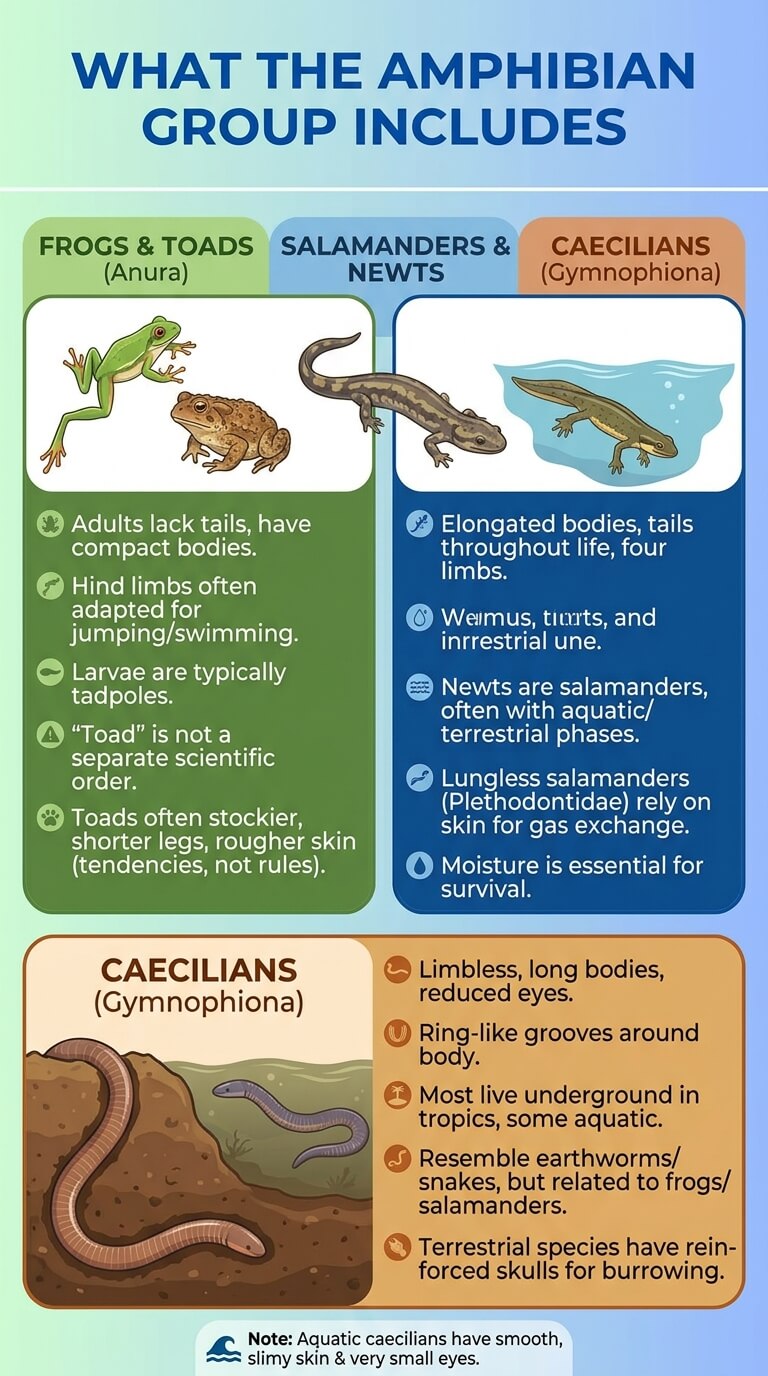
Frogs and toads belong to Anura, a name that refers to the absence of a tail in adults. Their bodies are usually compact, and their hind limbs are often adapted for jumping or swimming. Larvae are commonly called tadpoles, although tadpole form, diet, habitat, and development time vary widely.
“Toad” is not a separate scientific order. True toads belong to the family Bufonidae, but common names do not follow one perfect anatomical rule. Many animals called toads have stockier bodies, shorter hind legs, and rougher-looking skin than animals called frogs. Those traits are useful tendencies, not universal tests.
Salamanders and Newts
Salamanders usually have elongated bodies, tails throughout life, and four limbs, although limb size and number vary. Newts are salamanders, not a separate order. The word commonly refers to members of several salamander groups with life histories that may include aquatic and terrestrial phases.
Some salamanders live in streams, lakes, swamps, or underground water. Others are strongly terrestrial and remain beneath logs, rocks, moss, or leaf litter. The lungless salamanders, family Plethodontidae, rely heavily on gas exchange across the skin and tissues lining the mouth. Moisture is therefore essential even when no pond is nearby.
Caecilians and Other Lesser-Known Amphibians
Caecilians are limbless amphibians with long bodies, reduced eyes, and ring-like grooves around the body. Most live underground in tropical regions, where they push through moist soil and leaf litter. Others are aquatic. Their shape may resemble an earthworm, snake, or eel, but they are more closely related to frogs and salamanders than to any of those animals.
The Smithsonian’s aquatic caecilian profile describes adults with smooth, slimy skin and very small eyes, features that suit an animal living in murky water. Terrestrial species often have a reinforced skull and compact head that help them move through soil.
The Amphibian Survival Framework

Moist Skin and Gas Exchange
Amphibian skin is living tissue with many functions. In numerous species, oxygen and carbon dioxide move across the skin by diffusion, a process called cutaneous respiration. The skin must remain moist for efficient gas exchange because the gases dissolve in a thin film of water before crossing tissues.
Skin breathing does not mean every amphibian can survive without lungs or gills. Some use lungs, some use gills during part or all of life, and some depend heavily on skin and the lining of the mouth. The relative importance of each route changes among species, life stages, activity levels, water temperatures, and oxygen conditions.
Permeability also creates costs. Water and some dissolved chemicals can move across amphibian skin more readily than they would cross the dry, scaled skin of a reptile. That is why clean moisture and suitable shelter matter so much. It is also why handling wild amphibians is best avoided. Oils, sunscreen, insect repellent, soap residue, and rough contact can damage delicate skin, while people can accidentally move pathogens between sites.
Metamorphosis and Changing Needs Across Life Stages
Metamorphosis is a major reorganization of the body. In a typical frog, a swimming tadpole with gills and a tail develops limbs, reshapes its mouth and digestive tract, changes how it breathes, and absorbs much of the tail as it becomes a froglet. These changes allow the animal to use food and habitat differently after leaving the larval stage.
Tadpoles are not all simple algae eaters. Depending on the species, they may scrape surfaces, filter suspended food, browse on detritus, eat small animals, scavenge, or consume other tadpoles. Adults are often predators, especially of invertebrates, but prey size and hunting method depend on body form and habitat.
Direct development is an important exception. In these species, development occurs inside the egg and the young hatch without a free-swimming tadpole or larva. Other amphibians follow an almost opposite path. Axolotls and several other salamanders can retain larval features into adulthood, a condition called paedomorphosis.
Temperature, Water, and Seasonal Survival
Because amphibians are ectothermic, they cannot maintain a high, stable body temperature in the same way birds and mammals do. They regulate exposure through behavior. An individual may move into shade, burrow into soil, enter water, flatten against a cool surface, or become active at night when evaporation is lower.
Cold and drought can trigger dormancy. In cold climates, some species spend winter below the frost line, under water, within mud, or inside insulated leaf litter. During hot or dry periods, others enter a reduced-activity state called estivation. The exact strategy depends on local climate and the animal’s tolerance for freezing, dehydration, and low oxygen.
Seasonal survival is closely tied to timing. A temporary pond must hold water long enough for eggs to hatch and larvae to develop. A stream-breeding salamander may need cool, oxygen-rich flow throughout summer. A woodland species may depend on a moist refuge during dry weather even though it never enters a pond.
Where Amphibians Live

Ponds, Streams, Wetlands, Forests, and Grasslands
Amphibians occur on every continent except Antarctica. Their habitats include tropical rainforests, temperate woodlands, mountain streams, desert basins, grasslands, peatlands, caves, lakeshores, marshes, and seasonal pools. Tropical regions contain the greatest overall diversity, but temperate North America is especially rich in salamanders.
Water bodies differ in ways that matter to amphibians. A fish-free seasonal pool may offer safer nursery habitat for eggs and larvae than a permanent pond filled with aquatic predators. Fast streams favor animals that can cling to rocks or hide in crevices. Still water may support floating egg masses, dense vegetation, and tadpoles adapted to feeding near the surface or bottom.
Land surrounding a breeding site is part of the habitat, not empty space between ponds. Adult frogs may feed in fields, gardens, and forests before returning to water to breed. Salamanders may move through leaf litter or along stream edges. Roads, cleared ground, and dry barriers can interrupt these movements.
Microhabitats That Reduce Water Loss
A microhabitat is a small area with conditions that differ from the surrounding environment. The underside of a rotting log may stay cool and damp while the exposed forest floor becomes hot and dry. Burrows, rock cracks, moss, dense vegetation, stream banks, and deep leaf litter can all provide similar shelter.
Removing fallen wood, draining shallow wetlands, mowing vegetation to the water’s edge, or compacting soil can reduce shelter even when a pond remains visible. For amphibians, habitat quality depends on the complete set of places used for breeding, feeding, hiding, and seasonal dormancy.
Why Healthy Freshwater Systems Matter
Eggs and larvae are often exposed directly to water conditions. Temperature, oxygen, acidity, contaminants, sediment, flow, and the presence of predators can affect whether a breeding attempt succeeds. Different species tolerate different conditions, so one pond cannot represent the needs of all amphibians.
Healthy freshwater systems also depend on the surrounding watershed, the land area that drains into them. Fertilizer, road runoff, pesticides, sediment, and altered stream flow can reach breeding habitat from far beyond the shoreline. Protecting only the water’s edge may miss the processes that determine water quality.
How Amphibians Feed, Move, and Avoid Predators

Diets From Tadpole to Adult
Diet often changes as an amphibian grows. Many tadpoles eat algae, plant matter, microbes, and detritus, although some are active predators or scavengers. Adult frogs and salamanders commonly eat insects and other invertebrates. Larger species may also take fish, crustaceans, smaller amphibians, reptiles, or small mammals when the opportunity fits their size and hunting ability.
Feeding methods are equally varied. Frogs may project a sticky tongue, lunge with the whole body, or grab prey directly with the mouth. Aquatic salamanders can use suction to draw prey inward. Caecilians locate underground animals using smell, touch, and specialized sensory structures near the head.
Jumping, Swimming, Climbing, Walking, and Burrowing
Long hind limbs help many frogs leap or swim, but frog movement is not limited to jumping. Some walk, run, climb, glide between trees, burrow backward into soil, or remain almost completely aquatic. Toe pads can improve grip on leaves and bark, while webbing can increase the surface area used to push against water.
Salamanders usually move with a walking gait in which the body bends from side to side. Aquatic species use the tail to generate thrust, and some stream specialists cling to rocks with broad feet or flattened bodies. Burrowing salamanders may have reduced limbs and elongated bodies.
Caecilians use muscular waves and a strong head to move through soil. Their compact skulls resist pressure, while sensory tentacles between the eyes and nostrils help gather chemical information. Aquatic caecilians swim by undulating the body much like an eel, although their internal anatomy remains distinctly amphibian.
Camouflage, Warning Colors, Toxins, and Escape Behavior
Camouflage makes an amphibian harder to detect against leaves, bark, mud, moss, or stones. Some species change shade within a limited range as light, moisture, temperature, or stress changes. Others rely on fixed patterns that break up the outline of the body.
Bright coloration can serve as aposematism, a warning that an animal may taste bad or contain defensive chemicals. Some poison frogs obtain important alkaloid toxins from small arthropods in their natural diet. The Smithsonian’s overview of poison frog defenses explains that certain wild frogs acquire these compounds from foods such as ants, termites, and mites, then store them in skin glands. Captive individuals eating different foods may lack the same chemical defenses.
Other defenses include inflating the body, making distress calls, producing sticky mucus, revealing a brightly colored belly, playing dead, biting, or releasing the tail. A detached salamander tail can continue moving and distract a predator, but losing and rebuilding tissue costs energy. Escape mechanisms are useful, not free.
Key Facts Readers Should Know
Why Frog and Toad Labels Can Be Misleading
Every toad is a frog in the broad scientific sense because true toads are members of Anura. Not every frog is a true toad. Everyday language separates the words because many familiar toads are stockier and more terrestrial, but the names do not create two clean evolutionary categories.
A rough skin texture, short hop, or dry-looking body can support an identification, yet none proves that an animal is a toad. Habitat and season can also change appearance. The best identification uses several traits together and compares them with species known from the location.
Salamander Regeneration and Its Limits
Many salamanders can regenerate a lost tail, and some can rebuild limbs with bone, muscle, nerves, blood vessels, and skin. Regrowth begins with wound healing and the formation of a mass of cells called a blastema. Signals from nerves and nearby tissues help organize the developing structure.
Regeneration is not instant and should not be described as consequence-free. It requires time and energy, and the outcome can vary with species, age, injury, health, and environmental conditions. A regenerated tail may differ from the original in internal structure, coloration, or performance.
Why Bright Coloration Can Signal Chemical Defense
Predators learn from unpleasant experiences. A bold, memorable color pattern can reduce repeated attacks when it reliably accompanies a bad taste, irritation, or toxin. This warning strategy works best when predators can recognize and remember the signal.
Color alone does not reveal how dangerous an amphibian is to a person. Toxicity varies among species, populations, diets, and circumstances. Some bright amphibians are strongly defended, others are mildly irritating, and some gain protection by resembling species that predators avoid.
Observation should remain hands-off. Do not lick, squeeze, or allow pets to mouth frogs, toads, newts, or salamanders. If a person or pet has significant exposure and develops symptoms, contact an appropriate medical professional, veterinarian, poison center, or emergency service rather than attempting a home treatment.
Common Myths and Misunderstandings
Amphibians Do Not All Live Only in Water
The name “amphibian” is often explained as a life divided between water and land, but many species do not follow that pattern neatly. Some are fully aquatic as adults. Others live on land and return to water mainly for breeding. Direct-developing species may complete early development in moist eggs laid away from standing water.
Even a terrestrial amphibian usually needs moisture. It may depend on humid air, damp soil, fog, seepage, leaf litter, or a protected burrow. The important question is not simply whether the animal enters water, but how it prevents dehydration and completes reproduction.
Touching a Toad Does Not Cause Human Warts
Toads have raised glands and skin structures that people commonly call warts, but these are not human warts and cannot transfer them to a person. Human warts are caused by human papillomaviruses that infect human skin.
That myth should not be replaced with the idea that handling is harmless. Some amphibians produce irritating secretions, and bare hands can carry substances that harm the animal. The safest approach is to watch without touching. If an amphibian must be moved from immediate danger, local wildlife guidance is preferable to casual handling or relocation.
Not Every Colorful Frog Is Dangerously Toxic
Bright color is a clue, not a chemical measurement. Poison frogs include species with very different toxin profiles, and the compounds present in wild individuals can depend on diet. Other colorful frogs may rely on camouflage at certain times, mimicry, sexual signaling, or a mild defensive secretion.
Likewise, dull coloration does not prove that an amphibian lacks chemical defenses. Many toads and salamanders have glands that release substances predators find unpleasant. Safe behavior should be based on avoiding unnecessary contact, not guessing toxicity from color.
Why Amphibians Lead to Bigger Questions
Comparing Frogs and Toads
The frog-toad comparison is useful when it is treated as a set of tendencies. Body proportions, skin texture, leg length, movement, egg arrangement, and habitat can all contribute to identification. Taxonomy and local species ranges provide the final context.
That comparison also highlights a broader lesson: common names are convenient, but they do not always match evolutionary relationships. Learning the major amphibian orders and families makes field observations more accurate without requiring every reader to become a taxonomist.
Seasonal Dormancy and Winter Survival
Winter survival shows how differently amphibians solve the same problem. Aquatic frogs may remain in oxygenated water, terrestrial toads may burrow below freezing conditions, and woodland salamanders may use insulated underground retreats. A few frogs tolerate partial freezing of body fluids, but that ability is species-specific and should not be generalized.
Population Decline and Amphibian Conservation
Amphibian conservation is urgent, but status must be checked species by species. The second global amphibian assessment reported that roughly two in five assessed amphibian species are threatened with extinction. That global result does not mean every frog, toad, salamander, or caecilian has the same risk. Some remain widespread, while others survive in tiny ranges or declining populations.
Major pressures include habitat loss and degradation, disease, climate change, pollution, invasive species, road mortality, and collection in some places. Their importance varies. A stream salamander may be most affected by altered flow and sediment, while an island frog may face invasive predators or a narrow climate range.
Chytridiomycosis is a skin disease caused by chytrid fungi and has contributed to severe declines in susceptible species. A U.S. Fish and Wildlife Service account of chytrid response describes how infection can disrupt the skin functions involved in water balance and gas exchange. Disease outcomes vary among pathogens, amphibian species, populations, temperatures, and environments.
Amphibians Within Freshwater Food Webs
Amphibians connect multiple feeding levels. Eggs and larvae feed predators in water. Tadpoles can influence algae, microbes, detritus, and nutrient movement. Adults consume terrestrial and aquatic prey, then become food for animals that may carry those nutrients farther from the breeding site.
For readers watching a backyard pond or local wetland, the practical lesson is to value variety. Shallow and deep water, native plants, leaf litter, shaded edges, and safe movement routes can support different life stages. Avoid adding wild-caught amphibians or moving eggs between sites because relocation can spread disease and disrupt local populations.
FAQ
Are Amphibians Reptiles?
No. Amphibians and reptiles are separate vertebrate groups. Amphibians generally have permeable, glandular skin and eggs without the leathery or hard protective shell typical of reptiles. Reptiles have scales made largely from keratin and reproduce through internal fertilization. There are exceptions in life history within both groups, but a salamander is not a lizard and a caecilian is not a snake.
Do All Amphibians Undergo Metamorphosis?
No. Many frogs, toads, and salamanders undergo a recognizable transformation from aquatic larva to juvenile or adult form. Direct-developing species complete those changes inside the egg and hatch as small terrestrial animals. Some salamanders retain larval features into reproductive adulthood. Metamorphosis is central to amphibian biology, but its form and visibility vary.
Can Amphibians Breathe Through Their Skin?
Many can exchange oxygen and carbon dioxide through moist skin. The amount varies greatly. Lungless salamanders rely heavily on skin and mouth tissues, while other amphibians combine skin breathing with lungs or gills. Skin respiration works only when the tissue remains healthy and moist, which helps explain amphibians’ close association with humid places and clean water.
Which Amphibian Group Has the Most Species?
Frogs and toads are by far the largest living amphibian group. They account for most recognized species, while salamanders and caecilians contain much smaller totals. The exact numbers change as species are described, combined, divided, or reassigned, so a current taxonomic database is more reliable than an undated total.
Final Thoughts
Amphibians are not simply animals that live half on land and half in water. They are a diverse vertebrate group built around close relationships with moisture, temperature, and changing life stages. Frogs and toads dominate in species number, salamanders display extraordinary variation in respiration and regeneration, and caecilians reveal an entire hidden branch of amphibian life beneath soil and water.
Their permeable skin and complex life histories create both opportunity and vulnerability. The same features that let amphibians exchange gases, move nutrients between habitats, and transform during development can make them sensitive to drying, contamination, disease, and disrupted breeding sites. Seeing that full picture makes amphibian facts more meaningful and shows why clean freshwater, damp refuges, connected habitats, and hands-off observation matter.

Ethan Walker is the founder and research editor of Animal Fact Central. He creates and reviews educational animal facts content using trusted wildlife, pet care, and science-based sources. His work focuses on making animal behavior, adaptations, habitats, and species facts clear, accurate, and engaging for everyday readers.
Read More Details About Ethan Walker: https://animalfactcentral.com/ethan-walker/