

Common animal tracks in the US often come from familiar mammals and birds: deer, raccoons, squirrels, rabbits, skunks, opossums, domestic dogs, coyotes, foxes, bobcats, ducks, geese, beavers, muskrats, and river otters. You may notice them in mud after rain, in fresh snow, along creek banks, on sandy paths, or in soft soil around gardens and fence lines.
The hard part is not seeing a footprint. The hard part is deciding how much confidence that footprint deserves. A single blurry print can look like several different animals, especially after snow melts, mud spreads, or another animal steps over it. A better reading comes from the whole pattern: track shape, toe count, claw marks, spacing, direction, nearby habitat, and repeated prints.
This field-style overview compares the animal tracks people in the United States are most likely to see in backyards, parks, farms, wetlands, forest edges, and neighborhood trails. It is not a promise that every animal on this list lives in every state. Instead, it gives you practical track examples and the caution you need before turning a footprint into a confident wildlife identification.
Quick Answer
The most common animal tracks in American backyards and parks are usually made by deer, raccoons, squirrels, rabbits, domestic dogs, cats, opossums, skunks, and common birds. In more open, wooded, or rural areas, you may also see coyote, fox, bobcat, beaver, muskrat, otter, elk, or moose tracks depending on your region.
For beginners, the easiest tracks to recognize are usually hoofed deer tracks, hand-like raccoon tracks, hopping rabbit patterns, webbed waterfowl prints, and dog-like canine tracks. The hardest are often partial prints, melted snow tracks, domestic dog versus coyote tracks, and small rodent tracks that overlap in messy patterns.
Use the track as a clue rather than a final answer. If the print appears near droppings, feeding marks, a den entrance, water, trails, or camera footage, those nearby signs can raise confidence. If the print is alone, distorted, or outside the expected range of the animal, treat it as uncertain.
How This Page Groups Common Tracks

Animal tracks become easier to compare when you group them by where people usually find them and by the kind of foot that made them. A deer hoof, a raccoon foot, and a duck foot are built for different movement, so their prints tend to leave very different shapes.
Backyard and neighborhood tracks
Backyard tracks often come from animals that tolerate people, fences, decks, trash cans, bird feeders, gardens, and lawns. Common examples include squirrels, rabbits, raccoons, skunks, opossums, domestic cats, and domestic dogs. In many neighborhoods, deer and coyotes may also pass through at dawn, dusk, or overnight.
These tracks are often mixed with human and pet prints. A muddy gate, mulch bed, snow-covered driveway, or soft patch under a bird feeder may show several animals in the same place. When prints overlap, look for the cleanest repeat pattern rather than the most dramatic single mark.
Forest and field tracks
Forest edges, fields, and brushy corridors often collect tracks from deer, coyotes, foxes, bobcats, rabbits, skunks, raccoons, and smaller mammals. These animals may use the same low-resistance paths people use: old logging roads, deer trails, fencerows, dry creek beds, and paths along cover.
Open fields and forest edges also show the limits of track identification. A sharp hoofprint in wet soil may be simple to call deer, while a canine print in thawing snow may be much harder. Wind, sun, freezing, thawing, and soil texture can change the size and shape of the same track within hours.
Snow, mud, sand, and water-edge tracks
Snow gives many people their first clear look at animal tracks because prints contrast against a bright surface. Yet snow is also tricky. Powder can hide toe details, wet snow can collapse around a print, and melting can make a small animal look larger than it was. Mud can preserve fine pad marks, but thick mud may pull at the foot and smear the edges.
Sand near water often shows birds, raccoons, otters, muskrats, beavers, and deer. Along shorelines, look for direction and repeated use. A single water-edge print may wash away or blur quickly, but a worn slide, a repeated trail to the water, or several matching prints can tell a stronger story.
Common Mammal Tracks Around Yards and Parks

Many of the tracks people notice close to home come from adaptable mammals that move through lawns, gardens, storm drains, tree lines, and quiet streets at night. These prints can be exciting, but they should be read with care because pets and wildlife often share the same spaces.
Raccoon tracks
Raccoon tracks are among the most recognizable wildlife footprints because they often look like small handprints. The front and hind feet can show five long toes, and the track pattern may appear side by side or slightly staggered as the animal walks. The U.S. Fish and Wildlife Service snow track notes describe raccoon prints as having five long, finger-like toes and a C-shaped palm pad.
Raccoon tracks are common near creeks, ponds, trash areas, garden edges, compost piles, muddy decks, and soft soil around sheds. Do not identify raccoons by tracks alone if the print is partial. Opossums can also leave five-toed tracks, and a raccoon stepping in soft mud can create a messy shape that hides the palm pad.
Squirrel and chipmunk tracks
Squirrel and chipmunk tracks are usually small and often show a bounding pattern. In a bound, the hind feet land ahead of the front feet, so the pattern may look like a set of small prints grouped in pairs or sets. On snow, these tracks often lead between tree trunks, fence tops, bird feeders, shrubs, and woodpiles.
Because these prints are small, details can vanish quickly. A squirrel trail may look like a dotted path after powdery snow or wind. In mud, the toes may show more clearly, but overlapping steps under feeders can turn the ground into a busy patch of tiny marks.
Rabbit tracks
Rabbit tracks are often recognized by their hopping pattern more than by the shape of each foot. In many rabbit trails, the larger hind feet land ahead of the smaller front feet. This can make the animal seem to be moving in the opposite direction from what a beginner expects.
In snow, rabbit tracks may form neat groups with two larger marks in front and two smaller marks behind. In soft mud, the shape may be less clean because the foot is furred and the animal may push off strongly. Tracks often appear near brush piles, hedges, woodland edges, gardens, and lawns with low cover.
Rabbit prints can be confused with squirrel prints when the pattern is incomplete. The setting helps. Rabbits often move along cover at ground level, while squirrel tracks frequently connect trees, fences, trunks, and elevated surfaces.
Skunk and opossum tracks
Skunk and opossum tracks can be confusing because both may leave small mammal prints around yards and crawl spaces. Skunks have five toes on each foot, and their claws may show because they dig for insects and other food in soil and lawns. Their tracks may appear near cone-shaped digging marks, decks, sheds, and garden edges.
Opossum tracks can also show five toes, but the hind foot may look unusual because of the opposable inner toe. In clear mud, this can make the hind track look more spread out than a raccoon or skunk print. In rough snow or mulch, that detail may disappear.
Both animals are often active at night, and both may visit places where food is easy to find. If you see tracks near pet food, spilled birdseed, compost, or trash, remove the attractant safely rather than trying to confront the animal.
Common Predator and Canine-Like Tracks

Predator tracks draw attention because people often want to know whether a wild animal came through the yard. This is where caution matters most. Domestic dogs, coyotes, foxes, and sometimes bobcats can all travel the same paths, and soft ground can change the look of claws and pads.
Dog tracks
Domestic dog tracks are common almost anywhere people walk dogs. They often show four toes, a central pad, and claw marks. Dog tracks can be round or spread out, and the path may wander because pets stop, sniff, turn, and pull toward interesting smells.
A dog print in mud may look very similar to a coyote print, especially if the dog is medium-sized. One clue is the trail pattern. Dogs often meander, circle, and vary their pace. Wild canines often travel with a more purposeful, energy-saving line, although this is not a perfect rule.
Because dogs vary so much in size and foot shape, do not use one print to claim a coyote or wolf. In suburban areas, domestic dog tracks are often the simplest explanation unless the trail pattern and nearby habitat suggest otherwise.
Coyote tracks
Coyote tracks are usually dog-like, with four toes, a central pad, and visible claws. Compared with many domestic dog tracks, coyote tracks often look more oval and compact, and their trails may run in a straighter line. That said, track shape overlaps enough that beginners should avoid overconfidence.
Coyotes live in many parts of the United States, including rural, suburban, and urban edges, but local presence varies. Their tracks may appear on dirt roads, field edges, snowy paths, dry washes, and trails near brushy cover. Tracks alone usually cannot tell you whether a coyote is a passing visitor, a regular neighborhood animal, or part of a nearby family group.
Fox tracks
Fox tracks are also canine-like, but they are usually smaller than coyote tracks. Red fox and gray fox prints can show four toes and claws, and the trail may look direct. In snow, fur on the feet can soften the track edges, making details harder to see.
Fox tracks may show up along hedgerows, woodland edges, fields, dunes, and quiet neighborhood routes. Foxes often hunt small mammals, so tracks may cross open spaces and then dive toward brush or cover.
Bobcat and domestic cat tracks
Cat tracks differ from canine tracks in several useful ways. They tend to look rounder, and claw marks are often absent because cats usually keep their claws retracted while walking. A New Mexico State University wildlife tracking publication notes that a typical bobcat track is rounded and usually shows no claw marks, which helps separate it from many coyote or dog tracks in good conditions.
Domestic cat tracks are much smaller than bobcat tracks, but scale can mislead in snow or mud. Bobcat tracks are more likely in suitable habitat such as brushy cover, rocky edges, forest, and rural routes, depending on region. Domestic cat tracks are more likely near homes, alleys, porches, garages, and sidewalks.
Bobcats are widely distributed in the United States, but they are not equally common everywhere. If a track looks cat-like but is unclear, keep the identification cautious. Look for a repeated trail, scat placement, camera evidence, and whether the size remains consistent across several prints.
Common Hoofed Animal Tracks

Hoofed tracks are often easier for beginners because they do not look like paws. Still, deer, elk, moose, goats, sheep, cattle, and feral pigs can all leave split or rounded hoof marks, depending on region and setting.
Deer tracks
White-tailed deer and mule deer are among the most familiar hoofed animals in the United States. Their tracks usually show two main hoof halves, often forming a heart-like or pointed shape. MassWildlife’s animal track overview notes that deer and other animals may place a hind foot into, or near, the front track, which can make the trail pattern look cleaner than scattered steps.
Deer tracks commonly appear in lawns, gardens, forest trails, farm fields, creek crossings, and muddy road edges. Fresh deer tracks may be deep if the soil is soft or the animal was running, but depth depends on mud, snow, animal weight, and speed. A small deer track does not always mean a fawn, and a large distorted track does not always mean an unusually large deer.
Look around the print for browsing marks, narrow trails through vegetation, pellet-shaped droppings, and repeated use. If the same hoof prints cross a fence line or enter a garden, deer are often a reasonable guess.
Elk or moose context where regionally relevant
Elk and moose tracks are larger than deer tracks, but they are regionally limited compared with deer. Elk tracks are more likely in parts of the West and some reintroduced or managed eastern areas. Moose tracks are mainly a northern and mountain-region possibility in the contiguous United States, with broader presence in Alaska.
Large hoofprints should be interpreted with local knowledge. In a northern wetland or mountain forest, a very large split hoof may fit moose or elk. Near farms, ranches, parks, or rural roads, livestock may be a better explanation.
Livestock tracks that can confuse beginners
Cattle, goats, sheep, pigs, and horses can all create tracks that confuse people looking for wild animals. Cattle tracks are often large, rounded, and heavy. Goat and sheep tracks may be smaller and pointed enough to resemble deer to a beginner. Horse tracks are usually single rounded hoof marks, often with clear human-related context such as a trail, road, or pasture.
Feral pigs, where present, can leave split hoofprints and rooting damage. These signs vary by region, and not every state has the same concern. If hoofprints appear near churned soil, crop damage, or wet ground, local wildlife or agriculture agencies may be more useful than a general track chart.
Common Wetland, River, and Shoreline Tracks
Water edges are excellent places to notice animal tracks because damp sand and mud hold impressions. They are also places where tracks blur quickly. A print at the edge of a pond may be stepped on, washed out, or softened by waves within a short time.
Beaver and muskrat clues
Beaver and muskrat tracks can be hard to read as clean footprints because both animals spend so much time in and near water. Instead of relying only on toes, look for trails in mud, slide marks, tail or body drag marks, cut vegetation, lodges, dams, bank holes, and repeated paths into the water.
Beavers are larger and leave more obvious wood-cutting signs. Freshly gnawed sticks, pencil-pointed stumps, and worn water routes can support a beaver guess. Muskrats are smaller and often use bank burrows, marsh vegetation, and narrow muddy runs.
Otter tracks and slides
River otters may leave tracks along muddy banks, sandbars, snow near streams, and paths between water bodies. Their tracks can show five toes, but prints are often partial because otters move with a low, bounding body and may slide on mud, snow, or ice.
A slide is not just a fun-looking mark. It can be a travel sign where the animal moved down a slope or entered water. Repeated slides near a bank, paired with small tracks and scat on raised places, can suggest otter activity.
Heron, duck, and goose tracks
Bird tracks around water can be easier to recognize by foot type. Ducks and geese often leave webbed prints, while herons and egrets leave long-toed wading bird tracks without the same broad webbing. The Cornell Lab’s Canada Goose guide describes Canada Geese as large waterbirds with large webbed feet, which helps explain why their shoreline prints look broad and paddle-like.
Goose tracks are usually larger than duck tracks, and both may appear near droppings, feathers, grazed grass, and water access points. Heron tracks are often more delicate and long-toed, matching a bird that walks through shallow water while hunting fish, frogs, and other small aquatic animals.
Bird tracks can overlap heavily at popular ponds, boat ramps, marsh edges, and park lawns. Instead of trying to identify every print, sort them into webbed waterfowl, long-toed waders, and smaller perching birds unless you have a very clear track and local bird knowledge.
Quick Comparison Framework for Similar Tracks
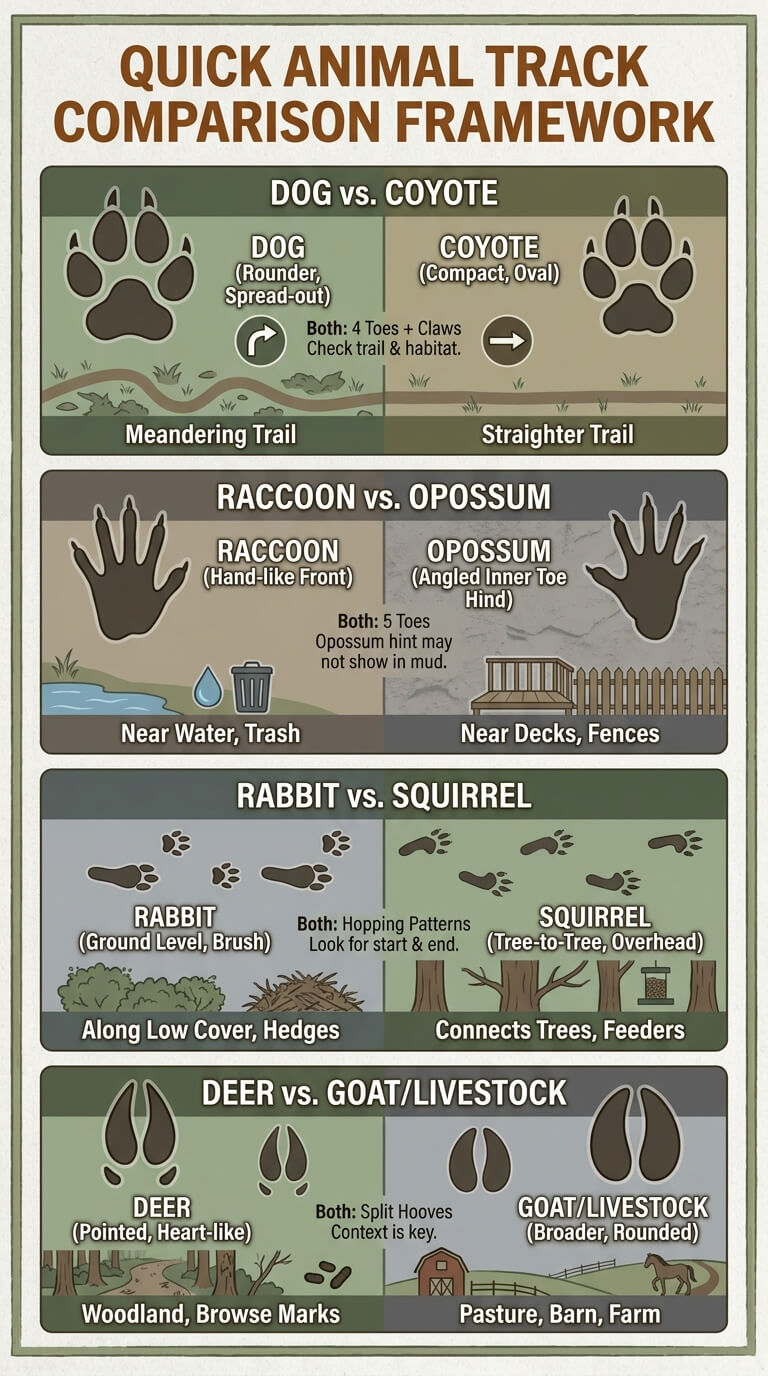
Many common animal tracks in the US become confusing because different animals share the same general foot plan. Four toes and claws can mean dog, coyote, or fox. Five toes can mean raccoon, opossum, skunk, otter, or another mammal. Split hoofprints can mean deer, goat, sheep, pig, elk, moose, or cattle. Comparing likely pairs helps reduce mistakes.
Dog versus coyote
Dog and coyote tracks are one of the most common mix-ups. Both can show four toes, claw marks, and a central pad. Coyote tracks often appear more compact and oval, with a straighter trail, while dog tracks may be rounder, more spread out, and more meandering.
These clues are helpful but not absolute. A small dog can move in a straight line, and a coyote can wander or pause. Use several prints, direction of travel, habitat, and local wildlife presence before deciding.
Raccoon versus opossum
Raccoon and opossum tracks both may show five toes, which is why they often confuse beginners. Raccoon prints can look more hand-like, especially the front feet. Opossum hind prints may show a distinctive inner toe that angles differently from the others.
In messy mud or shallow snow, that opossum clue may not show. Raccoon tracks near water, trash, or a latrine-like area may fit raccoon, while opossum tracks near decks, crawl spaces, fences, and food scraps may need more supporting evidence.
Rabbit versus squirrel
Rabbit and squirrel tracks can both show hopping or bounding patterns, with larger hind feet landing ahead of smaller front feet. The setting often helps. Rabbit trails usually stay at ground level and run along brush, low cover, and open feeding areas. Squirrel trails often connect trees, trunks, feeders, fences, and overhead routes. In backyards, comparing the signs of raccoons, squirrels, and skunks can help separate similar tracks using damage, timing, odor, and den clues.
Look for where the trail starts and ends. If the path goes from tree to tree or circles a feeder, squirrel is more likely. If it follows a hedge, brush pile, or garden edge, rabbit may be more likely.
Deer versus goat or livestock
Deer tracks and some livestock tracks can look similar because both may show split hooves. Deer prints often look more pointed and heart-like, while goats, sheep, and cattle may leave broader or more rounded impressions. Feral pig tracks can also enter the confusion where pigs occur.
Context is the strongest clue. A print inside a pasture, beside a barn, or on a horse trail may not be wildlife at all. A print crossing a wooded trail with browsing marks and pellet droppings nearby may fit deer better.
Common Mistakes and Myths
Track reading is most useful when it stays humble. The goal is not to name every footprint instantly. The goal is to build a more careful picture of which animals are moving through a place.
Why track size varies by age, sex, and surface
Track size can change for many reasons. Young animals leave smaller prints than adults. Large adults may leave deeper prints than small adults. Wet mud spreads. Dry sand crumbles. Snow melts. Ice crust breaks. A running animal may dig in and make the print look longer than a walking animal would.
This is why measurements should be used with shape, pattern, and setting. A print that looks huge in melting snow may not belong to a huge animal. A small neat print in firm mud may be more reliable than a large, slushy one.
Why common does not mean possible in every state
A track can be common in the United States without being common where you live. Moose tracks are realistic in parts of the northern United States and Alaska, but not in most suburban neighborhoods. Elk tracks are normal in some western and mountain areas, but not expected in many eastern yards. Alligator slides, armadillo digging, and javelina tracks are strongly regional.
When a track seems unusual, check local wildlife ranges before making the call. State wildlife agencies, park naturalists, and local extension offices can help narrow what is realistic for your county or region.
Better Clues Around the Same Footprints
Tracks rarely stand alone. The same animal may leave footprints, droppings, chew marks, digging, rub marks, feathers, hair, trails, or camera footage. More than one clue can improve confidence, but it can also reveal that the first guess was wrong.
When to use a step-by-step track checklist
Use a step-by-step method when you have a clean print or a clear trail. Start with foot type: paw, hoof, bird foot, or webbed print. Then compare toe count, claw marks, pad shape, track size, and gait. After that, add setting and local range.
This order matters because it keeps you from jumping straight to a dramatic animal. For example, a four-toed track with claws should first be treated as canine-like, not immediately as coyote. A round cat-like print should be checked against domestic cat, bobcat, and regional wild cats before being named.
When droppings, holes, nests, or cameras add evidence
Droppings, holes, nests, and trail cameras can help, but they also come with safety and ethics limits. Do not handle unknown droppings, reach into holes, disturb nests, or follow tracks toward dens. If you find a sick, injured, or dead mammal, Florida Fish and Wildlife Conservation Commission guidance says to note details and seek proper help rather than attempting risky contact.
FAQ
What are the most common animal tracks in American backyards?
The most common backyard tracks often come from squirrels, rabbits, raccoons, skunks, opossums, domestic cats, domestic dogs, deer, and common birds. In some neighborhoods, coyotes and foxes also pass through. The exact list depends on your state, season, habitat, and how much food, cover, and water the yard provides.
What animal track looks like a tiny human hand?
Raccoon tracks are the classic “tiny hand” tracks because they can show five long toes and a palm-like pad. Opossum tracks may also look hand-like, especially when the hind foot shows the angled inner toe. A clear trail pattern and nearby clues, such as water, trash, or deck activity, can help separate them.
What animal tracks are easiest to recognize in snow?
Some of the easiest snow tracks for beginners are deer hoofprints, rabbit hopping patterns, raccoon hand-like prints, and webbed goose or duck tracks near water. Snow can also mislead because melting enlarges prints and powder hides toe details, so it is best to compare several fresh prints before deciding.
Final Thoughts
Common animal tracks in the US are easiest to read when you compare the whole trail, not just one footprint. Deer leave split hoof clues, raccoons often leave hand-like prints, rabbits and squirrels show hopping patterns, canines leave four-toed tracks with claws, cats tend to leave rounder prints without obvious claws, and wetland animals often add slides, webbing, or muddy water-edge trails.
The best track reading is careful rather than dramatic. Ask what animals are realistic for your region, look for repeated prints, notice the habitat, and use nearby clues only from a safe distance. A footprint is a small moment from an animal’s life, but with patience, it can reveal how wildlife moves through the same places people walk every day.

Ethan Walker is the founder and research editor of Animal Fact Central. He creates and reviews educational animal facts content using trusted wildlife, pet care, and science-based sources. His work focuses on making animal behavior, adaptations, habitats, and species facts clear, accurate, and engaging for everyday readers.
Read More Details About Ethan Walker: https://animalfactcentral.com/ethan-walker/