

Animal droppings identification can help you figure out what wildlife has been visiting a yard, trail, attic, shed, garden, deck, or crawl space, but it should always start with safety. Droppings can carry germs, parasite eggs, fungal spores, or other contamination, and many piles look similar once weather, diet, and age change their appearance.
The safest approach is to look without touching. Notice the size, shape, texture, location, pattern, and nearby clues, then treat your answer as a likely match rather than proof. A pile of pellets may point toward deer or rabbits. Tubular scat with fur, seeds, or bone bits may point toward a meat-eating or omnivorous mammal. Tiny dark pellets indoors may point toward mice, rats, bats, or roosting birds, depending on where they appear.
This guide explains how to read common droppings in a cautious, practical way. It also highlights the situations that deserve extra care, especially raccoon latrines, rodent droppings, bat guano, and indoor contamination where children, pets, or people with weakened immune systems could be exposed.
Quick Answer

To identify animal droppings, first keep children and pets away, avoid touching or smelling the material, and do not sweep, vacuum, or stir up unknown droppings. Then compare the evidence by size, shape, location, freshness, contents, and repeated use of the same spot.
Round pellets often come from plant-eating mammals such as deer, rabbits, squirrels, or other rodents, but size and location matter. Tubular scat may come from raccoons, skunks, opossums, coyotes, foxes, bobcats, dogs, or cats. Very small dark droppings in cabinets, sheds, garages, attics, or wall spaces often deserve rodent or bat caution until proven otherwise.
Identification is easiest when droppings are combined with other clues, such as tracks, chew marks, den openings, garden damage, feeding scraps, attic noises, or trail camera images. It is least reliable when you have only one old, weathered pile.
Safety First: What to Do Before You Try to Identify Droppings

Curiosity is normal when you find mystery droppings, but feces is not just an animal clue. It is waste. It can contain bacteria, parasites, viruses, fungi, and bits of contaminated soil or nesting material. You do not need to panic, but you should avoid casual handling.
Do not touch or smell droppings
Do not pick up unknown droppings with bare hands, crush them between your fingers, or smell them closely. Odor is not a safe identification method, and disturbing dry material can send dust into the air. The Internet Center for Wildlife Damage Management scat guide notes that feces can change with diet and warns readers to avoid handling droppings without proper protection.
For outdoor droppings on a trail, the safest choice is usually to observe from a short distance, take a photo if needed, and move on. For droppings near a home, pet area, garden bed, attic, shed, or play space, treat the site as a possible cleanup or exclusion issue rather than a fun identification puzzle.
Keep children and pets away
Children may be tempted to poke or collect unusual outdoor objects, and pets may sniff, lick, roll in, or eat feces. Keep kids and animals away from droppings until you understand the situation. This matters most around repeated piles, indoor droppings, droppings near sandboxes or play equipment, and areas where raccoons, rodents, or bats may be active.
If a pet has eaten unknown droppings, is vomiting repeatedly, seems lethargic, has diarrhea, has trouble breathing, or shows sudden unusual behavior, contact a veterinarian. Do not try to identify droppings as a substitute for veterinary care.
When protective cleanup or professional help may be needed
A single deer or rabbit pellet pile on a trail is very different from heavy rodent waste in a cabin or a raccoon latrine on a deck. Professional help is worth considering when droppings are indoors, widespread, repeated in the same place, mixed with urine or nesting material, inside insulation, in an air duct, near a child play area, or associated with bats, raccoons, rodents, or sick-looking wildlife.
The CDC says not to vacuum or sweep droppings or nesting material from rodents because contaminated particles can become airborne. Use that as a general safety principle: if droppings are dry, dusty, indoors, or extensive, do not disturb them casually.
How to Identify Animal Droppings Safely

Good animal droppings identification is less about memorizing one perfect picture and more about collecting several clues. Droppings vary with food, age, moisture, health, and weather. A raccoon that has been eating berries may leave very different scat from one that has been feeding near trash. Deer pellets can clump when the animal has eaten softer, wetter foods. A coyote scat full of hair in winter may look different from one with berries in summer.
Size, shape, texture, and contents
Start with size and shape, but do not stop there. Pellets usually point toward herbivores or small mammals. Tubes, ropes, segments, or twisted shapes often point toward omnivores and carnivores. White, chalky splashes often point toward birds or reptiles, though exact species can be hard to determine from droppings alone.
Texture and contents can help. Plant-eating animals may leave fibrous, grassy, or pellet-like droppings. Omnivores may leave seeds, fruit skins, insect parts, or mixed material. Meat-eating mammals may leave hair, feathers, bones, or a tapered shape. These clues are useful, but they are not perfect because many backyard animals eat varied diets.
Location and pattern
Location can be more revealing than the pile itself. Droppings along a game trail, under a bird roost, on a deck railing, in an attic corner, near a chimney, under a porch, beside a hole, or around a garden tell different stories. Repeated piles in one chosen spot can indicate a latrine or regular travel route.
Patterns matter. Scattered pellets across a lawn may suggest deer or rabbits feeding as they move. Concentrated pellet piles in a small area may suggest rabbits. Droppings under a roofline or rafters may point toward roosting birds or bats. Small pellets in kitchen cabinets or along walls suggest a very different problem from deer pellets near shrubs.
Freshness, season, and repeated activity
Fresh droppings are often darker, moister, and more defined. Older droppings may fade, dry out, crumble, grow mold, get rained flat, or become mixed with soil. Freshness can hint at recent animal activity, but it should not be treated like a clock. Shade, sun, humidity, rain, snow, and insects can change droppings quickly.
Season changes what animals eat and where they move. Fruit, acorns, insects, carrion, birdseed, pet food, garden produce, and trash can all change the look of scat. If droppings keep appearing in the same place, the pattern is more important than a single pile.
Common Animal Droppings You Might Find
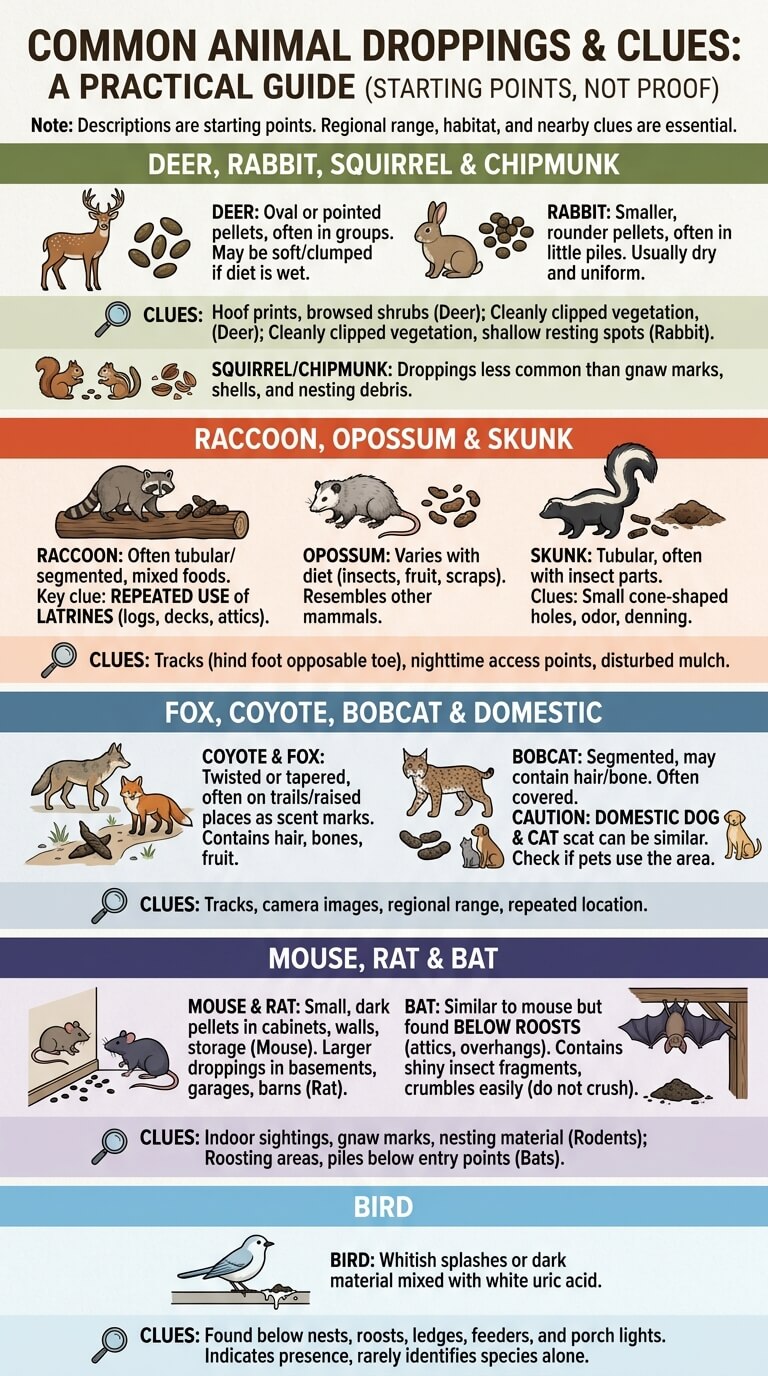
The following descriptions are practical starting points, not final proof. Regional range, habitat, and nearby clues matter. A species that is common in one state may be rare or absent in another, and domestic animals can confuse the picture.
Deer, rabbit, squirrel, and chipmunk droppings
Deer droppings are often seen as groups of oval or slightly pointed pellets, usually on lawns, trails, gardens, forest edges, and feeding areas. When deer eat wetter green vegetation, pellets can be softer or clumped. Deer evidence often appears with hoof prints, browsed shrubs, nipped hostas, rubbed saplings, or trails through vegetation.
Rabbit droppings are usually smaller, rounder pellets, often found in little piles near grass, garden edges, brush piles, and shelter cover. Rabbit pellets may look uniform and dry. Nearby rabbit clues can include cleanly clipped vegetation, shallow resting spots in grass, and hopping track patterns in snow or mud.
Squirrel and chipmunk droppings are much smaller than deer or rabbit droppings and are usually noticed near feeding or nesting places rather than in large open piles. Around homes, people are more likely to notice gnaw marks, nut shells, seed debris, attic noises, or nesting material than droppings alone.
Raccoon, opossum, and skunk droppings
Raccoon droppings are often tubular or segmented and may contain seeds, fruit, insect parts, or other mixed foods. The bigger clue is repeated use of the same place. Raccoons may create latrines on logs, stumps, decks, rooftops, attics, woodpiles, or flat outdoor surfaces. A raccoon latrine deserves more caution than a random outdoor scat pile.
Opossum droppings can vary because opossums eat many foods, including insects, fruit, carrion, pet food, and discarded scraps. Their droppings may resemble other medium-sized mammals, so location and behavior clues are important. Look for tracks with a hind foot that can show an opposable toe, nighttime movement, and access points under porches or sheds.
Skunk droppings are often tubular and may contain insect parts, seeds, or other food remains. Skunk signs around homes are often easier to identify by digging than by scat: small cone-shaped holes in lawns, disturbed mulch, odor, and denning under decks or sheds can all point toward skunks.
Fox, coyote, bobcat, dog, and cat scat
Coyote and fox scat is often found along trails, road edges, field borders, or raised places where it can work as a scent mark. It may be twisted or tapered and may contain hair, bones, feathers, insects, or fruit. Coyote scat is often larger than fox scat, but overlap and diet can blur the difference.
Bobcat scat may be segmented and may contain hair or bone fragments, but cats often cover feces, which can make it harder to notice. Domestic cats can also leave similar evidence in gardens, mulch, sand, or loose soil. Tracks, camera images, regional range, and repeated location are important before assuming a wild cat.
Dog feces can strongly resemble wildlife scat, especially when found on trails, lawns, parks, or neighborhood paths. Before deciding you have coyote or fox scat, ask whether domestic dogs use the area. Pet waste is common in human spaces and can mislead beginners.
Mouse, rat, bat, and bird droppings
Mouse droppings are small, dark, pellet-like, and often found along walls, in cabinets, under sinks, in drawers, near food storage, in sheds, or around nesting material. Rat droppings are larger and may appear in basements, garages, crawl spaces, barns, alleys, or around stored food and trash. Indoor rodent droppings should be treated as a health and exclusion concern, not just an identification challenge.
Bat droppings can look similar to mouse droppings at first glance, but they are often found below roosting areas such as attic rafters, shutters, porch overhangs, barns, or entry points. Bat guano may contain shiny insect fragments and can crumble more easily than rodent droppings, but you should not crush it to test it. Location is safer and more useful.
Bird droppings often appear as whitish splashes or dark material mixed with white uric acid. You may find them below nests, roosts, ledges, feeders, branches, rafters, vehicles, docks, or porch lights. Bird droppings can indicate roosting or nesting, but they rarely identify the exact bird species on their own.
Droppings That Need Extra Caution

Some droppings deserve a higher level of caution because of where they appear, how often they appear, or what animals may have left them. This does not mean every pile will make someone sick. It means the possible downside is serious enough to avoid direct contact and use professional or official guidance when needed.
Raccoon latrines and parasite risk
Raccoon latrines are repeated toilet sites used by raccoons. They may appear on decks, roofs, attics, woodpiles, logs, stumps, large rocks, haylofts, or near the base of trees. The concern is raccoon roundworm, also called Baylisascaris. The CDC explains that people become infected by swallowing infectious eggs and notes that eggs passed in raccoon feces are not immediately infectious but can become infectious after time in the environment through its raccoon roundworm overview.
Do not sweep, hose, play near, or let pets investigate a suspected raccoon latrine. Keep children away, take note of the location from a safe distance, and consider professional cleanup when the latrine is indoors, on porous material, in insulation, near a play area, or repeatedly used.
Rodent droppings and disease risk
Mouse and rat droppings around homes can be more than a nuisance. Rodents may contaminate food areas, stored items, nesting spaces, sheds, barns, garages, cabins, and vehicles. The safest response depends on how much contamination is present and where it is located.
For rodent waste, the CDC says not to vacuum or sweep droppings or nesting material because contaminated particles can become airborne. Its rodent cleanup guidance recommends disinfecting before wiping and using proper protective equipment, with extra precautions for heavy infestations.
If droppings are widespread, inside insulation, in air ducts, in a vehicle ventilation area, or linked with a heavy infestation, do not treat the site like ordinary household dirt. Contact a qualified pest or cleanup professional and follow local public health guidance.
Bat guano and indoor contamination context
Bat droppings can build up below roosts in attics, barns, porches, chimneys, and wall voids. The main identification clue is often location, not shape. If droppings appear below a high entry gap, rafter, shutter, or porch overhang and you notice bats at dusk, guano becomes more likely.
Bat and bird droppings can be associated with Histoplasma, a fungus found in soil, especially where bird or bat droppings accumulate. The CDC describes histoplasmosis as a lung infection caused by breathing in fungal spores from the environment and notes that in the United States the fungus mainly lives in soil in central and eastern states in its histoplasmosis information.
Do not disturb guano piles in enclosed spaces. Do not seal bats inside a structure. Bat exclusion is timing-sensitive in many areas because young bats may be present during maternity season. A licensed wildlife professional or local wildlife agency can help prevent harm to bats while reducing human exposure.
Common Mistakes and Myths
Droppings feel like direct evidence, but they are still easy to misread. Most mistakes happen when people focus on one trait while ignoring location, season, weather, and nearby signs.
Why color alone is not reliable
Color changes with diet, age, moisture, sun exposure, and decay. Fresh scat may be dark and glossy, but the same material may turn gray, pale, moldy, chalky, or crumbly after time outdoors. Berries can create purple or reddish tones. Plant material can produce greenish or tan tones. Bird and reptile droppings may include white uric acid.
Use color as a supporting clue, not the main clue. A dark pile is not automatically coyote. A pale pile is not automatically bird. A reddish pile is not automatically blood. If you see droppings that look bloody near a pet, treat that as a veterinary concern rather than a wildlife identification question.
Why one pile rarely proves the species
One pile of scat can narrow the possibilities, but it rarely proves the animal. Different animals can eat similar foods. Weather can reshape scat. Domestic pets can leave droppings in the same places wildlife travels. Young animals may leave smaller droppings than adults.
Try to build a pattern. Are there tracks nearby? Does the pile reappear in the same location? Is there a hole, trail, chew mark, den entrance, feather pile, damaged trash can, or food debris? Did a camera catch movement at night? The more clues agree, the more confident you can be.
Why old droppings may not show current activity
Old droppings can remain visible long after the animal has moved on. This is especially true in dry areas, sheltered corners, attics, barns, crawl spaces, and under decks. An old pile does not always mean an animal is still living nearby.
Look for new material, repeated deposits, fresh tracks, new gnawing, current noises, fresh digging, or recent camera images. If you are dealing with indoor droppings, even old waste may still need careful cleanup, but activity level and cleanup risk are separate questions.
Edge Cases and Exceptions
Real outdoor evidence rarely matches a perfect field guide photo. A cautious reader expects exceptions and avoids overconfidence.
Diet changes and seasonal food
Diet can completely change the appearance of scat. A raccoon eating fruit may leave seed-filled droppings. A coyote eating rodents may leave hair-filled scat. A deer eating soft spring plants may leave clumped pellets instead of separate, dry pellets. A bear, where present, may leave scat that changes dramatically with berries, acorns, insects, carrion, or human food.
Season also changes where droppings appear. In winter, tracks in snow may make droppings easier to interpret. In summer, thick vegetation may hide travel routes. In fall, nut shells, fruit skins, and acorns can add context around yards and woods.
Pet waste versus wildlife scat
Pet waste is one of the biggest sources of confusion. Dogs, outdoor cats, and neighborhood pets often use the same lawns, trails, gardens, sandboxes, and mulched beds where wildlife travels. A coyote-like scat on a suburban path may simply be dog feces. A bobcat-like scat in loose garden soil may be from a domestic cat.
Before assuming a wild animal, ask whether pets have access. Look at the setting, repeated pattern, tracks, camera evidence, and local wildlife range. Wildlife identification should not be used to blame an animal without stronger evidence.
Mixed signs from multiple animals
Backyards, trails, farms, and wooded edges often have multiple visitors. Deer may browse shrubs in the evening. Rabbits may feed before dawn. Raccoons may cross the deck at night. Squirrels may scatter shells during the day. A single area can collect many clues that do not all belong to the same species.
Mixed evidence is why timing matters. Fresh droppings, new tracks, recent chew marks, and camera timestamps can separate one visitor from another. Without timing, it is easy to combine unrelated clues into the wrong story.
Other Wildlife Clues That Help Confirm Droppings
Droppings are strongest when they fit the rest of the scene. Tracks, holes, chewing, food remains, and camera images can turn a guess into a more reasonable identification.
Tracks, holes, and chew marks as supporting clues
Tracks can show foot shape, toe count, gait, and direction of travel. Holes can show digging style, entrance size, spoil pile, or repeated use. Chew marks can point toward rodents, rabbits, deer, beavers, squirrels, or raccoons depending on height, shape, and material.
For example, pellet droppings plus hoof prints and browsed shrubs are stronger evidence for deer than pellets alone. Small dark droppings plus gnawed food packaging and wall-edge travel marks are stronger evidence for rodents than droppings alone. Tubular scat plus cone-shaped lawn holes may make skunk activity more likely than a random scat pile would.
Trail cameras when droppings keep appearing
A trail camera can be useful when droppings keep showing up and you need to know whether the visitor is a raccoon, skunk, opossum, fox, coyote, deer, rabbit, cat, dog, or another animal. Place cameras without baiting, crowding dens, pointing toward neighbors, or disturbing nests and roosts.
Camera evidence can still mislead if the image is blurry, too close, too far away, or missing scale. Use the footage as one more clue, not a reason to approach or harass wildlife. If the evidence points to an indoor infestation, repeated raccoon latrine, bat roost, or sick animal, contact the right professional instead of trying to solve it by direct contact.
FAQ
Is animal scat dangerous to touch?
Animal scat can be risky to touch because it may contain germs, parasite eggs, fungal spores, or contaminated dust. The level of concern depends on the animal, location, freshness, amount, and whether the droppings are indoors or near people and pets. Unknown droppings should not be handled with bare hands.
Outdoor droppings on a trail can usually be left alone. Indoor droppings, raccoon latrines, rodent waste, bat guano, and droppings near children or pets deserve more caution. If you think you swallowed contaminated material, inhaled dust from heavy droppings, or developed symptoms after exposure, contact a healthcare professional.
What animal droppings look like pellets?
Pellet-like droppings often come from plant-eating mammals, including deer, rabbits, squirrels, chipmunks, mice, rats, and other rodents. Size, shape, location, and pattern help narrow the possibilities. Deer pellets are generally larger than rabbit pellets. Mouse and rat pellets are usually much smaller and are often found indoors or near stored food, walls, or nesting areas.
Pellets alone are not enough for a perfect identification. Check for hoof prints, hopping tracks, gnaw marks, garden browsing, wall-edge trails, burrows, or repeated activity in the same location.
When should you call a wildlife or pest professional?
Call a licensed wildlife or pest professional when droppings are indoors, widespread, repeated, in insulation, in air ducts, in a crawl space, near a play area, under a bat roost, or part of a suspected raccoon latrine. Professional help is also wise when you cannot safely access the area or when animals may still be inside a structure.
You should also get professional guidance before excluding bats, sealing holes, or dealing with animals that may have young inside. Do not trap, poison, seal in, or handle wildlife without checking local rules and humane best practices. For immediate human or pet health concerns, contact a doctor, veterinarian, poison control service, or local public health office.
Final Thoughts
Animal droppings identification is useful, but it works best when curiosity is balanced with caution. Look at size, shape, contents, location, age, season, and repeated patterns. Then compare those clues with tracks, holes, chew marks, feeding signs, noises, and camera evidence.
The most important takeaway is not to force a species name from one pile. Treat droppings as one piece of outdoor evidence, and treat raccoon latrines, rodent waste, bat guano, and indoor contamination with extra care. When droppings appear in places where people or pets may be exposed, safe distance and professional guidance matter more than a perfect identification.

Ethan Walker is the founder and research editor of Animal Fact Central. He creates and reviews educational animal facts content using trusted wildlife, pet care, and science-based sources. His work focuses on making animal behavior, adaptations, habitats, and species facts clear, accurate, and engaging for everyday readers.
Read More Details About Ethan Walker: https://animalfactcentral.com/ethan-walker/