

Animal babies survive in the wild through a combination of built-in traits, learned behavior, carefully timed development, suitable habitat, and, in many species, help from adults. Some newborns remain hidden and nearly motionless. Others can stand, swim, or follow a parent soon after birth or hatching. Many rely on camouflage, group protection, rapid growth, warning signals, or nursery areas that reduce exposure to predators.
No single strategy makes a young animal safe. Early life often brings the highest risks because juveniles are small, inexperienced, and still developing the strength, senses, temperature control, and feeding skills of adults. A useful survival method in an open grassland may be ineffective in a forest, river, desert, or polar colony.
Understanding how animal babies survive also helps people avoid a common mistake. A quiet fawn, fledgling, or young rabbit found alone may be following a normal hiding strategy rather than waiting for rescue. The safest response usually begins with distance, careful observation, and qualified wildlife advice when there is clear injury or immediate danger.
Quick Answer

Young animals survive by reducing the chance that predators find them, reaching food and shelter, staying within tolerable temperatures, avoiding disease and injury, and developing fast enough to handle the next stage of life. They may hide, freeze, burrow, travel in groups, follow adults, use defensive chemicals, display warning colors, or occupy shallow and densely covered nursery habitats.
The starting point differs greatly among species. Altricial young hatch or are born relatively undeveloped and usually need intensive feeding, warming, or protection. Precocial young arrive more mature and mobile, but mobility does not make them independent. Researchers describe these patterns as an altricial to precocial spectrum, not two boxes that perfectly fit every animal.
Parents can improve the odds through feeding, guarding, warming, grooming, carrying, alarm signals, and shelter. Yet some animals receive little or no care after birth or hatching. Their survival depends more heavily on egg provisions, timing, numbers, habitat choice, and behaviors that work immediately.
Why Early Life Is the Most Dangerous Stage

Predators, Exposure, Hunger, and Disease
A young animal can face several threats at once. It may need to avoid predators while also staying warm, finding enough food, and resisting parasites or infection. A storm that would merely inconvenience an adult can chill a small hatchling. A short food shortage can matter more to a rapidly growing juvenile than to an adult with larger energy reserves.
Small Size, Inexperience, and Limited Mobility
Small bodies lose heat quickly and have less room for stored fat or water. Young animals may also lack adult weapons, armor, speed, diving ability, or endurance. Even when a juvenile has claws, teeth, a shell, or venom, those defenses may be smaller, less controlled, or less effective than they are in a mature animal.
Inexperience creates a different problem. Juveniles must learn which sounds indicate danger, where cover is located, what food is safe, when to freeze, and when to flee. Some responses are strongly inherited, while others improve through practice or by following older animals.
Competition With Siblings and Other Young
Brothers, sisters, and unrelated juveniles may compete for milk, food deliveries, warm positions, shelter, or access to a parent. The effect ranges from mild differences in growth to severe losses when resources are scarce. Competition is often strongest where many young depend on a limited feeding site or where parents cannot provide equally to every offspring.
Two Starting Points: Helpless Young and Mobile Young
Altricial Young That Depend Heavily on Care
Altricial young begin life with limited movement, sensory ability, insulation, or temperature control. Many songbird nestlings hatch with closed eyes and sparse covering. Puppies, kittens, mice, and numerous other mammals are also unable to travel with a parent at birth. Their early survival depends on a protected site and reliable adult care.
This strategy allows substantial growth to occur after birth or hatching. A sheltered nest or den can support rapid development while adults deliver food. The cost is dependence. If protection, warmth, or provisioning fails, altricial young may have few immediate ways to compensate.
Precocial Young That Can Move Soon After Birth or Hatching
Precocial young are more developed when they enter the outside world. Ducklings can walk and swim soon after hatching. Hoofed mammals may stand and follow an adult shortly after birth. Many ground-nesting birds hatch covered in down and can peck at food while remaining close to a parent.
Early mobility is useful where staying in one nest would be dangerous or where food is spread across the habitat. It helps young follow a moving group, leave a birth site that attracts predators, and reach cover. However, these juveniles may still need warmth, milk, alarm calls, route guidance, and defense.
Why Neither Strategy Guarantees Survival
Altricial and precocial development solve different problems. A nest-bound chick can grow in a protected space but depends on adults reaching that space safely. A mobile chick can move away from danger but must spend energy walking, feeding, and keeping up. Each pattern carries benefits and costs.
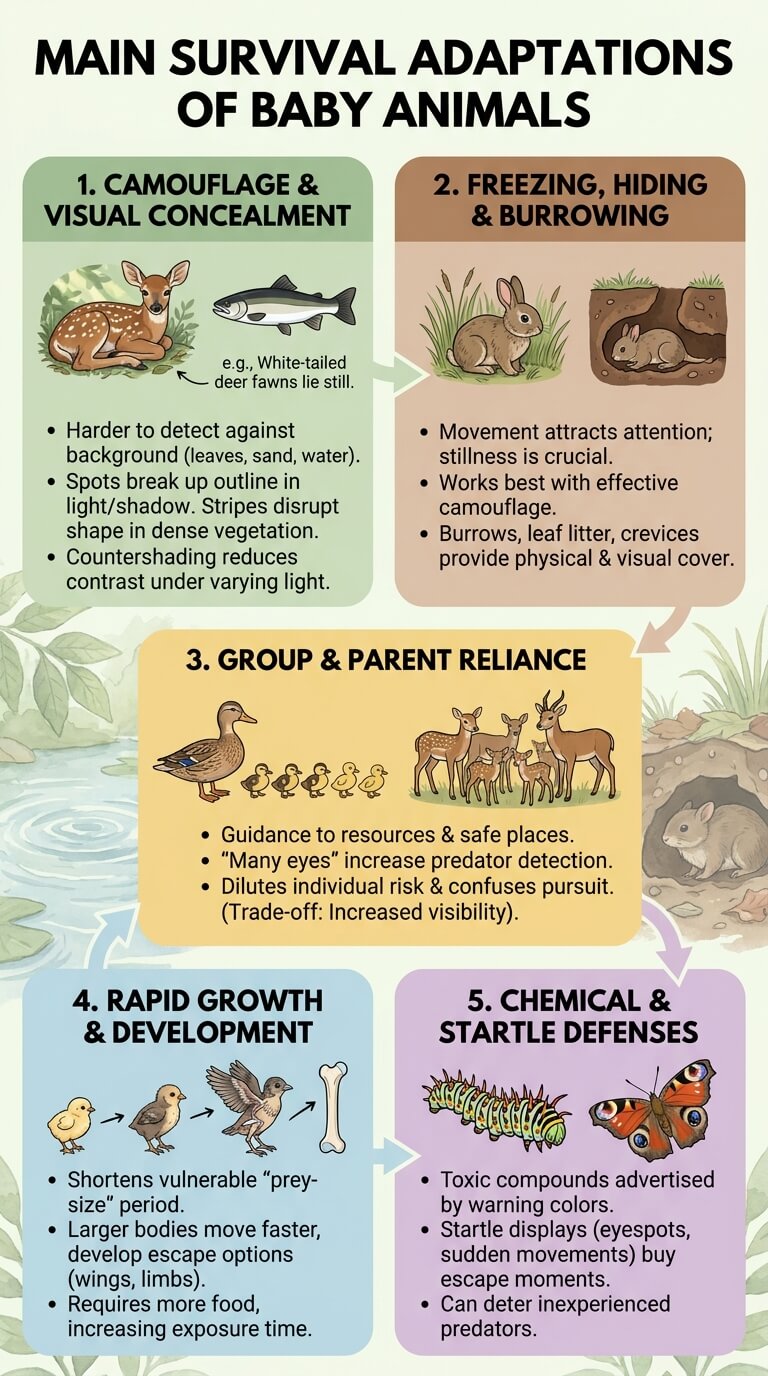
The Main Survival Adaptations of Baby Animals
Camouflage, Spots, Stripes, and Countershading
Camouflage makes a young animal harder to detect against leaves, grass, sand, bark, or water. Spots can break up the outline of a fawn lying among patches of light and shadow. Stripes may disrupt body shape in dense vegetation. Dull or mottled colors help eggs and hatchlings blend into nest material or soil.
White-tailed deer provide a familiar hiding example. Females leave fawns concealed while foraging, and the young lie flat and remain still. The Animal Diversity Web profile of white-tailed deer describes this temporary separation and the fawn’s camouflage on the forest floor.
Countershading is another form of visual concealment. A darker back and lighter underside can reduce contrast under certain lighting conditions. It is common in aquatic animals and can help a juvenile blend when viewed against darker water below or brighter surface light above. Its effectiveness depends on depth, posture, water clarity, and the predator’s vision.
Freezing, Hiding, Burrowing, and Staying Silent
Movement attracts attention. Many young prey animals respond to danger by becoming still, lowering the body, and remaining quiet. This works best when camouflage is already effective. The strategy can fail if the predator hunts mainly by smell, has already located the animal, or can search the hiding place directly.
Burrows, cavities, leaf litter, rock crevices, and dense vegetation provide physical barriers as well as visual cover. Young reptiles and amphibians may disappear into soil or debris. Small mammals use tunnels and nest chambers. Juvenile fish shelter among vegetation, roots, reef structure, or shallow margins that are difficult for larger predators to enter.
Following a Parent or Staying Inside a Group
Following keeps a juvenile near an animal that knows the route to water, food, shelter, and safer resting places. Adults may also detect predators earlier or defend young directly. In herd, flock, school, or colony settings, many eyes and ears increase the chance that danger is noticed.
Groups can dilute individual risk because a predator can capture only a limited number of animals at one time. They can also confuse pursuit by presenting many moving targets. The trade-off is visibility. A large group can be easier to find, and crowded young may compete for food or spread parasites more readily.
Rapid Growth and Early Development
Growth can shorten the period when a juvenile fits into the easiest prey-size category. Larger bodies may retain heat better, move faster, dive longer, or handle a broader range of food. Developing wings, stronger limbs, adult teeth, thicker shells, or improved coordination opens new escape options.
Fast growth is not free. It requires food and can force juveniles to spend more time feeding, which may increase exposure. Tissues also need to develop in the right sequence. A young animal that gains size quickly may still lack adult skill or endurance. Survival depends on coordinated development, not body mass alone.
Chemical Defenses, Warning Signals, and Startle Displays
Some juveniles are protected by chemicals they produce, obtain from food, or receive through eggs or parental provisioning. Toxic or distasteful prey may advertise the risk with contrasting colors. Predators can learn to avoid those patterns, although inexperienced predators may still attack before learning.
Other young animals suddenly reveal eyespots, bright patches, raised spines, inflated bodies, or unexpected movement. A startle display may buy a moment to escape rather than defeat the predator. These defenses work in combination with hiding, armor, speed, or group behavior, and their effectiveness varies with the attacker.
How Timing and Habitat Improve Survival

Seasonal Births When Food Is Most Available
Many animals time birth, hatching, or larval emergence so the period of greatest demand overlaps with favorable conditions. Spring plant growth can support milk production in grazing mammals. Insect peaks can feed growing chicks. Seasonal floods can create temporary feeding and nursery areas for fish, amphibians, and invertebrates.
Timing is not exact in every year. Weather, drought, snowmelt, ocean conditions, and plant growth can shift. A mismatch between birth and food availability can slow growth or force parents to travel farther. Flexible species may adjust somewhat, while highly seasonal species can be more exposed to unusual conditions.
Synchronized Births That Dilute Predator Risk
In some populations, many females give birth within a relatively short period. This can overwhelm the number of young that local predators are able to capture, reducing the chance that any one newborn is taken. This idea is often called predator swamping, but synchronized timing can also reflect seasonal food and climate.
Research on maternal behavior and newborn ungulate survival discusses reproductive synchrony as one possible way prey populations reduce individual predation risk. It is not a universal shield. Predators may concentrate near birthing areas, and late or weak young may remain especially vulnerable.
Nursery Areas, Shallow Water, Dense Cover, and Protected Microhabitats
A nursery habitat offers conditions that improve feeding, concealment, temperature control, or access to shelter during early life. Mangrove roots, salt marsh edges, seagrass beds, tidal creeks, flooded forests, shallow ponds, and sheltered coves can hold abundant small prey while limiting access for some large predators.
NOAA describes the still waters among mangrove roots as protective feeding and nursery areas used by fish, crustaceans, and other animals. A nursery is not predator-free. Its value comes from a better balance of food, cover, and physical conditions than surrounding areas offer to a particular stage.
Terrestrial young also rely on microhabitats. A shaded burrow can reduce heat and water loss. Dense grass hides a newborn. A sun-warmed patch helps a small reptile raise body temperature, while a nearby crevice provides escape cover. These fine-scale choices can matter as much as the broad habitat name.
How Parents Help Without Solving Every Risk
Guarding, Feeding, Grooming, and Warming
Adults can defend young, drive away smaller predators, produce alarm signals, or position themselves between danger and offspring. They may deliver milk, captured prey, regurgitated food, or access to feeding sites. Grooming can remove debris or parasites, while brooding and close body contact help young maintain temperature.
Care remains limited by the adult’s energy, health, and need to feed. A parent cannot watch every direction or prevent every attack. Leaving to forage may be necessary even when absence creates risk. The most successful pattern is often a compromise between staying close and gathering enough resources.
Carrying Young During Dangerous Movements
Carrying allows adults to move offspring that cannot travel safely on their own. Primates and sloths have young that cling. Crocodilians may transport hatchlings in the mouth. Some frogs carry tadpoles to small water sites, while spiders and scorpions may carry young on the body.
Nests, Dens, and Temporary Shelters
A nest or den creates a controlled space for young that cannot regulate temperature or escape. Walls, plant material, soil, feathers, fur, silk, foam, or bubbles can provide insulation and concealment. Adults may repair the site, remove waste, change the bedding, or move the young if conditions deteriorate.
Examples From Different Environments

Open Grasslands and Fast-Following Young
Open habitats provide long sight lines but limited places to hide. Hoofed mammals often give birth to young that can stand and follow relatively early. Mobility lets them leave the scent and disturbance of the birth site, remain with a herd, and reach new feeding areas as the group moves.
Not every grassland newborn follows immediately. Some antelope and deer use a hiding phase, with the parent returning to nurse. The difference reflects body size, predator community, group structure, and how the adults use the landscape. Both following and hiding can work within the same broad environment.
Forests and Concealment Strategies
Forests offer layers of cover, including canopy, shrubs, fallen logs, leaf litter, cavities, and underground spaces. Young animals can use mottled coloration and stillness to disappear against complex backgrounds. Arboreal juveniles may remain in nests or cling to adults until climbing control improves.
Dense cover can also limit visibility. A parent may rely on scent, calls, remembered locations, or repeated routes to find hidden young. Juveniles must learn when to remain silent and when to signal. Calling too often can attract attention, while failing to respond can make reunion harder.
Rivers, Coasts, and Aquatic Nursery Habitats
Aquatic young often occupy different areas from adults. Shallow water can warm quickly, support plankton or small prey, and exclude some large predators. Vegetation and complex structure break up currents and provide hiding places. Larvae and juveniles may later shift into deeper water as swimming ability and diet change.
Deserts, Polar Regions, and Extreme-Weather Timing
In deserts, young animals may remain underground during the hottest hours, emerge after rain, obtain water from food, or grow during short periods of abundance. Adults may select shaded dens, reduce daytime activity, or time reproduction so nursing and growth coincide with cooler or wetter conditions.
Polar and subpolar young face cold, wind, and strongly seasonal food. Insulation, huddling, sheltered birth sites, parental warmth, and dense milk can help. Timing is critical because a juvenile may need enough size, feathers, fur, or fat before winter, migration, sea-ice change, or the loss of seasonal feeding opportunities.
Trade-Offs and Edge Cases
Large Litters Versus High Investment in Fewer Young
Producing many offspring can spread risk when mortality is high and unpredictable. Even if only a small portion survive, the strategy may sustain the population. Producing fewer young allows more nutrients, protection, or learning per offspring, but losing one represents a larger part of that reproductive effort.
Sibling Competition, Brood Reduction, and Unequal Growth
When food is insufficient, age and size differences can amplify competition. Older or stronger young may secure more milk or food deliveries, grow faster, and become even better competitors. In some birds and other animals, the smallest young may die, reducing the number that parents continue to support.
Brood reduction should not be described as a universal plan by parents. It can emerge from hatching order, food shortage, sibling aggression, selective feeding, illness, or accidents. Studies of sibling competition and signaling show that begging and competition are shaped by family conditions rather than one simple rule.
Orphaned Young and Species That Are Independent From the Start
Some young lose a parent and may be adopted, fed by group members, or survive if they are already near independence. Others cannot survive without specialized care. Outcomes depend on age, species, weather, injuries, available helpers, and whether another parent remains.
Common Myths and Mistakes
Myth: Every Baby Animal Is Protected Constantly by a Parent
Constant attendance can attract predators or prevent the adult from feeding. Parents of hidden young may visit only to nurse or deliver food. Others guard from a distance or rely on a nest site rather than remaining beside every offspring. Absence must be interpreted through the normal behavior of the species.
Some animals also stop direct care earlier than people expect. Once young can feed, regulate temperature, or avoid danger, adult attention may decline quickly. That transition can look harsh while still being a normal developmental step.
Myth: A Motionless Young Animal Has Been Abandoned
Stillness is often a defense. A fawn curled in grass or a rabbit kit concealed near a nest may be waiting for a parent that returns briefly. Approaching repeatedly can draw attention to the location or keep the adult away.
Visible injury, flies gathering on the body, continuous distress, a confirmed dead parent, or immediate hazards may justify professional advice. Being alone, quiet, or hidden is not enough by itself to prove abandonment.
Mistake: Assuming Human Rescue Is Always the Safest Option
Wild young can be harmed by incorrect food, stress, temperature changes, handling, or separation from parents. They may also carry parasites or pathogens, and adults may defend them. Keeping native wildlife can be restricted by law and rehabilitation requires species-specific knowledge.
The U.S. Fish and Wildlife Service advises people who find apparently orphaned wildlife to observe from a safe distance and give parents space when the young animal is not visibly injured. Keep children and pets away, and contact a licensed wildlife rehabilitator or local wildlife agency when clear distress or danger is present.
How Survival Changes on the Road to Independence
Parental Care Is One Part of a Larger Survival System
Adult care works together with the young animal’s own traits and surroundings. Camouflage is more useful when a parent chooses a good hiding place. Early mobility is more useful when the juvenile can follow an experienced adult. A nest succeeds only if its temperature, location, and maintenance fit the developing young.
This interaction explains why removing a young animal from its setting can create problems that are not obvious. Food alone cannot replace protection, social information, normal microbes, temperature conditions, movement practice, and the timing of independence.
Each Developmental Stage Brings New Risks
Survival changes as the animal grows. A hidden newborn may face cold and starvation. A newly mobile juvenile faces traffic, territorial adults, unfamiliar predators, and mistakes while feeding. A dispersing adolescent may need to find habitat, avoid conflict, and establish a place in a group or territory.
Independence is therefore a process. Young may stop receiving milk before they stop following adults. They may fly before they forage efficiently, or feed themselves before they recognize every danger. The safest stage is not necessarily the moment when they first look like a smaller adult.
FAQ
Do Most Baby Animals Survive to Adulthood?
There is no meaningful percentage that applies to all animals. Survival varies enormously among species, populations, years, habitats, and developmental stages. Animals that produce many eggs or larvae often experience high early mortality. Species with fewer young and extended care may have higher survival per offspring, but they can still lose young to predators, weather, disease, or food shortages.
Reliable estimates must name the species, location, age interval, and study method. A figure for hatchlings on one beach or fawns in one managed population should not be treated as a rule for the entire animal kingdom.
How Do Young Animals Recognize Predators?
Some responses are present very early, including freezing, hiding, fleeing from rapidly approaching shapes, or reacting to alarm calls. Other recognition develops through experience. Young animals may learn by watching adults, associating a smell or sound with danger, or surviving an encounter.
Learning can make responses more precise. A juvenile that flees every movement wastes time and energy, while one that ignores a real threat is at greater risk. Social species may gain an advantage from adults that signal which predators are nearby and what action to take.
Why Do Some Baby Animals Freeze Instead of Run?
Running makes noise and reveals location. If the animal is well camouflaged and the predator has not detected it, freezing can preserve concealment. It is especially useful for young that lack the speed or endurance to outrun a hunter.
Freezing is not the best response after discovery. Many animals switch among stillness, sudden escape, hiding, group defense, or a startle display depending on distance and cover. The sequence is shaped by both inherited behavior and experience.
Can Siblings Help or Harm One Another’s Survival?
They can do both. Siblings may share warmth, provide social practice, help detect danger, or reduce the chance that one individual is selected by a predator. In cooperative species, older siblings may even guard or feed younger ones.
They also compete for food, milk, shelter, and parental attention. The outcome depends on resource availability, age differences, brood size, and species behavior. A group that is beneficial during cold weather can become intensely competitive when food is scarce.
Final Thoughts
How animal babies survive in the wild depends on matching the right traits and behaviors to a particular stage and habitat. Camouflage, stillness, early movement, group living, rapid development, defensive signals, seasonal timing, nursery areas, and parental care all reduce certain risks while creating costs of their own.
The most important lesson is that vulnerability does not always look dramatic. A quiet young animal may be using concealment exactly as it should, while a mobile juvenile may still depend heavily on adults. Observe wildlife from a distance, avoid feeding or moving young animals, keep pets away, and seek help from licensed professionals when injury or immediate danger is clear.

Ethan Walker is the founder and research editor of Animal Fact Central. He creates and reviews educational animal facts content using trusted wildlife, pet care, and science-based sources. His work focuses on making animal behavior, adaptations, habitats, and species facts clear, accurate, and engaging for everyday readers.
Read More Details About Ethan Walker: https://animalfactcentral.com/ethan-walker/