

Why animals abandon their young is more complicated than a parent simply deciding not to care. A young animal found alone may still be receiving normal care from a parent that feeds nearby, avoids drawing predators to the hiding place, or returns only when people have left. In other cases, care may decrease or stop because the parent has died, the environment has changed, the offspring is unlikely to survive, or another adult has taken over.
Biologists separate temporary absence, reduced care, desertion, rejection, orphaning, brood reduction, and offspring killing because these events have different causes. Human words such as neglect or cruelty can obscure those differences. The most useful approach is to look at the species, the young animal’s developmental stage, the parent’s normal schedule, and clear signs of injury or distress before deciding that intervention is needed.
Quick Answer
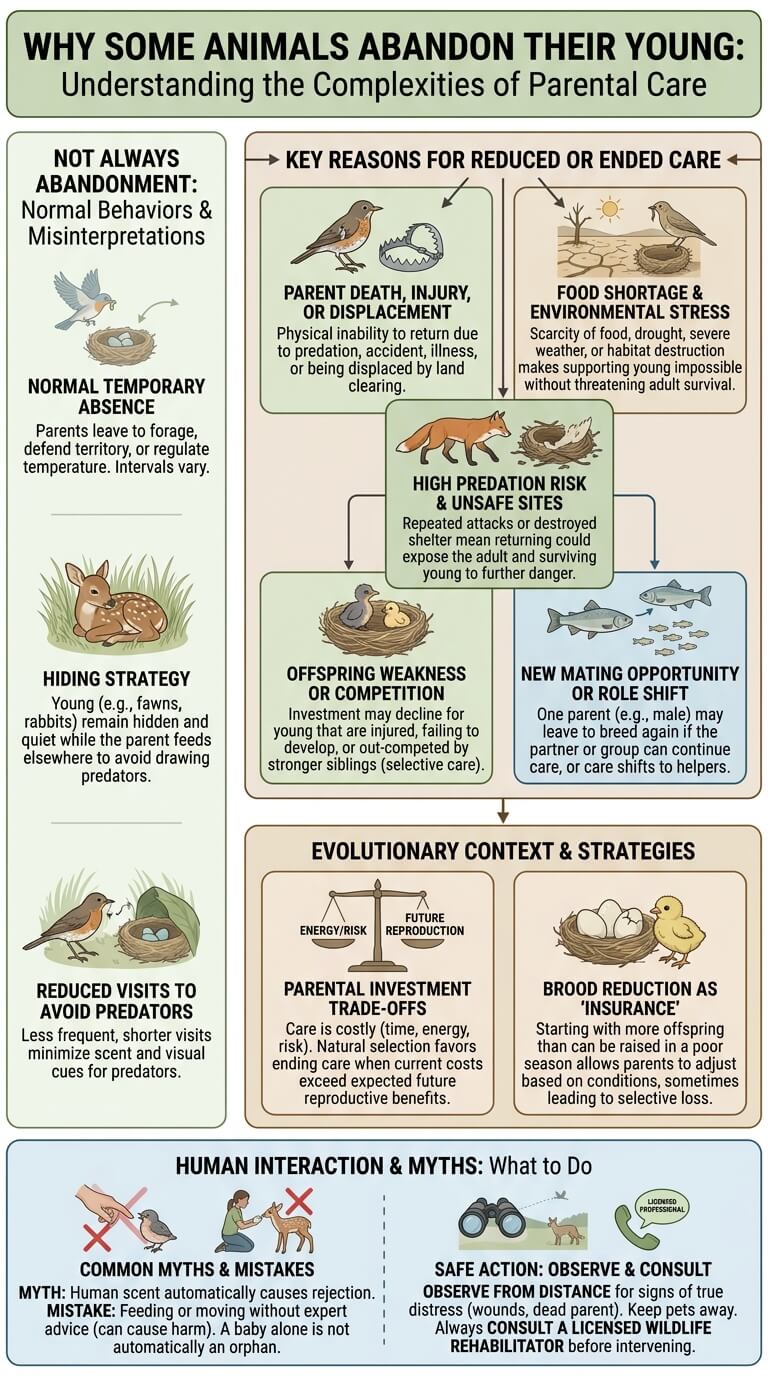
Some animals leave their young because parental care is costly. Feeding, guarding, warming, carrying, and defending offspring require time and energy that cannot be used for the adult’s own survival or future reproduction. Care may decline when food is scarce, danger increases, the parent is injured, or the expected benefit of continued investment becomes very low. In species with two caregivers, one parent may also leave when the other can finish raising the young.
However, a baby animal alone is not necessarily abandoned. Fawns, rabbits, hares, seals, and many birds may spend long periods without a visible parent. The adult may be feeding elsewhere or waiting for danger to pass. For people who find young wildlife, distance and patience are usually safer than immediate rescue unless there is obvious injury, a confirmed dead parent, or guidance from a licensed wildlife professional.
Is the Young Animal Truly Abandoned?
Normal Temporary Absence
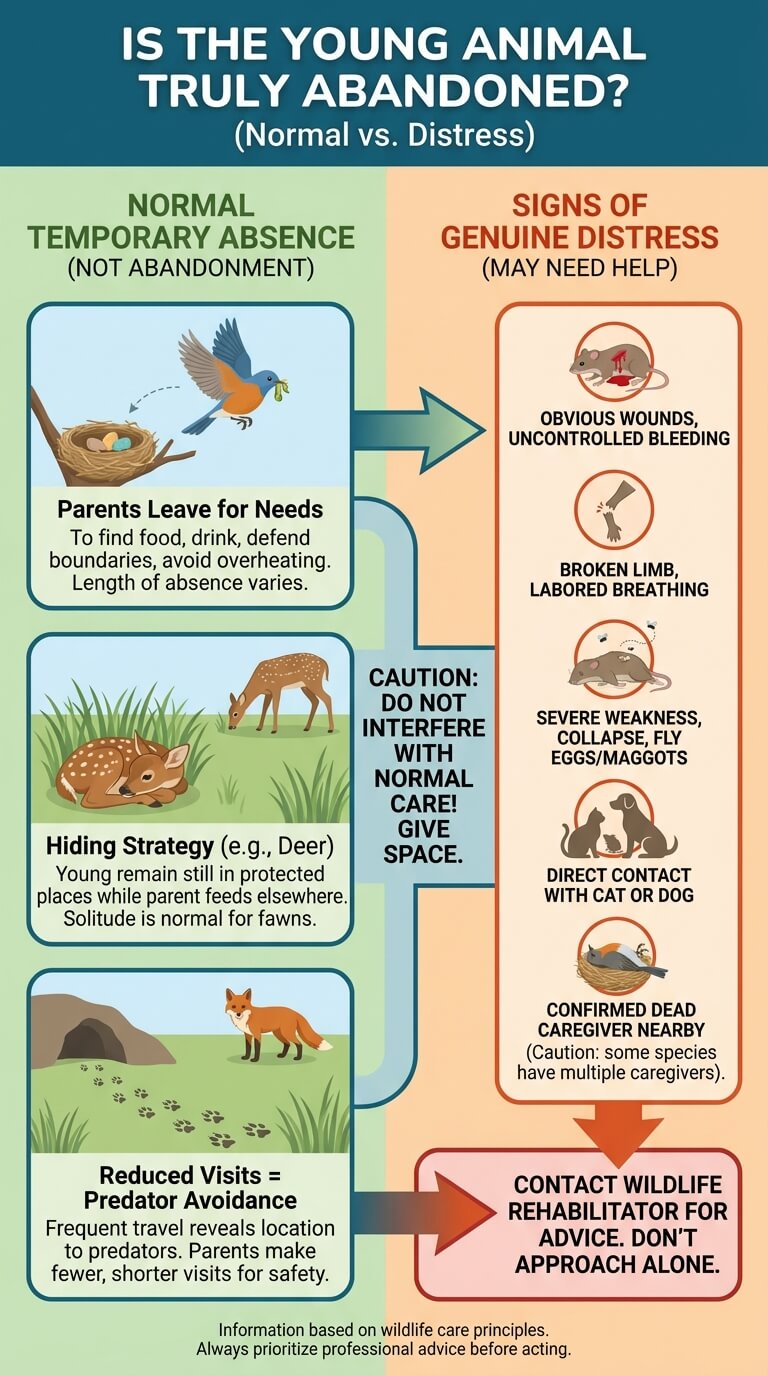
Parents do not need to remain beside their young every minute to provide effective care. An adult may leave to find food, drink, defend a boundary, avoid overheating, or reduce attention around a nest or hiding place. The length of a normal absence varies widely. A small songbird may return repeatedly during the day, while a deer may visit a hidden fawn only briefly before moving away again.
Hiding Young While the Parent Feeds
Some mammals use a hiding strategy. The young remain still in vegetation, a shallow form, a burrow, or another protected place while the parent feeds elsewhere. Young white-tailed deer are a familiar example. The U.S. Fish and Wildlife Service explains that does commonly leave fawns alone for long periods and return to nurse them, so solitude by itself does not show that a fawn is orphaned. Its fawn season guidance also emphasizes giving the pair enough space for the mother to return.
Reduced Visits to Avoid Attracting Predators
Frequent travel to a nest, den, or hiding place can reveal it. Predators may notice tracks, repeated flight paths, alarm calls, scent, or adults carrying food. Some parents therefore make shorter or less frequent visits, especially when young are concealed and can tolerate intervals between meals. This is not absence of care. It is care delivered in a way that limits information available to predators.
Signs That May Indicate Injury, Orphaning, or Genuine Distress
Concern is more justified when the young animal has an obvious wound, uncontrolled bleeding, a broken limb, labored breathing, severe weakness, persistent collapse, fly eggs or maggots, or direct contact with a cat or dog. A dead adult nearby can also change the situation, although the adult must be confirmed as the actual caregiver. Some species use more than one caregiver, and a remaining parent or group member may continue providing care.
Why Parental Desertion Can Evolve
Protecting Future Reproduction
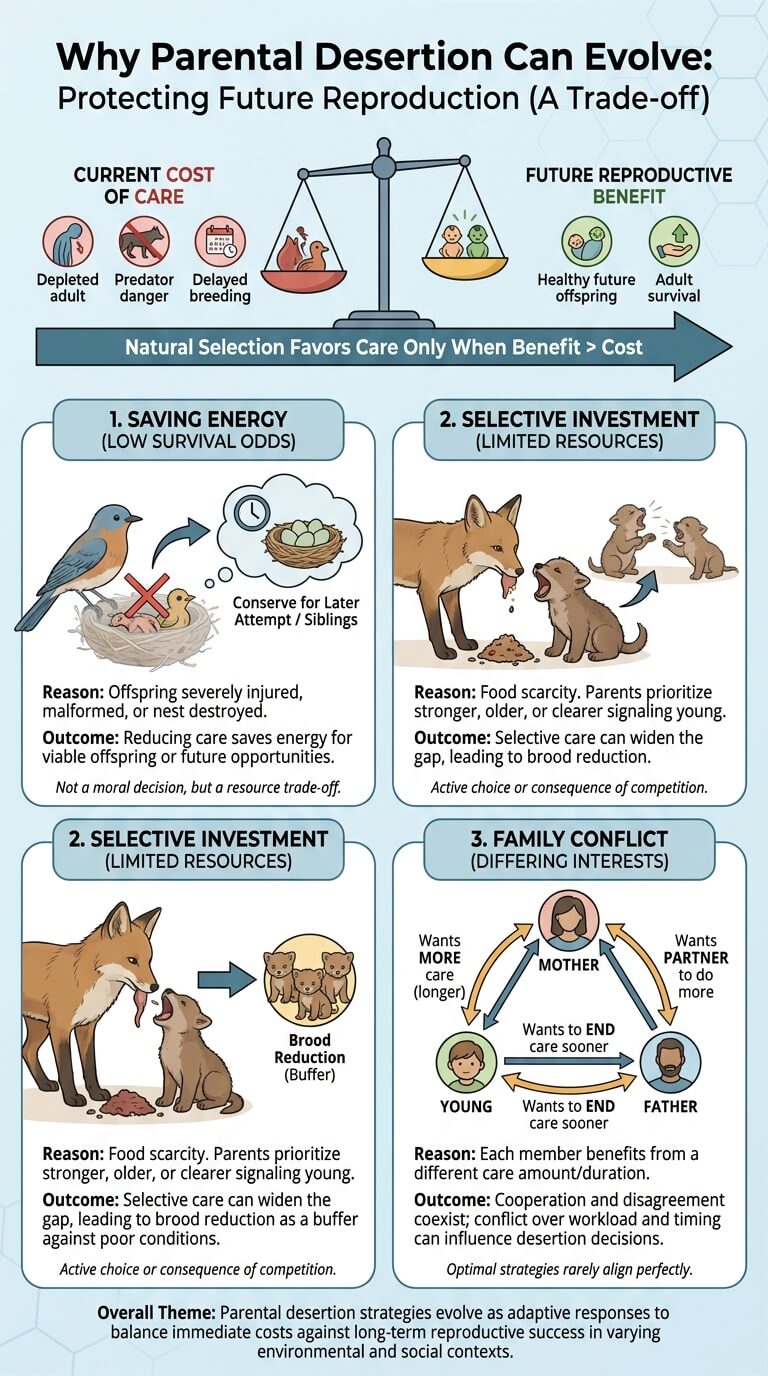
Parental care can improve offspring survival and growth, but it can also reduce an adult’s condition, increase exposure to predators, and delay another breeding attempt. A scientific review of the benefits and costs of parental care describes why natural selection favors care only when its expected reproductive benefit exceeds its costs under the current conditions.
Saving Energy When Survival Odds Are Extremely Low
When an offspring is severely injured, failing to develop, unable to compete for food, or exposed after a nest is destroyed, additional investment may have little chance of changing the outcome. In those circumstances, reducing care can conserve energy for surviving siblings or for a later breeding attempt. This pattern is easier to understand as a trade-off than as a moral decision.
Investing More in Some Offspring Than Others
When food is limited, parents may feed the strongest beggars first, concentrate care on older young, or respond more to offspring that provide clearer signals. In broods or litters with large size differences, this can widen the gap between siblings. The result may be selective care rather than the immediate abandonment of one individual.
Brood reduction is a related outcome in which fewer young survive than initially hatch or are born. It can function as a buffer against uncertain food conditions, especially when parents begin with more young than they can raise during a poor season. The details differ among species, and not every death within a brood reflects an active parental choice.
Conflict Between Mothers, Fathers, and Young
Each family member may benefit from a different amount or duration of care. Young often benefit from receiving more food or protection, while a parent may benefit from ending care sooner and saving resources. In two-parent systems, each adult can also benefit if the partner does more of the work. A review of offspring desertion and conflict between parents shows why cooperation and disagreement can exist within the same breeding attempt.
Common Reasons Care Stops or Decreases

Parent Death, Injury, Illness, or Displacement
A parent cannot return if it has been killed by a vehicle, taken by a predator, trapped, displaced during land clearing, or severely injured. Illness may reduce feeding, nursing, or defense before the adult disappears completely. These cases are genuine loss of care, but proving them can be difficult when only the young animal is visible.
Food Shortage, Drought, Severe Weather, or Habitat Disturbance
Care becomes harder when adults cannot find enough food or when extreme heat, cold, storms, fire, flooding, or drought changes the habitat. A nursing mammal must support both its own metabolism and milk production. A bird delivering prey may need longer trips when local food declines. Parents may visit less often, lose condition, or end a breeding attempt.
Predators, Human Activity, and Unsafe Nest or Den Sites
A parent may desert a site after repeated predator attacks or sustained disturbance. Returning could expose the adult, reveal surviving young, or provide little benefit if the shelter has been destroyed. In other cases, adults move eggs or young when their anatomy and behavior allow it. Crocodilians can transport hatchlings, some mammals carry young to another den, and many birds can only rebuild and begin a new attempt.
Offspring Weakness, Developmental Problems, or Competition
Parents respond to movement, calls, touch, scent, temperature, and other cues from offspring. A young animal that cannot signal normally may receive less care. Sibling competition can intensify the problem when larger young intercept food or occupy the safest position. In some species, parents actively favor particular offspring; in others, unequal outcomes arise mainly because siblings differ in strength or timing.
Observers should not diagnose developmental problems from appearance alone. Newborn animals can look unusually small, uncoordinated, or inactive while still being normal for their stage. A licensed professional can compare the animal with species-specific expectations.
A New Mating Opportunity or Shift in Caregiving Role
In some birds, fish, and other animals, one parent may leave when the partner can continue care and another breeding opportunity is available. The departing adult may begin a new clutch with a different mate while the first brood remains with the original caregiver. This is parental desertion by one adult, but it is not the same as leaving the young entirely unattended. Pair bonds can influence parental desertion because one partner may continue care while the other leaves, re-pairs, or pursues another breeding opportunity.
Caregiving can also shift to older siblings, grandparents, unrelated helpers, or group members. The biological parents are important, but they are not the only animals capable of feeding, guarding, carrying, or teaching young in cooperative species.
How Abandonment Differs Across Animal Groups
Mammals That Leave Hidden Young for Long Periods
Deer, hares, rabbits, and some hoofed mammals use variations of hiding behavior. Their young remain quiet while the mother forages and returns to nurse. Tree shrews provide an especially striking form of absentee maternal care: a mother may visit a separate nursery nest only at long intervals, delivering rich milk during short nursing bouts. What looks like very little attention can be the normal pattern for that species.
Reptiles, Fish, and Invertebrates With Little or No Post-Birth Care
Many animals complete their investment before offspring emerge. They may produce yolk-rich eggs, choose a protected site, build a nest, coat eggs, guard them briefly, or simply release large numbers of eggs. Once hatching occurs, the young may feed and avoid danger without parental assistance. In those species, absence after birth or hatching is normal rather than abandonment.
Other reptiles, fish, amphibians, and invertebrates provide elaborate care. Crocodilians guard nests and assist hatchlings. Cichlids may protect eggs and fry. Some frogs transport tadpoles, and some insects guard eggs or feed larvae. A review of parental care beyond mammals highlights how diverse these systems are and why no animal class can be labeled uniformly caring or non-caring.
Species With Brood Reduction or Selective Care
In some birds, egg laying and hatching are spread over time. Older chicks may be larger and more competitive before the youngest hatch. During plentiful seasons, parents may raise most or all of them. During shortages, later or smaller chicks may receive less food. The extra egg can be understood as insurance that allows parents to raise more young when conditions are favorable.
Cooperative Groups Where Another Adult May Continue Care
Meerkats, wolves, elephants, some primates, many birds, and social insects can involve caregivers beyond the mother. Helpers may guard, babysit, carry, provision, or defend young. If a parent dies or reduces its contribution, the group may partly compensate. That does not guarantee the young will survive, but it changes what parental absence means.
Rejection, Desertion, and Offspring Killing Are Different
Defining Each Behavior Carefully
Rejection usually means a parent does not accept, nurse, retrieve, or respond normally to particular young. Desertion means a caregiver ends attendance or investment before the young become independent. Orphaning means the necessary parent or parents have died or permanently disappeared. Brood reduction describes a decrease in surviving offspring, whether caused by competition, shortage, predation, disease, or parental behavior.
When Cannibalism or Infanticide Can Occur
Infanticide is the killing of young by an animal of the same species. Filial cannibalism occurs when a parent consumes some or all of its own offspring. These behaviors are documented in certain mammals, birds, fish, amphibians, and invertebrates, but their causes differ. They can be associated with mating competition, food shortage, low brood value, disturbance, illness, or the recovery of nutrients.
Evidence should be interpreted carefully. An adult consuming an offspring that was already dead is different from killing a healthy young animal. A single observation does not establish the usual behavior of a species. Because these events are rare or difficult to observe in many animals, confident explanations require detailed study.
Why Human Moral Labels Can Mislead
People judge parenting through human expectations of intention, obligation, and fairness. Wildlife behavior is shaped by different developmental needs and ecological pressures. A turtle that never meets its hatchlings is not less successful than a mammal that nurses for months. Each strategy works only in the context in which it evolved.
Common Myths and Mistakes
Myth: Human Scent Makes Every Parent Reject Its Young
Human scent is not a reliable explanation for abandonment. Alaska Department of Fish and Game biologists note that young birds and mammals handled during fieldwork are commonly reunited with parents, and that disturbance is the larger concern. A parent may delay returning while people remain nearby, even when scent alone would not prevent care.
This does not make unnecessary handling safe. Contact can injure a fragile animal, expose people to bites or disease, transfer harmful substances, or move the young away from the exact place a parent expects to find it. The correct lesson is not that touching is harmless. It is that the familiar scent myth is too simple.
Myth: A Baby Alone Is Automatically an Orphan
Many healthy young animals spend time alone. A parent may be feeding out of sight, waiting for people to leave, or caring for another young animal nearby. Fledgling birds may remain on the ground while adults continue feeding them. A rabbit nest can look unattended because the mother visits briefly. A seal pup may rest while its mother feeds offshore.
Observation should be discreet and species-aware. Watching from a window or a distant concealed position is different from standing over the animal. Persistent close attention can create the very separation the observer fears.
Myth: Only Mothers Abandon Offspring
Male and female care vary across species. Mothers provide pregnancy and milk in mammals, but fathers may guard, carry, feed, or defend young in many animals. In some fish and birds, the male is the main caregiver. Either parent may reduce care, and one may desert while the other remains.
Mistake: Feeding or Moving Wildlife Without Expert Advice
Young animals have species-specific diets, feeding intervals, temperatures, hydration needs, and handling risks. The wrong food or delivery method can cause aspiration, digestive illness, nutritional damage, or fatal stress. Moving an animal can also prevent reunion by placing it outside the parent’s search area.
Do not offer milk, water by syringe, pet food, or improvised formula unless a licensed rehabilitator or veterinarian gives direct instructions. Well-intended care can make later rehabilitation harder.
What to Do if You Find an Apparently Abandoned Young Animal

Observe From a Safe Distance Before Intervening
First, step away. Note the exact location, time, weather, nearby hazards, visible injuries, and whether a parent appears after people leave. Use binoculars or observe from indoors when possible. The correct observation period depends on species, age, and conditions, so avoid applying a fixed number of minutes to every animal.
Immediate action is more appropriate when the animal is in active traffic, has been attacked by a pet, is visibly injured, or is beside a confirmed dead caregiver. Even then, contact a professional before handling whenever circumstances allow.
Keep People and Pets Away
Dogs and cats can injure young wildlife, expose nests, and keep parents from returning. Bring pets indoors or use a leash well away from the site. Ask other people not to gather around. Quiet distance gives the adult a chance to resume care and reduces stress for the young animal.
Barriers can sometimes keep people away without enclosing the animal, but do not block the parent’s route. Avoid covering nests, placing boxes over young mammals, or constructing makeshift shelters unless a wildlife professional directs it.
Document Location and Visible Injuries Without Handling
A clear photo taken from a safe distance can help a rehabilitator identify the species and developmental stage. Record whether the animal can stand, whether both wings or limbs appear aligned, whether there is bleeding, and whether flies are present. Do not repeatedly reposition the animal for better images.
Exact location matters because returning young to the place where they were found may allow reunion. If a hazard forced a very short move, note the original and new positions. Do not transport the animal across town or release it in a habitat that merely looks suitable.
Contact a Licensed Wildlife Rehabilitator or Local Wildlife Authority
When signs of distress are present, call before capturing or feeding. The Humane Society’s guidance on orphaned or injured baby wildlife recommends getting instructions from a local wildlife center or licensed rehabilitator, who can decide whether the animal needs care and explain safe transport if necessary.
Rules differ by state and species. Many wild animals cannot legally be kept without permits, and specialized animals such as bats, raptors, marine mammals, and rabies-vector species require trained handling. A rehabilitator, state wildlife agency, animal control office, or veterinarian can direct the next step.
Important Exceptions
Domestic Animals Versus Wild Animals
A dog, cat, horse, or farm animal refusing to nurse or remaining away from newborns is a veterinary concern rather than a wildlife observation problem. Pain, birth complications, infection, stress, inadequate milk, inexperience, or illness in the young may contribute. The mother and offspring may need prompt examination, especially when newborns are cold, weak, crying continuously, failing to feed, or being injured.
Do not force contact between an aggressive mother and newborns without professional guidance. A veterinarian can assess both physical illness and the safest way to support feeding and warmth.
Human Disturbance That Prevents a Parent From Returning
A parent may remain nearby yet avoid the site while people, vehicles, lights, cameras, or pets are present. This is especially relevant around nests, dens, fawns, beach-resting young, and nocturnal species. Repeated visits can extend the interruption and eventually reduce the chance of reunion.
Young That Are Naturally Independent Very Early
Many reptiles, fish, amphibians, and invertebrates receive no care after hatching or birth. Some can move, hide, and feed almost immediately. Their small size may trigger a human urge to rescue them, but independence is part of their normal life history.
Even early-independent young can be vulnerable to habitat loss, pollution, pets, vehicles, and collection. Helping them usually means reducing the hazard and leaving them in the appropriate habitat, not raising them by hand.
Care, Survival, and the Move Toward Independence
Parental Investment Has Limits
Parental investment includes energy, nutrients, protection, time, and risk devoted to offspring. It is limited because an adult must also feed, avoid predators, maintain its body, and survive long enough to reproduce. Animals differ in how they divide that investment. Some produce many young with little care, while others raise a small number over months or years.
Early-Life Survival and the Timing of Independence
The same separation can mean danger at one age and normal development at another. A newborn mammal may depend on warmth and milk, while an older juvenile is expected to forage alone. A nestling bird outside its nest may need help, while a feathered fledgling on the ground may still be receiving care as it learns to fly.
Species identification and developmental stage are therefore central to any decision. The question is not simply whether the parent is visible. It is whether the young animal is behaving and developing as expected for its species, age, habitat, and time of day.
FAQ
Will a Mother Animal Reject a Baby Touched by Humans?
Usually, human scent alone does not cause automatic rejection. Many birds and mammals resume care after limited contact. The greater risks are injury during handling, moving the young away from its original location, and keeping the parent away through prolonged human presence. Avoid touching wildlife unless safety requires a brief move or a licensed professional provides instructions.
Do Animals Abandon the Weakest Baby?
Some parents reduce care for an offspring that is severely compromised or loses competition with siblings, but this is not a universal rule. Parents may also compensate by feeding a weaker young animal, and unequal survival can result from sibling competition rather than active rejection. Appearance alone is not enough to identify the cause.
Can Fathers Abandon Their Young Too?
Yes. In species where fathers provide care, a male can reduce effort or leave before the young are independent. The mother, another caregiver, or a social group may continue care. In other species, the father normally provides little or no care from the beginning, which should not be described as desertion.
Should You Move a Baby Animal That Is Alone?
Usually not. Leave a healthy young wild animal where it is, create distance, keep pets away, and seek local advice if you are unsure. A very short move may be justified to remove an animal from immediate traffic or another direct hazard, but species differ. Contact a licensed rehabilitator or wildlife authority before handling whenever possible.
Final Thoughts
Understanding why animals abandon their young begins with distinguishing true loss of care from normal absence. Parents may hide young, reduce visits, shift care to a partner, or end investment when survival costs and opportunities change. Some species provide no care after birth or hatching, while others depend on family or group support for a long time. For a person who finds a young wild animal alone, the safest first response is usually to step back, control pets, look for clear signs of distress, and consult a licensed professional before feeding, moving, or capturing it.

Ethan Walker is the founder and research editor of Animal Fact Central. He creates and reviews educational animal facts content using trusted wildlife, pet care, and science-based sources. His work focuses on making animal behavior, adaptations, habitats, and species facts clear, accurate, and engaging for everyday readers.
Read More Details About Ethan Walker: https://animalfactcentral.com/ethan-walker/