
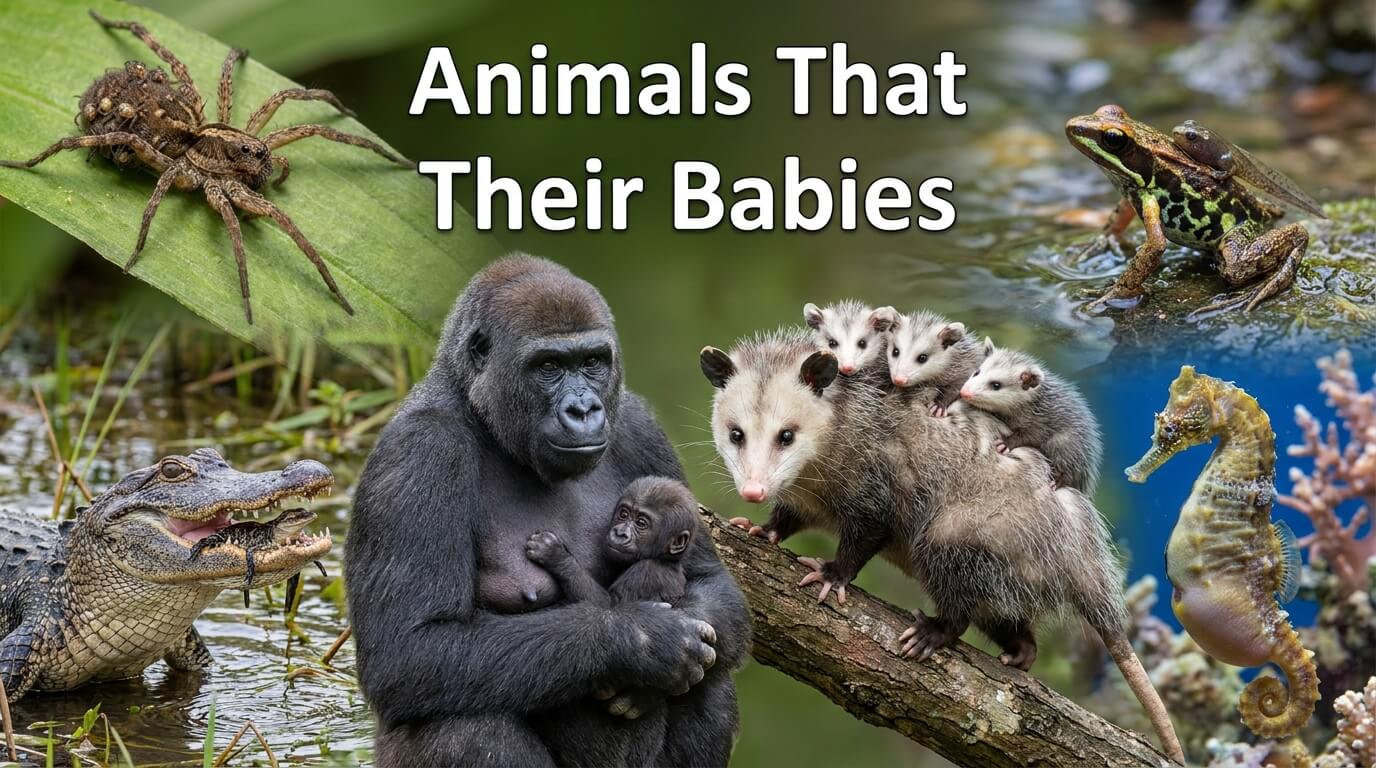
Many animals carry their babies, but they do not all do it in the same way. A gorilla infant may cling to its mother’s belly, an opossum youngster may ride on her back, an alligator may lift hatchlings in her mouth, and a male seahorse may protect developing embryos inside a brood pouch. Spiders, scorpions, frogs, fish, insects, shrimp, and other animals have evolved their own versions of mobile child care.
Carrying can move vulnerable young away from danger, keep them in a suitable temperature or moisture range, and help a parent transfer them between feeding or nursery sites. It also has costs. Extra weight can slow the adult, interfere with feeding, reduce maneuverability, or make the parent easier to notice. The examples below show that carrying young is not one behavior but a collection of solutions to different survival problems.
Quick Answer
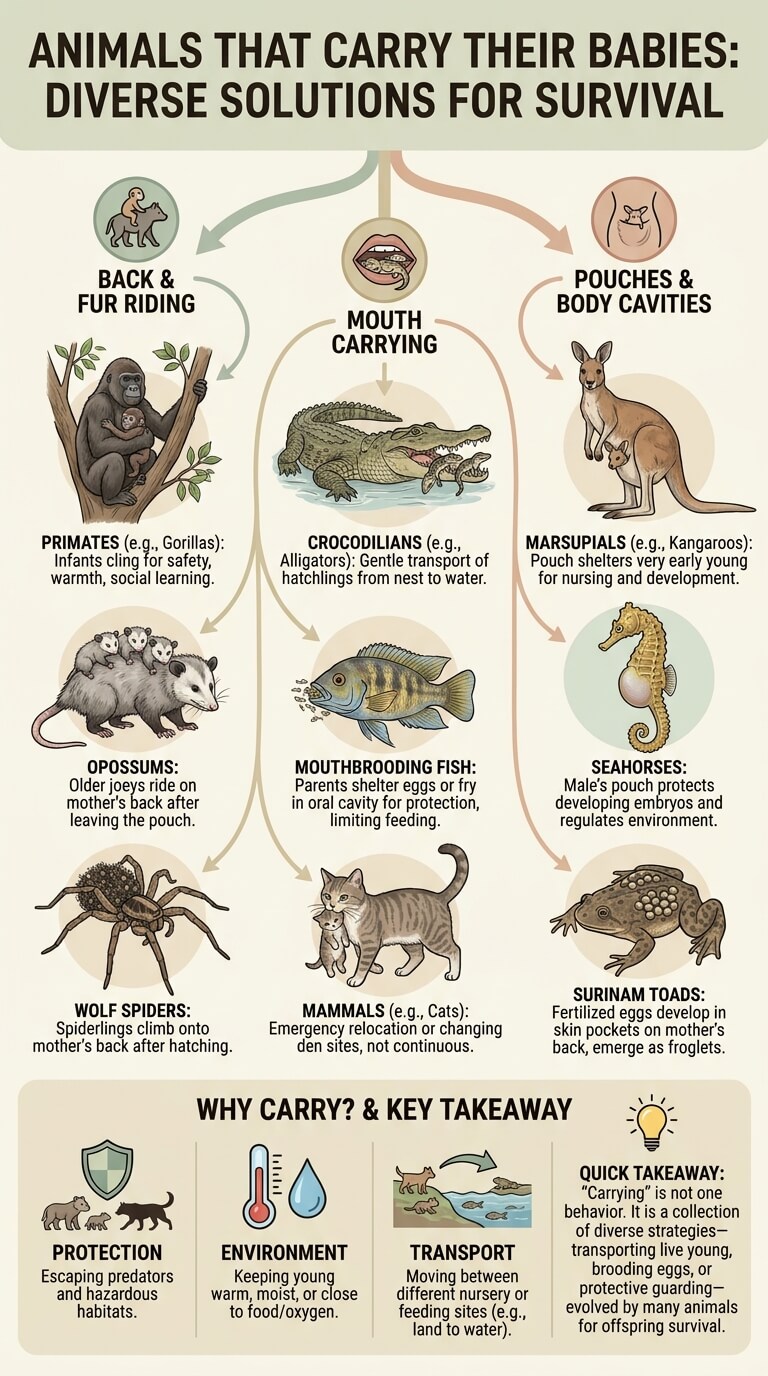
Animals that carry their babies include many primates, sloths, opossums, kangaroos and other marsupials, crocodilians, mouthbrooding fish, poison frogs, seahorses, wolf spiders, scorpions, giant water bugs, shrimp, crayfish, and several other invertebrates. Some transport live young after birth or hatching. Others carry eggs, embryos, larvae, or tadpoles during only one part of development.
The location also varies. Young may cling to fur, skin, or a parent’s back; rest inside a pouch; remain attached beneath an abdomen; sit inside the mouth; or develop in specialized tissue. Calling every one of these cases “carrying babies” is convenient, but accurate explanations must identify what stage is being carried and whether the parent is transporting, brooding, incubating, or simply guarding it.
What Counts as Carrying Young?
Transport After Birth or Hatching
The clearest form of carrying happens when an adult physically moves a live newborn, hatchling, larva, or juvenile from one place to another. The young may hold on by itself, as many primate infants do, or the adult may grasp it. Crocodilians can pick up hatchlings, while some frogs let tadpoles climb onto their backs before traveling to water. In these cases, carrying is a form of transport rather than pregnancy.
Transport can be routine or occasional. A baby sloth may remain attached to its mother through daily movement in the canopy, while a cat carries a kitten mainly when changing den sites. Other species carry offspring only during a short transition, such as the trip from a terrestrial egg site to an aquatic nursery.
Brooding Eggs or Embryos on the Body
Brooding means keeping eggs or developing young in conditions that support development. A brooding parent may provide protection, oxygen, moisture, temperature control, or physical support. Female wolf spiders carry an egg sac attached to their spinnerets. Some male giant water bugs carry eggs glued to their backs. Female shrimp hold eggs beneath the abdomen and fan them with swimming appendages.
Carrying Versus Gestation, Nesting, and Guarding
Gestation is development inside a reproductive tract or womb-like structure before birth. Nesting places eggs or young in a constructed or selected site. Guarding means remaining near offspring or defending them. Carrying involves the parent’s body directly supporting or transporting the developing young, though the categories can overlap.
A seahorse brood pouch combines physical carriage with incubation. A marsupial pouch supports very early young that continue nursing after birth. A crocodilian may guard a nest and later carry hatchlings. An octopus can guard and ventilate eggs without traveling around with them. Looking at the actual behavior prevents very different forms of care from being treated as identical.
Why Animals Carry Their Young
Escaping Predators and Dangerous Habitats
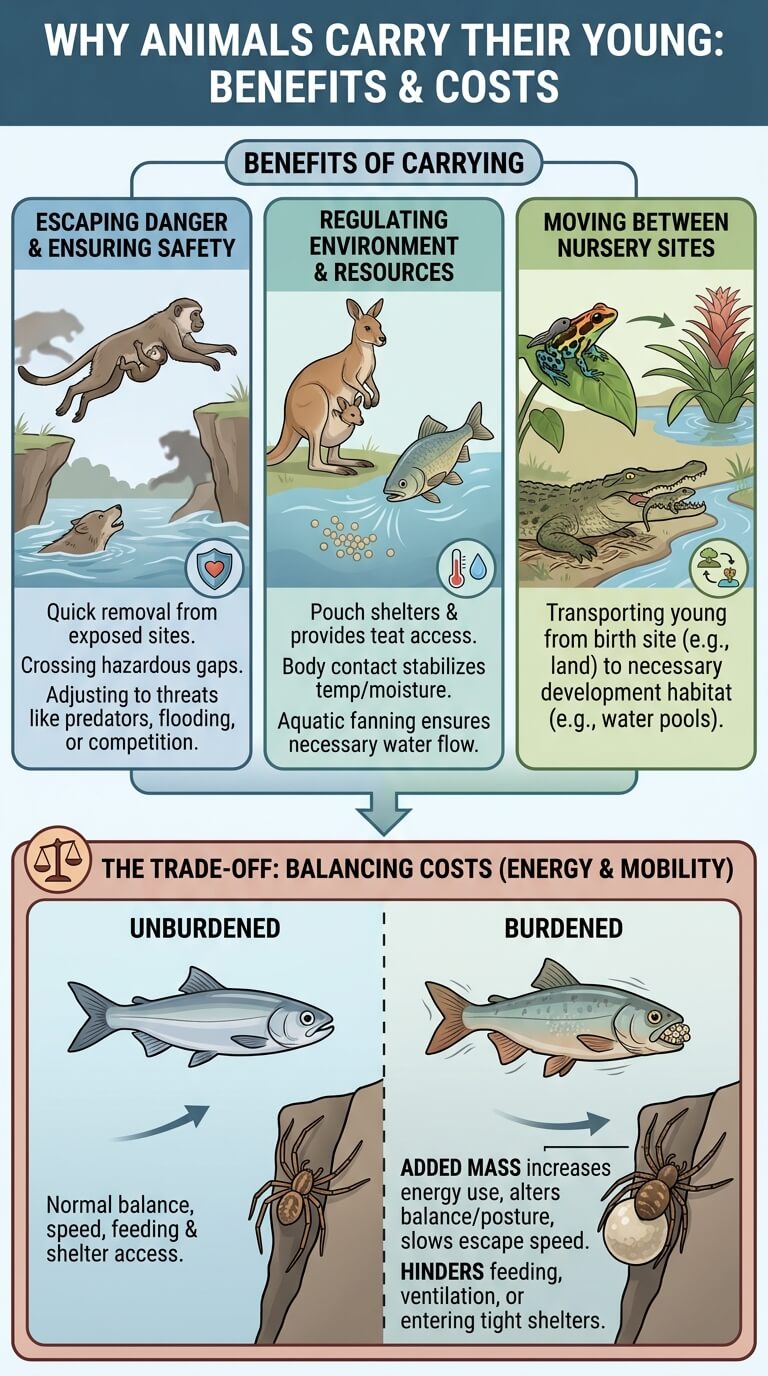
Young animals are often small, slow, and inexperienced. Carrying lets a parent remove them from an exposed birth site, cross a hazardous gap, or keep them attached while the adult escapes. A mobile parent can also adjust position when predators, flooding, drying, disturbance, or competition make the current site unsafe.
Keeping Young Warm, Moist, or Close to Food
Contact with a parent’s body can stabilize the immediate environment around developing offspring. A pouch can shelter young and maintain close access to a teat. Egg-carrying aquatic animals may fan or reposition eggs so water flows around them. Amphibians that transport tadpoles can select pools with water and, in some species, suitable feeding conditions.
Moving Between Nursery Sites
Some young begin life in one habitat and must develop in another. Poison frog eggs are commonly placed on land, while the tadpoles need water. A carrying adult solves the problem by moving the newly hatched larvae to a pool, stream, or water-filled plant structure. Crocodilian nests are built on land, but hatchlings usually need help reaching the water safely.
Balancing Protection With Energy and Mobility Costs
Carrying is work. Added mass can change balance, posture, swimming angle, escape speed, and the amount of energy needed to move. A mouthbrooding fish may have less room to feed or ventilate normally. A spider with an egg sac cannot squeeze through every shelter it could use when unburdened. An arboreal mammal must support the young while climbing.
Animals That Carry Babies on Their Backs or Fur

Primates With Clinging Infants
Many primate infants cling to a parent’s fur with their hands and feet. Newborn great apes commonly travel against the mother’s belly before older infants shift to riding on the back. The young remains close to milk, warmth, protection, and social information while the adult moves through trees or over the ground.
Clinging is active participation by the infant, not the same as being held continuously. Strength, coordination, body size, and the mother’s posture all affect how the pair moves. A Smithsonian account of a young gorilla describes the infant becoming strong enough to cling to her mother’s belly while the mother walked and climbed.
Sloths and Other Arboreal Mammals
Young sloths are born with curved claws that help them hold the mother’s long fur. Riding provides more than transportation. It keeps the infant in the canopy, close to milk, and beside an experienced adult moving through known feeding routes. The youngster can begin sampling leaves while remaining supported.
Opossums Carrying Older Young Outside the Pouch
Virginia opossums illustrate a two-stage system. Very small newborns crawl into the mother’s pouch and attach to teats. After they become larger and more developed, they may ride on her back during movement. The Smithsonian’s Virginia opossum profile explains that the young enter the pouch immediately after birth, showing why pouch development and later back-riding should not be described as one unchanged behavior.
Back-riding does not mean the mother uses her tail to tie the young in place, a common cartoon image. The youngsters cling with their own feet. As they grow, the combined load becomes harder to carry, and they spend more time exploring away from the mother.
Wolf Spiders and Scorpions Carrying Many Young
Female wolf spiders first carry a silk egg sac attached behind the abdomen. After the spiderlings hatch, they climb onto the mother’s back and remain there for a limited period before dispersing. This is unusual among spiders and gives the young mobile protection during a vulnerable stage. The behavior is described in a University of Missouri Extension guide to wolf spiders.
Scorpions give birth to live young rather than laying an exposed clutch of eggs. The pale newborns climb onto the mother’s back and remain there until after their first molt, when the outer covering has hardened enough for them to leave. In both arachnid examples, the parent’s back functions as a temporary platform, but wolf spiderlings hatch from a carried egg sac while scorpion young are born alive.
Animals That Carry Young in Their Mouths

Crocodilians Moving Hatchlings Gently
Crocodilian jaws are powerful feeding tools, yet adults can also use the mouth with fine control. When hatchlings call from a nest, a female may open the nest and transport them toward water in her mouth. The young are not being chewed or swallowed. They are held gently during a short but important journey.
This behavior is documented in several crocodilian species, although the details of care differ. Smithsonian keepers note that female alligators may carry newly hatched young gently in the mouth. The same mouth can perform very different jobs because jaw pressure and movement are controlled rather than fixed at maximum force.
Fish That Mouthbrood Eggs or Fry
Mouthbrooding fish keep eggs, larvae, or fry in the oral cavity for protection. In some species the female broods, in others the male does, and a smaller number use care by both sexes. The parent may pick up eggs after spawning, tumble them gently, and later allow fry to leave while taking them back during danger.
This strategy protects young from many predators and keeps them with a mobile adult, but it creates constraints. Space used by the brood cannot be used normally for feeding, and the parent must continue moving water for respiration. Mouthbrooding is therefore more than using the mouth as a container. It changes the adult’s feeding, swimming, and energy budget.
Frogs That Transport Tadpoles Without Using the Mouth
Many poison frogs provide a useful contrast. Their tadpoles climb onto the adult’s back rather than entering the mouth. The parent then moves them from a land-based egg site to water. Depending on the species, the carrier may be the male, the female, or either parent.
The Smithsonian’s poison frog profile describes tadpoles wriggling onto an adult’s back before being taken to a stream, pool, or another small body of water. This is why “animals that carry babies in their mouths” should not become a catch-all label for every parent that transports young near the head or during a trip to water.
Animals That Carry Young in Pouches or Specialized Structures

Marsupial Pouches as a Brief Transport Context
Most familiar marsupial pouches belong to females and contain teats. Marsupial young are born at an extremely early stage of development compared with newborn placental mammals. After reaching a teat, they continue growing while attached and sheltered. A pouch can support nursing, warmth, protection, and transport, but pouch form varies widely and not every marsupial has a large, forward-opening pocket like a kangaroo.
The pouch is therefore not simply a backpack. It is closely tied to reproduction and lactation. Older joeys may leave and return, and some species later carry young on the back. A full explanation of marsupial development requires more than saying that the mother stores a finished baby in a bag.
Male Seahorse Brood Pouches and Why They Are Different
In seahorses, the female transfers eggs to a male’s brood pouch. The eggs are fertilized and develop there until the male releases the young. The pouch protects the embryos and helps regulate their internal environment. It is a reproductive organ, not a marsupial pouch, and the male is carrying developing embryos rather than nursing newborn mammals.
Seahorse relatives show useful variations. Some pipefish have brood pouches, while male sea dragons carry eggs on an exposed brood patch beneath the tail. The distinction is summarized by the Monterey Bay Aquarium’s leafy sea dragon profile, which notes that sea dragons lack the enclosed pouch found in seahorses.
Skin Pockets, Dorsal Cells, and Other Amphibian Systems
Some amphibians carry developing offspring in specialized structures on the back. Female Surinam toads carry fertilized eggs embedded in thickened dorsal skin. The young develop inside individual chambers and emerge as small froglets rather than free-swimming tadpoles. In some marsupial frogs, eggs develop in a dorsal pouch or beneath a flap of skin.
Animals That Carry Eggs on the Body
Giant Water Bugs and Paternal Egg Carrying
In some giant water bug genera, females glue eggs onto a male’s back. The male carries the clutch until hatching and moves in ways that help expose the eggs to oxygenated water or air. This is paternal care, and it prevents the eggs from being left as an unattended mass.
Not every giant water bug uses the same system. Some place eggs above water on vegetation, where males guard and moisten them instead. The University of Florida’s giant water bug account specifically identifies back-carrying in the genera Abedus and Belostoma, which helps avoid turning a genus-level pattern into a claim about the entire family.
Crustaceans Carrying Eggs Beneath the Abdomen
Many female shrimp, crayfish, lobsters, and crabs carry fertilized eggs beneath the abdomen. The eggs attach to abdominal appendages, often called pleopods or swimmerets. Movement of these appendages can clean and aerate the clutch while the female continues to move through the habitat.
The familiar term “berried” is often used for egg-bearing lobsters and some other crustaceans because the clustered eggs resemble berries. The mother is not carrying hatched juveniles in the same way as a primate or opossum. She is brooding attached eggs, and the young may leave at hatching or remain associated briefly, depending on the species.
Other Invertebrate Brooding Strategies
Invertebrates offer several body-based nurseries. Female isopods and many related crustaceans brood embryos in a chamber beneath the body. Some sea spiders have males that carry egg masses on specialized appendages. Nursery web spiders may hold an egg sac with their mouthparts before placing it in a protective silk structure near hatching.
How Babies Stay Attached and Avoid Falling
Gripping Hands, Feet, Claws, and Fur
Clinging young use anatomy suited to the parent’s surface. Primate hands and feet can wrap around fur and body contours. Sloth infants use curved claws. Opossum young grip fur with their feet. The adult often supports this grip by changing posture, moving more carefully, or keeping the young close to the trunk where swinging forces are lower.
Pouches, Adhesive Eggs, Silk, and Body Shape
Young that cannot grip need other solutions. Pouches surround the developing offspring. Wolf spider egg sacs are secured with silk. Giant water bug eggs are glued to the male’s back. Crustacean eggs attach to abdominal appendages with specialized material. Surinam toad skin grows around eggs after they are placed on the female’s back.
Position matters as much as the adhesive. Eggs carried beneath an abdomen are sheltered by the parent’s body. A compact pouch keeps the load close to the center of mass. A spider’s egg sac trails behind but remains connected to the spinnerets. These arrangements balance access to oxygen and water with protection and mobility.
Parent Posture, Speed, and Route Choice
The carrier’s behavior completes the system. A primate mother may support a very young infant with an arm. An opossum carrying several young may move differently from one traveling alone. A frog transporting tadpoles must reach water without drying the larvae. A mouthbrooding fish must ventilate both itself and the brood.
Common Myths and Mistakes
Myth: Every Pouch-Carrying Animal Is a Marsupial
A pouch is a body structure, not a taxonomic label. Marsupials are mammals defined by a set of reproductive and anatomical traits, and many females have a pouch or skin fold associated with teats. Seahorses are fish, and the male brood pouch performs a different reproductive role. Some frogs and crustaceans also have brood chambers that are unrelated to marsupial anatomy.
Even within marsupials, pouch shape varies. Some are deep and obvious, some open backward, some are shallow folds, and some species lack a permanent enclosed pouch. Identifying the animal must come before interpreting the structure.
Myth: Crocodilians Carry Hatchlings to Eat Them
A hatchling inside a crocodilian’s mouth can look like prey, especially in a still photograph. Context changes the interpretation. During parental transport, the adult collects live hatchlings from a nest area and moves them toward water without the feeding movements used to seize and process prey.
That does not mean crocodilians are gentle in every situation or that people can approach safely. They are powerful wild predators, and adults guarding nests or young may be defensive. The behavior should correct a misconception about parental care, not encourage close observation.
Mistake: Treating Egg Brooding and Live-Baby Transport as Identical
A wolf spider carrying an egg sac, a scorpion carrying live newborns, and a gorilla carrying a clinging infant are all supporting offspring on the body. The physical and developmental problems are different. Eggs need appropriate moisture, oxygen, and incubation conditions. Newborn arachnids need protection while their bodies harden. Mammal infants may need milk, warmth, learning, and transport for a much longer period.
Edge Cases and Exceptions
Species That Carry Young Only During Emergencies
Some mammals routinely leave their young in a den or hiding place but carry them when the site becomes unsafe. Cats, many rodents, and some carnivores grasp young with the mouth and relocate them one at a time. This emergency or den-moving transport is different from continuous riding.
Humans should not imitate the behavior with wild animals. An adult’s grip and knowledge of the destination are species-specific. Handling can cause stress, injury, separation, or defensive behavior from a nearby parent.
Young That Switch From a Pouch to the Parent’s Back
Opossums and some other marsupials show that carrying can change form as the young grows. A tiny newborn may need enclosed access to a teat. A larger youngster may emerge, return for nursing, and later ride externally. Eventually the young becomes too large for regular transport and begins moving independently.
Parents That Carry Only One Developmental Stage
Poison frogs may transport tadpoles only between hatching and deposition in water. Giant water bugs carry eggs but not free-living nymphs. Seahorse males carry embryos until release, after which the young generally receive no continuing transport. Wolf spiders shift from an egg sac to spiderlings on the back before care ends.
The end of carrying is therefore not always the end of parental care, and the reverse is also true. Some young receive guarding or feeding after transport stops. Others become independent immediately after being released.
Carrying Is Only One Part of Early Care
How Carrying Supports Survival
Carrying works with other defenses rather than replacing them. A young animal may also use camouflage, silence, rapid development, group protection, or a sheltered nursery. The parent may feed, guard, groom, or teach the young before or after the carrying stage.
The most useful question is not simply which animals carry babies. It is what problem the behavior solves. For a frog, the problem may be moving an aquatic larva across land. For an opossum, it may be supporting very early mammalian development and later transporting mobile young. For an insect, it may be keeping eggs oxygenated.
How Carrying Differs From Nest Building and Extended Parenting
A nest keeps offspring in a place. Carrying keeps them attached to or held by a mobile adult. Some animals use both. Crocodilians build and guard nests before transporting hatchlings. Marsupials may use a den while the young is also carried in a pouch or on the body. A frog may guard terrestrial eggs and later carry tadpoles.
Extended parenting can continue long after the young stops riding. Primates may nurse, protect, share social information, and maintain close bonds as juveniles become increasingly mobile. In other animals, the carrying period is the main or only direct care the parent provides.
FAQ
Which Animals Carry Babies in Their Mouths?
Crocodilians can carry hatchlings in the mouth during transport from a nest to water. Many fish are mouthbrooders and keep eggs, larvae, or fry inside the oral cavity for protection. Cats and several other mammals may carry young by gently grasping loose skin during relocation. These behaviors differ in duration, grip, and developmental stage.
Why Do Some Babies Ride on Their Mother’s Back?
Back-riding keeps young close while the mother travels, feeds, or escapes danger. It can reduce the chance of separation and allow the young to reach places it could not navigate alone. In some species, riding also exposes the youngster to routes, foods, and social behavior it will later need to manage independently.
The father or another caregiver may carry in species with different family systems, so back-riding should not automatically be described as maternal in every animal.
Can Baby Animals Fall Off While Being Carried?
Yes. Carrying adaptations reduce risk but do not eliminate it. Young may lose their grip, be displaced during a chase, or become separated if the parent is injured. Pouches, claws, gripping limbs, silk, adhesives, and careful adult movement all make attachment more reliable.
A fallen wild youngster should not be handled automatically. The parent may be nearby, and the safest response depends on the species, visible injuries, immediate hazards, and local wildlife guidance.
Do Any Fathers Carry the Young?
Yes. Male seahorses brood embryos in a pouch, male pipefish and sea dragons carry eggs in specialized structures, and male giant water bugs carry or guard eggs in several species. Male mouthbrooding fish also occur. In some poison frogs, males transport tadpoles, while in other species females or either sex may do so.
Paternal carrying does not mean the father performs every form of care. The sex that transports, feeds, guards, or remains with the young can differ among closely related species.
Final Thoughts
Animals that carry their babies demonstrate how the same basic challenge can produce very different solutions. Fur and gripping limbs let mammal infants ride. Controlled jaws move crocodilian hatchlings. Mouths shelter fish broods. Pouches protect marsupial young and seahorse embryos. Silk, adhesives, body chambers, and abdominal appendages support eggs and tiny invertebrates.
The important distinction is what is being carried, where it is held, and why the behavior occurs. Separating live-young transport from egg brooding, gestation, guarding, and nesting turns a collection of surprising examples into a clearer picture of how animals protect offspring during vulnerable stages.

Ethan Walker is the founder and research editor of Animal Fact Central. He creates and reviews educational animal facts content using trusted wildlife, pet care, and science-based sources. His work focuses on making animal behavior, adaptations, habitats, and species facts clear, accurate, and engaging for everyday readers.
Read More Details About Ethan Walker: https://animalfactcentral.com/ethan-walker/