

Sea turtles are endangered or threatened mainly because they face danger in two very different worlds: the beaches where females nest and the ocean where turtles feed, migrate, and grow. Fishing bycatch, loss of nesting beaches, artificial beach lighting, plastic and other marine debris, direct harvest of turtles or eggs in some regions, vessel strikes, and climate change can all reduce survival at different stages of a sea turtle’s life.
The careful answer is that not every sea turtle species, population, or country uses the same status label. Some sea turtle populations have improved after decades of protection, while others remain in serious trouble. For U.S. readers, NOAA Fisheries explains that six sea turtle species occur in U.S. waters and all are listed and protected under the Endangered Species Act. NOAA Fisheries’ sea turtle overview
That mix of recovery and risk is what makes sea turtle conservation so important. Sea turtles are long-lived marine reptiles. They may travel hundreds or thousands of miles between feeding areas and nesting beaches, and a threat in one place can affect a population that depends on another place far away.
Quick Answer
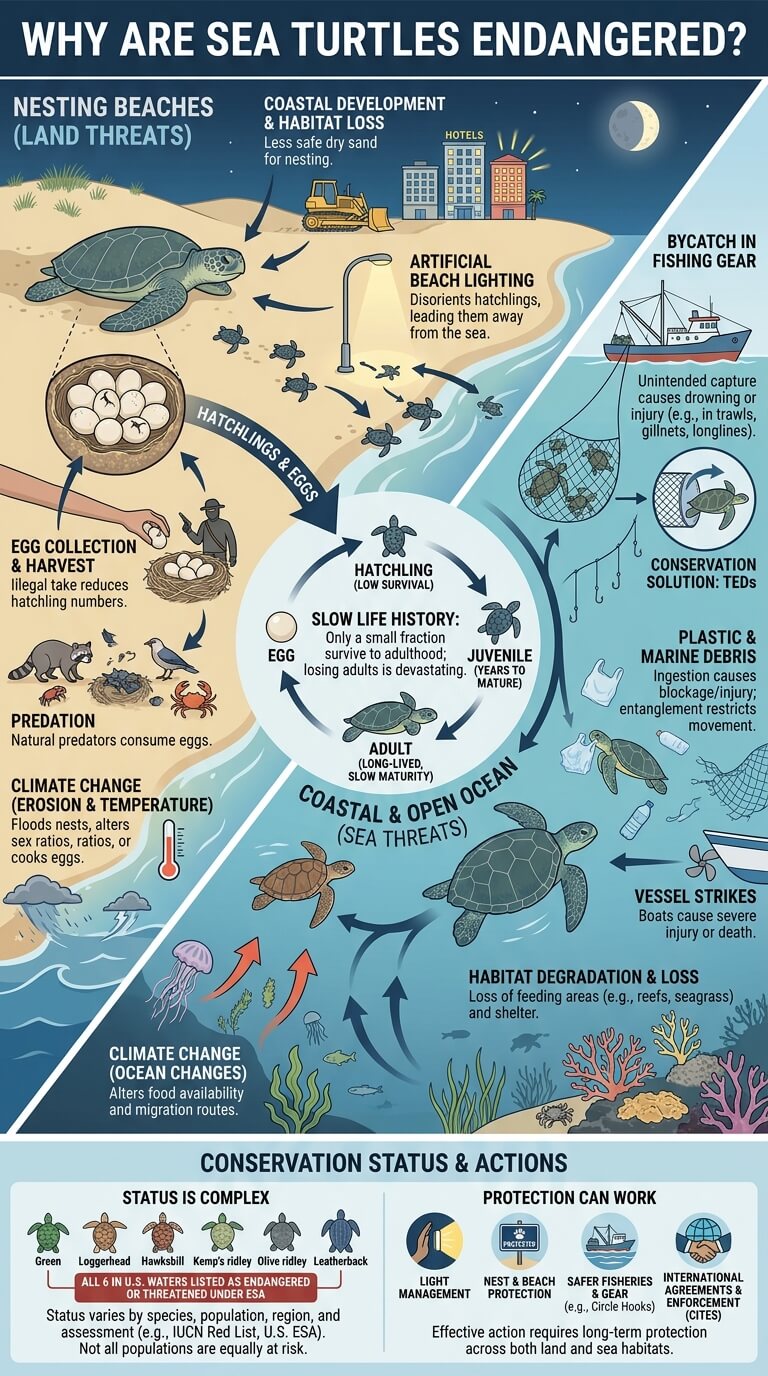
Sea turtles are endangered or threatened because many turtles die before they can reproduce, and adults can be harmed by human-caused threats across their range. Eggs can be lost to beach disturbance, erosion, flooding, predators, or illegal collection. Hatchlings can be confused by artificial lights and crawl away from the ocean. Juveniles and adults can be caught in fishing gear, struck by boats, entangled in debris, or affected by habitat loss and climate change.
Sea turtles also have a slow life history. Many species take years to reach maturity, and only a small fraction of hatchlings naturally survive to adulthood. That strategy can work in a healthy ocean when enough nesting females survive for many years. It becomes risky when adult females are killed, nesting beaches are degraded, and young turtles face extra threats before they can grow.
The main takeaway is not that sea turtles are helpless. Protection can work. Nest monitoring, beach protection, fishing gear improvements, and better enforcement have helped some populations. The problem is that sea turtles need safe beaches and safer ocean routes for decades, not just one good nesting season.
Are All Sea Turtles Endangered?

People often ask this as if there is one global answer, but sea turtle status depends on the species, the population, the legal system, and the date of the assessment. There are seven living sea turtle species worldwide: green, loggerhead, hawksbill, Kemp’s ridley, olive ridley, leatherback, and flatback. Six of them are found in U.S. waters.
Why status differs by species and region
A species can look better globally while some regional populations remain in trouble. Green turtles are a good example. Some nesting areas have rebounded after long-term protection, while other subpopulations still face high risk from bycatch, habitat loss, illegal take, or changing beach conditions. That is why conservation biologists often look at nesting colonies, regional management units, or distinct population segments instead of treating the whole species as one uniform group.
For readers, this means a sentence like “sea turtles are endangered” is useful as a broad warning, but it is not precise enough for every species. Hawksbill turtles, leatherbacks, loggerheads, and green turtles do not all have the same population trend in every ocean basin. The most accurate writing names the species and, when possible, the population or region.
Endangered, threatened, and vulnerable labels
Endangered, threatened, vulnerable, critically endangered, and least concern are not interchangeable labels. In the United States, endangered and threatened are legal categories under the Endangered Species Act. The IUCN Red List uses global conservation categories that are designed for extinction risk assessment. CITES focuses on international trade controls. Those systems overlap, but they do not always produce identical wording.
This is why a sea turtle may be protected under U.S. law even when a global assessment is more nuanced. NOAA and the U.S. Fish and Wildlife Service manage sea turtle recovery under U.S. law, while global assessments and trade agreements help describe risk and regulate international pressure.
Why current status should be checked carefully
Sea turtle status can change when new data are reviewed. The State of the World’s Sea Turtles program, which works with sea turtle researchers and conservation groups, tracks global status information and highlights that risk differs among species and subpopulations. The State of the World’s Sea Turtles program
For a school report, conservation article, or wildlife guide, the safest approach is to avoid saying every sea turtle is endangered in exactly the same way. A better explanation is that sea turtles as a group face serious conservation threats, all six species in U.S. waters are listed as endangered or threatened under U.S. law, and global categories vary by species and population.
Sea Turtle Life Cycle and Why It Creates Risk

Sea turtles are vulnerable because their life cycle stretches across beaches, coastal waters, and the open ocean. A turtle may survive one stage and still face another completely different set of hazards years later.
Eggs and nesting beaches
Female sea turtles come ashore to lay eggs in sandy nests. The beach must have suitable sand, temperature, moisture, and access from the ocean. Coastal development can remove or harden nesting habitat. Seawalls, roads, buildings, beach furniture, vehicle traffic, and heavy foot traffic can make nesting harder or reduce the amount of safe dry sand.
Eggs also face natural risks from predators, storms, flooding, and erosion. Those natural losses are part of sea turtle ecology, but human pressure can add extra losses. Illegal egg collection still occurs in some parts of the world, and beach disturbance can lower the chance that a nest produces healthy hatchlings.
Hatchlings crossing to the sea
After hatching, baby sea turtles usually emerge at night and move toward the brightest natural horizon, which is often the open ocean reflecting moonlight and starlight. Artificial lighting can confuse them. Instead of crawling toward the water, hatchlings may move inland toward buildings, roads, parking lots, or beach lights.
The U.S. Fish and Wildlife Service urges people near nesting beaches to shield or redirect lights, keep beaches clear, fill holes, and avoid disturbing nesting turtles and hatchlings. the U.S. Fish and Wildlife Service’s sea turtle guidance
Juveniles growing in coastal and open ocean habitats
Young sea turtles may spend years feeding and growing in coastal waters, seagrass beds, reefs, bays, estuaries, or open-ocean areas, depending on the species and life stage. During this time, they can encounter plastic debris, fishing lines, hooks, nets, boat traffic, and changing food availability.
Juveniles are important because they represent the future adult population. If too few young turtles survive long enough to reproduce, a nesting beach may look active for a while but still decline later as older adults disappear.
Adults returning to nesting areas
Adult females often return to nesting regions after long migrations. This makes nesting beach protection especially important. A beach that produces hatchlings today may need to stay suitable for decades so surviving females can come back and lay eggs.
Adult survival is especially valuable for long-lived animals. Losing a mature female is not the same as losing one egg. A single adult female may nest multiple times in a season and return in future nesting years if she survives. Threats that remove adults, such as bycatch or illegal take, can slow recovery even when hatchling production improves.
Major Threats to Sea Turtles
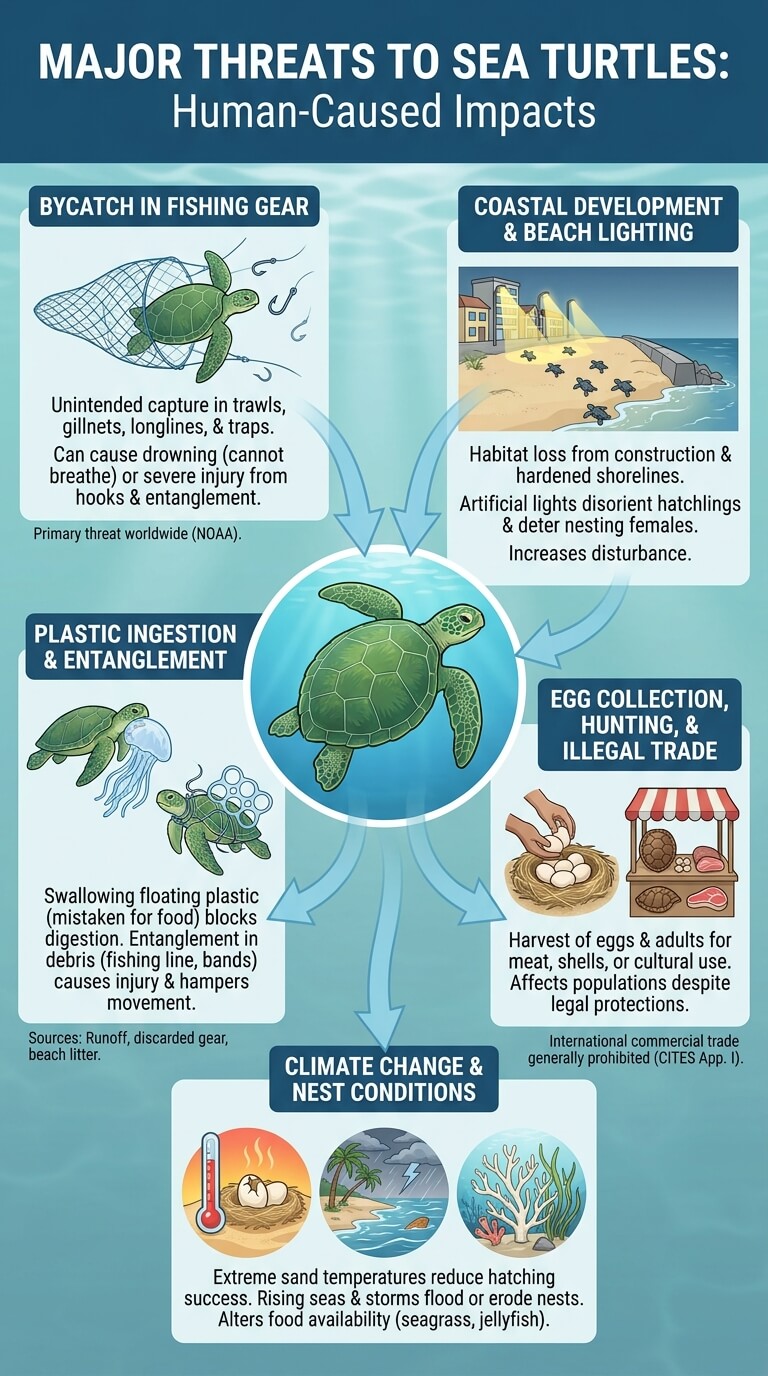
No single threat explains every sea turtle decline. The risk changes by species, region, season, and life stage. Still, several human-caused threats appear repeatedly in sea turtle conservation work.
Bycatch in fishing gear
Bycatch is the unintended capture of animals while fishing for something else. Sea turtles can become caught in trawls, gillnets, longlines, hook-and-line gear, and traps. Some drown when they cannot reach the surface to breathe. Others are injured by hooks, lines, or entanglement.
NOAA’s green turtle profile describes bycatch as a primary threat to sea turtles worldwide and lists gear such as trawls, gillnets, longlines, hook and line, and pot or trap gear as concerns for green turtles. NOAA Fisheries’ green turtle profile
Plastic ingestion and entanglement
Plastic pollution affects sea turtles in more than one way. A turtle may swallow floating plastic that resembles food, become tangled in fishing line or packing bands, or carry debris that makes swimming and feeding harder. Plastic is not the only threat to sea turtles, but it is highly visible because turtles often feed near floating or drifting materials.
Plastic problems are also connected to other forms of pollution. Runoff, discarded gear, balloons, and beach litter can enter waterways and eventually reach coastal habitats. For sea turtles, a small object can become dangerous if it blocks the digestive tract, causes injury, or entangles the animal.
Coastal development and beach lighting
Sea turtles need beaches that still function like nesting habitat. Coastal development can remove vegetation, change beach shape, harden shorelines, increase human disturbance, and bring artificial light close to nests. Beach lighting can deter nesting females and disorient hatchlings.
This threat is especially difficult because many nesting beaches are also popular vacation areas. A beach can be beautiful to people but stressful for turtles if it is too bright, crowded, armored, or cluttered with obstacles at night.
Egg collection, hunting, and illegal trade in some regions
Historically, many sea turtle populations were reduced by harvest of adults and eggs. In some regions, direct take still affects turtles despite legal protections. The reasons vary, including meat, eggs, shell products, local trade, or cultural practices. Conservation work must handle this carefully because rules, traditions, enforcement, and community needs differ by place.
International trade is also restricted. CITES notes that marine turtle species are included in Appendix I, the category used for species threatened with extinction where commercial international trade is generally prohibited. CITES information on marine turtle trade
Climate change and nest temperature
Sea turtle nests are affected by temperature. Warmer or cooler sand can influence hatchling development, and extreme heat can reduce hatching success. Rising seas, stronger storms, and beach erosion can also flood or wash away nests. These effects do not hit every nesting beach equally, but they can add pressure to populations that already face bycatch, habitat loss, and pollution.
Climate change can also affect food. Green turtles depend heavily on seagrass and algae as adults, leatherbacks feed mostly on jellyfish and other soft-bodied animals, and other species use different prey. Changes in ocean temperature, storms, and coastal habitat can alter where food is available.
Species Examples Without Treating All Sea Turtles the Same
Sea turtles share a basic life cycle, but the details matter. Their diets, shell types, migration patterns, nesting areas, and threat levels are not identical.
Leatherback sea turtles
Leatherbacks are the largest living turtles and are easy to distinguish from hard-shelled sea turtles because they have a leathery, ridged carapace instead of a hard shell covered with scutes. NOAA describes leatherbacks as highly migratory and notes that some can travel more than 10,000 miles in a year between nesting and foraging areas. NOAA Fisheries’ leatherback turtle profile
Their wide-ranging movements help them find gelatinous prey such as jellyfish, but migration also exposes them to fisheries across huge areas. Pacific leatherback populations are especially concerning in NOAA recovery work. For leatherbacks, protecting a nesting beach is not enough if adults are still being caught far away at sea.
Green sea turtles
Green turtles are named for the greenish color of their body fat, not for a bright green shell. Adults often graze on seagrasses and algae, which connects them strongly to shallow coastal habitats. Healthy seagrass beds can provide food, and turtle grazing can help maintain seagrass growth patterns.
Green turtles also show why conservation status must be written carefully. Some populations have responded well to protection, while others remain vulnerable to local threats. A global improvement does not mean every beach or feeding area is safe.
Hawksbill sea turtles
Hawksbills are closely associated with coral reef habitats in many regions and have a narrow, pointed beak that helps them feed among reef crevices. They are famous for their patterned shell, which historically made them a target for tortoiseshell products.
For hawksbills, trade history and reef health both matter. Protecting them involves stopping illegal trade, protecting nesting beaches, reducing bycatch, and maintaining healthy reef ecosystems where they feed.
Loggerhead sea turtles
Loggerheads have large heads and strong jaws suited for crushing hard-shelled prey such as crabs, conchs, and other invertebrates. They nest on beaches in the southeastern United States and other regions, and they can use both coastal and open-ocean habitats during different life stages.
Loggerheads show how one species can face several pressures at once: fisheries interactions, coastal development, beach lighting, vessel strikes, and nest threats. Their conservation depends on both ocean management and beach protection.
Why Sea Turtles Matter to Ocean Ecosystems
Sea turtles are not just animals people want to save because they are charismatic. They also play ecological roles in coastal and marine systems.
Grazing seagrass beds
Adult green turtles graze seagrass and algae. Grazing can influence seagrass growth and help keep some beds productive. Seagrass beds matter because they shelter young fish and invertebrates, stabilize sediment, and support coastal food webs.
This does not mean sea turtles are the only factor controlling seagrass health. Water quality, nutrients, storms, grazing pressure, disease, and coastal development also matter. But green turtles are one of the large grazers that can shape parts of this habitat.
Moving nutrients from sea to beach
Nesting turtles move nutrients from the ocean to beaches. Eggs, eggshells, and hatchlings that do not survive can become food for beach animals and contribute nutrients to coastal dunes. This may sound small at the level of one nest, but nesting beaches can receive repeated nutrient inputs over many seasons.
That connection shows why sea turtle conservation is not only about the ocean. Beaches, dunes, plants, scavengers, and coastal predators can all be part of the same story.
Supporting reef and coastal food webs
Different sea turtles feed on different foods. Hawksbills can influence sponge communities on reefs. Leatherbacks consume jellyfish and similar soft-bodied prey. Loggerheads feed on hard-shelled invertebrates. Green turtles graze plants and algae. These feeding roles connect turtles to reefs, seagrass beds, open-ocean food webs, and coastal habitats.
Sea turtles also become prey, especially as eggs and hatchlings. Birds, crabs, raccoons, fish, and many other animals may feed on eggs or young turtles. Although this is hard to watch, it is part of natural food webs. The conservation problem is not natural predation. It is extra human-caused mortality added on top of natural losses.
Conservation Actions That Help Sea Turtles

Sea turtle conservation works best when it protects turtles at several stages of life. A program that saves eggs but ignores bycatch may not recover a population. A fishery rule that reduces bycatch may still fall short if nesting beaches disappear.
Protected nesting beaches
Beach protection can include nest monitoring, seasonal restrictions, beach patrols, predator management where appropriate, limits on vehicles, and rules against disturbing nesting females or hatchlings. In some places, trained teams relocate nests at immediate risk from erosion or flooding, but casual visitors should not move nests or handle hatchlings.
The safest rule for beachgoers is simple: watch from a distance, keep lights low or off where turtles nest, remove obstacles, fill holes, and contact local wildlife authorities if a turtle appears stranded, injured, dead, or trapped.
Turtle excluder devices and fishery rules
Turtle excluder devices, often called TEDs, are escape openings built into some trawl nets so captured turtles can get out while shrimp or fish pass into the net. Other fishery tools may include circle hooks, different bait, time-area closures, gear depth changes, weak links, and handling rules that improve survival after release.
No single device solves every bycatch problem. A method that helps in a shrimp trawl will not necessarily help in a gillnet or longline fishery. Effective rules depend on the gear, target catch, turtle species, location, and monitoring.
Light management near nesting beaches
Light management is one of the most practical ways coastal communities can help. Shielded, low, long-wavelength lights can reduce the glow visible from the beach. Closing curtains, turning off balcony lights, avoiding flash photography, and keeping flashlights off nesting beaches can reduce disorientation risk.
Good lighting choices help both hatchlings and nesting females. They also remind visitors that a beach at night is not just a scenic place. During nesting season, it can be active wildlife habitat.
Rescue, rehabilitation, and long-term monitoring
Stranding networks, rescue teams, veterinarians, aquariums, researchers, and trained volunteers help respond to injured, cold-stunned, entangled, or stranded turtles. Monitoring also tracks nesting trends, hatch success, strandings, bycatch, disease, and movement patterns.
Long-term data matter because sea turtles take so long to mature. A conservation action may need years before its effect appears in nesting numbers. Patience, consistent funding, and accurate monitoring are part of the recovery work.
Common Mistakes and Myths About Sea Turtle Conservation
Sea turtles are popular, which means their conservation is often simplified into slogans. Simple messages can help, but myths can hide important facts.
Myth: baby turtles only need help getting to the water
It can be tempting to pick up a hatchling and carry it to the surf. In most places, that is not the right response. Hatchlings should not be handled by beach visitors unless trained local authorities instruct otherwise. The better help is to keep the beach dark, quiet, and clear so hatchlings can orient naturally.
If a hatchling is clearly trapped, injured, or crawling into danger, contact the local sea turtle hotline, wildlife agency, beach patrol, or permitted rescue group. Rules vary by location, and sea turtles are protected animals.
Myth: plastic straws are the only serious threat
Plastic straws can harm wildlife, and reducing single-use plastic is worthwhile. But sea turtle conservation is much bigger than one item. Fishing bycatch, nesting beach loss, artificial lighting, vessel strikes, illegal take, climate change, and abandoned fishing gear can all be serious threats.
Focusing on only one type of litter can make people miss the broader picture. Sea turtles need cleaner water, safer fisheries, darker nesting beaches, protected habitats, and enforcement against illegal trade.
Myth: every sea turtle species faces the same risk
Sea turtles share some threats, but they do not share the same risk profile. Leatherbacks migrate across huge distances and feed differently from green turtles. Hawksbills are strongly tied to reefs in many places. Loggerheads use powerful jaws to feed on hard-shelled prey. A local green turtle rookery may be improving while a leatherback population elsewhere continues to decline.
Good conservation avoids treating sea turtles as one identical group. It protects the species and populations most at risk while keeping successful protections in place where recovery is underway.
Ocean Problems That Often Hit Sea Turtles Together
Sea turtles sit at the center of many ocean conservation issues because they use beaches, coastal waters, reefs, seagrass beds, and open ocean routes. A threat that begins on land can follow them to sea, and a threat at sea can reduce the number of females that return to land.
Why plastic pollution stories often feature sea turtles
Sea turtles often appear in plastic pollution stories because they can mistake floating debris for food or become tangled in discarded material. Their long migrations also make them likely to cross areas where debris accumulates.
Still, plastic should be understood as one part of a larger threat picture. Removing beach litter helps, but it does not replace bycatch reduction, nest protection, or climate action.
How bycatch directly affects sea turtle survival
Bycatch can remove juveniles and adults from a population before they reproduce again. This is especially serious for slow-maturing animals. A population cannot recover well if young turtles survive the beach but adults are repeatedly lost in fishing gear.
This is why fishery changes are often central to sea turtle recovery. Better gear and better monitoring can reduce deaths in the ocean, while beach protection supports nesting success on land.
Why ocean and beach protection can both matter
Marine protected areas, fishery rules, and coastal beach protections can support sea turtles in different ways. A protected feeding area may help turtles find food with less disturbance. A protected nesting beach may give eggs and hatchlings a better chance. A fishery rule may reduce accidental capture along migration routes.
Because sea turtles move, no one protected area can solve every problem. The strongest conservation plans usually combine local beach action with ocean-scale cooperation.
FAQ
What is the biggest threat to sea turtles?
There is no single biggest threat for every sea turtle species and population. Bycatch in fishing gear is one of the most serious threats in many regions because it can kill juveniles and adults. Nesting beach loss, artificial lighting, plastic and other debris, direct harvest, vessel strikes, and climate change can also be major threats depending on where the turtles live and nest.
Why do lights on beaches hurt sea turtles?
Artificial lights can confuse nesting females and hatchlings. Hatchlings usually move toward the natural brightness over the ocean. Bright buildings, flashlights, streetlights, or beach-facing lights can pull them away from the water, leaving them vulnerable to exhaustion, vehicles, predators, or dehydration. Darker, turtle-safe beaches give hatchlings a better chance to reach the sea on their own.
How many sea turtle species are endangered?
The answer depends on the authority and the date. In U.S. waters, NOAA says all six sea turtle species that occur there are listed as endangered or threatened under the Endangered Species Act. Globally, IUCN-style categories differ by species and subpopulation, and recent assessments have changed for some turtles. The safest answer is to check the specific species, region, and assessment source before using a status label.
What should you do if you find a sea turtle on the beach?
Do not touch, ride, feed, drag, turn, or push a sea turtle. Stay back, keep pets away, avoid flash photography, and do not shine lights on it. If the turtle appears injured, stranded, dead, trapped, or in immediate danger, contact the local wildlife agency, sea turtle hotline, beach patrol, or a permitted rescue group. Sea turtles are protected, and trained responders know how to handle them safely and legally.
Final Thoughts
Sea turtles are endangered or threatened because their survival depends on many linked places: dark nesting beaches, safe migration routes, healthy feeding areas, and fisheries that reduce accidental capture. Their long lives and slow maturity make adult survival especially important, while eggs and hatchlings need beaches that still work as wildlife habitat.
The hopeful part is that sea turtle conservation can succeed when protections are consistent. Darker beaches, safer fishing gear, cleaner coastlines, strong trade enforcement, rescue networks, and long-term monitoring all help. The most accurate way to think about sea turtles is not as one identical group, but as several species and populations that need careful, place-specific protection across both land and sea.

Ethan Walker is the founder and research editor of Animal Fact Central. He creates and reviews educational animal facts content using trusted wildlife, pet care, and science-based sources. His work focuses on making animal behavior, adaptations, habitats, and species facts clear, accurate, and engaging for everyday readers.
Read More Details About Ethan Walker: https://animalfactcentral.com/ethan-walker/