

Bycatch is marine life caught unintentionally while people are fishing for something else. A boat may be targeting shrimp, tuna, swordfish, cod, or another seafood species, but the gear can also catch animals that fishers did not mean to catch. Those animals may be undersized fish, non-target fish, sea turtles, dolphins, whales, porpoises, seabirds, sharks, rays, corals, sponges, or other ocean life.
The reason bycatch matters is simple: fishing gear works in the same water where wild animals feed, migrate, hide, and reproduce. Even careful fisheries can interact with animals that share the same space as the target catch. The real conservation question is not whether fishing is automatically bad. It is how often unintended animals are caught, how many survive, which species are affected, and whether the fishery has strong ways to avoid or reduce that harm.
Quick Answer

Bycatch means marine animals caught incidentally during fishing for another species. It can include animals that are thrown back because they are unwanted, illegal to keep, the wrong size, or the wrong species. It can also include animals that die unseen after direct contact with fishing vessels or gear. NOAA Fisheries describes bycatch as a complex issue involving fish, marine mammals, sea turtles, and seabirds that may be hooked or entangled while fishing for something else. NOAA Fisheries’ bycatch overview
Bycatch is different from overfishing, although the two can overlap. Overfishing happens when too many animals from a target stock are removed over time. Bycatch is about unintended capture. A fishery can have a bycatch problem even if the target fish population is not overfished, and an overfished stock can also be worsened by bycatch if young fish or non-target animals are killed before they can reproduce.
The most useful way to understand bycatch is to picture a fishing method meeting a mixed ocean. Nets, hooks, lines, traps, and trawls are designed for certain animals, but the ocean does not separate animals into neat lanes. Predators follow prey. Turtles travel through fishing grounds. Seabirds dive near bait. Dolphins and porpoises may encounter nets. That overlap is where bycatch begins.
What Bycatch Means in Fishing

Bycatch sounds like one simple word, but it can mean slightly different things depending on the fishery, law, country, and management system. In everyday language, most people use it to mean animals caught by accident. In fishery management, the definition can be narrower or more technical.
Target catch vs non-target catch
The target catch is the animal a fishery is trying to catch. A shrimp trawl targets shrimp. A longline may target tuna or swordfish. A gillnet may be set for a particular fish species. Non-target catch is anything else caught during that effort.
Some non-target catch is kept and sold if regulations allow it. Some is released alive. Some is discarded dead or dying. Some never reaches the deck because an animal breaks free, sinks, or dies after a gear encounter. This is why bycatch is not only a pile of animals seen on a boat. It can include visible discards and less visible deaths connected to fishing gear.
Accidental capture vs illegal fishing
Bycatch is not the same thing as illegal fishing. Bycatch can happen in legal, regulated fisheries that are trying to follow rules. Illegal fishing involves breaking laws, such as fishing in closed areas, using banned gear, ignoring quotas, or keeping protected animals. The two can overlap if illegal fishing causes accidental deaths, but they are not identical ideas.
Why definitions can vary by fishery and region
NOAA Fisheries notes that different U.S. laws and management authorities define bycatch differently. For its national strategy, the agency uses a broad meaning that includes discarded catch of marine species and unobserved mortality from direct encounters with fishing vessels and gear. NOAA Fisheries’ National Bycatch Reduction Strategy
That careful wording is important. A manager working under one law may focus on discarded fish. A protected-species team may focus on whales, dolphins, turtles, seabirds, or other animals covered by specific protections. A seafood certification program may use terms like unwanted catch. For readers, the big idea stays the same: bycatch is the unintended capture or death of animals connected to fishing activity.
Why Bycatch Happens
Bycatch happens because fishing takes place in living ecosystems, not empty water. The same areas that support valuable seafood often support predators, prey, young fish, migratory animals, and bottom-dwelling life. Fishing gear can be selective, but no method is perfect in every place and season.
Animals share space with fishing grounds
Productive fishing grounds are often productive wildlife areas. Cold currents, upwelling zones, continental shelves, reefs, estuaries, and ocean fronts can concentrate food. Fishers go to these places because target species gather there. Sea turtles, seabirds, marine mammals, sharks, rays, and other fish may gather there for the same reason.
For example, a longline set where tuna feed may also attract seabirds that try to grab bait. A net placed in a coastal fish migration path may also intercept a porpoise or turtle. A shrimp trawl working near the seafloor may encounter non-target fish, crabs, rays, or turtles. The shared food and movement patterns create the risk.
Some gear is not perfectly selective
Fishing gear is designed to catch animals efficiently. That efficiency can become a problem when the gear does not distinguish well between target and non-target animals. Mesh size, hook shape, bait type, net depth, soak time, fishing speed, and the time of day can all affect what is caught.
Selectivity is not only about species. Gear may catch juvenile fish that are too small to keep, adult fish of the wrong species, or protected animals that cannot be legally retained. A small change in gear design can sometimes reduce bycatch, but a change that works in one fishery may not work in another because the animals, seafloor, weather, vessels, and fishing practices differ.
Migration routes and feeding areas overlap with fisheries
Many marine animals move across large areas. Sea turtles can travel between nesting beaches and feeding grounds. Whales follow feeding routes and breeding migrations. Seabirds search widely for fish and squid. Sharks and rays may follow prey or seasonal temperature changes. These movements can cross active fishing areas.
Fishing Gear That Can Cause Bycatch

Different fishing methods create different bycatch risks. No gear type is automatically the worst everywhere, and no method is automatically harmless. Risk depends on where the gear is used, how it is set, which animals are present, how long it stays in the water, and whether reduction measures are used.
Trawls
Trawls are large nets pulled through the water or along the seafloor. Some target shrimp or bottom fish. Others work in the water column. Because trawls filter a volume of water or sweep across an area, they can catch animals that are not the target. In shrimp fisheries, sea turtles have historically been a major concern where turtles and trawls overlap.
Trawls can also catch non-target fish and invertebrates. Bottom trawls may disturb seafloor habitat depending on the gear, substrate, depth, and fishing frequency.
Longlines
Longlines use a main line with many baited hooks. They can be set near the surface or deeper in the water. Longlines are used for species such as tuna, swordfish, halibut, and other fish. The bait that attracts target fish can also attract sea turtles, seabirds, sharks, rays, and marine mammals.
Longline bycatch can happen when an animal bites a hook, becomes snagged, or is attracted to bait or catch already on the line. Mitigation may involve circle hooks, different bait, hook depth, line weighting, night setting, streamer lines for seabirds, or area rules. The right mix depends on the species at risk and the target fishery.
Gillnets
Gillnets are walls of netting that catch fish by the gills or body as they try to swim through. They can be effective for target fish, but they can also entangle animals that cannot see or avoid the net. Dolphins, porpoises, seals, sea turtles, seabirds, sharks, rays, and non-target fish may be at risk in some places.
Gillnet risk is strongly tied to location, mesh size, depth, season, and the animals using the area. Some fisheries use acoustic devices, net illumination, time-area closures, or other changes to reduce encounters. These tools require careful testing because a signal that deters one animal may not help another.
Purse seines and other gear contexts
Purse seines are nets that encircle a school of fish and close like a drawstring. They are often associated with tuna fisheries, but bycatch risk depends heavily on how and where the net is set. A set around a free-swimming school can have a different risk profile from a set around floating objects that attract many species.
Pots, traps, dredges, handlines, and other gear can also create bycatch or entanglement concerns. The details matter more than the gear name alone.
Marine Animals Affected by Bycatch
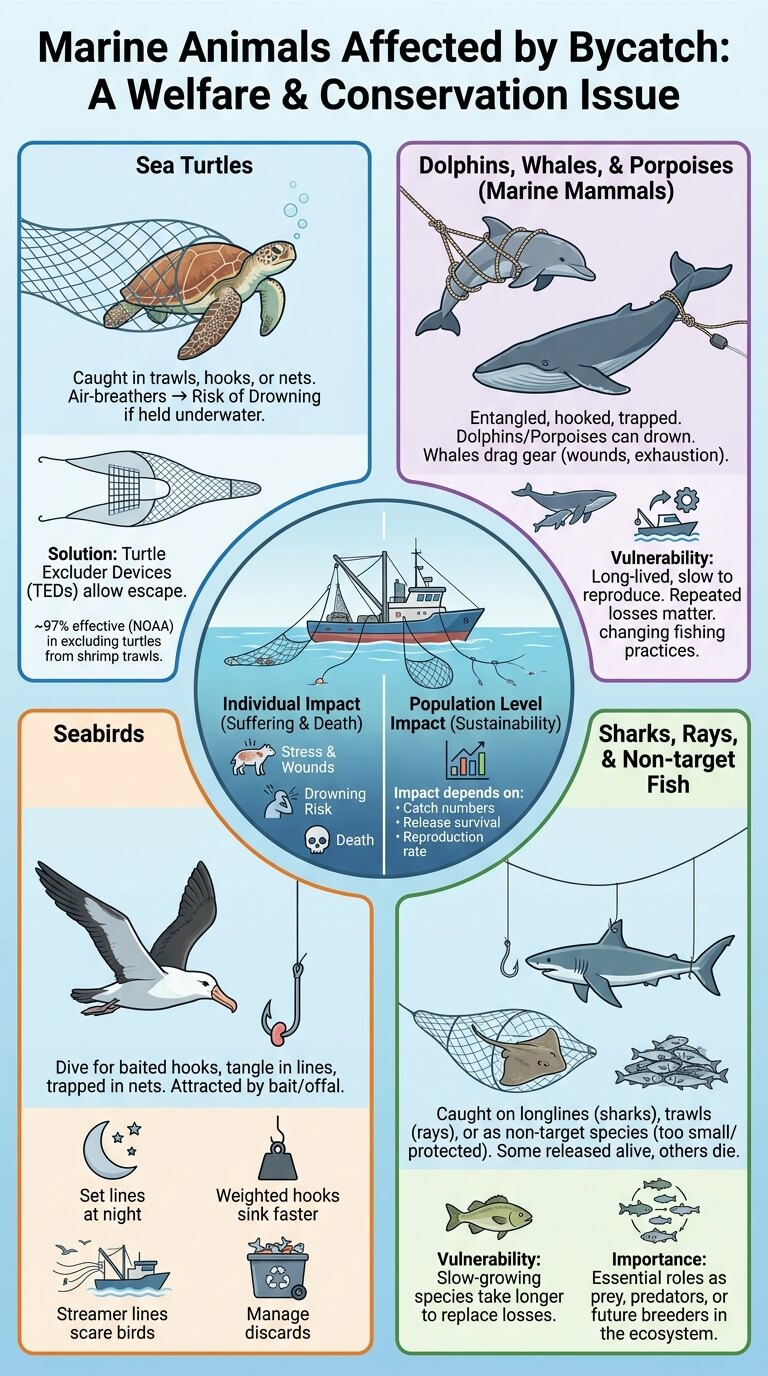
Bycatch is an animal welfare issue and a conservation issue. The affected animal may suffer stress, wounds, drowning, exhaustion, internal injury, or death. At the population level, the impact depends on how many animals are caught, how many survive release, and how quickly the species can replace losses through reproduction.
Sea turtles
Sea turtles can be caught in trawls, hooked on longlines, or entangled in nets and lines. The danger is especially serious because turtles breathe air. If a turtle is held underwater by gear for too long, it can drown. In the southeastern United States, turtle excluder devices were developed to let larger animals such as sea turtles escape shrimp trawls while shrimp pass through the net. NOAA Fisheries says current TED designs are determined to be 97 percent effective in excluding turtles from shrimp trawls. NOAA Fisheries’ turtle excluder device explanation
Dolphins, whales, and porpoises
Marine mammals may become entangled in nets or ropes, hooked by gear, trapped, or injured while feeding near fishing activity. Dolphins and porpoises can drown if they are held underwater. Large whales may drag gear for long distances, which can cause wounds, infection, exhaustion, or reduced feeding ability.
Because marine mammals are often long-lived and slow to reproduce, repeated serious injuries or deaths can matter for some populations. Reducing that risk usually requires knowing where interactions happen and changing fishing practices in those places.
Seabirds
Seabirds can be caught when they dive after baited hooks, become tangled in lines, or are trapped in nets while pursuing fish. Albatrosses, petrels, gannets, cormorants, murres, puffins, and other diving or scavenging birds may face risks in certain fisheries.
Seabird bycatch is often tied to behavior. Birds may follow vessels because bait, offal, or disturbed fish signal a feeding opportunity. Mitigation can include setting lines at night, adding weights so baited hooks sink faster, using streamer lines that scare birds away from hooks, managing discarded bait and fish waste, or changing where and when gear is deployed.
Sharks, rays, and non-target fish
Sharks, rays, skates, and non-target fish can also be caught as bycatch. Some are released alive, some are kept if allowed, and some die during capture or after release. Slow-growing species can be more vulnerable because they may take longer to replace adult losses.
This article is not centered on sharks, but they are part of the bycatch picture in many fisheries. A tuna longline may catch sharks. A trawl may catch rays. A net set for one fish may catch another fish that is too small, protected, or not allowed under local rules. Bycatch is not only about charismatic animals. It can also affect ordinary-looking fish that play important roles as prey, predators, or future breeding adults.
Why Bycatch Matters for Conservation
Bycatch matters because it can remove animals from the ocean without that loss being the goal of the fishery. Some bycatch is released alive. Some animals survive with injuries. Others die quickly. When bycatch repeatedly affects vulnerable species, it can slow recovery or push extra pressure onto populations already facing other threats.
Injury and death of protected animals
Many protected marine animals are not targeted by fisheries, but they can still be harmed by gear. Sea turtles, marine mammals, seabirds, and certain fish may be protected under national or international rules. If they are caught or killed accidentally, the fishery may face new restrictions, closures, or monitoring requirements.
For the animal, the issue is not legal wording. It is survival. A turtle trapped in a trawl, a bird hooked while diving, or a whale dragging rope may suffer even though nobody intended to catch it. This is why bycatch reduction focuses on both prevention and survival after release.
Population pressure on slow-breeding species
Some animals can replace losses faster than others. Many small fish produce large numbers of eggs, though only a tiny fraction survive. Large whales, sea turtles, albatrosses, sharks, and some rays often mature slowly or reproduce over long time scales. For these species, adult deaths can have a stronger population effect.
This does not mean every bycatch event has the same conservation impact. It means managers need to know which species are being caught, how often, whether released animals survive, and whether the affected population is already declining. A fishery with rare bycatch of a resilient species is a different problem from repeated bycatch of a threatened, slow-breeding population.
Food web and ecosystem consequences
Bycatch can also affect the wider food web. Removing non-target fish can reduce prey available to predators. Catching predators can change pressure on prey species. Damaging corals, sponges, or seafloor organisms can reduce habitat complexity for young fish and invertebrates.
Healthy fisheries depend on healthy ecosystems. Bycatch reduction protects wildlife while also helping fisheries remain stable and less likely to face emergency closures.
Bycatch vs Overfishing: The Difference
Bycatch and overfishing are connected, but they answer different questions. Bycatch asks: were animals caught unintentionally while targeting something else? Overfishing asks: is the catch rate on a fish stock too high for that population to stay healthy over time?
Accidental capture vs taking too many target animals
Overfishing usually concerns the target stock or managed fish population. If too many adult fish are removed year after year, the stock may shrink and produce fewer young. NOAA Fisheries explains that U.S. fishery management aims to prevent overfishing, rebuild overfished stocks, and maintain long-term seafood supplies. NOAA Fisheries’ sustainable fisheries overview
Bycatch, by contrast, can involve animals the fishery was not trying to catch at all. A swordfish longline may accidentally catch a turtle. A shrimp trawl may catch juvenile fish. A gillnet may entangle a porpoise. These events can happen even if the target species is managed within a legal limit.
How the two problems can overlap
The two problems overlap when bycatch adds fishing pressure to animals that are already depleted or when juveniles of a target stock are discarded before they can reproduce. Bycatch can also slow rebuilding if a recovering fish stock continues to be caught in gear aimed at other species.
For example, if a fishery accidentally catches large numbers of young fish from a rebuilding stock, those fish may never join the adult population. If a protected whale population is already very small, even occasional entanglement deaths may matter. The overlap depends on species biology and the amount of unintended capture.
Why they need different solutions
Overfishing is often addressed with catch limits, stock assessments, seasons, size limits, and rebuilding plans. Bycatch may need gear changes, escape devices, deterrents, area closures, observer coverage, electronic monitoring, release methods, or changes in bait and fishing depth.
Good fishery management often needs both approaches. A fishery can set a responsible catch limit and still need better bycatch controls. It can also reduce bycatch while still needing to manage the target stock carefully. Treating the two issues as the same can lead to weak solutions.
Ways Bycatch Can Be Reduced

Bycatch reduction works best when it is specific. A device that helps turtles escape a shrimp trawl may not help seabirds near longlines. A rule that protects whales in one region may not fit a tropical tuna fishery. The strongest programs combine science, fisher knowledge, monitoring, and rules that can be checked.
Gear changes and escape devices
Gear changes can make fishing more selective. Examples include turtle excluder devices in trawls, bycatch reduction devices for non-target fish, circle hooks that may reduce some turtle interactions compared with certain hook designs, weak links or rope changes for whale entanglement risk, acoustic deterrents in some net fisheries, and streamer lines for seabirds. NOAA Fisheries supports work on technological solutions and fishing-practice changes through its bycatch science and engineering programs. NOAA Fisheries’ bycatch reduction technology page
Gear changes must be tested in real fisheries because they can affect target catch, crew safety, cost, and the survival of released animals. A device that lets one species escape may not reduce injury for another. The best designs reduce harm without simply moving the problem to a different animal or place.
Time and area closures
Time and area closures limit fishing in places or seasons where bycatch risk is high. A closure might protect turtles during migration, whales during feeding, or juvenile fish in nursery areas. Some closures are long-term. Others are dynamic, shifting as animals or ocean conditions change.
Closures can be powerful, but they need good data. If a closure is too broad, it may burden fishing communities without enough conservation gain. If it is too narrow, animals may still be caught nearby.
Better monitoring and reporting
You cannot reduce what you do not measure. Bycatch monitoring may include human observers, cameras, logbooks, dockside reports, electronic sensors, and stranding data. Each method has strengths and weaknesses. Observers can identify species and record details, but not every vessel can carry one. Cameras can collect continuous evidence, but they require review and clear rules. Logbooks can cover many trips, but they depend on accurate reporting.
Good monitoring helps managers see patterns. Are animals caught in one season? One depth? One gear setup? One region? One vessel practice? Pattern recognition turns bycatch from a vague problem into a solvable one.
Fisher cooperation and science-based rules
Fishers often help solve bycatch problems. They know where gear snags, when non-target animals appear, which designs are practical on deck, and which changes might create new risks. Scientists can test those observations with data.
Cooperation does not replace enforcement. Rules still matter, especially where protected species are at risk. But practical solutions are more likely to last when methods are tested and adjusted with real fishing conditions in mind.
Common Mistakes and Myths About Bycatch
Bycatch is often shown through shocking photos, but clear thinking helps more than outrage. The common myths below can make the problem seem either hopeless or too easy to solve.
Myth: bycatch only happens in careless fisheries
Careless fishing can increase bycatch, but bycatch can also happen in regulated fisheries with trained crews. The ocean is mixed, animals move, and gear cannot always identify species perfectly. The goal is to make interactions rarer and less deadly, not to pretend that every accidental catch proves bad intent.
Myth: all bycatch is the same
Bycatch can mean a small non-target fish released alive, a juvenile fish discarded dead, a seabird hooked on a longline, a turtle drowned in a trawl, or a whale seriously injured by rope. These events are not equal in conservation impact, welfare impact, or legal consequence.
That is why bycatch reports need species identification, numbers, survival estimates, location, gear type, and timing. Without those details, the word bycatch can hide the most important information.
Myth: bycatch solutions are simple everywhere
Some solutions are simple in concept, such as adding an escape opening or changing hook type. Applying them across real fisheries is harder. A solution that reduces turtle bycatch in one fishery may do little for seabirds in another.
Effective reduction usually means testing, monitoring, training, and adjusting. A rule written on paper is only useful if the gear is installed correctly, used consistently, and checked against real bycatch results.
Where Bycatch Overlaps With Other Ocean Threats
Bycatch is one ocean threat among many, and it often intersects with other conservation problems. Understanding those overlaps helps readers see why ocean conservation is not a single-issue puzzle.
Sea turtle protection and escape devices
Sea turtles face threats on land and at sea, including nesting beach disturbance, egg predation, coastal development, vessel strikes, pollution, climate-related changes, and fishing gear. Bycatch is one of the at-sea threats that managers can reduce with gear changes and area rules. Turtle excluder devices show how a targeted fix can help when the problem is well understood.
Whale entanglement and fishing gear
Whale entanglement can involve ropes, nets, or other gear in the water. Some entanglement comes from active fishing gear, while some involves lost or abandoned gear that becomes marine debris. These cases can look similar from the animal’s point of view: rope tightens, movement becomes harder, and wounds may develop. For people, the safest response is to report an entangled whale or marine mammal to trained authorities, not attempt a rescue.
How bycatch differs from plastic pollution
Plastic pollution can trap, injure, or be swallowed by marine animals, but bycatch refers specifically to fishing-related capture or mortality during, or because of, fishing operations. Lost fishing gear can blur the line because it may become marine debris while still catching animals. Still, a plastic bottle swallowed by a turtle and a turtle caught in an active trawl are different problems with different prevention tools.
FAQ
What animals are most affected by bycatch?
The animals most affected depend on the fishery and region. Commonly reported groups include non-target fish, juvenile fish, sea turtles, dolphins, porpoises, whales, seals, seabirds, sharks, rays, skates, corals, sponges, and bottom-dwelling invertebrates. Conservation concern is highest when bycatch affects protected, threatened, slow-breeding, or already declining populations.
Is bycatch illegal?
Bycatch itself is not always illegal. It can happen in legal fisheries, and some fishery rules allow certain non-target catch to be retained or require it to be discarded. However, catching protected species, exceeding bycatch limits, using banned gear, failing to report required interactions, or fishing in closed areas can violate regulations. The legal answer depends on the species, fishery, region, and rule in place.
What is a turtle excluder device?
A turtle excluder device, often called a TED, is a grid fitted inside some trawl nets. Small target animals such as shrimp pass through the bars into the back of the net, while larger animals such as sea turtles are guided toward an escape opening. TEDs are designed to reduce turtle drowning in trawl fisheries where turtles and trawls overlap.
Can seafood choices reduce bycatch?
Seafood choices can help when they support well-managed fisheries with strong bycatch monitoring and reduction measures. Labels, fishery information, and seafood guides can be useful, but they are not perfect because bycatch risk varies by species, fishing method, region, and management quality. Asking where seafood came from and how it was caught is often more useful than judging by species name alone.
Final Thoughts
What is bycatch? It is the unintended capture or death of marine life during fishing for another species, and it matters because the animals caught by accident can include fish, turtles, marine mammals, seabirds, sharks, rays, and seafloor life. Bycatch is not the same as overfishing, illegal fishing, or plastic pollution, but it can overlap with all of them. The best solutions are practical and specific: better gear, better timing, better monitoring, better reporting, and rules that protect vulnerable animals while recognizing how real fisheries work. When bycatch is measured honestly and reduced carefully, ocean animals and fishing communities both have a better chance of lasting into the future.

Ethan Walker is the founder and research editor of Animal Fact Central. He creates and reviews educational animal facts content using trusted wildlife, pet care, and science-based sources. His work focuses on making animal behavior, adaptations, habitats, and species facts clear, accurate, and engaging for everyday readers.
Read More Details About Ethan Walker: https://animalfactcentral.com/ethan-walker/