

Signs of raccoons, squirrels, and skunks can overlap around a home, especially when the evidence is limited to noises, overturned soil, damaged trash, or a few unclear tracks. The best identification comes from combining several clues: the shape of the footprints, where the damage appears, when the activity happens, whether there is a strong odor, what kind of food was disturbed, and whether the animal seems to be using a roof, attic, deck, lawn, or ground-level den.
Raccoons usually leave larger hand-like tracks, repeated droppings at latrine sites, opened trash, disturbed water features, and entry clues around chimneys or attics. Tree squirrels more often leave gnaw marks, shredded nesting material, cached nuts, small daytime noises near rooflines, and leafy nests in trees. Skunks are most strongly suggested by shallow cone-shaped lawn holes, a persistent musky odor, five-toed tracks with obvious claws, and possible denning under low structures. None of these clues is perfect by itself, so the location and pattern matter as much as the individual sign.
Quick Answer
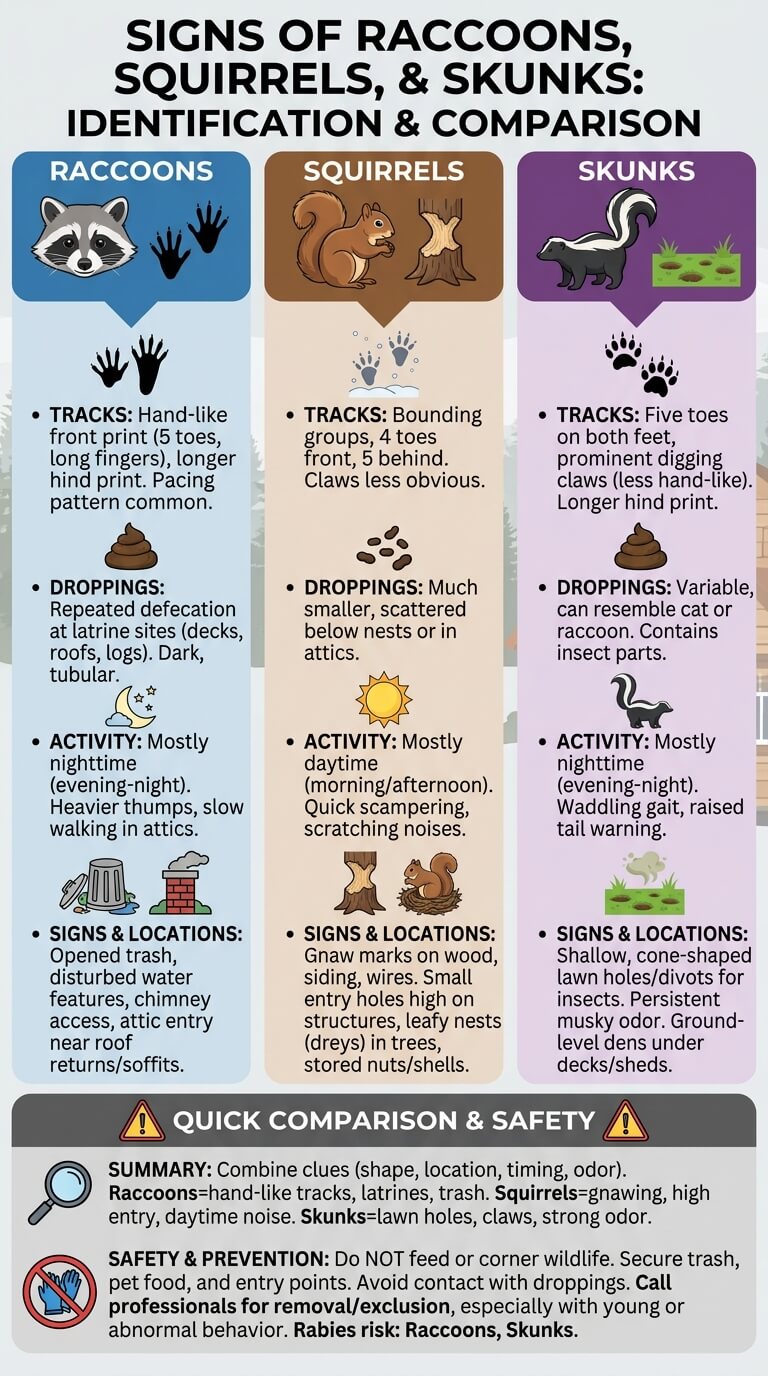
If the problem centers on trash cans, a chimney, a deck, a pool, a pond, or a broad five-toed print that resembles a small hand, a raccoon is a strong possibility. If the evidence is gnawing around eaves, small entry holes high on a structure, shells or nuts in an attic, or scratching sounds during the day, a squirrel is more likely. If the lawn has many small, shallow divots and the area has a sharp sulfur-like or musky odor, a skunk may have been digging for insects.
Use at least two or three independent clues before deciding. For example, an attic noise alone does not separate a squirrel from a raccoon, bird, rat, or other animal. A lawn hole alone does not prove a skunk because raccoons, armadillos, moles, birds, and other animals can also disturb turf. A smell alone may drift from a skunk that passed through, sprayed elsewhere, or was struck on a nearby road.
Why These Three Animals Are Often Confused
Raccoons, squirrels, and skunks all live successfully near people because yards and buildings can supply food, water, shelter, and travel routes. Garbage, fallen fruit, birdseed, unsecured pet food, compost, grubs, roof gaps, crawl spaces, woodpiles, and dense landscaping can attract one or more of them. A single property may host all three at different times.
The animals also leave signs at different scales. A homeowner may hear an animal without seeing it, find damaged insulation after the animal has left, or discover tracks after rain has distorted them. Nighttime security footage may make an animal appear larger or darker than it really is. Snow can melt a small print into a broad shape, and loose soil may hide individual toes.
Timing helps but is not absolute. Squirrels are usually active during daylight. Raccoons and skunks are more often active from evening through night, but either can appear in daylight for normal reasons. A mother caring for young, an animal displaced from a resting site, or an individual taking advantage of food may be visible outside its usual peak hours. Behavior that is disoriented, unusually fearless, aggressive, circling, staggering, or otherwise neurologically abnormal deserves more concern than daylight alone.
Raccoon Signs Around a Yard or House

Raccoons are adaptable climbers and foragers. Around homes, they may travel along fences, creek edges, building walls, rooflines, or routes between food and water. They can use hollow trees, brush piles, abandoned burrows, attics, crawl spaces, chimneys, and other sheltered places. The Washington Department of Fish and Wildlife raccoon profile describes their five dexterous front toes, urban food habits, and use of attics, crawl spaces, and chimneys as den or resting sites.
Tracks and hand-like prints
Raccoon tracks usually show five long toes on both the front and hind feet. The front print can look like a tiny human hand because the toes are narrow and finger-like. The hind print is longer and may resemble a small bare foot with an extended heel. In good mud, the claws may show, but partial tracks can hide a toe or make the pad look smaller.
Raccoons commonly walk with a pacing or overstep pattern that can place a front print beside a longer hind print from the opposite side. This creates paired-looking groups that are different from the bounding pattern of many squirrels. Look for repeated prints along a fence, beside a pond, near trash, around a deck, or at the base of a tree rather than judging one isolated mark.
Droppings and latrine clues
Raccoons often use repeated defecation sites called latrines. These may occur on flat or raised surfaces such as decks, rooftops, logs, stumps, woodpiles, tree forks, or areas in an attic. Droppings may be dark and tubular and can contain visible seeds or other undigested food, but appearance varies with diet and weather.
Do not handle suspected raccoon droppings or sweep dry material into the air. Raccoon feces can contain Baylisascaris roundworm eggs, and contaminated soil or objects can create a health risk when infectious eggs are accidentally swallowed. The CDC overview of raccoon roundworm explains that human infections are rare but can be severe and advises careful removal of feces and contaminated material. Children and pets should be kept away from a suspected latrine until safe guidance is obtained.
Trash, water, attic, and chimney clues
A raccoon may tip or unlatch trash containers, pull bags apart, scatter food widely, empty a pet bowl, raid a compost pile, or disturb fish, frogs, and objects around a pond or pool. The damage can look surprisingly deliberate because the front paws can grasp and manipulate objects. Repeated nightly messes near a water source or garbage area are more informative than a single overturned can.
Inside a structure, raccoons can create heavier thumps, slow walking sounds, scraping, or vocalizations. Entry points may be larger than squirrel openings and can appear near roof returns, soffits, vents, damaged screens, chimneys, or weak exterior panels. A female with young may remain in one sheltered site for a period, so sealing an opening without confirming that every animal has left can trap adults or dependent young.
Chimney activity may include sounds above the fireplace, nesting material, odor, or a damaged cap. Do not start a fire or lower objects into the chimney to force an animal out. A licensed wildlife professional can determine whether the site is active and whether young are present before exclusion or repair.
Squirrel Signs Around a Yard or House

Several squirrel species may occur around US homes, including gray squirrels, fox squirrels, red squirrels, flying squirrels, and ground squirrels. Their habits are not identical. Tree squirrels are the usual concern in attics and rooflines, while ground squirrels create burrow systems in suitable regions. The clues below focus mainly on tree squirrels because they are the squirrels most often heard or found in upper parts of buildings.
Chew marks, gnawing, and stored food
Squirrel incisors grow continuously, so squirrels gnaw on hard materials as part of normal tooth wear and access behavior. Around a house, this may leave paired grooves or rough-edged openings in wood, fascia, siding, vents, or roof materials. Gnawing can enlarge an existing gap enough for entry. Chewed insulation, damaged stored items, and exposed wiring are reasons to address an attic intrusion promptly.
The Penn State Extension guide to tree squirrels notes that squirrels may chew siding and areas under eaves to enter buildings and can damage insulation and electrical wiring. These signs are more suggestive when they occur high above the ground near branches, utility lines, gutters, or roof edges that squirrels use as travel routes.
Food remains can include opened walnuts, acorns, pinecone scales, seeds, or other plant material. A pile of shells in a quiet attic corner may suggest repeated feeding or food storage, but mice and rats can also cache food. Compare shell size, tooth marks, droppings, entry location, and noise timing before deciding.
Tree, roofline, attic, and wall noises
Tree squirrels are generally active by day, so scratching, rolling, scampering, or gnawing sounds in the morning or afternoon fit squirrel activity better than heavy movement late at night. Flying squirrels are an exception because they are nocturnal. Sound alone is not enough, but time of activity can narrow the possibilities.
Squirrel movement often sounds quick and light compared with the heavier step of a raccoon. You may hear rapid runs across the roof, short bursts inside a soffit, chewing in a wall, or movement that follows the same route each day. Noises can become more noticeable during nest building or when young are present.
Do not pound on walls, release pets into an attic, or block an opening immediately after hearing animals. First identify the active entry point and determine whether dependent young could be inside. Repairs should occur after safe exclusion, not while animals are still using the space.
Small holes, nests, and scattered shells
A squirrel entry opening may begin as a construction gap or damaged vent and then be enlarged by gnawing. Likely sites include soffit intersections, roof edges, fascia boards, attic vents, loose flashing, and areas where tree limbs provide easy access. Rub marks or smudges may appear around a frequently used opening, although these are not unique to squirrels.
Outside, tree squirrels build leafy nests called dreys in branch forks and also use tree cavities. A drey often looks like a dense ball of leaves and twigs rather than a loose seasonal clump. The presence of a drey shows that squirrels use the area, but it does not prove that attic sounds come from the same animal.
Small digging in flower beds, newly planted containers, or mulch can come from squirrels burying or retrieving nuts. These shallow disturbances are usually scattered and associated with food caching. They differ from the repeated cone-shaped turf divots often linked with skunk foraging.
Skunk Signs Around a Yard or House
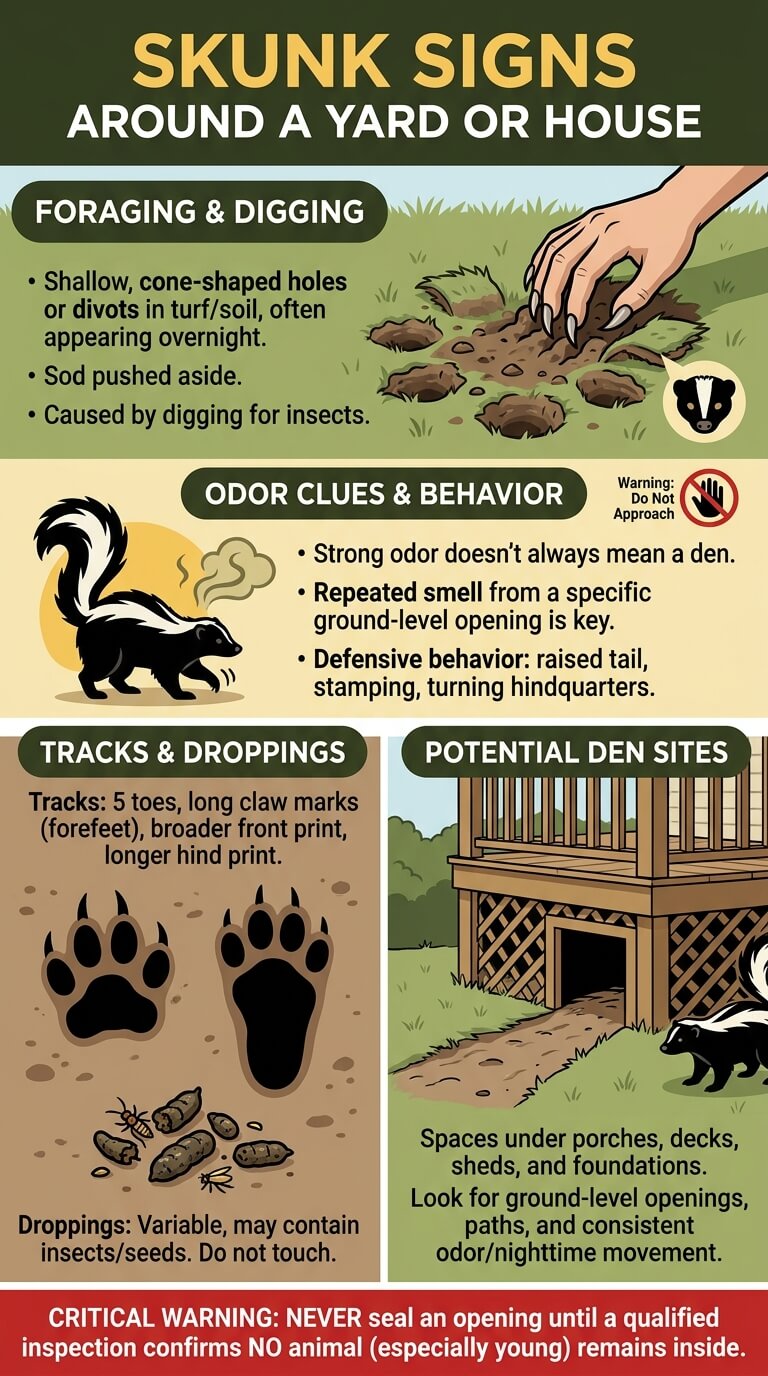
Striped skunks are common across much of the United States, while other skunk species occur in parts of the country. Skunks usually forage at ground level and may use abandoned burrows, brush piles, culverts, rock piles, sheds, crawl spaces, and spaces under decks or porches. Their odor is memorable, but digging and track evidence are often more useful for deciding whether a skunk is regularly using a property.
Cone-shaped lawn holes and digging
Skunks use their strong front claws and pointed snouts to investigate soil for insects and other food. The result can be a cluster of shallow, cone-shaped holes or small divots in turf, leaf litter, garden soil, or sand. The sod may be pushed aside or peeled back in small patches. Damage can appear overnight because skunks commonly forage after dark.
The Massachusetts wildlife guide to skunks describes their foraging as digging that often leaves a single small hole in lawns, leaf litter, or sand. Similar holes can be made by raccoons, armadillos, birds, and other animals, so check for skunk tracks, odor, nighttime footage, and den access before assigning the damage.
A skunk may return repeatedly while soil insects remain available. Treating the animal as the only problem can miss the underlying attraction. Lawn care advice from a local extension office can help determine whether grubs or another turf issue is present without encouraging unnecessary pesticide use.
Odor clues and defensive behavior
A strong skunk odor can mean an animal sprayed nearby, but it does not automatically mean a skunk is living under the house. Wind can carry odor, and spray can persist on soil, buildings, pets, vehicles, or roadways. Repeated odor from the same ground-level opening, especially around dawn or dusk, is more useful than a one-time smell.
Skunks generally spray defensively when they feel threatened. Warning behavior may include raising the tail, turning the hindquarters toward a threat, stamping, or making short charges. Do not approach to test whether the animal will spray. Back away slowly, keep pets indoors, and give the skunk a clear escape route.
If a pet is sprayed, prevent the pet from rubbing contaminated oil onto furniture and contact a veterinarian if spray reached the eyes, breathing appears difficult, the pet was bitten, or there was direct physical contact. Avoid using harsh chemicals around the pet’s face.
Tracks, droppings, and den sites
Skunk tracks usually show five toes on both front and hind feet. The toes are shorter and less finger-like than raccoon toes, and long claw marks may be obvious in front of the forefeet because the claws are adapted for digging. The hind print is longer, while the front print is broader. In poor substrate, a fifth toe may not register clearly.
Skunk droppings are variable and can resemble those of cats, raccoons, or other medium-sized mammals. Contents may include insect parts, seeds, fur, or other food. Do not identify the animal from droppings alone, and do not handle unknown feces with bare hands.
Potential den sites include spaces under porches, decks, sheds, steps, and building foundations. Look for a ground-level opening, worn path, tracks, hair, odor, or repeated nighttime movement. A skunk may also temporarily shelter without establishing a long-term den. Never seal an opening until a qualified inspection confirms that no animal, especially dependent young, remains inside.
Raccoon vs. Squirrel vs. Skunk Comparison

The table below summarizes the most useful differences. Treat it as a starting point rather than a guarantee, because substrate, weather, age, local species, and building conditions can change the signs.
| Clue | Raccoon | Squirrel | Skunk |
|---|---|---|---|
| Typical activity | Mostly evening and night, sometimes daytime | Mostly daytime for common tree squirrels; flying squirrels are nocturnal | Mostly evening and night |
| Track impression | Five long hand-like toes; longer hind foot | Four toes often show in front, five behind; bounding groups common | Five toes with prominent digging claws; less hand-like than raccoon |
| Common property sign | Opened trash, latrine, water disturbance, heavier attic activity | Gnawing, shells, quick roof or attic noises, leafy tree nests | Shallow lawn divots, musky odor, ground-level den access |
| Likely access area | Chimney, attic, crawl space, deck, ground or tree cavity | Roofline, soffit, fascia, vent, tree cavity | Under deck, porch, shed, steps, brush or ground shelter |
| Main safety concern | Bites, rabies exposure, contaminated latrines | Bites, structural and wire damage, trapped young | Spray, bites, rabies exposure, trapped young |
Tracks and foot shape
Raccoon and skunk tracks both often show five toes, which is one reason people confuse them. Raccoon toes are longer and more finger-like, while skunk toes are shorter and paired with more obvious front claw marks. Squirrel track groups usually reflect bounding: the larger hind feet land ahead of the smaller front feet. Clear track patterns across several steps are more reliable than one print.
Droppings and health caution
Raccoon latrines are distinctive because feces accumulate at a repeatedly used site. Squirrel droppings are much smaller and may collect below a nest or inside an attic. Skunk droppings vary with diet and can overlap in size and appearance with other mammals. Because droppings can carry parasites or germs, observe without touching and keep children and pets away.
Damage pattern and time of activity
Raccoon damage often involves pulling, opening, climbing, or broad disturbance. Squirrel damage more often involves gnawing, small high entry points, stored food, and quick daytime movement. Skunk damage is usually close to the ground and may involve repeated small holes or den access under a structure. Time-stamped camera footage can strengthen an identification, but the footage should match the tracks and damage pattern.
Risk context and safe next steps
Raccoon and skunk contact deserves special caution because both are important rabies hosts in parts of the United States. Squirrels are more commonly a building-damage problem, although any wild mammal can bite when cornered or handled. The safest response is distance, removal of attractants, professional assessment when animals are inside structures, and prompt medical or veterinary guidance after a bite, scratch, or direct saliva exposure.
Common Mistakes and Myths
Why daytime sightings do not always mean rabies
Seeing a raccoon or skunk in daylight is not, by itself, proof of rabies. Animals may be feeding, moving between shelter sites, caring for young, or responding to disturbance. A squirrel appearing by day is usually normal because most familiar tree squirrels are daytime animals.
Concern rises when daytime activity is combined with abnormal behavior such as staggering, circling, paralysis, repeated falling, unexplained aggression, extreme loss of fear, or inability to respond normally to surroundings. Do not approach or attempt to diagnose the animal. Keep people and pets away and contact local animal control or a wildlife agency.
Why smell alone does not prove a skunk is living there
Skunk odor can travel and linger. A skunk may have sprayed a predator, a dog, a vehicle, or another surface and then moved on. Odor can also enter a house through vents and crawl spaces from outside. Before assuming there is a den, look for a ground-level opening, tracks, repeated activity, worn paths, or camera evidence.
Why attic noise may not be squirrels only
Attics can host squirrels, raccoons, bats, birds, mice, rats, and other animals depending on the region and entry point. Time of day, sound weight, droppings, tracks, entry size, nesting material, and exterior footage all help separate the possibilities. A heavy animal moving slowly at night differs from rapid daytime scampering, but acoustics can exaggerate both.
Avoid entering a confined attic if there may be an aggressive animal, contaminated droppings, damaged wiring, or unstable flooring. A professional inspection can identify the animal and find every active entry point without relying on sound alone.
Safety, Prevention, and When to Call a Licensed Professional
Do not feed or corner wildlife
Feeding changes wildlife behavior and can draw repeated visits from several animals. Do not leave pet food outside overnight, offer food by hand, or use food to lure an animal closer for a photograph. Never corner a raccoon or skunk against a fence, wall, garage, or enclosed space. A frightened animal may bite, scratch, or spray while trying to escape.
Keep dogs leashed or supervised at night if skunks or raccoons are active nearby. Cats are safer indoors. Children should be taught not to approach wildlife, touch droppings, investigate dens, or reach into dark openings.
Secure trash, pet food, vents, and entry points
Use trash containers with tight lids or latches, clean residue from cans, pick up fallen fruit, store birdseed securely, and bring pet food and water indoors. Clean grills and outdoor eating areas. If a pond or pool attracts wildlife, remove nearby food rewards and monitor for repeated droppings.
Inspect roof vents, soffits, chimney caps, crawl-space screens, siding gaps, and spaces beneath decks or sheds. Repairs should use durable materials suited to the opening and animal. Do not seal an entry while it is active. A one-way exclusion plan may be appropriate in some situations, but breeding season, dependent young, local laws, and animal welfare must be considered.
When droppings, bites, sick behavior, or denning needs expert help
Call a licensed wildlife professional when an animal is inside a chimney, attic, wall, or crawl space; when young may be present; when repeated damage continues after attractants are removed; or when safe access is not possible. Call local animal control or a wildlife agency for an animal that is injured, trapped, unusually aggressive, disoriented, or unable to move normally.
The CDC rabies guidance identifies bats, skunks, raccoons, and foxes among the wildlife most frequently found with rabies in the United States. If a person is bitten, scratched, or may have had saliva contact with broken skin, eyes, nose, or mouth, wash the area and seek urgent medical advice. If a pet has direct contact with a raccoon or skunk, contact a veterinarian and local public health or animal-control authorities promptly.
Suspected raccoon latrines, large accumulations of droppings, or contaminated attics may require specialized cleanup. Dry sweeping or casual vacuuming can spread dust and contaminated debris. Follow current public-health guidance or hire a qualified cleanup service familiar with wildlife waste.
Using Tracks, Droppings, Holes, and Cameras Together
Tracks and droppings as supporting evidence
A strong identification often uses a sequence. First, note where the damage occurred. Second, photograph tracks with a ruler or familiar object for scale without touching the print. Third, note whether droppings form a repeated latrine, a scattered attic accumulation, or an isolated sample. Fourth, compare the timing and movement pattern.
Do not force all signs to fit the first animal you suspected. A raccoon may visit trash while squirrels use the attic and a skunk digs in the lawn. Separate the signs by location and date. A dated log can separate overlapping activity.
Holes and trail cameras for repeated activity
For ground-level activity, a camera aimed across the travel path rather than directly into a den opening can confirm size, gait, time, and behavior with less disturbance. Do not bait the camera, place it beside an active nest or den, or position it where it records neighbors or public areas without permission.
Compare the footage with the hole shape. Small lawn divots plus a low, waddling animal with a raised tail strongly support skunk activity. A larger animal manipulating trash supports raccoon activity. Quick daytime movement along a fence or roofline supports a squirrel. One blurry frame should remain a tentative clue, not a final answer.
FAQ
How can you tell if you have raccoons or squirrels?
Start with the activity location and time. Squirrels more often create quick daytime noises, gnawed high entry points, shell piles, and leafy tree nests. Raccoons more often create heavier nighttime sounds, larger openings, hand-like five-toed tracks, disturbed trash, and latrine sites. A raccoon can also use a roof or attic, so the strongest answer combines tracks, entry size, noise timing, droppings, and camera footage.
If animals are inside the building, do not seal the entrance until an inspection confirms that adults and young are out. A licensed professional can distinguish the signs and choose an exclusion plan that does not trap wildlife inside.
What does skunk digging look like in a lawn?
Skunk foraging often leaves small, shallow cone-shaped holes or divots where the animal pushed its nose and front claws into the soil. There may be many holes in a concentrated area, loose plugs of turf, or small patches of rolled sod. The damage frequently appears overnight and may be accompanied by musky odor, five-toed tracks, or camera footage.
Raccoons and other animals can produce similar damage, so lawn holes alone are not proof. Check whether the holes are shallow feeding marks or a deeper entrance under a structure. Deep burrow openings require a different identification process.
Are raccoons, squirrels, or skunks dangerous to pets?
Any wild mammal can injure a pet if chased, cornered, or attacked. Raccoons and skunks also matter because of rabies risk in parts of the United States. Skunk spray can cause intense eye irritation, and direct fights can cause bite or scratch wounds. Squirrels usually avoid pets but can bite when caught.
Keep pets away from wildlife and maintain veterinarian-recommended vaccinations. After direct contact, a bite, a scratch, or spray to the eyes, call a veterinarian promptly rather than waiting for symptoms. Do not handle the wild animal or attempt to capture it yourself.
Final Thoughts
The most reliable way to read signs of raccoons, squirrels, and skunks is to compare several clues instead of trusting one footprint, sound, hole, or odor. Hand-like tracks, latrines, opened trash, and heavier nighttime activity point toward raccoons. Gnawing, high entry points, shell piles, leafy nests, and daytime scurrying favor squirrels. Shallow cone-shaped lawn holes, long claw marks, ground-level dens, and musky odor favor skunks.
Once the likely animal is identified, the safest response is usually simple: remove food rewards, protect pets, avoid direct contact, repair entry points only after the space is clear, and involve qualified wildlife, veterinary, or public-health professionals when droppings, young animals, bites, abnormal behavior, or indoor denning create added risk.

Ethan Walker is the founder and research editor of Animal Fact Central. He creates and reviews educational animal facts content using trusted wildlife, pet care, and science-based sources. His work focuses on making animal behavior, adaptations, habitats, and species facts clear, accurate, and engaging for everyday readers.
Read More Details About Ethan Walker: https://animalfactcentral.com/ethan-walker/