

If you want to know how to tell what animal dug a hole, start with the hole itself, then widen your search. The best clues are size, shape, depth, location, soil pile, nearby damage, tracks, droppings, chew marks, and whether the same spot changes overnight. A single hole rarely proves one animal, but a pattern often narrows the answer.
Small shallow holes in lawns often come from animals foraging for insects, seeds, nuts, or bulbs. Larger entrances near sheds, decks, banks, fences, and brushy edges may be burrows used for shelter. Some holes are not made by mammals at all. Birds, insects, tree roots, water movement, and old collapsed tunnels can create openings that look like animal digging.
This article explains how to read those clues safely without sticking your hand into a hole, flooding a burrow, or assuming every opening belongs to a dangerous animal. The goal is careful identification, not risky contact with wildlife.
Quick Answer
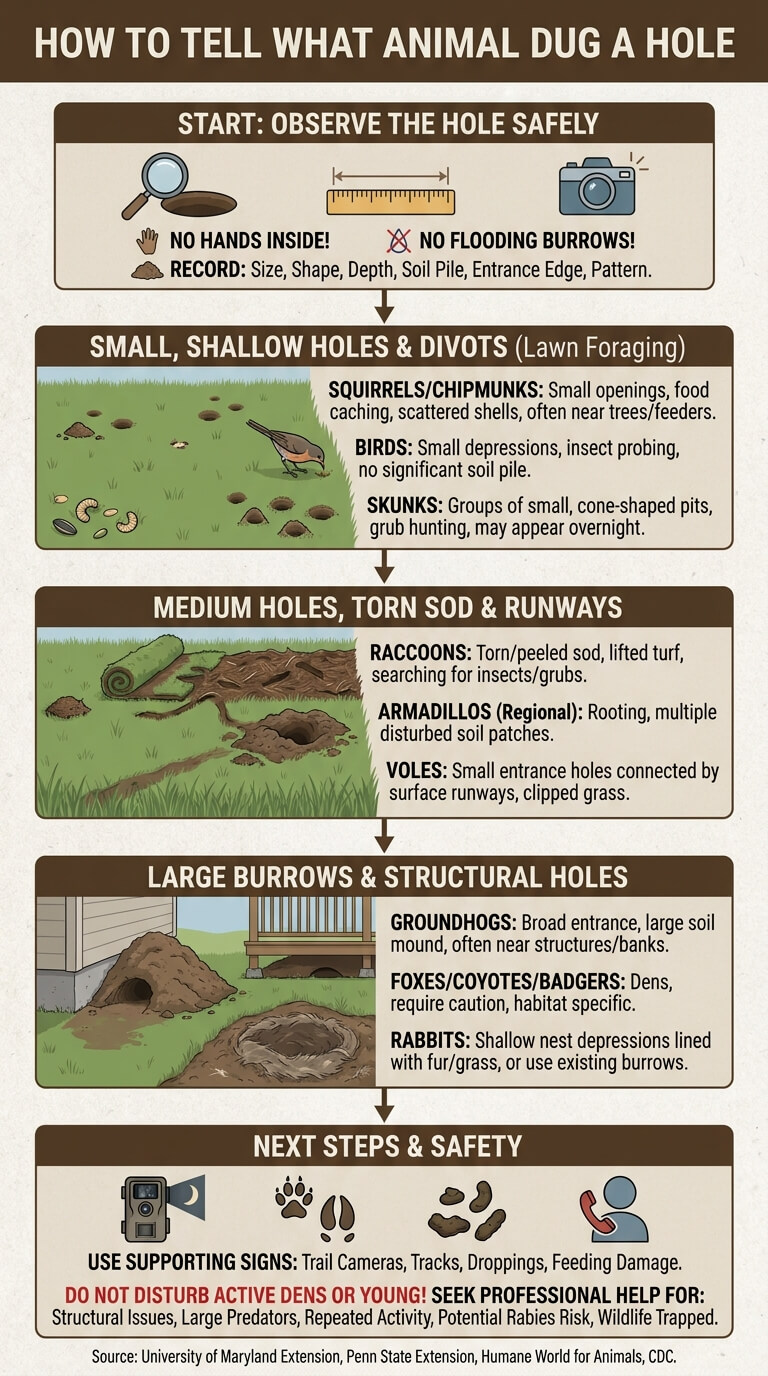
To identify what dug a hole, measure the opening, note whether it is shallow or tunnel-like, look for loose soil, study the surrounding damage, and check for repeated activity. Then compare the pattern with common diggers in your area.
A group of small cone-shaped holes in a lawn may point toward skunks foraging for grubs. Rolled or peeled sod may suggest raccoon feeding activity. Raised tunnels and soil mounds suggest moles more than surface-feeding animals. Small entrance holes with surface runways can fit voles. A wide burrow entrance with a noticeable mound of excavated soil may suggest a groundhog or similar burrowing mammal, depending on your region.
Location matters as much as shape. A hole in a flower bed, a hole under a shed, and a hole along a creek bank may have different likely animals even when the opening looks similar. If the hole is near a foundation, under a deck, beside a retaining wall, or connected to repeated digging under a structure, treat it as a wildlife and property issue rather than a simple mystery.
Why Animal Holes Are Easy to Misread
Animal holes are tricky because digging is only one part of a larger story. The hole you see may be a feeding mark, a travel tunnel, a nest entrance, an old burrow, a collapsed tunnel, or an opening enlarged by several animals over time. Wind, rain, lawn mowing, watering, pets, and foot traffic can change the edges of a hole before you notice it.
Many animals also create similar damage while doing different things. A skunk may dig for beetle larvae. A squirrel may bury or recover food. A vole may use shallow runways under grass. A mole may push soil upward while tunneling underground. A bird may probe the ground for insects. The result can be a yard full of openings, but not all of them mean an animal lives inside the hole.
The University of Maryland Extension notes that identifying the culprit behind lawn digging can be difficult because many animals dig out of sight, often overnight, and their damage can overlap in appearance. Its lawn wildlife advice also warns against assuming grubs are the cause without checking first, because grub treatment is not always the right response to digging damage. University of Maryland Extension lawn wildlife guidance
Build a case from several clues. Ask what the animal is probably doing: feeding, denning, traveling, nesting, caching food, escaping weather, or passing through. That question keeps you from treating every hole as the same problem.
Step 1: Record the Hole Size, Shape, and Entrance

Start with a simple record before you disturb the area. Take a photo from above and a wider photo that shows the surrounding yard or habitat. Place a ruler, coin, or other safe size reference near the hole without putting your fingers inside. Measure the width of the entrance and the length if it is oval.
Look at the entrance edge. A freshly dug hole may have crisp edges and loose soil. An older hole may be softened by rain or partly filled with leaves. A tunnel entrance usually has a direction, while a feeding divot may be shallow with no clear passage. A burrow entrance may show packed paths, smoothed soil, fur, plant fragments, or repeated use around the opening.
Small shallow holes
Small shallow holes are often feeding or caching marks rather than true burrows. Squirrels and chipmunks may dig small openings when burying or retrieving nuts and seeds. Birds can make small depressions while probing for insects or worms. Insects can leave neat openings with small soil mounds. Voles may create small holes connected to grass runways, especially where vegetation gives them cover.
These holes are more useful as pattern clues than as single-animal proof. A line of holes along a garden bed, repeated openings near bulbs, or small holes connected by narrow surface paths tells a stronger story.
Medium digging and lawn divots
Medium holes and torn lawn patches often point to foraging. Skunks, raccoons, armadillos in parts of the southern United States, and sometimes domestic dogs can make noticeable holes while searching for insects, grubs, worms, or other food. This type of damage often looks like digging down into the soil rather than an animal making a tunnel to live in.
Skunk digging is often described as small, cone-like holes, while raccoons are more likely to lift or roll sod where they are searching for food. These are general patterns, not guarantees. Wet soil and weak turf can make lawn damage look worse and blur the difference between diggers.
Large burrow entrances and tunnels
Large burrow openings require more caution. Groundhogs, foxes, coyotes, badgers, armadillos, rabbits, and other animals can use or dig burrows, but which species is likely depends heavily on region and habitat. A big entrance near a shed in Pennsylvania does not mean the same thing as a similar opening in Texas or Arizona.
Groundhog burrows are among the easier large openings for many eastern and midwestern homeowners to notice because they often have a broad entrance and a mound of excavated soil. Penn State Extension describes woodchuck burrows as identifiable by a large mound of excavated earth, which helps separate them from small feeding holes or shallow lawn divots. Penn State Extension woodchuck information
Do not assume a large hole is empty because you do not see an animal. Some animals use old burrows made by another species, so the current resident may not be the original digger.
Step 2: Look at Location and Surrounding Damage

The place where the hole appears is often the clue that makes the size meaningful. Write down whether the hole is in turf, mulch, a vegetable garden, a flower bed, a compost area, under a fence, beside a shed, near water, on a slope, or along a trail. Animals dig where the reward is worth the effort.
Look for a reason the animal chose that spot. Loose mulch is easier to dig than compacted soil. Decks and sheds offer cover. Vegetable gardens attract plant-eaters and animals searching for insects. Banks and edges provide den sites for some species. Bird feeders, pet food, fallen fruit, and garbage can draw animals that then leave digging nearby.
Lawn, garden, mulch, and flower bed holes
Lawns and gardens often show feeding holes. If the holes are scattered, shallow, and appear overnight, think about animals searching for food close to the surface. Skunks and raccoons may dig where insect larvae or other food items are available. Squirrels and chipmunks may dig in loose soil or mulch while caching food. Birds may probe in damp soil after rain.
Garden holes can also involve bulbs, seedlings, compost, earthworms, or fallen fruit. A hole near missing bulbs is different from a hole in a patch of loose sod. In a vegetable bed, look for clipped stems, half-eaten fruit, footprints, and whether the digging follows rows or edges. The damage pattern matters more than the animal name at first.
Holes near decks, sheds, fences, and foundations
Holes under structures deserve extra care because animals may be denning, raising young, or using the space as shelter. The opening may be under a deck, porch, shed, crawl space, fence line, retaining wall, or concrete step. Even if the hole looks small, the hidden space behind it can be larger.
Do not seal a suspected den entrance until you are confident it is inactive and no young animals are inside. Humane exclusion methods focus on preventing reentry without trapping animals. Humane World for Animals recommends checking for activity before finishing exclusion work and warns that changes around a den should be monitored so animals or young are not trapped inside. Humane World for Animals exclusion advice
If a hole is close to a foundation, driveway, retaining wall, septic area, or place where people could trip, the issue may go beyond identification. A licensed wildlife control professional, local animal control office, or state wildlife agency can help you decide what is legal and safe in your area.
Holes along trails, banks, fields, and wooded edges
Holes along habitat edges often have a different meaning than holes in a manicured lawn. Creek banks, pond edges, brush lines, and wooded trails provide cover, travel routes, and softer soil.
In natural areas, avoid enlarging holes or blocking entrances just to identify them. A burrow may be active even without obvious fresh tracks. If you are hiking, photographing, or observing wildlife signs, keep distance and record what you see.
Step 3: Compare Common Hole-Making Animals

Once you have size, shape, location, and damage pattern, compare the clues with likely animals in your region. Use categories first, not a single guess. A small mammal category, a lawn-foraging category, and a large-burrow category are more reliable than naming one animal from one hole.
Squirrels, chipmunks, and voles
Squirrels and chipmunks often create small holes in soil, mulch, and lawns when they bury or retrieve food. The opening may be neat and shallow, with little soil piled nearby. If you see scattered shells, disturbed mulch, or repeated small holes near trees and bird feeders, food caching becomes more likely.
Voles are different. They are small rodents that often use surface runways through grass and low vegetation. Their signs may include small openings, clipped grass, feeding damage near plant roots, and narrow paths that become obvious after snow melts or tall grass is flattened. The University of Minnesota Extension describes vole surface runways as one of the easiest signs to recognize and notes that voles may make small holes to reach bulbs and tubers. University of Minnesota Extension vole damage information
Small holes near shrubs or garden plants are not always from one animal. Look for the whole pattern: runways suggest repeated small-mammal travel, while isolated holes in loose soil may be caching or probing.
Skunks, raccoons, and armadillos where regionally relevant
Skunks and raccoons often attract attention because their feeding damage can appear suddenly. They may dig in lawns while searching for insects and other small prey. Skunk holes are commonly described as small cone-shaped pits, often in groups. Raccoons can leave more torn or lifted sod, especially where turf is loose or food is easy to reach.
Armadillos are important to consider in parts of the southern and south-central United States, where they dig while searching for insects and other invertebrates. Their rooting can create multiple holes or disturbed soil patches. Because armadillo range is regional, do not use it as a default explanation in northern yards unless local wildlife agencies list them for your area.
Timing matters. Fresh holes that appear overnight, especially with overturned sod, disturbed mulch, or tracks near food sources, often point toward nocturnal foraging.
Groundhogs, rabbits, foxes, coyotes, and badgers where regionally relevant
Groundhogs, also called woodchucks, make substantial burrows in many parts of the eastern and central United States. Their openings are much larger than squirrel caching holes or skunk feeding pits, and a large soil mound can be a strong clue.
Rabbits can use shallow nest depressions in lawns or use burrows made by other animals in some situations. A rabbit nest in a lawn is not the same as a deep tunnel entrance. It may look like a shallow depression lined with grass and fur. Avoid mowing directly over a suspected nest until you have checked from a safe distance and, when needed, contacted a licensed wildlife rehabilitator or local wildlife office.
Foxes, coyotes, and badgers can dig dens, but they are not equally likely in every neighborhood. Region, property type, and habitat matter. A large burrow in open western grassland has a different set of possibilities than a hole under a suburban shed. If you suspect a larger predator or a den with young, keep people and pets away and ask a local wildlife authority for guidance.
Birds, insects, and non-animal causes that mimic holes
Not every hole is a mammal hole. Birds can make small depressions while searching for insects or caching food. Ground-nesting bees and wasps can leave small soil mounds around individual holes. Crayfish can create chimney-like mud structures in wet areas. Turtles may dig nests in sandy or loose soil near water or open sunny areas.
Some holes are not animal-made at all. Decaying roots, irrigation leaks, washouts, settling soil, and collapsed old tunnels can create openings. If there are no tracks, fresh soil, food damage, or repeated changes, consider drainage or soil structure before blaming wildlife.
Step 4: Use Supporting Signs Without Disturbing Wildlife
The safest identification comes from evidence around the hole, not from reaching into it. Check from the outside in daylight. Use photos, a ruler, and careful observation. Keep pets and children away while you are still unsure what is using the area.
Tracks and soil marks
Fresh soil can hold toe marks, claw scratches, tail drags, or smoothed paths. Tracks can disappear quickly after rain or irrigation, so photograph them before they blur.
Do not expect perfect prints at a burrow entrance. Loose soil collapses. Animals step on their own tracks. Several species may pass the same opening. Track evidence works best when combined with hole size, location, and timing.
Droppings and feeding clues
Droppings can help identify wildlife, but they should be treated as a safety clue, not something to touch, sniff, or crush for inspection. Note their location, shape, and pattern from a distance, then wash hands after being outdoors. Keep children and pets away from suspected droppings until you know what to do next.
Feeding clues are often safer and more useful. Look for dug-up bulbs, clipped stems, gnawed bark, rolled sod, empty nut shells, disturbed compost, torn trash, missing vegetables, or insect activity. These signs can show whether the animal was feeding on plants, insects, stored food, garbage, or roots.
Trail camera evidence and repeated timing
A trail camera can confirm nighttime activity without close contact. Place it at a respectful distance, aim it at the general area rather than into the entrance, and avoid blocking the hole. The goal is to see when an animal visits, not to harass or trap it.
Timing can be as revealing as the image. New digging every morning suggests nighttime activity. If the hole changes only after rain, drainage or soil collapse may be part of the explanation.
Common Mistakes and Myths
Mystery holes invite quick guesses, but quick guesses often fail. The most common mistakes involve assuming one shape equals one animal, treating old burrows as active dens, or trying to remove the problem before understanding what is actually happening.
Why every lawn hole is not a snake hole
Snakes usually do not dig most of the holes people find in yards. Many snakes use existing shelter such as old burrows, rock gaps, brush piles, foundation spaces, or hollow logs. A snake seen near a hole may be using it, hunting around it, or passing through. That does not prove the snake dug it.
A “snake hole” label can make people overreact. Most yard holes are better interpreted by size, soil, location, and repeated activity. If you see a snake, give it space and do not put your hands into the opening.
Why a burrow entrance does not always show the current resident
Burrows can have histories. A groundhog may dig a burrow, another animal may later use part of it, and smaller animals may travel around the entrance. A hole can be active, inactive, abandoned, shared, or only occasionally used. Fresh tracks, fresh soil, repeated camera detections, and new damage are stronger evidence than an opening alone.
Season also changes use. Some animals den for winter, some raise young in spring, and some shift shelters when food, cover, or weather changes.
Why filling holes too quickly can be unsafe or ineffective
Filling a hole without understanding it can trap animals, separate young from adults, push wildlife into another part of a structure, or simply lead to the hole being reopened. Flooding burrows is also risky and can harm animals, destabilize soil, or create new problems around structures.
If the hole is shallow and clearly inactive, repairing the soil may be reasonable. If it is an active den, a structural opening, or a repeated digging site, first determine whether wildlife is present and what local rules allow.
Safety, Ethics, and When to Call a Professional

Animal holes should be approached with caution. Most wildlife does not want contact with people, but animals may defend themselves when cornered, sick, injured, or protecting young. Some species that dig or use dens, including raccoons, skunks, foxes, and bats, are also important in rabies safety discussions in the United States.
Avoid reaching into holes
Never reach into a hole to see what is inside. Do not place your face near the entrance, use smoke, pour chemicals into burrows, or encourage pets to investigate. These actions can lead to bites, scratches, stings, sprayed odor, trapped animals, or illegal harm to wildlife.
The CDC advises people in the United States to keep distance from wildlife and to avoid approaching animals that appear sick, injured, dead, unusually tame, or active at unusual times for that species. If you may have been bitten or scratched by a wild or unfamiliar animal, contact medical or public health professionals promptly. CDC rabies prevention guidance
Watch for active dens, young animals, and protected species
Spring and early summer can bring young animals in dens, nests, and shallow depressions. Blocking or sealing an entrance during that period can create a welfare problem and may violate local rules. Birds, some mammals, reptiles, amphibians, and other wildlife can also have legal protections that vary by species and state.
Before changing an active wildlife area, check your state wildlife agency or local animal control office. If young animals may be present, a licensed wildlife rehabilitator or wildlife control professional can help you avoid separating families or trapping animals inside structures.
When holes near structures need licensed help
Call for qualified help when a hole is under a foundation, deck, porch, shed, concrete slab, retaining wall, or driveway, or when digging threatens a place where people walk. Also get help if you suspect a rabies-risk animal, a large predator, an active den with young, repeated damage, or an animal stuck inside a wall.
Licensed professionals can identify legal options in your state, time exclusion to reduce harm, and avoid trapping wildlife where it cannot escape. They can also tell you when the issue is not wildlife at all, such as drainage failure, soil settling, or structural erosion.
Tracks, Droppings, and Other Clues That Confirm the Hole
A hole is only one clue. The clearest identifications usually come from matching it with tracks, droppings, feeding damage, and timing. This helps when several animals could make similar openings. The opening should be read as one part of the broader animal tracks and signs around the site, not as proof by itself.
Use tracks and droppings as confirmation clues
Tracks can separate hoofed animals, pawed mammals, hopping animals, and birds. Droppings can suggest herbivores, omnivores, or carnivores, but they should be observed safely and left alone unless cleanup is necessary. Together, tracks and droppings can show whether a hole is part of repeated animal activity or a one-time disturbance.
If you cannot identify droppings safely, do not collect them casually. Some animal waste can carry parasites, bacteria, or viruses. Use distance, photos, and professional help when the droppings are in an attic, crawl space, shed, play area, or pet-accessible space.
Read house and yard signs together
Raccoons, squirrels, and skunks can all leave signs near homes, but the signs differ. Raccoons may disturb trash, water sources, chimneys, or rooflines. Squirrels often leave gnawing, scattered shells, attic noises, and small digging from food caching. Skunks often leave odor clues and small digging in lawns where they forage.
Reading these signs together prevents overconfidence. A hole under a shed, a nighttime odor, and small cone-shaped lawn pits suggest a different situation than small holes under an oak tree with acorn shells nearby. The more clues that point in the same direction, the stronger your identification becomes.
FAQ
What animal digs small round holes in a lawn?
Small round holes in a lawn can be made by several animals, including squirrels, chipmunks, voles, skunks, birds, insects, and sometimes other local wildlife. The best clue is the pattern. Tiny scattered holes near trees or feeders may suggest food caching. Small openings connected to runways may suggest voles. Cone-like holes in groups may suggest skunks looking for food near the soil surface.
Do not identify the animal from the hole alone. Check whether the holes are shallow or tunnel-like, whether there is loose soil, whether new holes appear overnight, and whether tracks, droppings, sod damage, or feeding marks appear nearby.
What animal digs a hole under a shed or deck?
Holes under sheds or decks can be used by groundhogs, skunks, raccoons, foxes, opossums, rabbits, feral cats, or other animals depending on the region and size of the opening. A large entrance with a soil mound may suggest a burrowing mammal such as a groundhog in areas where they live. A smaller entrance under cover may suggest a denning or sheltering animal.
Do not close the hole until you know it is inactive. Young animals may be inside, especially in spring and early summer. If the opening is near a structure or shows repeated use, contact local animal control, your state wildlife agency, or a licensed wildlife control professional.
Should you cover an animal hole in your yard?
You can repair some shallow, inactive holes after you have checked for ongoing wildlife activity. Covering or filling an active burrow is different. It can trap animals, separate young from adults, or cause animals to dig another exit in a worse location.
Before covering a hole, watch for fresh soil, tracks, droppings, repeated reopening, odor, or camera activity. If the hole is under a structure, near a foundation, or possibly connected to a den, get professional guidance before sealing it.
Final Thoughts
Learning how to tell what animal dug a hole is really about reading a pattern. Hole size matters, but it is only the beginning. The entrance shape, soil pile, location, surrounding damage, tracks, droppings, season, and timing all help narrow the possibilities.
Stay cautious and humane. Do not reach into holes, flood burrows, use poison, or seal animals inside structures. Observe from a safe distance, compare multiple clues, and ask a licensed professional or local wildlife agency for help when the hole is active, near a structure, or connected to an animal that could pose a safety risk.

Ethan Walker is the founder and research editor of Animal Fact Central. He creates and reviews educational animal facts content using trusted wildlife, pet care, and science-based sources. His work focuses on making animal behavior, adaptations, habitats, and species facts clear, accurate, and engaging for everyday readers.
Read More Details About Ethan Walker: https://animalfactcentral.com/ethan-walker/