

Coral reefs are important because they give thousands of ocean animals food, shelter, nursery space, and places to hunt, hide, clean, breed, and grow. They also help protect coastlines from waves, support fisheries and tourism, and hold scientific value because reef animals produce unusual chemicals that researchers study. For such small areas of the ocean, reefs carry an outsized share of ocean life.
The simplest way to understand a coral reef is to picture a living city built by tiny animals. The coral animals create hard skeletons, those skeletons form ledges and caves, and those spaces become homes for fish, crabs, shrimp, sponges, sea stars, mollusks, sea urchins, worms, turtles, rays, and many other animals. NOAA National Ocean Service describes reefs as covering only a small part of the ocean while providing habitat for at least a quarter of marine life, a reminder that reef importance is about structure as much as color.
Quick Answer
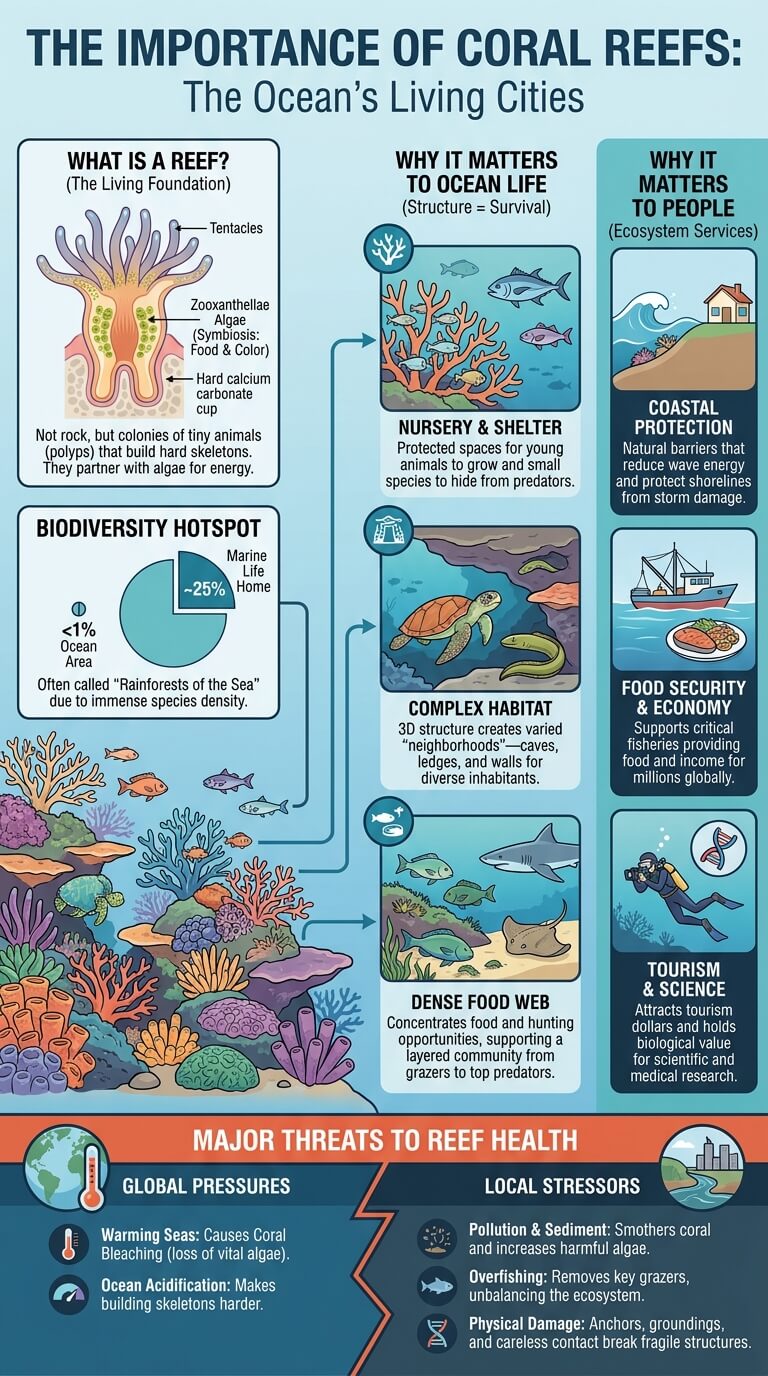
Coral reefs matter because they build three-dimensional habitat in warm, shallow seas and, in some places, deeper or colder waters. This structure supports a dense web of animal life. Small fish hide in coral branches. Juvenile animals grow in protected spaces. Predators patrol edges and channels. Grazers keep algae in check. Filter feeders clean particles from the water. Larger visitors, including sea turtles and rays, use reefs as feeding grounds, resting areas, or travel stops.
For people, reefs can help reduce wave energy before it reaches shore, support local seafood, attract divers and snorkelers, and provide cultural value to coastal communities. Their value is not only economic. Coral reefs also help scientists understand animal partnerships, reef recovery, disease, heat stress, and how living structures shape entire marine communities.
The reason reef loss is so serious is that a reef is not one animal or one rock. It is a habitat made by living animals and used by many other animals. When coral cover declines, the whole community can change.
What Coral Reefs Are and Why They Are Alive
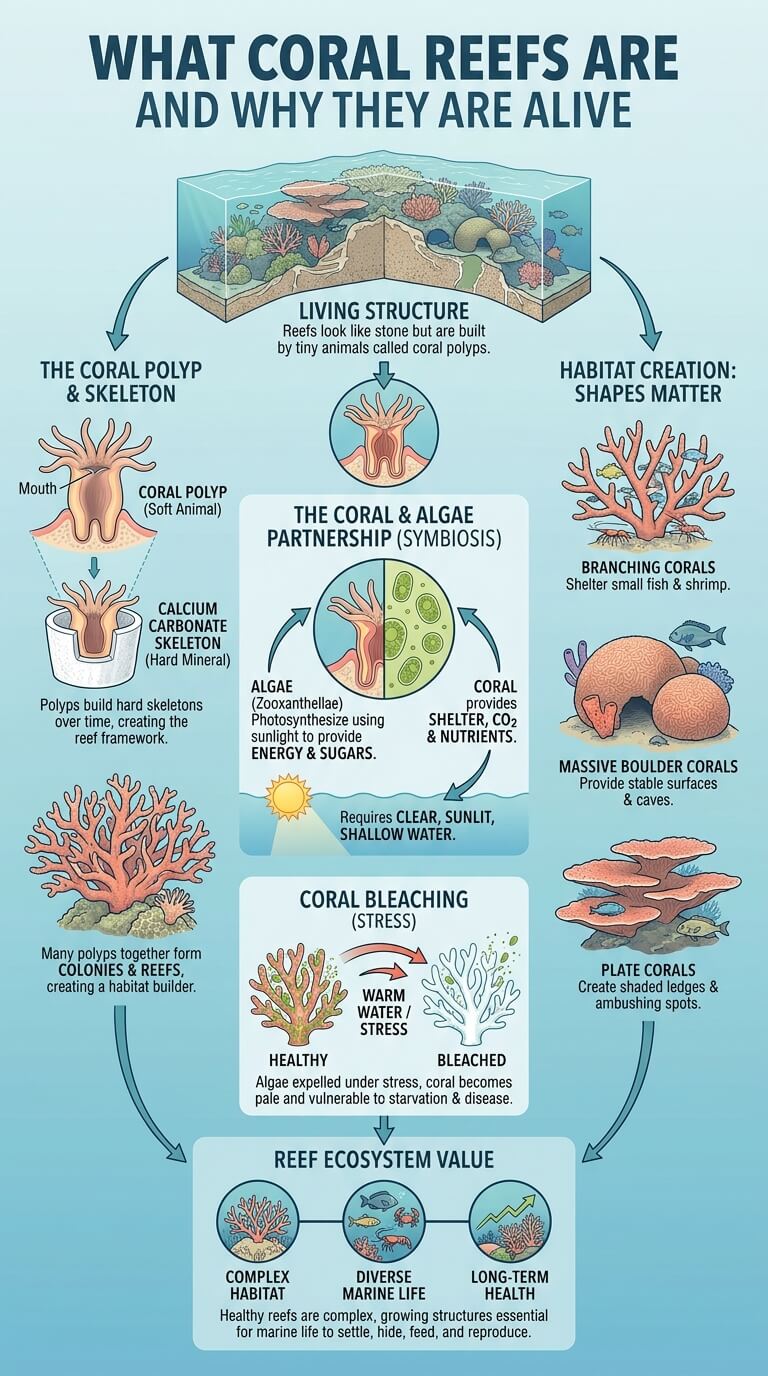
A coral reef may look like stone, but the living part is made of coral polyps. A polyp is a small animal related to jellyfish and sea anemones. Many reef-building corals live in colonies, meaning many polyps grow together. Over time, hard corals build skeletons of calcium carbonate, the same broad mineral family found in shells and limestone.
The living coral tissue is thin compared with the hard skeleton beneath it. That is why a reef can look like rock from a distance. Up close, it is a surface of tiny animals, mucus, tentacles, algae, bacteria, and other organisms interacting in a very crowded space. EPA’s basic coral reef overview explains that reef-building coral polyps contain microscopic algae in a symbiotic relationship, and that most of these corals need clear, shallow water because the algae depend on sunlight.
Coral polyps and their skeletons
Coral polyps are small, soft-bodied animals. Each polyp has a mouth surrounded by tentacles. At night or during feeding periods, some corals extend their tentacles to capture tiny drifting animals and particles. During the day, many reef-building corals also rely heavily on the food made by algae living inside their tissues.
The skeleton matters because it turns a soft animal colony into a habitat builder. A single coral colony can create bumps, plates, fingers, domes, or branching shapes. Many colonies together create reef slopes, walls, rubble fields, crevices, caves, and sheltered lagoons. Those shapes give other animals places to settle, hide, ambush prey, scrape algae, lay eggs, or rest out of strong currents.
Different coral shapes create different animal neighborhoods. Branching corals can shelter small fish and shrimp. Massive boulder corals can provide stable surfaces and caves. Plate-like corals can create shaded ledges. Even dead coral skeleton can temporarily offer hiding places, although long-term reef health depends on living coral growth, stable structure, and a balanced animal community.
The coral and algae partnership
Many shallow-water reef-building corals live with tiny algae often called zooxanthellae. The algae photosynthesize, which means they use sunlight to make sugars. The coral provides shelter and access to carbon dioxide and waste nutrients, while the algae provide much of the coral’s energy. This partnership is one reason clear, sunlit water is so important for many tropical reefs.
The same partnership helps explain coral bleaching. When corals are stressed, especially by unusually warm water, they may lose or expel many of their algae. Without the algae’s color, the pale coral skeleton shows through the transparent coral tissue. Bleaching does not always mean the coral is already dead, but it does mean the coral is under stress and may starve, become more vulnerable to disease, or die if conditions do not improve.
Hard corals, soft corals, and reef-building habitats
Hard corals are the main reef builders in many tropical coral reef systems because they produce rigid calcium carbonate skeletons. Soft corals, sea fans, sea whips, black corals, and other coral-like animals may live on reefs too, but they do not all build large reef frameworks in the same way.
This distinction matters for animal habitats. A soft coral garden may be rich with life, but a reef framework made by hard corals creates the long-lasting structure that many reef animals depend on. The reef’s value comes from both living tissue and physical shape. A healthy reef is not just colorful. It is complex, growing, grazed, cleaned, damaged, repaired, and constantly used by animals.
Why Coral Reefs Matter to Ocean Animals
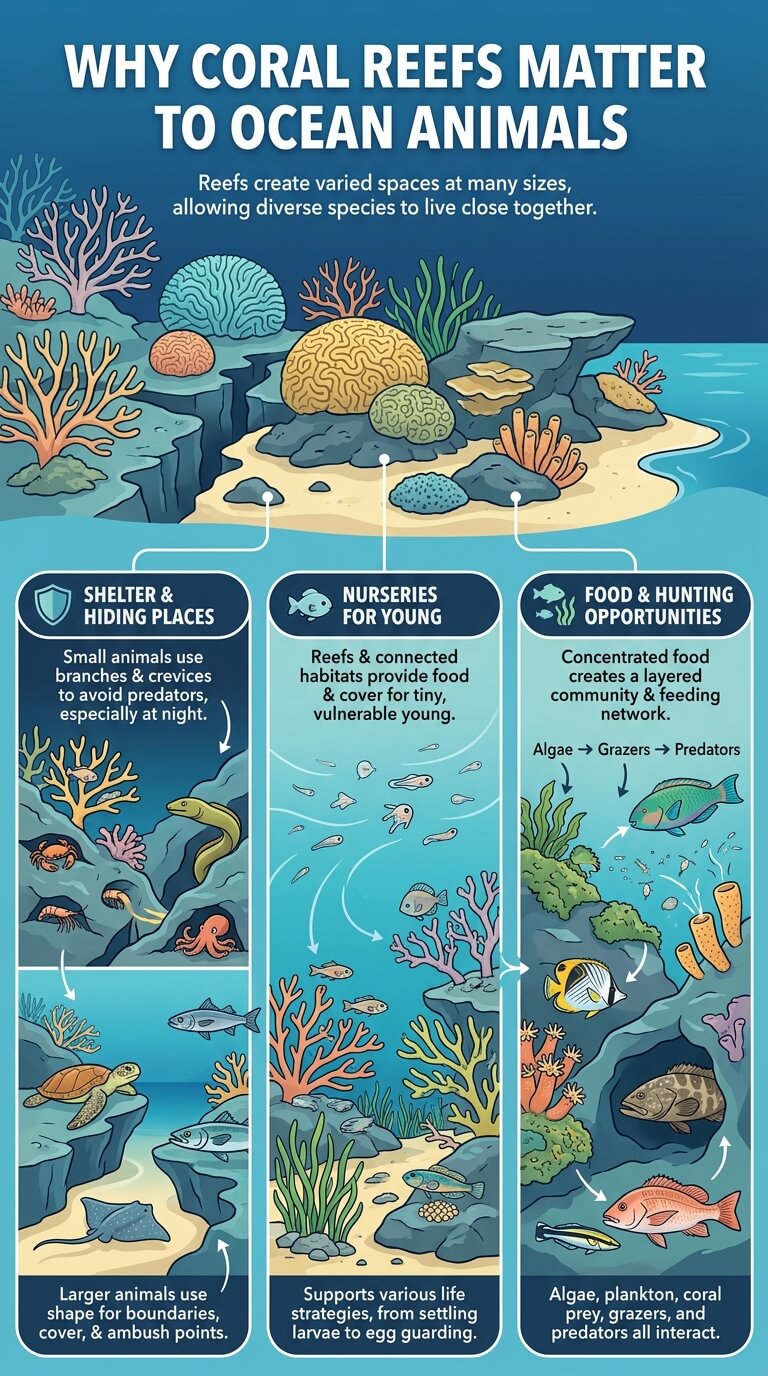
Coral reefs matter to ocean animals because they create small spaces at many sizes. A reef has holes small enough for a shrimp, cracks large enough for a goby, ledges for moray eels, cleaning stations for larger fish, sandy edges for rays, and open-water edges where predators can hunt. That variety lets many species live close together without using the habitat in exactly the same way.
Reefs create shelter and hiding places
For small reef animals, shelter can be the difference between surviving the night and being eaten. Juvenile fish use coral branches and rubble to avoid larger predators. Crabs and shrimp tuck into crevices. Octopuses may use holes and dens. Eels hide in reef cracks and emerge to hunt. Many reef fish sleep in tight spaces, sometimes changing color or behavior at night.
Shelter is not only for small animals. Larger animals also use reef shape. A sea turtle can rest near ledges, a ray may cruise over sand channels beside a reef, and predatory fish may patrol reef edges where prey gather. The reef creates boundaries, cover, and ambush points, which makes the habitat active at many levels of the food web.
Reefs support nurseries for young fish and invertebrates
Many reef animals begin life as tiny larvae drifting in the water. Some later settle onto reefs, seagrass beds, mangroves, rubble, or nearby hard surfaces. Coral reefs and connected habitats can give young animals food and cover while they are still small enough to be eaten by many predators.
Nursery habitat does not mean every reef species raises young the same way. Some fish guard eggs. Some release eggs and sperm into the water. Many invertebrates have drifting larval stages. The common thread is that young animals need suitable places to settle, feed, and avoid predators. Reef structure helps provide those places.
Reefs concentrate food and hunting opportunities
Reefs are busy because food moves through them in many ways. Algae grow on hard surfaces. Tiny plankton drift past in currents. Corals capture small prey and dissolved nutrients. Sponges filter water. Crabs and worms break down organic material. Herbivorous fish graze algae. Predators hunt grazers and smaller fish.
This concentration of food creates a layered community. Parrotfish and surgeonfish scrape or crop algae. Butterflyfish may feed on coral polyps, small invertebrates, or other reef foods depending on species. Groupers and snappers use reef structure for cover and hunting. Cleaner fish and cleaner shrimp may remove parasites from larger animals at specific spots. The reef is not a static backdrop. It is a feeding network.
Coral Reefs as Biodiversity Hotspots
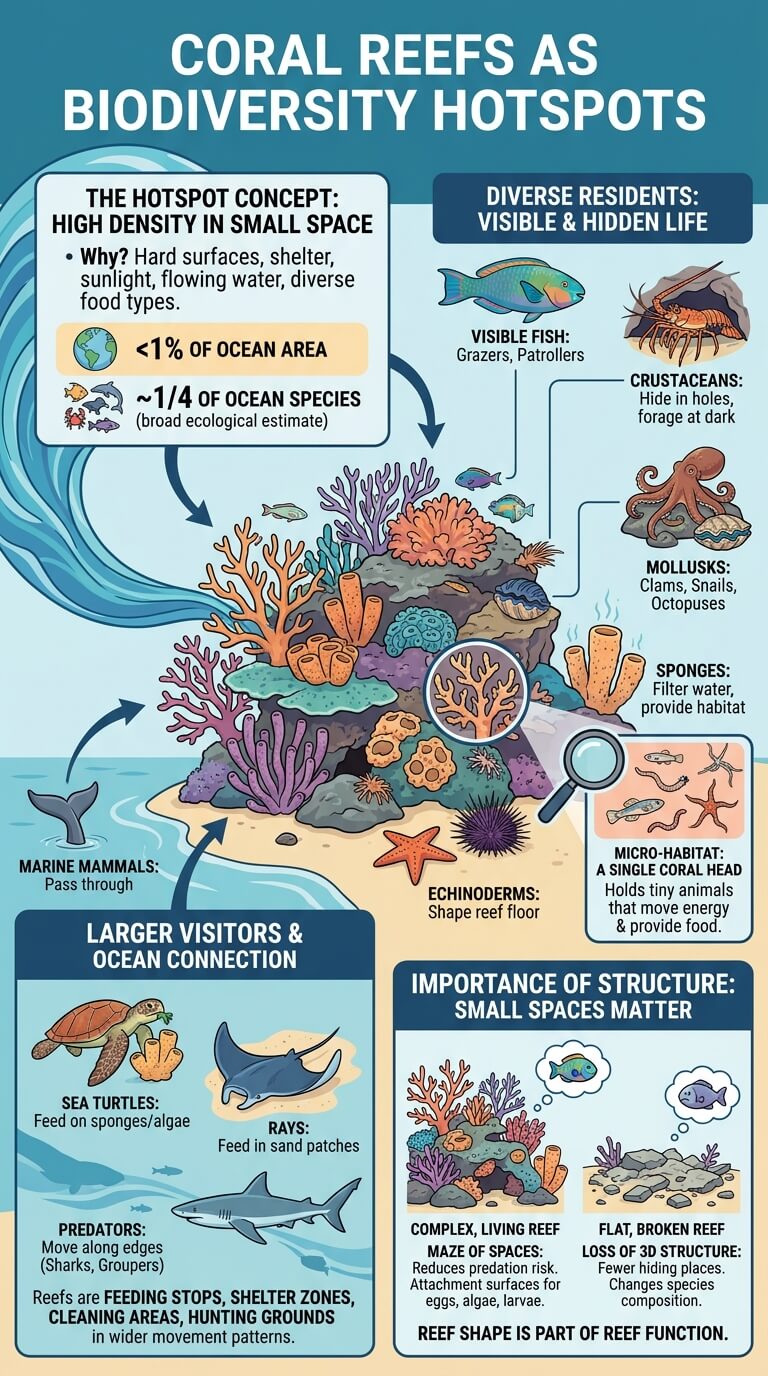
Coral reefs are often called biodiversity hotspots because many species can live in a relatively small space. That density happens because reefs provide hard surfaces, shelter, sunlight, flowing water, and many food types. Reefs can support animals that graze, filter, scrape, drill, hide, burrow, ambush, patrol, and migrate through.
NOAA Fisheries shallow coral reef habitat page notes that reefs occur in less than 1 percent of the ocean yet are home to nearly one-quarter of ocean species. That figure is commonly used to show why reefs are so valuable, but it should be read as a broad ecological estimate rather than a precise count for every reef.
Fish, crustaceans, mollusks, and reef invertebrates
Reef fish are the most visible animals to many snorkelers, but fish are only part of the story. Crustaceans such as crabs, lobsters, and shrimp hide in holes and forage after dark. Mollusks include clams, snails, octopuses, and nudibranchs. Sponges filter water and provide habitat for smaller animals. Sea stars, brittle stars, sea cucumbers, and urchins help shape the reef floor.
Some animals are easy to miss because they are tiny, camouflaged, or active at night. A single coral head can hold small gobies, worms, amphipods, brittle stars, and juvenile fish. This hidden life matters because small animals move energy through the reef and provide food for larger animals.
Sea turtles, rays, and larger visitors
Not every animal that uses a coral reef lives there all the time. Sea turtles may visit reefs to feed on sponges, algae, or other foods depending on the species. Rays may feed in nearby sand patches. Reef sharks, groupers, barracudas, jacks, and other predators may move along reef edges. Marine mammals may pass through reef regions in some areas, though they are not reef residents in the same way small reef fish are.
These larger visitors show that reefs are connected to the wider ocean. A reef can be a feeding stop, shelter zone, cleaning area, or hunting ground inside a larger movement pattern. Protecting reefs can therefore help animals that use several habitats during their lives.
Why many reef species depend on small spaces
On land, a hollow log or dense shrub can shelter many animals. On a reef, the equivalent is a maze of coral branches, holes, overhangs, rubble, and sponge-covered surfaces. Small spaces reduce the chance that a predator can reach an animal. They also create surfaces where eggs, algae, larvae, and tiny invertebrates can attach.
This is one reason a flat, broken reef is not the same as a complex living reef. Even if fish are still present for a while, the loss of three-dimensional structure can reduce hiding places and change which species can live there. Reef shape is part of reef function.
How Coral Reefs Support People and Coastlines
Coral reefs also matter because people live, fish, travel, and build near reef coastlines. Their benefits are easiest to understand in three categories: coastal protection, food and jobs, and knowledge. These human benefits depend on the same thing animals need: a living, structurally complex reef.
Natural wave barriers and coastal protection
Reefs can reduce some wave energy before it reaches beaches, mangroves, seagrass beds, homes, roads, and harbors. They do this because waves break and lose force as they pass over the reef crest and rough reef surface. The amount of protection depends on reef shape, depth, storm direction, sea level, and local coastline conditions.
This protection is not a magic wall. A severe storm can still cause dangerous flooding and damage. But a healthy reef can be part of a natural coastal defense system, especially when combined with mangroves, dunes, wetlands, and careful coastal planning.
Fisheries and local food systems
Many communities near reefs depend on reef-associated fish and invertebrates for food, income, or culture. Commercial and recreational fisheries may also depend on reef habitat during part of a species’ life cycle. If nursery areas decline or food webs become unbalanced, fisheries can be affected even when fishing boats are not targeting corals themselves.
Healthy fisheries need more than plenty of fish. They need habitat, breeding adults, nursery areas, and rules that prevent harvest from outpacing reproduction. Reefs are one part of that system, which is why overfishing can damage reef communities as well as fish populations.
Tourism, science, and medicine-related discoveries
Reefs attract divers, snorkelers, photographers, fishers, boat tours, students, and researchers. Tourism can support local jobs, but it also needs careful management because anchors, careless fins, trampling, wildlife disturbance, and pollution can damage reefs. Responsible reef tourism depends on keeping visitors away from coral contact and reducing stress on wildlife.
Reefs also matter for science. Many reef animals use chemical defenses, unusual partnerships, camouflage, venom, toxins, or regeneration. Researchers study these traits to understand biology and, in some cases, to investigate compounds that may inspire future medicines. That does not mean reefs are valuable only because they might help humans. It means their biological diversity contains knowledge that would be hard to replace.
The Biggest Threats to Coral Reefs

Coral reefs face both global and local stress. Global stress includes warming seas and ocean acidification. Local stress can include pollution, sediment, disease, careless tourism, destructive fishing, vessel groundings, and overfishing. These pressures can interact, making corals less able to recover from heat, storms, or disease.
Warming seas and coral bleaching
Warm-water corals can tolerate only a limited temperature range. When unusually warm water lasts long enough, corals may bleach by losing the algae that help feed them. NOAA’s climate and coral reef explanation lists warming oceans, sea level rise, storm changes, runoff, altered currents, and ocean acidification as climate-related pressures on reefs.
Bleached corals are not automatically dead, and some reefs can recover if stressful conditions ease. However, repeated or severe bleaching can reduce coral growth, reproduction, and survival. Heat stress can also make disease outbreaks more damaging. Because warming is a global pressure, local reef care helps but cannot fully solve bleaching risk by itself.
Ocean acidification and slower reef growth
As the ocean absorbs more carbon dioxide from the atmosphere, seawater chemistry changes. One result is ocean acidification, which can make it harder for corals and some shell-building animals to build or maintain calcium carbonate structures. This matters because reef growth depends on coral building outpacing erosion, storms, boring organisms, and physical breakage.
Acidification does not affect every species in the same way, and local chemistry can vary. Still, the basic concern is clear: if corals build skeletons more slowly or weaker reef structures erode faster, the habitat can become less complex over time.
Pollution, sediment, and physical damage
Land-based pollution can harm reefs when nutrients, chemicals, sewage, trash, or sediment flow from watersheds into coastal water. Excess nutrients can encourage algal growth. Sediment can cloud the water, block sunlight, and settle on coral tissue. Trash and lost gear can snag, scrape, shade, or smother reef animals.
Physical damage also matters. Anchors, ship groundings, careless diving, standing on coral, souvenir collecting, and poorly planned coastal construction can break coral colonies that took years or decades to grow. Reef animals should not be touched, chased, fed, collected, or removed from the water for photos.
Overfishing and food web imbalance
Fishing pressure can change reefs when it removes too many key grazers, predators, or breeding adults. Herbivorous fish and urchins can help control algae, though the balance differs by reef. Predators can shape the behavior and abundance of other animals. If fishing changes these relationships, algae may gain space, coral recruitment may decline, and the reef community may shift.
Fishing impacts are not only about the number of fish taken. Some gear can damage habitat, and lost fishing gear can continue trapping or entangling animals. Good management considers both animal populations and the habitat that supports them.
Common Mistakes or Myths About Coral Reefs
Coral reefs are easy to misunderstand because they look still from the surface. In reality, they are animal-built habitats full of feeding, competition, movement, injury, recovery, and change.
Myth: coral is a plant or rock
Coral is not a plant or a rock. The living coral is an animal. Many reef-building corals contain algae, and the skeleton can look like stone, so the confusion makes sense. A more accurate description is that many corals are animal colonies that build hard skeletons and often live with photosynthetic algae.
Myth: all colorful reefs are healthy
Bright color can be a sign of living coral, algae, sponges, fish, and other reef life, but color alone does not prove a reef is healthy. Some stressed reefs can still look colorful because algae or other organisms have taken over. Some healthy reefs may look less bright depending on depth, water clarity, season, or coral species.
A reef’s health is better judged by living coral cover, disease signs, fish and invertebrate communities, algae balance, water quality, recruitment of young corals, and whether the structure is growing or breaking down.
Myth: reefs only matter in tropical vacation places
Many famous reefs are in tropical vacation areas, but reefs matter far beyond tourism. They support food systems, coastal protection, cultural traditions, research, and animal communities. They also exist in U.S. waters, including Florida, Hawaiʻi, Puerto Rico, the U.S. Virgin Islands, Guam, American Samoa, and other Pacific areas.
Reefs are not valuable only when people visit them. A reef that never appears on a travel poster may still support fish, invertebrates, shoreline protection, and local community needs.
Edge Cases and Exceptions
Not all coral habitats fit the familiar image of a sunny, shallow, tropical reef with bright fish. Some corals live in deep or cold water. Some damaged reefs can recover under the right conditions. Some protected places improve, while others remain under stress because heat, disease, and water chemistry are larger than any one local action.
Cold-water corals
Cold-water corals can live in deeper, darker, colder areas where sunlight does not support the same algae partnership found in many shallow reef-building corals. These corals capture food from the water instead of relying heavily on photosynthesis. They can create habitat for fish and invertebrates in places that look very different from tropical reefs.
This matters because coral conservation is not only a tropical issue. Deep coral habitats can be vulnerable to bottom-contact fishing gear, energy development, ocean acidification, and slow recovery after damage. They are often less visible to the public, but they can still be important animal habitats.
Reefs that recover after disturbance
Some reefs can recover after storms, bleaching, disease, or local damage if enough living coral remains, water quality is suitable, young corals can settle, grazing is balanced, and repeated stress does not arrive too quickly. Recovery is usually measured in years to decades, not weeks.
Recovery should not be treated as guaranteed. A reef that is hit by repeated heat stress, pollution, disease, and physical damage may shift toward algae-dominated or rubble-dominated conditions. The possibility of recovery is a reason to protect reefs, not an excuse to damage them.
Places where local protection helps but cannot solve warming alone
Local protection can reduce direct damage, improve water quality, protect herbivores, manage fishing, and give corals a better chance after stress. NOAA Fisheries restoration page describes reef restoration as one tool among broader efforts to improve habitat quality, prevent coral loss, enhance resilience, and improve coral survival.
Still, local protection cannot completely shield reefs from marine heatwaves or global ocean chemistry changes. The best reef outcomes usually require both local care and larger efforts to reduce the causes of warming and acidification.
How Reef Health Overlaps With Other Ocean Problems
Coral reefs are one example of how ocean problems overlap. A reef can be stressed by heat, then hit by pollution, then lose grazing fish, then struggle to recover after a storm. Looking at one threat at a time can miss how animals experience the habitat as a whole.
Coral reefs as living ocean habitat
Reefs show why habitat structure matters. Ocean animals do not only need water. They need feeding areas, hiding places, breeding spaces, safe movement routes, and the right physical conditions. Coral reefs provide many of those needs in one concentrated place.
How plastic pollution and overfishing add stress to reefs
Plastic can snag coral, shade animals, break fragile structures, or contribute to poor habitat conditions. Microplastics and chemical pollution are more complex and still being studied, but the practical point is simple: cleaner water and less trash reduce avoidable stress.
These risks show how plastic pollution affects marine animals as well as the habitats they use.
Overfishing can also make reefs less resilient by changing the animals that graze algae, control prey, or maintain food web balance. The details differ from reef to reef, but removing too many key species can make it harder for corals to hold space and recover.
Why protected areas may help some reefs
Marine protected areas and other local rules can help when they reduce direct damage, protect important animals, manage visitor use, or support recovery zones. They work best when they are well designed, enforced, and matched to local problems.
Protected areas are not a cure for every threat. A reef inside a protected area can still bleach during a marine heatwave. But protection can reduce local pressure, and that may give corals and reef animals a better chance to survive and recover.
FAQ
Why are coral reefs called rainforests of the sea?
Coral reefs are called rainforests of the sea because they hold a high variety of species in a small area, much like tropical rainforests on land. The comparison is not perfect, but it helps explain how a structurally complex habitat can support many animals that use different spaces and foods.
What animals need coral reefs to survive?
Many fish, shrimp, crabs, lobsters, clams, snails, worms, sea stars, urchins, sponges, octopuses, and small reef invertebrates depend on reefs for shelter, food, or breeding space. Some larger animals, including sea turtles, rays, groupers, and reef-associated predators, may use reefs for feeding, resting, cleaning, or hunting even if they also move through other habitats.
What happens if coral reefs die?
If living coral declines and reef structure breaks down, many animals lose hiding places, nursery areas, food sources, and breeding spaces. Fish communities can change, algae may spread, coastal protection can weaken, and communities that depend on reefs for food, tourism, or culture may be affected. The exact outcome depends on the reef, the cause of damage, and whether recovery conditions remain available.
Can damaged coral reefs recover?
Some damaged reefs can recover if stress decreases, water quality is good, enough living coral or coral larvae remain, and the reef is not repeatedly hit by severe heat, disease, or physical damage. Recovery can take years or decades. It is more realistic to say reefs can recover under the right conditions than to assume any damaged reef will bounce back on its own.
Final Thoughts
Coral reefs are important because they are living habitats that support a huge variety of ocean animals while also helping people, coastlines, fisheries, tourism, culture, and science. Their value comes from the way tiny coral animals build structures that many other species use. When reefs are healthy, they create shelter, food, nursery space, and coastal protection. When reefs decline, the effects can spread through fish communities, local economies, and shoreline safety.
The best way to think about coral reefs is not as underwater decoration, but as animal-built infrastructure for the ocean. Protecting them means protecting the coral animals, the reef structure, the water quality, the food web, and the many species that depend on small spaces in a complex living habitat.
Protecting reefs is part of broader ocean conservation, which connects healthy habitats with the animals that depend on them.

Ethan Walker is the founder and research editor of Animal Fact Central. He creates and reviews educational animal facts content using trusted wildlife, pet care, and science-based sources. His work focuses on making animal behavior, adaptations, habitats, and species facts clear, accurate, and engaging for everyday readers.
Read More Details About Ethan Walker: https://animalfactcentral.com/ethan-walker/