

Some animals form partnerships that last for years, and a few pairs remain together until one partner dies. Albatrosses may reunite at the same breeding colony after months apart at sea. Wolves often live in family groups centered on a breeding pair. Beavers may share a territory and lodge across multiple breeding seasons. These relationships are real, but the familiar phrase mate for life can hide more than it explains.
In animal behavior, living together, raising young together, and producing offspring only with one partner are separate questions. A species can be socially monogamous while occasional offspring are fathered by an animal outside the social pair. Another species may pair only for one breeding season, then choose a different partner the next year. The most accurate answer is that many animals form long-term pair bonds, but very few can be described as permanently and exclusively monogamous in every sense.
Quick Answer

Animals commonly described as mating for life include several albatrosses, swans, geese, wolves, beavers, gibbons, prairie voles, and other birds and mammals that form stable pair bonds. In some species, the same partners cooperate for many breeding seasons. In others, a pair lasts only while both animals return to the same territory, remain reproductively successful, or survive long enough to reunite.
The phrase should not automatically mean sexual exclusivity, equal parenting, or an unbreakable partnership. Biologists usually describe what they can observe and test: whether two animals share space, defend a territory, coordinate breeding, care for young, prefer one another, and produce offspring together. Those measures often point to a strong bond, but they do not always produce the same answer.
What Does Mate for Life Actually Mean?
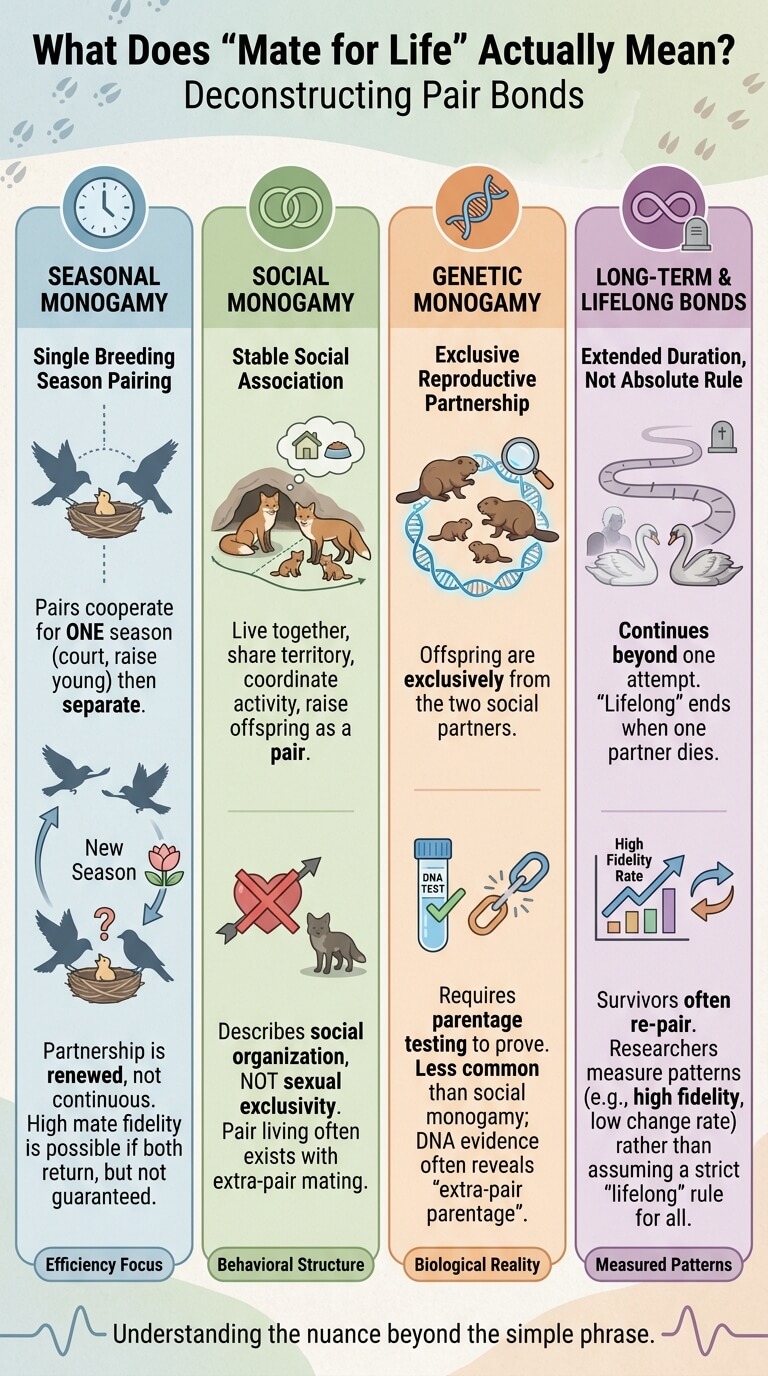
Seasonal Monogamy
Seasonal monogamy means that one male and one female form a social pair for a single breeding season or breeding attempt. They may court, defend a site, incubate eggs, or feed young together, then separate afterward. When the next breeding season arrives, either animal may return to the previous partner or form a new pair. This arrangement is especially common when two caregivers can raise offspring more effectively than one, but maintaining contact throughout the nonbreeding season would offer little advantage.
A seasonally monogamous species can still show strong mate fidelity. If both animals survive and return to the same place at a similar time, they may pair again. The important distinction is that the partnership is renewed rather than maintained continuously throughout the year. This helps explain why one species may be described as monogamous even when its adults spend months apart and do not reunite with the same partner every season.
Social Monogamy
Social monogamy describes a stable association between two animals. They may live together, share a territory, coordinate activity, or raise offspring as a pair. It is mainly a description of social organization, not proof that every mating occurs within the partnership. A broad scientific review of the distinction between social and genetic monogamy explains why pair living can exist even when sexual exclusivity is incomplete.
Genetic Monogamy
Genetic monogamy means that the offspring produced during a period come from the two members of the social pair. Parentage testing is needed to establish it reliably. Before genetic methods became common, researchers often inferred mating systems from which adults were seen together. DNA evidence later showed that some apparently monogamous species had extra-pair parentage. Genetic monogamy does occur, but it is less common than social monogamy and may vary among populations or years.
Long-Term and Lifelong Pair Bonds
A long-term pair bond continues beyond one breeding attempt. A lifelong bond lasts until one partner dies, although proving this requires following known individuals for much of their lives. Even in strongly bonded species, a survivor may eventually re-pair. Researchers therefore tend to describe measured patterns, such as high mate fidelity, repeated breeding with the same partner, or a low rate of partner change, rather than assuming every pair follows the same rule.
Why Long-Term Pair Bonds Evolve
Raising Young That Need Two Caregivers
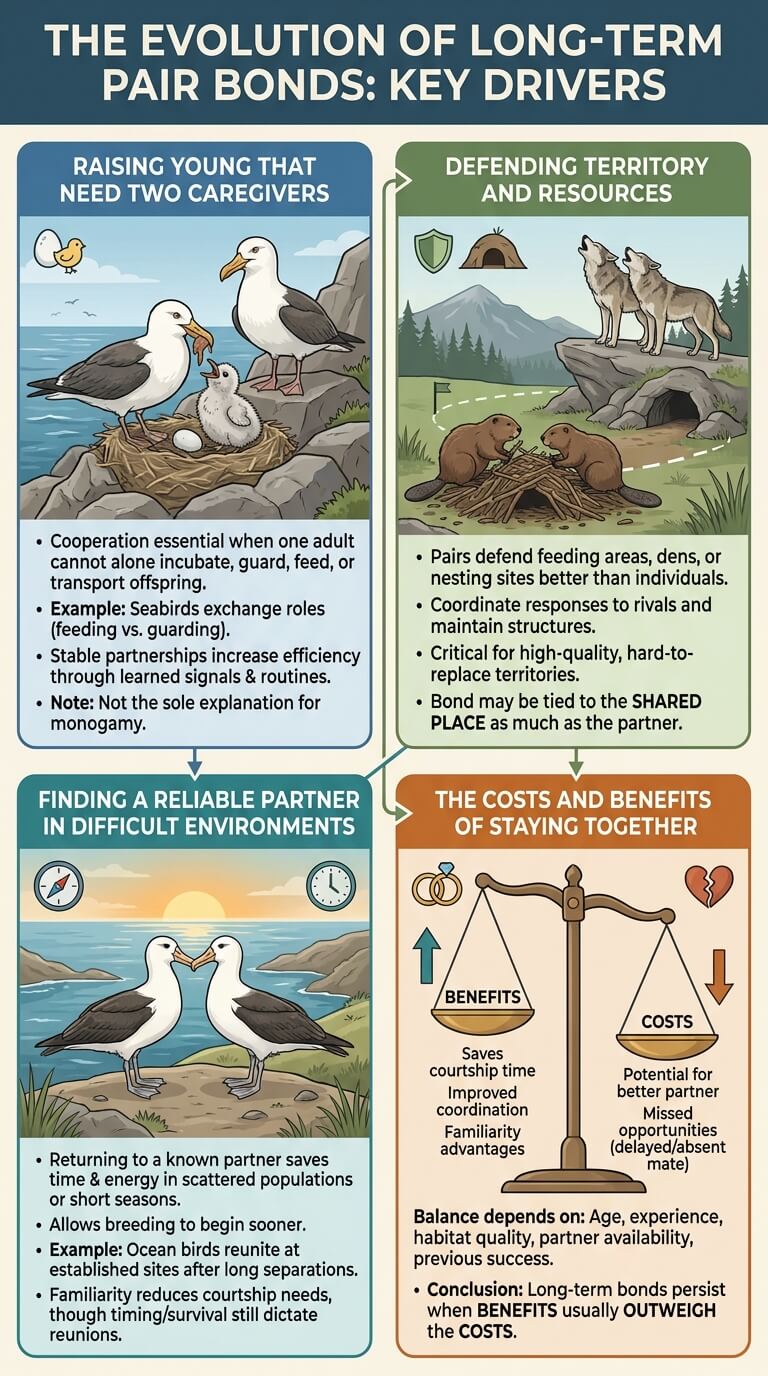
When one adult cannot easily incubate, guard, feed, or transport offspring alone, cooperation can improve the chance that young survive. Seabirds illustrate the value of coordinated care. One bird can remain with an egg or chick while the other travels to feed, then the partners exchange roles. A stable partnership may become more efficient as both animals learn each other’s signals, timing, and routines. Still, two-parent care is only one possible explanation for monogamy and does not occur in every pair-living species.
In many species, cooperation also includes nest building, incubation, guarding, or food delivery, although each partner may perform different tasks.
Defending Territory and Resources
Two animals may defend a feeding area, den, lodge, nesting site, or boundary more effectively than one. A pair can watch for rivals, maintain structures, and coordinate responses to intruders. This is useful when a high-quality territory is difficult to obtain or expensive to rebuild. In such cases, the bond may be tied as strongly to a shared place as to the partner. If one animal disappears, the remaining territory holder may accept a new mate rather than abandon the resource.
Finding a Reliable Partner in Difficult Environments
In widely scattered populations or brief breeding seasons, searching for a new partner can consume time and energy. Returning to a known partner may allow breeding to begin sooner. Long-lived ocean birds often spend much of the year far from their colonies, yet meet again at established breeding sites. Familiarity can reduce the need for repeated courtship and help the pair coordinate demanding care, although arrival timing and survival still determine whether a reunion occurs.
The Costs and Benefits of Staying Together
Keeping the same partner can save courtship time and improve coordination, but it can also carry costs. An unsuccessful pair may produce better results after one or both animals change partners. A delayed or absent mate can cause a missed breeding opportunity. The balance depends on age, breeding experience, partner availability, habitat quality, and previous success. Long-term bonds persist when the benefits of familiarity and cooperation usually outweigh the possible gains from switching.
Animals Commonly Described as Mating for Life
Albatrosses and Other Long-Lived Seabirds
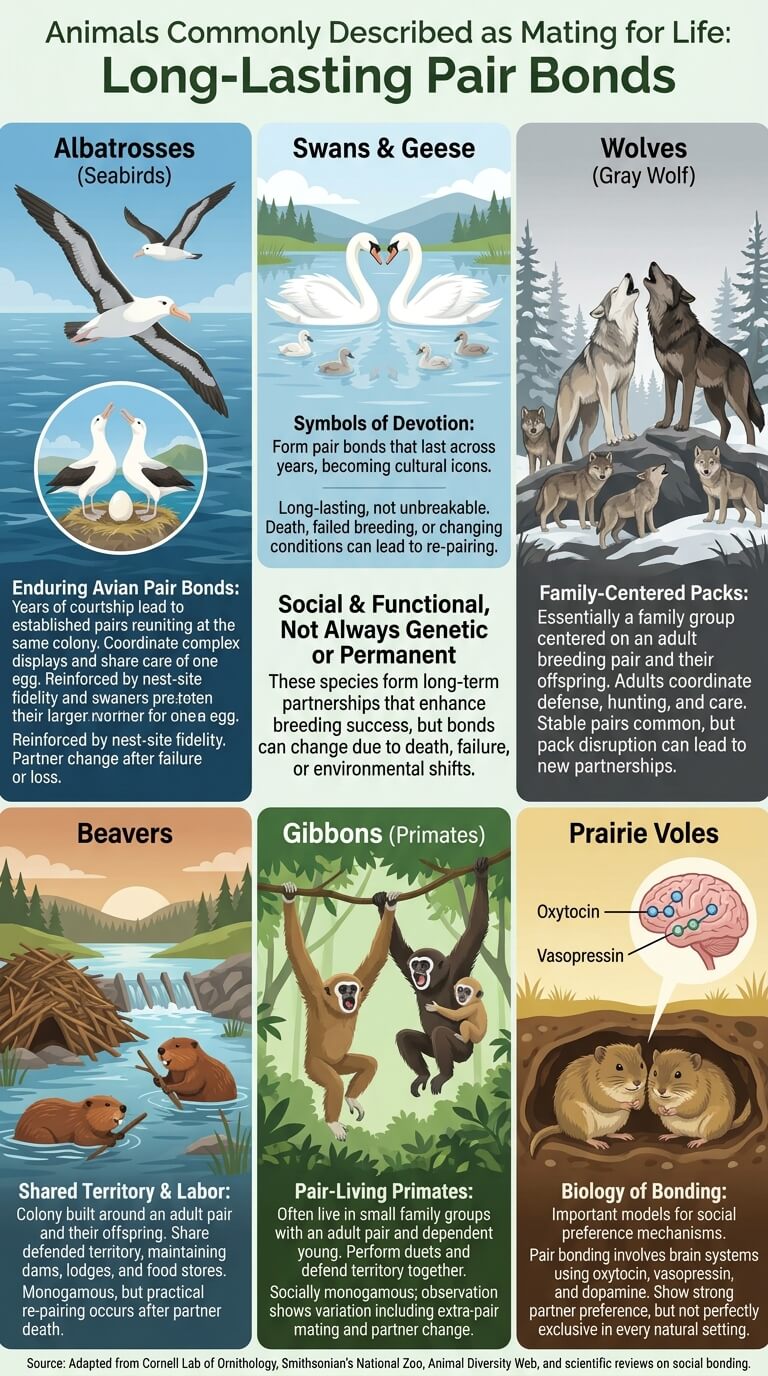
Albatrosses are among the clearest examples of long-lasting avian pair bonds. Young birds spend years learning courtship displays before breeding, and established pairs may reunite repeatedly at the same colony. The Cornell Lab’s Laysan Albatross life history notes that pairs tend to form lasting bonds and coordinate elaborate displays before sharing care of a single egg. Even here, partner change can occur after breeding failure, prolonged absence, or the loss of a mate.
Mate fidelity and nest-site fidelity can reinforce one another. Returning to a familiar colony or territory gives established partners a place to find each other, while repeated breeding lets them refine their timing. That does not mean the birds remain side by side year-round. Many seabird partners forage separately for long periods, so reunion depends on survival, navigation, and arrival at the colony within a workable breeding window.
Swans and Geese
Many swans and geese form pair bonds that last across years, which has helped turn them into cultural symbols of devotion. Mute Swans, for example, are described in the Cornell Lab’s Mute Swan profile as forming long-lasting pair bonds. The careful phrase is long-lasting rather than unbreakable. Death, failed breeding, disappearance, or changing conditions can lead a surviving bird to pair again.
Wolves and Stable Breeding Pairs
A wild gray wolf pack is often a family made up of a breeding pair and offspring from one or more years. The adults coordinate territory defense, travel, hunting, and care of pups, while older young may also contribute. The Smithsonian’s gray wolf profile describes the pack as essentially a family group centered on an adult pair and their offspring. Stable pairs are common, but death, dispersal, and pack disruption can lead to new partnerships.
Beavers and Shared Territory
Beavers commonly live in colonies built around an adult pair, their current kits, and older offspring that have not dispersed. The pair shares a defended territory and benefits from maintaining dams, lodges, food stores, and travel routes over time. The Animal Diversity Web account of American beavers describes them as monogamous and notes that an animal may seek a new mate after its partner dies. This is long-term partnership with practical re-pairing, not permanent widowhood.
Gibbons and Other Pair-Living Primates
Gibbons are often introduced as monogamous apes because many live in small groups containing an adult pair and dependent young. Bonded pairs may duet and defend a territory together. Longer observation and genetic work have revealed more variation than the old stereotype suggests. Some gibbon populations show partner changes, extra-pair mating, or group structures involving more than one adult of a sex. It is safer to describe many gibbons as pair-living and socially monogamous rather than treating every species as genetically exclusive for life.
Duets are especially useful evidence of social coordination, but a duet alone cannot reveal genetic parentage or guarantee a lifelong partnership. Calls may help advertise territory, maintain contact through dense forest, and coordinate the pair’s presence. Scientists combine such observations with long-term identification and genetic evidence when possible, because no single behavior captures the entire mating system.
Prairie Voles and the Biology of Pair Bonding
Prairie voles became important laboratory animals because many form enduring social preferences after mating. Researchers can measure whether a vole chooses to spend time near a familiar partner instead of an unfamiliar animal. A classic review of prairie vole pair bonding discusses the roles of brain systems involving oxytocin, vasopressin, dopamine, and stress hormones. Prairie voles help explain attachment mechanisms, but they should not be portrayed as perfectly exclusive in every natural setting.
Cases That Need More Careful Wording
Penguins That Reunite Seasonally or Change Partners
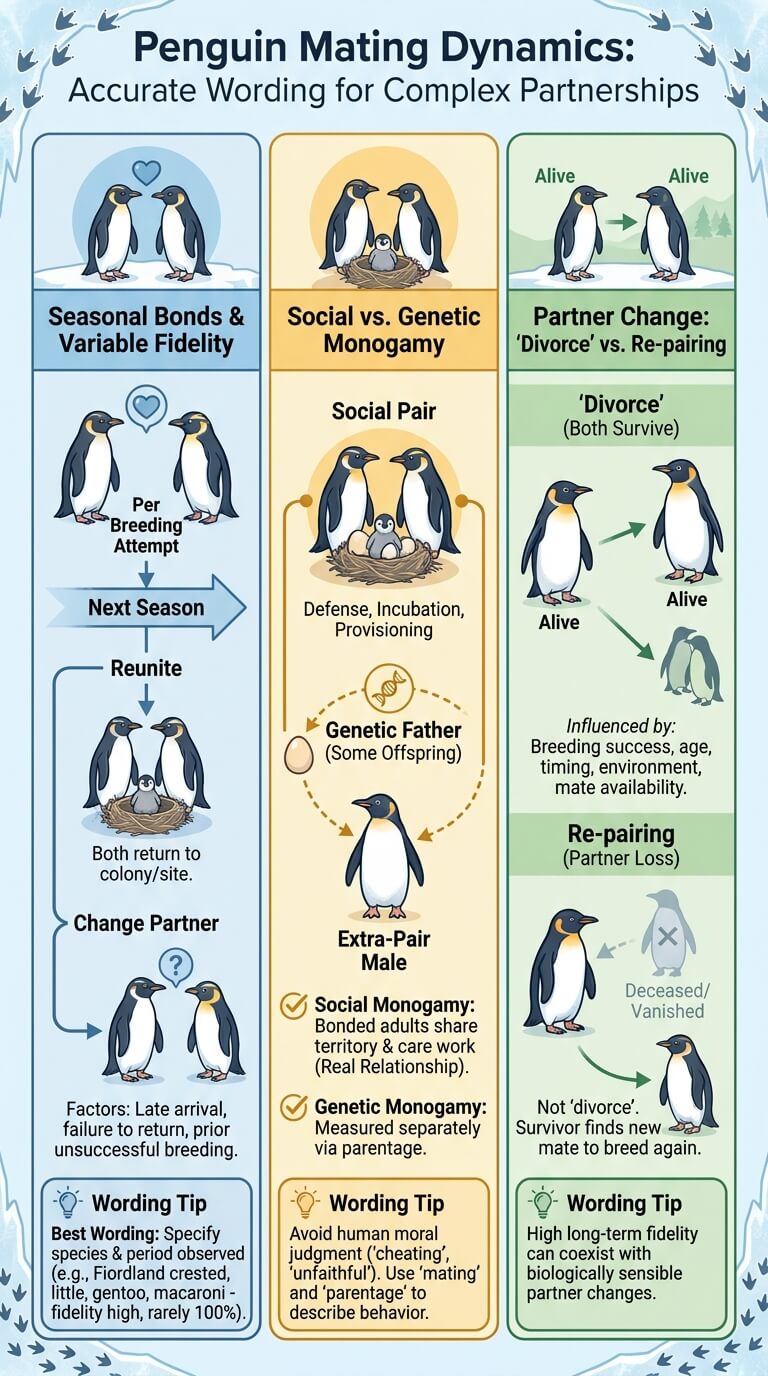
Penguins are often presented as universal lifelong couples, yet the pattern differs among species. Many form one social pair during a breeding attempt, and some reunite in later seasons when both return to the same colony and site. Other pairs change, especially when one partner arrives late, fails to return, or previous breeding was unsuccessful. Studies of Fiordland crested, little, gentoo, macaroni, and other penguins show that mate fidelity can be high without reaching 100 percent. The best wording names the species and the period observed.
Species With Social Partners but Extra-Pair Mating
A bird may share a territory and raise chicks with one partner while some offspring are genetically related to another male. This does not make the social relationship imaginary. The bonded adults may still perform most of the work that defines the pair, including defense, incubation, provisioning, and care. It does show why social monogamy and genetic monogamy must be measured separately. Words such as cheating or unfaithful add human moral judgment to a behavior better described through mating and parentage.
Pairs That Separate After Failed Breeding or Partner Loss
Researchers sometimes use the term divorce when both animals survive but one or both form a new partnership. Rates can be influenced by breeding success, age, arrival timing, environmental conditions, and the number of available mates. If one partner dies or vanishes, re-pairing is not divorce. It may be the only way the survivor can breed again. A species can therefore show high long-term fidelity and still include partner changes that make biological sense.
How Scientists Study Animal Monogamy
Field Observation and Long-Term Tracking
Scientists mark or identify individuals, record which animals share a territory, and follow pairs across breeding seasons. Bands, tags, natural markings, radio transmitters, and remote cameras can help, depending on the species. Long-term work matters because a one-season study cannot distinguish a temporary pair from a bond lasting many years. Researchers must also account for animals that disappear. An absent individual may have died, moved, skipped breeding, or simply escaped detection.
Genetic Parentage Testing
DNA sampling allows researchers to compare social families with biological parentage. Feathers, blood, hair, tissue, or other appropriate samples can reveal whether young were produced by both members of the observed pair. These tests transformed the study of mating systems, especially in birds. They showed that sharing a nest or territory does not guarantee genetic exclusivity. They also revealed species and populations where social and genetic monogamy do align closely.
Parentage data also have limits. A study may include only one colony, a few breeding seasons, or the offspring that survived long enough to be sampled. Results from one population should not automatically be applied to an entire species. The strongest conclusions combine genetics with repeated field observations, because DNA identifies biological parents while behavior shows who defended, incubated, fed, or lived with the young.
Hormones, Brain Circuits, and Pair-Bond Research
Laboratory studies examine how brain signaling affects partner preference, affiliation, aggression toward strangers, and responses to separation. Oxytocin and vasopressin receive much attention, but no single chemical creates a complex social bond by itself. Dopamine, stress systems, sensory cues, previous experience, sex, and species-specific brain organization also matter. Results from prairie voles or other laboratory animals can reveal mechanisms, but they should not be treated as a complete explanation for every bonded species.
Does Mating for Life Mean Equal Parenting?
Shared Care in Some Pair-Bonded Species
Stable pairs often occur where two adults can divide demanding care. Albatross partners alternate long foraging trips and nest attendance. Many geese guard mobile young together. Wolf parents provision and protect pups within a wider family group. Cooperation does not require identical tasks. One animal may incubate or nurse while the other supplies food, guards a boundary, or relieves the partner at critical times.
Unequal Roles Within Stable Pairs
Pair bonding does not erase biological or behavioral differences between partners. In mammals, the female alone provides pregnancy and milk, while the male’s contribution varies greatly among species. In birds, one sex may do most incubation while both feed chicks, or one may defend while the other builds. The relationship can remain stable even when effort is uneven. Measuring care requires tracking time, energy, risk, and the stage of reproduction rather than counting only visible visits.
Monogamy Without Extensive Parental Care
Some animals form pair associations mainly for territory defense, access to resources, or repeated mating, with little care after eggs are laid or young are born. Conversely, some species provide intensive care without long-term monogamy. Parenting and pair bonding can reinforce one another, but neither guarantees the other. Treating them as separate traits makes it easier to understand why similar social systems can evolve for different reasons.
Myth Versus Fact
Myth: A Lifelong Pair Never Mates Outside the Bond
Fact: A pair can remain socially bonded while extra-pair mating occurs. Genetic parentage studies are the only reliable way to test exclusivity. Some species show little extra-pair parentage, while others show enough that social and genetic mating systems receive different labels. The bond may still organize territory, care, cooperation, and daily life even when not every offspring belongs genetically to both partners.
Myth: Every Penguin Keeps One Partner Forever
Fact: Penguin partnerships differ by species and circumstance. Some pairs reunite across several seasons, while others pair with a new animal after separation, late arrival, breeding failure, or partner loss. Emperor and king penguins, for example, face tight seasonal schedules that can favor finding an available partner rather than waiting indefinitely. Saying penguins are often seasonally monogamous is more accurate than saying every penguin mates for life.
Myth: Pair-Bonded Animals Grieve Exactly Like Humans
Fact: Animals may search, call, reduce activity, alter social contact, or show physiological stress after losing a partner. Those responses deserve careful study, but they do not prove that another species experiences loss in exactly the same way a human does. Researchers describe observable behavior and measurable changes rather than assuming an identical inner experience. Compassion and scientific caution can exist together.
Edge Cases and Exceptions
Same-Sex Pair Bonds and Cooperative Partnerships
Pair bonds are not limited to male-female pairs. Female Laysan Albatrosses have been documented forming long-term cooperative pairs and raising a chick together in populations with more females than males. Same-sex partnerships and parenting have also been observed in other birds and mammals. Their function varies by species and setting, so they should not be reduced to one universal explanation. They demonstrate that a social pair is defined by behavior and cooperation, not only by reproduction between the partners.
Widowed Animals That Re-Pair
When a partner dies, the survivor’s response depends on species, age, season, and opportunity. Some animals may skip breeding while maintaining a territory or waiting for a partner. Others form a new bond quickly. Re-pairing does not mean the previous partnership was weak. Natural selection favors behavior that works under current conditions, and a new partner may restore the cooperation needed to breed or defend resources.
Flexible Mating Systems That Change With Ecology
Mating systems are not always fixed labels applied evenly across a species. Food distribution, population density, sex ratio, predator pressure, habitat fragmentation, and breeding synchrony can change the costs and benefits of pair living. A species may be mostly monogamous in one population but show more partner sharing or switching in another. This flexibility is one reason broad claims should be checked against the species, place, and time period being discussed.
Pair Bonds Within Parenting and the Animal Life Cycle
Pair Bonds as One Possible Parenting Strategy
A stable partnership can make prolonged care possible when young need guarding, feeding, warmth, transport, or instruction. It is not the only successful strategy. Some animals rely on one parent, cooperative groups, nests that protect unattended eggs, or many offspring with little direct care. Pair bonding is best understood as one solution among many, shaped by the needs of the young and the challenges adults face.
Why Life Span and Breeding Timing Affect Bond Duration
A bond can last only as long as both partners survive and continue to breed. Long-lived animals may have years to benefit from improved coordination with the same mate. Short-lived species can be socially monogamous for an entire life even if the actual partnership lasts only one season. Migration and synchronized breeding also matter. Partners must arrive at the right place and time, or the cost of waiting may exceed the benefit of reunion. Pair bonds also fit within the animal life cycle because their duration depends on maturity, breeding seasons, survival, and opportunities to reproduce.
FAQ
Do Swans Really Mate for Life?
Many swans form long-lasting pair bonds and may remain with the same partner for many years. That makes the phrase reasonable as a general description, but not as an absolute rule. A swan may re-pair after a mate dies, disappears, or after a partnership ends. Species and populations can also differ in how often partners remain together.
Do Wolves Stay With One Mate?
Gray wolf packs are commonly organized around a stable breeding pair and their offspring. The pair may remain together for years while leading a family group. If one breeding adult dies or the pack breaks apart, the survivor may form a new pair. Wolves therefore provide a strong example of long-term social monogamy, not a guarantee that every individual has only one partner in its lifetime.
Are Any Animals Completely Monogamous?
Some species and populations show very high social and genetic monogamy, but the word completely is difficult to prove. Researchers need long-term observation and genetic parentage data from many individuals. Even a species with strong pair fidelity may include rare extra-pair mating, partner loss, or re-pairing. It is usually more accurate to report the measured pattern than to claim perfect exclusivity.
What Happens When a Lifelong Mate Dies?
The surviving animal may call, search, change its activity, remain alone for a period, skip breeding, or form a new partnership. The response varies greatly. In species that depend on two adults for reproduction or territory defense, re-pairing can be especially useful. Scientists avoid assuming every response matches human mourning, but they can document behavioral and physiological changes after partner loss.
Final Thoughts
Animals that mate for life are better understood as animals that form stable pair bonds, sometimes for one season and sometimes for many years. Albatrosses, swans, wolves, beavers, gibbons, prairie voles, and several other animals show important forms of social monogamy, but the details differ. A shared territory does not automatically prove genetic exclusivity, and a long partnership does not prevent re-pairing after death or separation. The useful question is not simply whether an animal is faithful. It is how the partnership works, how long it lasts, and what survival or reproductive problem it helps the pair solve.

Ethan Walker is the founder and research editor of Animal Fact Central. He creates and reviews educational animal facts content using trusted wildlife, pet care, and science-based sources. His work focuses on making animal behavior, adaptations, habitats, and species facts clear, accurate, and engaging for everyday readers.
Read More Details About Ethan Walker: https://animalfactcentral.com/ethan-walker/