

Overfishing affects ocean animals by removing fish and other marine life faster than some populations can replace themselves. The most obvious result is fewer target animals, but the damage can spread much farther. Predators may lose prey, prey species may shift out of balance, seafloor habitats can be disturbed by certain gear, and slow-growing animals may take years or decades to recover.
Fishing itself is not automatically destructive. The problem starts when pressure becomes too high for a population, habitat, or food web to absorb.
Quick Answer

Overfishing happens when fishing removes animals from a population at a rate that is too high for that population under current conditions. In practical terms, that can mean fewer breeding adults, smaller average fish, lower reproductive output, and weaker recovery after storms, warming events, disease, or habitat loss.
Ocean animals feel those effects in different ways. A heavily fished species may decline directly. A seabird, seal, dolphin, large fish, or whale may be affected indirectly if prey becomes harder to find. Reef animals may suffer when key grazing fish are depleted and algae grows more freely. Bottom-dwelling animals can be affected when fishing gear repeatedly disturbs seafloor habitat.
The good news is that overfishing is not mysterious. It can be measured, managed, and in many cases reduced. NOAA Fisheries describes stock status through terms such as overfishing, overfished, and rebuilt in its Status of Stocks report, which shows why careful definitions matter.
What Overfishing Means
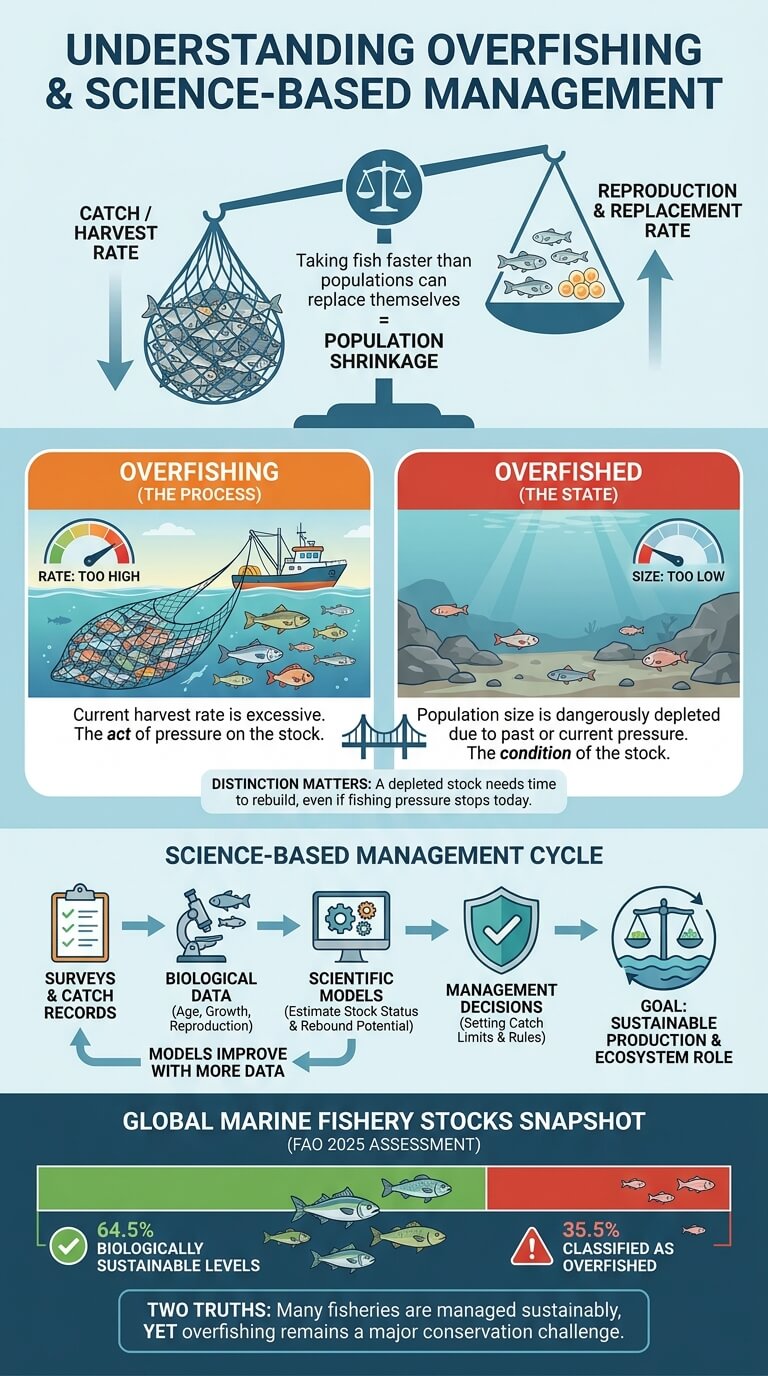
Overfishing is often used in casual language to mean “too much fishing,” but fishery managers use it more carefully. The details matter because a fish population can be low for several reasons, including past fishing, habitat change, pollution, disease, climate shifts, or a mix of pressures.
Taking fish faster than populations can replace themselves
A fish population replaces itself through reproduction and survival of young animals. If adults are removed faster than enough young fish can grow into breeding age, the population can shrink. That shrinkage may not be obvious at first because fishing boats can still find fish by using better technology, traveling farther, or targeting the remaining dense groups.
For ocean animals, the key issue is not just how many fish are caught in one trip. It is how total fishing pressure compares with the population’s ability to replace losses. A fast-growing fish with many young may withstand more pressure than a slow-growing species that matures late. Deep-sea fish, some large reef fish, and certain long-lived predators are often more vulnerable because their life histories do not support fast rebound.
Overfished vs overfishing
Overfishing and overfished do not mean the same thing. Overfishing refers to a harvest rate that is too high. Overfished refers to a population size that is too low. A stock can be experiencing overfishing now, or it can be overfished because of earlier pressure or other stressors.
This distinction helps readers avoid a common mistake. If fishing pressure is reduced today, a depleted population may still need time to rebuild. Likewise, a population that is not currently overfished can still be at risk if catch levels rise beyond what science-based management recommends.
Why definitions depend on science-based management
Fishery scientists estimate stock status with surveys, catch records, age and growth studies, reproduction data, and models. Those models are not magic, and they improve as more information becomes available. Still, they help managers answer the basic animal question: can this population keep producing young and playing its role in the ecosystem if fishing continues at this level?
On a global scale, the Food and Agriculture Organization reported in 2025 that 64.5 percent of assessed marine fishery stocks were exploited within biologically sustainable levels, while 35.5 percent were classified as overfished in its global assessment of marine fish stocks. Those figures show two truths at the same time: many fisheries are managed sustainably, and overfishing remains a major conservation problem.
How Overfishing Affects Target Species
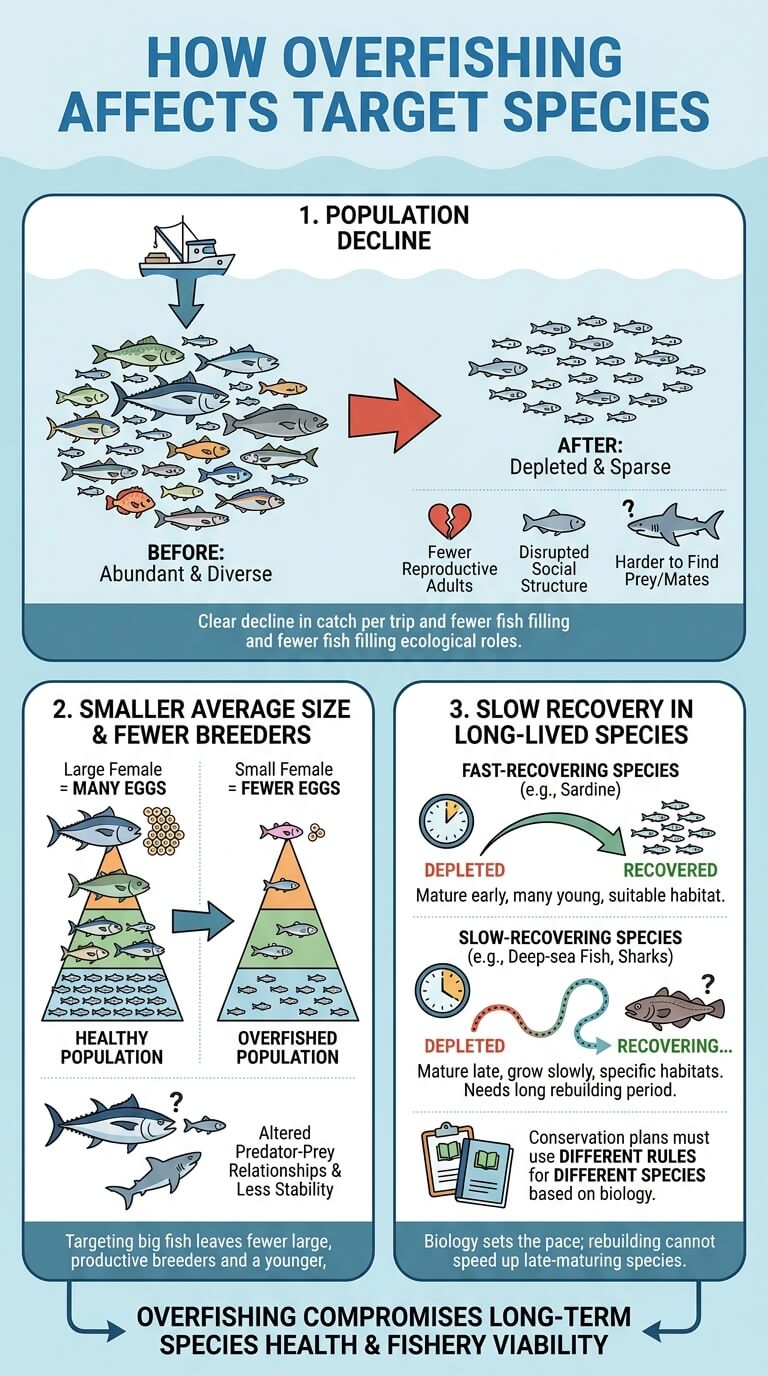
The animals most directly affected by overfishing are the target species. These are the fish, shellfish, or other marine animals that a fishery is trying to catch. When pressure is too high, the population can lose abundance, age structure, and resilience.
Population decline
Population decline is the clearest effect. If too many animals are removed, fewer remain to reproduce, hold territory, migrate, school, or fill their ecological role. In a fishery, the decline may appear as lower catch per trip, smaller catches near shore, longer travel distances, or fewer older fish in surveys.
For animals, lower numbers can change daily life. Schools may become smaller. Predators may search longer for prey. Breeding groups may become less reliable. In species that gather to spawn, intense fishing around spawning aggregations can remove many breeding adults in a short time.
Smaller average body size and fewer breeding adults
Many fisheries select larger animals because they are easier to sell, easier to see, or more likely to be caught by certain gear. Over time, heavy pressure on large individuals can leave a population with fewer big breeders. This matters because in many fish species, larger females can produce more eggs than smaller females.
Smaller average body size can also alter predator-prey relationships. A predator that once ate large prey may have to switch to smaller prey or spend more energy hunting. A fish population made mostly of younger animals may also be less steady from year to year because young fish often have more variable survival.
Slow recovery in long-lived species
Some ocean animals can recover quickly when pressure is reduced, especially if they mature early, produce many young, and still have suitable habitat. Others recover slowly. Species that grow slowly, mature late, or live in deep or cold habitats may need a long rebuilding period after heavy fishing.
Slow recovery does not mean recovery is impossible. It means the biology of the animal sets the pace. A rebuilding plan can reduce fishing pressure, but it cannot make a late-maturing species reproduce like a sardine. This is why conservation plans often use different rules for different species instead of treating every fish as if it has the same life cycle.
How Overfishing Changes Ocean Food Webs
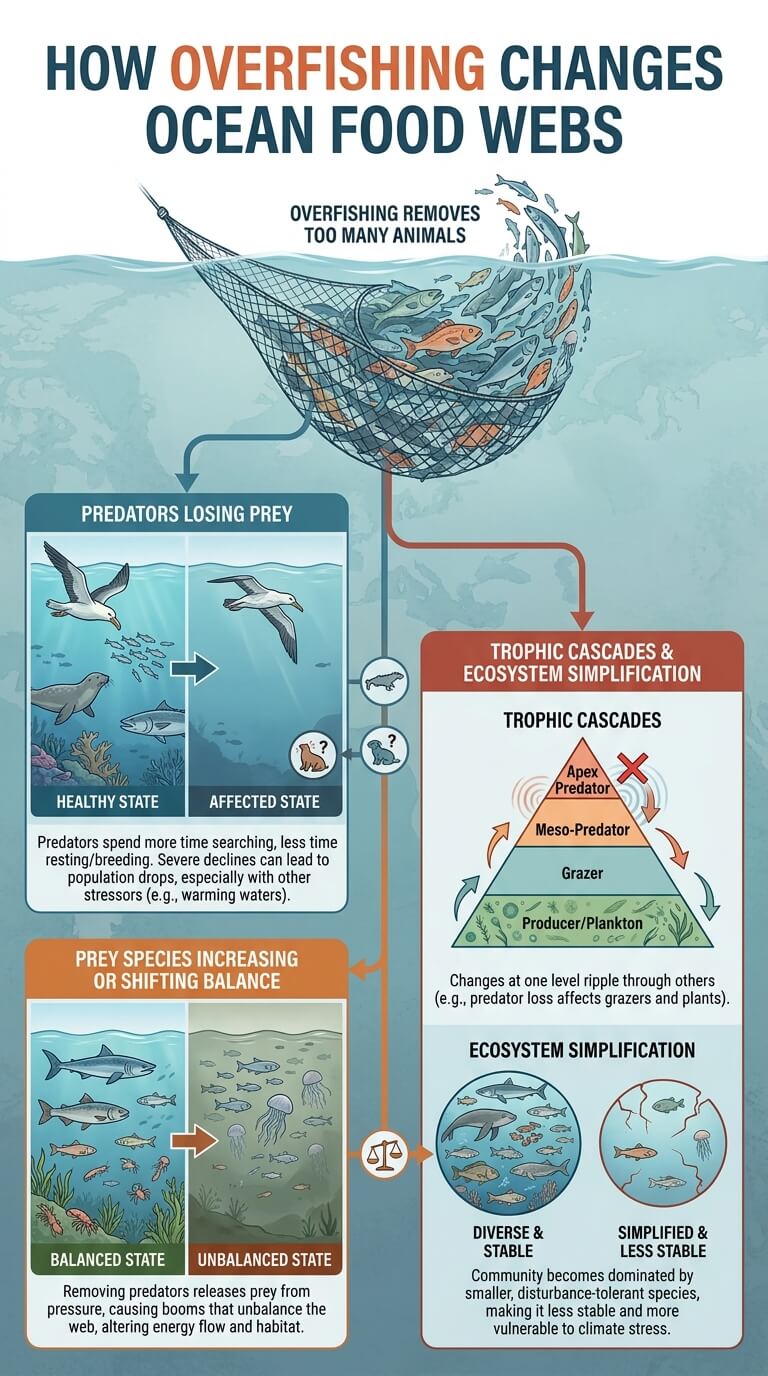
Ocean animals do not live as isolated populations. They live in food webs, which are feeding relationships among predators, prey, grazers, scavengers, plankton, and decomposers. When fishing removes too many animals from one part of the web, effects can spread in several directions.
Predators losing prey
Many marine predators depend on dense, predictable prey. Seabirds may need small schooling fish near the surface. Seals and dolphins may follow seasonal fish movements. Larger fish may rely on forage fish, squid, or juvenile fish. When prey populations are reduced, predators may spend more time searching and less time resting, breeding, or feeding young.
The impact is not always simple. A predator might switch prey, move to another area, or tolerate a temporary dip. Problems grow when prey declines are severe, long-lasting, or combined with warming waters, breeding stress, pollution, or habitat change.
Prey species increasing or shifting balance
Removing predators can also release prey from pressure. If large predatory fish decline, smaller fish or invertebrates may increase in some places. That might sound positive, but a food web can become less balanced when one group expands because its predators are missing.
These shifts can change what young animals eat, where they hide, and how energy moves through the ecosystem. A simplified food web may still contain animals, but it may not support the same diversity, body sizes, or feeding relationships that existed before heavy fishing.
Trophic cascades and ecosystem simplification
A trophic cascade happens when a change at one feeding level affects other levels. In the ocean, this can involve predators, grazing fish, algae, plankton, or bottom-dwelling animals. Not every fishery creates a cascade, and scientists are careful about proving cause and effect. Still, the idea is useful because it reminds us that removing animals can reshape more than the target population.
Ecosystem simplification is another concern. When large, old, or specialized animals decline, the remaining community may be dominated by smaller, faster-growing, or more disturbance-tolerant species. That can make an ecosystem less stable, especially when it faces climate stress or habitat damage at the same time.
Effects on Other Ocean Animals
Overfishing can affect animals that are not being targeted. Some feel the impact through food shortages. Others are affected because fishing changes habitat structure or because the same fishery also involves accidental capture. These effects are related, but they are not all the same problem.
Seabirds and marine mammals that rely on fish
Seabirds, seals, sea lions, dolphins, and some whales can depend on fish or squid that are also important to fisheries. When prey availability drops, these animals may need to travel farther or switch to less suitable food. Breeding adults may have a harder time feeding chicks or pups if prey is not close enough to nesting or resting sites.
This does not mean every local prey decline is caused only by fishing. Ocean temperature, currents, natural cycles, and prey movement all matter. But heavy fishing pressure can add another stress, especially when predators need prey during a narrow breeding season.
Reef animals and grazing balance
Coral reefs can be sensitive to fishing pressure because reef fish do more than provide food for people and predators. Some graze algae, some eat invertebrates, some clean other fish, and some move nutrients around the reef. When key species are depleted, the reef can lose important functions.
NOAA Ocean Service explains that unsustainable fishing on reefs can deplete key species and that some gear can damage coral reefs, seagrass beds, and other important habitats in its coral reef overfishing explanation. This is why reef fishery management often pays attention not only to catch numbers, but also to the roles different fish play.
Scavengers and bottom-dwelling animals
Scavengers and bottom-dwelling animals can be affected in complicated ways. Some scavengers may temporarily benefit from discarded fish or disturbed prey. But repeated disturbance can reduce habitat quality for animals that live on or in the seafloor, including worms, crabs, brittle stars, sponges, corals, and juvenile fish.
Bottom habitats are not empty mud. Many are living neighborhoods where small animals hide, feed, reproduce, and become food for larger species. When those habitats are simplified, the animals that depend on them may lose shelter or feeding places.
Habitat Damage and Fishing Pressure
Overfishing is mainly about harvest pressure, but fishing pressure can also affect habitats. Gear type, location, depth, and frequency all matter. A hook-and-line fishery, a purse seine fishery, a trap fishery, and a bottom trawl fishery do not interact with habitats in the same way.
Bottom trawling and seafloor habitats
Bottom trawling involves towing gear along or near the seafloor. In some soft-bottom areas, effects may be different from effects on rocky reefs, deep-sea coral, sponge gardens, or other structured habitats. The largest concerns arise when heavy or repeated bottom contact occurs in places where living structures grow slowly or provide shelter for many animals.
NOAA’s Greater Farallones National Marine Sanctuary describes seafloor conservation areas where locations with higher densities of corals, sponges, sea pens, and sea whips were closed to bottom trawling as part of seafloor habitat conservation. That kind of action shows how managers can reduce habitat risk without assuming every fishing method has the same impact.
Coral and sponge communities
Deep-sea corals and sponges can create three-dimensional habitat for fish and invertebrates. These communities often grow slowly, and recovery after disturbance can be slow or uncertain. When fishing gear damages them, the effect is not just the loss of a few attached animals. It can also reduce shelter for the fish and invertebrates that use those structures.
NOAA Fisheries notes that Alaska deep-sea coral and sponge communities provide habitat for important commercial fish and are vulnerable to damage from commercial fishing gear in its deep-sea coral and sponge research. This is a good example of how fishery management and habitat conservation can support each other.
Why gear type matters
Gear type matters because the same amount of seafood can come with very different ecological effects depending on how it is caught. Some gear is highly selective. Some gear has more contact with the seafloor. Some gear has higher risk of accidental capture. Some gear is easier to monitor than others.
That is why responsible management often focuses on practical details: where gear can be used, how much can be caught, what sizes can be kept, how lost gear is reduced, and how fishing effort is tracked. The goal is not to make a simple good-or-bad label. The goal is to match fishing pressure to what animal populations and habitats can actually sustain.
Overfishing vs Bycatch: Related but Different
Overfishing and bycatch can happen in the same fishery, but they describe different problems. Keeping the distinction clear helps readers understand why solutions vary.
Too many target animals vs accidental capture
Overfishing is about catching too many of the animals a fishery is trying to catch, or catching them at a rate that is too high. Bycatch is about catching animals that were not the intended target. A fishery can have a target stock problem, a bycatch problem, both problems, or neither.
For example, a fishery could catch its target species at a sustainable level but still accidentally capture protected animals. Another fishery could have low bycatch but still remove too many target fish. The animal outcome matters more than the label.
How one fishery can involve both problems
A fishery can affect ocean animals in more than one way. It might reduce a target fish population, catch non-target species, and disturb habitat. These pressures can add up, especially when the affected animals are slow-growing, already depleted, or stressed by warming water and habitat change.
This is why fishery management often uses several tools at once. A catch limit may address overfishing. A gear modification may reduce bycatch. A closed area may protect a spawning site or sensitive seafloor habitat. One tool rarely solves every animal impact by itself.
Why solutions are not identical
Because overfishing and bycatch are different, their solutions are not identical. Reducing overfishing usually requires controlling total fishing mortality on a target population. Reducing bycatch may require gear changes, avoidance of certain areas, real-time reporting, or release practices that improve survival.
Both problems require monitoring. Without reliable data, managers cannot tell whether fewer animals are being caught because the rules are working, because fishing effort changed, or because the population has already declined.
Tools That Help Reduce Overfishing

Overfishing can sound like an unstoppable ocean problem, but many tools are designed to prevent it or help depleted populations rebuild. The strongest programs combine biological science, enforcement, fishing community knowledge, and ongoing adjustment as conditions change.
Catch limits and size rules
Catch limits set a maximum amount that can be caught during a period. Size rules can protect young animals until they have a better chance to reproduce, or in some cases protect large breeders. These rules work best when they are based on up-to-date data and paired with monitoring.
NOAA Fisheries describes U.S. fish stock reporting as part of an adaptive process that relies on science, management, enforcement, and partnerships in its Status of Stocks reports. That kind of system is important because ocean conditions, fishing effort, and animal populations all change over time.
Seasonal and area closures
Seasonal closures can protect animals when they gather to spawn, migrate, or use nursery areas. Area closures can protect sensitive habitats, young fish, or places where vulnerable animals are more likely to be caught. These tools are most useful when they match real animal behavior.
A closure that protects a spawning aggregation can help breeding adults survive long enough to reproduce. A closure that protects a nursery habitat can help young fish grow. A closure that protects deep coral or sponge habitat can preserve shelter for bottom-associated species.
Gear changes and monitoring
Gear changes can make fishing more selective or reduce habitat contact. Monitoring can include onboard observers, electronic monitoring, logbooks, vessel tracking, port sampling, and scientific surveys. Each method has limits, but together they help turn fishing from guesswork into managed pressure.
Marine protected areas as one tool, not a magic fix
Marine protected areas can protect habitats, spawning sites, nursery areas, or whole ecosystems from some kinds of fishing pressure. They can be especially useful when animals stay in one place or use predictable habitats. They are less complete as a solution for highly migratory species that spend much of their lives outside protected boundaries.
Protected areas work best when they are well designed, enforced, and paired with catch controls outside their borders. A protected reef can still be affected by warming, pollution, storms, and fishing pressure just outside the area. A mobile fish population may need both habitat protection and fishery-wide harvest limits.
Common Mistakes or Myths About Overfishing
Overfishing is easy to oversimplify. Some myths make the problem seem less serious than it is. Others make it seem hopeless or blame all fishing in the same way. Neither approach helps ocean animals.
Myth: the ocean is too big to run out of fish
The ocean is enormous, but fish populations are not evenly spread through it. Many species gather along shelves, reefs, upwelling zones, migration routes, spawning areas, and nursery habitats. Fishing often focuses on those productive places because that is where animals are catchable.
A local or regional stock can decline even when the ocean as a whole still looks vast. This is why stock assessments focus on defined populations, not just a general idea of “fish in the sea.” For an animal population, the relevant question is whether enough breeding adults remain in the right area at the right time.
Myth: farmed seafood always solves overfishing
Aquaculture can reduce pressure on some wild fisheries, but it is not automatically a complete solution. Some farmed species need feed ingredients, clean water, disease management, habitat safeguards, and responsible siting. Poorly managed aquaculture can create its own environmental problems.
Myth: all fishing is equally harmful
Fishing methods differ widely. A well-managed fishery with strong monitoring, science-based limits, and selective gear can have a very different animal impact from an unmanaged fishery that removes too many breeders, damages habitat, or catches vulnerable non-target species.
Blaming all fishermen also misses an important point. Many fishing communities depend on healthy animal populations for their future. Sustainable management is not just about protecting wildlife from people. It is about keeping ocean ecosystems productive enough for animals and coastal communities to continue living with them.
Why This Issue Matters Across the Ocean
Overfishing rarely acts alone. It can interact with warming water, pollution, reef decline, bycatch, habitat loss, and weak enforcement. Understanding those overlaps helps explain why ocean conservation often needs several actions at once.
Coral reef stress
On coral reefs, overfishing can remove important grazers or predators and make the reef less able to handle other stresses. If algae grows faster than grazing animals can control it, young corals may have less space to settle. If fishing gear damages reef structure, shelter for fish and invertebrates can decline.
This does not mean fishing is the only threat to coral reefs. Heat stress, disease, coastal development, pollution, and storms also matter. But reducing unsustainable fishing is one local action that can support reef animals while larger climate and water-quality problems are addressed.
Whales and seabirds need healthy prey populations
Many whales and seabirds do not eat the same seafood species people buy at a grocery store, but they may rely on forage fish, squid, or schooling fish that are also affected by fisheries. When prey becomes scarce or shifts location, predators may spend more energy feeding.
For animals that breed in a specific place, timing matters. A seabird colony may need fish close to the nesting area while chicks are growing. A marine mammal may need enough prey during migration or nursing. Healthy prey populations help those predators do more than survive; they help them reproduce successfully.
Bycatch and protected areas fit into fishery conservation
Bycatch and protected areas are closely related to the overfishing conversation, but they should not be collapsed into one idea. Bycatch focuses on accidental capture. Protected areas focus on reducing certain human activities in defined places. Overfishing focuses on whether harvest pressure is too high for a population.
Strong conservation often uses all three ideas. A fishery may need a catch limit for target species, gear changes for non-target animals, and closed areas for spawning or habitat protection. The best solution depends on the animals, the gear, the place, and the evidence.
FAQ
What animals are most affected by overfishing?
The animals most directly affected are the target species being caught too quickly, such as fish or shellfish populations under heavy pressure. Indirectly affected animals can include seabirds, marine mammals, larger predatory fish, reef animals, scavengers, and bottom-dwelling species that depend on the same prey or habitat.
Risk is usually higher for species that mature late, grow slowly, gather predictably to spawn, or depend on habitats that are also disturbed by fishing gear. Local conditions matter, so it is more accurate to ask which population is under pressure than to assume every species in a group is affected equally.
Is overfishing the same as bycatch?
No. Overfishing means fishing pressure on a target population is too high or has helped push the population too low. Bycatch means animals are caught accidentally while fishing for something else. They can happen together, but they are different problems.
A fishery can have sustainable catch levels for its target species and still have a bycatch concern. Another fishery can have little bycatch but still take too many target animals. Different problems need different tools.
Can fish populations recover from overfishing?
Yes, some fish populations can recover when fishing pressure is reduced and the habitat remains suitable. Recovery may involve catch limits, rebuilding plans, closed areas, size rules, and better monitoring. The recovery timeline depends on the species, the severity of depletion, reproduction, survival of young fish, climate conditions, and enforcement.
Fast-growing species may respond more quickly than long-lived species that mature late. A population may also recover slowly if habitat damage, warming waters, pollution, or weak management continue to limit survival.
How does overfishing affect coral reefs?
Overfishing can affect coral reefs by removing fish that graze algae, control other animals, recycle nutrients, or support reef food webs. When important reef species decline, the reef may become less balanced and less able to handle other stresses.
Some fishing gear can also damage coral, seagrass, and sponge habitats. Reef impacts are usually worse when overfishing is combined with heat stress, poor water quality, storms, disease, or coastal development.
Final Thoughts
How overfishing affects ocean animals depends on the species, the gear, the place, and the strength of management. At its core, the problem is simple: when animals are removed faster than populations and habitats can handle, the effects spread through breeding, food webs, predator survival, seafloor structure, and reef balance.
The most useful takeaway is not that all fishing is bad. It is that ocean animals need fishing pressure to stay within biological limits, and they need habitats and food webs healthy enough to support recovery. Science-based catch limits, selective gear, monitoring, seasonal closures, habitat protection, and well-designed protected areas can all help keep marine life productive for the long term.

Ethan Walker is the founder and research editor of Animal Fact Central. He creates and reviews educational animal facts content using trusted wildlife, pet care, and science-based sources. His work focuses on making animal behavior, adaptations, habitats, and species facts clear, accurate, and engaging for everyday readers.
Read More Details About Ethan Walker: https://animalfactcentral.com/ethan-walker/