

Whales are important to the ocean because they move nutrients, shape food webs, support deep-sea life after death, and can help ocean ecosystems store carbon over long periods. They are not just large animals passing through the water. Their feeding, diving, migration, waste, and carcasses all move energy and nutrients through the sea.
The answer also depends on the kind of whale. A blue whale filtering krill, a sperm whale diving for squid, and a gray whale feeding near the seafloor do not affect the ocean in exactly the same way. Still, whales matter because their bodies and behaviors connect the surface ocean, deep ocean, coastal waters, polar feeding grounds, and warm breeding areas.
Quick Answer

Whales help the ocean by moving nutrients from deep water to the surface, feeding predators and scavengers, influencing prey populations, transporting nutrients during migration, and creating whale falls that feed deep-sea communities. Some whales also store carbon in their bodies and may help support phytoplankton, the tiny drifting organisms that form the base of many marine food webs.
That does not mean whales can fix climate change by themselves. Their ecological role is real, but it is complex. The most accurate way to think about whales is that they are large, mobile ecosystem participants. When whale populations are reduced, the ocean loses more than individual animals. It can lose nutrient movement, feeding interactions, deep-sea food pulses, and cultural knowledge passed through whale groups.
Whales as More Than Big Marine Mammals
Whales belong to the larger group of marine mammals called cetaceans, which also includes dolphins and porpoises. A NOAA Fisheries overview of whales explains that whales occur in every ocean and include both baleen whales and toothed whales. That variety matters because different whales feed, dive, migrate, and interact with food webs in different ways.
Many people picture whales mainly as gentle giants or spectacular animals to watch from a boat. Those images are not wrong, but they miss the ecological story. A whale is also a predator, a nutrient mover, a breathing mammal that dives through layers of water, and eventually a large body of organic material that can feed deep-sea animals.
Different whale groups and feeding styles
Baleen whales filter small prey from seawater using baleen plates rather than teeth. Depending on the species, they may eat krill, copepods, small schooling fish, or other tiny animals. Humpback whales may lunge through schools of fish or krill. Gray whales are known for feeding near or on the seafloor in some areas. Blue whales specialize heavily on krill.
Toothed whales, including sperm whales, beaked whales, belugas, and many smaller cetaceans often grouped with whales, use teeth to catch prey such as fish, squid, or other marine animals. Sperm whales are famous for deep dives in search of squid. These feeding differences change how each whale species affects its surroundings.
A whale that filters krill near the surface has a different ecological footprint from a whale that dives deep for squid. Both can move nutrients, but they do so through different pathways. That is why it is more accurate to talk about whale roles rather than one single whale role.
Why size changes ecological impact
Whales are unusually influential partly because they are large. A large animal eats more, produces more waste, carries more nutrients in its body, and leaves behind a much larger carcass than a small fish or invertebrate. Size also allows many whales to migrate long distances between feeding and breeding areas.
Large body size can make whales important even when they are not extremely abundant. One whale may move through different water layers in a day and across ocean basins in a season. Over a lifetime, that animal can connect habitats that seem separate to a human observer.
Size also changes the effect of death. When a tiny animal dies, it may be eaten quickly or decomposed in the upper ocean. When a large whale sinks, it can deliver a concentrated food pulse to the seafloor. That event can matter for animals living in deep places where food is often limited.
Migratory lives across ocean regions
Many large whales migrate between rich feeding areas and warmer breeding or calving areas. This movement is not just a travel story. A whale that feeds heavily in one region can carry nutrients in its body and release waste along the way or in a different region.
Migration also means whales depend on many habitats during a single year. Feeding grounds, breeding areas, coastal corridors, offshore routes, and resting areas can all be part of one whale’s life. Damage in one part of that route can affect the animal elsewhere.
The Whale Pump Explained

The whale pump is a simple name for a powerful idea: whales can move nutrients upward through the water. Some whales feed at depth and return to the surface to breathe, digest, and release waste. That waste can contain nutrients such as nitrogen, phosphorus, and iron, which can be useful to plankton in sunlit surface waters.
NOAA Fisheries describes this process in its discussion of whales and carbon sequestration, noting that whales can store carbon in their bodies and transport nutrients that benefit ocean food chains. The important point is not that whale waste is magical. It is that whales move materials between parts of the ocean that would otherwise be less directly connected.
Feeding at depth and releasing nutrients near the surface
The surface ocean receives sunlight, so it is where phytoplankton can photosynthesize. Photosynthesis is the process of using light energy to turn carbon dioxide and water into living matter. But sunlight alone is not enough. Phytoplankton also need nutrients.
Some whales dive below the surface to feed, then return upward because they breathe air. When they release waste near the surface, nutrients from deeper prey can become available in brighter water. In nutrient-limited areas, even small inputs can matter locally, especially near feeding aggregations where many animals are active.
How nutrients can support plankton growth
Phytoplankton are tiny, but they are not minor. They form the base of many ocean food webs. When conditions are right, nutrients released near the surface can help plankton grow. That growth can support zooplankton, krill, larval fish, schooling fish, and larger predators.
The whale pump is easiest to picture with a diving whale, but nutrient movement can also happen horizontally. Migrating whales may feed in one region and release waste in another. This movement is sometimes described as a kind of whale conveyor belt because nutrients are carried across distance, not just up and down.
What scientists know and what should be stated carefully
Scientists have strong reasons to see whales as nutrient movers, but the size of the effect can vary by species, location, season, and whale abundance. A feeding hotspot with many whales may experience a more noticeable local effect than an area where whales pass through briefly.
It is also easy to exaggerate the idea. Whale waste does not automatically create huge plankton blooms everywhere whales swim. Nutrients are only one part of plankton growth. Light, water mixing, temperature, grazing by other animals, and ocean chemistry also matter.
The careful version is the most useful one: whales can contribute to nutrient cycling, especially through diving, feeding, migration, and waste release. That contribution is one reason whale recovery can matter for whole ecosystems, not just for whale lovers.
Whales in Ocean Food Webs

Whales sit inside food webs, not above them. Some whales are major predators of small animals. Some compete with or feed alongside fish, seabirds, seals, and other marine predators. Calves and weakened animals may be vulnerable to predators such as orcas. Dead whales support scavengers and deep-sea life.
A food web is a network of feeding relationships. Whales can affect that network as consumers, prey, nutrient carriers, and carcasses. Their importance comes from all of those roles together.
Baleen whales and krill
Baleen whales can consume huge amounts of small prey when feeding conditions are good. The NOAA Fisheries blue whale profile notes that blue whales feed almost entirely on krill and that some of the largest individuals may eat up to 6 tons of krill a day. That kind of feeding places whales directly inside the relationship between plankton, krill, fish, seabirds, and other predators.
At first, it may seem that eating krill would only reduce prey for other animals. The system is more complicated. Whales also recycle nutrients, and healthy prey populations can support repeated feeding by many predators. The effect of whales depends on prey abundance, season, location, and the condition of the wider food web.
Baleen whales also help reveal where prey is concentrated. When many whales feed in one area, it often means ocean conditions have gathered krill or small fish there. Their behavior can show scientists where the ocean is especially productive at a given time.
Toothed whales and prey pressure
Toothed whales influence food webs in a different way. Sperm whales hunt squid and other deep-water prey. Belugas, pilot whales, and other toothed whales may feed on fish, squid, or benthic animals depending on the species and habitat. Because they often hunt mobile prey, their influence can be spread through deep and midwater communities.
Predation is not just about removing animals. Predators can affect where prey spend time, how prey school, and how energy moves upward through the food web. In some systems, a predator’s presence can change behavior even when it does not eat every prey animal it encounters.
Toothed whales also show why whale importance is not limited to the largest baleen whales. Smaller cetaceans and toothed species can be ecologically important in coastal, polar, river, or open-ocean systems, especially where they are regular predators.
Whales as prey and scavenger support
Adult large whales have few natural predators, but calves, smaller species, and weakened individuals can be attacked by orcas in some areas. This means whales can also be part of predator diets. Even when predation is rare, it can affect behavior, calf defense, and group movement.
Scavenging is another major pathway. A dead whale may feed sharks, hagfish, crabs, worms, amphipods, bacteria, and many other organisms depending on where the carcass ends up. The whale’s importance continues after active life because its body becomes food and habitat for other animals.
What Happens When a Whale Dies

When a whale dies at sea, its body may float for a time, be scavenged near the surface, strand on shore, or sink to the seafloor. A sinking carcass is called a whale fall. Whale falls are especially important in deep water, where large food events are rare.
MBARI researchers studying deep-sea whale falls describe whale carcasses as major inputs of food to generally food-limited deep-sea environments. Their whale-fall research also highlights unusual animals such as bone-eating Osedax worms that can live on whale bones with the help of bacteria.
Whale falls
A whale fall can create a temporary island of food on the seafloor. First, mobile scavengers may remove soft tissue. Later, smaller animals and microbes continue breaking down remaining tissue and bones. Over time, chemical processes around the bones can support specialized communities.
Deep-sea habitats often receive food slowly as marine snow, which is the rain of tiny organic particles from above. A whale fall is different because it delivers a large package of energy at once. That concentrated food can attract animals from a wide area.
Whale falls do not last forever, but they can shape local communities for years. The exact timeline depends on the size of the whale, water depth, oxygen levels, scavenger activity, and how much bone and fat remain.
Deep-sea animals that use carcasses
The animals around whale falls can include sleeper sharks, hagfish, crabs, shrimp-like amphipods, sea cucumbers, octopuses, worms, snails, clams, and bacteria. Some arrive quickly to eat soft tissue. Others specialize in later stages when bones and chemical-rich sediments become more important.
Osedax worms are among the most famous whale-fall animals because they bore into whale bones. They do not chew bones in the way a mammal might. Instead, they rely on bacteria to help them access nutrients from bone material. This strange relationship shows how a dead whale can create opportunities for highly specialized life.
Not every whale fall has the same animal community. Depth, location, age of the carcass, ocean chemistry, and local species pools all influence what appears. That variety is one reason whale falls are valuable for deep-sea research.
Why dead whales still matter
It may feel odd to say a dead whale is important, but death is part of ocean productivity. The nutrients and carbon in a whale’s body do not vanish. They move into scavengers, microbes, sediments, and deep-sea food webs.
Whale falls also show how surface life and deep-sea life are connected. A whale may feed near the surface or in deep water for decades, then its body may sink and support animals that never saw sunlight. That connection helps explain why losing large whales can remove more than living predators from the ocean.
In this way, whales connect ecosystems across time. Their living behavior matters, and their bodies can keep feeding life after they die.
Whales, Carbon, and Climate: Useful but Often Oversimplified
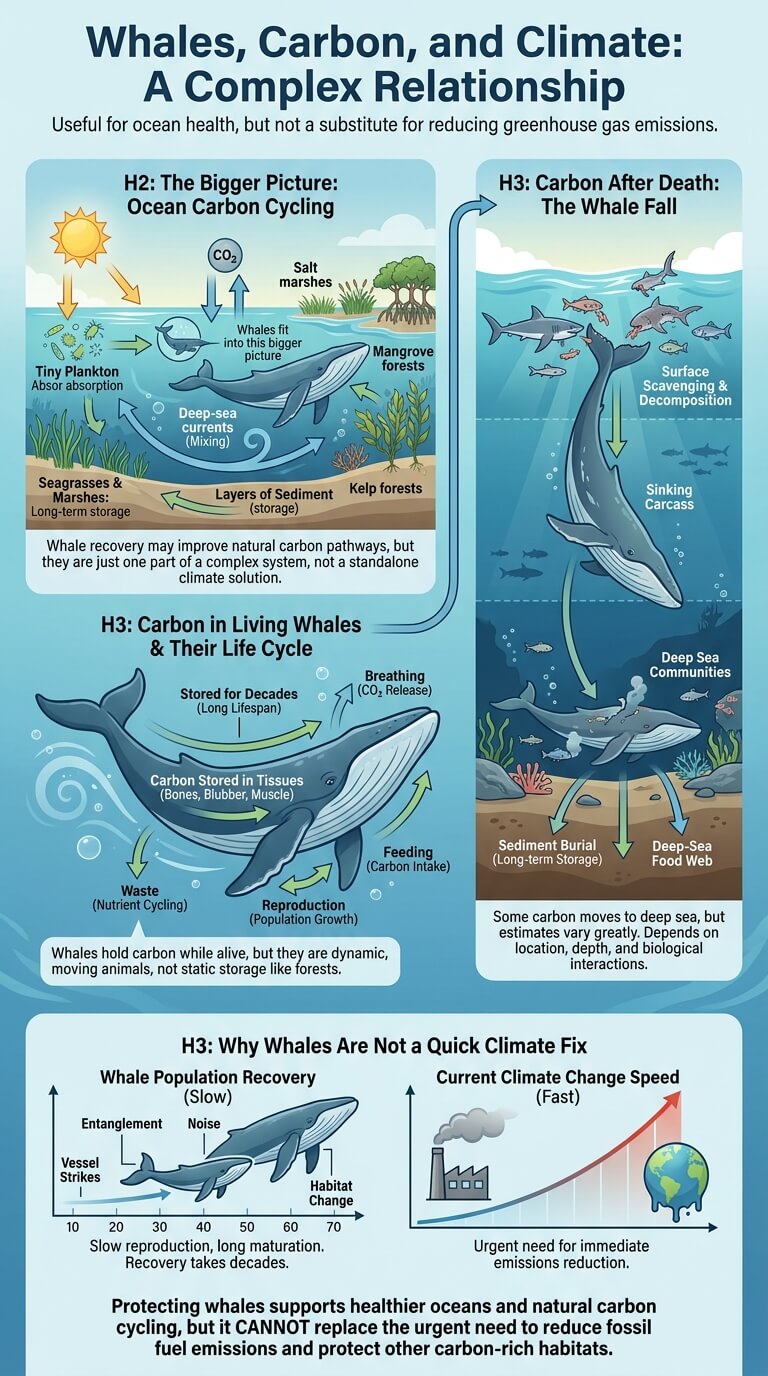
Whales are part of the ocean carbon story, but they are not a substitute for reducing greenhouse gas emissions. The ocean absorbs and stores carbon through many pathways, including plankton growth, deep-water mixing, sediments, seagrasses, marshes, mangroves, kelp, and animal bodies. Whales fit into this bigger picture.
The most careful way to describe whales and carbon is that whale recovery may help improve natural carbon pathways while also restoring animal populations and food-web functions. That is different from claiming whales can solve climate change on their own.
Carbon stored in living whale bodies
Whales store carbon because their bodies are made of carbon-containing tissues, just like other living things. Since many large whales can live for decades, carbon can remain in their bodies over long periods while they are alive. Larger animals can hold more body carbon than smaller animals, but this varies by species and individual size.
This kind of storage is not the same as a forest or a seagrass meadow. Whales move, feed, breathe, reproduce, and eventually die. Their role in carbon cycling includes living biomass, waste, prey interactions, and what happens to the body after death.
Carbon reaching the deep sea after death
When a whale carcass sinks, some carbon in that body can move to the deep sea. If material becomes buried in sediment or remains in long-lasting deep-sea pathways, it may stay away from the atmosphere for a long time. This is one reason whale falls are often discussed in carbon storage conversations.
The amount of carbon involved depends on whether the whale sinks, where it sinks, how much is eaten near the surface, how decomposition unfolds, and what happens to remaining material. Those variables make exact estimates difficult.
The main idea is still important: a living whale is not the only ecological stage that matters. The whale’s death can move energy and carbon into deep-sea communities in ways that smaller animals usually cannot match.
Why whales are not a quick climate fix
Whale recovery is valuable, but it is slow compared with the speed of current climate change. Many whales reproduce slowly, invest heavily in calves, and may take years to reach maturity. Population recovery can take decades, especially for species still affected by entanglement, vessel strikes, underwater noise, prey shifts, or habitat change.
That means whale conservation should be presented honestly. Protecting whales can support healthier oceans and may strengthen natural carbon cycling, but it cannot replace reducing fossil fuel emissions or protecting other carbon-rich habitats.
Why Whale Recovery Matters
Some whale populations have improved since the end of large-scale commercial whaling, but recovery is uneven. The status of whales varies by species, population, and region. Some populations remain at serious risk, while others are more stable or increasing.
NOAA Fisheries notes that North Atlantic right whales are threatened by vessel strikes and fishing gear entanglement throughout their range in its North Atlantic right whale overview. This example matters because it shows how modern threats can slow recovery even after commercial whaling has ended.
Protecting migration routes and feeding areas
Whales often rely on predictable feeding areas where prey gathers. If climate change, fishing pressure, or ocean conditions shift prey, whales may have to travel farther or feed in riskier places. Some may move closer to shipping lanes, fishing gear, or crowded coastal waters.
Protecting whales therefore requires more than protecting a single breeding area. It can involve feeding habitat, migration corridors, quieter waters, safer vessel speeds, and careful management of fisheries that overlap with whale routes.
Because whales move across political boundaries, conservation often depends on cooperation among governments, scientists, fishers, shipping industries, and coastal communities. A whale does not know when it has crossed from one management zone to another.
Reducing entanglement and vessel strike risk
Entanglement in fishing gear can injure whales, reduce feeding ability, cause infection, or lead to death. Vessel strikes can also injure or kill large whales, especially in busy waters where whales surface to breathe. These threats are not dramatic myths. They are documented conservation problems for several whale populations.
Reducing these risks can include gear changes, seasonal management areas, speed rules, better monitoring, real-time whale alerts, and careful response by trained teams. Ordinary boaters should never attempt to disentangle a whale. That work is dangerous and requires permits, training, and specialized equipment.
For the ocean, reducing whale deaths is not only about kindness to individual animals. It also helps preserve the ecological roles those animals perform over long lives.
Keeping conservation status species-specific
It is not accurate to say all whales are endangered. It is also not accurate to assume whales are safe because some populations have rebounded. Conservation status depends on the exact species, population, region, and assessment system.
For example, a local population may face intense risk even when another population of the same or related species is doing better. Some whales are listed under national laws, some are assessed by global conservation systems, and some have different risk levels in different areas.
Careful wording matters because conservation is practical. When people understand that whale recovery is uneven, they are more likely to support targeted protections rather than vague concern.
Common Myths About Whales and Ocean Health
Myth: Whales are only passengers in the ocean
Whales do not simply swim through the ocean without affecting it. Their feeding, waste, migrations, sounds, deaths, and interactions with prey all influence other life. They are participants in ocean systems.
That said, whales are not the only important animals. Fish, plankton, corals, squid, crabs, seabirds, sharks, rays, turtles, and countless invertebrates also shape the sea. Whale importance is part of a larger web.
Myth: Whale poop is a magic climate solution
Whale waste can help move nutrients into surface waters where plankton may use them. That is real and interesting. The myth begins when people treat whale poop as if it automatically cancels out human emissions or creates massive blooms wherever whales appear.
The real ocean is more complicated. Plankton growth depends on light, nutrients, water movement, grazing, temperature, and chemistry. Whales can contribute to the process, but they do not control it alone.
Myth: All whales have the same role
A blue whale, gray whale, humpback whale, sperm whale, beluga, and bowhead whale do not live identical lives. They differ in diet, migration, diving behavior, habitat, social patterns, and threats. Their ecological roles overlap in some ways and differ in others.
This is why species-specific conservation matters. Protecting one kind of whale does not automatically protect all whale roles. Healthy oceans need many species performing many functions.
Whale Watching and Everyday Choices That Help
Keep distance and respect viewing rules
Whale watching can inspire people to care about the ocean, but boats should keep a responsible distance. Whales need room to breathe, rest, feed, travel, and care for calves. Crowding a whale can disrupt behavior, even when the animal does not immediately flee.
If you see a whale from shore, enjoy it without trying to get closer. If you are on a boat, follow local viewing rules and instructions from trained operators. Never attempt to touch, feed, chase, block, or swim toward a whale.
Choose responsible ocean products and reduce debris
Some whale threats are connected to fishing gear, marine debris, and ocean use. Choosing seafood from responsibly managed fisheries, reducing single-use plastics, properly disposing of fishing line, and supporting cleanup programs can help reduce pressure on marine animals.
No single consumer choice solves the problem. Still, many small choices can support bigger changes when paired with science-based rules, industry improvements, and habitat protection.
Support science-based protection
Whale protection works best when it is based on monitoring, animal movement data, prey studies, stranding reports, and practical risk reduction.
Support for rescue networks, marine mammal research, responsible boating, and conservation policy can help whales continue feeding, migrating, reproducing, moving nutrients, and supporting ocean life.
FAQ
Are whales keystone species?
Some whales may act like keystone species in certain ecosystems because their feeding, migration, nutrient cycling, and carcasses can have effects beyond their own populations. A keystone species is one whose influence is larger than its abundance might suggest. However, it is best to use the term carefully because whale roles vary by species and ecosystem.
Do whales help phytoplankton grow?
Whales can help support phytoplankton growth by releasing nutrient-rich waste near the surface, especially after feeding at depth or in productive feeding areas. Phytoplankton still need the right combination of light, nutrients, water conditions, and grazing pressure, so whales are one contributor rather than the only driver.
What is a whale fall?
A whale fall is a whale carcass that sinks to the seafloor. It can feed scavengers, worms, microbes, and other deep-sea animals. Over time, the carcass may create a temporary habitat where animals use soft tissue, bones, fats, and chemical byproducts from decomposition.
Are whales more important than sharks or fish?
Whales are important, but the ocean does not depend on one animal group alone. Sharks, fish, plankton, corals, squid, seabirds, turtles, and invertebrates all help shape marine ecosystems. Whales stand out because their large bodies, migrations, diving behavior, and carcasses move nutrients and energy in unusual ways.
Why protect whales if some populations have recovered?
Whale recovery is uneven. Some populations have improved since commercial whaling declined, while others still face serious threats from entanglement, vessel strikes, prey changes, noise, pollution, and habitat shifts. Protecting whales helps preserve long-lived animals and the ecological roles they perform over decades.
Final Thoughts
Whales are important to the ocean because they help move nutrients, shape food webs, support deep-sea communities, and contribute to long-term carbon pathways. Their value is not only in their size or beauty. It is in the way their lives connect surface waters, deep habitats, prey populations, migration routes, and the animals that feed from them after death.
The strongest takeaway is simple: healthy whale populations are part of healthy ocean systems. Protecting whales does not solve every ocean problem, but it helps keep important ecological processes in motion.

Ethan Walker is the founder and research editor of Animal Fact Central. He creates and reviews educational animal facts content using trusted wildlife, pet care, and science-based sources. His work focuses on making animal behavior, adaptations, habitats, and species facts clear, accurate, and engaging for everyday readers.
Read More Details About Ethan Walker: https://animalfactcentral.com/ethan-walker/