

Birds are famous for nest building, but they are far from the only animals that make protected places for eggs, young, rest, or social life. Gorillas bend branches into sleeping platforms. Crocodilians gather vegetation into mounds. Some frogs whip mucus into foam, some fish arrange plants or stones, and social insects excavate or construct chambers that can support an entire colony.
A nest is best understood by its function, not by one familiar shape. It may be a shallow scrape, a woven pouch, a bubble raft, a leaf shelter, a mud chamber, or a cavity enlarged with jaws. The structure may last one night, one breeding season, or many years. Looking at who builds it, what materials are used, and what problem it solves reveals why nest architecture is so diverse. Even related species may choose different sites when climate, predators, or available materials change.
Quick Answer

Animals that build nests include birds, rodents, great apes, crocodilians, turtles, frogs, fish, ants, bees, wasps, termites, caterpillars, spiders, and some crustaceans. Their structures serve different purposes. Many protect eggs or young, some provide a place to sleep, and others regulate temperature, moisture, airflow, or access to food.
Not every animal that lays eggs constructs a nest, and not every nest is a permanent home. Some species simply clear a small patch of ground. Others modify an existing cavity or borrow a structure made by another animal. A useful definition therefore includes places that are built, excavated, woven, molded, or deliberately prepared for a particular stage of life.
What Is an Animal Nest?

Nest Versus Den, Burrow, Lodge, Hive, and Roost
These words overlap but emphasize different features. A nest is usually a prepared site for eggs, young, or rest. A den is a sheltered retreat, a burrow is a tunnel or chamber, a lodge is a substantial repeated-use shelter, a hive houses a social bee colony, and a roost is a resting place. One structure may fit more than one term, such as a grass nest built inside a mammal burrow.
Temporary Nurseries Versus Long-Term Social Structures
Many nests are temporary nurseries used until eggs hatch or young become more independent. Social insect nests may be repaired and enlarged across years, while great apes make short-lived sleeping platforms. The Smithsonian’s account of gorilla nest building describes wild gorillas using nearby branches and leaves to construct nests on the ground or in trees.
Why Definitions Vary Across Animal Groups
A fish nest may be a cleaned patch, pit, plant bundle, or floating bubble mass. A frog nest can be foam or folded leaves. Invertebrates may tie leaves with silk, excavate chambers, or line burrows. These structures look different, but each involves deliberate preparation that changes the conditions around the animal, its eggs, or its young.
Why Animals Build Nests

Protecting Eggs, Embryos, and Young
Eggs and newborn young are often less mobile than adults. A nest can reduce exposure to predators, crushing, strong currents, drying, and sudden temperature changes. It can also keep a clutch together so a parent can incubate, guard, ventilate, or feed efficiently.
Location can be as important as the walls of the nest. Many wading birds place colonies in vegetation surrounded by water, which can make access more costly for land predators. University of Florida guidance on nesting islands explains how water can provide a protective buffer around colony sites, although no location removes every risk.
A nest can also concentrate care. When eggs are held in one prepared place, a parent can turn, shade, fan, moisten, or defend them without searching across a large area. This benefit must be balanced against concentration risk, because a predator that finds the nest may reach several offspring at once.
Controlling Temperature, Moisture, and Airflow
Construction changes the small environment around eggs or young. Linings reduce heat loss, burrows limit temperature extremes, tunnels move air, and damp vegetation can affect moisture and warmth around buried eggs. The useful design depends on climate: insulation that helps in cold conditions may overheat in direct sun, while a foam nest must remain moist and close to suitable water.
Attracting Mates and Signaling Quality
Construction can also be courtship. A prospective mate may inspect a structure, its location, or the builder’s effort. Male fish in several groups prepare spawning sites, while male bowerbirds arrange display structures. A bower is not a chick nursery: the female lays eggs in a separate nest, so display architecture and parental shelter should not be treated as the same thing.
Resting, Molting, Hibernating, or Living Socially
Nests are not limited to reproduction. Great apes make sleeping platforms, rodents assemble insulated resting nests, and some insects build silk shelters before molting or pupating. Ants, bees, wasps, and termites use colony structures for brood care, food storage, defense, and social organization. A nest is therefore a deliberately prepared environment, not simply a container for eggs.
The Main Types of Animal Nests

Cups, Platforms, Scrapes, Mounds, and Cavities
A scrape is a shallow depression with little added material. A cup supports eggs in a bowl-like interior, while a platform is broader and flatter. Mounds pile soil or vegetation around a brood, and cavities use enclosed spaces in trees, banks, cliffs, buildings, or wood. Cavities offer shelter but can still flood, overheat, or admit specialized predators.
Buried, Floating, Hanging, and Woven Nests
Buried nests use soil or sand as insulation and concealment. Floating nests must resist sinking and waves. Hanging and woven nests rely on flexible fibers fastened through repeated movements, as in orioles, weaverbirds, and some rodents. The final form emerges from inherited behavior adjusted to available materials, site shape, wind, and water.
Foam, Silk, Mud, Leaves, Sticks, Stones, and Saliva
Animals build with materials they can collect, produce, or modify. Mud hardens into walls, silk binds leaves or suspends eggs, saliva joins fibers or stabilizes bubbles, and stones shape spawning sites. Texture affects grip, flexibility, drainage, insulation, and camouflage, so builders may combine a strong frame with a softer lining.
Birds as Famous Nest Builders
Variation in Site Choice and Construction
Bird nests range from almost no structure to elaborate woven chambers. Killdeer make scrapes, woodpeckers excavate cavities, robins form cups, orioles weave pouches, and raptors build platforms. Each form has trade-offs. Open nests allow easy access but expose their contents, while cavities provide enclosure but depend on suitable holes and can still flood or overheat.
Which Parent Builds and Why It Differs
Female-only, male-only, and shared construction all occur in birds. One partner may build while the other defends a territory, contributes material, incubates, or feeds young. The builder is not necessarily the only caregiver, so construction, guarding, incubation, and feeding should be considered as separate roles.
Reuse, Repair, and Seasonal Abandonment
Some birds build a new nest for each breeding attempt. Others repair an old platform, add fresh lining, or occupy a cavity used in an earlier year. Large stick nests may grow as material is added repeatedly, while fragile cups usually deteriorate more quickly. An unused structure also does not prove that parents abandoned their young; the brood may have fledged, moved, failed before hatching, or never occupied that nest.
An empty-looking nest should not be assumed available for collection. Adults may be between visits, another nesting attempt may begin, or the structure may be protected by law. Observing from a distance avoids damaging the nest or revealing it to predators.
Reuse can save construction effort, but an old structure may hold parasites, weakened material, or debris. Species differ in how they respond. Some add a fresh layer, some choose a different cavity, and others dismantle or ignore the old nest. A visible structure therefore does not reveal whether it will be used again.
Mammals That Build Nests
Rodent Leaf and Grass Nests
Mice, squirrels, voles, and other rodents arrange vegetation, bark, moss, or fur into resting and nursery nests. A nest may sit in a cavity, burrow chamber, building, dense vegetation, or woven ball above ground. Its soft inner space conserves heat and contains newborn young, but one animal may maintain several shelters rather than live in a single nest continuously.
Great Ape Sleeping Nests
Gorillas, chimpanzees, bonobos, and orangutans bend and layer vegetation into sleeping nests. Placement varies with species, individual, habitat, and perceived risk. These platforms support the body during rest rather than serving as egg or birth sites. Young apes develop construction skill over time as they select branches and arrange materials.
Mammal Nursery Nests and Insulated Chambers
Many mammals combine digging with a softer nest. Rabbits line nursery chambers with grass and fur, while hedgehogs and dormice arrange vegetation for rest, reproduction, or seasonal dormancy. Insulation helps newborn mammals that regulate body temperature less effectively than adults, working together with parental warmth, milk, and protection.
Nursery nests are often hidden within a larger shelter. The burrow, hollow tree, or den provides the outer barrier, while the inner nest forms a warm, soft chamber. This layered arrangement helps explain why a person may see an entrance without seeing the carefully arranged material surrounding the young.
Reptiles, Amphibians, and Fish That Build Nests
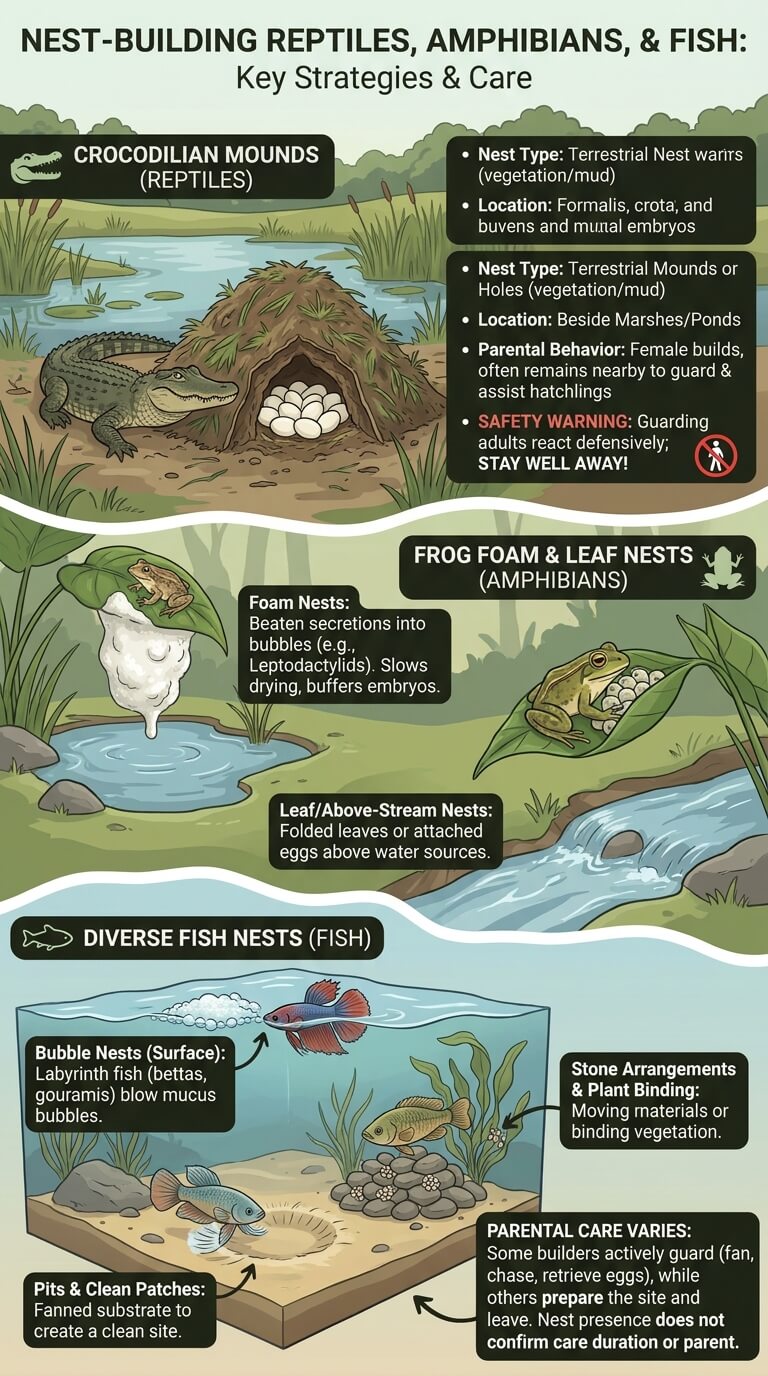
Crocodilian Mounds and Guarded Nest Sites
Female crocodilians prepare terrestrial nest sites as holes or mounds, depending on species and local conditions. Many remain nearby after laying. Smithsonian information on alligators describes females building vegetation nests beside marshes or ponds and later assisting hatchlings. A guarding adult can react defensively, so people should stay well away.
Foam Nests and Leaf Nests Made by Frogs
Several frog lineages place eggs in foam rather than open water. Secretions are beaten into bubbles that can slow drying and buffer embryos until larvae hatch or enter water. Animal Diversity Web’s profile of leptodactylid frogs describes terrestrial foam nests made with reproductive secretions. Other frogs fold leaves or attach eggs above streams.
Fish Pits, Plant Nests, Bubble Nests, and Stone Arrangements
Nest-building fish work with current, substrate, sediment, and oxygen. Some fan clean patches, dig pits, move stones, or bind vegetation. Labyrinth fish such as bettas and gouramis blow mucus-coated bubbles at the surface, where eggs are placed and tended. Other fish guard eggs attached to rock, wood, shells, or plants, even when no raised walls are visible.
Parental care after spawning varies even among nest-building fish. A builder may chase intruders, remove dead eggs, fan fresh water across the clutch, or retrieve drifting eggs. Another species may prepare the site and leave. The presence of a fish nest does not by itself identify which parent remains or how long care lasts.
Insects, Spiders, and Other Invertebrate Builders
Bees, Wasps, Ants, and Termites
Social insects create chambers for brood care, food storage, defense, and colony organization. Bees use wax, many wasps shape paper from chewed fibers, ants excavate soil or wood, and termites construct galleries and covered routes. Ohio State University Extension’s carpenter ant guide explains that carpenter ants remove wood to expand galleries but do not eat it as food.
Colony architecture can change as workers respond to crowding, damage, temperature, moisture, and available space. Large mounds are only one termite solution; many species remain underground or inside wood. Claims that every termite nest works like a perfectly regulated air conditioner oversimplify structures that vary greatly among species and environments.
Caterpillar Shelters and Silk Structures
Caterpillars use silk as thread and fastener. Some roll leaves, draw leaf edges together, or build communal tents that reduce exposure while keeping food nearby. A cocoon serves the pupal stage rather than functioning as a colony nest, so leaf shelters, communal webs, egg coverings, and pupal cases should be distinguished by purpose.
Spiders, Crustaceans, and Other Less Familiar Examples
Many spiders make silk retreats for hiding, molting, guarding eggs, or waiting for prey. Trapdoor spiders line burrows and conceal entrances with hinged doors. Crabs and other crustaceans excavate burrows or build tubes from sediment, mucus, and plant fragments, altering water flow and creating stable places for feeding, refuge, or brooding.
How Animals Choose Materials and Locations
Local Availability and Structural Strength
Builders usually use materials within practical reach because carrying sticks, mud, or fibers costs energy and increases exposure. They also adjust during construction. Birds tug fibers, apes test branches, and fish remove unsuitable debris. The result combines inherited behavior with immediate responses to breakage, wind, water, and site shape.
Camouflage, Drainage, Ventilation, and Predator Risk
A hidden nest may avoid detection, but concealment is only one concern. Low sites can flood, enclosed sites can trap heat or moisture, and exposed sites face weather. Animals balance these risks rather than eliminating them, which helps explain why the same strategy can succeed in one season and fail in another.
Human-Made Materials and Their Potential Hazards
Birds and other animals sometimes incorporate string, plastic, wire, fishing line, insulation, or treated fibers. Human-made material can appear strong or soft but create entanglement, choking, chemical, drainage, or overheating risks. People should not assume that an animal’s willingness to pick up an item proves it is safe.
Cornell Lab’s NestWatch guidance on nest materials recommends natural options such as untreated grasses, leaves, moss, twigs, and rootlets while warning against stringy items, dryer lint, and potentially treated hair or fur.
The safer way to support nesting wildlife is usually to preserve natural vegetation, leave suitable native plant fibers available, reduce pesticide use, and protect cavities or cover where appropriate. Offering manufactured fibers can create a problem the builder cannot recognize until an adult or youngster becomes tangled.
Who Builds, Guards, and Maintains the Nest?
Female-Only, Male-Only, and Shared Construction
There is no universal rule for which sex builds. Female birds often lead construction, male fish frequently prepare spawning sites, and crocodilian females make terrestrial nests. In other species both partners contribute, or one builds while the other chooses. Roles may shift during guarding, incubation, ventilation, and feeding. In some species, long-term pair bonds support repeated nest construction, guarding, and care, but shared building alone does not prove lifelong monogamy.
Cooperative Colonies and Division of Labor
Social insect construction is distributed among many workers that excavate, move material, repair damage, adjust openings, and relocate brood. No individual needs a complete plan. Communal vertebrates can also share defense or feeding without jointly building every structure, as in colonies containing many separate bird nests.
Simple local actions can produce a complex colony structure. Workers follow odors, airflow, contact with nestmates, and the condition of nearby material. Repeated small decisions create branching tunnels and chambers without a foreman directing the work, making social insect nests useful examples of self-organized construction.
When Nest Building Ends Before Parenting Begins
Some builders leave soon after laying. Sea turtles cover an egg chamber and return to the ocean, while many reptiles, amphibians, fish, and invertebrates provide little later care. A carefully selected and prepared site can still benefit offspring, so nest building is a form of investment but not proof of extended parenting.
Common Myths About Animal Nests
Myth: Only Birds Build Nests
Birds show remarkable architectural diversity, but mammals, reptiles, amphibians, fish, insects, arachnids, and crustaceans also build nests. Their materials include vegetation, mud, silk, foam, bubbles, wax, soil, stones, and excavated wood. The myth persists because aquatic, underground, and temporary structures rarely resemble a familiar twig cup.
Myth: Every Nest Is an Animal’s Permanent Home
Many nests serve only eggs, young, one sleeping period, a molt, or a breeding season. Birds often spend much of the year away from breeding nests, gorillas leave sleeping platforms after use, and fish may defend a spawning site only until the brood develops. Long-lived insect colonies are maintained exceptions, not a model for every nest.
Myth: An Empty Nest Is Safe to Disturb or Collect
An adult may be feeding nearby or waiting for danger to pass, and small eggs or young can be hard to see. NestWatch’s code of conduct advises brief, careful observation and no handling without permits. Disturbance can damage a structure, expose it to predators, or cause young to leave prematurely.
Unusual Cases and Exceptions
Animals That Borrow, Steal, or Parasitize Nests
Not every nest user is the builder. Owls, ducks, mammals, bees, and other animals occupy natural cavities or structures made by another species. Some birds take over old open nests, while brood parasites place eggs in a host’s nest. Reuse saves effort but can create competition where suitable cavities or sites are scarce.
Species That Prepare a Site Without Building a Structure
A cleared patch, shallow pit, polished surface, or buried chamber can function as a nest with little added material. Fish fan sediment away, ground-nesting birds make slight scrapes, and sea turtles dig and cover egg chambers. Site selection, cleaning, excavation, and concealment can matter more than visible height or complexity.
Nests Used for Display More Than Child Care
Some structures advertise the builder rather than shelter offspring. Bowerbird bowers are display courts, and certain fish create cleared or geometric sites used in courtship. Display and nursery functions can overlap in some animals, but asking where eggs are laid and young develop separates courtship architecture from parental shelter.
Nests Within the Larger Story of Raising Young
Nests as One Tool for Baby Survival
A nest can hide, support, warm, cool, ventilate, or contain offspring, but parents may still need to incubate, guard, clean, move, or feed them. In species with little later care, site choice carries more of the protective role. The structure’s value also changes as hatchlings or newborns become mobile.
The same nest feature can create both benefits and costs. A narrow entrance may exclude a large predator but slow a parent’s escape. Deep insulation may protect against cold but reduce ventilation. Natural selection favors workable compromises in a particular setting rather than one perfect nest design for every hazard.
Nest Building as Parental Investment and a Life-Cycle Event
Construction costs time and energy that could otherwise support feeding or predator avoidance. Its benefit may come through courtship, adult rest, colony function, or improved survival of offspring. Building can occur before mating, egg laying, birth, sleep, or molting, after which the structure may be repaired, reused, abandoned, occupied by another animal, or broken down.
Nest construction can mark a specific point in an animal life cycle, occurring before egg laying, birth, hatching, rest, or metamorphosis depending on the species.
FAQ
Do Animals Sleep in Their Nests?
Some do. Great apes make sleeping nests, rodents rest in nests inside cavities or burrows, and social insects live within colony structures. Many adult birds use breeding nests mainly for eggs and young rather than as year-round beds. Purpose depends on species, season, and life stage.
Do Fish Really Build Nests?
Yes. Fish clear pits, move stones, glue vegetation, clean egg-laying surfaces, or create bubble nests. Some guard and ventilate eggs, while others leave after spawning. Water flow, oxygen, sediment, and egg attachment shape these structures, which is why they may look unlike nests built in air.
Why Do Animals Abandon Old Nests?
A nest may deteriorate, collect parasites or waste, become exposed, or no longer fit the animal’s needs. Seasonal movement, changing food, flooding, and the end of breeding can also make continued use unnecessary. Leaving a temporary nest does not mean it failed if it already served its purpose.
What Is the Difference Between a Nest and a Den?
A nest is generally a prepared structure or site for eggs, young, or rest. A den is a sheltered retreat often used by a mammal for sleep or raising young. A den may contain a separate nest made from grass, leaves, or fur, so the clearest description states what was built and how it is used.
Final Thoughts
Animals that build nests demonstrate that architecture is not limited to hands, tools, or permanent houses. Beaks weave fibers, jaws excavate wood, legs whip foam, mouths blow bubbles, bodies bend branches, and colonies move countless particles. Each structure changes the immediate environment in a way that can improve rest, mating, brood care, or survival.
The most useful way to understand a nest is to ask four questions: who built it, what it is made from, what stage of life uses it, and what risk or need it addresses. Those questions reveal the biological logic behind everything from a nearly invisible scrape to a great ape’s leafy bed or a social insect’s network of chambers.

Ethan Walker is the founder and research editor of Animal Fact Central. He creates and reviews educational animal facts content using trusted wildlife, pet care, and science-based sources. His work focuses on making animal behavior, adaptations, habitats, and species facts clear, accurate, and engaging for everyday readers.
Read More Details About Ethan Walker: https://animalfactcentral.com/ethan-walker/