
Everyday life with a dog includes small habits that make the household run smoothly or cause frustration. This guide focuses on foundational, reward-based approaches you can use at home to improve common habits like jumping, pulling, barking, chewing, and impulse control. It is aimed at dog and puppy owners who want safe, practical steps to shape better behavior while recognizing when a problem is beyond home training and needs professional help.
What Is Dog Behavior Training?
Dog behavior training teaches dogs alternative actions and routines that fit human homes. It overlaps with obedience training, but the two emphasize different goals and day-to-day outcomes.
Readers comparing dog behavior training may also find dog to dog behavior useful for a closer look at a related part of canine behavior.
Readers comparing https://animalfactcentral.com/dog-behavior-training/ may also find behavior training useful for a closer look at a related part of canine behavior.
Readers comparing dog behavior training may also find female dog behavior after spaying useful for a closer look at a related part of canine behavior.
Readers comparing dog behavior training may also find dog in heat behavior useful for a closer look at a related part of canine behavior.
Behavior training vs obedience training
These terms are often used together, but they have distinct focuses.
Obedience teaches commands
Obedience training typically focuses on teaching a dog clear cues or commands, such as sit, down, stay, and come. These skills provide control and structure for specific moments and are often taught with consistent prompts and rewards.
Behavior training changes daily habits
Behavior training aims to alter what a dog does automatically throughout the day. Examples include choosing to sit instead of jumping on guests, walking politely on leash rather than pulling forward, or settling calmly instead of barking for attention. Behavior training examines triggers, consequences, and the environment, and uses management plus reinforcement of desired alternatives.
Why dogs repeat unwanted behavior
Understanding why a behavior persists helps you choose the most effective response. Unwanted actions often continue because they meet a need or produce a result the dog prefers.
The behavior gets rewarded
Many unwanted behaviors persist because they produce something valuable to the dog: attention, access to a resource, a game, or removal of something aversive. If a dog jumps and then receives attention, even scolding attention, the jumping is being reinforced.
The dog is bored
Without appropriate outlets for physical and mental activity, dogs may invent activities that are problematic at home, such as chewing household items or excessive barking.
The dog is stressed
Stress or uncertainty can drive behaviors like pacing, whining, or compulsive chewing. These behaviors function as coping mechanisms and require a calm, structured response that addresses the underlying stressor as well as the behavior itself.
The environment allows it
Environments full of easy rewards make unwanted behavior more likely. If a dog can reach the counter and steal food, or if visitors inadvertently reward excitement by pushing the dog away while laughing, the environment is teaching the dog to repeat the behavior. Changing the environment reduces opportunities for the behavior to occur and be reinforced.
The Core Rules of Dog Behavior Training
These core rules form the backbone of effective, humane behavior training at home. They are focused on teaching alternatives, preventing reinforcement of undesirable actions, and making success predictable and repeatable.
Reward the behavior you want
Make the desired action more rewarding than the unwanted action. Reinforce exactly what you want: if you want a dog to sit to greet people, reward the sit immediately and make it obvious that calm greetings follow the sit. Reinforcement can be food, toys, attention, or access to desired locations or activities.
Prevent the behavior you do not want
Management prevents accidental rewards and gives you space to teach alternatives. Use barriers, leashes, baby gates, or supervised freedom to stop the behavior from happening while you train. Prevention reduces learning opportunities for the unwanted behavior.
Stay consistent
Everyone in the household should apply the same rules and responses. Inconsistent responses confuse dogs and slow progress. Decide on the household standard for behaviors like counter access, greeting guests, and feeding, and make a shared plan to enforce it consistently.
Train in short sessions
Frequent, brief training sessions are easier for dogs to focus on and for owners to fit into daily life. Short practice bouts spread over the day build habits more reliably than a single long session after which both dog and owner are tired.
Make the right behavior easy
Adjust the environment and cueing so the right choice is the easy choice. If you want your dog to settle in a mat when guests arrive, make the mat more inviting and reinforce staying on it before increasing duration or distractions.
Essential Behaviors to Teach First
These foundational behaviors support safety and daily life. Teaching them with patience and positive reinforcement creates a toolkit you can use in many situations.
Attention to name
Getting a reliable attention response when you call your dog by name is the building block for many other behaviors. It gives you a chance to redirect, reward, and teach alternatives before an unwanted action escalates.
Why attention comes before control
Control begins with connection. If a dog will orient to you when called, you can more easily guide them toward an appropriate behavior such as sitting, leaving an item, or moving away from a trigger. Without attention, cues and corrections have less impact.
How to reward eye contact
Start by saying the dog’s name in a calm tone and reward any look toward you with something the dog values. Make the reward immediate and clearly linked to the look. As the dog learns that eye contact brings good things, lengthen the time you expect before reward and vary the rewards so attention remains interesting.
Sit
Sit is a compact, practical behavior used as a polite alternative to jumping and as a starting position for many other skills. Teach sit by marking and rewarding the earliest clear approximation that looks like a sit, then gradually shaping a full sit and adding a verbal cue.
Down
Down is a calm position useful for settling and long-duration control. Because lying down is a more relaxed posture than sit, it is especially helpful in situations where you want the dog to be quiet and steady. Shape down in small steps and reward calmness in the position.
Stay
Stay teaches duration and impulse control. Begin with short, predictable stays within the dog’s comfort zone and increase the duration and distance slowly. Always return to the dog to reward rather than calling the dog back as that undermines the stay command.
Leave it
Leave it prevents a dog from taking or touching objects you want them to ignore. Teach leave it by letting the dog investigate a low-value item, then rewarding for withdrawing attention or nose away. Reinforce the dog for choosing something you offer instead of the forbidden item.
Drop it
Drop it is for retrieving items already in the dog’s mouth. Trade for higher-value rewards, exchange with a toy, and avoid punishment. Making a trade rewarding teaches the dog that giving up an item leads to a better outcome.
Come when called
A reliable recall is essential for safety. Teach recall with high-value reinforcement and practice in low-distraction contexts first. Make coming to you predictably enjoyable so the dog prefers returning to you over staying or engaging with distractions.
Loose leash walking
Loose leash walking lets both dog and owner enjoy walks safely. Train loose leash walking by rewarding the dog for keeping slack in the lead and by stopping or changing direction when the dog pulls, so pulling does not lead to forward progress.
Training Common Dog Behavior Problems
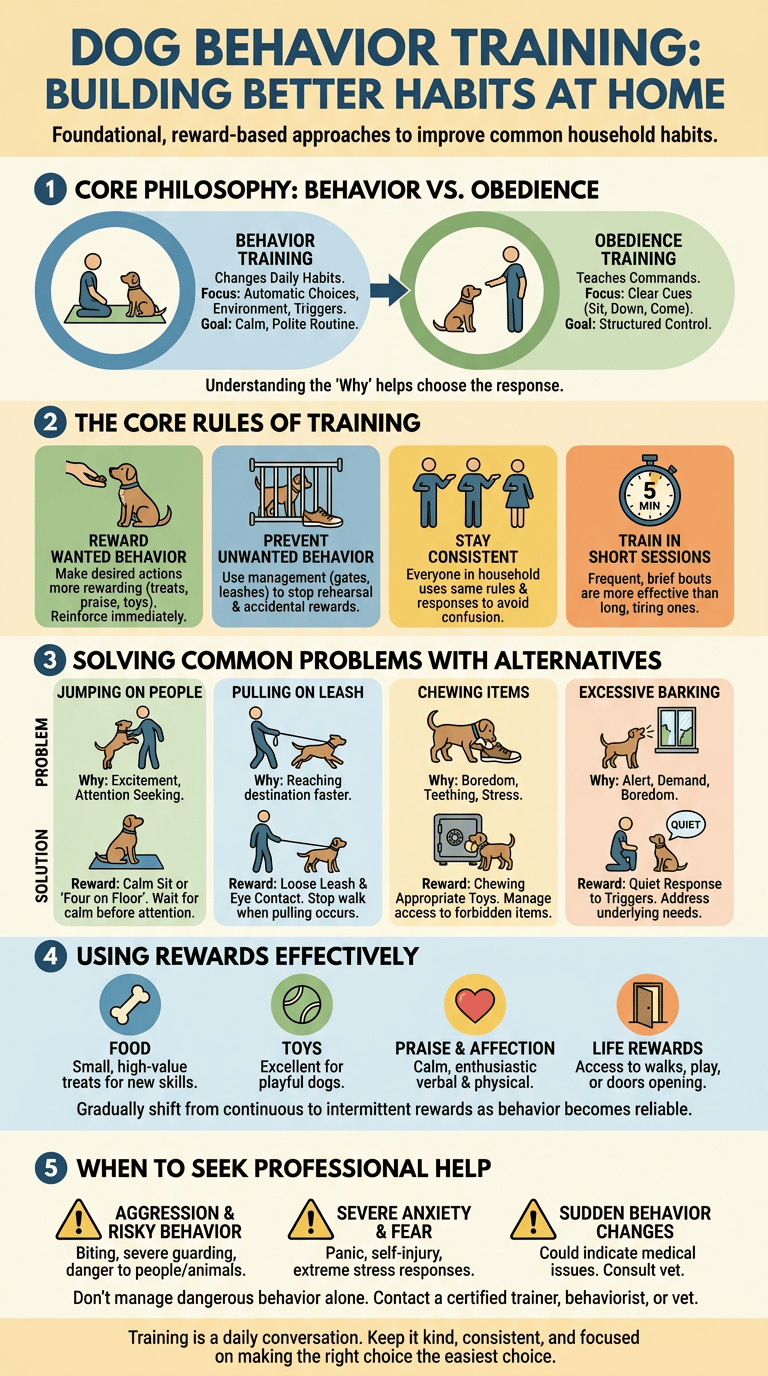
Below are practical, positive strategies for common household problems. Each section explains why the behavior occurs and what to reinforce instead.
Jumping on people
Jumping is a common greeting method for dogs that feel excited or expect access. It is often reinforced because people instinctively respond with attention, even if the attention is a negative reaction.
Why dogs jump
Jumping can be driven by excitement, an attempt to get closer to a human face, a learned greeting style, or a search for attention. Puppies often jump because they have not learned an appropriate alternative yet.
What to reward instead
Decide on a calm alternative such as sitting, offering a paw, or remaining at a mat. Have everyone who greets the dog wait until the dog is calm before giving attention. Reinforce the calm choice immediately so the dog learns that settling, not jumping, gains the reward.
Mistakes that make jumping worse
Common mistakes include rewarding with attention, laughing, pushing the dog away physically while still talking, or permitting jumping for some people but not others. These mixed signals teach the dog that jumping sometimes works. Consistency and preventing the jump with a leash or barrier help break the pattern.
Pulling on leash
Leash pulling occurs when the dog finds the destination more rewarding than walking calmly beside you. Pulling often becomes self-reinforcing because it brings the dog closer to the reward.
Why pulling works for dogs
From the dog’s perspective, pulling delivers faster access to smells, people, or locations. If pulling is rewarded by progress, the dog repeats it.
Stop-and-reward method
When the dog pulls, stop walking and wait for slack. As soon as the leash relaxes and the dog looks back or moves toward you, reward and continue. Reinforce relaxed walking so progress is contingent on keeping slack in the leash.
Direction-change method
Change direction when the dog pulls so forward progress is unpredictable during pulling. Reward the dog for rejoining you and walking with slack. Over time, the dog learns that paying attention to your position brings movement and rewards, while pulling does not.
Chewing household items
Chewing is a normal canine behavior that may serve exploration, teething relief, boredom management, or stress regulation. The goal of management and training is to provide acceptable outlets and prevent access to dangerous or valued items.
Puppy chewing
Puppies explore with their mouths and may chew to relieve teething discomfort. Provide a variety of safe chew items and supervise closely. Teach the puppy what is acceptable to chew and exchange forbidden items for approved ones when needed.
Boredom chewing
When chewing arises from boredom, increase physical and mental enrichment. Rotate durable toys, offer food puzzles, and schedule interactive play. Reducing boredom decreases the motivation to chew inappropriate objects.
Anxiety chewing
If chewing accompanies separation-related signs or other stress behaviors, focus on reducing the dog’s anxiety and providing safe, calming alternatives. For persistent anxiety, seek advice from a veterinarian or qualified behavior professional.
Barking too much
Barking is a natural mode of canine communication. The goal is not to suppress all barking but to teach appropriate contexts and quiet cues so barking does not become a persistent nuisance.
Alert barking
Dogs often bark to signal something new or to alert their household. Teach a calm alert by rewarding a quiet response after initial notification. Reinforce the dog for moving from alert to quiet rather than for sustained alarm.
Demand barking
Demand barking aims to obtain attention or an object. Avoid reinforcing demand barking with direct attention or access. Teach a replacement behavior, such as sitting or going to a mat, that is rewarded with the desired outcome.
Boredom barking
Barking from under-stimulation reflects unmet physical and mental needs. Increase enrichment and structured exercise. Use management to prevent the dog from rehearsing a barking routine while you work on long-term changes.
Begging for food
Begging often develops when table scraps, dropped food, or routine attention at mealtime reward the dog. Changing feeding routines and teaching an alternative behavior reduces the pressure at mealtimes.
Why table feeding creates begging
When a dog repeatedly receives food from the table or finds dropped items, the dog learns to beg and persists because the behavior is successful. Even occasional reinforcement sustains the habit.
Replacement behavior
Teach the dog to go to a mat or a designated spot during meals. Reward the dog for staying there calmly while people eat, and only offer special rewards when the dog chooses the mat. Management such as crate or baby gate use during meals can prevent accidental reinforcement while the new habit is being taught.
How to Use Rewards Correctly
Rewards are the engine of positive training. Using them thoughtfully increases the likelihood that the dog will repeat desired behaviors.
Food rewards
Food is a powerful and precise reinforcer. Use small, highly valuable treats for new or difficult behaviors, and vary the treat type to keep the dog engaged. Ensure treats are offered immediately after the behavior so the dog links the action with the reward.
Toy rewards
Toys are excellent rewards for dogs that prefer play. Use a toy as an exchange for a dropped item or as a reward for recall. Reserve high-value toys for training sessions so their appearance signals meaningful reinforcement.
Praise
Calm, enthusiastic praise combined with physical affection can reinforce social dogs. Match the level of excitement in your praise to the behavior you want to encourage. For calm behaviors, use calm praise and touch.
Life rewards
Life rewards are consequences like access to a walk, opening a door, or playing with a toy. Use these outcomes as deliberate rewards by making access contingent on the dog performing the desired behavior rather than allowing the dog to get the reward by default.
When to reduce treats
Gradually shift from continuous food rewards to a mix of reinforcement types. Start by rewarding intermittently so the dog maintains the behavior without expecting a treat every time. Continue to use high-value rewards for rare, high-difficulty situations so the behavior remains reliable under distraction.
What Not to Do During Dog Behavior Training
Certain actions slow progress or create risk for the dog. Avoid methods that rely on fear, pain, or unpredictability, and focus on clear communication and predictable outcomes.
Do not punish fear
Punishing fearful behavior typically increases fear and reduces trust. If a dog shows fear, arrange the environment to reduce exposure to the fear trigger and use desensitization and counterconditioning strategies under the guidance of a qualified professional.
Do not reward chaos accidentally
Many owners unintentionally reward unwanted behavior by reacting, providing attention, or allowing access to reinforcing outcomes. Pause and observe interactions to identify accidental reinforcements, then prevent them with management until the new behavior is learned.
Do not train only when the dog is already overexcited
Training requires a learning-ready state. If a dog is highly aroused, it is difficult to teach calm alternatives. Work on training in calmer windows and use short activities to help the dog settle before practicing skills that require focus.
Do not expect instant results
Changing habits takes time and repetition. Break large goals into small steps, celebrate small wins, and expect gradual improvement. Patience and consistency lead to reliable changes.
Dog Behavior Training by Age
Training priorities shift with life stage. Tailoring expectations and activities to age helps you meet the dog where they are developmentally.
Puppy behavior training
Puppies benefit from socialization, basic cue training, and clear management for safety. Teach bite inhibition, reliable attention, and safe chew choices. Socialization with controlled experiences helps puppies build confidence and learn appropriate responses to people and other animals.
Adolescent dog behavior training
Adolescence can bring increased independence and testing. Maintain structure, increase practice of basic skills in distracting settings, and keep enrichment high. Reinforce reliable behaviors consistently to prevent regression.
Adult dog behavior training
Adult dogs are often ready to refine skills and generalize behaviors to a variety of contexts. Maintain regular practice, continue to vary rewards, and increase real-world application so behaviors hold up under everyday conditions.
Senior dog behavior training
Seniors may need adjustments for physical limitations and changes in sensory function. Keep training sessions gentle, focus on comfort and mental engagement, and adapt expectations based on health. If behavior changes appear suddenly, consult a veterinarian to rule out medical causes.
When Training Is Not Enough
Some behaviors point to underlying medical issues, significant fear, or entrenched aggression and require expert help. Recognizing the limits of home training keeps dogs and people safe.
Signs you need behavior modification
- Behaviors that are dangerous or could lead to injury
- Progress that has plateaued despite consistent management and training
- Behaviors that escalate in intensity or frequency over time
When these signs appear, a qualified behaviorist can design a gradual, scientifically informed program to reshape behavior safely.
Signs you need a veterinarian
Seek veterinary attention when a behavior changes suddenly or accompanies other medical signs such as appetite change, mobility issues, pain responses, or altered elimination. Medical conditions can drive or worsen behavioral problems.
Signs you need a certified trainer or behaviorist
If a behavior involves aggressive responses, severe anxiety, or risks to safety, consult a certified trainer or a certified applied animal behaviorist. Look for professionals who use force-free, evidence-aware methods and who will collaborate with your veterinarian when needed.
Dog Behavior Training FAQ
How long does dog behavior training take?
Training timelines vary widely depending on the behavior, the dog’s history, the consistency of practice, and the environment. Small, simple habits can begin to change with repeated short practice sessions in a matter of days, while more established or complex behaviors require longer-term planning and gradual change.
Can older dogs learn new behavior?
Yes. Dogs remain capable learners throughout life. Older dogs may need adjustments for physical ability and sensory changes, but positive, consistent training and appropriate rewards can produce meaningful improvements.
Should I punish bad dog behavior?
Punishment is not recommended as a primary training tool because it can damage trust, increase fear, and obscure the learning process. Focus on preventing the behavior through management, reinforcing desirable alternatives, and teaching replacements. If you are considering corrective methods, seek guidance from a qualified professional who prioritizes welfare and safety.
What is the easiest behavior to train first?
Attention to name and a simple polite alternative to jumping, such as sit for greetings, are often good first goals. These behaviors provide immediate benefit for safety and everyday interactions and create a foundation for more complex skills.
For general resources on observing animal behavior and careful observation techniques across species, consider the Cornell Lab of Ornithology for broader educational materials from an animal behavior perspective. For information on global conservation frameworks and how conservation and welfare are considered internationally, see the IUCN Red List for broader context and listings.
If you face persistent or risky behavior issues, reach out to your veterinarian or a certified trainer or behaviorist. Do not try to manage dangerous behaviors on your own. Professionals can assess medical contributors, guide safe behavior modification, and help you design a training plan that protects both your family and your dog.
Training is a daily conversation between you and your dog. Keep it kind, consistent, and focused on teaching alternatives that make good behavior the easiest and most rewarding choice.

Ethan Walker is the founder and research editor of Animal Fact Central. He creates and reviews educational animal facts content using trusted wildlife, pet care, and science-based sources. His work focuses on making animal behavior, adaptations, habitats, and species facts clear, accurate, and engaging for everyday readers.
Read More Details About Ethan Walker: https://animalfactcentral.com/ethan-walker/