
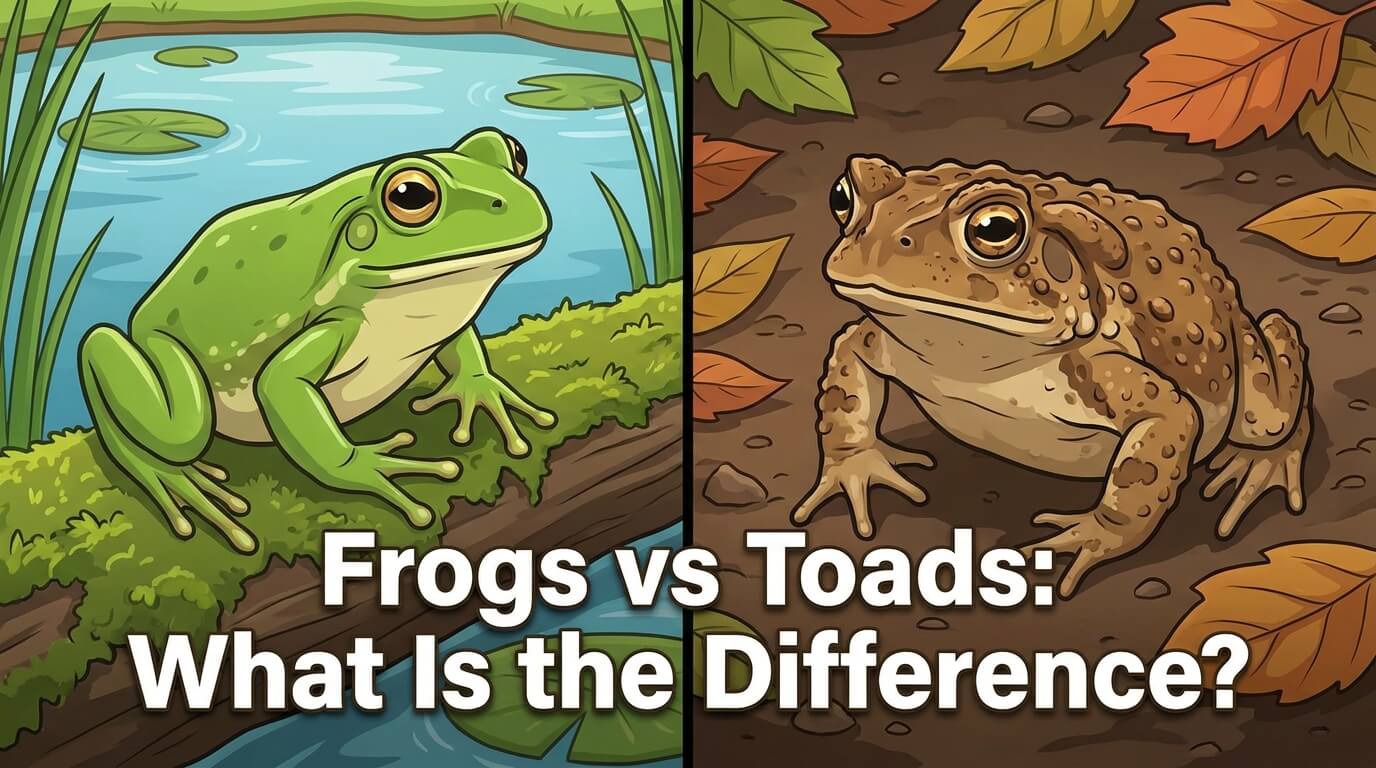
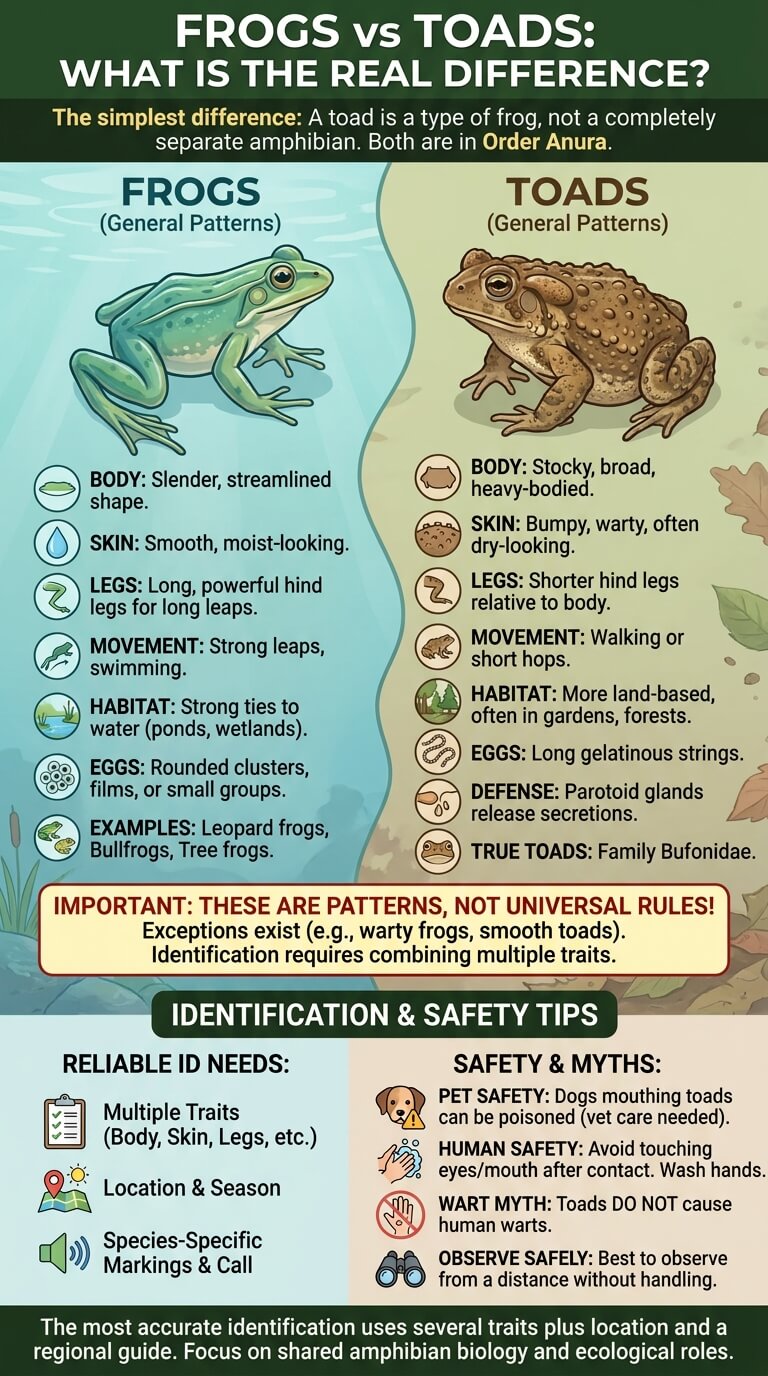
The simplest difference between frogs and toads is that a toad is a type of frog, not a completely separate kind of amphibian. Both belong to the order Anura, the group of tailless adult amphibians. Animals commonly called toads often have stockier bodies, shorter hind legs, bumpier skin, and a more land-based lifestyle. Animals commonly called frogs often look slimmer, have longer legs, smoother-looking skin, and stronger ties to water.
Those patterns are useful, but they are not universal rules. Some frogs have rough, warty skin. Some toads live close to ponds. Some frogs walk more than they leap, and some toads can make surprisingly strong hops. Common names developed from appearance and tradition, so reliable identification comes from combining body shape, skin, movement, habitat, egg form, location, season, and species-specific markings.
Quick Difference Between Frogs and Toads
The Most Reliable Short Answer
In everyday use, “frog” usually describes a slender anuran with relatively long hind legs and moist-looking skin, while “toad” usually describes a heavier-bodied anuran with shorter legs and visibly bumpy skin. Frogs are often seen at the edge of ponds, streams, or wetlands. Toads commonly spend more time on land and return to water mainly to breed.
The scientific answer is different. There is no single formal taxonomic boundary separating every animal called a frog from every animal called a toad. The Animal Diversity Web overview of Anura explains that frogs and toads are members of the same order and that the everyday distinction is not a scientific division. True toads are members of the family Bufonidae, but other families also contain species with “toad” in their common names.
Why No Single Feature Works Every Time
Skin texture is the clue most people notice first, yet it produces many mistakes. Gray tree frogs, for example, can have coarse, warty skin even though they are tree frogs rather than true toads. Several harlequin frogs are members of the toad family but have smoother bodies than the stereotypical backyard toad.
Leg length also overlaps. A squat frog adapted to crawling through leaf litter may not have the dramatic hind legs of a leopard frog. A toad can still hop when disturbed, even though it may usually walk or use short hops. Habitat is equally flexible because both groups need suitable moisture, and nearly all North American species must reach water or another moist breeding site to reproduce.
Frog vs Toad Comparison Table
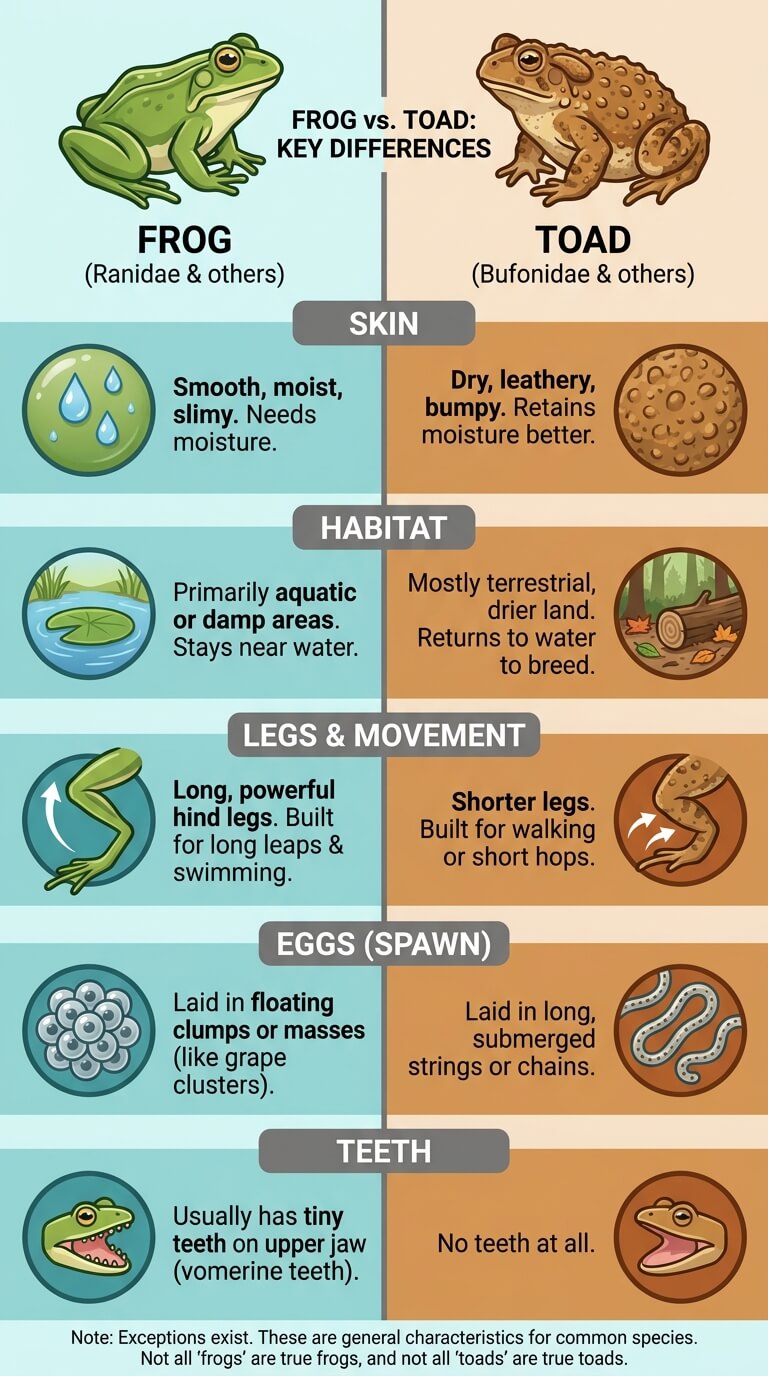
| Feature | Typical Frog Pattern | Typical Toad Pattern | Important Exception |
|---|---|---|---|
| Scientific grouping | Any member of Anura may be called a frog | True toads belong to Bufonidae | Common names do not always follow family boundaries |
| Body shape | Often slimmer with a narrower waist | Often stockier and broader | Body shape varies with species, age, and condition |
| Skin | Often smooth or finely textured and moist-looking | Often dry-looking, thick, and bumpy | Some frogs are warty, and some true toads are relatively smooth |
| Hind legs | Often long and powerful | Often shorter relative to the body | Not every frog is a long-distance jumper |
| Movement | Frequently leaps or dives | Frequently walks or makes short hops | Both can hop, crawl, swim, or burrow |
| Feet | May have strong webbing or enlarged toe pads | May have digging structures and less webbing | Feet reflect habitat more than the common-name label |
| Adult habitat | Often stays near water or humid vegetation | Often ranges farther onto land | Both require moisture and suitable shelter |
| Eggs | Often laid in clusters, sheets, films, or small groups | Many true toads lay long gelatinous strings | Egg form varies widely and should be used with location and season |
| Defense | Mucus, camouflage, escape, and sometimes toxins | Prominent skin glands and irritating secretions are common | Defensive chemistry varies greatly among species |
Are Toads Actually Frogs?
The Order Anura
Frogs and toads are anurans. Adult anurans lack the long tail seen in salamanders, and their compact skeletons are organized around powerful movement by the hind limbs. Their life cycles often include aquatic eggs and tadpoles, followed by metamorphosis into four-legged juveniles, but reproduction is much more varied worldwide.
True Toads in the Family Bufonidae
True toads are members of Bufonidae. Familiar U.S. examples include American toads, Fowler’s toads, western toads, southern toads, oak toads, and Great Plains toads. Many have paired parotoid glands behind the eyes. These raised glands release defensive secretions that make a toad unpleasant or harmful for some predators to bite.
Why Common Names Create Exceptions
Common names reflect history, local language, and appearance rather than one global naming system. Spadefoot toads are famous examples. They look toadlike and possess hardened structures on the hind feet for digging, but North American spadefoots are not members of Bufonidae. Fire-bellied toads and narrow-mouthed toads also belong to other families.
The reverse occurs too. The Panamanian golden frog is a true toad in the family Bufonidae despite its frog name and relatively smooth appearance. These exceptions show why family, genus, and species are more dependable than a common-name label when precision matters.
Body Shape and Skin Texture
Typical Frog Proportions
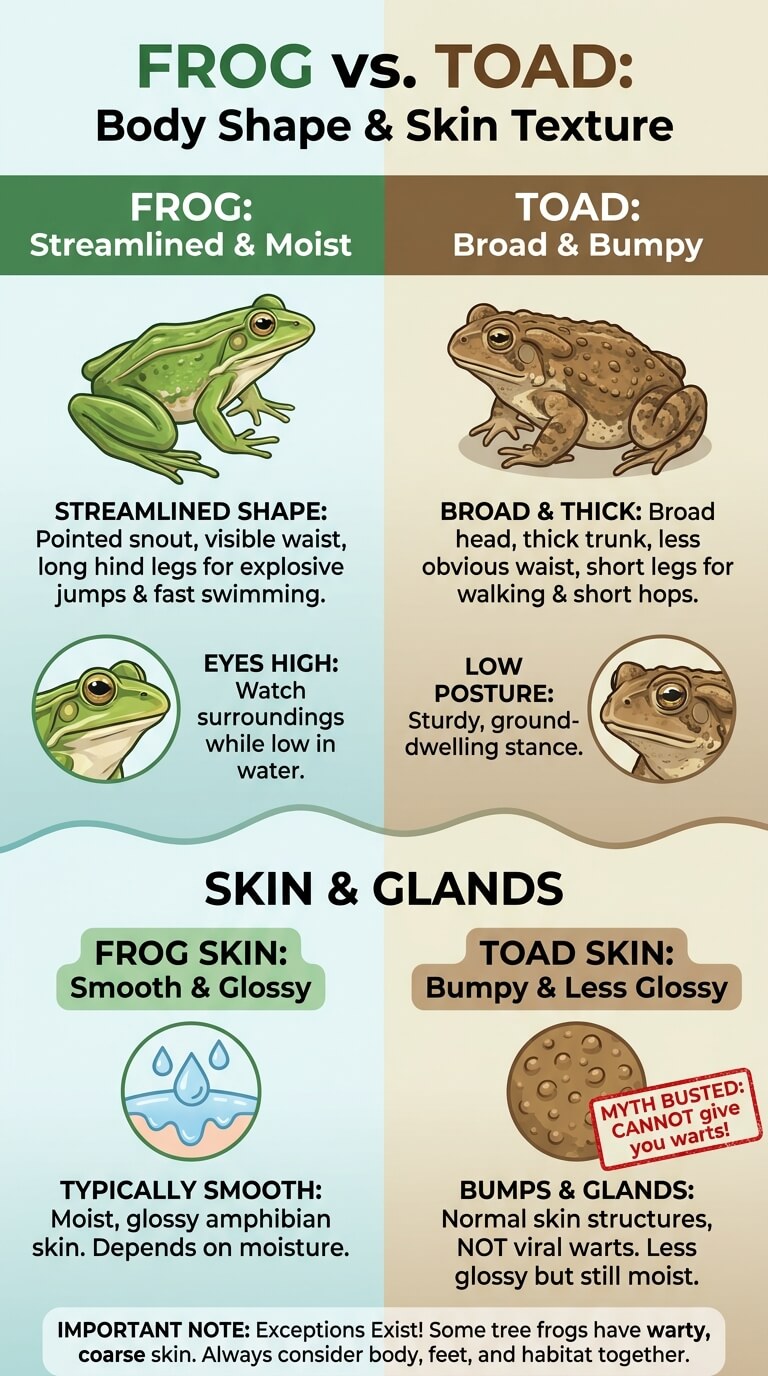
Many familiar pond frogs have a streamlined shape, a pointed or rounded snout, a visible waist, and hind legs that extend well beyond the body when stretched. This form supports explosive jumps and fast swimming. Eyes often sit high on the head, allowing the animal to watch its surroundings while much of the body remains low in the water.
Tree frogs may be small and lightweight, with enlarged toe pads for climbing. Aquatic frogs may have broad webbed feet. Ground-dwelling frogs can be compact and muscular rather than slim. The body should therefore be read together with the feet and the place where the animal was found.
Typical Toad Proportions
A typical toad has a broad head, thick trunk, less obvious waist, and hind legs that appear short relative to the body. Its posture is often low and sturdy. This shape suits walking, short hops, and spending time on the ground rather than making repeated long leaps.
Warts, Glands, and Skin Moisture
The bumps on a toad are normal skin structures and glands, not viral warts. A person cannot develop human warts merely by touching a toad. The old myth probably survives because the raised skin resembles the appearance of a wart, but the cause is unrelated.
“Dry skin” is also an imprecise description. Toad skin may look less glossy than the skin of a pond frog, yet it is still living amphibian skin that depends on moisture. Toads reduce water loss partly through behavior, body posture, shelter use, and skin characteristics, but they can still dehydrate.
Texture has striking exceptions. The Smithsonian’s gray tree frog profile describes a tree frog with warty, coarse skin and variable coloration. Seeing bumps therefore does not automatically make an animal a toad.
Legs, Feet, and Movement
Jumping and Leaping Tendencies
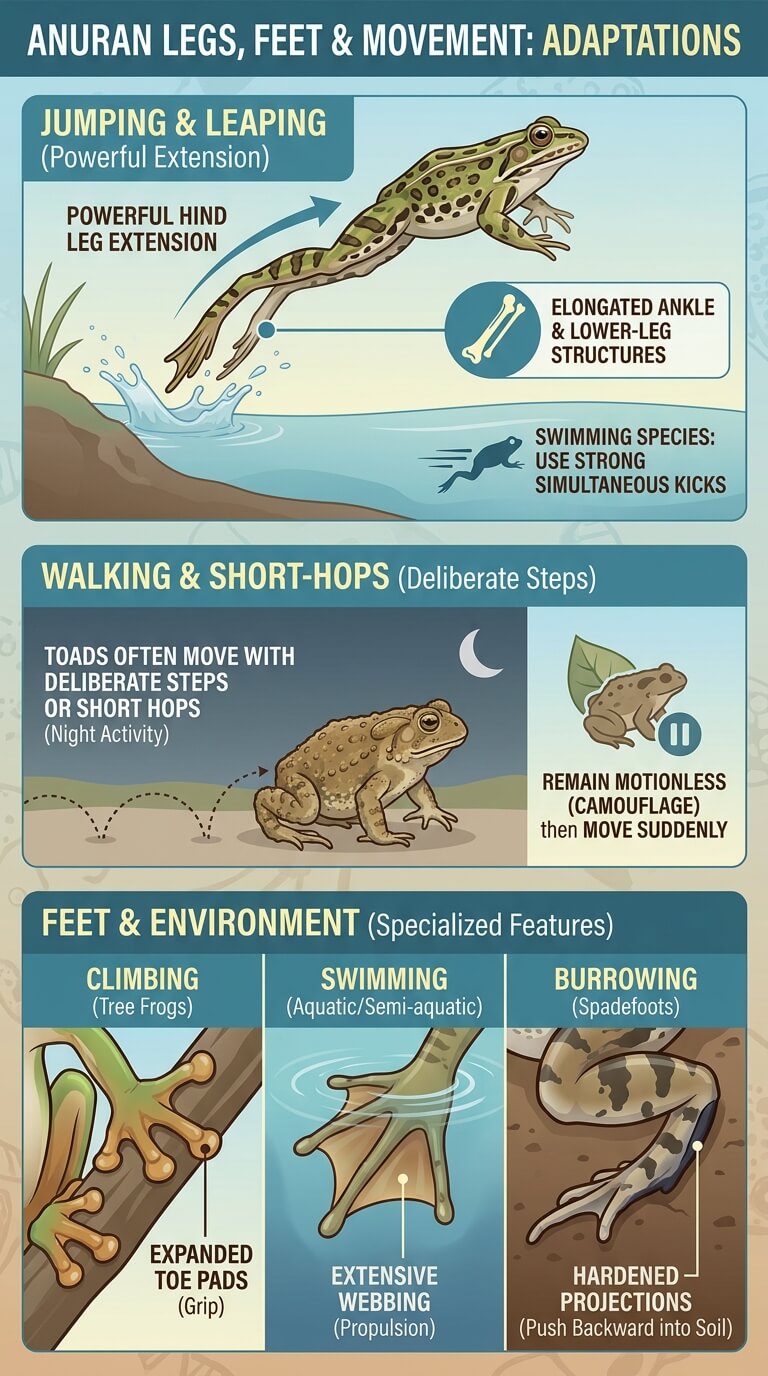
Long-legged frogs such as leopard frogs can launch themselves rapidly toward water when startled. Their elongated ankle and lower-leg structures contribute to the powerful extension used in jumping. Swimming species also use the hind legs in strong simultaneous kicks.
Walking and Short-Hop Tendencies
Toads often move with deliberate steps or short hops. This is one reason people encounter them crossing lawns, patios, trails, or roads at night. A toad may remain motionless when it senses danger, relying on camouflage, then move suddenly when a predator comes too close.
Toe Pads, Webbing, and Burrowing Features
Feet reveal how an anuran uses its environment. Expanded toe pads usually indicate climbing ability, especially in tree frogs. Extensive webbing often supports swimming, although the amount differs among aquatic and semi-aquatic species. Hardened projections on the hind feet can help spadefoots and other burrowers push backward into soil.
Habitat and Daily Activity
Association With Water
Frogs are often more closely associated with open water, saturated soil, or humid vegetation than typical toads. Bullfrogs, green frogs, and many leopard frogs may remain along pond, lake, or stream edges for much of the active season. When alarmed, they frequently dive or leap into water.
Toads may travel hundreds of yards from a breeding site and spend much of the year in gardens, fields, forests, dunes, or dry-looking uplands. That does not make them independent of water. Their eggs and tadpoles usually develop in ponds, pools, wetlands, slow stream margins, or temporary rain-filled depressions.
Terrestrial and Burrowing Behavior
Many toads avoid heat and water loss by hiding during the day. They may dig into soft soil, occupy existing holes, settle beneath boards or stones, or use deep leaf litter. Some emerge after rain because the ground is moist and invertebrate prey is active.
Frogs can be terrestrial too. Wood frogs spend much of the year in forests, and greenhouse frogs complete direct development on land without a free-swimming tadpole stage. Tree frogs may breed in water but spend adult life high in vegetation. Habitat should be interpreted at the species level rather than treated as a strict frog-toad boundary.
Night Activity and Weather Conditions
Many frogs and toads are easiest to find after sunset, especially on warm, humid, or rainy nights. Darkness reduces exposure to some visual predators, while cooler air slows water loss. Males may call from breeding sites, and individuals may cross roads or lawns while moving between feeding areas and water.
Eggs, Tadpoles, and Development
Egg Clusters Versus Strings
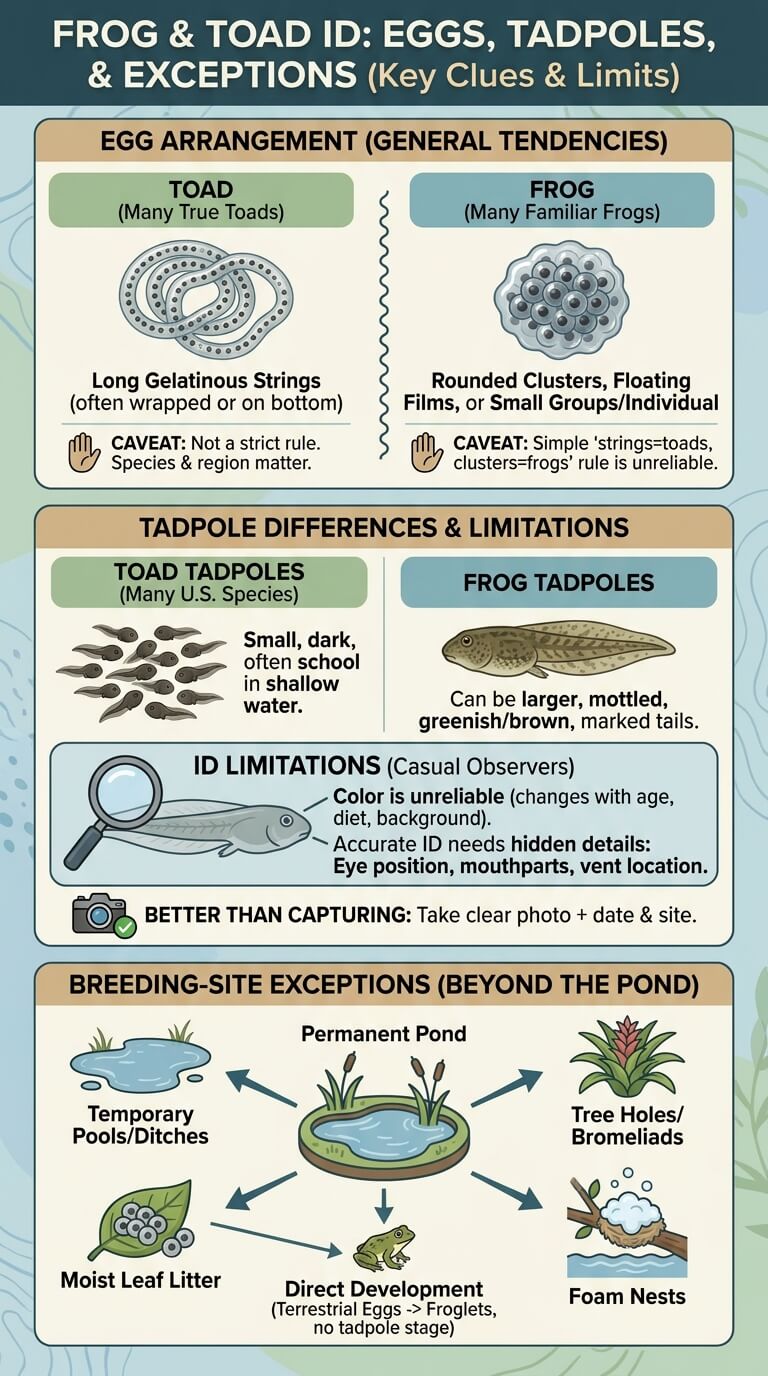
Egg arrangement can be a valuable seasonal clue. Many true toads lay eggs in long gelatinous strings, often wrapped loosely around submerged plants or lying across the bottom. Many familiar frogs lay rounded clusters, floating films, small groups, or individual eggs.
The pattern is useful only after considering species and region. The USGS field guide to amphibian eggs and larvae shows how egg form differs among species and how even closely situated breeding animals can use very different arrangements. It also demonstrates why a simple “clusters equal frogs, strings equal toads” rule cannot identify every clutch.
Tadpole Differences and Identification Limits
Toad tadpoles in many U.S. species are small, dark, and likely to school in shallow water. Frog tadpoles may be larger, mottled, greenish, brown, or marked along the tail. These are broad tendencies. Color can change with age, water conditions, background, diet, and predator presence.
Larval identification often requires details that casual observers cannot see safely, including eye position, mouth structure, tail-fin shape, vent position, and tiny pigment patterns. Guessing from color alone can be unreliable. A clear photograph of the entire animal in the water, along with the date and site, is more useful than capturing it.
Breeding-Site Exceptions
Not every anuran lays eggs in a permanent pond. Some use temporary woodland pools, roadside ditches, flooded grass, tree holes, bromeliads, foam nests, moist leaf litter, or streamside surfaces. Direct-developing frogs lay terrestrial eggs from which froglets hatch without a free-swimming tadpole.
Chemical Defenses and Human Safety
Parotoid Glands and Defensive Secretions
Many true toads have large parotoid glands behind the eyes. When a predator bites or presses the animal, these glands and smaller skin glands can release milky or sticky secretions containing defensive compounds. The secretion is better described as poison because it harms through contact with tissues or ingestion rather than being injected through a fang or stinger. Chemical defense reaches a different extreme in poison dart frogs, whose wild alkaloids are closely tied to the tiny arthropods they eat.
Potency varies greatly. A secretion that merely tastes bad to one predator can cause stronger effects in another. Large cane toads and Sonoran Desert toads are associated with especially serious pet poisonings in parts of the United States, while contact with many smaller native toads causes irritation rather than severe systemic illness. Species, dose, animal size, and duration of contact all matter.
Risks to Pets and Sensitive Skin
Dogs are at greatest risk when they mouth, bite, or swallow a toad. Drooling, pawing at the mouth, gagging, vomiting, weakness, breathing difficulty, tremors, seizures, or collapse require prompt veterinary attention. The Merck Veterinary Manual guidance on toad poisoning notes that severity depends heavily on the toad species and exposure, with large toxic species responsible for the most dangerous cases.
People should avoid rubbing their eyes or mouth after contact with an amphibian. Skin secretions can be irritating, and amphibians can carry microbes such as Salmonella without looking sick. Anyone who accidentally handles one should wash hands thoroughly afterward. Children should be supervised around frogs and toads, not because every animal is dangerous, but because hands easily move from soil and animals to the face.
Safe Observation Without Touching
The best approach is to leave the animal where it is and observe from a short distance. Use a phone camera with zoom rather than holding it. Photograph the back, side, head, and surrounding habitat if possible. Record the date, time, weather, and general location.
Do not squeeze a toad to examine its glands, turn it over repeatedly, place it in dry containers, or move it to a different pond. Amphibian skin can be harmed by sunscreen, lotion, insect repellent, soap, and other residues. Moving animals can also spread disease or place them in unsuitable territory.
How to Tell Them Apart in the Field
Use Several Traits Together
Start with the whole body. Is it slender or broad? Are the hind legs noticeably longer than the body? Does the skin look finely textured, pebbled, or covered in distinct raised glands? Are there obvious parotoid glands behind the eyes? Does the animal leap toward water, climb vegetation, walk across the ground, or burrow?
Next, check habitat and behavior. An animal sitting in a pond with long legs and strong webbing is more likely to fit the familiar frog pattern. A stocky animal walking through a dry garden with visible glands behind the eyes is more likely to be a true toad. Then compare the observation with species documented in the state or county.
Photograph-First Identification Checklist
- Photograph the animal without touching or blocking its escape.
- Capture a top view and side view when possible.
- Include the eyes, area behind the eyes, hind legs, and feet.
- Note whether the skin is glossy, finely granular, or strongly bumpy.
- Record whether it walked, hopped, leaped, climbed, swam, or burrowed.
- Describe the setting, such as pond edge, forest floor, lawn, tree, stream, or temporary pool.
- Record date, approximate time, weather, and a non-sensitive location.
- Compare the images with a state wildlife agency, museum, university, or reputable regional field guide.
Calls can be more diagnostic than appearance during breeding season. Many visually similar species produce different advertisement calls. Record from a distance and avoid playing calls back repeatedly, which can disturb territorial or breeding animals.
When Location and Season Provide Better Clues
Season also matters. A species that breeds during cold early-spring rains may be unlikely to call in midsummer. A temporary pool full of egg strings after a warm rain can point toward a locally breeding true toad. Timing does not prove identity, but it can make a visual clue much stronger.
Common Myths and Mistakes
Toads Do Not Cause Warts
Human warts are caused by human papillomaviruses, not by amphibian skin bumps. The warty appearance of a toad is part of its normal anatomy. Penn State Extension’s guide to amphibians and the wart myth also explains that the visible bumps are associated with skin glands rather than contagious human warts.
This does not make unnecessary handling a good idea. The concern is irritation, microbes, stress to the animal, damage to its skin, and movement of pathogens, not the creation of warts.
Dry-Looking Skin Is Not Proof of a Toad
Lighting can make moist skin appear matte, and a frog’s surface may not look shiny at every moment. Some toads appear smoother than expected, while some frogs have obvious bumps. A single close-up photo can also hide body proportions that would clarify the identification.
Look for a combination of parotoid glands, body shape, hind-leg proportions, feet, movement, and local range. Skin texture should be one clue among several.
Frogs Are Not Always Harmless to Pets
The strongest pet warnings often focus on toads, but “frog” as a common name does not guarantee harmlessness. Some frogs produce irritating or toxic skin compounds, and any small amphibian can be injured or swallowed by a curious pet. There is also a choking or gastrointestinal risk unrelated to toxins.
Keep dogs leashed or closely supervised during warm, wet evenings when amphibians are active. Outdoor water bowls and lights that attract insects can create repeated encounters. A pet showing sudden drooling, vomiting, weakness, tremors, breathing trouble, or collapse after mouthing an amphibian needs urgent veterinary advice.
Why Frogs and Toads Matter Around Water and on Land
Shared Amphibian Biology
Frogs and toads share permeable skin, ectothermy, and life histories shaped by moisture. Even a toad found far from a pond must manage water balance and usually return to a breeding site. Both can be affected by contaminated runoff, road crossings, loss of seasonal pools, disease, and removal of shelter.
Their similarities are often more biologically important than their everyday labels. Both are predators of invertebrates, prey for many larger animals, and part of the movement of energy between freshwater and land.
Seasonal Survival
Cold winters and dry summers require different strategies among species. Some frogs overwinter underwater, some tolerate partial freezing in protected leaf litter, and many toads burrow below exposed soil. During drought, activity may shrink to humid nights or stop for long periods.
These seasonal patterns explain why a yard can seem empty for months and suddenly contain calling frogs or traveling toads after rain. The animals were not created by the storm. Moisture and temperature made movement and breeding possible.
Ecological Roles of Frogs and Toads
Adults consume insects, spiders, worms, snails, and other prey that fit their size and hunting style. Tadpoles may graze algae, process organic matter, filter particles, or hunt small organisms. Eggs, tadpoles, juveniles, and adults feed fish, aquatic insects, birds, snakes, mammals, and other amphibians.
No single species performs every role, and the value of a frog or toad cannot be reduced to mosquito control. Their effects depend on abundance, diet, life stage, season, and the ecosystem around them.
FAQ
Can Frogs and Toads Live in the Same Pond?
Yes. Multiple frog and toad species may breed in the same pond, wetland, ditch, or temporary pool, especially when the site offers different depths, vegetation, temperatures, and calling positions. They may arrive at different times and place eggs in different parts of the water.
Sharing a breeding site does not mean their adult lifestyles are identical. Some frogs remain close to the shoreline, while toads may move well into surrounding uplands after breeding. Protecting the water without protecting nearby land can therefore leave part of the life cycle unsupported.
Can a Frog Turn Into a Toad?
No. A frog does not transform into a toad as it ages. Tadpoles develop into adults of their own species. A toad tadpole becomes a toad, and a frog tadpole becomes a frog.
The confusion may come from metamorphosis, which changes body shape dramatically, or from young toads that look smoother and more frog-like than adults. Common names can also be misleading, but family and species identity do not switch during development.
Are All Toads Poisonous?
True toads produce defensive skin secretions, but the chemistry and potency differ among species and populations. Calling every toad highly poisonous exaggerates the danger. Many encounters cause a predator to release the toad because the secretion tastes bad or irritates the mouth. Certain large species can cause severe poisoning when mouthed by dogs or cats.
People should avoid deliberate contact with secretions and wash after accidental handling. Pets should not be allowed to bite or carry any toad, even when the local species is not known for severe poisoning.
Which Is Better at Jumping?
Many long-legged frogs are better adapted for long leaps than typical true toads. Their body proportions and elongated hind limbs generate powerful takeoff. Toads usually walk or make shorter hops, which suits a ground-based lifestyle.
There is no fair contest between every frog and every toad. Anuran movement reflects species, body size, habitat, temperature, and immediate danger. A small tree frog may climb rather than leap, while a frightened toad can move much faster than its resting posture suggests.
Final Thoughts
The practical frogs vs toads difference is a pattern, not a perfect rule. Toads are frogs in the broad scientific sense, and true toads belong to Bufonidae. Stocky shape, shorter legs, bumpy skin, visible parotoid glands, walking movement, terrestrial habits, and egg strings often point toward a true toad. Slender shape, long legs, smoother skin, strong leaps, aquatic habits, and clustered eggs often point toward a familiar frog.
The most accurate identification uses several traits plus location, season, call, and a regional guide. Observe without handling, keep pets from mouthing amphibians, and leave the animal in the habitat it selected. That approach protects both the observer and an amphibian whose skin and behavior are finely matched to its surroundings.

Ethan Walker is the founder and research editor of Animal Fact Central. He creates and reviews educational animal facts content using trusted wildlife, pet care, and science-based sources. His work focuses on making animal behavior, adaptations, habitats, and species facts clear, accurate, and engaging for everyday readers.
Read More Details About Ethan Walker: https://animalfactcentral.com/ethan-walker/