
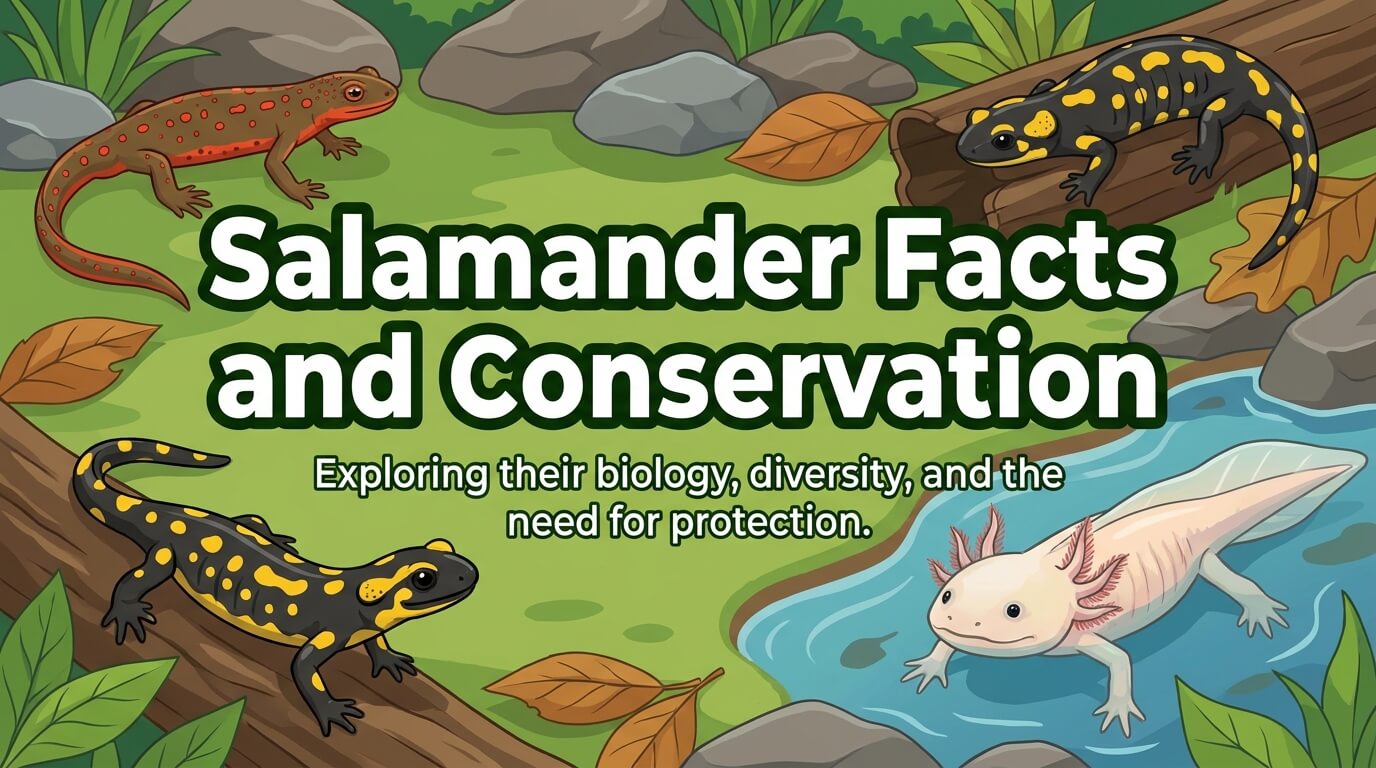
Salamanders are amphibians with long bodies, tails, soft skin, and an extraordinary range of life histories. Some live their entire lives in cold streams, while others spend nearly all their time beneath logs, rocks, moss, or soil. Some have lungs, some rely heavily on their skin for gas exchange, and the largest salamander family has no lungs at all. Certain species pass through an aquatic larval stage, while others hatch from land-laid eggs as miniature versions of adults.
They are also famous for regeneration, but that ability is often exaggerated. Many salamanders can regrow tails, limbs, and other tissues, yet regeneration takes energy, varies among species and life stages, and does not make an animal immune to injury, infection, stress, or death. Understanding salamanders means looking beyond one remarkable trait to see how moisture, temperature, prey, breeding habitat, disease, and connected landscapes shape their survival.
Quick Salamander Facts
What Salamanders Are
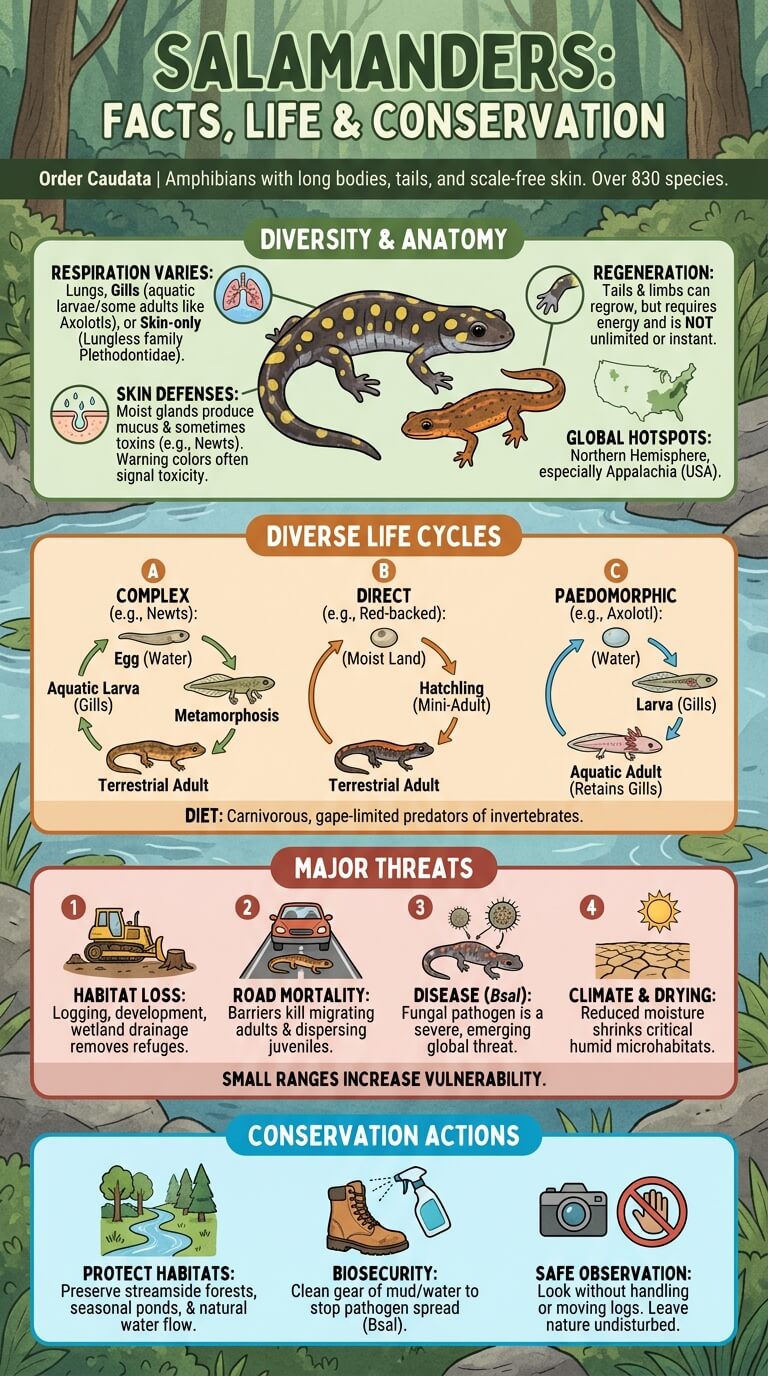
Salamanders belong to the amphibian order Caudata, also called Urodela in some scientific literature. Unlike adult frogs and toads, adult salamanders normally retain a tail. Most have four limbs, although sirens have only front limbs and amphiumas have extremely small limbs. Their skin lacks the dry scales of lizards and usually needs protection from drying.
As of July 14, 2026, AmphibiaWeb listed 837 salamander and newt species across 10 families and 69 genera. That number can change as researchers describe new species, revise species boundaries, or update taxonomy.
How Newts Fit Within the Salamander Group
Every newt is a salamander, but not every salamander is a newt. The name newt is used for certain members of the family Salamandridae, a group that also includes animals commonly called true salamanders. Many newts have a complex seasonal life cycle, moving between aquatic breeding habitats and terrestrial feeding or overwintering habitats.
Classification and Global Diversity
Major Salamander Families
Modern salamanders are grouped into 10 living families. Plethodontidae contains the lungless salamanders and is by far the largest family. Salamandridae includes many newts and true salamanders. Ambystomatidae contains mole salamanders, including tiger salamanders, spotted salamanders, and axolotls. Cryptobranchidae includes giant salamanders and hellbenders.
Other families include Hynobiidae, often called Asiatic salamanders; Proteidae, which includes mudpuppies and the olm; Sirenidae, the eel-like sirens; Amphiumidae, the aquatic amphiumas; Dicamptodontidae, the Pacific giant salamanders; and Rhyacotritonidae, the torrent salamanders. Family names describe evolutionary relationships, not one uniform lifestyle.
Lungless Salamanders, Mole Salamanders, Newts, Sirens, and Giants
Lungless salamanders show how dramatically one body plan can diversify. AmphibiaWeb currently recognizes more than 500 plethodontid species, making Plethodontidae the largest living salamander family. Members occupy forest floors, caves, streams, trees, rock faces, and underground spaces. All lack lungs and depend on moist skin and the lining of the mouth for gas exchange.
Mole salamanders often spend much of the year underground and travel to ponds for breeding. Newts may alternate between terrestrial and aquatic phases. Sirens remain aquatic and have external gills as adults. Giant salamanders and hellbenders are fully aquatic, broad-bodied animals adapted to flowing water. These differences make “typical salamander” a useful starting image, but not a complete description.
Where Salamander Diversity Is Highest
Salamanders occur mainly in the Northern Hemisphere, with important diversity centers in eastern North America, Mexico, Central America, parts of South America, Europe, and Asia. North America is especially rich in lungless salamanders, and the Appalachian region is a major center of plethodontid diversity.
Anatomy and Body Features
Long Bodies, Tails, Limbs, and Skin
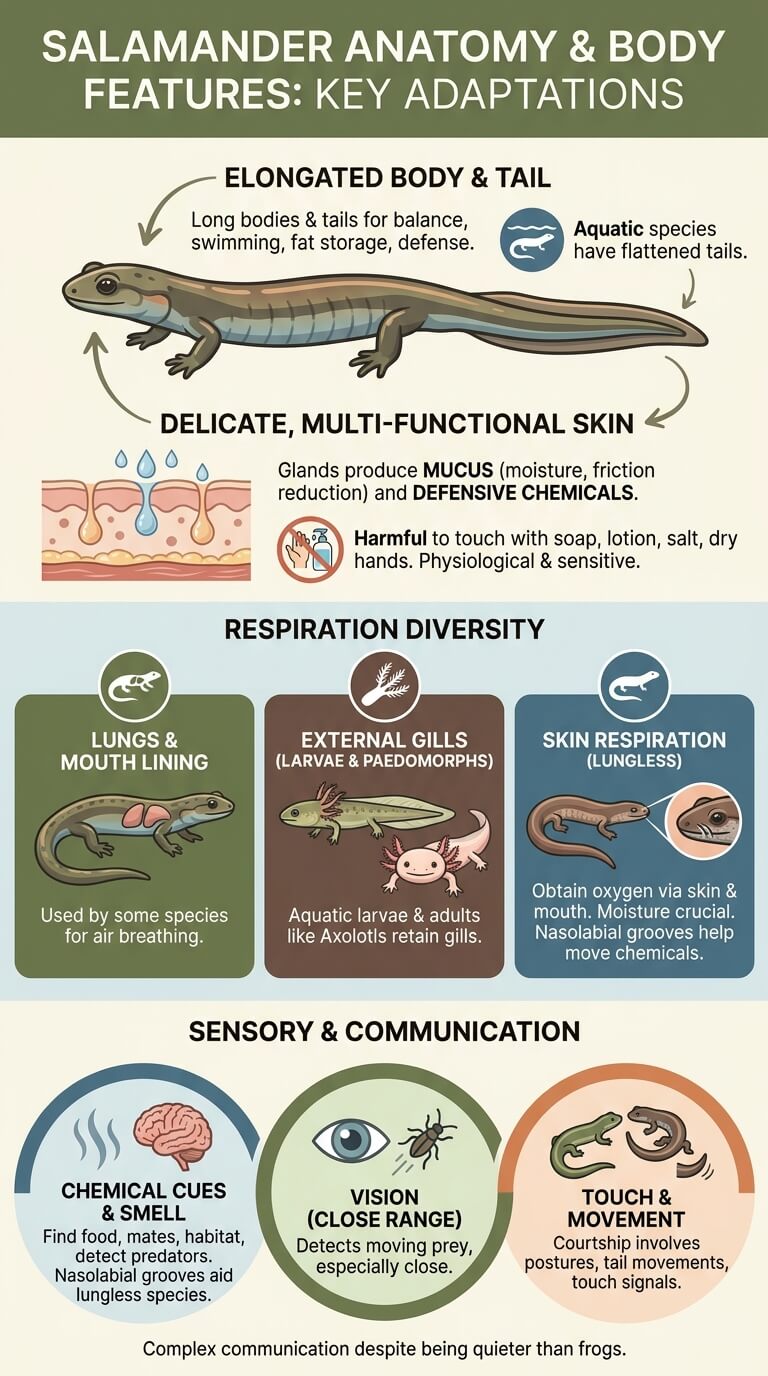
Most salamanders have elongated bodies, short limbs that project from the sides, and tails used for balance, swimming, fat storage, courtship, defense, or movement. Terrestrial species may have sturdy toes for walking or climbing. Aquatic species often have flattened tails that push against water. Cave and burrowing species may have reduced eyes, pale coloration, or slender bodies suited to narrow spaces.
The skin contains glands that produce mucus and, in many species, defensive chemicals. Mucus helps maintain a moist surface and can reduce friction or support skin function. Because the skin is delicate and physiologically active, soap, lotion, sunscreen, insect repellent, salt, dry hands, and rough handling may harm salamanders.
Lungs, Gills, and Skin Respiration
Salamander breathing varies widely. Some species use lungs, skin, and the lining of the mouth. Aquatic larvae commonly have external gills, which may disappear during metamorphosis. Paedomorphic adults such as axolotls retain external gills, while mudpuppies, sirens, and several other aquatic salamanders also keep larval-looking gills into adulthood.
Lungless salamanders obtain oxygen through their skin and mouth lining. This makes moisture, body shape, temperature, and access to humid refuges especially important. Even species with lungs may depend substantially on skin respiration. The balance changes with activity, water oxygen, temperature, body size, and species.
Sensory Abilities and Chemical Communication
Salamanders use smell and chemical cues to find food, recognize habitat, locate mates, identify rivals, and detect predators. Lungless salamanders have grooves between the nostrils and upper lip called nasolabial grooves. These structures help move dissolved chemical information toward sensory tissues.
Vision also matters, especially for detecting moving prey at close range. Aquatic larvae may use the lateral-line system to sense water movement. Courtship can include body postures, tail movements, touch, and chemical signals released from glands. Salamanders are usually quieter than frogs, but their communication is still complex.
Where Salamanders Live
Forest Floors, Caves, Streams, Ponds, and Wetlands
Terrestrial salamanders often live in leaf litter, rotting logs, rock cracks, root channels, burrows, moss, and moist soil. Stream salamanders use spaces beneath stones and along shaded banks. Pond-breeding species may spend only a short breeding season in water, then return to forests or grasslands.
Moist Microhabitats and Seasonal Movement
A fallen log is more than a hiding place. It can hold moisture, moderate temperature, support prey, and provide nesting spaces. Rocks, leaf litter, bark, underground mammal tunnels, and stream gravel can serve similar roles. Removing these features may reduce habitat even when the surrounding forest remains standing.
Seasonal movement is often triggered by rain, temperature, snowmelt, or water level. Mole salamanders may cross roads on rainy nights to reach breeding ponds. Newts can shift between land and water. Stream species may retreat deeper into rock spaces during drought or freezing conditions. Movement routes are therefore part of the habitat.
Fully Aquatic, Terrestrial, and Semi-Aquatic Lifestyles
Hellbenders, sirens, mudpuppies, amphiumas, and axolotls are aquatic as adults. Red-backed salamanders are terrestrial and lay eggs on land, with no free-swimming larval stage. Eastern newts typically pass through aquatic larval, terrestrial juvenile, and aquatic adult phases, although life cycles vary.
What Salamanders Eat and How They Hunt
Invertebrate Prey and Gape Limits
Most salamanders are predators. Terrestrial species commonly eat insects, spiders, mites, springtails, worms, slugs, snails, and other small invertebrates. Aquatic salamanders may take insect larvae, crustaceans, worms, mollusks, fish eggs, small fish, tadpoles, or smaller salamanders.
Prey size is limited partly by gape, meaning how widely the mouth can open and what the animal can swallow. A tiny woodland salamander targets very different prey from a hellbender. Diet also changes with age, season, habitat, and prey availability.
Sit-and-Wait Versus Active Foraging
Some salamanders wait beneath cover and strike when prey moves close. Others crawl through leaf litter, climb vegetation, or search stream bottoms. Lungless salamanders may project the tongue rapidly to capture prey, while aquatic species can use suction created by opening the mouth.
Larval and Aquatic Feeding Strategies
Larvae often begin with very small aquatic prey, then take larger insect larvae, crustaceans, worms, and other animals as they grow. Cannibalism occurs in some species, especially where food is limited or larvae differ greatly in size, but it is not universal.
Hellbenders feed heavily on crayfish in many streams. Sirens consume invertebrates and other small aquatic food, while axolotls use suction to take worms, insect larvae, crustaceans, and appropriately sized vertebrate prey. Diet descriptions should remain species-specific because aquatic salamanders do not share one menu.
Life Cycle and Reproduction
Courtship and Spermatophores
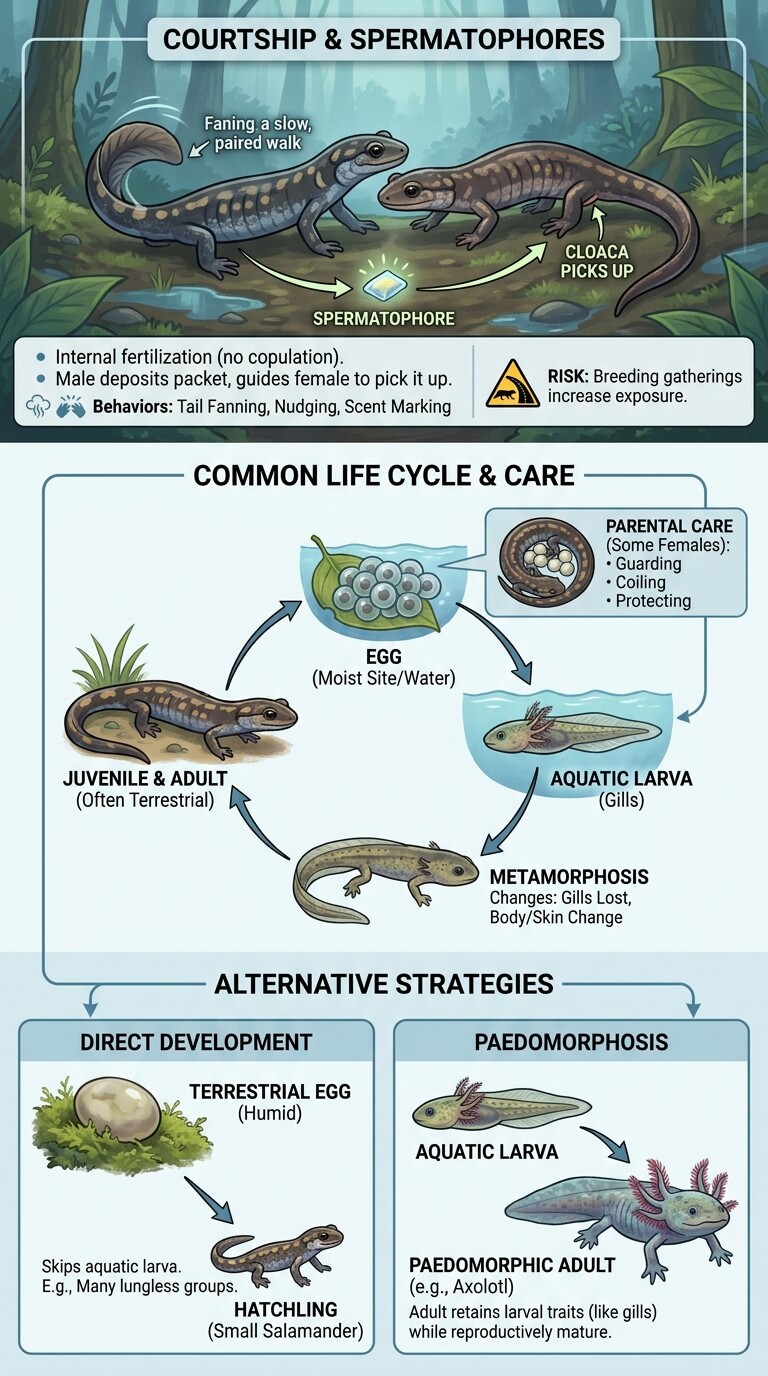
Many salamanders use internal fertilization without direct copulation. A male deposits a spermatophore, a small packet containing sperm, and guides the female so she can pick it up with her cloaca. Courtship may include tail fanning, nudging, scent marking, body rubbing, or a slow paired walk.
Some primitive salamander groups use external fertilization, and reproductive behavior differs among families. Timing may depend on rain, temperature, stream flow, or seasonal flooding. Breeding gatherings can increase opportunities for mating while also increasing exposure to roads, predators, and pathogens.
Egg Laying, Parental Care, and Larval Development
Eggs may be laid singly or in clusters in ponds, streams, caves, underground chambers, moss, logs, or other moist sites. Some females guard eggs, coil around them, move them, or protect the nest from predators and fungi. In a few groups, reproduction includes live birth rather than egg laying.
A common life cycle includes egg, aquatic larva with gills, metamorphosis, juvenile, and adult. During metamorphosis, body proportions, skin, feeding structures, and respiration change. The larva may lose its external gills and leave the water, but this pattern is only one of several salamander life histories.
Direct Development and Paedomorphosis
Direct-developing salamanders skip a free-swimming larval stage. Their embryos complete major developmental changes inside terrestrial eggs, and hatchlings emerge as small salamanders. Many lungless salamanders use this strategy, allowing reproduction away from ponds while still requiring humid nesting conditions.
Paedomorphosis means that adults retain traits associated with an earlier life stage. The Mexican axolotl is the best-known example. The AmphibiaWeb axolotl account describes an aquatic adult that retains external gills and other larval features while becoming reproductively mature. Paedomorphosis is broader than neoteny, which refers specifically to slowed body development relative to reproductive maturation.
Salamander Survival Adaptations
Tail Loss and Defensive Secretions
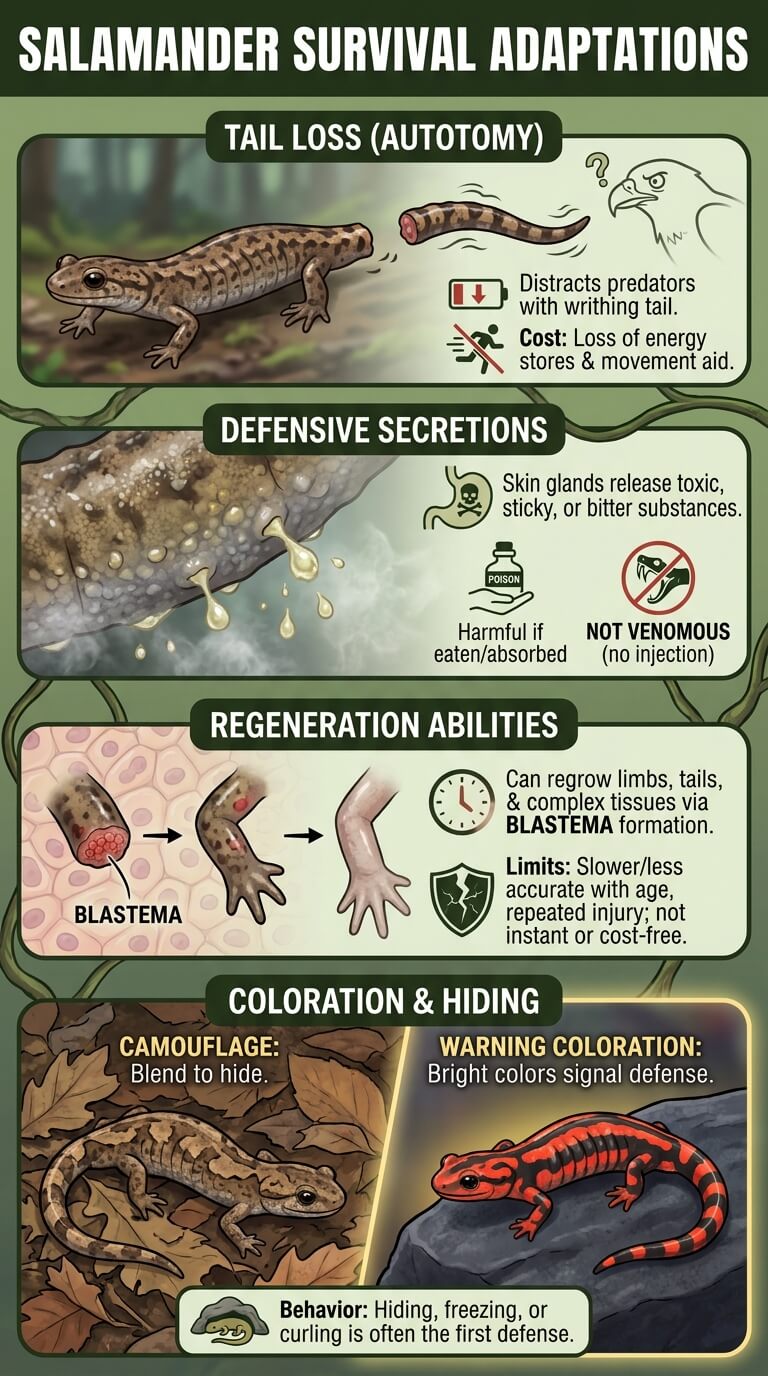
Some salamanders can release part of the tail when attacked. The detached tail may writhe and distract a predator while the salamander escapes. Tail loss carries costs because the tail may store energy, aid movement, or play a role in courtship.
Skin glands can release bitter, sticky, irritating, or toxic substances. Newts are especially known for chemical defenses, but toxicity differs greatly among species and populations. These animals are poisonous because toxins are harmful when eaten or absorbed, not venomous in the usual sense of injecting toxin through a bite or sting.
Regeneration Abilities and Biological Limits
Salamanders can regenerate complex tissues more extensively than other living four-limbed vertebrates. Depending on species and conditions, they may regrow tails, limbs, parts of the spinal cord, eye tissues, jaw structures, and portions of some internal organs. Limb regeneration begins with wound closure and formation of a blastema, a mass of cells that supports rebuilding.
A 2024 review of salamander limb regeneration explains that successful regrowth depends on coordinated nerves, immune cells, skeletal tissues, patterning signals, and developmental processes. Regeneration can be slower or less accurate after repeated injury, with age, infection, severe tissue damage, or poor conditions. It is not instant, cost-free, or unlimited.
Camouflage, Warning Coloration, and Hiding Behavior
Brown, gray, black, and mottled patterns help many salamanders disappear against soil, bark, rocks, and leaf litter. Others display bright red, orange, yellow, or black patterns that may warn predators of chemical defenses. Some expose a bright tail or underside only when threatened.
Remaining hidden is often the first defense. Salamanders retreat into narrow spaces, freeze against the background, curl the body, raise the tail, lash at attackers, or release sticky secretions. A warning color is useful evidence of defense, but it does not tell a person how toxic the species is.
Remarkable Salamander Examples
Axolotls and Retained Larval Traits
Axolotls are mole salamanders native to the lake and canal system of Xochimilco in Mexico City. Wild animals are generally dark and mottled, unlike the pale pink domestic color commonly seen in captivity. They remain aquatic, retain external gills, and reproduce without undergoing the usual land-adult transformation.
Hellbenders and Other Giant Aquatic Salamanders
Hellbenders are large, flattened salamanders of cool, flowing rivers in the eastern United States. Their loose skin folds increase surface area for gas exchange, and adults spend much of their time beneath large rocks. Sediment can fill the spaces beneath those rocks and cover gravel used by larvae.
The U.S. Fish and Wildlife Service eastern hellbender profile describes widespread population loss and decline linked to sedimentation, degraded water quality, habitat damage, disease, and direct mortality. Federal status differs by population and subspecies, so conservation claims should specify the exact taxon and date.
Lungless Salamanders and Skin Respiration
Lunglessness may sound limiting, yet plethodontids have become the most species-rich salamander family. Small body size, moist skin, low metabolic demand, and access to humid microhabitats make skin-based gas exchange possible. Many also possess highly specialized tongues and chemical-sensing structures.
The same dependence creates vulnerability. Drying forest floors, warmer conditions, canopy loss, soil disturbance, and altered stream moisture can reduce safe activity time. A lungless salamander may remain underground during unfavorable conditions, making population changes difficult to detect through casual observation.
Salamander Conservation
Habitat Loss, Stream Degradation, and Road Mortality
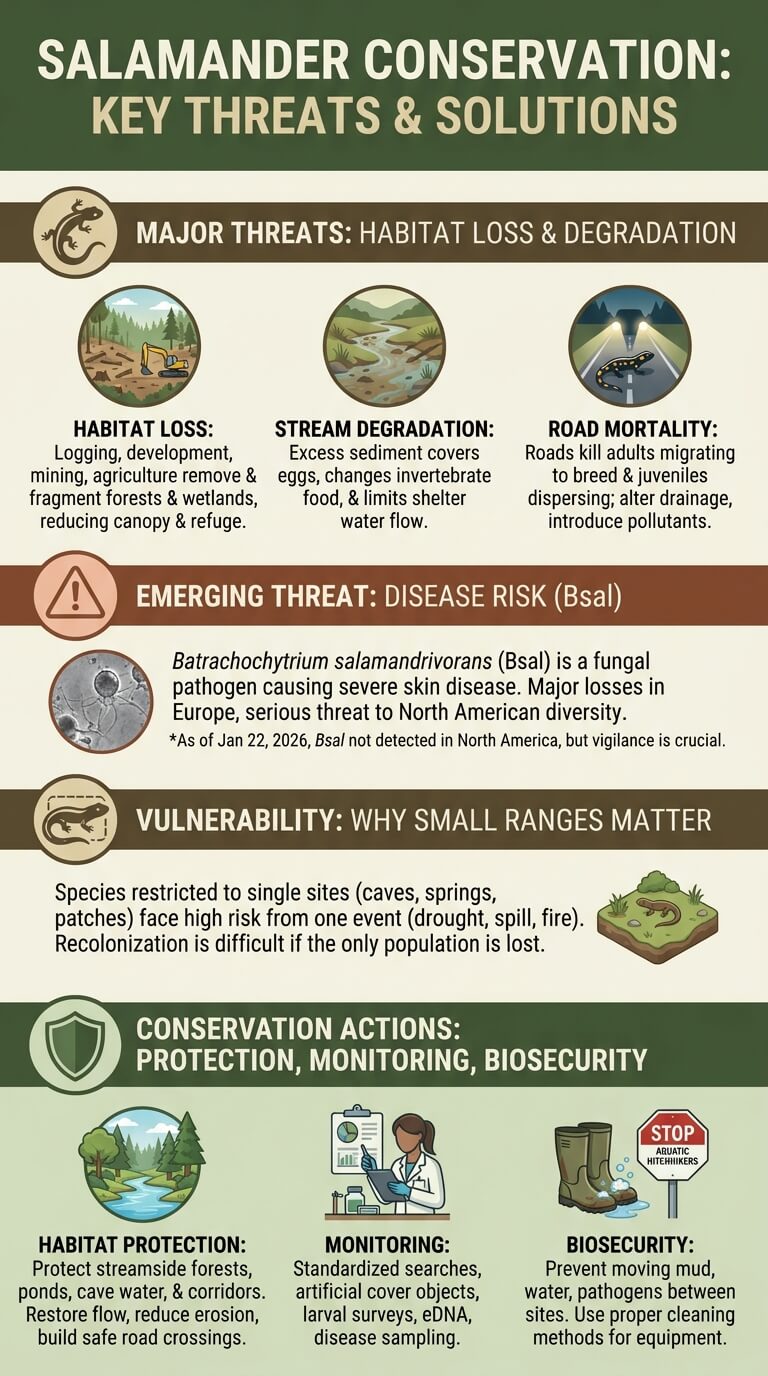
Logging, development, mining, agriculture, dams, water withdrawal, and wetland drainage can remove or fragment salamander habitat. In streams, excess sediment fills rocky spaces, covers eggs, changes invertebrate communities, and reduces water movement around shelters. On land, loss of canopy, leaf litter, and fallen wood reduces moisture and refuge.
Roads can kill adults moving to breeding sites and juveniles dispersing away from ponds. They also alter drainage and introduce salt, oil, metals, and heat. Protecting a breeding pond without its surrounding forest or migration route may leave the population incomplete.
Disease Risk Including Bsal
Batrachochytrium salamandrivorans, shortened to Bsal, is a fungal pathogen capable of causing severe skin disease in susceptible salamanders. It has caused major losses in parts of Europe and is considered a serious threat to North American salamander diversity.
According to the USGS Bsal surveillance update dated January 22, 2026, Bsal had not been detected in North America at that time. This is a time-sensitive finding, not a guarantee that introduction cannot occur. Trade safeguards, monitoring, reporting, and clean field equipment remain important.
Why Small Ranges Can Increase Vulnerability
A salamander restricted to one cave, spring, mountaintop, stream, or forest patch has few options when that site changes. One drought, contaminant spill, fire, mine, road project, or disease introduction can affect a large share of the entire species.
Small ranges also make recolonization difficult. If a population disappears from its only known site, another population may not exist nearby to replace it. Taxonomic research matters because a population once treated as part of a widespread species may turn out to be a distinct, narrowly distributed species.
Habitat Protection, Monitoring, and Biosecurity
Conservation can protect streamside forests, seasonal ponds, cave water, fallen wood, groundwater, and movement corridors. Restoring flow, reducing erosion, limiting sediment, and building properly designed road crossings may help specific populations.
Monitoring can include standardized searches, artificial cover objects used by trained teams, larval surveys, environmental DNA, disease sampling, and long-term habitat measurements. Biosecurity means preventing mud, water, plants, animals, and pathogens from being moved between sites. The correct cleaning method depends on agency guidance and the material being cleaned.
Safe and Ethical Salamander Observation
Look Without Collecting or Relocating
The safest observation is usually a photograph taken without touching the animal. Do not bring a wild salamander home, move it to a different pond, or release a captive salamander. A healthy-looking animal can carry pathogens, and a moved salamander may belong to a locally adapted population.
If a salamander is crossing a road, personal safety comes first. Follow local wildlife-agency guidance rather than entering traffic or creating an unauthorized rescue operation.
Protect Skin and Microhabitat
Avoid handling because dry skin and residues on human hands can damage a salamander’s surface. Never apply water, chemicals, medication, or disinfectant to a wild animal. Do not lick or allow pets to mouth salamanders because defensive secretions can irritate tissues or cause poisoning.
If you gently lift a cover object to observe beneath it, replace it exactly as found and do not repeatedly disturb the same shelter. Rolling logs, peeling bark, rearranging stream rocks, or opening sealed rotting wood can destroy refuge and nesting habitat.
Avoid Spreading Mud and Pathogens Between Sites
Boots, nets, buckets, tires, boats, and field equipment can carry mud and organisms. Do not move water, plants, eggs, larvae, or animals between ponds and streams. Follow posted decontamination instructions and clean equipment away from natural water.
Report unusual numbers of sick or dead salamanders to the relevant state wildlife agency, park staff, or wildlife disease program. Do not collect specimens unless an authorized professional gives specific instructions.
Common Myths and Mistakes
Salamanders Are Amphibians, Not Lizards
Salamanders and lizards can share a long body and tail, but they belong to different vertebrate groups. Salamanders have amphibian skin and life histories, while lizards are reptiles with scales, claws, and different reproductive and physiological traits.
A quick field clue is skin texture, but identification should also consider toes, claws, habitat, head shape, and movement. Never handle an animal simply to check whether it feels moist or scaled.
Regeneration Is Not Unlimited
A salamander may regrow a lost limb, but the process requires time, food, nerves, immune activity, and healthy tissue. Regrowth may differ from the original structure, especially after repeated loss or severe damage. The animal can still suffer pain, infection, reduced movement, predation, and death.
Regeneration is a research subject, not permission to test the ability. Deliberately injuring wildlife is unethical and may be illegal.
Not Every Salamander Is Highly Toxic
Many salamanders produce defensive skin chemicals, yet potency and risk vary greatly. Some secretions mainly taste unpleasant or irritate a predator. Certain newts carry powerful toxins, but that does not make every salamander equally dangerous.
The sensible rule is to avoid touching or ingesting any wild amphibian and to keep pets from mouthing them. A species’ bright colors may signal defense, but color alone cannot measure toxicity.
Salamanders Within Amphibian and Freshwater Life
Shared Amphibian Skin and Life-Cycle Biology
Salamanders share permeable skin, ectothermy, and moisture dependence with other amphibians, but their retained tails and diverse reproductive modes set them apart from adult frogs and toads. Some undergo aquatic metamorphosis, some develop directly on land, and others remain paedomorphic in water.
Broader Causes of Amphibian Decline
Habitat loss, disease, climate change, pollution, invasive species, roads, and wildlife trade affect amphibians broadly. Salamander biology changes how those pressures operate. A stream hellbender, cave salamander, woodland plethodontid, and pond-breeding mole salamander do not face identical risks.
Freshwater Habitats and Seasonal Survival
Salamanders help connect stream, pond, wetland, cave, and forest food webs. Aquatic larvae consume small prey and feed larger predators. Terrestrial adults consume invertebrates and become prey for snakes, birds, mammals, fish, and other amphibians.
Seasonal survival depends on stable refuges. Some retreat below frost, some remain in flowing water, and others reduce activity in deep soil or rock spaces. Winter, drought, and breeding migrations reveal why protecting only the place where an animal is seen may not protect its full life cycle.
FAQ
Can All Salamanders Regrow Limbs?
Many salamanders can regenerate limbs, especially during larval or juvenile stages, but the ability and quality of regrowth vary by species, age, injury, tissue condition, and environment. Tail regeneration is also widespread, yet not every replacement is identical to the original.
Regeneration should never be tested by injuring an animal. It does not prevent pain, infection, stress, or death.
Are Newts Poisonous?
Many newts produce defensive toxins in their skin, and a few species can be dangerous if eaten. Toxicity varies by species and population. Newts are generally poisonous rather than venomous because the toxin is not normally injected by a specialized bite or sting.
Do not handle, lick, collect, or allow a pet to mouth a newt. Contact a veterinarian or poison-control professional promptly if a pet has bitten or swallowed one.
Do Any Salamanders Keep Their Gills as Adults?
Yes. Axolotls, mudpuppies, sirens, and several other aquatic salamanders retain external gills after reaching reproductive maturity. This is one form of paedomorphosis, the retention of juvenile traits in an adult.
Not every aquatic salamander has external gills. Hellbenders lose their larval gills and rely mainly on gas exchange through folded skin.
What Is the Difference Between a Salamander and a Lizard?
A salamander is an amphibian with soft, glandular skin and no scales or claws. A lizard is a reptile with scales, claws in most species, and a different body covering, egg structure, and respiratory system. Salamanders often depend strongly on moist microhabitats, while many lizards tolerate much drier conditions.
Both groups can lose and regrow tails, but salamanders generally have much broader regeneration abilities. Similar body shape does not indicate close relationship.
Final Thoughts
Salamander facts reveal one of the most diverse amphibian body plans. Salamanders can be fully aquatic, entirely terrestrial, cave-dwelling, tree-climbing, lungless, gilled as adults, direct-developing, or capable of major tissue regeneration. Newts are one branch within this larger group, not a separate kind of vertebrate.
Their survival depends on more than moisture alone. Clean streams, intact forest floors, seasonal ponds, hidden shelters, safe movement routes, disease prevention, and careful observation all matter. Protecting salamanders means protecting the connected freshwater and land habitats that support every stage of their lives.

Ethan Walker is the founder and research editor of Animal Fact Central. He creates and reviews educational animal facts content using trusted wildlife, pet care, and science-based sources. His work focuses on making animal behavior, adaptations, habitats, and species facts clear, accurate, and engaging for everyday readers.
Read More Details About Ethan Walker: https://animalfactcentral.com/ethan-walker/