
Frogs are important because they perform several jobs at once. Adult frogs hunt insects and other small animals, while eggs, tadpoles, juveniles, and adults feed a wide range of predators. Many tadpoles graze on algae, scrape biofilms, or process decaying material in freshwater. When young frogs leave the water after metamorphosis, they also move energy and nutrients from ponds and streams into nearby forests, fields, and gardens.
That combination makes frogs more than familiar voices on a warm night. They help connect aquatic and land-based food webs, influence the abundance and behavior of other organisms, and give scientists useful information about environmental change. Their exact impact differs among species and habitats, so frogs should not be treated as universal mosquito-control machines or perfect water-quality tests. Their value comes from the many ecological relationships they support.
Quick Answer
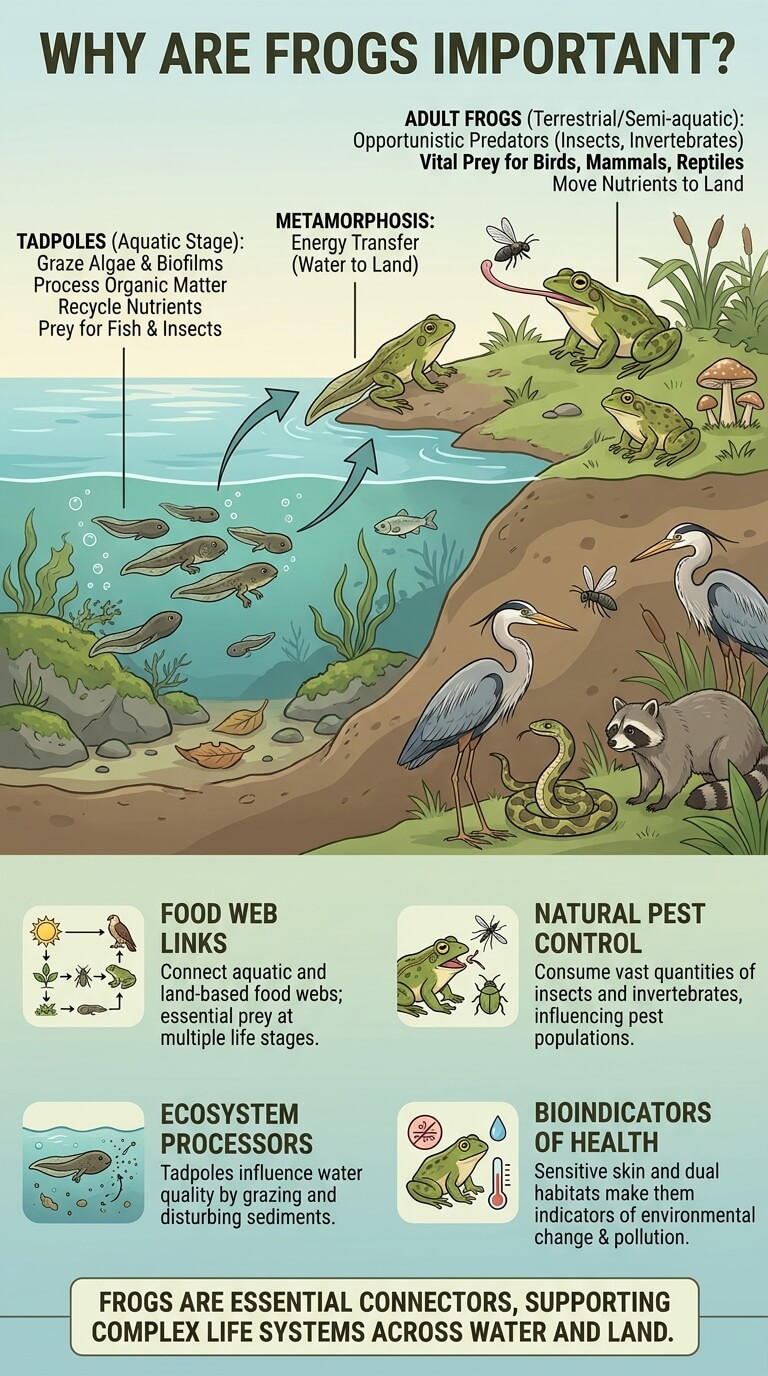
Frogs Link Freshwater and Land-Based Food Webs
Most frogs use more than one environment during their lives. Eggs and tadpoles often develop in ponds, wetlands, lakes, slow streams, temporary pools, or water held in plants. After metamorphosis, many species move onto shorelines, forest floors, grasslands, shrubs, or trees. A frog may therefore eat and be eaten in two different environments during one lifetime.
The U.S. Geological Survey overview of amphibian ecology describes amphibians as links between water and land that contribute to nutrient cycling and food webs. Frogs are especially visible examples because their larval and adult stages often occupy different feeding roles.
Their Importance Changes From Tadpole to Adult
A tadpole is not simply a smaller adult frog. Its body, mouthparts, movement, habitat, and diet may be very different. Many tadpoles feed low in aquatic food webs by scraping algae and microorganisms from surfaces or consuming suspended and decaying material. Some are filter feeders, predators, scavengers, or even cannibals under certain conditions.
After metamorphosis, most frogs become predators. They may take insects, spiders, worms, snails, crustaceans, or small vertebrates, depending on species and body size. At the same time, frogs remain prey for fish, snakes, turtles, birds, mammals, aquatic insects, and other frogs. The shift from grazing or filtering tadpole to hunting adult means one species can affect several parts of an ecosystem.
Frogs as Predators
Insects and Other Invertebrate Prey
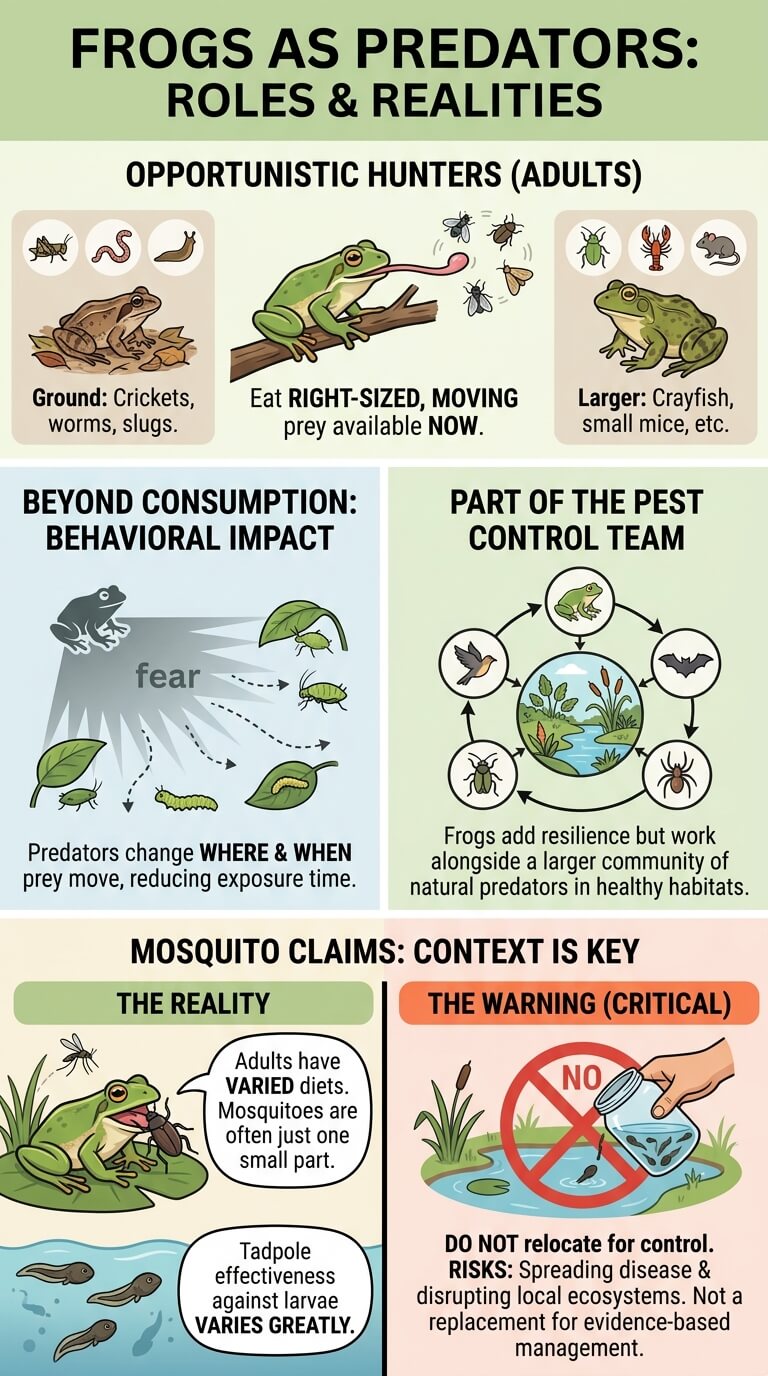
Adult frogs are generally opportunistic hunters. Rather than searching for one preferred pest, they respond to prey that is the right size, moving within reach, and available at the right time. A small tree frog may catch flies, moths, beetles, ants, or spiders on vegetation. A ground-dwelling frog may take crickets, worms, slugs, and other animals moving through leaf litter. Larger frogs can eat crayfish, fish, small snakes, mice, or smaller frogs.
This feeding pressure matters because invertebrates are abundant and reproduce quickly. A frog does not need to eliminate a prey population to influence it. Predators can change where prey feed, when they move, and how long they remain exposed. Those behavioral effects can be important even when the number of prey eaten is difficult to measure.
When Frogs May Help Limit Pest Populations
Frogs can contribute to natural pest control where healthy frog populations overlap with dense insect populations. Toads hunting on the ground may eat beetles, caterpillars, crickets, and other invertebrates in gardens or farm edges. Tree frogs can capture flying and plant-dwelling insects. Aquatic frogs may take insects at the water surface or along shorelines.
The safest interpretation is that frogs form one part of a larger predator community. Birds, bats, spiders, predatory insects, fish, reptiles, and small mammals may be feeding on the same general prey base. A landscape with varied native vegetation, clean breeding water, and limited pesticide exposure supports many of these predators together. Frogs add ecological resilience, but they are not a replacement for careful, evidence-based pest management.
Why Mosquito-Control Claims Need Context
Frogs do eat mosquitoes, but the statement needs qualification. An adult frog may catch adult mosquitoes when they are available, yet it usually eats many kinds of prey and may not encounter enough mosquitoes to produce a noticeable local reduction. Tadpoles also differ greatly. Some may consume mosquito eggs or larvae, some compete with mosquito larvae for resources, and others have little meaningful effect.
Habitat conditions can further complicate the picture. A shallow container or neglected pond may produce mosquitoes even when frogs are nearby. Fish, aquatic insects, water movement, vegetation, temperature, and drying cycles can all influence mosquito survival. Protecting frogs is ecologically valuable, but adding frogs or moving tadpoles into water should not be promoted as a mosquito-control method. Relocation can spread disease, introduce non-native animals, and disrupt local populations.
Frogs as Prey
Food for Fish, Birds, Reptiles, Mammals, and Other Amphibians
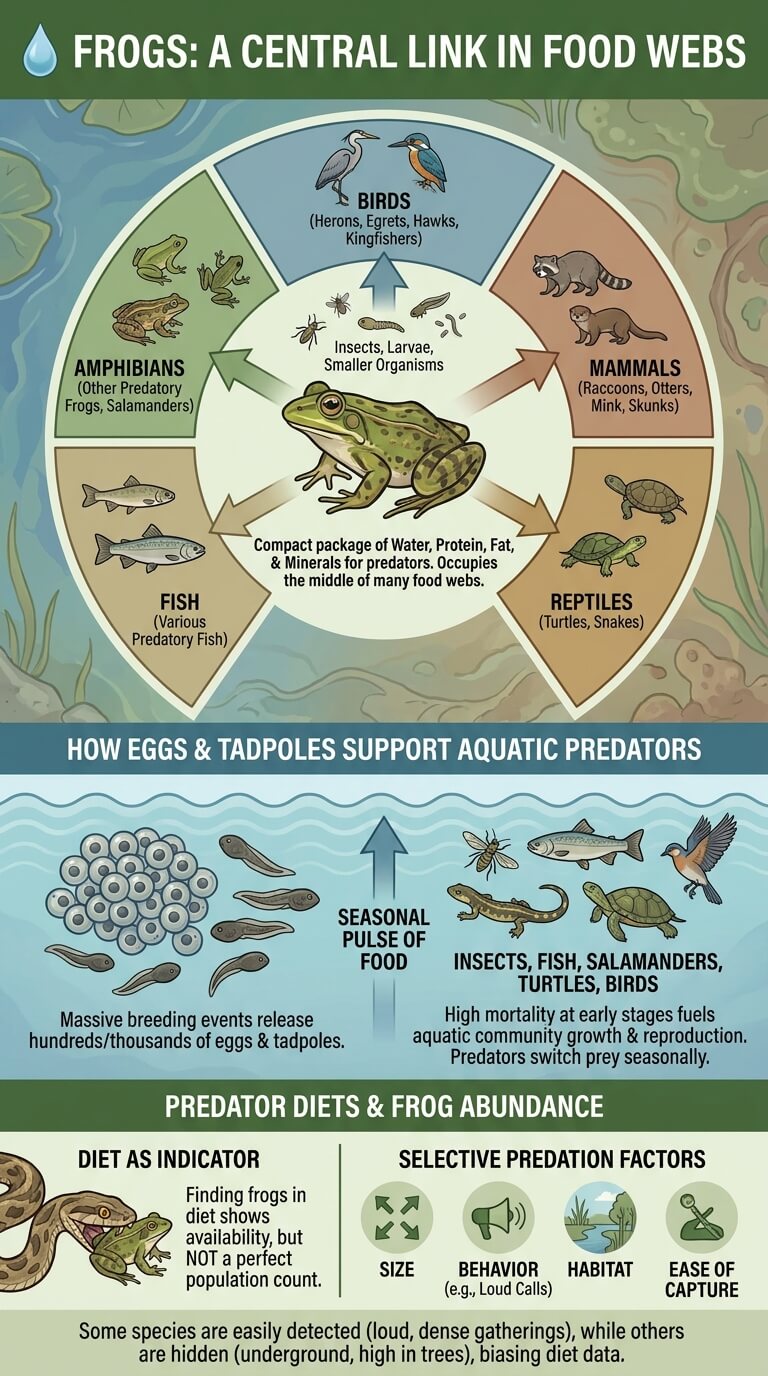
Frogs occupy the middle of many food webs. They consume smaller organisms but are also compact packages of water, protein, fat, and minerals for larger predators. Herons, egrets, kingfishers, hawks, raccoons, otters, mink, skunks, turtles, snakes, fish, and predatory amphibians may all eat frogs where their ranges overlap.
Different predators take different life stages. A snake may hunt adult frogs along a wetland edge. A fish may consume tadpoles. A wading bird may take both juveniles and adults. Aquatic insect larvae can attack eggs or small tadpoles. Because frogs are available in several sizes and habitats, their energy can move through many feeding pathways rather than one simple chain.
How Eggs and Tadpoles Support Aquatic Predators
Frog reproduction can create a seasonal pulse of food. A breeding event may place hundreds or thousands of eggs into a pond, although clutch size varies enormously among species. Many eggs and tadpoles will not survive to adulthood. Instead, they become food for insects, fish, salamanders, turtles, birds, and other frogs.
High mortality at early life stages is not evidence that those lives are wasted. It is part of the way energy moves through an aquatic community. A predator that feeds heavily on tadpoles during spring may switch to insects, fish, or other prey later in the year. Temporary abundance can support growth and reproduction in species that time their own activity around frog breeding.
What Predator Diets Reveal About Frog Abundance
Finding frogs in a predator’s diet can show that frogs are available, but it does not provide a perfect count of the local frog population. Predators select prey by size, behavior, habitat, and ease of capture. A frog species that calls loudly or gathers densely to breed may be especially visible to predators for a short period. Another species may be common but difficult to detect because it stays underground or high in trees.
Tadpoles and Freshwater Ecosystem Work
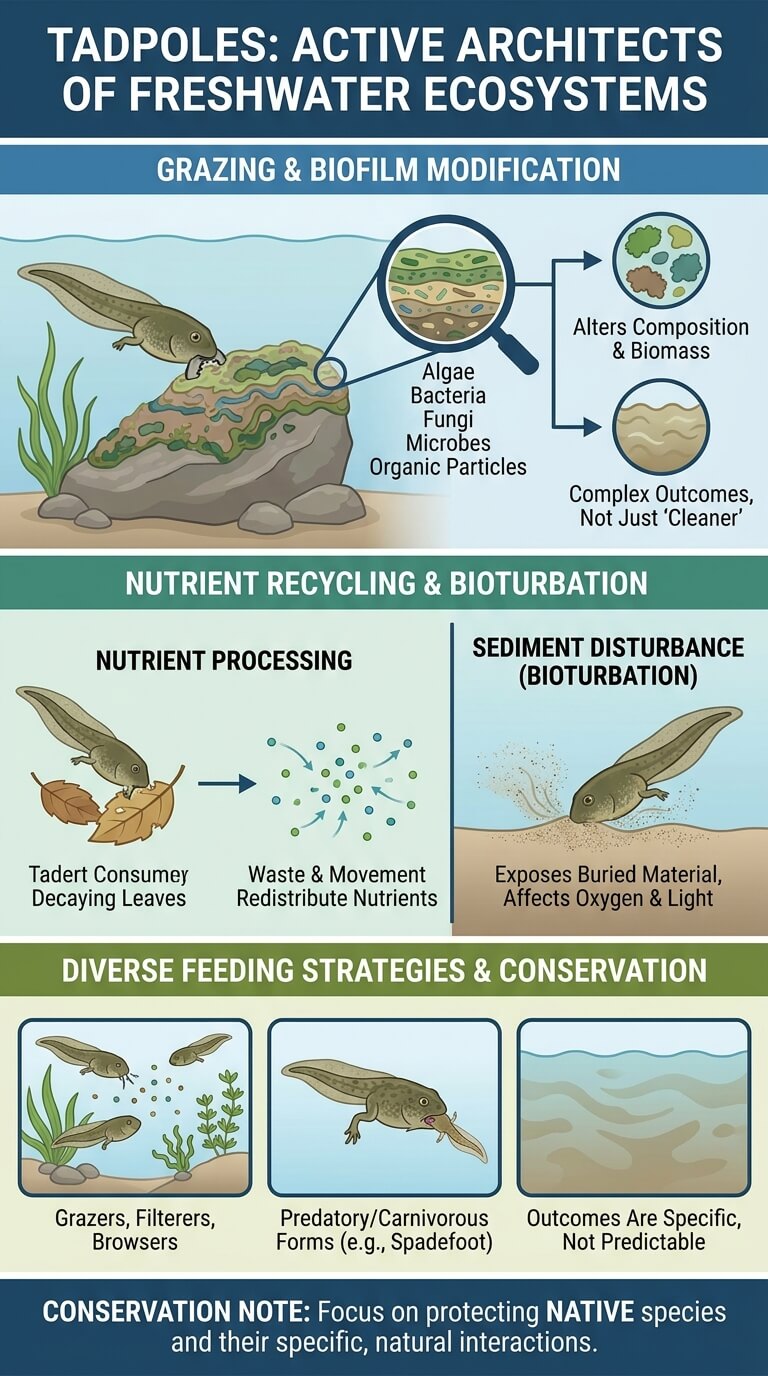
Grazing on Algae and Biofilms
Many tadpoles use specialized mouthparts to scrape surfaces. What they collect is often more complex than visible green algae. A submerged leaf, stone, or stem can carry a biofilm made of algae, bacteria, fungi, microscopic animals, and trapped organic particles. Tadpole grazing can remove part of that layer and change which organisms dominate it.
The result depends on the tadpole species, its density, water flow, nutrients, temperature, and the type of surface. In some systems, grazing reduces algal biomass. In others, it changes the composition of algae without simply making the water clearer. A study of stream communities found that the presence or absence of tadpoles could alter periphyton structure, showing why the ecological effect of tadpole loss is more specific than the slogan “tadpoles clean ponds.” The peer-reviewed amphibian-loss experiment also emphasizes that outcomes depend on the community being studied.
Processing Organic Matter and Recycling Nutrients
Leaves, dead algae, animal waste, and other organic material enter freshwater habitats continually. Microbes begin breaking that material down, and some tadpoles consume the softened particles and associated microorganisms. Their feeding, digestion, waste production, and movement can redistribute nutrients within the pond or stream.
Tadpoles also disturb fine sediments as they forage. This bioturbation can expose buried material, move particles, and affect oxygen and light at the bottom. The effect is not uniformly beneficial or harmful. A dense population of one species may produce a strong change, while a few individuals in a large lake may have little measurable influence. The important point is that tadpoles participate actively in ecosystem processes rather than waiting passively to become frogs.
Species Differences Among Tadpole Feeding Strategies
The familiar algae-eating tadpole is only one pattern. Some tadpoles filter tiny particles from the water. Others browse plant material, eat animal remains, prey on eggs or smaller larvae, or switch foods as conditions change. Spadefoot tadpoles can develop different feeding forms, including more carnivorous individuals, depending on diet and environmental cues.
These differences prevent simple predictions. Removing a grazing species may allow certain algae to increase. Losing a predatory tadpole may affect smaller animals instead. Introducing a non-native frog can create new competition or predation rather than replacing a missing ecological role. Conservation works best when it protects native species and the habitats that support their natural interactions.
Moving Energy and Nutrients Between Water and Land
Metamorphosis as an Ecological Transfer Point
Metamorphosis transforms an aquatic larva into a juvenile capable of living partly or mostly on land. The froglet carries tissues built from food and nutrients obtained in the water. When many froglets leave a pond, they transport that biological material across the shoreline.
This movement is sometimes called an aquatic subsidy, meaning a transfer of organisms or nutrients from water to a land-based consumer community. The USGS work on linked food webs notes that pond-breeding amphibians can be abundant as aquatic larvae and then become terrestrial prey as juveniles and adults. Metamorphosis therefore changes not only the frog’s body but also where its energy becomes available to predators.
Adult Movement Into Forests, Fields, and Gardens
After breeding, adults of many species travel away from open water. Wood frogs may spend much of the year in forest leaf litter. Toads can forage in fields, yards, dunes, and woodland edges. Tree frogs move among shrubs and trees. These animals carry nutrients in their bodies and return some through waste, shed skin, eggs, and eventually decomposition.
Seasonal Pulses of Food for Predators
Frog activity often rises with rainfall, temperature, or breeding season. A sudden emergence of froglets can supply abundant prey along shorelines. Calling adults may attract snakes, birds, and mammals. In dry regions, frogs that emerge after rain can briefly become important consumers and prey before returning underground.
Are Frogs Bioindicators?
Permeable Skin and Environmental Exposure
Frogs are often described as bioindicators, organisms whose condition or population patterns can provide information about environmental change. Their skin can exchange water and gases with the environment, and many species use both aquatic and terrestrial habitats. Eggs and tadpoles may be exposed directly to substances dissolved in water, while juveniles and adults encounter soil, air, prey, and surface contaminants.
That life history creates several routes of exposure. The U.S. Environmental Protection Agency’s frog research explains that pesticide exposure can occur during different life stages and through more than one pathway. Sensitivity still varies among species, chemicals, concentrations, temperatures, and developmental stages.
What Frog Changes Can Signal
A decline in calling males, fewer egg masses, poor tadpole survival, unusual development, or the loss of a formerly common species can justify closer investigation. Possible causes include habitat loss, altered water levels, pollution, road mortality, invasive predators, disease, drought, severe weather, or several pressures acting together.
Frog observations can also reveal habitat connections. If adults remain present but breeding repeatedly fails, the problem may be concentrated in the aquatic stage. If breeding ponds look suitable but adults disappear, the surrounding land or migration route may have changed. Long-term monitoring is most useful because one quiet night or one dry year can be misleading.
Why Frogs Alone Cannot Diagnose Water Quality
The presence of frogs does not prove that water is clean. Some species tolerate disturbance better than others, and a pond may support adults while exposing eggs or tadpoles to harmful conditions. Frogs can also disappear from good water because the shoreline has been cleared, fish have been introduced, disease is present, or roads block access.
Likewise, one dead frog does not identify a pollutant. Scientists compare multiple sites and years, test water and tissue, examine disease, measure habitat, and study several species. Frogs are valuable pieces of evidence, not living test strips that deliver a single answer.
Frogs in Science, Medicine, and Education
Developmental Biology and Physiology Research
Frogs have helped scientists study how vertebrate bodies develop. African clawed frogs in the genus Xenopus produce embryos that are comparatively large and can be observed and manipulated in laboratory research. That has made them useful for investigating early development, cell signaling, organ formation, genetics, and the effects of chemicals.
The National Institute of General Medical Sciences description of Xenopus laevis identifies the species as a long-used model for embryonic development. Results from a model organism do not automatically apply to humans, but they can reveal biological processes shared across vertebrates and guide further testing.
Chemical Compounds and Biomedical Research Without Miracle-Cure Hype
Frog skin secretions contain mixtures of molecules involved in defense against microbes or predators. Researchers have isolated and tested some peptides for antimicrobial, antiviral, metabolic, and other biological activity. These studies can identify promising chemical structures, but a compound that works in a laboratory assay is not automatically a safe or effective medicine.
A review of frog-derived host-defense peptides discusses therapeutic possibilities while also reflecting the early, experimental nature of much of the work. Responsible reporting should separate a research lead from an approved treatment and should never encourage people to touch, lick, collect, or extract secretions from wild frogs.
Frogs as Accessible Models for Teaching Ecosystems
A frog life cycle makes several ecological ideas visible in one animal. Students can compare eggs, tadpoles, froglets, and adults; observe changes in feeding and movement; map connections between water and land; and discuss how predators, weather, and habitat shape survival.
What Happens When Frogs Decline?
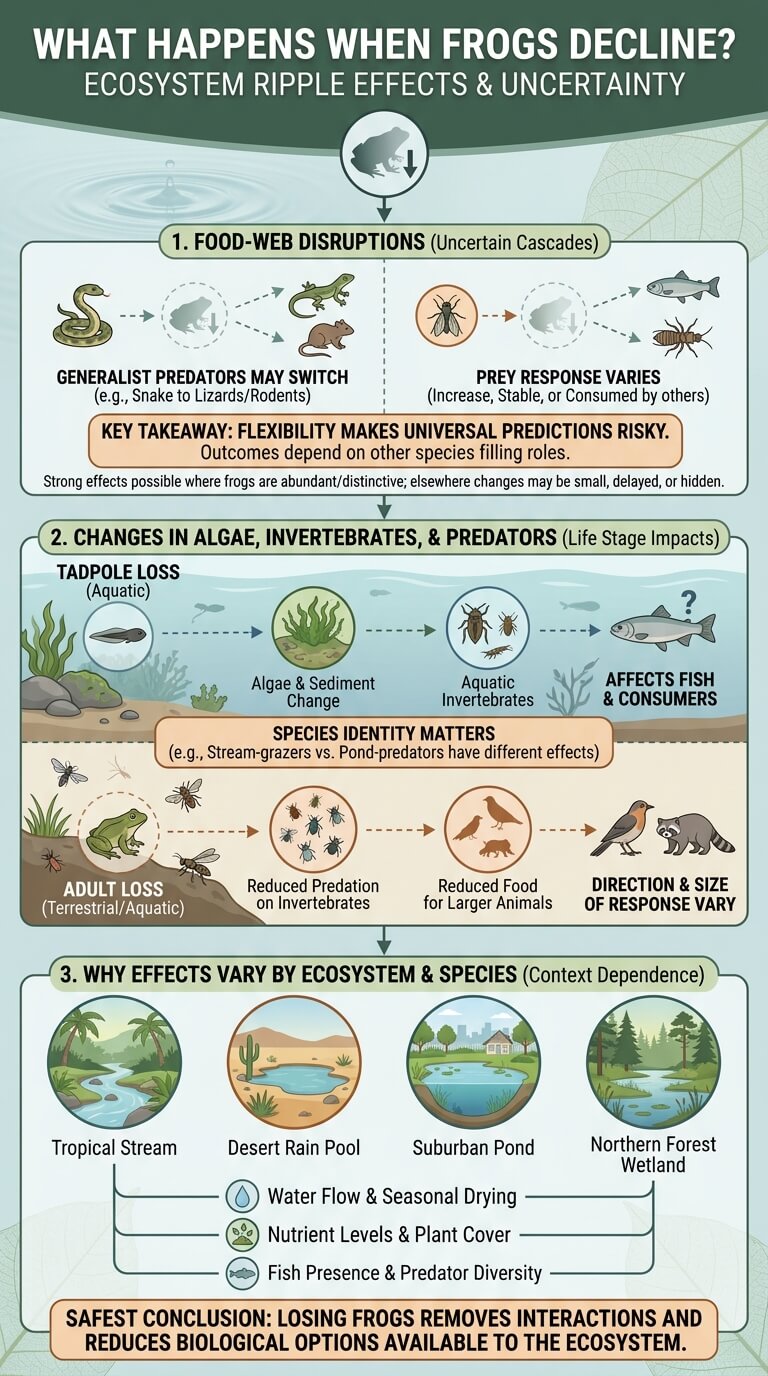
Food-Web Disruptions
When a frog population falls, predators lose one food source and prey lose one consumer. The outcome depends on whether other species can fill those roles. A generalist snake may switch to lizards or rodents. A fish may eat more insects. Invertebrate prey formerly eaten by frogs may increase, remain stable, or be consumed by another predator.
This flexibility is why it is risky to promise one universal cascade. A decline can produce strong effects where frogs are abundant or perform a distinctive function. Elsewhere, changes may be smaller, delayed, or hidden by natural variation. The safest conclusion is that losing frogs removes interactions and reduces the biological options available to the ecosystem.
Changes in Algae, Invertebrates, and Predators
Loss of tadpoles can change the surfaces they graze, the sediments they disturb, and the nutrients they process. Those changes may affect algae and aquatic invertebrates, which can then influence fish and other consumers. Loss of adults can reduce predation on ground and flying invertebrates while also reducing food for larger animals.
Field studies and experiments have documented ecological changes after amphibian losses, but the direction and size of the response vary. Species identity matters. A large population of stream-grazing tadpoles cannot be assumed to have the same effect as a small population of predatory tadpoles in a temporary pond.
Why Effects Vary by Ecosystem and Species
A tropical stream, a desert rain pool, a suburban pond, and a northern forest wetland have different frog communities and different limiting resources. Water flow, nutrients, fish presence, seasonal drying, plant cover, and predator diversity all shape what frogs do there.
Common Misunderstandings
Not Every Frog Species Performs the Same Ecological Job
Frogs vary in body size, diet, breeding habitat, activity period, and life cycle. A bullfrog that takes vertebrate prey has a different influence from a tiny tree frog hunting insects in foliage. A stream tadpole scraping rocks differs from a tadpole filtering particles in a still pond.
This diversity is a reason to protect multiple native species rather than treating frogs as interchangeable. It is also why releasing a captive or non-native frog does not restore an ecological role. The newcomer may carry pathogens, compete with native animals, prey on them, or fail to survive.
More Frogs Do Not Automatically Mean Perfect Water Quality
A loud chorus can be an encouraging sign that adults reached a breeding site, but it does not measure every aspect of environmental health. Some species breed successfully in human-made ponds or disturbed areas. Others disappear after small changes in water chemistry, canopy cover, hydroperiod, or surrounding forest.
Frog Importance Is Broader Than Eating Bugs
Insect predation is easy to notice, so it often dominates public discussion. Yet frogs also feed predators, shape aquatic communities as tadpoles, move material across shorelines, contribute to scientific knowledge, and help people understand environmental change.
Reducing their value to pest control can also create a harmful expectation that wildlife must provide an immediate human service to deserve protection. Frogs are parts of living communities with relationships built around local species, seasons, and habitats. Protecting those relationships is valuable even when no single benefit can be converted into a simple number.
Frog Life Cycles Tie Ponds to the Wider Landscape
Freshwater Is Only Part of the Story
A breeding pond can look like the center of a frog’s world, but many species depend equally on the land around it. Forest litter, burrows, fallen logs, shrubs, wet meadows, and migration corridors provide feeding areas and protection from heat, cold, and predators.
This means pond conservation should include the shoreline and nearby uplands. Leaving some native vegetation, reducing unnecessary night lighting, avoiding pesticide drift, and keeping pets from hunting wildlife can lower pressure on local frogs. Any habitat work should favor native species and avoid moving frogs, eggs, or tadpoles between sites.
Population Declines Can Remove Several Roles at Once
A frog decline is not only a reduction in the number of adult insect hunters. It can also mean fewer eggs for aquatic predators, fewer tadpoles grazing or processing organic matter, fewer froglets transferring energy onto land, and less prey for terrestrial animals.
The severity depends on the species and ecosystem, but the multiple-stage life cycle makes the potential loss unusually broad. Protecting breeding water, surrounding habitat, seasonal movement routes, and disease safeguards is more effective than focusing on one stage alone.
Seasonal Survival Shapes Ecological Timing
Frogs must survive dry periods, cold winters, floods, and changing water levels before they can perform their ecological roles. Some overwinter below water, some shelter under litter or soil, and a small number tolerate partial freezing. Others avoid harsh seasons through dormancy in burrows.
When seasonal conditions shift, breeding may begin earlier or later, ponds may dry before tadpoles transform, or adults may move during unsafe weather. Those timing changes can alter when frogs are available as predators and prey. Ecological importance therefore includes not only what frogs do, but when and where they are able to do it.
FAQ
What Would Happen if Frogs Disappeared?
There would not be one identical result everywhere. Many predators would lose a food source, some invertebrates would lose a predator, and aquatic systems could lose the grazing, filtering, sediment-moving, or nutrient-processing activities of tadpoles. Other organisms might partly compensate, but ecosystems would have fewer interactions and less functional diversity.
The strongest effects would likely occur where frogs are abundant, where a species performs a distinctive role, or where predators depend heavily on seasonal frog production. Complete disappearance would also remove the water-to-land transfer created when froglets leave breeding habitats.
Do Frogs Really Eat Many Mosquitoes?
Some frogs eat adult mosquitoes, and some tadpoles interact with mosquito eggs or larvae. However, frogs are usually opportunistic feeders rather than mosquito specialists. Their effect depends on species, prey availability, frog abundance, habitat, and life stage.
Frogs should therefore be valued as members of a diverse predator community, not advertised as a guaranteed mosquito solution. Do not buy, move, or release frogs for pest control. Managing standing water responsibly and following local public-health guidance are more dependable approaches to mosquito problems.
Why Are Tadpoles Important in Ponds?
Many tadpoles graze on algae and biofilms, consume microscopic organisms or organic material, disturb sediments while feeding, recycle nutrients, and provide food for aquatic predators. Their exact role depends on species. Some are filter feeders, scavengers, omnivores, or predators rather than simple algae grazers.
Tadpoles also store energy that may later leave the pond when froglets complete metamorphosis. Those young frogs then become prey and predators in the surrounding landscape, connecting pond processes with land-based food webs.
Can Frogs Indicate Pollution?
Changes in frog survival, development, reproduction, or community composition can help scientists detect environmental stress. Their permeable skin, aquatic early stages, and use of surrounding land expose them to several possible stressors.
They cannot identify pollution by themselves. Disease, drought, habitat loss, invasive predators, road mortality, and natural population cycles can produce similar patterns. Reliable assessment combines frog monitoring with chemical tests, habitat measurements, disease screening, and observations of other organisms.
Final Thoughts
Why are frogs important? They are predators, prey, aquatic grazers, nutrient processors, seasonal food pulses, and travelers between water and land. Their life cycles allow them to influence ecosystems in several different ways, while their sensitivity and habitat use can help scientists recognize environmental change.
The details vary among species, so simple slogans about mosquito control or perfectly clean water miss the larger picture. Frogs matter because they support many relationships at once. Protecting native frogs means protecting clean breeding water, surrounding land, safe movement routes, and the complex food webs that depend on them.

Ethan Walker is the founder and research editor of Animal Fact Central. He creates and reviews educational animal facts content using trusted wildlife, pet care, and science-based sources. His work focuses on making animal behavior, adaptations, habitats, and species facts clear, accurate, and engaging for everyday readers.
Read More Details About Ethan Walker: https://animalfactcentral.com/ethan-walker/