
Behavior modification training focuses on changing how a dog feels and reacts to specific situations rather than only teaching obedience cues. For owners dealing with fear, aggression, chronic reactivity, anxiety, guarding, or other problems that basic training has not resolved, behavior modification offers a structured, science-based path to safer, more predictable responses.
What Is Behavior Modification Training?
Behavior modification changes emotional responses
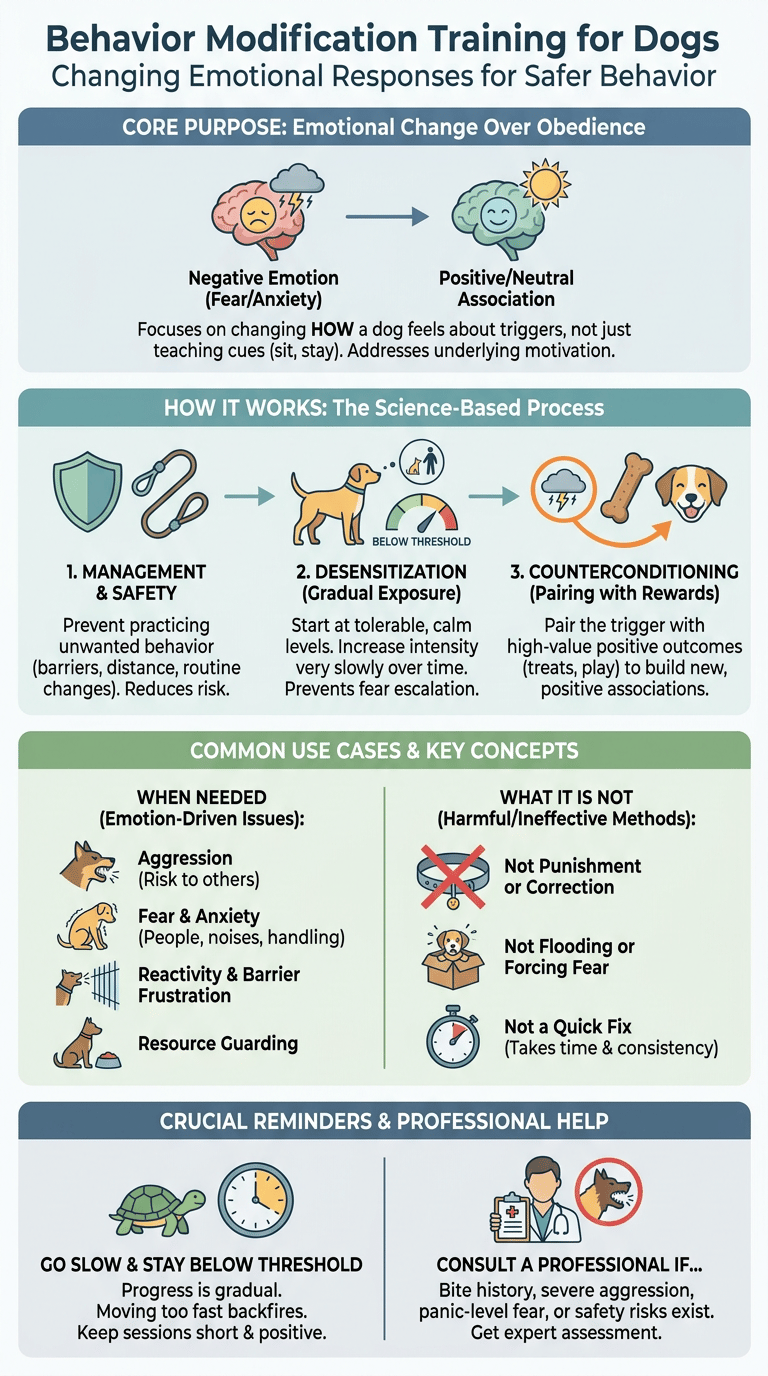
Behavior modification aims to change the emotional and motivational systems that underlie a dog’s behavior. Instead of trying to suppress a behavior with punishment, the approach uses management, careful exposures, and reward-based learning to alter how the dog perceives a trigger. Veterinary guidance describes desensitization, counterconditioning, and management as core techniques for changing emotional responses and reducing problematic behaviors in dogs. For an overview written for owners, see the discussion of behavior modification in the Merck Veterinary Manual.
Merck Veterinary Manual overview of behavior modification
How it differs from basic obedience
Basic obedience teaches cues such as sit, stay, and recall that help manage or redirect a dog. Behavior modification addresses why a dog reacts the way it does by reshaping the dog’s underlying emotional association with people, animals, or situations. Obedience can be one tool within a behavior plan, but it is usually not sufficient on its own when a dog is driven by fear, panic, or active aggression. Clinical behavior resources emphasize the need to assess and treat the emotional state in problem cases rather than relying solely on obedience training.
Why it is used for fear, aggression, anxiety, and reactivity
Behavior modification is commonly used when behaviors are driven by negative emotional states. Fear, anxiety, and reactivity are examples where the dog’s emotional response to triggers makes simple cue training ineffective. By reducing the intensity of the emotional reaction and teaching new positive associations, behavior modification aims to lower the likelihood of escalation and increase the dog’s capacity to remain calm or disengage.
When Dogs Need Behavior Modification
Aggression
Aggression that puts people or other animals at risk is a situation where behavior modification is often required. Clinical behavior services recommend a professional assessment to determine underlying causes, medical contributors, and an individualized plan. When aggression is present, safety planning and professional involvement are important components of care. For clinic-level guidance on when and how behavior specialists work with aggressive dogs, see the UC Davis Behavior Service information.
UC Davis Veterinary Behavior Service overview
Fear of people
Dogs that show avoidance, flight responses, or fear-based aggression toward people benefit from a behavior modification plan that reduces fear and builds positive associations with human presence. Structured desensitization and counterconditioning work to replace fear with relaxed or neutral emotional responses, and management reduces accidental rehearsals of fearful reactions.
Dog reactivity
Reactivity toward other dogs, bicycles, cars, or strangers is a common reason owners seek behavior modification. Reactive behavior is typically an over-aroused or fearful response to a trigger and requires careful identification of triggers, management to prevent escalation, and reward-based learning to change the dog’s emotional response. University veterinary guidance on managing reactive behavior outlines trigger identification and stepwise approaches for safe progress.
Cornell Veterinary guidance on managing reactive behavior
Separation-related distress
Separation-related distress ranges from moderate anxiety during owner absences to severe panic that results in property damage or injury. Behavior modification addresses the emotional component by creating predictable departures and arrivals, teaching independence, and using gradual desensitization exercises. Management strategies reduce the chance of the dog practicing the distressed behavior while the plan is implemented.
Resource guarding
Dogs that guard food, toys, or resting places may escalate to bites if the guarding is not addressed. Resource guarding is commonly treated with desensitization and counterconditioning that teaches a positive association with people approaching guarded items, often using controlled trade-up exercises to teach that human approach predicts good things. Practical owner-facing guides discuss stepwise exercises and safety steps to follow. The ASPCA provides a clear, safety-focused introduction and exercises for food guarding.
ASPCA guide on resource guarding and counterconditioning
Noise sensitivity
Sensitivity to fireworks, thunderstorms, or construction noise can cause panic behaviors. Behavior modification uses graded exposure to sound at tolerable levels and pairings with positive reinforcement to reduce fear. Management includes creating safe, predictable environments and minimizing inadvertent reinforcement of fear-driven behaviors.
Handling sensitivity
Dogs that react to being touched, groomed, or handled often need a plan that pairs gentle, brief touches with rewards and that increases handling duration in tiny steps. This reduces stress during veterinary care and routine handling by creating calm associations with touch rather than forcing acceptance through restraint.
The Core Concepts
Trigger
A trigger is any person, animal, object, sound, or situation that elicits an unwanted emotional reaction in the dog. Identifying precise triggers and the context in which they appear is the first step in an effective behavior modification plan.
Threshold
Threshold is the level of intensity at which the dog moves from calm to aroused, fearful, or reactive. Working below threshold means keeping exposures gentle enough that the dog can still learn without becoming overwhelmed. Accurate threshold assessment is essential to prevent setbacks.
Distance
Distance is a simple, practical variable for managing exposure to triggers. Increasing distance usually reduces emotional intensity, and decreasing distance very gradually is a core tactic in desensitization. Adjusting distance is a reliable way to keep training sessions productive and safe.
Desensitization
Desensitization involves repeated, controlled exposure to a trigger at a level the dog can tolerate, with the intensity increased slowly over time so the dog does not escalate into fear or aggression. Veterinary behavior resources describe desensitization as a standard clinical technique for reducing sensitivity to triggers.
Clinical description of desensitization in the Merck Veterinary Manual
Counterconditioning
Counterconditioning pairs the presence of a trigger with something the dog finds positive, such as high-value food, so the dog replaces a negative association with a positive one. Counterconditioning is typically used alongside desensitization to change emotional responses to problematic triggers.
Management
Management reduces risk and prevents the dog from repeatedly practicing unwanted behavior while training proceeds. Management can include physical barriers, leashes, muzzles when appropriate, scheduling, and altering routines so the dog encounters fewer high-risk situations until the emotional response improves.
Reinforcement
Reinforcement is the process of providing rewards that increase the likelihood of a desirable response. In behavior modification, reinforcement is used to reward calm, appropriate behaviors and to build new, positive associations with previously problematic triggers.
Desensitization Explained
Starting below threshold
Desensitization begins at a level of exposure where the dog remains calm or mildly curious. Starting below threshold prevents the dog from rehearsing fearful or aggressive responses and allows learning to occur. Veterinary manuals emphasize the importance of keeping exposures tolerable so the dog can form new, nonthreatening associations.
Merck Veterinary Manual on which exposures to use
Gradual exposure
Gradual exposure means increasing intensity, proximity, or duration very slowly across many short, successful sessions. Progress is typically small and steady. Short, frequent sessions that end while the dog is still calm tend to be more productive than long sessions that risk pushing the dog past threshold.
Why going too fast backfires
Moving too quickly can increase fear or trigger aggressive responses, which strengthens the unwanted behavior and sets back progress. When a dog experiences repeated failures while exposed to intense triggers, the dog’s emotional reactivity can worsen rather than improve. Conserving the dog’s confidence and minimizing traumatic experiences are critical to success.
How to measure progress
Progress is measured by observable changes in the dog’s body language, latency to react, the intensity of the reaction, and the dog’s ability to remain calm in the presence of the trigger. Keeping a simple training log of sessions, distances, and the dog’s behavior can help track small but meaningful gains over time.
Counterconditioning Explained
Changing the dog’s emotional association
Counterconditioning explicitly pairs the trigger with a positive consequence so the dog learns to expect something good when the trigger appears. Over repeated, controlled pairings, the trigger can become a predictor of positive outcomes instead of threat.
Pairing triggers with rewards
Rewards should be highly motivating and delivered reliably. For many dogs, high-value food works well because it is immediate and strongly reinforcing. The timing of the reward is critical: the reward must occur while the trigger is present to form the new association.
Why timing matters
Correct timing ensures that the dog links the trigger with the reward rather than reinforcing a distracted or reactive response. Immediate delivery of rewards while the dog is calm or showing low-intensity interest helps the dog learn the desired emotional connection.
Common mistakes
- Working above threshold and inadvertently reinforcing fear or aggression.
- Using rewards that are not sufficiently motivating for the dog.
- Relying on punishment or corrections that can increase anxiety and damage the relationship.
- Neglecting management so the dog practices the unwanted reaction between training sessions.
Behavior Modification Examples
Dog reactive to other dogs
Reactive dogs often respond to the sight, sound, or scent of other dogs with barking, lunging, or freezing. A behavior modification plan uses distance, control of the environment, and reward pairings to reduce reactivity.
Starting distance
Begin at a distance where the dog can see another dog but remains relaxed enough to take treats or attend to the handler. The exact distance varies by dog and situation. The handler’s task is to watch the dog’s signals and avoid getting closer until the dog shows calm behavior consistently.
Rewarding calm observation
When the reactive dog notices another dog and does not escalate, immediately reward with a high-value treat. Replace the dog’s automatic reactive script with the expectation that noticing another dog predicts something good. Repeat many times at tolerable distances.
Reducing distance slowly
Decrease the distance in very small steps only after the dog routinely remains calm at the current distance. If the dog escalates, increase distance again and return to easier exposures. Safety and consistency are essential throughout this process. Cornell University provides practical guidance on managing and training reactive dogs, emphasizing trigger identification and safety strategies.
Cornell Vet guidance on reactive behavior
Dog afraid of strangers
Fear of strangers can be addressed without forced interactions. The dog should learn that a stranger’s presence predicts pleasant outcomes without being cornered or grabbed for forced greetings.
No forced greetings
Do not force the dog into close contact with strangers. Forced greetings can reinforce fear and lead to escalation. Instead, teach the dog that calm presence, even at a distance, earns rewards.
Letting the dog choose distance
Allowing the dog to set the initial distance fosters control and reduces perceived threat. As the dog shows comfort, decrease distance incrementally while continuing to pair the stranger’s presence with rewards.
Rewarding calm presence
When the dog looks toward a stranger without signs of distress, reward immediately. Over time, the dog learns that strangers predict positive outcomes rather than danger.
Dog guarding food
Food or resource guarding should be treated with careful, safety-first steps. Management to avoid accidental confrontations is essential while a structured desensitization and counterconditioning plan is implemented. The ASPCA provides owner-friendly exercises and steps to keep people safe while working to reduce guarding behavior.
Safety first
Prioritize safety for household members and other animals. Use management tools such as separate feeding locations and clear household rules to prevent high-risk interactions while training proceeds.
Trade-up games
Trade-up exercises teach the dog that relinquishing an item predicts a better reward. Start with low-value items and offer a higher-value treat in exchange for the object, gradually working up to more valued belongings under controlled conditions.
Professional help for serious guarding
Serious or escalating guarding that results in snapping or biting should prompt consultation with a qualified trainer or veterinary behaviorist. Professional guidance ensures safety and an appropriate, individualized plan. The ASPCA resource outlines when to seek professional support.
ASPCA recommendations for when to get professional help with guarding
Dog afraid of handling
Fearful responses during handling, grooming, or veterinary care require a cooperative approach that pairs gentle handling with rewards. The aim is to make touch predict calmness and positive outcomes rather than stress or restraint.
Cooperative care
Cooperative care methods teach the dog voluntary participation in handling tasks. Short, positive sessions that end before the dog becomes uncomfortable help create cooperative behavior without force.
Touch conditioning
Begin with brief touches in nonthreatening places while offering rewards, and gradually build up to longer handling. Timing and a calm environment are important so the dog can form positive associations with touch.
Vet visit preparation
Preparation for veterinary visits includes desensitization to carrier travel, examination surfaces, and brief handling exercises in low-stress settings. When a dog has significant handling fear, veterinary behaviorists can advise on medication options and specialized desensitization plans to make clinical care safe and humane. For information on clinical behavior services and medical evaluation, see the UC Davis Behavior Service.
UC Davis explanation of behavior service roles in complex cases
What Behavior Modification Is Not
It is not punishment
Behavior modification avoids punishment-based methods for reducing fear or aggression. Punishment can increase anxiety, damage the human-animal bond, and produce unpredictable outcomes. Veterinary behavior guidance advises reward-based approaches for changing emotional responses rather than corrections that exacerbate fear.
Merck Veterinary Manual discussion of punishment and reward-based strategies
It is not flooding
Flooding means exposing a dog to an intense trigger until the dog stops responding. This technique can be traumatic and is not part of modern, humane behavior modification. Desensitization uses gradual, tolerable exposures instead.
It is not forcing the dog to face fear
Forcing a dog toward a feared stimulus commonly increases fear and risk. Effective programs respect the dog’s threshold and employ carefully structured steps to build confidence without coercion.
It is not a quick fix
Behavior modification takes time and consistency. Small, incremental gains accumulate into meaningful change. Expect gradual progress and plan for long-term maintenance in many cases.
When to Work With a Professional
Bite history
If a dog has bitten a person or animal, consult a qualified professional before attempting at-home modification. A detailed assessment of risk, medical causes, and an individualized plan are essential to safety.
Severe aggression
Severe or escalating aggression requires professional evaluation. Board-certified veterinary behaviorists and clinical behaviorists can diagnose medical contributors, recommend behavior plans, and, when appropriate, discuss adjunctive medical therapies. For clinical service descriptions and referral guidance, see UC Davis Behavior Service.
UC Davis Behavior Service information on clinical evaluation and referral
Panic-level fear
Dogs that show panic responses or that cannot be safely handled during training should be evaluated by a professional. Veterinary input can help rule out pain or medical causes and can guide strategies to reduce risk and distress.
Multiple triggers
When a dog reacts to many different triggers or has complex, overlapping fears, a professional can prioritize targets, coordinate a safe plan, and coach owners through realistic expectations.
Safety risk to people or animals
Any situation where the dog poses a safety risk to household members, visitors, or other animals requires professional involvement for assessment, planning, and monitoring. Qualified professionals can provide safety strategies and modify plans if risk changes.
Behavior Modification Training FAQ
How long does behavior modification take?
There is no universal timeline. The pace of change depends on the dog’s history, the severity of the emotional response, the owner’s consistency, and how well the training stays below threshold. Some issues improve relatively quickly with consistent work, while more entrenched problems may require a much longer period. Consistent, small steps are the reliable path forward.
Can aggressive dogs improve with behavior modification?
Many dogs with aggression can improve when the cause is identified and addressed with an appropriate plan that includes management, desensitization, and counterconditioning. Severe cases or those with a history of bites need professional evaluation to assess risk and design a safe, effective program. Clinical behavior services emphasize combining behavioral and medical assessment when necessary.
UC Davis overview of clinical behavior evaluation
Can I do behavior modification at home?
Owners can implement many desensitization and counterconditioning exercises safely at home for mild to moderate problems if they understand thresholds and management. However, for severe aggression, panic-level fear, bite history, or complex cases, working with a qualified trainer or veterinary behaviorist is strongly recommended. University and veterinary resources provide clear guidance on safe home-based strategies and when to seek help.
Cornell Vet recommendations for managing reactive dogs at home
What is the difference between training and behavior modification?
Training commonly refers to teaching cues and skills, while behavior modification targets the underlying emotional causes of problematic behavior. Training and behavior modification overlap and can complement each other, but when emotions such as fear or panic drive behavior, a behavior modification plan focused on desensitization, counterconditioning, and management is usually required.
Important safety reminder: If your dog shows sudden changes in behavior, a history of bites, escalating aggression, or signs of pain, contact a qualified veterinary professional or certified behavior specialist. Do not attempt risky interventions without professional guidance.
If you are unsure where to start, consider a veterinary evaluation to rule out medical contributors and then seek a qualified, force-free trainer or a board-certified veterinary behaviorist for complex or high-risk cases. Clinical services at academic veterinary hospitals can provide assessments and specialized plans when needed.

Ethan Walker is the founder and research editor of Animal Fact Central. He creates and reviews educational animal facts content using trusted wildlife, pet care, and science-based sources. His work focuses on making animal behavior, adaptations, habitats, and species facts clear, accurate, and engaging for everyday readers.
Read More Details About Ethan Walker: https://animalfactcentral.com/ethan-walker/